Better Word Alignments with Supervised ITG Models
Aria Haghighi, John Blitzer, John DeNero and Dan Klein Computer Science Division, University of California at Berkeley {aria42,blitzer,denero,klein}@cs.berkeley.edu
Abstract
This work investigates supervised word align-ment methods that exploit inversion transduc-tion grammar (ITG) constraints. We con-sider maximum margin and conditional like-lihood objectives, including the presentation of a new normal form grammar for canoni-calizing derivations. Even for non-ITG sen-tence pairs, we show that it is possible learn ITG alignment models by simple relaxations of structured discriminative learning objec-tives. For efficiency, we describe a set of prun-ing techniques that together allow us to align sentences two orders of magnitude faster than naive bitext CKY parsing. Finally, we intro-duce many-to-one block alignment features, which significantly improve our ITG models. Altogether, our method results in the best re-ported AER numbers for Chinese-English and a performance improvement of 1.1 BLEU over GIZA++ alignments.
1 Introduction
Inversion transduction grammar (ITG) con-straints (Wu, 1997) provide coherent structural constraints on the relationship between a sentence and its translation. ITG has been extensively explored in unsupervised statistical word align-ment (Zhang and Gildea, 2005; Cherry and Lin, 2007a; Zhang et al., 2008) and machine translation decoding (Cherry and Lin, 2007b; Petrov et al., 2008). In this work, we investigate large-scale, discriminative ITG word alignment.
Past work on discriminative word alignment has focused on the family of at-most-one-to-one matchings (Melamed, 2000; Taskar et al., 2005; Moore et al., 2006). An exception to this is the work of Cherry and Lin (2006), who discrim-inatively trained one-to-one ITG models, albeit with limited feature sets. As they found, ITG
approaches offer several advantages over general matchings. First, the additional structural straint can result in superior alignments. We con-firm and extend this result, showing that one-to-one ITG models can perform as well as, or better than, general one-to-one matching models, either using heuristic weights or using rich, learned fea-tures.
A second advantage of ITG approaches is that they admit a range of training options. As with general one-to-one matchings, we can optimize margin-based objectives. However, unlike with general matchings, we can also efficiently com-pute expectations over the set of ITG derivations, enabling the training of conditional likelihood models. A major challenge in both cases is that our training alignments are often not one-to-one ITG alignments. Under such conditions, directly training to maximize margin is unstable, and train-ing to maximize likelihood is ill-defined, since the target alignment derivations don’t exist in our hy-pothesis class. We show how to adapt both margin and likelihood objectives to learn good ITG align-ers.
In the case of likelihood training, two innova-tions are presented. The simple, two-rule ITG grammar exponentially over-counts certain align-ment structures relative to others. Because of this, Wu (1997) and Zens and Ney (2003) introduced a normal form ITG which avoids this over-counting. We extend this normal form to null productions and give the first extensive empirical comparison of simple and normal form ITGs, for posterior de-coding under our likelihood models. Additionally, we show how to deal with training instances where the gold alignments are outside of the hypothesis class by instead optimizing the likelihood of a set of minimum-loss alignments.
Perhaps the greatest advantage of ITG mod-els is that they straightforwardly permit
structured alignments (i.e. phrases), which gen-eral matchings cannot efficiently do. The need for block alignments is especially acute in Chinese-English data, where oracle AERs drop from 10.2 without blocks to around 1.2 with them. Indeed, blocks are the primary reason for gold alignments being outside the space of one-to-one ITG align-ments. We show that placing linear potential func-tions on many-to-one blocks can substantially im-prove performance.
Finally, to scale up our system, we give a com-bination of pruning techniques that allows us to sum ITG alignments two orders of magnitude faster than naive inside-outside parsing.
All in all, our discriminatively trained, block ITG models produce alignments which exhibit the best AER on the NIST 2002 Chinese-English alignment data set. Furthermore, they result in a 1.1 BLEU-point improvement over GIZA++ alignments in an end-to-end Hiero (Chiang, 2007) machine translation system.
2 Alignment Families
In order to structurally restrict attention to rea-sonable alignments, word alignment models must constrain the set of alignments considered. In this section, we discuss and compare alignment fami-lies used to train our discriminative models.
Initially, as in Taskar et al. (2005) and Moore et al. (2006), we assume the scoreaof a potential alignmenta)decomposes as
s(a) = X
(i,j)∈a sij+
X
i /∈a si+
X
j /∈a
sj (1)
wheresij are word-to-word potentials andsi and
sj represent English null and foreign null poten-tials, respectively.
We evaluate our proposed alignments (a) against hand-annotated alignments, which are marked withsure(s) andpossible(p) alignments. Thealignment error rate(AER) is given by,
AER(a,s,p) =1−|a∩s|+|a∩p| |a|+|s|
2.1 1-to-1 Matchings
The class of at most 1-to-1 alignment match-ings, A1-1, has been considered in several works
(Melamed, 2000; Taskar et al., 2005; Moore et al., 2006). The alignment that maximizes a set of po-tentials factored as in Equation (1) can be found
in O(n3) time using a bipartite matching algo-rithm (Kuhn, 1955).1On the other hand, summing overA1-1 is#P-hard (Valiant, 1979).
Initially, we consider heuristic alignment poten-tials given by Dice coefficients
Dice(e, f) = 2Cef
Ce+Cf
where Cef is the joint count of words (e, f) ap-pearing in aligned sentence pairs, andCe andCf are monolingual unigram counts.
We extracted such counts from 1.1 million French-English aligned sentence pairs of Hansards data (see Section 6.1). For each sentence pair in the Hansards test set, we predicted the alignment fromA1-1 which maximized the sum of Dice
po-tentials. This yielded 30.6 AER.
2.2 Inversion Transduction Grammar
Wu (1997)’s inversion transduction grammar (ITG) is a synchronous grammar formalism in which derivations of sentence pairs correspond to alignments. In its original formulation, there is a single non-terminalXspanning a bitext cell with an English and foreign span. There are three rule types: Terminal unary productions X → he, fi, where e and f are an aligned English and for-eign word pair (possibly with one being null); normal binary rules X → X(L)X(R), where the
English and foreign spans are constructed from the children as hX(L)X(R), X(L)X(R)i; and
in-verted binary rules X ; X(L)X(R), where the
foreign span inverts the order of the children
hX(L)X(R), X(R)X(L)i.2 In general, we will call a bitext cell anormalcell if it was constructed with a normal rule andinverted if constructed with an inverted rule.
Each ITG derivation yields some alignment. The set of such ITG alignments,AIT G, are a strict subset ofA1-1 (Wu, 1997). Thus, we will view
ITG as a constraint on A1-1 which we will
ar-gue is generally beneficial. The maximum scor-ing alignment fromAIT Gcan be found inO(n6) time with synchronous CFG parsing; in practice, we can make ITG parsing efficient using a variety of pruning techniques. One computational advan-tage ofAIT G overA1-1 alignments is that
sum-mation overAIT Gis tractable. The corresponding
1
We shall usenthroughout to refer to the maximum of foreign and English sentence lengths.
2The superscripts on non-terminals are added only to
Indonesia's parliamentspeakerarraignedin court
印 尼 国会
议长
出庭
受审
印 尼 国会 议长 出庭
受审
Indonesia's parliamentspeakerarraignedin court
[image:3.595.80.513.60.233.2](a) Max-Matching Alignment (b) Block ITG Alignment
Figure 1: Best alignments from (a) 1-1 matchings and (b) block ITG (BITG) families respectively. The 1-1 matching is the best possible alignment in the model family, but cannot capture the fact thatIndonesiais rendered as two words in Chinese or thatin courtis rendered as a single word in Chinese.
dynamic program allows us to utilize likelihood-based objectives for learning alignment models (see Section 4).
Using the same heuristic Dice potentials on the Hansards test set, the maximal scoring align-ment from AIT G yields 28.4 AER—2.4 better thanA1-1—indicating that ITG can be beneficial
as a constraint on heuristic alignments.
2.3 Block ITG
An important alignment pattern disallowed by
A1-1 is the many-to-one alignment block. While
not prevalent in our hand-aligned French Hansards dataset, blocks occur frequently in our hand-aligned Chinese-English NIST data. Figure 1 contains an example. ExtendingA1-1 to include
blocks is problematic, because finding a maximal 1-1 matching over phrases is NP-hard (DeNero and Klein, 2008).
With ITG, it is relatively easy to allow contigu-ous many-to-one alignment blocks without added complexity.3 This is accomplished by adding ad-ditional unary terminal productions aligning a for-eign phrase to a single English terminal or vice versa. We will use BITG to refer to this block ITG variant andABIT G to refer to the alignment family, which is neither contained in nor contains
A1-1. For this alignment family, we expand the
alignment potential decomposition in Equation (1) to incorporate block potentialssef andsef which represent English and foreign many-to-one align-ment blocks, respectively.
One way to evaluate alignment families is to
3In our experiments we limited the block size to 4.
consider their oracle AER. In the 2002 NIST Chinese-English hand-aligned data (see Sec-tion 6.2), we constructed oracle alignment poten-tials as follows: sij is set to +1 if(i, j) is a sure or possible alignment in the handaligned data, -1 otherwise. All null potentials (si and sj) are set to 0. A max-matching under these potentials is generally a minimal loss alignment in the family. The oracle AER computed in this was is 10.1 for
A1-1 and 10.2 forAIT G. TheABIT G alignment family has an oracle AER of 1.2. These basic ex-periments show that AIT G outperforms A1-1 for
heuristic alignments, andABIT Gprovide a much closer fit to true Chinese-English alignments than
A1-1.
3 Margin-Based Training
In this and the next section, we discuss learning alignment potentials. As input, we have a training set D = (x1,a∗1), . . . ,(xn,a∗n) of hand-aligned data, wherexrefers to a sentence pair. We will as-sume the score of a alignment is given as a linear function of a feature vectorφ(x,a). We will fur-ther assume the feature representation of an align-ment,φ(x,a)decomposes as in Equation (1),
X
(i,j)∈a
φij(x) + X
i /∈a
φi(x) + X
j /∈a φj(x)
loss that decomposes across alignments. Specif-ically, for each alignment cell (i, j)which is not a possible alignment in a∗, we incur a loss of 1 when aij 6= a∗ij; note that if (i, j) is a possible alignment, our loss is indifferent to its presence in the proposal alignment.
A simple loss-augmented learning pro-cedure is the margin infused relaxed algo-rithm (MIRA) (Crammer et al., 2006). MIRA is an online procedure, where at each time step
t+ 1, we update our weights as follows:
wt+1 = argminw||w−wt||22 (2)
s.t. w·φ(x,a∗)
≥w·φ(x,a) +ˆ L(ˆa,a∗) where ˆa= arg max
a∈Awt·φ(x,a)
In our data sets, manya∗ are not inA1-1 (and
thus not in AIT G), implying the minimum in-family loss must exceed 0. Since MIRA oper-ates in an online fashion, this can cause severe stability problems. On the Hansards data, the simple averaging technique described by Collins (2002) yields a reasonable model. On the Chinese NIST data, however, where almost no alignment is in A1-1, the update rule from Equation (2) is
completely unstable, and even the averaged model does not yield high-quality results.
We instead use a variant of MIRA similar to Chiang et al. (2008). First, rather than update towards the hand-labeled alignment a∗, we up-date towards an alignment which achieves mini-mal loss within the family.4 We call this best-in-class alignmenta∗p. Second, we perform loss-augmented inference to obtainaˆ. This yields the modified QP,
wt+1 = argminw||w−wt||22 (3)
s.t. w·φ(x,a∗p)≥w·φ(x,a) +ˆ L(a,a∗p) where aˆ= arg max
a∈Awt·φ(x,a) +λL(a,a ∗ p)
By settingλ = 0, we recover the MIRA update from Equation (2). As λgrows, we increase our preference that aˆ have high loss (relative to a∗p) rather than high model score. With this change, MIRA is stable, but still performs suboptimally. The reason is that initially the score for all align-ments is low, so we are biased toward only using very high loss alignments in our constraint. This slows learning and prevents us from finding a use-ful weight vector. Instead, in all the experiments
4There might be several alignments which achieve this
minimal loss; we choose arbitrarily among them.
we report here, we begin withλ = 0and slowly increase it toλ= 0.5.
4 Likelihood Objective
An alternative to margin-based training is a likeli-hood objective, which learns a conditional align-ment distribution Pw(a|x) parametrized as
fol-lows,
logPw(a|x)=w·φ(x,a)−log X
a0∈A
exp(w·φ(x,a0))
where the log-denominator represents a sum over the alignment familyA. This alignment probabil-ity only places mass on members ofA. The likeli-hood objective is given by,
max w
X
(x,a∗)∈A
logPw(a∗|x)
Optimizing this objective with gradient methods requires summing over alignments. ForAIT Gand
ABIT G, we can efficiently sum over the set of ITG
derivationsinO(n6)time using the inside-outside algorithm. However, for the ITG grammar pre-sented in Section 2.2, each alignment has multiple grammar derivations. In order to correctly sum over the set of ITG alignments, we need to alter the grammar to ensure a bijective correspondence between alignments and derivations.
4.1 ITG Normal Form
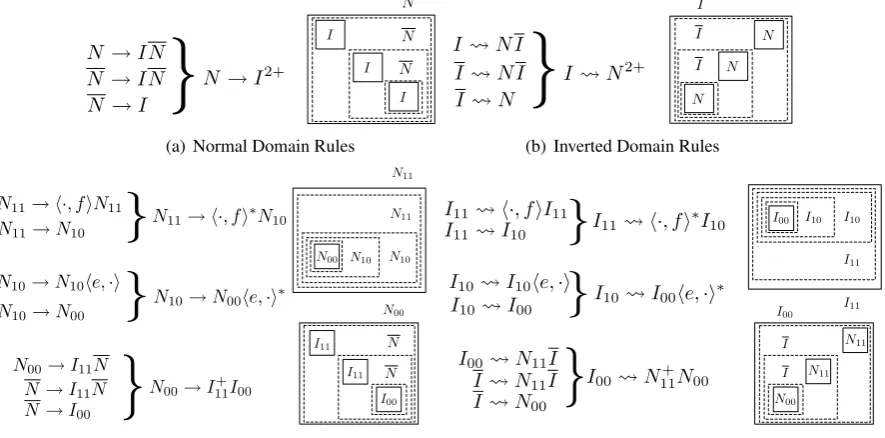
There are two ways in which ITG derivations dou-ble count alignments. First, n-ary productions are not binarized to remove ambiguity; this results in an exponential number of derivations for diagonal alignments. This source of overcounting is con-sidered and fixed by Wu (1997) and Zens and Ney (2003), which we briefly review here. The result-ing grammar, which does not handle null align-ments, consists of a symbolN to represent a bi-text cell produced by a normal rule andIfor a cell formed by an inverted rule; alignment terminals can be either N orI. In order to ensure unique derivations, we stipulate that aN cell can be con-structed only from a sequence of smaller inverted cellsI. Binarizing the rule N → I2+ introduces
the intermediary symbolN(see Figure 2(a)). Sim-ilarly for inverse cells, we insist anI cell only be built by an inverted combination ofN cells; bina-rization ofI ; N2+ requires the introduction of
N →I2+ N →IN
N →I
}
N →INI I I
N N N
(a) Normal Domain Rules
}
I !N2+ I !N II!N I
I!N N
N N
I I I
(b) Inverted Domain Rules
N11→ "·, f#N11 N11→N10
N10→N10"e,·# N10→N00
}
N11→ "·, f#∗N10}
N10→N00"e,·#∗}
N00→I11NN→I11N
N→I00
N00→I11+I00
N00 N10 N10
N11
N N I11
I11
I00
N00
N11
(c) Normal Domain with Null Rules
}
}
}
I11!!·, f"I11
I11!I10 I11!!·, f"
∗I
10
I10!I10!e,·"
I10!I00 I10!I00!e,·"
∗
I00!N11+N00 I I
N00
N11
N11 I00!N11I
I!N11I
I!N00
I00
I00 I10 I10
I11
I11
[image:5.595.79.522.65.284.2](d) Inverted Domain with Null Rules
Figure 2: Illustration of two unambiguous forms of ITG grammars: In (a) and (b), we illustrate the normal grammar without nulls (presented in Wu (1997) and Zens and Ney (2003)). In (c) and (d), we present a normal form grammar that accounts for null alignments.
which to attach null alignments to a bitext cell; we address this by adapting the grammar to force a null attachment order. We introduce symbols
N00, N10,andN11to represent whether a normal
cell has taken no nulls, is accepting foreign nulls, or is accepting English nulls, respectively. We also introduce symbols I00, I10, and I11 to represent
inverse cells at analogous stages of taking nulls. As Figures 2 (c) and (d) illustrate, the directions in which nulls are attached to normal and inverse cells differ. The N00 symbol is constructed by
one or more ‘complete’ inverted cells I11
termi-nated by a no-nullI00. By placingI00in the lower
right hand corner, we allow the largerN00 to
un-ambiguously attach nulls. N00 transitions to the N10symbol and accepts any number ofhe,·i
En-glish terminal alignments. ThenN10transitions to N11and accepts any number ofh·, fiforeign
ter-minal alignments. An analogous set of grammar rules exists for the inverted case (see Figure 2(d) for an illustration). Given this normal form, we can efficiently compute model expectations over ITG alignments without double counting.5 To our knowledge, the alteration of the normal form to accommodate null emissions is novel to this work.
5The complete grammar adds sentinel symbols to the
up-per left and lower right, and the root symbol is constrained to be aN00.
4.2 Relaxing the Single Target Assumption
A crucial obstacle for using the likelihood objec-tive is that a givena∗ may not be in the alignment family. As in our alteration to MIRA (Section 3), we could replacea∗ with a minimal loss in-class alignmenta∗p. However, in contrast to MIRA, the likelihood objective will implicitly penalize pro-posed alignments which have loss equal toa∗p. We opt instead to maximize the probability of the set of alignmentsM(a∗)which achieve the same op-timal in-class loss. Concretely, letm∗be the min-imal loss achievable relative toa∗ inA. Then,
M(a∗) ={a∈ A|L(a,a∗) =
m∗}
When a∗ is an ITG alignment (i.e., m∗ is 0),
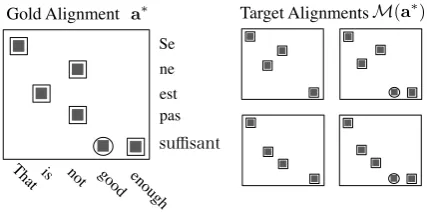
M(a∗)consists only of alignments which have all the sure alignments ina∗, but may have some sub-set of the possible alignments ina∗. See Figure 3 for a specific example wherem∗ = 1.
Our modified likelihood objective is given by,
max w
X
(x,a∗)∈D
log X a∈M(a∗)
Pw(a|x)
MIRA Likelihood
1-1 ITG ITG-S ITG-N
Features P R AER P R AER P R AER P R AER
[image:6.595.106.492.61.133.2]Dice,dist 85.9 82.6 15.6 86.7 82.9 15.0 89.2 85.2 12.6 87.8 82.6 14.6 +lex,ortho 89.3 86.0 12.2 90.1 86.4 11.5 92.0 90.6 8.6 90.3 88.8 10.4 +joint HMM 95.8 93.8 5.0 96.0 93.2 5.2 95.5 94.2 5.0 95.6 94.0 5.1
Table 1: Results on the French Hansards dataset. Columns indicate models and training methods. The rows indicate the feature sets used. ITG-S uses the simple grammar (Section 2.2). ITG-N uses the normal form grammar (Section 4.1). For MIRA (Viterbi inference), the highest-scoring alignment is the same, regardless of grammar.
That is not good enough Se
ne est pas
suffisant
a∗
Gold Alignment Target AlignmentsM(a∗)
Figure 3: Often, the gold alignment a∗ isn’t in our alignment family, hereABIT G. For the likelihood
ob-jective (Section 4.2), we maximize the probability of the setM(a∗)consisting of alignmentsABIT Gwhich
achieve minimal loss relative toa∗. In this example, the minimal loss is 1, and we have a choice of remov-ing either of the sure alignments to the English word
not. We also have the choice of whether to include the possible alignment, yielding 4 alignments inM(a∗). of the inside-outside algorithm where sure align-ments not present in a∗ are disallowed, and the number of missing sure alignments is appended to the state of the bitext cell.6
One advantage of the likelihood-based objec-tive is that we can obtain posteriors over individual alignment cells,
Pw((i, j)|x) = X
a∈A:(i,j)∈a
Pw(a|x)
We obtain posterior ITG alignments by including all alignment cells(i, j)such thatPw((i, j)|x)
ex-ceeds a fixed thresholdt. Posterior thresholding allows us to easily trade-off precision and recall in our alignments by raising or loweringt.
5 Dynamic Program Pruning
Both discriminative methods require repeated model inference: MIRA depends upon loss-augmented Viterbi parsing, while conditional
like-6Note that alignments that achieve the minimal loss would
not introduce any alignments not either sure or possible, so it suffices to keep track only of the number of sure recall errors.
lihood uses the inside-outside algorithm for com-puting cell posteriors. Exhaustive computation of these quantities requires an O(n6) dynamic program that is prohibitively slow even on small supervised training sets. However, most of the search space can safely be pruned using posterior predictions from a simpler alignment models. We use posteriors from two jointly estimated HMM models to make pruning decisions during ITG in-ference (Liang et al., 2006). Our first pruning tech-nique is broadly similar to Cherry and Lin (2007a). We select high-precision alignment links from the HMM models: those word pairs that have a pos-terior greater than 0.9 in either model. Then, we prune all bitext cells that would invalidate more than 8 of these high-precision alignments.
Our second pruning technique is to prune all one-by-one (word-to-word) bitext cells that have a posterior below10−4in both HMM models. Prun-ing a one-by-one cell also indirectly prunes larger cells containing it. To take maximal advantage of this indirect pruning, we avoid explicitly attempt-ing to build each cell in the dynamic program. In-stead, we track bounds on the spans for which we have successfully built ITG cells, and we only iter-ate over larger spans that fall within those bounds. The details of a similar bounding approach appear in DeNero et al. (2009).
In all, pruning reduces MIRA iteration time from 175 to 5 minutes on the NIST Chinese-English dataset with negligible performance loss. Likelihood training time is reduced by nearly two orders of magnitude.
6 Alignment Quality Experiments
[image:6.595.71.285.197.303.2]MIRA Likelihood
1-1 ITG BITG BITG-S BITG-N
Features P R AER P R AER P R AER P R AER P R AER
Dice, dist,
[image:7.595.74.525.61.129.2]blcks, dict, lex 85.7 63.7 26.8 86.2 65.8 25.2 85.0 73.3 21.1 85.7 73.7 20.6 85.3 74.8 20.1 +HMM 90.5 69.4 21.2 91.2 70.1 20.3 90.2 80.1 15.0 87.3 82.8 14.9 88.2 83.0 14.4
Table 2: Word alignment results on Chinese-English. Each column is a learning objective paired with an alignment family. The first row represents our best model without external alignment models and the second row includes features from the jointly trained HMM. Under likelihood, BITG-S uses the simple grammar (Section 2.2). BITG-N uses the normal form grammar (Section 4.1).
(2005); we compute external features from the same unlabeled data, 1.1 million sentence pairs. Our second is the Chinese-English hand-aligned portion of the 2002 NIST MT evaluation set. This dataset has 491 sentences, which we split into a training set of 150 and a test set of 191. When we trained external Chinese models, we used the same unlabeled data set as DeNero and Klein (2007), in-cluding the bilingual dictionary.
For likelihood based models, we set the L2 reg-ularization parameter, σ2, to 100 and the
thresh-old for posterior decoding to 0.33. We report re-sults using the simple ITG grammar (ITG-S, Sec-tion 2.2) where summing over derivaSec-tions dou-ble counts alignments, as well as the normal form ITG grammar (ITG-N,Section 4.1) which does not double count. We ran our annealed loss-augmented MIRA for 15 iterations, beginning with λat 0 and increasing it linearly to 0.5. We compute Viterbi alignments using the averaged weight vector from this procedure.
6.1 French Hansards Results
The French Hansards data are well-studied data sets for discriminative word alignment (Taskar et al., 2005; Cherry and Lin, 2006; Lacoste-Julien et al., 2006). For this data set, it is not clear that improving alignment error rate beyond that of GIZA++ is useful for translation (Ganchev et al., 2008). Table 1 illustrates results for the Hansards data set. The first row uses dice and the same dis-tance features as Taskar et al. (2005). The first two rows repeat the experiments of Taskar et al. (2005) and Cherry and Lin (2006), but adding ITG models that are trained to maximize conditional likelihood. The last row includes the posterior of the jointly-trained HMM of Liang et al. (2006) as a feature. This model alone achieves an AER of 5.4. No model significantly improves over the HMM alone, which is consistent with the results of Taskar et al. (2005).
6.2 Chinese NIST Results
Chinese-English alignment is a much harder task than French-English alignment. For example, the HMM aligner achieves an AER of 20.7 when us-ing the competitive thresholdus-ing heuristic of DeN-ero and Klein (2007). On this data set, our block ITG models make substantial performance im-provements over the HMM, and moreover these results do translate into downstream improve-ments in BLEU score for the Chinese-English lan-guage pair. Because of this, we will briefly scribe the features used for these models in de-tail. For features on one-by-one cells, we con-sider Dice, the distance features from (Taskar et al., 2005), dictionary features, and features for the 50 most frequent lexical pairs. We also trained an HMM aligner as described in DeNero and Klein (2007) and used the posteriors of this model as fea-tures. The first two columns of Table 2 illustrate these features for ITG and one-to-one matchings.
For our block ITG models, we include all of these features, along with variants designed for many-to-one blocks. For example, we include the average Dice of all the cells in a block. In addi-tion, we also created three new block-specific fea-tures types. The first type comprises bias feafea-tures for each block length. The second type comprises features computed from N-gram statistics gathered from a large monolingual corpus. These include features such as the number of occurrences of the phrasal (multi-word) side of a many-to-one block, as well as pointwise mutual information statistics for the multi-word parts of many-to-one blocks. These features capture roughly how “coherent” the multi-word side of a block is.
• English Block:[the X,X], [in X of,X]
• Chinese Block:[dX,X] [Xd,X]
For English blocks, for example, these features capture the behavior of phrases such as in spite of orin front of that are rendered as one word in Chinese. For Chinese blocks, these features cap-ture the behavior of phrases containing classifier phrases likeddordd, which are rendered as English indefinite determiners.
The right-hand three columns in Table 2 present supervised results on our Chinese English data set using block features. We note that almost all of our performance gains (relative to both the HMM and 1-1 matchings) come from BITG and block features. The maximum likelihood-trained nor-mal form ITG model outperforms the HMM, even without including any features derived from the unlabeled data. Once we include the posteriors of the HMM as a feature, the AER decreases to 14.4. The previous best AER result on this data set is 15.9 from Ayan and Dorr (2006), who trained stacked neural networks based on GIZA++ align-ments. Our results are not directly comparable (they used more labeled data, but did not have the HMM posteriors as an input feature).
6.3 End-To-End MT Experiments
We further evaluated our alignments in an end-to-end Chinese to English translation task using the publicly available hierarchical pipeline JosHUa (Li and Khudanpur, 2008). The pipeline extracts a Hiero-style synchronous context-free grammar (Chiang, 2007), employs suffix-array based rule extraction (Lopez, 2007), and tunes model pa-rameters with minimum error rate training (Och, 2003). We trained on the FBIS corpus using sen-tences up to length 40, which includes 2.7 million English words. We used a 5-gram language model trained on 126 million words of the Xinhua section of the English Gigaword corpus, estimated with SRILM (Stolcke, 2002). We tuned on 300 sen-tences of the NIST MT04 test set.
Results on the NIST MT05 test set appear in Table 3. We compared four sets of alignments. The GIZA++ alignments7are combined across di-rections with the grow-diag-final heuristic, which outperformed the union. The joint HMM align-ments are generated from competitive posterior
7We used a standard training regimen: 5 iterations of
model 1, 5 iterations of HMM, 3 iterations of Model 3, and 3 iterations of Model 4.
Alignments Translations
Model Prec Rec Rules BLEU
GIZA++ 62 84 1.9M 23.22
Joint HMM 79 77 4.0M 23.05
Viterbi ITG 90 80 3.8M 24.28
[image:8.595.310.523.61.146.2]Posterior ITG 81 83 4.2M 24.32
Table 3: Results on the NIST MT05 Chinese-English test set show that our ITG alignments yield improve-ments in translation quality.
thresholding (DeNero and Klein, 2007). The ITG Viterbi alignments are the Viterbi output of the ITG model with all features, trained to maximize log likelihood. The ITG Posterior alignments result from applying competitive thresholding to alignment posteriors under the ITG model. Our supervised ITG model gave a 1.1 BLEU increase over GIZA++.
7 Conclusion
This work presented the first large-scale applica-tion of ITG to discriminative word alignment. We empirically investigated the performance of con-ditional likelihood training of ITG word aligners under simple and normal form grammars. We showed that through the combination of relaxed learning objectives, many-to-one block alignment potential, and efficient pruning, ITG models can yield state-of-the art word alignments, even when the underlying gold alignments are highly non-ITG. Our models yielded the lowest published er-ror for Chinese-English alignment and an increase in downstream translation performance.
References
Necip Fazil Ayan and Bonnie Dorr. 2006. Going beyond AER: An extensive analysis of word align-ments and their impact on MT. InACL.
Colin Cherry and Dekang Lin. 2006. Soft syntactic constraints for word alignment through discrimina-tive training. InACL.
Colin Cherry and Dekang Lin. 2007a. Inversion trans-duction grammar for joint phrasal translation mod-eling. InNAACL-HLT 2007.
Colin Cherry and Dekang Lin. 2007b. A scalable in-version transduction grammar for joint phrasal trans-lation modeling. InSSST Workshop at ACL. David Chiang, Yuval Marton, and Philip Resnik. 2008.
David Chiang. 2007. Hierarchical phrase-based trans-lation. Computational Linguistics.
Michael Collins. 2002. Discriminative training meth-ods for hidden markov models: Theory and experi-ments with perceptron algorithms. InEMNLP. Koby Crammer, Ofer Dekel, Shai S. Shwartz, and
Yoram Singer. 2006. Online passive-aggressive al-gorithms. Journal of Machine Learning Research. John DeNero and Dan Klein. 2007. Tailoring word
alignments to syntactic machine translation. InACL. John DeNero and Dan Klein. 2008. The complexity of phrase alignment problems. InACL Short Paper Track.
John DeNero, Mohit Bansal, Adam Pauls, and Dan Klein. 2009. Efficient parsing for transducer gram-mars. InNAACL.
Kuzman Ganchev, Joao Graca, and Ben Taskar. 2008. Better alignments = better translations? InACL. H. W. Kuhn. 1955. The Hungarian method for the
as-signment problem. Naval Research Logistic Quar-terly.
Simon Lacoste-Julien, Ben Taskar, Dan Klein, and Michael Jordan. 2006. Word alignment via quadratic assignment. InNAACL.
Zhifei Li and Sanjeev Khudanpur. 2008. A scalable decoder for parsing-based machine translation with equivalent language model state maintenance. In
SSST Workshop at ACL.
Percy Liang, Dan Klein, and Dan Klein. 2006. Align-ment by agreeAlign-ment. InNAACL-HLT.
Adam Lopez. 2007. Hierarchical phrase-based trans-lation with suffix arrays. InEMNLP.
I. Dan Melamed. 2000. Models of translational equiv-alence among words. Computational Linguistics. Rada Mihalcea and Ted Pedersen. 2003. An
evalua-tion exercise for word alignment. InHLT/NAACL Workshop on Building and Using Parallel Texts. Robert C. Moore, Wen tau Yih, and Andreas Bode.
2006. Improved discriminative bilingual word alignment. InACL-COLING.
Franz Josef Och. 2003. Minimum error rate training in statistical machine translation. InACL.
Slav Petrov, Aria Haghighi, and Dan Klein. 2008. Coarse-to-fine syntactic machine translation using language projections. InEmpirical Methods in Nat-ural Language Processing.
Andreas Stolcke. 2002. Srilm: An extensible language modeling toolkit. InICSLP 2002.
Ben Taskar, Simon Lacoste-Julien, and Dan Klein. 2005. A discriminative matching approach to word alignment. InNAACL-HLT.
L. G. Valiant. 1979. The complexity of computing the permanent. Theoretical Computer Science, 8:189– 201.
Dekai Wu. 1997. Stochastic inversion transduction grammars and bilingual parsing of parallel corpora.
Computational Linguistics, 23.
Richard Zens and Hermann Ney. 2003. A comparative study on reordering constraints in statistical machine translation. InACL.
Hao Zhang and Dan Gildea. 2005. Stochastic lexical-ized inversion transduction grammar for alignment. InACL.
Hao Zhang, Chris Quirk, Robert C. Moore, and Daniel Gildea. 2008. Bayesian learning of non-compositional phrases with synchronous parsing. In