University of Warwick institutional repository: http://go.warwick.ac.uk/wrap This paper is made available online in accordance with
publisher policies. Please scroll down to view the document itself. Please refer to the repository record for this item and our policy information available from the repository home page for further information.
To see the final version of this paper please visit the publisher’s website. Access to the published version may require a subscription.
Author(s): Robert A. Nash, Kimberley A. Wade and Rebecca J. Brewer Article Title: Why do doctored images distort memory?
Year of publication: 2009 Link to published version:
“IN PRESS” AT CONSCIOUSNESS & COGNITION
Final author draft only – the final copyedited article may differ slightly from this manuscript version.
Why do Doctored Images Distort Memory?
Robert A. Nash, Kimberley A. Wade, & Rebecca J. Brewer University of Warwick, Coventry, UK
Corresponding author: Robert A. Nash
Department of Psychology University of Warwick Coventry, CV4 7AL United Kingdom
Abstract
Doctored images can cause people to believe in and remember experiences that never occurred, yet the underlying mechanism(s) responsible are not well understood. How does compelling false evidence distort autobiographical memory? Subjects were filmed observing and copying a Research Assistant performing simple actions, then they returned 2 days later for a memory test. Before taking the test, subjects viewed video-clips of simple actions, including actions that they neither observed nor performed earlier. We varied the format of the video-clips between-subjects to tap into the source-monitoring mechanisms responsible for the ‘doctored-evidence effect.’ The distribution of belief and memory distortions across conditions suggests that at least two mechanisms are involved: doctored images create an illusion of familiarity, and also enhance the perceived credibility of false suggestions. These findings offer insight into how external evidence influences source-monitoring.
Why do Doctored Images Distort Memory?
Seeing used to be believing, but image-manipulation technology is increasingly blurring the line between fact and fiction. Up to 75% of users on social-networking websites, for instance, enhance photos of themselves before posting them online (Wynne-Jones, 2008) and in recent years many scientific journals have adopted screening procedures to ensure that the images they publish are authentic (Young, 2008). Yet image-manipulation is more than a tool for personal enhancement:
doctored images can cause people to believe in and remember experiences that never occurred (see Garry & Gerrie, 2005). In this paper we ask: why are doctored images such an effective form of suggestion? What happens to memory when people encounter fabricated evidence of an event?
The power of fake photographs and videos to foster false memories (hereafter, the
Source Confusions
According to the SMF, memory distortions occur when our mental images of a fictional event are mistaken for memories. Indeed, when our mental images possess the phenomenological qualities we normally associate with memories, such as a feeling of familiarity and rich sensory details, we can struggle to distinguish between imagined and real experiences (Johnson, Foley, Suengas, & Raye, 1988). A SMF account of the doctored-evidence effect suggests that doctored images might distort beliefs and memories via three cognitive mechanisms. First, doctored images might enhance people’s feeling of familiarity with the suggested event. Second, doctored images could boost people’s ability to vividly imagine relevant details of the event. Third, people might perceive doctored images as highly credible evidence that the suggested event occurred, and so be willing to attribute less familiar or vivid mental images of the event to memory. Any of these three mechanisms—familiarity, imagery
and credibility—could play a crucial role in the doctored-evidence effect.
subjects reported greater confidence that they had experienced the events presented in anagram form than those presented in regular form. The authors proposed that
subjects misattributed the fluency they felt when successfully solving an anagram to actually experiencing the event in childhood. Numerous studies show that images, similarly, can elicit a powerful form of ‘visual fluency’ (Winkielman, Schwarz, Reber, & Fazendeiro, 2003). Therefore, a familiarity account of the doctored-evidence effect predicts that doctored images make suggested events come to mind more readily, and subjects misattribute this feeling of familiarity as remembering.
Imagery. Another cue that people use to determine the source of mental images is the phenomenological characteristics of those images. According to the SMF, real memories typically contain more perceptual and conceptual details than do imagined events, and so imaginations that are rich in these details can be misattributed to memory (Johnson et al., 1988). Along these lines, Lindsay, Hagen, Read, Wade and Garry (2004) found that adult subjects were more likely to develop false memories of a fictional childhood event if they used their school class-photo as a memory aid. The researchers suggested that the class-photos might have provided subjects with visual details of real memories (e.g. what their teacher looked like) that overlapped with the suggested event and enabled subjects to construct detailed mental images that were misattributed as memories. Relatedly, Henkel and Carbuto (2008) showed that real (i.e., non-doctored) photos caused more source monitoring errors than did
descriptions of the actions the photos portrayed. Their finding suggests that
memories from the time of the suggested event and that they could easily confuse with memories.
Credibility. Finally, the SMF posits that people decide whether their mental images are, for instance, vivid or familiar enough to attribute to memory by setting implicit criteria that those images must match. However, it is possible that people might lower their criteria when an event seems likely to have occurred (Mazzoni & Kirsch, 2002). We know that people are more likely to accept misleading information from credible sources than from non-credible sources (Echterhoff, Hirst, & Hussy, 2005; Vornik, Sharman, & Garry, 2003), therefore a credibility-based account suggests that doctored images might cause people to lower their source-monitoring criteria. Put differently, whereas people might typically attribute mental images as memories only when they are highly vivid or familiar, doctored photos or videos might be perceived as highly credible evidence that the suggested event occurred, and consequently lead people to attribute less vivid or familiar mental images as
memories.
The present experiment
the RA performing critical actions. RA-Only subjects viewed video-clips identical to Self+RA subjects, but only saw the RA in the footage and not themselves. Stranger-Only subjects viewed video-clips identical to RA-Only subjects, but the actions were performed by a stranger in an unfamiliar room. Finally subjects completed a memory test in which they rated the extent to which they believed they performed each action (Belief rating) and their memory of performing each action (Memory rating).
Rationale for the manipulation. The distribution of Belief and Memory ratings across conditions should indicate the mechanisms underlying the doctored-evidence effect. If familiarity causes the doctored-evidence effect, then we should expect subjects in all three conditions to exhibit belief and memory distortions. Because all three videos contain clips of some person—either the RA or a stranger—performing critical actions, all three conditions should enable subjects to easily bring to mind (or fluently process) images of the critical actions. This fluent processing should cause illusions of familiarity, which should in turn be misattributed to recollection.
If the imagery provided by doctored video-clips causes the doctored-evidence effect, then we should see more belief and memory distortions among Self+RA and RA-Only subjects than among Stranger-Only subjects. In the Self+RA and RA-Only conditions, the visual details in the video-sequence overlap with the details in
subjects’ memories of Session 1: they depict the RA who took part in the event and the room where the event happened. Stranger-Only videos, however, contain visual details that conflict with subjects' memories: they show a stranger in a different room. Therefore, if the video-clips help subjects to imagine critical actions, then Self+RA and RA-Only subjects should be more likely to confuse imagined details for
Finally, if credibility causes the doctored-evidence effect, then we should see more belief and memory distortions among Self+RA subjects than among RA-Only and Stranger-Only subjects. Because Self+RA videos are the only videos in which subjects see themselves present while critical actions are performed, these clips should be compelling evidence that subjects performed those actions.
In sum, in the present study subjects were exposed to different forms of video-suggestion designed to differentiate between three mechanisms that potentially underlie the doctored-evidence effect.
Method
Subjects and Design
Sixty University of Warwick students and staff members (68% female; M = 20.73 years, SD = 4.54, Range = 18-41) individually attended two sessions over 3 days and received £6 for participating. The experiment was a mixed design with Critical action type (Video vs. Control) as a within-subjects factor and Video-sequence condition (Self+RA, RA-Only, or Stranger-Only) as a between-subjects factor. We randomly allocated subjects to video-sequence conditions.
Materials and Procedure
Actions. We used 42 of the simple actions used by Nash et al. (2009, Experiment 2), and selected 4 of these to be our critical actions which an independent group of volunteers rated as moderately memorable (Clap your hands; Salute; Click your fingers; Flex your arm)1. For each subject, two of these critical actions were randomly assigned as Video actions (i.e., those that subjects would neither observe nor perform, but that would be shown in the video-suggestion), and two were assigned as Control actions (i.e., those that subjects would neither observe nor perform, and that subjects
would not be exposed to until the memory test). Of the 38 non-critical actions, subjects observed and performed 26 during Session 1; the remaining 12 were new in the memory test in Session 2.
Session 1: Event
Subjects were informed that the study was investigating mental imagery and that they would be filmed observing and copying the RA performing various actions. The RA and subject sat at a table facing each other, and the remainder of Session 1 was filmed. The RA began by performing a non-critical action for 15 s, the subject then copied the same action for 15 s. Next the RA performed a second action, and so forth until the subject had observed and copied 26 non-critical actions (all subjects
performed the same 26 actions in the same order). A loud beep indicated when the subject and RA should start and stop performing each action. Subjects neither
observed nor performed any of the four critical actions at any stage. When the subject completed the final action, they were reminded to return 2 days later for Session 2.
Creating the video-sequences. To create the Self+RA and RA-Only
video-recordings, after the subject left the lab the RA filmed herself performing two of the four critical actions (i.e., the Video actions), the selection of which was
counterbalanced across subjects. For Self+RA subjects, we doctored these two extra clips by using a split-screen method to combine them with unused clips from other periods of Session 1, in which the subject was observing the RA (see Figure 1 and Nash et al., 2009). The doctored clips therefore ostensibly showed the subject
watching the RA perform the critical actions. Next, we inserted the two fake clips into a sequence made up of 10 untouched clips of the subject observing the RA
RA-Only subjects’ videos were identical to Self+RA subjects’, except that we masked the left half of all 12 clips so that the video only showed the RA. For
Stranger-Only subjects, prior to the experiment we created four versions of a standard video-sequence, each version differing only in terms of the two critical actions it contained. For these sequences, we filmed a male volunteer performing non-critical and critical actions in a different room to the location of Session 1 and, as for RA-Only sequences, we masked the left half of each clip.
All subjects saw the same ten non-critical actions in their video, and the two critical actions were in 7th and 10th positions. The twelve clips lasted 10 s each, and were separated by 10-s pauses, thus the sequences lasted 4 min in total.
Session 2: Suggestion and memory test
In Session 2, subjects were seated at a computer and told they would see several video-clips of different actions. The experimenter did not imply that the video-clips were from Session 1 or otherwise. Subjects watched the video-sequence twice through. During the first viewing, subjects wrote down after each clip an estimate of the number of times in the average week they perform the action shown. During the second viewing, subjects wrote down after each clip the name of the action shown. These tasks ensured that subjects attended to each clip. Next, subjects performed a 5-minute anagram-solving filler task. Finally, they completed a surprise memory test comprising the names of 28 actions, including all 4 critical actions (2 Video actions; 2 Control actions), 12 performed actions, and 12 new actions. Subjects rated their Belief
Beliefs and Memory Questionnaire. Finally, all subjects were debriefed and invited to attempt to identify which two actions in the video they did not perform.
Results and Discussion
Did our video-sequences distort subjects’ beliefs and memories? Collapsing our data across all subjects, we found that Video actions were assigned higher Belief [t(59) = 8.08, p < .0001, dz = 1.04] and Memory ratings [t(59) = 7.70, p < .0001, dz =
.99] than Control actions. Analyzing the data separately for each condition, we found that subjects in all three conditions rated Video actions higher than Control actions (Belief, largest p = .01, smallest dz = .64; Memory, largest p = .004, smallest dz = .73).
In other words, just seeing footage of an action being performed was sufficient to cause subjects some uncertainty about whether or not they performed that action, suggesting that a familiarity mechanism contributes to the doctored-evidence effect.
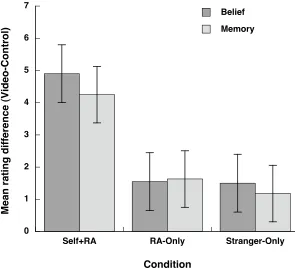
We turn now to our main aim: to compare Belief and Memory ratings across the three conditions. To calculate the effect of each type of video upon subjects’ beliefs and memories, we subtracted subjects’ mean Control ratings from their mean Video ratings. We then used the net differences to compare the effects of the three video-types. Although our initial analyses showed that all three video-types influenced subjects’ beliefs and memories, these additional analyses revealed significant differences between the three groups [Belief: F(2, 57) = 18.88, p < .0001, !p2 = .40; Memory: F(2, 57) = 14.37, p < .0001, !p2 = .34]. As Figure 2 shows, post-hoc analyses revealed that Self+RA videos were much more powerful than RA-Only and Stranger-Only videos (all ps < .001, all ds > 1.24), suggesting that a credibility
words, increasing the congruence between the imagery in the video-footage and in Session 1—in terms of the room setting or the person who performed the actions—did not increase belief or memory distortion over and above that explainable by a
familiarity mechanism. It is also worth noting that there were no significant differences between any of the three groups in terms of ratings for Control actions [Belief: MSelf+RA = 2.28; MRA-Only = 1.95; MStranger-Only = 1.95; F(2, 57) = .696, p = .50, !p2 = .02; Memory: MSelf+RA = 1.73; MRA-Only = 1.28; MStranger-Only = 1.33; F(2, 57) = 1.67, p = .20, !p2 = .06].
Recent research has emphasized the importance of distinguishing increases in confidence from actual false beliefs or memories (e.g., Smeets, Merckelbach,
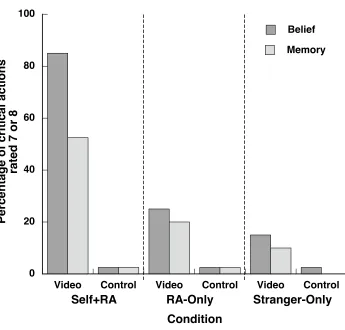
Horselenberg, & Jelicic, 2005). How often did our videos induce false beliefs or false memories of performing critical actions, as opposed to just increasing subjects’ confidence that they might have performed them? To address this question we calculated the number of critical Video and Control actions (out of a possible 2 for each action type) for which subjects assigned a ‘7’ or ‘8’ rating on the Belief and Memory scales. We found that subjects frequently reported false beliefs and false memories of critical Video actions (Figure 3). In particular, Self+RA subjects reported more false beliefs and memories of performing critical Video actions than either other group (Belief: both ps < .001, both ds > 1.84; Memory: both ps < .01, both ds > .99). The fact that these distortions occurred within minutes of exposure to the videos further serves to illustrate the power of the doctored-evidence effect.
two suggested a hypothesis involving fake video-evidence.2 Nevertheless, 60% of subjects across conditions were able to identify both critical Video actions—perhaps unsurprisingly given that they were asked to do so just minutes after seeing the video-sequence. Even so, many subjects expressed uncertainty about their choices, claiming they were making ‘educated guesses’ by eliminating actions that were in the video-sequence but that they recalled more strongly (“It could be ‘Click your Fingers’, although I’m sure I did that one”). If the doctored clips in Self+RA videos had seemed less than authentic, it would be reasonable to expect Self+RA subjects to identify more critical actions than RA-Only or Stranger-Only subjects. Yet Self+RA subjects identified directionally fewer critical Video actions than did the remaining subjects, although these differences were not significant [MSelf+RA= 1.4; MRA-Only = 1.65; MStranger-Only = 1.65, F(2, 57) = 1.33, p = .27, !p2 = .04]. Together these findings suggest that most Self+RA subjects were unaware of the trickery and that their memory test responses cannot be attributed to demand effects.
Alternative accounts of the present findings
Although the primary cause of the doctored-evidence effect appears to be a credibility mechanism, two alternative interpretations of our findings warrant further discussion. The first is that the extra details in Self+RA (and, indeed, RA-Only) videos could enhance the familiarity of these video-clips over Stranger-Only clips. As such, a familiarity mechanism alone might account for our pattern of findings. In fact, we have some evidence that the extra visual details did indeed boost familiarity. We analyzed subjects’ ratings for the 6 truly performed non-critical actions that were both in the video-sequences and the memory test. In line with the familiarity account, Belief ratings for these actions increased from Stranger-Only (M = 7.35), to RA-Only
(M = 7.77), to Self+RA (M = 7.93) subjects [F(2, 57) = 5.05, p < .01, !p2 = .15]. The same was true of Memory ratings, although these differences were not significant [Stranger-Only, M = 7.02; RA-Only, M = 7.40; Self+RA, M = 7.50; F(2, 57) = 1.58, p
= .21, !p2 = .05]. Looking closer at these data, the extra detail in RA-Only (compared to Stranger-Only) videos was sufficient to increase subjects’ Belief ratings for the 6 non-critical actions (p = .07), despite having no effect upon their ratings for critical Video actions (in fact, the difference fell in the opposite direction, p = .94). Put differently, although we detected that familiarity increased between these two
conditions, this increase did not influence subjects’ critical action ratings. This finding suggests it is unlikely that the extra detail in Self+RA (compared to RA-Only) videos can explain the very high critical Video ratings in the Self+RA condition. Further research, though, should explore the effects of different imagery—such as images of oneself—upon familiarity-based recollection.
A second interpretation of our results is that an imagery account might best describe the effectiveness of Self+RA videos, because they helped subjects to
Conclusions
Doctored images appear to be so effective at distorting beliefs and memories because as well as increasing at least one memory-like quality of people’s mental imagery (i.e., its familiarity), they also cause people to accept lower levels of memory-like qualities when attributing images of the suggested events as memories (i.e., due to their credibility).
The results of the present study help to support and refine Mazzoni and Kirsch’s (2002) model of autobiographical beliefs and memories. Specifically, Mazzoni and Kirsch proposed that people might lower their criteria for attributing as memories their images of events that seem highly likely to have occurred. Our results provide strong support for this proposal. Specifically, Self+RA subjects—who saw
themselves in the video-evidence—gave much higher ratings for Video actions than did the remaining subjects. The enhanced familiarity and imagery caused by seeing footage of oneself appear insufficient to have caused these large effects; the best explanation therefore, is that Self+RA subjects adopted lower source monitoring criteria because the evidence was simply so credible. Our data therefore offer a deeper understanding of the role of external evidence—as opposed to internal cognitive processes (Wade & Garry, 2005)—in source-monitoring. Of course, our results do not rule out the possibility that vivid imagery (and indeed familiarity and credibility) might be more important in different circumstances. For instance, when there is a long delay between exposure to the false images and the memory test, or when the
suggested event supposedly occurred in the more distant past, perceptually-detailed mental imagery might be more influential. A full account of the doctored-evidence effect, therefore, may need to be sensitive to these and other situational factors.3
References
Bernstein, D. M., Whittlesea, B. W. A., & Loftus, E. F. (2002). Increasing confidence in remote autobiographical memory and general knowledge: Extensions of the revelation effect. Memory & Cognition, 30, 432-438.
Dror, I. E., & Charlton, D. (2006). Why experts make errors. Journal of Forensic Identification, 56, 600-616.
Echterhoff, G., Hirst, W., & Hussy, W. (2005). How eyewitnesses resist misinformation: Social postwarnings and the monitoring of memory characteristics. Memory & Cognition, 33, 770-782.
Garry, M. & Gerrie, M. P. (2005). When photographs create false memories. Current Directions in Psychological Science, 14, 321-325.
Gohara, M. S. (2006). A lie for a lie: False confessions and the case for reconsidering the legality of deceptive interrogation techniques. Fordham Urban Law Journal, 33, 791-842.
Henkel, L. A., & Carbuto, M. (2008). Remembering what we did: How source misattributions arise from verbalization, mental imagery, and pictures. In M. Kelley (Ed.), Applied memory (pp. 213-234). Hauppauge, NY: Nova Science Publishers.
Jacoby, L. L., Kelley, C. M., & Dywan, J. (1989). Memory attributions. In H. L. Roediger III & F. I. M. Craik (Eds.), Varieties of memory and consciousness: Essays in honour of Endel Tulving (pp.391-422). Hillsdale, NJ: Erlbaum. Johnson, M. K., Foley, M. A., Suengas, A. G., & Raye, C. L. (1988). Phenomenal
characteristics of memories for perceived and imagined autobiographical events.
Johnson, M. K., Hashtroudi, S., & Lindsay, D. S. (1993). Source monitoring.
Psychological Bulletin, 114, 3-28.
Kassin, S. M., & Gudjonsson, G. H. (2004). The psychology of confessions: A review of the literature and issues. Psychological Science in the Public Interest, 5, 33-67. Lindsay, D. S. (2008). Source Monitoring. In H. L. Roediger, III (Ed.), Cognitive
psychology of memory. Vol. 2 of Learning and memory: A comprehensive
reference, 4 vols. (J. Byrne, Editor) (pp. 325-348). Oxford: Elsevier. Lindsay, D. S., Hagen, L., Read, J. D., Wade, K. A., & Garry, M. (2004). True
photographs and false memories. Psychological Science, 15, 149-154.
Mazzoni, G., & Kirsch, I. (2002). Autobiographical memories and beliefs: A preliminary metacognitive model. In T. J. Perfect, & B. L. Schwartz (Eds.),
Applied metacognition (pp. 121-146). Cambridge, UK: Cambridge University Press.
Moore, S. (2009, February 5). Science found wanting in nation’s crime labs. New York Times. Retrieved 5 February, 2009, from www.nytimes.com.
Nash, R. A., & Wade, K. A. (2009). Innocent but proven guilty: Eliciting internalized false confessions using doctored-video evidence.Applied Cognitive Psychology, 23, 624-637.
Nash, R. A., Wade, K. A., & Lindsay, D. S. (2009). Digitally manipulating memory: Effects of doctored videos and imagination in distorting beliefs and memories.
Memory & Cognition, 37, 414-424.
Smeets, T., Merckelbach, H., Horselenberg, R., & Jelicic, M. (2005). Trying to recollect past events: Confidence, beliefs, and memories. Clinical Psychology Review, 25, 917-934.
Tversky, A., & Kahneman, D. (1973). Availability: a heuristic for judging frequency and probability. Cognitive Psychology, 5, 207–232.
Vornik, L.A., Sharman, S.J., & Garry, M. (2003). The power of the spoken word: Sociolinguistic cues influence the misinformation effect. Memory,11, 101-109. Wade, K. A., & Garry, M. (2005). Strategies for verifying false autobiographical
memories. American Journal of Psychology,118, 587-602.
Wade, K. A., Garry, M., Read, J. D., & Lindsay, D. S. (2002). A picture is worth a thousand lies: Using false photographs to create false childhood memories.
Psychonomic Bulletin & Review,9, 597-603.
Winkielman, P., Schwarz, N., Reber, R., & Fazendeiro, T. A. (2003). Cognitive and affective consequences of visual fluency: When seeing is easy on the mind. In L. M. Scott, & R. Batra (Eds.). Persuasive imagery: A consumer response
perspective (pp.75-90). Mahwah, NJ: Lawrence Erlbaum.
Wynne-Jones, J. (2008, March 1). Web social networkers doctor photographs. Retrieved February 10, 2009, from www.telegraph.co.uk/news/uknews/1580372/ Web-social-networkers-doctor-photographs.html.
Author note
We thank Olwen Bryer for her assistance in data-collection, Leo Miles for appearing in our ‘Stranger-Only’ videos, and Friederike Schlaghecken, Cara Laney, Stefanie Sharman and two anonymous reviewers for their insightful comments on earlier drafts.
Figure Captions
Figure 1. Creating the critical video clips. The top row shows untouched footage filmed (A) during Session 1 and (B) immediately after Session 1. The bottom row shows the three types of critical clips. Self+RA clips were created by combining (A) and (B); RA-Only clips were created using right-half of (B); Stranger-Only clips were created prior to experiment.
Figure 2. Mean effect of each type of video upon subjects’ Belief and Memory ratings for critical actions (Mean Video ratings minus mean Control ratings). Error bars represent 95% confidence intervals.
Figure 1. Creating the critical video clips. The top row shows untouched footage filmed (A) during
Session 1 and (B) immediately after Session 1. The bottom row shows the three types of critical clips.
Self+RA clips were created by combining (A) and (B); RA-Only clips were created using right-half of
(B); Stranger-Only clips were created prior to experiment.
Stranger-Only Video RA-Only Video
Self+RA Video
A. Clip of non-critical action at Session 1
B. Clip of RA performing a critical action after Session 1
Figure 2. Mean effect of each type of video upon subjects’ Belief and
Memory ratings for critical actions (Mean Video ratings minus mean
Control ratings). Error bars represent 95% confidence intervals.
0 1 2 3 4 5 6 7
Self+RA RA-Only Stranger-Only Belief
Memory
Mean rating difference (Video-Control)
Figure 3. Percentage of critical actions to which subjects assigned
ratings of 7 or 8 on the Belief (i.e, false beliefs) and Memory (i.e., false
memories) scales.
0 20 40 60 80 100
Video Control Video Control Video Control Belief
Memory
Percentage of critical actions
rated 7 or 8
Condition