Learning Condensed Feature Representations from Large Unsupervised
Data Sets for Supervised Learning
Jun Suzuki, Hideki Isozaki, and Masaaki Nagata
NTT Communication Science Laboratories, NTT Corp. 2-4 Hikaridai, Seika-cho, Soraku-gun, Kyoto, 619-0237 Japan
{suzuki.jun, isozaki.hideki, nagata.masaaki}@lab.ntt.co.jp
Abstract
This paper proposes a novel approach for ef-fectively utilizing unsupervised data in addi-tion to supervised data for supervised
learn-ing. We use unsupervised data to
gener-ate informative ‘condensed feature represen-tations’ from the original feature set used in
supervised NLP systems. The main
con-tribution of our method is that it can of-fer dense and low-dimensional feature spaces for NLP tasks while maintaining the state-of-the-art performance provided by the recently developed high-performance semi-supervised learning technique. Our method matches the results of current state-of-the-art systems with
very few features, i.e., F-score 90.72 with
344 features for CoNLL-2003 NER data, and UAS 93.55 with 12.5K features for depen-dency parsing data derived from PTB-III.
1 Introduction
In the last decade, supervised learning has become a standard way to train the models of many natural language processing (NLP) systems. One simple but powerful approach for further enhancing the perfor-mance is to utilize a large amount of unsupervised data to supplement supervised data. Specifically, an approach that involves incorporating ‘clustering-based word representations (CWR)’ induced from unsupervised data as additional features of super-vised learning has demonstrated substantial perfor-mance gains over state-of-the-art supervised learn-ing systems in typical NLP tasks, such as named en-tity recognition (Lin and Wu, 2009; Turian et al., 2010) and dependency parsing (Koo et al., 2008). We refer to this approach as theiCWR approach, The iCWR approach has become popular for en-hancement because of its simplicity and generality.
The goal of this paper is to provide yet another
simple and general framework, like the iCWR ap-proach, to enhance existing state-of-the-art super-vised NLP systems. The differences between the iCWR approach and our method are as follows; sup-poseF is the original feature set used in supervised learning,Cis the CWR feature set, andHis the new feature set generated by our method. Then, with the iCWR approach, C is induced independently from
F, and used in addition toF in supervised learning,
i.e.,F ∪ C. In contrast, in our methodHis directly induced fromF with the help of an existing model already trained by supervised learning withF, and used in place ofF in supervised learning.
The largest contribution of our method is that it offers an architecture that can drastically reduce the number of features, i.e., from 10M features in F to less than 1K features in H by construct-ing ‘condensed feature representations (COFER)’, which is a new and very unique property that can-not be matched by previous semi-supervised learn-ing methods includlearn-ing the iCWR approach. One noteworthy feature of our method is that there is no need to handle sparse and high-dimensional feature spaces often used in many supervised NLP systems, which is one of the main causes of the data sparse-ness problem often encountered when we learn the model with a supervised leaning algorithm. As a result, NLP systems that are both compact and high-performance can be built by retraining the model with the obtained condensed feature setH.
2 Condensed Feature Representations
Let us first define thecondensed feature setH. In this paper, we call the feature set generally used in supervised learning,F, theoriginal feature set. Let
NandMrepresent the numbers of features inFand
H, respectively. We assumeM≤N, and generally
MN. A condensed feature hm∈ H is
Potencies are multiplied by a positive constant δ
0 1 2 -1
-2 3 4
Section 3.3:Feature potency quantization
Feature potency
Section 3.4:Condensed feature construction
F
N (e.g., N=100M)
Original feature set Section 3.1:Feature potency estimation
Features mapped into this area will be zeroed by the effect of C
C
0 -C
Section 3.2:Feature potency discounting Feature potency
′
0
Feature potency
∗ ( Integer SpaceN)
Condensed feature set
H
Each condensed feature is represented as a set of features in the original feature set F.
-1/δ
1/δ
3/δ φ
-2/δ
M (e.g., M=1K) The potencies are also utilized as an (M+1)-th condensed feature
H
(Quantized feature potency)
[image:2.612.74.299.66.230.2]Features mapped into zero are discarded and never mapped into any condensed features
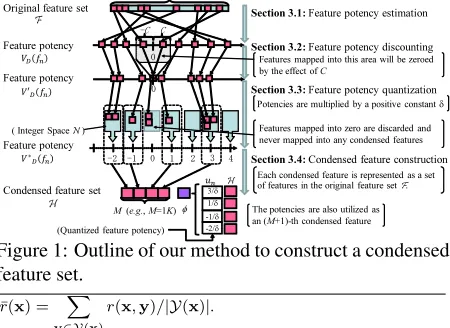
Figure 1: Outline of our method to construct a condensed feature set.
¯
r(x) = X y∈Y(x)
r(x,y)/|Y(x)|.
VD+(fn) =
X
x∈D
fn(x,ˆy)(r(x,yˆ)−r¯(x))
VD−(fn) =−
X
x∈D
X
y∈Y(x)\yˆ
fn(x,y)(r(x,y)−¯r(x))
Rn=
X
x∈D
X
y∈Y(x)
r(x,y)fn(x,y), An=
X
x∈D
¯
r(x) X y∈Y(x)
fn(x,y)
Figure 2: Notations used in this paper.
terized as a set of features in F, that is, hm=Sm whereSm ⊆ F. We assume that each original fea-turefn∈Fmaps, at most, to one condensed feature
hm. This assumption prevents two condensed fea-tures from containing the same original feature, and some original features from not being mapped to any condensed feature. Namely,Sm∩Sm0=∅for allm andm0, wherem6=m0, and∪Mm=1Sm⊆F hold.
The value of each condensed feature is calcu-lated by summing the values of the original fea-tures assigned to it. Formally, let X and Y repre-sent the sets of all possible inputs and outputs of a target task, respectively. Let x ∈ X be an in-put, andy∈ Y(x) be an output, where Y(x)⊆ Y
represents the set of possible outputs given x. We write the n-th feature function of the original fea-tures, whose value is determined by x and y, as
fn(x,y), where n ∈ {1, . . . , N}. Similarly, we write them-th feature function of the condensed fea-tures ashm(x,y), wherem∈{1, . . . , M}. We state that the value ofhm(x,y) is calculated as follows:
hm(x,y) =
∑
fn∈Smfn(x,y).
3 Learning COFERs
The remaining part of our method consists of the way to map the original features into the condensed features. For this purpose, we define the feature po-tency, which is evaluated by employing an existing
supervised model with unsupervised data sets. Fig-ure 1 shows a brief sketch of the process to construct the condensed features described in this section.
3.1 Self-taught-style feature potency estimation
We assume that we have a model trained by super-vised learning, which we call the ‘base supervised
model’, and the original feature setF that is used
in the base supervised model. We consider a case where the base supervised model is a (log-)linear model, and use the following equation to select the best outputyˆgivenx:
ˆ
y= arg max
y∈Y(x)
∑N
n=1wnfn(x,y), (1)
where wn is a model parameter (or weight) offn. Linear models are currently the most widely-used models and are employed in many NLP systems.
To simplify the explanation, we define function
r(x,y), wherer(x,y)returns1ify= ˆyis obtained from the base supervised model givenx, and0 oth-erwise. Let¯r(x)represent the average ofr(x,y)in x(see Figure 2 for details). We also defineVD+(fn) andVD−(fn) as shown in Figure 2 where D repre-sents the unsupervised data set. VD+(fn) measures the positive correlation with the best outputyˆgiven by the base supervised model since this is the sum-mation of all the (weighted) feature values used in the estimation of the one best outputyˆ over allxin the unsupervised data D. Similarly, VD−(fn) mea-sures the negative correlation withy. Next, we de-ˆ
fineVD(fn)as the feature potency offn:VD(fn) =
VD+(fn)−VD−(fn).
An intuitive explanation ofVD(fn)is as follows; if|VD(fn)|is large, the distribution offnhas either a large positive or negative correlation with the best outputyˆ given by the base supervised model. This implies thatfn is an informative and potent feature in the model. Then, the distribution offnhas very small (or no) correlation to determineyˆ if|VD(fn)| is zero or near zero. In this case,fncan be evaluated as an uninformative feature in the model. From this perspective, we treatVD(fn)as a measure of feature potency in terms of the base supervised model.
The essence of this idea, evaluating features against each other on a certain model, is widely used in the context of semi-supervised learning,
2008; Druck and McCallum, 2010). Our method is rough and a much simpler framework for imple-menting this fundamental idea of semi-supervised learning developed for NLP tasks. We create a simple framework to achieve improved flexibility, extendability, and applicability. In fact, we apply the framework by incorporating a feature merging and elimination architecture to obtain effective con-densed feature sets for supervised learning.
3.2 Feature potency discounting
To discount low potency values, we redefine feature potency asVD0(fn)instead ofVD(fn)as follows:
VD0(fn) =
log [Rn+C]−log[An]ifRn−An<−C
0 if −C≤Rn−An≤C
log [Rn−C]−log[An]ifC < Rn−An
where Rn and An are defined in Figure 2. Note that VD(fn) = VD+(fn)− VD−(fn) = Rn −An. The difference fromVD(fn)is that we cast it in the log-domain and introduce a non-negative constant
C. The introduction of C is inspired by the L1
-regularization technique used in supervised learning algorithms such as (Duchi and Singer, 2009; Tsu-ruoka et al., 2009). C controls how much we dis-countVD(fn)toward zero, and is given by the user.
3.3 Feature potency quantization
We define VD∗(fn) as VD∗(fn) = dδVD0(fn)e if
VD0(fn) > 0 and VD∗(fn) = bδVD0(fn)c otherwise, whereδ is a positive user-specified constant. Note that VD∗(fn) always becomes an integer, that is,
VD∗(fn)∈ N whereN ={. . . ,−2,−1,0,1,2, . . .}. This calculation can be seen as mapping each fea-ture into a discrete (integer) space with respect to
VD0(fn). δ controls the range of VD0(fn) mapping into the same integer.
3.4 Condensed feature construction
Suppose we haveM different quantized feature po-tency values inVD∗(fn) for alln, which we rewrite as {um}Mm=1. Then, we define Sm as a set of fn whose quantized feature potency value is um. As described in Section 2, we define the m-th con-densed feature hm(x,y) as the summation of all the original features fn assigned to Sm. That is,
hm(x,y) =
∑
fn∈Smfn(x,y). This feature fusion
process is intuitive since it is acceptable if features
with the same (similar) feature potency are given the same weight by supervised learning since they have the same potency with regard to determining y.ˆ δ
determines the number of condensed features to be made; the number of condensed features becomes large if δ is large. Obviously, the upper bound of the number of condensed features is the number of original features.
To exclude possibly unnecessary original features from the condensed features, we discard featurefn for allnifun = 0. This is reasonable since, as de-scribed in Section 3.1, a feature has small (or no) effect in achieving the best output decision in the base supervised model if its potency is near 0.C in-troduced in Section 3.2 mainly influences how many original features are discarded.
Additionally, we also utilize the ‘quantized’ fea-ture potency values themselves as a new feafea-ture. The reason behind is that they are also very infor-mative for supervised learning. Their use is impor-tant to further boost the performance gain offered by our method. For this purpose, we defineφ(x,y)
as φ(x,y) = ∑Mm=1(um/δ)hm(x,y). We then useφ(x,y) as the (M + 1)-th feature of our con-densed feature set. As a result, the concon-densed fea-ture set obtained with our method is represented as
H={h1(x,y), . . . , hM(x,y), φ(x,y)}.
Note that the calculation cost ofφ(x,y)is negli-gible. We can calculate the linear discriminant func-tion g(x,y) as: g(x,y) = ∑Mm=1wmhm(x,y) +
wM+1φ(x,y) =
∑M
m=1w0mhm(x,y), wherew0m=
(wm + wM+1um/δ). We emphasize that once
{wm}Mm=1+1 are determined by supervised learning, we can calculate w0m in a preliminary step before the test phase. Thus, our method also takes the form of a linear model. The number of features for our method is essentiallyM even if we addφ.
3.5 Application to Structured Prediction Tasks
We modify our method to better suit structured pre-diction problems in terms of calculation cost. For a structured prediction problem, it is usual to decom-pose or factorize output structureyinto a set of lo-cal sub-structures z to reduce the calculation cost and to cope with the sparsity of the output space
and given input x. We write z ∈ y when the lo-cal sub-structure z is a part of output y, assuming that output y is constructed by a set of local sub-structures. Then formally, then-th feature is written asfn(x, z), andfn(x,y) =
∑
z∈yfn(x, z) holds. Similarly, we introducer(x, z), where r(x, z) = 1
ifz∈y, andˆ r(x, z) = 0otherwise, namelyz /∈y.ˆ
We define Z(x) as the set of all local sub-structures possibly generated for all y in Y(x).
Z(x)can be enumerated easily, unless we use typi-cal first- or second-order factorization models by the restriction of efficient decoding algorithms, which is the typical case for many NLP tasks such as named entity recognition and dependency parsing.
Finally, we replace all Y(x) withZ(x), and use
fn(x, z)andr(x, z)instead offn(x,y)andr(x,y), respectively, inRnandAn. When we use these sub-stitutions, there is no need to incorporate an efficient algorithm such as dynamic programming into our method. This means that our feature potency esti-mation can be applied to the structured prediction problem at low cost.
3.6 Efficient feature potency computation
Our feature potency estimation described in Section 3.1 to 3.3 is highly suitable for implementation in the MapReduce framework (Dean and Ghemawat, 2008), which is a modern distributed parallel com-puting framework. This is becauseRnandAncan be calculated by the summation of a data-wise cal-culation (map phase), andVD∗(fn)can be calculated independently by each feature (reduce phase). We emphasize that our feature potency estimation can be performed in a ‘single’ map-reduce process.
4 Experiments
We conducted experiments on two different NLP tasks, namely NER and dependency parsing. To fa-cilitate comparisons with the performance of previ-ous methods, we adopted the experimental settings used to examine high-performance semi-supervised NLP systems; i.e., NER (Ando and Zhang, 2005; Suzuki and Isozaki, 2008) and dependency pars-ing (Koo et al., 2008; Chen et al., 2009; Suzuki et al., 2009). For the supervised datasets, we used CoNLL’03 (Tjong Kim Sang and De Meulder, 2003) shared task data for NER, and the Penn Treebank III
(PTB) corpus (Marcus et al., 1994) for dependency parsing. We prepared a total of 3.72 billion token text data as unsupervised data following the instruc-tions given in (Suzuki et al., 2009).
4.1 Comparative Methods
We mainly compare the effectiveness of COFER with that of CWR derived by the Brown algorithm. The iCWR approach yields the state-of-the-art re-sults with both dependency parsing data derived from PTB-III (Koo et al., 2008), and the CoNLL’03 shared task data (Turian et al., 2010). By compar-ing COFER with iCWR we can clarify its effective-ness in terms of providing better features for super-vised learning. We use the termactive featuresto refer to features whose corresponding model param-eter is non-zero after supervised learning. It is well-known that we can discard non-active features from the trained model without any loss after finishing su-pervised learning. Finally, we compared the perfor-mance in terms of the number of active features in the model given by supervised learning. We note here that the number of active features for COFER is the number of featureshm ifw0m = 0, which is notwm= 0for a fair comparison.
Unlike COFER, iCWR does not have any archi-tecture to winnow the original feature set used in supervised learning. For a fair comparison, we prepared L1-regularized supervised learning
algo-rithms, which try to reduce the non-zero parameters in a model. Specifically, we utilizedL1-regularized
CRF (L1CRF) optimized by OWL-QN (Andrew and Gao, 2007) for NER, and the online struc-tured output learning version of FOBOS (Duchi and Singer, 2009; Tsuruoka et al., 2009) withL1
-regularization (ostL1FOBOS) for dependency pars-ing. In addition, we also examined L2
regular-ized CRF (Lafferty et al., 2001) optimregular-ized by L-BFGS (Liu and Nocedal, 1989) (L2CRF) for NER, and the online structured output learning version of the Passive-Aggressive algorithm (ostPA) (Cram-mer et al., 2006) for dependency parsing to illus-trate the baseline performance regardless of the ac-tive feature number.
4.2 Settings for COFER
86.0 88.0 90.0 92.0 94.0 96.0
1.0E+01 1.0E+03 1.0E+05 1.0E+07 1.0E+09
iCWR+COFER: L2CRF iCWR+COFER: L1CRF COFER: L2CRF COFER: L1CRF iCWR: L2CRF iCWR: L1CRF Sup.L2CRF Sup.L1CRF
F
-s
c
o
r
e
# of active features [log-scale]
δ=1e+01δ=1e+02δ=1e+04
δ=1e+00 proposed
90.0 91.0 92.0 93.0 94.0 95.0
1.E+02 1.E+04 1.E+06 1.E+08
iCWR+COFER: ostPA iCWR+COFER: ostL1FOBOS COFER: ostPA COFER: ostL1FOBOS iCWR: ostPA iCWR: ostL1FOBOS Sup.ostPA Sup.ostL1FOBOS
# of active features [log-scale]
U
n
la
b
e
le
d
A
tt
a
c
h
m
e
n
t
S
c
o
re δ=1e+00
δ=1e+05 δ=1e+01
δ=1e+03 proposed
[image:5.612.315.540.56.305.2](a) NER (F-score) (b) dep. parsing (UAS)
Figure 3: Performance vs. size of active features in the trained model on the development sets
In addition, we also report the results when we treat iCWR as COFER’s base supervised mod-els (iCWR+COFER). This is a very natural and straightforward approach to combining these two.
We generally handle several different types of fea-tures such as words, part-of-speech tags, word sur-face forms, and their combinations. Suppose we haveK differentfeature types, which are often de-fined byfeature templates,i.e., (Suzuki and Isozaki, 2008; Lin and Wu, 2009). In our experiments, we re-strict the merging of features during the condensed feature construction process if and only if the fea-tures are the same feature type. As a result, COFER essentially consists ofKdifferent condensed feature sets. The numbers of feature typesKwere 79 and 30 for our NER and dependency parsing experiments, respectively. We note that this kind of feature par-tition by their types is widely used in the context of semi-supervised learning (Ando and Zhang, 2005; Suzuki and Isozaki, 2008).
4.3 Results and Discussion
Figure 3 displays the performance on the develop-ment set with respect to the number of active fea-tures in the trained models given by each supervised learning algorithm. In both NER and dependency parsing experiments, COFER significantly outper-formed iCWR. Moreover, COFER was surprisingly robust in relation to the number of active features in the model. These results reveal that COFER pro-vides effective feature sets for certain NLP tasks.
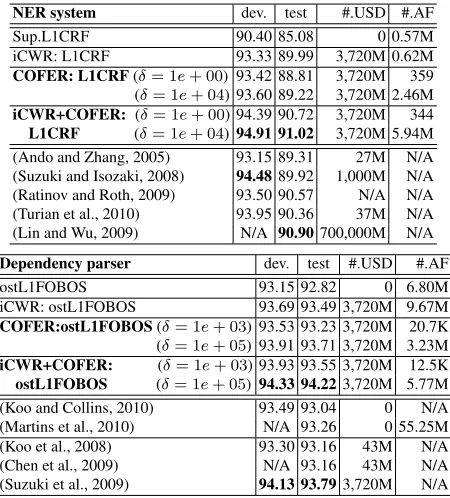
We summarize the noteworthy results in Figure 3, and also the performance of recent top-line systems for NER and dependency parsing in Table 1. Over-all, COFER matches the results of top-line
semi-NER system dev. test #.USD #.AF
Sup.L1CRF 90.40 85.08 0 0.57M
iCWR: L1CRF 93.33 89.99 3,720M 0.62M
COFER: L1CRF(δ= 1e+ 00) 93.42 88.81 3,720M 359
(δ= 1e+ 04) 93.60 89.22 3,720M 2.46M
iCWR+COFER: (δ= 1e+ 00) 94.39 90.72 3,720M 344
L1CRF (δ= 1e+ 04) 94.91 91.02 3,720M 5.94M
(Ando and Zhang, 2005) 93.15 89.31 27M N/A
(Suzuki and Isozaki, 2008) 94.4889.92 1,000M N/A
(Ratinov and Roth, 2009) 93.50 90.57 N/A N/A
(Turian et al., 2010) 93.95 90.36 37M N/A
(Lin and Wu, 2009) N/A 90.90700,000M N/A
Dependency parser dev. test #.USD #.AF
ostL1FOBOS 93.15 92.82 0 6.80M
iCWR: ostL1FOBOS 93.69 93.49 3,720M 9.67M
COFER:ostL1FOBOS(δ= 1e+ 03) 93.53 93.23 3,720M 20.7K
(δ= 1e+ 05) 93.91 93.71 3,720M 3.23M
iCWR+COFER: (δ= 1e+ 03) 93.93 93.55 3,720M 12.5K
ostL1FOBOS (δ= 1e+ 05) 94.33 94.223,720M 5.77M
(Koo and Collins, 2010) 93.49 93.04 0 N/A
(Martins et al., 2010) N/A 93.26 0 55.25M
(Koo et al., 2008) 93.30 93.16 43M N/A
(Chen et al., 2009) N/A 93.16 43M N/A
(Suzuki et al., 2009) 94.13 93.793,720M N/A
Table 1: Comparison with previous top-line systems on test data. (#.USD: unsupervised data size. #.AF: the size of active features in the trained model.)
supervised learning systems even though it uses far fewer active features.
In addition, the combination of iCWR+COFER significantly outperformed the current best results by achieving a 0.12 point gain from 90.90 to 91.02 for NER, and a 0.43 point gain from 93.79 to 94.22 for dependency parsing, with only 5.94M and 5.77M features, respectively.
5 Conclusion
[image:5.612.74.302.60.191.2]References
Rie Kubota Ando and Tong Zhang. 2005. A
High-Performance Semi-Supervised Learning Method for
Text Chunking. InProceedings of 43rd Annual
Meet-ing of the Association for Computational LMeet-inguistics, pages 1–9.
Galen Andrew and Jianfeng Gao. 2007. Scalable
Training of L1-regularized Log-linear Models. In
Zoubin Ghahramani, editor, Proceedings of the 24th
Annual International Conference on Machine Learn-ing (ICML 2007), pages 33–40. Omnipress.
Wenliang Chen, Jun’ichi Kazama, Kiyotaka Uchimoto, and Kentaro Torisawa. 2009. Improving Dependency
Parsing with Subtrees from Auto-Parsed Data. In
Pro-ceedings of the 2009 Conference on Empirical Meth-ods in Natural Language Processing, pages 570–579. Koby Crammer, Ofer Dekel, Joseph Keshet, Shai
Shalev-Shwartz, and Yoram Singer. 2006. Online
Passive-Aggressive Algorithms. Journal of Machine Learning
Research, 7:551–585.
Jeffrey Dean and Sanjay Ghemawat. 2008. MapReduce:
Simplified Data Processing on Large Clusters.
Com-mun. ACM, 51(1):107–113.
Gregory Druck and Andrew McCallum. 2010. High-Performance Semi-Supervised Learning using
Dis-criminatively Constrained Generative Models. In
Pro-ceedings of the International Conference on Machine Learning (ICML 2010), pages 319–326.
John Duchi and Yoram Singer. 2009. Efficient
On-line and Batch Learning Using Forward Backward
Splitting. Journal of Machine Learning Research,
10:2899–2934.
Terry Koo and Michael Collins. 2010. Efficient
Third-Order Dependency Parsers. InProceedings of the 48th
Annual Meeting of the Association for Computational Linguistics, pages 1–11.
Terry Koo, Xavier Carreras, and Michael Collins. 2008.
Simple Semi-supervised Dependency Parsing. In
Pro-ceedings of ACL-08: HLT, pages 595–603.
John Lafferty, Andrew McCallum, and Fernando Pereira. 2001. Conditional Random Fields: Probabilistic Mod-els for Segmenting and Labeling Sequence Data. In
Proceedings of the International Conference on Ma-chine Learning (ICML 2001), pages 282–289. Dekang Lin and Xiaoyun Wu. 2009. Phrase
Cluster-ing for Discriminative LearnCluster-ing. In Proceedings of
the Joint Conference of the 47th Annual Meeting of the ACL and the 4th International Joint Conference on Natural Language Processing of the AFNLP, pages 1030–1038.
Dong C. Liu and Jorge Nocedal. 1989. On the Limited Memory BFGS Method for Large Scale Optimization.
Math. Programming, Ser. B, 45(3):503–528.
Mitchell P. Marcus, Beatrice Santorini, and Mary Ann Marcinkiewicz. 1994. Building a Large Annotated
Corpus of English: The Penn Treebank.
Computa-tional Linguistics, 19(2):313–330.
Andre Martins, Noah Smith, Eric Xing, Pedro Aguiar, and Mario Figueiredo. 2010. Turbo Parsers: Depen-dency Parsing by Approximate Variational Inference. In Proceedings of the 2010 Conference on Empirical Methods in Natural Language Processing, pages 34– 44.
Lev Ratinov and Dan Roth. 2009. Design Challenges and Misconceptions in Named Entity Recognition. In
Proceedings of the Thirteenth Conference on Compu-tational Natural Language Learning (CoNLL-2009), pages 147–155.
Jun Suzuki and Hideki Isozaki. 2008. Semi-supervised Sequential Labeling and Segmentation Using
Giga-Word Scale Unlabeled Data. InProceedings of
ACL-08: HLT, pages 665–673.
Jun Suzuki, Hideki Isozaki, Xavier Carreras, and Michael
Collins. 2009. An Empirical Study of
Semi-supervised Structured Conditional Models for
Depen-dency Parsing. InProceedings of the 2009 Conference
on Empirical Methods in Natural Language
Process-ing, pages 551–560.
Erik Tjong Kim Sang and Fien De Meulder. 2003. Intro-duction to the CoNLL-2003 Shared Task:
Language-Independent Named Entity Recognition. In
Proceed-ings of CoNLL-2003, pages 142–147.
Yoshimasa Tsuruoka, Jun’ichi Tsujii, and Sophia Ana-niadou. 2009. Stochastic Gradient Descent Training for L1-regularized Log-linear Models with
Cumula-tive Penalty. InProceedings of the Joint Conference
of the 47th Annual Meeting of the ACL and the 4th International Joint Conference on Natural Language Processing of the AFNLP, pages 477–485.
Joseph Turian, Lev-Arie Ratinov, and Yoshua Bengio. 2010. Word Representations: A Simple and General
Method for Semi-Supervised Learning. In