PARSING AS NATURAL DEDUCTION
Esther KSnig
U n i v e r s i t g t S t u t t g a r t
I n s t i t u t f i i r M a s c h i n e l l e S p r a c h v e r a r b e i t u n g , K e p l e r s t r a s s e 17, D - 7 0 0 0 S t u t t g a r t 1, F R G
Abstract
T h e logic behind parsers for categorial g r a m m a r s can be formalized in several different ways. Lam- bek Calculus (LC) constitutes an example for a na- tural deduction 1 style parsing method.
In natural language processing, the task of a parser usually consists in finding derivations for all different readings of a sentence. T h e original Lam- bek Calculus, when it is used as a p a r s e r / t h e o r e m prover, has the undesirable property of allowing for the derivation of more t h a n one proof for a reading of a sentence, in the general case.
In order to overcome this inconvenience and to turn L a m b e k Calculus into a reasonable parsing method, we show the existence of "relative" normal form proof trees and make use of their properties to constrain the proof procedure in the desired way.
1
I n t r o d u c t i o n
Sophisticated techniques have been developed for the implementation of parsers for (augmented) con- text-free grammars. [Pereira/Warren 1983] gave a characterization of these parsers as being resolu- tion based theorem provers. Resolution might be taken as an instance of Hilbert-style theorem pro- ving, where there is one inference rule (e.g. Modus Ponens or some other kind of Cul Rule) which al- lows for deriving theorems from a set of axioms. In the case of parsing, the g r a m m a r rules and the lexicon would be the axioms.
When categorial g r a m m a r s were discovered for computational linguistics, the most obvious way to design parsers for categorial g r a m m a r s seemed 1 "natural deduction" is used here in its broad sense, i.e. natural deduction as opposed to Hilbert-style deduction
to apply the existing methods: The few combi- nation rules and the lexicon constitute the set of axioms, from which theorems are derived by a resolution rule. However, this strategy leads to unsatisfactory results, in so far as extended c a - tegorial g r a m m a r s , which make use of combina- tion rules like functional composition and type raising, provide for a proliferation of derivations for the same reading of a sentence. This pheno- menon has been dubbed the spurious ambiguity problem [Pareschi/Steedman 1987]. One solution to this problem is to describe normal forms for equivalent derivations and to use this knowledge to prune the search space of the parsing process [Hepple/Morrill 1989].
Other approaches to cope with the problem of spurious ambiguity take into account the peculari- ties of categorial g r a m m a r s c o m p a r e d to g r a m m a r s With "context-free skeleton". One characteristic of categorial g r a m m a r s is the shift of information from the g r a m m a r rules into the lexicon: g r a m m a r rules are mere combination s c h e m a t a whereas syntactic categories do not have to be atomic items as in the "context-free" formalisms, but can also be structu- red objects as well.
T h e natural deduction approach to parsing with categorial g r a m m a r s splits up into two general mainstreams both of which use the Gentzen se- quent representation to state the corresponding calculi. T h e first alternative is to take a general purpose calculus and propose an adequate transla- tion of categories into formulae of this logic. An example for this approach has been carried out by Pareschi [Pareschi 1988], [Pareschi 1989]. On the other hand, one might use a specialized cal- culus. Lambek proposed such a calculus for ca- tegorial g r a m m a r more than three decades ago [Lambek 1958].
The aim of this paper is to describe how Lam- bek Calculus can be implemented in such a way that it serves as an efficient parsing mechanism. To achieve this goal, the main drawback of the original Lambek Calculus, which consists of a version of the "spurious ambiguity problem", has to be overcome. In Lambek Calculus, this overgeneration of deriva- tions is due to the fact t h a t the calculus itself does not giye enough constraints on the order in which the inference rules have to be applied.
In section 2 of the paper, we present Lambek Calculus in more detail. Section 3 consists of the proof for the existence of normal form proof trees relative to the readings of a sentence. Based on this result, the parsing mechanism is described in section 4.
head of a complex category is the head of its value category. T h e category in the succedens of a se- quent is called goal category. T h e category which is "decomposed" by an inference rule application is called current functor.
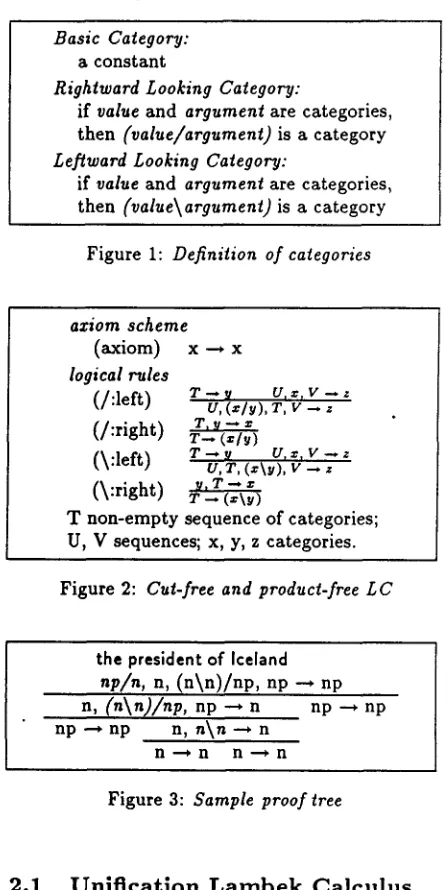
Basic Category: a constant
Rightward Looking Category:
if value and argument are categories, then (value/argument) is a category Leftward Looking Category:
if value and argument are categories, then (value\argument) is a category
Figure h Definition of categories
axiom scheme (axiom) x --* x logical rules
(/:left) r -- ~t U, ~, v -- U , (z]y), T, V --* z
(/:right)
T , y - -T-- (~ly)
(\:left) T --,' y U, z , V .--., z U, T, (~\v), v -. (\:right) T -- (=\v) v, T -
T non-empty sequence of categories; U, V sequences; x, y, z categories.
Figure 2: Cut-free and product-free L C
the president of Iceland
np/n,
n, ( n \ n ) / n p , np --* npn, (n\n)/np,
np --. n np --* np 2 L a m b e k C a l c u l u sIn the following, w e restrain ourselves to cut- free and product-free L a m b e k Calculus, a calculus which still allows us to infer infinitely m a n y deri- ved rules such as Geach-rule, functional composi- tion etc. [Zielonka 1981]. T h e cut-free and product- free L a m b e k Calculus is given in figures 1 and 2. Be aware of the fact that w e did not adopt L a m - bek's representation of complex categories. Proofs in L a m b e k Calculus can be represented as trees whose nodes are annotated with sequents. A n ex- ample is given in figure 3. A lexical lookup step which replaces lexemes by their corresponding ca- tegories has to precede the actual theorem proving process. For this reason, the categories in the an- tecedens of the input sequent will also be called le- zical categories. W e introduce the notions of head, goal category, and current fanctor: T h e head of a category is its "innermost" value category: The head of a basic category is the category itself. The
np ~ np n, n\n -.* n n ---* n n ---* n
Figure 3: Sample proof tree
2 . 1 U n i f i c a t i o n L a m b e k C a l c u l u s
[image:2.612.317.541.142.587.2]we extend Lambek Calculus to Unification Lambek Calculus (ULC).
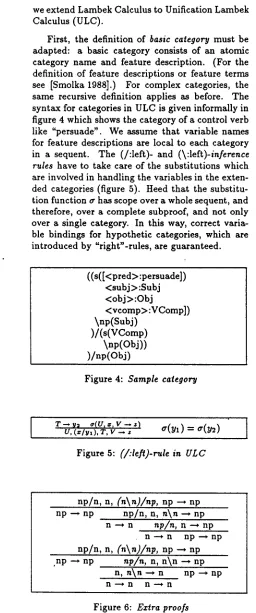
First, the definition of basic category must be adapted: a basic category consists of an atomic category name and feature description. (For the definition of feature descriptions or feature terms see [Smolka 1988].) For complex categories, the same recursive definition applies as before. The syntax for categories in ULC is given informally in figure 4 which shows the category of a control verb like "persuade". We assume that variable names for feature descriptions are local to each category in a sequent. The (/:left)- and (\:left)-inference rules have to take care of the substitutions which are involved in handling the variables in the exten- ded categories (figure 5). Heed that the substitu- tion function o" has scope over a whole sequent, and therefore, over a complete subproof, and not only over a single category. In this way, correct varia- ble bindings for hypothetic categories, which are introduced by "right"-rules, are guaranteed.
((s([<pred>:persuade]) < s u b j > : S u b j < o b j > : O b j
< v c o m p > : V C o m p ] ) \ n p ( S u b j )
)/(s(VComp) \ n p ( O b j ) ) ) / n p ( O b j )
Figure 4: Sample category
I T --* Y2 a(U v z~ V ~ z)
~J, (=Iv,). T, V --,, a(yl ) = a(y2)
Figure 5: (/:lefl)-rule in ffLC
n p / n , n, (n\n)/np, np -- np np ---* np n p / n , n, n\n ~ np
n ---* n n p / n , n --, np n ----* n n p ~ n p
n p / n , n, (n\n)/np, np ---, np . n p - - , n p np/n, n, n \ n ---* np
n, n \ n ~ n np --~ np n - - - ~ n n----~ n
Figure 6: Extra proofs
3
N o r m a l P r o o f T r e e s
The sentence in figure 3 has two other proofs, which are listed in figure 6, although one would like to contribute only one syntactic or semantic reading to it. In this section, we show that such a set of a possibly abundant number of proofs for the same reading of a sequent possesses one distinguished member which can be regarded as the represen- tative or the normal form proof tree for this set.
In order to be able to use the notion of a "rea- ding" more precisely, we undertake the following definition of structures which determine readings for our purposes. Because of their similarity to syn- tax trees as used with context-free grammars, we also call them "syntax trees" for the sake of sim- plicity. Since, on the semantic level, the use of a "left'-rule in Lambek Calculus corresponds to the functional application of a functor term to some argument and the "right"-rules are equivalent to functional abstraction [van Benthem 1986], it is es- sential that in a syntax tree, a trace for each of these steps in a derivation be represented. Then it is guaranteed that the semantic representation of a sentence can be constructed from a syntax tree which is annotated by the appropriate partial se- mantic expressions of whatever semantic represen- tation language one chooses. Structurally distinct syntax trees amount to different semantic expres- sions.
A syntax tree t condenses the information of a proof for a sequent s in the following way:
1. Labels of single.node trees, are either lexical categories or arguments of lexical categories. 2. The root of a non.trivial tree has either
(a) one daughter tree whose root is labelled with the value category of the root's la- bel. This case catches the application of a "right'-inference rule; or
(b) two daughter trees. The label of the root node is the value category, the label of the root of one daughter is the functor, and the label of the root of the other daugh- ter is the argument category of an appli- cation of a "left"-inference rule.
[image:3.612.57.313.78.691.2]ning those relative normal forms of proofs, which we are aiming at, amounts to describing proof trees of a certain structure which can be more easily cor- related with syntax trees as would possibly be the case for other proofs of the same set of proofs.
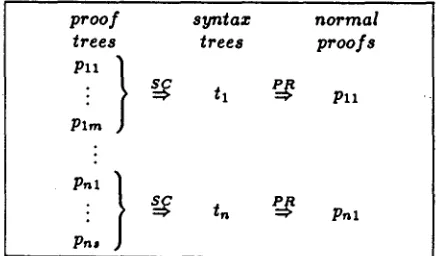
The outline of the proof for the existence of nor- mal form proof trees in Lambek Calculus is the fol- lowing: Each proof tree of the set of proof trees for one reading of a sentence, i.e. a sequent, is map- ped onto the syntax tree which represents this rea- ding. By a proof reconstruction procedure (PR), this syntax tree can be m a p p e d onto exactly one of the initial proof trees which will be identified as being the normal form proof tree for that set of proof trees.
It is obvious t h a t the m a p p i n g from proof trees onto syntax trees (Syntax Tree Construction - SC) partitions the set of proof trees for all readings of a sentence into a finite n u m b e r of disjoint subsets, i.e. equivalence classes of proof trees. P r o o f trees of one of these subsets share the property of ha- ving the same syntax tree, i.e. reading. Hence, the single proof tree which is reconstructed from such a syntax tree can be safely taken as a representative for the subset which it belongs to. In figure 7, this argument is restated more formally.
proof syntax normal
trees trees proofs
Pn }
: N t, N Pn
Plm
Pnl
}
Pn*
Figure 7: Outline of the proof for normal forms
We want to prove the following theorem: T h e o r e m 1 The set of proofs for a sequent can be partitioned into equivalence classes according to
their corresponding syntax trees. There is exactly one proof per equivalence class which can be iden- tified as its normal proof.
This theorem splits up into two l e m m a t a , the first of which is:
L e m m a 1 For every proof tree, there exists exactly one syntax tree.
The proof for l e m m a 1 consists of constructing the required syntax tree for a given proof tree.
T h e preparative step of the syntax tree con- struction procedure SC consists of augmenting le- xical categories with (partial) syntax trees. Partial syntax trees are represented by A-expressions to in- dicate which subtrees have to be found in order to make the tree complete. The notation for a cate- gory c paired with its (partial) syntax tree t is c : t. A basic category is associated with the tree con- sisting of one node labelled with the name of the category.
Complex categories are m a p p e d onto partial binary syntax trees represented by A-expressions. We omit the detailed construction procedure for partial s y n t a x trees on the lexical level, and give an example (see fig. 8) and an intuitive characte- rization instead. Such a partial tree has to be built up in such a way that it is a "nesting" of functional applications, i.e. one distinguished leaf is labelled with the functor category which this tree is associa- ted with, all other leaves are labelled with variables bound by A-operators. T h e list of node labels along the p a t h from the distinguished node to the root node must show the "unfolding" of the functor ca- tegory towards its head category. Such a path is dubbed projection line.
( s \ n p ) / n p :
Az,Az2
s
)
's\np'
z2
/
' ( s \ n p ) / n p ' z l
Figure 8: Category and its partial syntax tree
[image:4.612.78.298.406.534.2] [image:4.612.322.540.430.519.2]The steps for the construction of a syntax tree along with a proof are encoded as annotations of the categories in L a m b e k Calculus (see figure 9). An example for a result of Syntax Tree Construc- tion is shown in figure 10 where "input" syntax trees are listed below the corresponding sequent, and "output" syntax trees are displayed above their sequents, if shown at all.
Since there is a one-to-one correspondence bet- ween proof steps and syntax tree construction steps, exactly one syntax tree is constructed per successful proof for a sequent. This leads us to the next step of the proof for the existence of normal forms, which is paraphrased by l e m m a 2.
L e m m a 2 From every syntax tree, a unique proof tree can be reconstructed.
T h e proof for this l e m m a is again a constructive one: By a recursive traversal of a syntax tree, we obtain the normal form proof tree. (The formula- tion of the algorithm does not always properly di- stinguish between the nodes of a tree and the node labels.)
(axiom) (/:left) (/:right) (\:left) (\:right)
z : t - - * x : t
T - * V:~. ~', z : t t [ t . ], V --. z : t U, ( z / y ) : t 1, T, V - - z:t T~ ~ ...* x : t
T - - (=/y):'(x/y)'(t)
T - - ~:t. ~ , =:~/[t.], v - - z : t U , T , ( ~ \ y ) : t s , V - . z : t
T -- (=\~):'(=\v)'(O
T non-empty sequence of categories; U, V sequences; x, y, z categories; t, ta, t I partial syntax trees.
Figure 9: Syntax Tree Construction in L C
Proof Reconstruction ( P R )
Input: A syntax tree t with root node label g. Output: A proof tree p whose root sequent s with antecedens A and goal category g, and whose i daughter proofs pi (i = 0, 1, 2) are determined by the following method:
Method:
• I f t consists of the single node g, p consists of an s which is an instantiation of the axiom scheme with g --~ g. s has no daughters. • I f g is a complex category z / y reap. z \ y and
has one daughter tree tl, the antecedens A is the list of all leaves of t without the leftmost resp. the rightmost leaf., s has one daughter
proof which is determined by applying Proof Reconstruction to the daughter tree of g. • I f g is a basic category and has two daughter
trees tt and t~_, then A is the list of all leaves of t. s has two daughter proof trees Pt and P2- C is the label of the leaf whose projection line ends at the root g. tl is the sister tree of this leaf. Pl is obtained by applying P R to t l . P2 is the result of applying P R to t2 which remains after cutting off the two subtrees C and tt from t.
Thus, all proofs of an equivalence class are map- ped onto one single proof by a composition of the two functions Syntax Tree Construction and Proof Reconstruction. [:]
4
T h e P a r s e r
We showed the existence of relative normal form proof trees by the detour on syntax trees, assu- ming t h a t all possible proof trees have been gene- rated beforehand. This is obviously not the way one wants to take when parsing a sentence. The goal is to construct the normal form proof directly. For this purpose, a description of the properties which distinguish normal form proofs from non- normal form proofs is required.
T h e essence of a proof tree is its nesting of cur- rent functors which can be regarded as a partial or- der on the set of current functors occuring in this specific proof tree. Since the current functors of two different rule applications might, coincidently, be the same form of category, obviously some kind of information is missing which would make all cur- rent functors of a proof tree (and hence of a syntax tree) pairwise distinct. This happens by stating which subsequence the head of the current functor spans over. As for information on a subsequence, it is sufficient to know where it starts and where it ends.
whom m a r y loves 'tel'( 'rel/(s/np)',
's/n/(
' s ' ( ' n / , ' s \ n p ' ( ' ( s \ n p ) l n p ' , 'np' )))) r e l / ( s / n p ) , np, ( s \ n p ) / n p ---, relAz 'tel'( x ), 'np', AzlAz2 ' s ' ( z2, 's\np'( ' ( s \ n p ) / n p ' , z l ))
's/n/(
's'(
'rip',
'
s\np'( '(s\np)/np', 'rip'
)))
n p ,
(s\np)/np
---*slnP
'.p', ~ 1 ~ 2 's'( x2, 's\np'('(s\np)/np', xl ))
np, (s\np)/np, np --* s
'np',
AxQ~z2's'(
x2,'s\np'(
'(s\np)/np',
X 1)), tllp!
np ~ np ' n p '
np, s \ n p --* s
'rip', x2's'(x2,' s\np'('(s\.p)/.p', '.p'))
n p ~ n p s---*s
'nit/ ' s ' ( ' n / / , 's\np'( ' ( s \ n p ) / n p ' , 'np' )) "
rel --*rel
Figure 10: Sample syntax tree construction
The augmentation of categories by their positional indices is done most efficiently during the lexical lookup step.
s ( [ < s t a r t > : 1, < e n d > : 3 ]) \ n p ( [ < s t a r t > : 1, < e n d > : 2 ])
Figure 11: Category with position features
We can now formulate what we have learned from the Proof Reconstruction ( P R ) procedure. Since it works top-down on a syntax tree, the cha- racteristics of the partial order on current functors given by their nesting in a proof tree are the follo- wing
Nesting Constraints:
1. Right.Rule Preference: Complex categories on th.e righthand side of the arrow become cur- rent functors before complex categories on the lefthand side.
2. Current Functor Unfolding: Once a lefthand side category is chosen for current functor it has to be "unfolded" completely, i.e. in the next inference step, its value category has to become current functor unless it is a basic ca- tegory.
3. Goal Criter~um: A lefthand side functor ca- tegory can only become current functor if its head category is unifiable with the goal cate- gory of the sequent where it occurs.
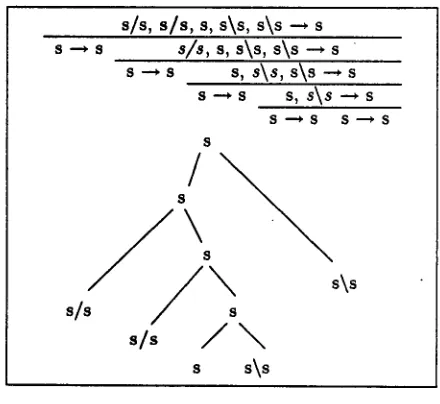
Condition 3 is too weak if it is stated on the background of propositional Lambek Calculus only. It would allow for proof trees whose nesting of cur- rent functors does not coincide with the nesting of
current functors in the corresponding syntax tree (see figure 12).
S/S, S / S , S, S\S, S\S -"* S
S "-* S S / 8 , S~ S\S, S\S ""+ S s ---, s s, s\s, s \ s --* s
S " + S S, $ \ 8 -'* S
S "-*S S ' " * S S
sis
/ \
S S \ 8
Figure 12: Non.normal form proof
The outline of the p a r s i n g / t h e o r e m proving al- gorithm P is:
• A" sequent is proved if it is an instance of the axiom scheme.
• Otherwise, choose an inference rule by obey- ing the nesting constraints and try to prove the premises of the rule.
[image:6.612.76.538.81.232.2] [image:6.612.316.536.298.500.2]4 . 1 F u r t h e r I m p r o v e m e n t s
The performance of the parser/theorem prover can be improved further by adding at least the two fol- lowing ingredients:
The positional indices can help to decide where sequences in the "left"-rules have to be split up to form the appropriate subsequences of the premises.
In [van Benthem 1986], it was observed that theorems in LC possess a so-called count invariant, which can be used to filter out unpromising sugge- stions for (sub-)proofs during the inference process.
5
C o n c l u s i o n
T h e cut-free and product-free part of L a m b e k Cal- culus has been augmented by certain constraints in order to yield only normal form proofs, i.e. only one proof per "reading" of a sentence. Thus, theorem provers for Larnbek Calculus become realistic tools to be employed as parsers for categorial grammar.
General efficiency considerations would be of in- terest. Unconstrained L a m b e k Calculus seems to be absolutely inefficient, i.e. exponential. So far, no results are k n o w n as to h o w the use of the
nesting
constraints and the count invariant filter systema- tically affect the complexity. At least intuitively, it seems clear that their effects are drastic, because due to the former, considerably fewer proofs are ge- nerated at all, and due to the latter, substantially fewer irrelevant sub-proofs are pursued.
From a linguistic standpoint, for example, the following questions have to be discussed: How does Lambek Calculus interact with a sophisticated le- xicon containing e.g. lexical rules? Which would be linguistically desirable extensions of the infe- rence rule system that would not throw over the properties (e.g. normal form proof) of the original Lambek Calculus?
An implementation of the normal form theorem prover is currently being used for experimentation concerning these questions.
6
A c k n o w l e d g e m e n t s
The research reported in this paper is supported by the LILOG project, and a doctoral fellowship,
both from IBM Deutschland GmbH, and by the Esprit Basic Research Action Project 3175 (DY- ANA). I thank Jochen D6rre, Glyn Morrill, Remo Pareschi, and Henk Zeevat for discussion and criti- cism, and Fiona McKinnon for proof-reading. All errors are my own.
R e f e r e n c e s
[Calder/Klein/Zeevat 1988] Calder, J.; E. Klein and H. Zeevat(1988): Unification Categorial Grammar: A Concise, Extendable Grammar for Natural Language Processing. In: Proceedings of the 12th International Conference Computa- tional Linguistics, Budapest.
[Gallier 1986] Gallier, J.H. (1986): Logic for Com- puter Science. Foundations of Automatic Theo- rem Proving. Harper and Row, New York.
[Hepple/Morrill 1989] Hepple, M. and G. Morrill (1989): Parsing and derivational equivalence. In: Proceedings of the Association for Computatio- nal Linguistics, European Chapter, Manchester, UK.
[Lambek 1958] Lambek, J. (1958): The mathe- matics of sentence structure. In: Amer. Math. Monthly 65, 154-170.
[Moortgat 1988] Moortgat, M. (1988): Categorial Investigations. Logical and Linguistic Aspects of the Lambek Calculus. Forts Publications.
[Pareschi 1988] Pareschi, R. (1988): A Definite Clause Version of Categorial Grammar. In: Proc. of the 26th Annual Meeting of the Association for Computational Linguistics. Buffalo, N.Y.
[Pareschi 1989] Pareschi, R. (1989): Type-Driven Natural Language Analysis. Dissertation, Uni- versity of Edinburgh.
[Pareschi/Steedman 1987] Pareschi, R. and M. Steedman (1987): A Lazy Way to Chart-Parse with Categorial Grammars. In: Proc. 25th An- nual Meeting of the Association for Computatio- nal Linguistics, Stanford; 81-88.
[Pereira/Warren 1983] Pereira, F.C.N and D.H.D. Warren (1983): Parsing as Deduction. In: Pro- ceedings of the 21st Annual Meeting of the As- sociation of Computational Linguistics, Boston; 137-144.
[Uszkoreit 1986] Uszkoreit, H. (1986): Categorial Unification Grammar. In: Proceedings of the 1 lth International Conference on Computational Linguistics, Bonn.
[van Benthem 19861 Benthem, 3. v. (1986): Essays In Logical Semantics. Reidel, Dordrecht. [Zielonka 1981] Zielonka, W. (1981): Axiomatiza-