
Toward Solutions to Problems of Diversity
A thesis
submitted in partial fulfilment of the requirements for the Degree
of
Doctor of Philosophy in Computer Science in the
University of Canterbury by
Robert Lewis Biddle
LIBRARY
THESIS
Preface
I began this project with a great deal of idealism, having decided that there wa~ a topic in Computer Science that interested me enough to spend considerable time in research. This topic, programming language diversity, has served me well- perhaps too well for the scope of the project. The aspects that interest me most have lead me away from programming languages, to the contexts of wider language and art. In those contexts, the problems of programming language diversity do not admit any straightforward solution, perhaps not any solution at all. This does not displease me, and I look forward to exploring this subject in general, free from concern with "solution".
In practical computer programming, however, there do remain problems of incompatibility in the diversity of programming languages. Accordingly, I have studied the practical methods that have addressed these problems, and concluded that while most methods are successful in limited ways, there is a more general approach suggested. This new approach, "interprogramming", is a collaboration between programming languages, relying on operating systems support. I have described how this collaboration could work, and investigated its possibilities and implications with several programming languages and operating systems. I think it's a good idea: not startlingly dramatic, but a helpful integration of techniques from several areas.
I end the project with idealism still, but weary. I believe the topic is an important one, though little directly discussed, and hope my surveying and exploration worthwhile. More work does need to be done: more theory, more development, more practice. But the topic is very large, and the directions to pursue are themselves divergent. I feel my perspective has become rather lost, atid I look forward very much to finding a new one.
I would like to express my appreciation to those in whose companionship I have worked on this project: my supervisor, Bruce McKenzie, and all the staff and students of the Computer Science department at the University of Canterbury. I'd particularly like to thank the postgraduate students of the department for many stimulating discussions and shared explorations of computing, and for their general enthusiasm and devotion to the subject: I wish them well. I am also very grateful to those responsible for U1e Commonwealth Scholarship that brought me to New Zealand, now my home.
Projects like this are sometimes dedicated to those personally close, but I have always found that inappropriate. I dedicate this project to other naive students interested in pursuing the same topic: I hope my work maps out the area, shows where many directions lead, and helps them understand the difficulties and
opportunities concealed. ·
To my family, to Anthea, I dedicate: new time, new energy, new life.
The success of programming language design is so great and diverse that the resulting incompatibilities have become an important practical problem. This is a study of possible solutions.
J:he first part is a consideration of reasoning to convergence. An operational model of programming language is used, and both implementation and application aspects are examined, in application encompassing approaches of linguistic precedent, mathematical theory, psychological principle, and empirical analysis. Some progress seems evident in looking at language implementation, but in language application the difficulty of understanding the human factor seriously impedes further reasoning.
The second part is a survey of practical methods for coping with programming language diversity, limiting the diversity or limiting the effects of the problem. Two general approaches are explored, compromise in new design and cooperation in accepting existing design, each comprising a variety of techniques. While no one method was seen completely successful, all had specific advantages and some, particularly cooperative methods, seemed open to further development
PART:
CHAPTER
INTRODUCTION
I INTRODUCTION
I PERSONAL MOTIVATION
ll PERSPECTIVE
Ill PLAN
ONE: CONVERGING
TWO:
THREE:
II CAN WE REASON TO CONVERGENCE?
COPING
I INIMPLEMENTATION
ll IN APPLICATION
1 Linguistic Precedence 2 Mathematical Approach 3 Psychological Ap.Proach 4 Empirical Analys1s
Ill CONTEXT
1 From Programming Language to Natural Language
2 From Natural Language
IV CONCLUSION
III COPING BY COMPROMISING
I STANDARDISATION
II MINIMISATION
Ill MULTIPLICATION
IV EXTENSION
V ABSTRACTION
VI CONCLUSION
IV COPING BY COOPERATING
I TRANSLATION
II INCLUSION
Ill FLEXIBLE DEFINITION
IV COMMON IMPLEMENTATION
V PROGRAMME COORDINATION
VI CONCLUSION
COLLABORATING
V COLLABORATION
COOPERATION BY DESIGN
I INTERPROGRAMMING
II CONNECTION
III COMMUNICATION
IV CONTEXT OPENING
V CONCLUSION
VI INTERPROGRAMMING:
INSIDE PROGRAMMING LANGUAGES
I FORTRAN
II PASCAL
III C
IV ICON
V PROLOG
VI guASI PROGRAMMING LANGUAGE
. VII ONCLUSION
VII INTERPROGRAMMING:
OUTSIDE PROGRAMMING LANGUAGES
II PRIMOS
lli UNIX
III PROGRAMMINGLANGUAGES
BETWEEN PROGRAMMING LANGUAGES
III CONCLUSION
CONCLUSION
VIII CONCLUSION
REFERENCES
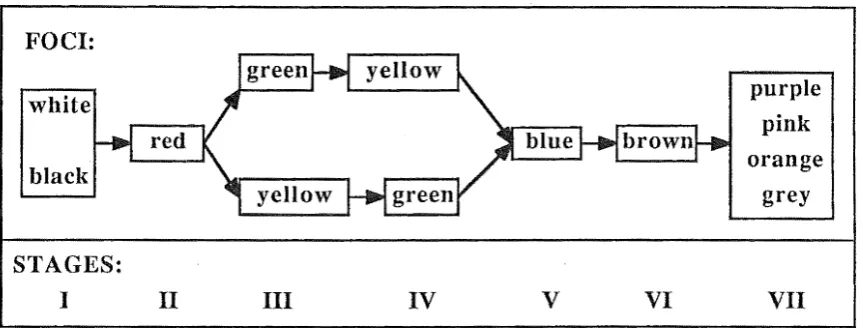
Figure Title Page 1.1.1 An altemati ve in Pascal data stmcture notation. 2 1.2.1 Structural relationships in the tenninology used. 3 2.3.1 An example of matching words and images. 28 2.3.2 Apparant hierarchy in colour tenns across languages. 29
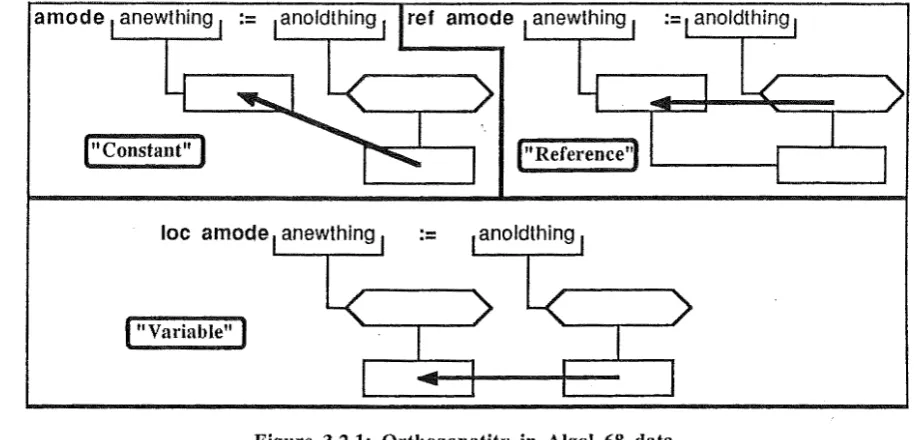
3.2.1 Orthogonality in Algol 68 data. 42
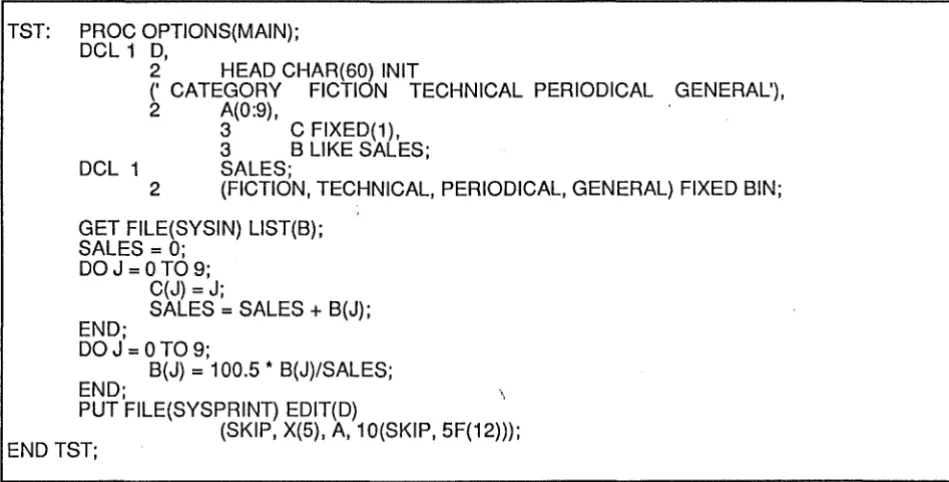
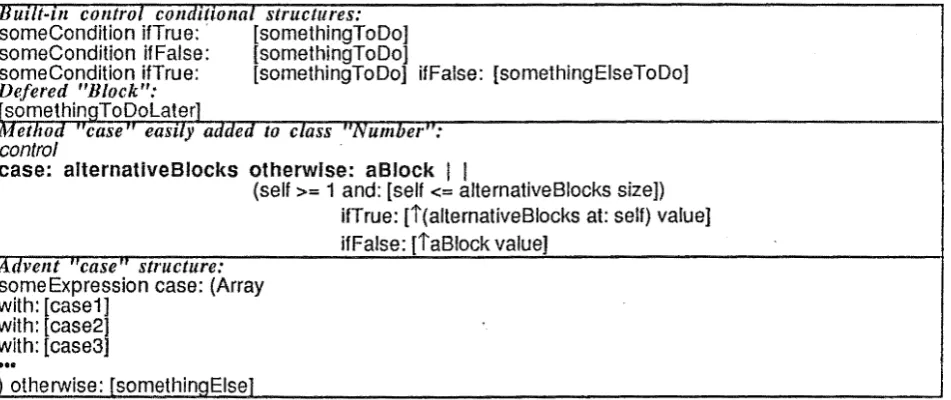
3.3.1 Programme illustrating PL/I's heritage. 46 3.4.1 C preprocessor used to create Algol68like disguise. 51 3.4.3 How a case statement can he added to Smalltalk. 53 3.5.1 Jackson Structured Programming diagram. 56 3.5.2 Programme fragment written in Guarded Commands. 58 3.6.1 Summary of advantages and disadvantages of compromise. 59 4.2.1 Bossi et al. 's decomposition of Ada into a language hierarchy.
64
4.3.1 An Algol68 program in two different representations. 67 4.4.1 Communication between common levels of implementation. 714.5.1 Fragment of JCL/360. 76
4.5.2 Control structures of the Unix (Bourne) Shell. 76 4.6.1 Summary of advantages and disadvantages of cooperation. 79 5.1.1 Interprogramming through "context openings". 82 5.2.1 Levels of parallelism for coordination. 85
5.2.2 Different models for coordination. 88
5.3.1 Programmes in different languages linked via a third. 94 5.4.1 Most common openings in programming language design. 97 6.1.1 Fortran Interprogramming: CALL-EXTRINSIC-ANSWER. 106 6.2.1 Pascal Interprogramming: program header and extrinsics. 113
6.3.1 C Interprogramming: fcall and ffunc. 117
6.4.1 Icon Interprogramming: call and answer. 121 6.5.1 Prolog Interprogramming: t:request and treply. 124 6.6.1 Doris Interprogramming: .req and .rep. 127
6.6.2 Chef Interprogramming: XCandQF. 129
7.1.1 Primos process stack structure showing command levels. 137 7.1.2 Primos outside-process interprogramme structure. 138 7.1.3 Primos interprogramming through a coordinated file. 140
7.2.1 Unix process operations. 142
7.2.2 Unix process structure. 143
7.2.3 Unix shell pipeline between programmes. 145 7.2.4 Using a Unix pipe to process serial data. 146 7.2.5 Representations of a hierarchy of communicating processes. 149 7.2.6 Simple implementation of Unix "tagged" pipes. 150 7.2.7 Using tagged pipes to build interprogramming connections. 152
7.2.8 Unix process openings . 154
. 7.2.9 Generality of openings imitated via intennediate programme. 155 7.3.1 Rap programme for automatic file transfer. 161
7.3.2 Structure of Mux directives. 163
7.3.3 Fragments of Mux files of interprogrammed Icon and Fortran 163 7.3.4 Mux file with multiplexed C and documentation.
164
7.3.5 Lys programme for simple data translation. 167CHAPTER
I
INTRODUCTION
Programming language design is generally thought to have proven a useful and successful pursuit in support of practical computing. While apparently easing some problems, however, continuing design has itself worsened others. In practice, design requires implementation, and the continuing variety in computing facilities has thus lead to interest in portability, both in implementation and in design. But beyond ti1is concern is another, for the diversity of programming language design is itself a practical problem.
Programming language diversity is a problem when one language alone is restrictive. There arc problems of availability: when a necessary or useful programme or programme component already exists -but in an incompatible language. There are problems of applicability: when an application spans more than any one programming language context or paradigm. Both reduce programming flexibility and mobility, and U1us in tum affect ti1e practical acceptance and experience of design evolution.
Sammet's annual "roster" of programming languages included only languages in use by people other than the implementors, and the number surveyed rose from 42 in the first roster in 1967 to 166 in the last in 1978. As even different dialects of the same language are often incompatible, however, ti1e diversity problem is greater than fuose numbers suggest. And fue number will be larger now anyway, if only because of the more widespread use oflanguage building software.
Diversity is a common problem, a practical problem; it is a result of success in creating many useful programming languages - but one that limits success in using them. As programming language design continues to develop, perhaps in quality and certainly in quantity, and as implementation becomes better understood, so increases the diversity problem. As programming language portability continues to be better understood and effected, so increases the importance of the diversity problem. There has been very little direct attention to ti1e problem in general, though much research and practice in many fields appears relevant.
Winograd (1979) has speculated about programming "beyond programming languages", suggesting computing should follow not from "how", but rather from "what", tile programme specifications describe. While the direction is certainly interesting, it is not beyond "language", and only beyond "programming" in the restricted sense of navigation. The word has been extended in application to computing already, and not with such restriction. Anyway, in here speculating about programming "between programming languages" no similar restriction is implied. This study is an exploration of possible solutions to the problems ofprogran1ming language diversity.
PERSONAL MOTIVATION
"conventional" languages. I have moved with strong, though often ignorant, partisan support of favourite languages, like APL, through daily practical application of many languages. But as practical involvement with differing languages and paradigms increased, so partisan feeling diminished. I know, as I believe all practical programmers know, language design can and does affect programme and programming quality. But quality, of programme, programming, and so of programming language seems an uncettain basis on which to reason further. And yet, the resulting and remaining diversity is itself a problem.
As an artist must consider both canvas and palette, so the programmer might then consider boU1 progranm1e and language. And as next beyond quality concern is portability concern, so even then beyond is diversity concern. In an early essay I considered the palette problem of representing arbitrary data structures in general purpos·e languages (1983a). I suggested a "relational" approach in contrast to the usual "network" orientation, further showed that implementation efficiency would be comparable, and as an example suggested a modification to Pascal. But there the question of the importance of the diversity concern became alarming. Certainly most, perhaps all, programming contexts include some bothersome aspects. And it is not too great a difficulty to conceive new language facets or indeed new languages; it's rather fun. But how to evaluate their worth without practice?
type retperson
=
Aperson;person
=
record name: nametype; sex: sextype; age: agetype; nextyounger, nextolder: refperson end {Old}var nextyounger, nextolder: mapping[refperson} of refperson; {New}
...
{Old}
{New}
ppreviousA.nextolder := newperson; newpersonA.nextolder == p; p1\nextyounger
:=
newperson; newpersonA.nextyounger==
ppreviousnextolder[pprevious}
==
newperson; nextolder[newperson]==
p; nextyounger[p) := newperson· nextyounger[newperson) := ppreviousFigure 1.1.1: An alternative in Pascal data
structure
notation • It would be possible to replace explicit pointer ope1·ations with a "mapping" structure of the same efficiency. This mightbe argued notationally superior, but it is not clear how to resolve such issues. Where such new ideas are explored, potentially bothersome incompatibility can result.
PERSPECTIVE
The problems of programming language diversity do directly involve practical, operational, programming. An operational orientation seems thus most suitable: concern with the actual, though general, methods of programming practice. So saying is to exclude direct concern with theoretical programming -indeed the diversity problem as described does not there arise (in as much as there is a distinction between theory and practice in as abstract a subject as programming). The viewpoint of most direct concern is thus that of the programmer, albeit the programmer in general. So saying is to exclude direct concern with others less directly concerned in operational programming - computer manufacturers or marketing representatives may well see diversity, and portability, differently.
But while essentially practical in purpose, discussion of the diversity problem must be at a high level of abstraction so to cover t11e understood variance in actual practice. Some even common nomenclature used in the discussion is not well agreed upon, so some declaration of usage here is called for. "Computing" is the formal mathematics of symbol manipulation of concern, and more generally the field surrounding and based upon it. A "computing model" is a formal mathematical context for computing, a "computer" is an implementation of a computing model. A "programme" is a descliption of computing within some computing model, and "Programming" is the human activity involving expression of a programme or programmes. A "programming language" is a computing model for direct human expression of programmes. In this way "programming" is a more general term than that implied by Winograd.
Subject faradigm
Human Programmer
t
Programme
!
Translation Procedure
Figure 1.2.1: Structural t·elationships in the terminology used -"Programming" is distinguished as the necessarily human activity of programming language application;
However, in discussing the diversity problem, concern is mostly with longer lived programmes as reusable artefacts. Accordingly, "programme" and "programming" will usually concern these artefacts and not the more transient and often interactive case. In some situations the distinction of interactivity is difficult anyway. Few limits are intended on interpretation- inclusion of canonical practice is certainly implicit.
It is, however, the artefact nature of the programme and the mathematical context defining its operation that is the kernel of the particularly practical nature of the diversity problem. Computing, and programming, necessarily do not have the flexibility of many other notational contexts: for practical computing that iey a strengU1 so novel for mailiematical models, though here it is also a weakness. Hence a distinction between computing and programming, and hence a distinction between implementation and application - the practical process and practical rutefact are of primary importance in discussing diversity.
Even in Ule operational practice involving programming language, however, two aspects are seen: application, language and progran1mer; and implementation, language and (eventually and recursively) computer. In application, the operational activities of writing and reading are day-to-day familiarities. In implementation, the operational activity is translation, interpretation or compilation as in linguistics. All U1ese distinctions can Ulen lead to a resolution of Ule nature of the diversity problem, the first and necessary step in understanding how the problem might be resolved.
PLAN
Over all, this exploration of solutions to the problems of programming language diversity is structured with tlwe divisions progressively narrowing in scope.
First is a consideration of the possibilities for reasoning to convergence in programming languages, thereby eliminating the problems of diversity by eliminating the diversity: integration at the roots of diversity. Central here is the question of programming language "quality" and how it might be evaluated. These questions are extraordinaiily deep, and conclusions can really only underline the difficulty and importance of the problem. In these discussions scope is generally restricted to matters directly involving computing. As matters seem to lead away to other experience and more general enquiry, this is somewhat arbitrary and perhaps raU1cr unsatisfying. Wiiliin the practical context, however, simply establishing the direction of difficulties is sufficient.
significant drawbacks that do keep their usefulness limited. Even so, some cooperative practices appear on examination to suggest further development of a more general strategy may be worthwhile.
Third is the proposal for a new general strategy for addressing and tackling the diversity problem. The philosophical problems realised in the first part of the study and· the practical directions suggested by the second section do not quite seem in collision. Indeed it seems possible to practically evade problems of diversity as much as any particular programming language design permits, while avoiding any necessary implication of impossible universality. So such success must necessarily be limited, but some increased success is possible. The approach involves minimally collaborative design in programming languages, and necessary supp01t from environments exterior to them. Though grounded in applicable practice, these proposals do not follow through in requiring specific action- there remains much choice. These are design ptinciples for languages and support systems, and could be evolved toward. However, several programming languages are explored, and opportunities for useful access described or modifications suggested. To practically examine the question of the exterior support, two operating systems are also discussed, and the requirements of necessary design established. The importance of new software both to assist and take advantage of this "programming between programming languages" is illustrated with some new programming tools.
So more exploration and experience are indicated, and detailed study for particular programming languages and operating systems design would then be of most concern, as well as more attention to
PART ONE
CONVERGING
From INTRODUCTION:
Over all, this exploration of solutions to the problems of programming language diversity is structured with three divisions progressively narrowing in scope.
First is a consideration of the possibilities for reasoning to convergence
in programming languages, thereby eliminating the problems of diversity by
eliminating the diversity: integration at Ute roots of diversity. Central here is the
question of programming language "quality" and how it might be evaluated.
These questions are extraordinarily deep, and conclusions can really only
underline the difficulty and importance of the problem. In these discussions
scope is generally restricted to matters directly involving computing. As matters
seem to lead away to other experience and more general enquiry, this is somewhat
arbitrary and perhaps rather unsatisfying. Within the practical context, however,
simply establishing the direction of difficulties is sufficient.
Sooond is a survey of established computing practices and techniques that in some way approach solution to the diversity problems. This •-mninder that much that is impossible to totally resolve can still managed with tolerably. The approaches examined are grouped into those seeking "compromise": reducing different languages to one, and those seeking "cooperation": ways of using different languages together. Often the diver.nty problem has been only a minor or unstated concem of fonnal developments and studies, so some conclusions can be only infonnally drawn. Many strategies still have defmite advantattes in certain cireurnstances, however, and several deserve to continue being applied. But most strategies also have significant drawbacks that do keep their usefulness limited, Even so, some cooperative practices appear on e:~tamination to suggest fuither development of a more general strategy may be worthwhile.
Third is the proposal for a new general strategy fur addressing and tackling the diversity problem. The philosophical problems realised in the first part of the study and the practical directions suggested by the second section do not quite seem in collision. Indeed it seems possible to practically evade problems of diversity as much as any particular programming language design pennits, while avoiding any necessazy implication of impossible onlvet~ality. So such success must necessarily be limited, but some increased success is possible, The approach involves minimally collaborative desij!,n in pro!t'ammlng languages, and nooessazy support from environments exterior to them. Though. grounded in applicable practice, these proposals do not follow through in requinng specific action· there remains much choice, These are design principles for languages and support systems, and could be evolved toward. However, several progranuning lanjplages are explored, and opportunities for useful access described or modifications suggested. To practically examine the question of the exterior support, two operating systems are also discussed, and the !ejulrements of
necessary design established. The importance of new software both to assist and take advantage of this "programming between programming languages is illustrated with some new programming tools.
CHAPTER
II
CAN WE REASON TO CONVERGENCE?
Programming language diversity has atisen amid the novelty of the application of computers in general, and to many particular fields in turn, by a community it.-:elf diverse in background and in outlook. In tllis time, however, much has been leamed about programming, and about programming language. The rare explicit discussions of the programming diversity problem generally simply accept that re-convergence will not occur (see Beech, 1982, for example). Perhaps it is time to question this, and examine the possibilities for reasoning to convergence in the now more mature discipline of computing. Reasoning to convergence will require selecting few languages from many, so will require comparing languages. Comparing languages involves many factors, but must centre on the effect of the language itself on the programming: the language "quality". But any argument for convergence must not only show direction, but must so do with great confidence. The weight of past knowledge, learning, reasoning, and expression will shun any proposal unlikely to lead to convergence, or unlikely to lead sufficiently far. Convergence may seem attractive: the possibility of its realisation needs be convincingly strong.Programming language diversity was fostered not only by difference in perception of quality, but by practical and pragmatic expedience. Much of the pragmatic problem concerns simple availability. In essence, tllis is tl1e problem tackled tluough seeking language implementation "portability", and has received much attention resulting in several approaches of notable success and developing promise. The problems were recognised early and have lead to the very successful use in well known languages, U1e general "macro" implementation for Snobol (Gtiswold, 1972), translation to generalised target languages for BCPL (Richards and Whitby-Strevens, 1980) and Pascal (Pemberton and Daniels, 1982), and heuristic "re-targeting" strategies: Ganapathi, Fischer, and Hennessy (1982) provide a survey. Much work in understanding and applying fom1al programming language specification promises to even further lift problems of availability (see Cattel, 1980). There does seem to be significant progress being made, and some implications of this are discussed later.
In practice, of course, pragmatic influences may be imperative or irresistible, for good or ill.
SECTION I.
IN IMPLEMENTATION
In examining language quality from the implementation perspective, the practical impmtance of the translation process is paramount In this translation, only computing is regarded as significant. As both source and target are fonnal computing models, translation can follow fonnal analysis and synthesis. In analysis, two criteria seem significant: complexity of the translation as primary; generality of that complexity as secondary. And complexity is of great practical importance because it consumes resources valued in practice. In isolation, though, the "complexity of translation" means little without reference to some target model. This is the starting point of the paradigm for research in algorithm complexity since established by Hartmanis and Steams in 1965 with the basis of the "abstract machine". While mathematically several models might be of interest, pragmatically it is those ones similar to those that can actually be physically constructed that are regarded significant. So with that generality considered, "complexity" refers implicitly to some sufficiently general and common target computing model. Recent movements in complexity theory have in fact focussed on the probabilistic orientation suggested by Karp (see Karp, 1986) because of the difficulties in lack of distinction and the often practical inappropriateness of worst-case analysis. It may be that a similar line could be taken in programming language analysis yielding more useful distinction in language design, but the avenue appears yet unexplored.
Complexity defers to computing power, though in practice this is not important: programming languages generally demand all the computing power there is and no more. Complexity defers to completeness and consistency too, as othe1wise resulting syntactic and semantic ambiguity can limit language and programme generality and hence portability. Ambiguity resulting from informality in specification of Fortran (USA Standards Institute, 1966) for example, resulted in the later need for specific clmifying documents (1969, 1971), a need that continues. Emphasis on formal language specification, however, has greatly lessened tllis implementation nightmare.
Translation complexity clearly is formally limited by source and target languages themselves, but as both are in some circumstances plastic, opportunities do arise to effect language change in order to increase efficiency. Translation complexity has been seen as an important measure of overall language design, originally overwhelmingly so (see Backus, 1978b, for examples in the design of Fortran), and programming languages are usually well scrutinised for unwan'anted translation demands. More formally, much investigation has sought language characteristics that best allowed efficient translation methods.
and commonly involves, more specifically, LL languages that pem1it easily written recursive descent parsing, or LR languages that allow the application of automatic parser generators. The line of study continues, the cmTent work explming not so much better parsing methods, but rather strategies to allow complete automatic implementation from formal specifications (Cattel, 1980). Cleatiy such definition is possible, as the two level grammars of van Wijngaarden (1965) and used in the definition of Algol68 (et al., 1969) have been shown (Sintzoff, 1967) capable of generating any recursively enumerable set. This includes not only the total syntax (including static semantics) as in the revised report (van Wijngaarden et al., 1976), but also the total language (including dynamic semantics), as demonstrated by Cleaveland and Uzgalis (1977). Of course, this has linguistic problems too, as such formal specifications may not be particularly suitable for human use. Language definitjon could then proceed on such a base, however, as Pagan suggests (1975, 1978, 1980b), using a language such as Algol 68 itself for definition. But it seems doubtful that any approach, no matter how seemingly fonnal, can be entirely rid of all informality. Even in recursive definitions, such as that for simple Lisp (such as given by McCarthy, 1978a), or in mathematical definitions such as U10se following Scott and Strachey (1971, and Stoy, 1977), there seems a difficulty inherent in human application. While the human component is not formally understood itself a problem with interesting recursive implications -formality in language specification cam1ot be total, and cam1ot detetmine convergence.
SECTION II. IN APPLICATION
While the human mind is not new, and while our experience with it is extensive as any we have, understanding of its behaviour is limited and unclear. This may seem trite, but it is seems seldom mentioned and oft forgotten in much design. In programming language application, the human factor is central -"programming" languages were originally developed to ease the human task of machine programming. In analysis of the effects of language design on language application several approaches are popular: deference to linguistic precedence, mathematical consideration of the notation, and psychological consideration of the programmer.
Even d~stinguishing the human activities involved in language application illustrates the problems faced throughout. The primary direct activity is clearly expression - wliting. Chronologically consequent, but in many cases more frequently involved is comprehension- reading. There are several intertwinings, though: surely some reading is involved in any sufficiently lengthy wliting; and perhaps "maintenance" might involve much reading followed by little writing. Much t110ught has recently been given to fmmal reasoning about programmes - is this merely "comprehension"? And the problems go deeper still: for programming and programming languages have themselves become involved beyond initial intent. On a low level, for instance, it is often possible to "test" or "de-bug", exploring dynamic behaviour. On a high level, once the notation exists and is sufficiently familiar, it may itself augment or supplant other notations in use in the application paradigm and become ito;;elf a conceptual framework. Is "thinking" a language application activity? It seems so, at least to some extent, and analysis is then particularly difficult.
In evaluating language design in service of these activities we might look first, as with implementation, to complexity and its proviso, generality. However, we lack fonnal models for human behaviour and notice moreover that, in detail and in general, humans err. Should other values be considered: robustness? reliability? safety? It's difficult to argue otherwise.
Certainly evaluation is beyond any simple axiomatic approach. Many axioms we do have themselves conflict, and resolution is a human concerr~. For example, consider compactness: to begin with, the converse, redundancy, is valued too; to finish with, the reality of serious compactness is worth remembering. Even in related programming contexts, severe disagreements alise between experts. In comparing two languages of a similar age and popularity, C and Pascal, both Algol 60 descendants, both general purpose programming languages, several studies disagree. Several direct compalisons, for instance, most notably that of Feuer and Gehani (1979, 1980, later 1982), prompted KemighQ.Il to explain "Why Pascal Is Not My Favorite Language" (1981) relating experience of remaking the Ratfor (Fortran preprocessor) based Software Tools book (Kernighan and Plauger, 1976) to a Pascal base (1981). He was concemed that as a language for practical programmes that would work together, Pascal had important deficiencies, and much eff01t was expended in overcoming them. Then to face reviews long and scathing in their condemnation of the approach. Lecanne (1983) concludes:
" ... they do not use any of the new capabilities provided by a language which is new for them
upon the reader their programming tricks and manias, and fill their text with self-satisfied remarks in the style of 'Consider what we do, and proceed like us."'
So experts differ.
Surveys of programming language, if considering evaluation at all, usually discuss and illustrate how different values yield different languages. Clearly most languages are designed to fit some frame, and in such terms evaluation might be possible. But there are many such frames, and so arguments assuming some understood universality, such as Iverson's (1980), assuming great importance for lexical compactness (for
which Iverson's own APL design has become famous or infamous) are not convincing. What method might lead to resolution?
Linguistic Precedence
In the history of programming languages, probably the earliest value seen significant was that of correspondence to another notational model perceived important. Fair enough, computing is abstraction: one can know noU1ing of computing wifuout knowing anyfuing of something else. Notational precedence is an attractive approach in U1at it avoids directly addressing new questions of value. Pragmatically, programming language graphemes have most often been drawn from symbols already in use, most often in commercial business practice. Nicholls (1975) in discussing this lexical level refers to the mathematical history of
symbols compiled by Cajori (1928), but it is clear from work on character set standardisation (sec MacKenzie (1980), for example), that recent business machine practice has a great impact. In well established languages probably only APL bucks this influence, and it too (see Iverson, 1962) is itself based in mathematics practice.
Weinberg, in 1971, does say that no work has been done on the human factors in programming languages, but this is perhaps misleading- it was a major goal of, for example, Fortran (Backus, 1978b). Though Backus does say " ... we simply made up the language as we went along", the remark is perhaps misleading. Fortran follows notations of numerical mathematics- not coincidentally, its target application paradigm: "engineers and scientists". In later language design, other notations in mathematics and general use have frequently been followed. Recently, for example, widely popular and successful programming systems have been modelled on the business "spreadsheet". The first establishment of the model, VisiCalc (see Ramsdell, 1980), was a reasonably straightforward interactive programme relying on fast access to a screen on the newly economical personal computer. Large modem spreadsheet systems, however, now commonly encompass integrated macroprocessors and verge on progranliDing language (see Poole, 1985). A more recent example of the same phenomenon is the Hypercard progranliDing system of Atkinson (Apple, or Goodman, 1987) where the "card index" paradigm is stretched to programming language status.
and a successful "performance" of screen graphics is the goal. And perhaps marking some current outer bound of this approach is "Puppy Love" (Snyder, 1987), where a beginners programming language and accompanying development environment is completely oriented about the paradigm of teaching tricks to a (simulated) dog!
Even simple mathematics offers choice: consider the wealth of notation, both in symbol and in stmcture, employed in common arithmetic. And natural language, of course, embraces an awe-inspiring variety, both in diction and in grammar, employed in common speech. Further, such choices of paradigm may themselves be inter-related: one precedent might seem appropriate from a first point of view, but another clearly more so from a second. There may well be an argument for following precedent; but choosing which precedent to follow may well still be unclear.
In the concluding sections of her 1969 language catalogue, and again in concluding a 1972 retrospective, Sammet looks to the future and discusses the possibilities for English as a programming language. Sammet herself, of course, was involved in the development of Cobol, the early and most successful language designed with a similar goal in mind. If the difficulties of realisation are ignored, the advantage of familiality of English (to U1e English familiar) might be clear. For interactive environments, interfaces based on English do now have many advocates (Ledgard, 1981, for example, or Small and Weldon, 1983). Of course, a great wealth even of interactive practice is not so based, yet it is popular. And English-like languages are still being developed for non-interactive use, ~ork such as that by Biermann and Ballard (1980) attempting to use more advanced linguistic principles and a more complete development environment to improve their acceptability.
There have also been related suggestions, and Wile, Balzer, and Goldman (1977) do discuss how conventional programme language structure might be "delived" from English text. A less direct approach is that of Hobbs (1977), who suggests some very general mles from linguistics might be applied to programming language design, redundancy, for instance, ellipsis of assumed components, and anaphora-use of following explanation. And, interestingly, a dominant orientation about spatial concerns. To the comeback of MacLennan (1979), however, that the history of notation is one of departing from natural language because of inadequacies. Notably Hill (1972, 1983) has claimed that the imprecision of English is exactly what needs to be avoided in programming. Plum (1977) wams particularly about the danger of structures that appear similar to ones in natural language, but in detailed operation work differently. Taking tllis concem to the limit, Beckman (1977) points out that there is even a danger in allowing natural language "comments" in programmes, because inaccuracies there cannot be formally checked, yet have great power in misleading readers. And apatt from any disadvantages of natural language, Sclmeidennan (1980), points out that for many a specific task the precedent most applicable is not any natural language such as English, but ratl1er the specific notations and languages that have become established for specific applications.
model, a new notation, and a new programming language (Griswold, 1978). Curiously, while a number of ideas behind were clearly better thought out in the languages evolving from Snobol, the language structure itself became less distinct. So the current carrier of that torch, Icon (Griswold and Griswold, 1983), resembles much more general purpose languages very closely ~ to the disappointment of some enthusiasts.
For still, as notation and models in any application area are only human inventions, it is clear new notations and models following a new programming language might perhaps prove superior. Correspondence to an existing notation may seem initially mnemonic, familiar and reassuring, but may otherwise prove a liability.
In defeJ:?.ding canonical practice, it appears easy to overstate the case. Quite aside from the symbols involved, APL bucks tradition in having expressions evaluated linearly right to left. Ledgard and Marcotty (1981) remark on this, and quite reasonably point out that "it might well be that the APL rule is the best one and traditional mathematics is wrong in its approach". But they then refer to the traditional approach as "the intuitive one of most of us". This might be, but it is not manifesUy obvious, and the person who learns APL first might well express doubt. But the issue is wider than APL. Ledgard and Marcotty themselves quote Whitehead (1911):
"By relieving the brain of all unnecessary work, a good notation sets it free to concentrate on more advanced problems, and in effect increases the mental power of the race. Before the introduction of Arabic notation, multiplication was difficult, and the division of integers called into play the highest mathematical faculties. Probably nothing in the modern world would have more astonished a Greek mathematician than to learn that ... a large proportion of the population ofWestern Europe couldpeiform the operation of division for the largest numbers. This fact would have seemed to him a sheer impossibility . ... Our modern power of easy reckoning with decimal fractions is the almost miraculous result of the gradual discovery of a peifect notation."
The current western notation used in arithmetic may seem much preferable to others, but "perfect" is a strong word. It seems some distance from the utility of following precedence to any reasoning far to convergence. Clearly it might possibly lead that way if followed, but it's not clear that it's significantly more attractive than other directions.
M
athenzatical Approach
In consideration of the mathematical characteristics of programming language application, the human factor is largely ignored. No one openly disputes its impottance, but many seem to feel it premature or perhaps even even pretentious to build much upon such a flimsy foundation as our current understanding.
systems in Cobol and payroll systems in Lisp -but it still seems silly. Even when some less language-like contexts require less powerful computing models, the comparisons of interest frequently involve similarly powerful alternatives. On the other hand, it is possible in practice for simple languages to model more complex ones sufficiently well for many applications given sufficient resources - most computers are finite state automata, though mostly progranuned otherwise.
As discussed briefly with regard to language implementation, consistency and completeness in specification has been much explored and developed since early programming languages. In application too this is important as programmers can find it uncomfortable wandering into undefined or ill defined language. Many such problems seemed reduced as data typing was widely introduced, and fonnal techniques of language definition and have now done much to further their reduction. The bewildering English of the early Fortran standard was eclipsed by the BNF syntax definition technique employed for Algol 60 - both were surpassed by the "two level grammar" used by van Wijngaarden in defining both the syntax and "static" semantics of Algol 68 (van Wijngaarden et al., 1976). Cleaveland and Uzgalis (1977) showed that "two level grammars" can totally define a language, but the notation is often thought again bewildering. Marcolty, Ledgard, and Bochmann (1976) provide a survey of definition techniques, and McGettrick (1980), and Pagan (1981) more recent texts.
The formal tractability of programming languages and their underlying computing models is a subject of much recent dispute and controversy. Perhaps the best example of this is the question of "Structured Programming", firstly that regarding "control flow". In the classicalcomputer model, "control" is achieved by the loading of a memory address. At machine level, this is the "branch" instruction; at the "higher" level of programming languages, this is the "goto" of languages from Fortran on. Historically, in accordance with a desire to serve frequent needs with well suited facilities, language designers provided statements to simplify the specification of common control statement patterns: most commonly the "while" and "if-then-else" structures. Such constructions proved popular and were widely used.
Interested in the theoretical properties of control statements, Bohm and Jacopini (1966) studied these language sttuctures and concluded that the new control structure yielded the same computing power as the "goto". Dijkstra (1968b) then proposed it was the "goto" itself that was harmful- and that it be wholly abandoned in programming language design. There was widely felt shock. As argued in quick reply, and later more reflectively by Knuth (1974b), there did seem to be some situations, such as the "n-and-a-half times" loop, that seemed to occur rather frequently and required an explicit branch - or some other control suucture - for U1eir elegant construction. Denning (1974) suggested abandoning the term "stmctured programming" altogether because there it was being interpreted as compelling much more rigidity than was warranted. And in their survey of conu-ol structure possibilities, Ledgard and Marcotty (1975) trace U1e histories of several kinds and many valiants, each applicable to some particular circumstance.
a language allowed the existence of programmes about which little could be said, little could be reasoned. Formally, one could not be certain of their behaviour, and thus they could not be tolerated.
The idea was sufficiently successful to markedly change programming, programming language, and programming education. As such, mathematical tractability has proven a powerful influence in language design. One consideration has been whether programmes reliant on explicit branching might be structured automatically. While Bohm and Jacopini have shown this is always formally possible, some more recent work suggests it might further be practically useful (see Baker, 1977) in structming "unstructured" programmes. In other discussion, it is suggested that models far different from the "von Neumann" might lead to even superior tractability: hence Backus' (1978a) argument for the superiority of "functional" progran1ming lan'guages.
A second major development in programming languages founded on a perhaps mathematical basis is the importance of data "typing" or "strong typing". While there is an important mathematical facet to typing, the influence of "strong typing" as a mathematical reason for programming language convergence is perhaps overrated. The important mathematical facet concerns language definition: the concept of type enables distinction that frees language design and analysis from some implementation concerns while maintaining total definition and ensuring programme integrity. In this way, an implementation may deal differently with, say, a letter of the alphabet and an integer without needing be concerned about their logical disjunction. In the same way, "overloading", oflanguage symbols with different meanings for different type becomes possible.
There are several reasons why typing is not a strong force for convergence. Firstly, it should be admitted that in practice programmers often do wish access, both reception and transmission, to some language implementation levels~ typically data storage encodings and control structure generated code. The reasons are usually to do with extending the possiblities of the language, and the efficiency of access is important too. The access at all, and more so efficient access, erode the mathematical argument for typing: where it cannot be ensured itself, it cannot itself ensure.
Secondly, it might be mentioned that typing, strong typing, may be achieved in surprising ways. Should a language be willing to embrace definition of it's own implementation, as many "systems programming languages" might do, even the most "typeless" language might thus be "strongly typed"~ even the Turing Machine could be strongly typed. Nor need this be a capability of the lowest level languages, as concern with implementation might also be achieved by an implementation itself flexible enough, interpretive enough, to join the otherwise disjoint.
implicit trade-off. Pascal, for example, restricts some flexibility in demanding some type surety in programme definition. The rest, and there is always more, becomes an implementation responsibility. What is the error in division by zero, if not one of type?
It remains a possibility that our usual computing model is too difficult for our mathematical tools -the issue raised in -the flow control question. If so, we must then decide whether we should change our computing model, or change our mathematical tools. It remains a possibility that mathematics cannot directly help in these matters at all, as Goedel (1931) has shown it cannot always help itself. There may be programmes that are completely correct that cannot be so proven.
Within.mathemalics there is much diversity yet equivalence: cartesian and polar coordinates do not govern separate applications, nor do different bases govern different arithmetic, nor yet different numeral systems govern different numbers. Do they? In the human application of programming language, is "tractability" a mathematical property? It's difficult rule on such questions because of the wide range of factors involved with the human element: books may not be completely judged by their covers, but covers are associated with books and so cannot be ignored.
At the higher level of discussing programming, the possibility of confusion between mathematics and human politics has caused concern. De Millo, Lipton, and Perlis (1979) expressed concern about the interplay between mathematical reasoning and social argument, especially with regard to t11e structured programming debate. Interpreting Dijkstra's stand as one for formal verification of programmes, they questioned the role of such a difficult and theoretical process when better operational engineering teclmiques would be more appropriate. As Dijkstra makes clear, however, especially witll Gries (1981), he advocates not verification afterward, but formal development throughout. But the further point of De Millo et aL remains significant: tlley claim that even mathematically formal proofs - and this would apply to development as well as verification- are subject to social processes before being accepted. The argument basically points out that what is universally accepted true one day, may be proven false the next. As it is possible to make a mistake in a programme, so it is also possible to make a mistake in a "proof'. This leaves any superiority claim for a mathematical approach in doubt because it puts mathematical development and operational programming on an apparently even footing. There are further arguments both ways, but no conclusion.
Regardless of the philosophical difficulties, priorities at the day-to-day levels of programming may be also disputed. Languages can certainly be designed on fom1al principles, as Tennant (1977) has shown, so to assist in t11e formal analysis of programmes written in such languages. But it is neither guaranteed nor even clear that such languages will make it easy for people to write programmes, or to read programmes, well. Naur (1975), for instance, is happy for theoreticians to follow mathematics, but feels that for applications programming more pragmatic models -from natural language already familiar- apply. And of course there really isn't any resolution, as there is no appropriate context for recourse.
Wittgenstein and Russell immediately agreed that " ... in fact all the propositions of logic say the same thing, to wit nothing" (Wittgenstein, 1961). Is there more to programming than mathematics? Rather
i
elegance". However, the practical and continuing nature of programming as a day-to day activity suggests this must be taken more seliously. The importance of context is clear, but determining relevant context is not straightforward.
Psychological Approach
Psychology is not directly able to answer the questions of language value, but the experimental methods of cognitive psychology have been applied in exploring those questions. Weinberg (1971) is generally credited with first suggesting the approach, though that first contlibution is largely anecdotal. More expelimental work quickly followed, however, with Sime, Green, and Guest (1973), Weissman (1974), and Lucas and Kaplan (1974), and since then a great deal of exploration has developed. Much, however, has involved immediate and interactive software with particular attention to novice subjects. Schneiderman (1980) surveys the human factors involved in software generally, and sees programming language as the very deep end of such study. Perhaps because ofthe strong feelings held about the subject of programming languages and programming in general, especially at the height of the "stmctured programming" debate, there has been informal doubt and scepticism about the psychological approach. Brooks (1980) looks critically at the methodology of experimentation and is concerned about the frequent lack of rigorous application of procedures developed over years of psychological research. But Sheil (1981), in his survey of the approach is very harsh in criticism not so much of the method, but of the conclusions drawn from them. Green, Sime, and Fitter (1981) discuss the difficulties in dealing with the notational aspects of programming language, noting especially the extraordinarily wide scope of psychology involved. Curtis (1983) provides a survey of the more experimentally practical work particular to programming language design, and generally seems optimistic. Curtis focusses, however, on the detail of stmcture in procedural languages, and does not really consider any wider possibilities or implications. More recently Wickens and Kramer (1985) provide, from the side of psychology, a survey of the application of psychology to enginee1ing in general, particularly including computer software and programming language, and seeing the situation as diverse exploration from several different perspectives, notably human factors engineering and human performance research. In general, it appears that where rigorous technique yields significant results, the depth and breadth of implication are not yet seen sufficent to influence programming language design.
Miller's 1956 classic "The Magic Number Seven Plus Or Minus Two"). In some cases, general psychological models are constructed, such as the network and process model suggested by Carroll and Thomas (1981, 1982), and the "information-processing" analysis for human behaviour proposed for experimentation by Card, Moran, and Newell (1980, 1982).
As an approach to exploring language values, psychological experiment has several advantages. Of initial interest: it is a method that obtains "actual" and theoretically repeatable results- statistical data enabling a variety of comparative analyses. Hypothetical developments may be examined without the immense effort and investment of language development and support, which is a significant attraction. Moreover, as investigations may concern details or general models, it could perhaps lead to inductive inquiry and foster more understanding. And beyond direct reasons is the benefit of the establishment: cognitive psychology, while young, is a discipline with primary aims that clearly encompass those of language quality and evaluation - perhaps it could serve computing as a guide'?
While research in U1e area can claim results, little of the work shows in language design yet established. Perhaps the Ada semicolon is a tetminator because of the study of Gannon and Homing (1975), to chose a small example, but perhaps because the influence ofPL/l was strong. There are so many factors it is very difficult to be certain of anything. Psychological research is new in application to programming languages and they take some time to become established- perhaps the connection may yet develop.
The approach does have drawbacks, however, some perhaps serious, especially with regard to the particular concern about programming language diversity and longer lived programmes.
Expense & Experience: Programming remains, fortunately or unfortunately, a skill much in demand, and in order to afford many experimental subjects, research commonly examines university students at an introductory level. It is not clear that what is learned about these subjects will apply to more experienced programmers.
Time & Tools: Controlled experiments cannot last very long. It seems possible, however, that many effects of notational tools are not realised until much familiarity has been achieved - it isn't clear how long it takes, or whether controlled experiments can manage that long. Especially in experimenting with application in mind, time itself may be a factor, as short term and long term application techniques might well diverge.
All these problems are ones of interpretation, and in each case the danger is overgeneralisation. This is understandable - we test what we suspect - but when applied to such large and complex situations is far too limiting. And in light of knowledge about how surprisingly adaptable human behaviour is, it is not realistic. Even change itself can influence behaviour, and it is not clear that programming should be exempt from "fashion". Sometimes U1e problems are recognised, but are considered problems of insufficient resources. The results would have been convincing - if more people could be coopted -if more time could be taken - if more cases could be studied. More is not available in the quantities needed, nor is it likely to be. In order to explore on the scale required, the apparatus must be more complex and diverse, the control must be less rigorous, and the observations must be more difficult. This is not experiment: it is history.
One line of psychological research conducted by Perlman (1984) is interesting in that it does concern itself with the low levels of interplay in programming language use. Perlman draws on a number of sources from natural language research and explore the relationships between symbols, names, and concepts. His expeliments appear to show a number of trade-offs occur at the low level, relating, for instance to application oflexical or semantic knowledge. Perlman uses these findings directly in designing systems where the immediacy of interaction makes U1e choice between tradeoffs clear, suggesting "menu" interfaces for interactive use, and applying the strategy to a command language. For the longer tern1, though, and at higher levels, the questions are still difficult. "Semantic knowledge" is a much encompassing tem1. It
seems reasonable to expect more tradeoffs, but experimentally exploration will be complex. Perlman explicitly rules out concern of this sort, and so loses some considerable import when expe1ienced and longer term software users are considered. And this is a main interest in practical programming language design.
Most careful work that has been done in applying psychology to software shares this approach. In
the design of calculator "key-pad" language, for instance, Mayer and Bayman (1981) are relatively free from concern with long term issues because calculator use is immediate and fleeting. The next step taken is usually to programming languages for people just learning to programme, and here too, Mayer (1981) for instance, can assume the relatively major changes happening in relatively small times will make significant conclusions possible. More than this, however, proves difficult. Trancz (1979), for example, maps out a cognitive processing model for progran1ming language use. But he explains that while iliere is general agreement on distinction between, say, short-term and long-term memory, the exact structures involved and capacities of both structures and connections are not sufficiently established to rule on detail necessary for relevant distinctions in actual programming practice.
possibly quite important factors, the methods used to teach the language, for example, and even then manage to tum experimental results that are quite equivocal into apparently insightful conclusions. Sheil questions whether they might not really show something else inadvertently:
"First, given the small sizes of and inconsistencies among the reported effects, it is not even clear that notation is a major factor in the difficulty of programming. The study of programming languages has been central to computer science for so long that it comes as a shock to realize how little empirical evidence there is for their importance. Second, many of these effects tend to disappear with practice or experience. This raises some doubt as to whether these results reflect stable differences between notations or merely learning effects and other transients that would not be significant factors in actual programming perfonnance."
One factor leading to the small significance often resulting is simply that it is usual to compare schemes where there is doubt anyway - few experiments compare APL and binary machine code.
While there is much enthusiasm for the application of psychology to computer science, the questions about programming, and then about programming language, seem to be the most difficult. Wickens and Kramer, theirs one of few surveys external to computing that do encompass the programming efforts, merely record views and claims one way and the other, and concentrate on the more immediate human-machine interactions that do not so easily defy analysis.
And perhaps surprisingly, no other notation more limited U1an natural language or more complex than direct interaction seems to have been singled out for detailed psychological study. While this means psychology attention is attracted to a computing problem, it also means there is little applicable experience. The application of psychology to programming language design is fascinating but not conclusive, perhaps not even convincing - understanding the interplay of tl1ought and notation simply requires greater understanding. Method there is; theory there is; authority there is not- not yet, anyway. Ergonomics is a proven design approach, but is founded on and limited by understanding of the human factor. Where the human factors involved are well understood, the importance and success of ergonomics cannot be doubted, for example in the classic telephone handset design of Dreyfuss (1955) based on hand and head physical proportions. But the proportions inside the hand and head that bear on programming language design are simply too complex to be well enough understood (yet), It is quite reasonable and perhaps important that the psychology of computing be further explored. The approach is far from silly, but it is far from definitive. At this stage it is not psychology that can serve computing as a guide, but computing that can serve psychology as a subject.
Ingalls, 1981, or Krasner, 1983, for example). Even assuming the premises of the argument, however, it is not clear why a notation designed to model one context need be the best to model another. Just as it's not clear that the most "intelligent" people can perform all tasks better than other people, so it's not clear that a language best enabling "artificial intelligence" is best for less glamorous applications.
Enzpirical Analysis
The importance and elusiveness of the human factor in understanding language application does make the idea of ~ata any empirical data - very enticing. Largely becaus,e of this appeal, one approach to language exploration involves the study of the empirically tractable artefacts of the programming process: usually the programmes themselves.
Knuth (1971) was an early proponent, and claims to have begun by studying waste punch cards-though later moved on to study programme libraries. Knuth's main interest was in language implementation, and he sought to detetmine from existing programmes the most frequent, statically and dynamically, language patterns in actual use. Many analyses have followed of many different programming languages, both statically and dynamically, mostly concerned with implementation implications. Halstead (1977) too saw empirical analysis as important, and this is the practical basis of his "software science". His interest was also not programming language, but programmes themselves, seeking to characterise various elusive textual properties of programmes. However, the "science" is not really completely accepted. Though regarded as very promising in some reviews (see Fitzsimmons and Love, 1978, for example), in others severe doubt has been expressed about both theoretical basis (Coulter, 1983), and empirical support (Shen, Conte, and Dunsmore, 1983). While the methods seem to have some attachment to practice, it seems difficult to say just what it is, and how much may then be reasoned on that basis. However, such measures are still used, and indeed wider applications are even suggested to mathematical and scientific notation generally (Patrick, 1983).
On a more day to day basis, empirical analysis has been suggested as a means of examining particular programmes. One application discussed has been in evaluation of student's programmes in and education and assessment situation as proposed by Robinson and Torsun (1977). (See Rees, 1982, for a Pascal context, or more recently the detailed discussion of Redish and Smyth, 1986, using Fortran 77). Such methods make all sorts of presumptions, of course, and in the assessment role pose some difficult questions. In a recent study, for example, Gannon, Katz, and Basill (1986) empirically examine programmes written by newcomers to Ada. It turned out that the programmers failed to use Ada in the way the experimenters regarded as most desirable, even though they were experienced programmers, trained in Ada, and knowledgeable about the application. So it was decided that even knowledgeable and experienced programmers ne~d special training to use Ada properly. Of course, this may well be true. It may also reveal something about Ada, but that was not considered.
However, similar methods of analysis can also be used simply as another way to exploring programmes, and in so doing, in a background way of course, exploring programming languages. In this way too various programme driven software may also be useful, profilers, structure diagrammers, even fmmatters- the ubiquitous "prettyprinter". Similar software is also available for natural language documents, spelling checkers, document fonnatters, and also more sophisticated programmes for concordances (such as the portable Oxford Concordance Program by Hockey and Marriott, 1980), and diction and grammar analysis (such as the Unix Style and Diction programmes by Cherry and Vestennan, 1980). In fact many of the applications of computing to natural language literature (see for example Sedelon's 1970 survey, or Hockey's 1980 guide) could well be considered for programming language "literature" roo. One interesting example of t11is combination was by Morgan (1970), who used spelling error detection methods integrated with a programming language to detect probable semantic errors. As with the tools commonly used with natural language, such programming language tools might not be able to prescribe, only to suggest, but that has proven useful.
Programmes have been used as empirical data in the study of language, language implementation, and student programmes, but progran1ffies are not the o~y artefact of the imperfect process of programming. "Programmes" often include errors, and error reports, as artefacts too, can also be recorded and studied. This technique has been considered primarily to study error diagnosis, as suggested by Wetherell (1977), a challenge picked up by Ripley and Druseikis (1978). A main interest here was in the possibilities for automatic error correction, like that done in the PL/I variant PL/C (Sprowls, 1972). But it also lead to rough knowledge usable in simpler application. The approach seems to have the potential to tell something about language application in general, if not as a direct report on language design, then perhaps as an aid in programming instruction (see, for example, Biddle, 1984).' But as there concluded, it is very difficult to reconstruct the causes of errors at that distance, and the approach seems useful more as an aid in indicating the need for attention. Otherwise the direct empirical approach of Pugh and Simpson (1979) in actually personally examining errors as they occur in the context they occur seems bound to be superior, though tedious - perhaps language implementations could design eiTor reporting expliciUy to aid this.
study it later- it might also be possible to construct "nosy" programming language implementation software to record or even analyse data habitually. If analysis over large practice is too abstract and remote, coverage could be reduced or otherwise structured so to bear on some particular application. In fact, the approach might also be useful in programme language implementation if by extending language software "memory" structures to include not only "input" but also "output" so enabling some bypass. In this way language software could "remember" input pattems and implied implementation without the need for detailed re-generation. The approach might be especially useful in iterative and cumulative development, and might be seen as specialised extension of "probabilistic" language (see Wetherell, 1980), or of "incremental" language implementation systems (see Ghezzi and Mandtioli, 1979), usually associated with language syntax oriented editors and environments. (See Medina-Mora, 1981, or Teitelbaum and Reps, 1981, and Reps, Teitelbaum, and Demers, 1983.)
It does seem an easy approach to understanding language use: simply watch what actually happens (on a large scale), and hope to leam. It is clear, though, that the past is not an easy way to see the future: empirical analysis is not clairvoyance, it is more like archaeology. There may indeed be lessons to be leamed, but whether they are lessons that apply to us - or are of interest to us - is not easy to discover. Presence or absence of simple lexical structures is easy to detect, but their interrelations - and many many interrelations might be of interest - are much more difficult to sort out. Even when hypotheses can indeed be formed, it can often be difficult to really determine cause. At this distance from the programming activity, motivation and causality are unclear. Moreover, should the sought be found, it might not prove conclusive. Empirically U1e popular idiom will dominate, and the connection between popularity and quality must then be
SECTION III. CONTEXT
As seen already, programming language design does often directly or indirectly use as precedent some linguistic context before or beyond computer programming. It is the human factor that hinders understanding of progran1ming language quality and convergence, and many of the resulting problems are similar to problems in all notation- indeed all language. Accordingly it seems indicated to at least explicitly inspect the these problems of quality and convergence in the linguistic contexts that are precedents.
It's often said tl1at programming languages are "artificial" languages, rather than "natural" languages, but this distinction is not clear. It is people that change, develop, and control English, say; and even specifically created languages such as Esperanto soon have native speakers. Computing itself is not new, and the more general task- algorithm- and the more specific task- programme- are both ancient, as Knuth shows in his exposition of "Ancient Babylonian Algorithms" (1972). In advocating language programme "synthesisers" rather than general text editors it is often claimed that programmes are, after all, not text (Teitelbaum and Reps, 1981). But wha
![Figure 3.4.1: C preprocessor used to create Algol 68 • like disguise for C. LFrom the Unix "Shell" • Bourne (1978)]](https://thumb-us.123doks.com/thumbv2/123dok_us/9066.500595/56.595.60.544.71.307/figure-preprocessor-create-algol-disguise-lfrom-shell-bourne.webp)
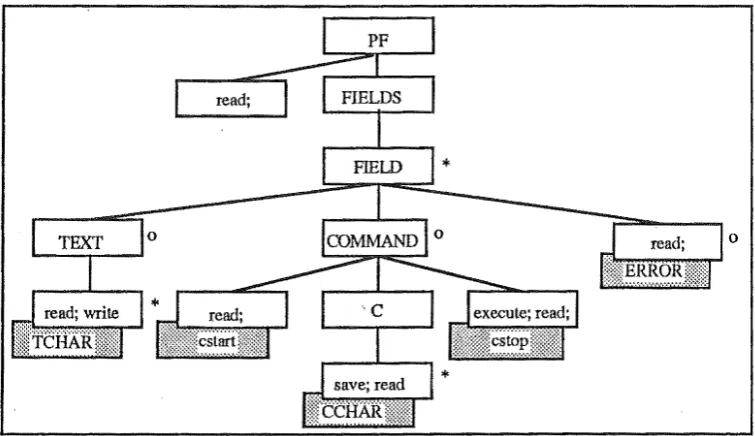


![Figure 4.2.1: Bossi et al.'s decomposition of Ada into a language hierarchy. [Adapted from Bossi, Cocco, and Dulll, 1983]](https://thumb-us.123doks.com/thumbv2/123dok_us/9066.500595/69.595.111.444.82.313/figure-bossi-decomposition-language-hierarchy-adapted-bossi-cocco.webp)
![Figure 4.3.1: An Algol 68 program in two different program representations. [Modified from Lindsey and van der Meulen, 1977]](https://thumb-us.123doks.com/thumbv2/123dok_us/9066.500595/72.595.58.542.482.705/figure-program-different-program-representations-modified-lindsey-meulen.webp)
