ORIGINAL RESEARCH
INTERVENTIONAL
Understanding Angiography-Based Aneurysm Flow Fields
through Comparison with Computational Fluid Dynamics
XJ.R. Cebral,XF. Mut,XB.J. Chung,XL. Spelle,XJ. Moret,XF. van Nijnatten, andX D. Ruijters
ABSTRACT
BACKGROUND AND PURPOSE: Hemodynamics is thought to be an important factor for aneurysm progression and rupture. Our aim was to evaluate whether flow fields reconstructed from dynamic angiography data can be used to realistically represent the main flow structures in intracranial aneurysms.
MATERIALS AND METHODS: DSA-based flow reconstructions, obtained during interventional treatment, were compared qualitatively with flow fields obtained from patient-specific computational fluid dynamics models and quantitatively with projections of the compu-tational fluid dynamics fields (by computing a directional similarity of the vector fields) in 15 cerebral aneurysms.
RESULTS:The average similarity between the DSA and the projected computational fluid dynamics flow fields was 78% in the parent artery, while it was only 30% in the aneurysm region. Qualitatively, both the DSA and projected computational fluid dynamics flow fields captured the location of the inflow jet, the main vortex structure, the intrasaccular flow split, and the main rotation direction in approximately 60% of the cases.
CONCLUSIONS: Several factors affect the reconstruction of 2D flow fields from dynamic angiography sequences. The most important factors are the 3-dimensionality of the intrasaccular flow patterns and inflow jets, the alignment of the main vortex structure with the line of sight, the overlapping of surrounding vessels, and possibly frame rate undersampling. Flow visualization with DSA from⬎1 projection is required for understanding of the 3D intrasaccular flow patterns. Although these DSA-based flow quantification techniques do not capture swirling or secondary flows in the parent artery, they still provide a good representation of the mean axial flow and the corresponding flow rate.
ABBREVIATIONS:CFD⫽computational fluid dynamics; MAFA⫽mean aneurysm flow amplitude (determined from DSA); MEAN⫽projection average; VEL⫽ mean aneurysm velocity (determined from CFD)
V
isualization of in vivo aneurysmal flow structures and quan-tification of aneurysm hemodynamic characteristics is im-portant in understanding the role of hemodynamics in the mech-anisms responsible for wall degeneration and progression toward rupture or stabilization1as well as for evaluating endovascularprocedures such as flow diversion.2,3
Previous studies have used computational fluid dynamics (CFD) to characterize the hemodynamic environment of the an-eurysm to study anan-eurysm evolution4,5and rupture.6-8Other
studies have used CFD to evaluate flow-diverting devices and pro-cedures.9,10On the other hand, imaging researchers have
investi-gated using phase-contrast MR imaging to depict the in vivo flow fields within cerebral aneurysms,11while others have developed
flow-quantification methods from dynamic angiography.12,13
Vi-sualization and quantification of flow fields directly from angiog-raphy data are attractive because they can be performed directly in the angiography suite while imaging the aneurysm for diagnosis or treatment. Previous studies along this line have shown the po-tential clinical value of these techniques and have compared the results with those of Doppler sonography and synthetic angiogra-phy generated from CFD simulations.14
The purpose of our study was to analyze the flow fields recon-structed from dynamic angiography data by comparing them with patient-specific CFD models; in particular, we investigated
Received October 18, 2016; accepted after revision January 25, 2017.
From the Bioengineering Department (J.R.C., F.M., B.J.C.), Volgenau School of Engi-neering, George Mason University, Fairfax, Virginia; Faculte´ de Me´decine Paris-Sud (L.S.), Le Kremlin-Bicetre, France; Interventional Neuroradiology (J.M.), Beaujon Uni-versity Hospital, Clichy, France; and Image Guided Therapy Innovation (F.v.N., D.R.), Philips Healthcare, Best, the Netherlands.
This work was supported by Philips Healthcare.
Please address correspondence to Juan R. Cebral, PhD, Bioengineering Department, Volgenau School of Engineering, George Mason University, 4400 University Dr, MSN 2A1, Fairfax, VA 22030; e-mail: [email protected]
Indicates article with supplemental on-line table. Indicates article with supplemental on-line photo.
whether these fields can be used to realistically represent the main intra-aneurysmal flow structures and identify limitations and fac-tors that affect the flow field reconstruction.
MATERIALS AND METHODS
Angiography-Based Flow Quantification
Fifteen cerebral aneurysms with diameters of⬎5 mm, imaged with 3D rotational angiography and 2D digital subtraction an-giography at 60 frames per second and a typical in-plane resolu-tion of 0.29 mm, were studied. Because the dose per frame is relatively low, the dose-area product level is comparable with a standard 3-frames per second DSA acquisition (dose-area prod-uct⫽716 mGy䡠cm2/s for the 60-frames per second protocol
versus 786 mGy䡠cm2/s for the 3-frames per second protocol). We
acquired the 2D DSA sequences from 2 different viewpoints, try-ing to minimize the overlap between the aneurysm and the sur-rounding vessels. These sequences spanned approximately 7–12 cardiac cycles. In 2 patients, DSA sequences were acquired from a single projection, making a total of 28 sequences for all 15 patients.
2D flow fields in the aneurysms and surrounding vessels were reconstructed from the DSA sequences by using a previously de-veloped technique based on an optical flow approach.12
Visual-izations of these DSA flow fields were created by using virtual particle tracing (ie, a visualization technique based on integration of the equation of motion of massless particles to visualize velocity vector fields). Measurements of the instantaneous flow rate in the parent artery were obtained by integration of the velocity profile in ROIs placed on the proximal parent artery. The mean aneu-rysm flow amplitude (MAFA) was calculated by averaging the velocity magnitude over an ROI delineating the aneurysm contour.13
Computational Fluid Dynamics Modeling
Computational fluid dynamics models with patient-specific ge-ometries were constructed from the 3D rotational angiography images by using previously described methods.15We performed
pulsatile flow simulations by numerically solving the 3D incom-pressible Navier-Stokes equations, assuming rigid walls and New-tonian fluid.16These assumptions seem reasonable because
aneu-rysm walls in general do not undergo large displacements, and shear thinning effects do not have enough time to develop in aneurysm flows.16The maximum element size was set to 0.02 cm,
and a minimum of 10 points across any vessel cross-section was specified. The resulting number of elements ranged from 3 to 4 million tetrahedra. The time-dependent flow rate measurements obtained in the parent artery from the DSA sequences were used to prescribe patient-specific inflow boundary conditions. The simulations were performed for all cardiac cycles covered by the dynamic DSA sequences, by using 120 time-steps per cycle. To avoid possible imprecisions due to the initialization of the flow calculations, we discarded data from the first cardiac cycle. The resulting CFD fields were saved at 60 frames per cycle, coinciding with the time instants of the DSA sequences. The mean aneurysm velocity (VEL) was calculated as the average of the 3D velocity magnitude over the aneurysm region and over the cardiac cycles and compared with the MAFA.
For comparison, the CFD flow fields were projected to the same views used for the DSA acquisitions. This projection results in a 2D vector field on the imaging plane normal to the line of sight. Because the 3D rotational angiography images used to re-construct the CFD models and the 2D DSA sequences were ac-quired relative to the same reference frame, this projection was straightforward (ie, it did not require any image coregistration). During the projection, the CFD velocity components along the line of sight were discarded. The remaining in-plane components were averaged along the line of sight. All CFD mesh points mapped to the same DSA pixels were averaged (for a MEAN or average projection), or the vector with the maximum magnitude was taken (for an MIP projection). The projected 2D CFD flow fields were visualized in a manner similar to the DSA fields by using virtual particle tracing.
Data Analysis
The 2D DSA and CFD flow fields were quantitatively compared by using a directional similarity measuresdefined as
s⫽ 1 N
冘
i僆ROI
vi䡠ui
⎪vi⎪⎪ui⎪⫽
100,
whereviis the DSA velocity vector;ui, the projected CFD velocity
vector;ROI, the region of interest (aneurysm or parent vessel);N, the number of pixels in theROI; and the dot operator denotes the dot product. This quantity measures the similarity of the direc-tions of the 2 vector fields over the ROI. A similarity of 100% means a perfect match, random input would yield a 0%, and
op-Similarity of DSA and MEAN CFD projected flow fields in the region of the vessel, aneurysm, and both regions combined
Patient View Vessel Aneurysm Combined
1 1 80.3% 66.0% 76.2%
2 1 93.9% 52.7% 76.7%
3 1 80.5% 46.4% 76.3%
2 91.3% 39.4% 86.0%
4 1 59.6% 55.9% 57.9%
2 73.4% 50.2% 67.9%
5 1 91.4% ⫺23.0% 48.0%
2 81.9% ⫺64.6% 20.3%
6 1 71.4% 66.8% 70.7%
2 71.3% 41.8% 66.8%
7 1 57.6% ⫺1.0% 46.8%
2 74.3% 9.8% 64.7%
8 1 78.9% 12.5% 71.2%
2 77.3% ⫺2.0% 66.9%
9 1 80.0% 32.8% 69.5%
2 85.2% 65.0% 79.6%
10 1 66.8% 67.9% 67.3%
2 83.0% 84.9% 83.7%
11 1 88.5% 25.7% 73.3%
2 81.5% 11.5% 68.7%
12 1 71.4% 46.1% 66.4%
2 82.9% 44.2% 76.8%
13 1 77.5% 63.1% 72.6%
2 93.6% 9.8% 72.5%
14 1 74.2% 15.3% 62.8%
2 58.3% 25.5% 52.1%
15 1 73.2% ⫺0.6% 43.2%
2 80.5% 26.8% 56.2%
FIG 1. A, Linear correlation between the MAFA and VEL.Red dotsrepresent cases discarded from the regression analysis due to substantial overlap between the aneurysm and surrounding vessels in the selected DSA view.B, Ratio of MAFA/VEL as a function of the number of frames needed for a particle to traverse the aneurysm diameter (mean aneurysm transit time).
[image:3.594.76.508.49.207.2] [image:3.594.81.505.249.688.2]posing fields would give a⫺100%. Similarities of the 2D DSA and CFD fields were calculated for the aneurysm and parent artery regions separately and for both regions combined.
The DSA flow fields and the 2D projected CFD fields were qualitatively compared with visualizations of the 3D flow fields obtained from the CFD models by using streamlines. These com-parisons were performed to evaluate whether the DSA or the pro-jected CFD fields were able to depict the location of the inflow jet, the main vortex structure within the aneurysm, the flow split within the aneurysm (if any), the direction of flow rotation within the aneurysm, and the swirling or secondary flows in the parent artery.
RESULTS
The directional similarity measures between the DSA and the pro-jected CFD flow fields are presented in theTablefor the aneurysm and vessel regions and for both regions combined. In the parent artery, the DSA and projected CFD flow fields are in good agree-ment with an average similarity of 78%. In contrast, the average agreement within the aneurysm region alone is quite poor with a mean similarity of only 30%.
To understand this discrepancy in the agreement of the DSA and CFD fields between the aneurysm and parent artery regions, we visually compared the 2D fields with visualizations of the 3D field. The results are presented in the On-line Table. This table indicates whether the DSA or projected CFD fields capture
differ-ent flow characteristics observed in the streamline visualizations of the 3D fields. As explained previously, the in-plane compo-nents of the projected CFD velocity were averaged along the line of sight. We denoted this field as MEAN. A second field was com-puted by keeping the in-plane vector with the largest magnitude, similar to a maximum intensity projection used for visualization of 3D images. We denoted this second field as MIP. The MIP field was introduced to highlight the effects of vessel overlaps and to better understand the effects of projection of 3D vector fields onto a 2D plane. The On-line Table includes results for both the MEAN and MIP fields. The results indicate that the DSA and MEAN CFD flow fields often fail to capture many of the flow features of inter-est (ie, they only provide reasonable representations in⬍60% of the cases). Furthermore, in many cases, certain features are cap-tured by the DSA field but not by the MEAN CFD field or vice versa. Qualitatively, the MIP CFD fields give a better depiction of the intrasaccular flow structure and provide a direct visualization of vessel overlaps but cannot be used directly to quantify the sim-ilarity with the DSA fields because the MIP projection loses any depth information and vessel overlaps tend to distort the aneu-rysm fields as discussed below.
Linear regression analysis (Fig 1A) indicates that the mean aneurysm flow amplitude determined from 2D DSA is linearly correlated to the mean aneurysm velocity estimated from the CFD models after discarding views with noticeable overlaps of the
[image:4.594.82.501.44.356.2]eurysm and surrounding vessels (slope⫽7.92⫾1.00,R2⫽0.80, P⬍.001). Vessel overlap was determined by inspection of the DSA and the projected CFD model and flow fields. Eight of the 25 DSA views were discarded (32%). This correlation is in agreement with earlier work comparing the MAFA ratios generated by DSA and CFD simulations.17This suggests that the MAFA is a good
surrogate measure for VEL but needs to be interpreted carefully because it provides an underestimation of the aneurysm mean velocity because it discards velocity components along the line of sight.
DISCUSSION
Several factors can affect the flow field quantification from DSA data and the projection of 3D CFD flow fields. CFD is not a crite-rion standard for representing intra-aneurysmal flow fields; how-ever, the comparison of DSA and CFD fields allows us to under-stand and interpret the flow structures observed in vivo with the DSA-based technique and to identify artifacts and limitations.
First, the alignment of the main intrasaccular vortex structure relative to the line of sight of the DSA projections can have an
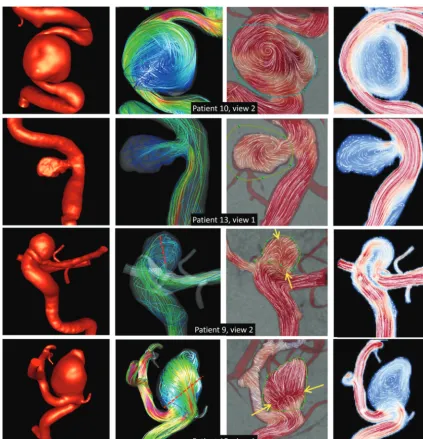
important effect on the reconstructed flow fields and the CFD projections. Four examples are presented inFig 2to illustrate this effect. In the first 2 examples (top two rows), the vortex core is roughly aligned with the line of sight and both the DSA and pro-jected CFD field can depict the main vortex structure. In contrast, in the third and fourth examples (bottom 2 rows), the vortex core is roughly perpendicular to the line of sight. In these cases, the DSA flow field shows interesting artifacts along a line roughly aligned with the vortex core. Along this line, the flow fields seem to converge. To explain this effect, see the example on the bottom row. Below the vortex line, the traces point upward toward the line and are aligned with the inflow velocity near the anterior wall of the aneurysm. However, above this line, the traces point down-ward todown-ward the line and are aligned with the velocity of the re-circulating blood near the posterior wall of the aneurysm. Thus, this feature gives the impression of converging flow toward the vortex core line. The projected CFD fields provide a misleading representation of the flow field because in these cases, they give the impression that there is a vortex roughly aligned with the line
[image:5.594.53.525.44.443.2]of sight when in reality, it is perpendicular to it. See the On-line Figure for further details.
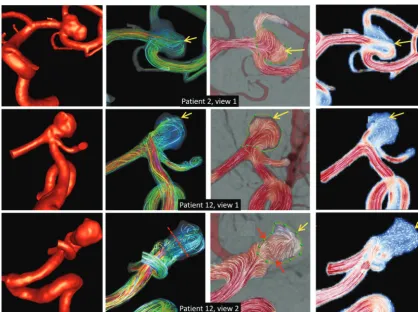
Second, in cases in which the flow splits within the aneurysm cavity, the correct representation of the flow split by the DSA and projected CFD flow fields depends on the location of the inflow stream in 3D as well as the 3D structure of the recirculation re-gions. Two examples are presented inFig 3. In the first example (top row), the inflow stream is located near the posterior wall of the vessel and the flow recirculates toward the anterior wall before flowing into the daughter branches. In this case, the flow split is properly visualized by the MEAN CFD field but not by the DSA field. In the second case (center row), the inflow stream is located near the anterior wall of the aneurysm and both the DSA and projected CFD fields provide adequate visualizations of the flow split. Furthermore, it is important to visualize the flow from⬎1 projection to understand the 3D flow structures. The bottom row ofFig 3shows a second projection of the second example of this figure. In this second projection, the flow split is still visible in the DSA field, as well as the effect of the converging vectors when the main vortex is perpendicular to the line of sight described previ-ously. Taken together, the DSA flow visualizations from the 2 roughly normal projections (Fig 3, center and bottom rows) pro-vide a picture that allows us to understand the main structures of the 3D flow field.
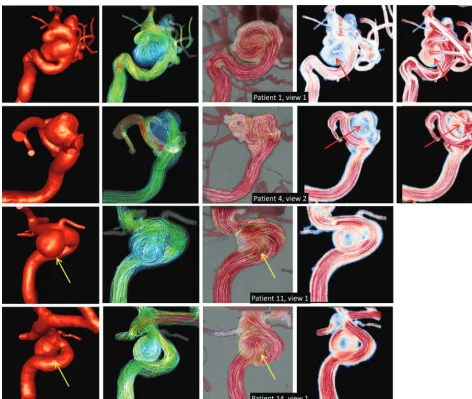
Third, overlapping of the aneurysm with surrounding vessels for a given view point can affect the projected MEAN CFD flow fields by, for instance, generating false vortex structures. Exam-ples of these kinds of distortions are presented inFig 4and are indicated by the red arrows. The MIP CFD fields shown in this figure clearly illustrate the effect of overlapping vessels on the field averaged along the line of sight and also illustrate why the MIP fields are also not appropriate for evaluating the DSA fields. On the other hand, vessel overlaps can affect the reconstruction of flow fields from DSA sequences by, for instance, generating false inflow or outflow regions, as illustrated inFig 4and indicated by
the yellow arrows. Thus, vessel overlaps can affect the DSA and projected CFD fields differently; these different results can lead to poor similarity between these fields.
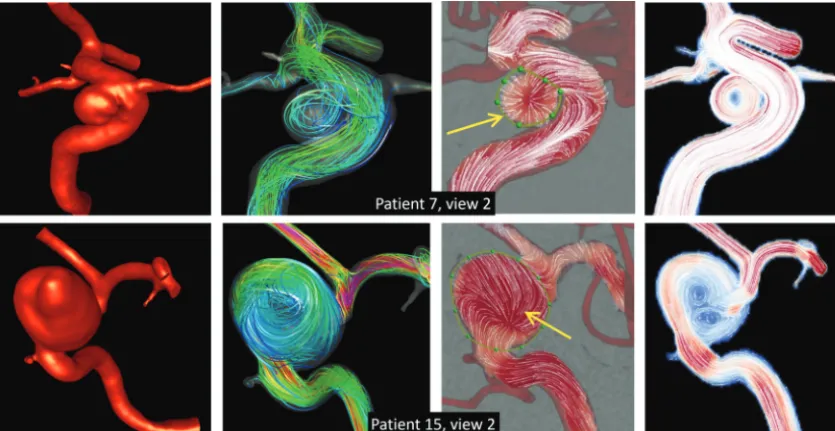
Finally, in cases in which the displacements of fluid particles in 1 timeframe are comparable with the dimensions of the aneu-rysm, an interesting effect can be observed in which particle traces seem to jump across streamlines instead of following them. This undersampling effect is illustrated inFig 5. The arrows point to regions where this effect is thought to take place. Note that this affects the DSA flow reconstruction but not the CFD projections; therefore, it can lead to poor similarity between the DSA and projected CFD fields. Because this can also affect the MAFA quan-tification, the difference (ratio) between MAFA and VEL is plot-ted inFig 1Bas a function of mean aneurysm transit time or the number of frames required for fluid particles to traverse the an-eurysm, estimated as Frames⫽60⫻Aneurysm Diameter / Mean Aneurysm Velocity. The difference decreases (the ratio becomes closer to 1) as the number of frames increases (the flow within the aneurysm is better resolved in time).
Most interesting, both the DSA and projected MEAN CFD flow fields neglect swirling or secondary flows in the parent artery but provide reasonable representations of the mean axial flow profile (which explains why the similarities are good in the vessel region). In the first example ofFig 2(top row), the flow in the proximal parent artery has strong secondary flows shown by the streamline visualization and the MIP CFD projection, but not by the DSA or MEAN CFD fields. Similarly, in the first example of
Fig 3(top row), a strong swirling can be observed proximal to the internal carotid artery bifurcation in the streamline visualization, but the DSA or MEAN CFD fields give the impression of a perfect laminar parallel flow in this region.
CONCLUSIONS
Linear regression analysis suggests that the mean aneurysm flow amplitude determined from DSA is linearly correlated to the
[image:6.594.84.502.48.263.2]mean aneurysm velocity determined from CFD after discarding views with substantial vessel overlap.
While a good correspondence between the arterial flow fields detected in DSA and CFD reconstructions has been observed (di-rectional similarity of 78% on average), the similarity fluctuated considerably for the aneurysm flow fields. Several factors affect the reconstruction of 2D aneurysm flow fields from angiography sequences. The most important factors are the 3-dimensionality of the intrasaccular flow patterns and inflow jets; the alignment of the main vortex structure with the line of sight; the overlapping of surrounding vessels, which many times is unavoidable; and possible frame-rate undersampling. Flow visualization with DSA from⬎1 projection is required for understanding the 3D intrasa-ccular flow patterns.
Although these DSA-based flow quantification techniques do not capture swirling or secondary flows in the parent artery, they still provide a good representation of the mean axial flow and the corresponding flow rate. This information is valuable for pre-scribing patient-specific flow conditions in CFD models of cere-bral aneurysms used to understand mechanisms of aneurysm evolution and rupture and to evaluate endovascular procedures and devices.
Disclosures: Juan R. Cebral—UNRELATED:Grants/Grants Pending: National Insti-tutes of Health, Philips Healthcare.* Fernando Mut—UNRELATED:Grant: National Institutes of Health.* Laurent Spelle—UNRELATED: Consultancy: Medtronic, Stryker. Jacques Moret—UNRELATED:Consultancy: MicroVention, Stryker, Medtronic. Fred van Nijnatten—UNRELATED:Employment: Philips Healthcare. Daniel Ruijters—
UNRELATED:Employment: Philips Healthcare. *Money paid to the institution.
REFERENCES
1. Sforza D, Putman CM, Cebral JR.Hemodynamics of cerebral aneu-rysms.Annu Rev Fluid Mech2009;41:91–107Medline
2. Chong W, Zhang Y, Qian Y, et al.Computational hemodynamics analysis of intracranial aneurysms treated with flow diverters: cor-relation with clinical outcomes.AJNR Am J Neuroradiol2014;35: 136 – 42CrossRef Medline
3. Sadasivan C, Cesar L, Seong J, et al.Treatment of rabbit elastase-induced aneurysm models by flow diverters: development of quan-tifiable indexes of device performance using digital subtraction angiography.IEEE Trans Med Imaging2009;28:1117–25CrossRef Medline
4. Watton PN, Raberger NB, Holzapfel GA, et al.Coupling the hemo-dynamic environment to the evolution of cerebral aneurysms:
computational framework and numerical examples.J Biomech Eng
2009;131:101003CrossRef Medline
5. Sforza DM, Kono K, Tateshima S, et al.Hemodynamics in growing and stable cerebral aneurysms.J Neurointerv Surg2016;8:407–12
CrossRef Medline
6. Shojima M, Oshima M, Takagi K, et al.Magnitude and role of wall shear stress on cerebral aneurysm: computational fluid dynamic study of 20 middle cerebral artery aneurysms.Stroke 2004;35: 2500 – 05CrossRef Medline
7. Xiang J, Natarajan SK, Tremmel M, et al. Hemodynamic-morpho-logic discriminants for intracranial aneurysm rupture.Stroke2011; 42:144 –52CrossRef Medline
8. Cebral JR, Mut F, Weir J, et al.Association of hemodynamic charac-teristics and cerebral aneurysm rupture.AJNR Am J Neuroradiol
2011;32:264 –70CrossRef Medline
9. Mut F, Raschi M, Scrivano E,, et al.Association between hemody-namic conditions and occlusion times after flow diversion in cere-bral aneurysms.J Neurointerv Surg2015;7:286 –90CrossRef Medline
10. Huang Q, Xu J, Cheng J, et al.Hemodynamic changes by flow divert-ers in rabbit aneurysm models: a computational fluid dynamic study based on micro-computed tomography reconstruction.
Stroke2013;44:1936 – 41CrossRef Medline
11. Wetzel S, Meckel S, Frydrychowicz A, et al.In vivo assessment and visualization of intracranial arterial hemodynamics with flow-sen-sitized 4D MR imaging at 3T.AJNR Am J Neuroradiol 2007;28: 433–38Medline
12. Bonnefous O, Pereira VM, Ouared R, et al.Quantification of arterial flow using digital subtraction angiography. Med Phys2012;39: 6264 –75CrossRef Medline
13. Pereira VM, Bonnefous O, Ouared R, et al.A DSA-based method using contrast-motion estimation for the assessment of the intra-aneurysmal flow changes induced by flow-diverter stents.AJNR Am J Neuroradiol2013;34:805–15CrossRef Medline
14. Brina O, Ouared R, Bonnefous O, et al.Intra-aneurysmal flow patterns: illustrative comparison among digital subtraction an-giography, optical flow, and computational fluid dynamics.AJNR Am J Neuroradiol2014;35:2348 –53CrossRef Medline
15. Cebral JR, Castro MA, Appanaboyina S,, et al.Efficient pipeline for image-based patient-specific analysis of cerebral aneurysm hemodynamics: technique and sensitivity.IEEE Trans Med Imaging
2005;24:457– 67CrossRef Medline
16. Cebral JR, Duan X, Gade PS, et al.Regional mapping of hemody-namics and wall characteristics of intracranial aneurysms.Ann Biomed Eng2016;44:3553– 67CrossRef Medline
17. Van Nijnatten F, Bonnefuus O, Morales HG.Mean aneurysm flow amplitude ratio comparison between DSA and CFD.In: Navab N, Hornegger J, Wells W, Frangi A, eds.Medical Image Computing and Computer-Assisted Intervention – MICCAI 2015. Lecture Notes in Computer Science, vol 9350. Switzerland: Springer; 2015:485–92