by
I. D. Coope and G. A. Watson
*
No. 32 September, 1983
Abstract A globally convergent algorithm is presented for the solution of a wide class of semi-infinite programming
problems. The method is based on the solution of a sequence of equality constrained quadratic programming problems, and usually has a second order convergence rate. Numerical results
illustrating the effectiveness of the method are given.
Keywords Semi-infinite programming, descent algorithm, penalty function, Lagrangian function, global convergence, second order convergence.
1. Introduction
There is currently increasing interest in that class of
opti-mization problems known as semi-infinite programming problems, which
are characterized by a finite number of variables and an infinite
number of constraints. Such problems arise, for example, in air
pollution control, in the solution of weakly singular integral
equations, in probability distributions, etc.: details of these and
other applications may be found in the conference proceedings [ 3 ] ,
(8] and in papers referenced therein. In particular, [ 3] is useful
as a state-of-the-art treatment of the subject area. It is clear
that a large body of theory exists for semi-infinite programming
problems, although with the exception of some special cases, such as
continuous linear Chebyshev approximation, the algorithmic
develop-ment is less far advanced. This is not to say that the provision of
algorithms for general problems has been entirely neglected. A number
of locally convergent methods have been published, mainly based on the
application of Newton's method to first order necessary conditions
for a solution (for example [10] [11]). Suitable initial approximations
can often be obtained through the solution of a discretization of the
original problem, and this has led to the formulation of two (or even
three) phase methods (see, for example,
[6]
and the review paper[9]).
To our knowledge, the only methods developed so far which claim
to be globally convergent are those given in [13] , [14] (although a
conceptual globally convergent method based on continuation is
suggested in [ 5 ] ) . The algorithm presented in [14] adapts to the
present situation a well-established technique for the globalization
of methods for finite problems, involving the minimization of an
.exact penalty function, and as the numerical results in [14] show,
However, it has two main disadvantages: firstly each iteration
requires the solution of anineq.iality constrained quadratic
programming problem and secondly, fast ultimate convergence
depends on conditions which may well not be satisfied. The
purpose of this paper is to present a modification of that
method which, in particular, overcomes these difficulties.
We begin by introducing the problem to be solved and some
notation. Let X C RN be a c:artesian product of closed intervals
and let g:X x Rn + R, with g twice continuously differentiable
as a function of its parameters. Let f :Rn + R be a twice
continuously differentiable function, and consider the problem:
find~ E Rn to minimize f(~) (1.1)
subject to g (x,a) ,..., ,..., ~ 0, Vx E X. ,...,
The algorithm to be developed will be capable of finding a
stationary point of (Ll), defined as follows. We let cp. (a) J ,...., and ~j(~,,~) respectively denote the partial derivatives off
and g with respect to a., j J
=
1,2, ..• ,n, although the explicit . dependence on ,?:S and a will sometimes be suppressed when noconfusion can arise.
Definition l. Let,.e* E Rn be feasible in (1.1) and let there
*
exist points x.
"'1.
multipliers A. * I
1.
*
cp . (.e ) + i t
L:
J i=l
*
* *
with g(x~ ,a) = O, i
=
1,2, •.. ,t and non-negative"'-1,...,
= 1,2, ..• ,t such that
* *
*
.:\. tjJ. (x. ,a )1. J "-'l. ,...,
o,
j = 1,2, ... ,n. (1. 2)3.
*
The Fritz-John first order necessary conditions for a
*
to solve (1.1) correspond to (1.2) with¢. (a ) replaced by J ,....,
*
-
*
Ao¢j (~ ) , where Ao ;;;:,: 0 (for example [ 1]). I f a first order
*
*
constraint.qualification holds at~ then Ao I 0 and (1.2)
becomes the usual (Kuhn-Tucker) necessary conditions.
A key assumption in the algorithm developed in [14] is that
*
in a neighbourhood of a , the variables ~. representing local
,...., 1.
maxima of the function g(~,,~) can be eliminated from (1.2) by
expressing them as functions of a. For this, we require, in
particular that the implicit function theorem be applicable to
any zero-derivative conditions characterizing these local maxima.
The algorithm in fact requires the more general assumption that
an analogous elimination be possible at all points encountered
in the solution process, and this forces restriction of points
n
~ being considered to a subset B, say, of R at which
appropriate ·conditions hold.
require some further notation.
We now define such a subset and
n In particular, for given~ ER ,
let E(~) denote the set of local maxima of g(~,~) in X which
satisfy <;/" (~, ~ ;;;:,: -
n'
wheren
>
0 is a prescribed constant.(The role of
n
will become clear subsequently; however it is aminor one and we will not explicitly show dependence upon it).
Let x EE(~), with cr1, cr2, ••• ,crl the indices of the components
of ~on the boundary of X. Also let 'Vig denote the vector in
Rl
whose components are the partial derivatives of g with respect" d h . N-l h ' 1
Let v2g enote t e vector in R w ose components are the partia
derivatives of g with respect to the remaining components of x
and let l/22g denote the corresponding (N-l)X(N-l) matrix of
second partial derivatives of g. Then we define B C Rn as the open set of points (assumed non-empty) such that
(1) there are a finite number of points ~ E X such that
(2) at each point of (1) corresponding to a local maximizer of g, l/22g is negative definite and each
component of Vig is non-zero.
The significance of these assumptions is that for ~EB,
appropriate components of each of the p local maximizers x. of
~i
g(·,~) may be regarded locally as differentiable functions of
the parameters ~ through the use of the implicit function
theorem applied to
l/2g(,iS. ,a) = O, i = 1,2, . . . ,p.
1. ,...,,
For any ~ E B, we may therefore define p
f(~) + .2:
1 A.h. (a),
i= 1 1 ,...,,
where
h.(R:,) 1 = g(x.(a),a), i = 1,2, ... ,p
,...._,J_ ,..._, ~
(1. 3)
the Lagrangian function
(1. 4)
(1. 5)
and the functions x.(a), i = 1,2, ... ,p, are defined by (1.3).
,....,,1,...,,
*
In particular, if a EB, then it is easy to see the relationship
between (1.2) and the usual first order necessary conditions, as the required result carries over directly from the finite
5.
* *
I/ £(a , A. ) = 0 ,
a -... -... ,,..., (1. 6)
*
.where without loss of generality we may assume that t = p(a ) .~
In addition we mayobtain the corresponding second order conditions in an analogous manner. The relevant results are as follows.
*
*
Theorem 1. Let a EB solve (1.1) and let there exist~ such that (1.6) holds. Then if a certain regularity assumption holds
T 2
* *
s ,..._, [I/ a £(a -... -... ,A. )]s~O ,..._,
for all R,: S T l/h , (
a ) =
*
Q f i=
1 f 2 I • • • f t •~ ]. ~
*
Theorem 2. Let ~ EB be a feasible point satisfying (1.6) and let
T 2
* *
s [I/ £(a ,A. )]s>o _,,, a -... -.,, ,,...,
T
*
*
for a l l s : s 'Vh. (a)
=
O, i= 1,2, ... ,t.
Then a is a local ~ ]. ~solution of (1.1).
The basis of the algorithm developed here is the systematic provision of descent directions for an exact penalty function appropriate to (1.1). Given 8
>
0 such a function may be defined for ~ E B by(1. 7)
where h.(a), i ]. ~ = 1,2, ..• ,p is given by (1.5) and (1.3). 'It may be shown by the standard arguments available in the finite case
*
that provided
e
>A,
I i=
1,2, ... , t then~ EB minimizing].
In the next section we show how descent directions for P may be calculated at any approximation ~ E B , and
in section 3 we describe a suitable active set strategy, This leads to the detailed statement of the proposed algorithm which is given in section
4.
Numerical results foran implementation of the algorithm, applied to a number of semi-infinite· programming problems, are presented in section 5.
2. The calculation of descent directions
In the algorithm of
[14],
a descent direction d for P(~) at a point ~ E B is obtained through the solution of the following quadratic programming problem.Find d E Rn to minimize
£T,S£(~)
+~£TH£
(2 .1)subject to h . 1 ,.._ (a) + ,.._ d 'ilh. T 1 _..., (a) ~ 0 , i = 1 , 2 , •.• , p,,
where H is a given positive definite matrix. It is shown in ~3] that a solution d to (2.1) is a descent direction for P at ~provided that there is a Lagrange multiplier vector
associated with (2.1) which has no component larger than 8. On the other hand, if
£
=Q
solves (2.1) then examination of the Kuhn-Tucker conditions for (2.1) shows that~ is a stationary point of (1.1) .A key property possessed by (2.1) is that if H is chosen to be 'i72£(a,A), with a and A approximations to the optimal values, ,..,.,, ,..,.,, ,..,.,,
*
7.
the application of Newton's method to the system of equations (1.6)
together with h. (a)= O, i =I ,2, ... ,p. ]. ,..., A potential difficulty
* *
however, is that V2£(~,~) may have negative eigenvalues, so that
if H is forced to be positive definite, then the desirable
connection with Newton's method is lost. The intention here is
to maintain that connection by working with an appropriate
equality. constraint quadratic subproblem instead of with (2 .1).
For given a EB, let C be the nXp matrix whose jth colwnn ,.._,
is Vh. (a), j = 1,2, •.• ,p and consider.the quadratic programming . J ,.._, problem:
find d E Rn to minimize dT¢ +
~dTHd
,.._, ,.._,
subject to (2.2)
where~.
EIf
has jth component h. (a) and where H is a given·- J ,.._,
(nXn) symmetric matrix. We assume for the moment that p ~ n.
Let the QR factorization of C (which we will assume to have full rank)
be given by C = [ W: Z] [
~
]( 2. 3)
p n n-p n
where W:R + R, Z:R + R with
[w:z]
orthogonal, andU:RP +RP is upper triangular. Let
Then if
£1
is chosen to satisfyT
u .s:!,1 = -,Q, , ( 2. 4) it is clear that the constraints of (2.2) are satisfied and we
are left with an unconstrained problem in the vector £_2.
(2.5)
which has a unique solution provided that the reduced
matrix ZTHZ is non-singular. If the conditions of Theorem 2 are satisfied at a stationary point a*, then ZT [9 2£(a,A)]Z is ,.._, ,.._, ,..,_,
positive definite in a neighbourhood of this point and it is
clear that the choice H = 92£(R:,,~) is appropriate (for some
suitably chosen
2J.
If 92£ is not positive definite (and there is no reason why
it should be) at a stationary point, then the choice H
=
9
2£ + µIcan be used with µ chosen to force positive definiteness of H.
This is the strategy used in
[14]
but it has the disadvantage ofslowing the rate of convergence on some problems. Clearly the
matrix ZTHZ is the one which should be forced to be positive
definite since then the choice H
=
9
2£+
µI will allow µ=
0 to bechosen in a neighbourhood of the solution where the conditions of
Theorem 2 hold. On the other hand, forcing only ZTHZ to be positive definite may cause the solutions to the quadratic programming
subproblems (2.1) or (2.2) to be non-descent directions for the penalty function (1.7) as the following example·illustrates.
(2. 6)
subject to x - a1a2
<
O, x E [0,1].The extra conditions a1,a2
>
0 have been added to exclude thelower branch of the hyperbolic constraint; they are not active
'::}.
The set E(~) = {l} is independent of~ in this simple example and
*
t = p(a ) = p(a)
"' "' 1 with the optimal Lagrange multiplier easily
calculated to be A*= 1. The definitions (1.4), (1.5) then give
[
o
-A]
-A
o
which is clearly indefinite.
T
Suppose now that~= (l-E,1-E) and A=~ is the current
* *
2approximation to (~ ,A ) and choose H = 9 £(~1A) so that Then the solution to
(2.1)
or(2.2)
gives£
= 6(1,l) T,B
= E +~E
2/(l
- E)which is clearly an excellent direction for 0
<
E<
1 . . The Lagrange multiplier associated with (2.1) or (2.2) is1-B/2
>
1 = A* 1-EHowever, the direction~' given by (2.7) is not a descent direction "
for the penalty function (1.7) when
e
=A because the directional derivative, P' (~ ;£)
=B
2>
0. Fortunately i t is always possible (and appropriate) to make £ a descent direction in such cases by increasing the penalty parametere
and the following results allow a threshold value to be determined.Theorem 3. If ZTHZ is positive definite and CTZ = (0) where [c:z] has full rank, then
3a
such that [H + crccT] is positive definite for all 0>
a .
This is essentially a restatement of the result in [ 4 ;p ·132 ] •
Theorem 4. I f £ solves the quadratic programming problem (2.2) then d also solves:
for any value of o and the Lagrange multipliers of problem (2.8)
"
~(O) say, are related to those of problem (2.2) by the equation
"
~(O)
~(O)
+ 0£. (2.9)This result is a straightforward application of the Kuhn-Tucker
conditions.
Using Theorems 3 and 4 and Han's result [
7],
we deduce that the solution to problem (2.1) will be a descent direction for thepenalty function (1.7) provided that the parameter
e
satisfiese~~.(o)
1. i 1,2, ... , p . (2.10)
At points remote from~* it may be necessary to increase 8 in
order to ensure the satisfaction of the inequalities (2.10). Of
-course O will not generally be known so in the algorithm described in section 4 if
,2_,
calculated to solve problem (2.1), is not a descent direction then the current value ofe
must be too small and so it is repeatedly doubled until the directional derivative changessign. (For a more detailed description of the overall strategy for
determining a suitable value of
e
see section 4).3. Active set strategy
In order to obtain a suitable descent direction for the penalty
function (1.7) we have shown that, if the correct active set of
constraints has been identified, it is appropriate to solve
problem (2.2) with the matrix
where )J (~O) is chosen so that ZTHZ is positive definite. Now the
matrix Z depends on the matrix C and this complicates matters when
some of the constraints of problem (2.2) would not be active at the
11.
since it implies that at least one of the Lagrange multipliers of
problem (2.2) is negative, indicating that a;constraint should be
dropped. A further difficulty now arises in that dropping a
constraint causes a column to be deleted from the matrix C, which
in turn results in the matrix Z defined by equation (2.3) having
an extra column. In this case the matrix ZTHZ is increased in size
by one row and column and i t is possible that the current value of
µ may not be large enough to guarantee positive definiteness of
this new ZTHZ matrix. It is, therefore, necessary to consider
increasing µ.when a constraint is deleted. Of course, increasing
µ may mean that the deleted constraint should be reinserted and
this is accounted for in the strategy adopted which essentially
solves a sequence of problems of the form (2.2) but adjusts the
number of equality constraints and the value of µ automatically
until a solution to (2.1) is obtained. Specifically, the active
set method described in [ 4 , pp88-90] is used except that initially,
and whenever a constraint is dropped from the active set, the matrix
H is revised if necessary to make ZTHZ positive definite by
increas-ing µ according to the formula
µ := 4µ + µ ' I
min (3.2)
and by repeatedly applying (3.2) until positive definiteness is
obtained. Initially µ = 0 is always tried, which explains the
need for the extra parameter µ . (
>
0) . minIn a neighbourhood of a*, the solution to equations (2.3) -,...,..
(2.5) will also usually solve problem (2.1) and the active set strategy is not invoked. If this is not the case, then the solution to
set strategy. The only potential difficulty occurs when p
>
n in which case problem (2.2) has no solution, whereas we assume problem (2.1) always has a solution. This difficulty is alsoeasily resolved using the active set strategy. All that is required is that some subset of the constraints be used to define_an initial feasible point for problem (2.1). In the algorithm described in the next section we have assumed, for simplicity, that satisfaction of the n most violated constraints (i.e. those with larger values of h.} always gives rise to a feasible point. This is not foolproof
l..
but almost always p ~ n was satisfied for the problems solved in section 5. An exception is in the case of problem 9 which has infinitely many local maxima in the set E(~*) and this caused failure of the algorithm.· (Note, however, that both assumptions
(1) and (2) of section 1 are not satisfied in this case).
4. A projected Lagrangian algorithm
The algorithm described in this section models very closely that described in
[14];
the major difference is due to the method of calculating the descent direction d for the penalty function(1.7) and this has already been discussed in sections 2 and 3. In order to guarantee descent -of the penalty function P a suitable step lengthy in the direction£ must be determined. As in
[14]
y is chosen as the largest member of the sequence {l,~1~1 • • • }satisfying
where
T(y,~)~ p I
T(y,~) = P(~,+y£) - P(~)
yP' (~
,2,)
( 4 .1)
.L _) •
and P' (~;~_)
<
0 is the directional derivative of the penaltyfunction (1.7) at a in the direction d. The value p
=
.0001 was usedI
as in [14] .
In order to calculate H, defined by equations (3.1) and (1.4),
at the start of each iteration i t is necessary to obtain
approximations to the Lagrange multipliers
A.,
i=
1,2, .•. ,p.i
Because successive values of p may change at each iteration,
(particularly far from a stationary point) it is not appropriate to
use the Lagrange multipliers of the problem (2.1) as estimates.
Instead,
A
was chosen at the start of each iteration to minimize theleast squares norm of the vector
p
+ .L
1\.;t:_(x. ,a) =
;t_
+ c~i = i - i ,....,
with any negative components replaced by zeros. This least squares
problem is easily solved, using the QR factorization of the
constraints of ,Problem (2.2), by back substitution in the triangular
system
To complete the definition of H it is necessary to fix a
suitable value for µ . to be used in (3.2). In early numerical min
trials the value µ . = 1 was useo and this usually gave good min
results. However, on some problems when ZTV2£(!:1l)Z was singular
it became clear that ·a smaller value was sometimes more
appropriate particularly when the current approximation a was
far from the solution. Also when ZTV2£(a,\)Z has large negative ,...., ,....,
eigenvalues i t makes sense to consider increasing µ Therefore min"
the following rules were used to adjust µ .
nun
through (3.2)) from iteration to iteration.
(and hence µ
(1) I f µ = µ and T
> .
5 and ymin l set µ min
(2) If µ
=
µ . and y ~ ~ set µ .=
µ . *4.min min min·
µ . /4
min
The motivation for rule (1) is that if the test is satisfied it indicates that the current value of µ (nece·ssarily greater than zero) may be causing too small a step to be taken in the direction defined by the quadratic programming subproblem. Because T
>
.5 there is reasonable agreement with a linear model and decreasingµ . by a factor of 4 should cause a corresponding increase in min
the size of d used for the next iteration. In rule (2) the situation suggests that the current step.size,y, has had to be decreased from 1 because the current value of µ is too small and
µ is therefore increased. These rules were found to work very min
well on the range of problems tested and were the ones used to obtain the numerical results of the next section.
15.
to the solution because ~(0) + ~(O) as the solution is approached. This is borne out by the numerical results for problem 14 presented in the next section.
Algorithm summary
(1) Given an approximation~ to a* determine the set E(~) defined in section 1.
(2) Determine a direction d as described in sections 2,3 and increase 8 if necessary so that d is a descent
direction for
P(!,8).
(3) Set R, = ~ + y~ with
Y
chosen to satisfy (4.1). (4) If insufficient accuracy go to step (1).Step (1) was implemented as in [14]by superimposing a uniform grid on the set X and identifying local maxima on the discrete set of points thus obtained. These discrete local maxima were then refined using a Newton-like iteration. The value
n =
0.5 was used in the definition of the set E(a) given in section 1, in order to ,.._,, obtain a valid comparison with the results presented in ~4] and summarized in Table 1.5. Numerical Results
derivative to a value greater than -.00001, that headed P' gives the
final value of the directional derivative and t gives the final number
of active points. Numbers in brackets correspond to values obtained
by the algorithm in [14] and it can be seen that the present
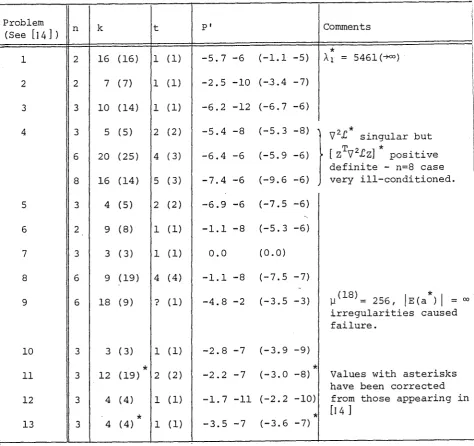
algorithm compares favourably, There is no significant difference in
the two algorithms on problems 1,2,7,10,12, and 13; of course, it is to
be expected that the two algorithms will give similar results whenever
V2£ remains positive definite throughout the calculation. Significant
improvements were, however, obtained on problems 3,4(n
=
6,8), 8 and 11.*
Problem 4 is interesting because
V
2£ ·
is singular and it is worthconsidering this problem in detail:
Problem 4
n 3
n
=
6x
= [ 0, l]f
g
T Starting point (0,0,0)
f*
=
0.649042= = n I: i=l tanx a* ,..., T Starting point (O,O,O,O,O,O) ;
a.
l.
i
n
i-1
-
I: a.xi=l l.
T
=
(0.08910, Q.42305, 1.04526) I~* = (O.O, 1.02326, -0.24060,
1.22168, -l.38826, 0.94133) I f*
=
0.616085.n = 8 Starting point: a* for n = 6, to 3 decimal places, with zeros
in the last two components; a*
=
(0.0, 1.00342, -0.06095,0.75112, -1.40994, 2.65270, -2.311602, 0.03267), f*
=
0.615653.In each case a* is the point reached by the algorithm when terminated
and f* is the corresponding function value. This problem arises from
l I •
poor choice of basis functions makes the problem severely ill-conditioned
for quite moderate values of n. When n = 6, Table 1 shows that the
earlier algorithm of
(14]
terminated after 25 iterations with adirectional derivative greater than -.00001, and with 3 active points
for the constraint function g. The present algorithm required only 20
iterations and found a solution with 4 active points. Because the
solutions to the two algorithms gave quite different results, the
projected Lagrangian algorithm was rerun using the solution to the n=6
problem, obtained by the algorithm of
(14],
as the starting point. Thenew algorithm did not accept this point as a solution but converged once
more to the solution given above. Similar remarks apply to the n=8
case but because this problem is so ill-conditioned it is unlikely that
the solution given above is accurate to more than 3 or 4 significant
figures.
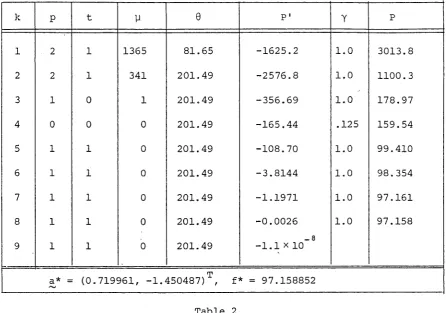
In problem 6, the presence of exponential terms in the constraint
function g(~1~) caused large negative eigenvalues to be present in the
projected Lagrangian Hessian in the early iterations. Initially the
value µ = 1365 was required to make zTV2£z + µI positive definite. This value was reduced to 341 on the ,second iteration and µ = 1 on the third;
thereafter µ
=
0 was acceptable. The detailed progress of thealgorithm on this problem is given in Table 2 and clearly demonstrates
the second order rate of convergence once the correct number of active
points is identified and the projected Lagrangian Hessian becomes
positive definite.
The only problem which caused difficulties for the algorithm was
problem 9. Here the ass1,llllptions of section 1 are not satisfied and
*
1 2 16 (16) 1 ( 1) -5.7 -6 (-1.l -5) )q = 5461 (-+oo)
2 2 7 ( 7) 1 (1) -2.5 -10 (-3.4 -7) 3 3 10 (14) 1 ( 1) -6.2 -12 (-6. 7 -6) 4 3 5 (5) 2 ( 2) -5.4 -8 (-5.3 -8)
}
2
*
V £ singular but 6 20 (25) 4 ( 3) -6.4 -6 (-5. 9 -6) [ TV2£ Z Z
J
*
positive. .
definite - n=8 case 8 16 (14) 5 ( 3) -7. 4 -6 (-9.6 -6) very ill-conditioned. 5 3 4 (5) 2 (2) -6.9 -6 (-7.5 -6)
~
6 2 9 (8) 1 (1) -1.1 -8 (-5.3 -6) 7 3 3 ( 3) 1 ( 1)
o.o
(0.0) 8 6 9 (19) 4 ( 4) -1.1 -8 (-7. 5 -7)
-µ(18 )= 256,
*
9 6 18 ( 9) ? (1) -4.8 -2 (-3.5 -3)
IE
(a )I
= 00irregularities caused failure.
10 3 3 ( 3) 1 ( 1) -2.8 -7 (-3. 9 -9)
*
*
11 3 12 (19) 2 (2) -2.2 -7 (-3.0 -8) Values with asterisks have been corrected 12 3 4 (4) 1 ( 1) -l. 7 -11 (-2.2 -10) from those appearing in
*
*
[I 4 ]13 3 4 ( 4) 1 (1) -3.5 -7 (-3. 6 -7)
Table 1
[image:19.595.96.571.100.546.2]Problem 9
19.
X = [ -1 I l] X [ -1 I l]
2
f = -4ai - 3(a4 +as)
g = a1 + azx + a3y + a4x + asxy + a6y2 - 3 - (x2 - y2)2•
Starting point (5,1,1,1,l,l)T ;
~*
= (3,0,0,0,0,0)T, f* -12.This example has an infinite number of points in E(a*), corresponding
to the line segments of y = .±_x within X. Symmetry in the
components of the starting point caused the algorithm to always generate
T
approximations of the form~= (a,O,O,S,O,S) . At such points the
constraint function g has one maximizing point at the centre of the
region X when S
<
0 and 4 local maximizing points, corresponding to thefour corners of the region X, when
S
>
0. Thus the set E(~) has either one, four or infinitely many members- accordingly asS
<
O,S
>
0 orS
= 0. ForS
<
0 the solution to the subproblem 2.1 always gives adirection which makes a1 = 3 if y = 1. If the corner constraints
were added to this subproblem then the exact solution would be obtained
in one iteration but unfortunately this can never be the case (unless
S
= 0 when the added complication of jE(~)I
= 00 arises). In practicethe algorithms switched between using 1 or 4 constraints and in either
case the projected Lagrangian Hessian matrix is singular, and the
choice of µ critically affects the size of the correction at each
iteration. Despite these difficulties the algorithm still made progress
towards the solution and after 18 iterations the approximation
(18) T
a = (3.002, 0.0, 0.0, -.000079, 0.0, -.000079) was obtained. An
error was flagged at iteration 19 because the local maximizer of g had
a numerically singular second derivative matrix, violating assumption 2
of section 1. This was the only problem for which the choice µ
=
0k p t µ
e
P' y p1 2 1 1365 81.65 -1625.2 1.0 3013. 8
2 2 1 341 201. 49 -2576.8 1.0 llOO. 3
3 1 0 1 201.49 -356.69 1.0 178.97
4 0 0 0 201. 49 -165.44 .125 159.54
5 1 1 0 201. 49 -108.70 1.0 99.410
6 1 1 0 201. 49 -3.8144 1.0 98.354
7 1 1 0 201. 49 -1.1971 1.0 97.161
8 1 1 0 201. 49 -0.0026 1.0 97.158
_a
9 1 1 0 201. 49 -1.1x10
a*
=
(0.719961, -1. 450487) TI f*=
97.158852,....,
Table 2
Details for Problem 6
k p t µ
e
P' y p1 0 0 0 1.0 -5.1 1.0 2.15
2 1 1 0 1.05 +0.05
2.10 -0.22 1.0 2.26
3 1 1 0 1.10 -0.055 1.0 2.2013
4 1 1 0 1.10 -0.0013 1.0 ·2.200000
5 1 1 0 1.10 -8. 2
x
10-72:.,*
=
(-.095310, .095310)T ; f*=
2.2Table 3
[image:21.595.100.547.80.393.2] [image:21.595.100.551.91.711.2]21.
Finally, we introduce a new problem to demonstrate the effect of
a persistent negative eigenvalue in the second derivative matrix of
the Lagrangian function (1.4).
Problem 14
x
= [ 0, l]f = c2ea1 + ea2
g = x - ea1 + a2
Starting point (0.8, 0.9) T i a* = (in
le
I,
R,nI
cI)
T, f* = 2Ic1.This has essentially the same properties as problem (2.6) but without
the need to include extra positivity constraints. The results of
applying the algorithm to this problem with c
=
1.1 are given inTable 3. Note that on the second iteration the solution to subproblem
(2.1) gives a non-descent direction for the penalty function, indicated
by the positive directional derivative. However, the matrix
ZT[V 2
£]z
is positive definite so that increasing the penalty parametere
temporarily by a factor of two causes the directional derivative tochange sign. The steplength has the value y = l on every iteration
andµ= 0 throughout
e~en
though V2£*=
L~lcl-1~1]
has one negative6. Concluding remarks
Th.e algorithm presented in this paper is capable of the
effective solution of a wide class of semi-infinite programming
problems. It is globally convergent under mild assumptions on the
problem, and typically has a second order convergence rate, with
the solution of an equality constrained quadratic progrannning
problem required per iteration. Perhaps the most awkward part of
the method is the computation of the set E(~), which is required
at least once on each iteration. This is of course not a finite
calculation, and must always be a compromise between theory and
practice. It should be emphasised, however, that this is an essential
calculation with any method which aims to provide an accurate
solution to a problem of this semi-infinite type.
It is possible that.far from a stationary point, better progress
can be made for some problems by incorporating a procedure for finding
the solution of a discretization of the original problem. This
remains to be seen, but whether as a method in its own right, or as a
safe and effective second phase for a method of the two-phase variety,
we believe that an algorithm such as the one described in this paper
has an important role to play in the numerical treatment of
semi-infinite programming problems.
Acknowledgement
This research was carried out while the second author was a
23.
References
[ l] Clarke, F. H., A new approach to Lagrange multipliers, Mathematics of Operations Research
l'
165-174 (1976).[ 2] Charalarnbous, C., A lower bound for the controlling parameter of the exact penalty function, Math. Programming, 17, pp 278-290
(1978).
[ 3] Fiacco, A.
v.
and K. O. Kortanek (eds), Semi-infiniteprogramming and applications, Proceedings of an international symposium, Springer-Verlag, Berling (1983).
[ 4] Fletcher, R., Practical methods of optimization, vol. II.
Constrained optimization, John Wiley and Sons, Chichester (1981).
[ 5] Gfrerer, H., Guddat, J., Wacker, Hj, and W. Zulehner,
Globalization of locally convergent algorithms for nonlinear optimization problems with constraints, in [3·] , pp 128-137
(1983) .
0
[ 6] Gustafson,
s.
-A., A three-phase algorithm for semi-infinite programs, in [ 3] , pp 138-157 (1983).[ 7] Han,
s.
P., A globally convergent method for non-linear programming, J. Opt. Theo. Applns, ~, pp 297-309 (1977).[ 8] Hettich, R. (ed), Semi-infinite programming. Proceedings of a workshop, Springer-Verlag, Berlin (1979).
[ 9] Hettich, R., A review of numerical methods for semi-infinite optimization, in [ 3) , pp 158-178 (1983).
[10] Hettich, R. and W. van Honstede, On quadratically convergent methods for semi-infinite programming, in [8], pp 97-111 (1979).
[11] van Honstede, W., An approximation method for semi-infinite problems, in [ 8], pp 126-136 (1979).
[ 12] Roleff, K., A stable multiple exchange aigorithm for linear semi-infinite programming, in [ 8], pp 83-96 (1979).
[13] Watson, G. A., Globally convergent methods for semi-infinite programming, BIT 21 pp 362-373 (1981).
[14] Watson, G. A., Numerical experiments with globally convergent methods for semi-infinite programming problems, in [3]