Consumer influence on product life : An explorative study.
EVANS, Sian Marie.
Available from Sheffield Hallam University Research Archive (SHURA) at:
http://shura.shu.ac.uk/19633/
This document is the author deposited version. You are advised to consult the publisher's version if you wish to cite from it.
Published version
EVANS, Sian Marie. (2005). Consumer influence on product life : An explorative study. Doctoral, Sheffield Hallam University (United Kingdom)..
Copyright and re-use policy
See http://shura.shu.ac.uk/information.html
Sheffield Hallam University Research Archive
Sheffield s _Ll 1 0 1x 8 1 0 7 1 5■ m i l I0
Sheffield Hallam University Learning and IT Services Adsetts Centre City Campus
Sheffield S1 1WB
Return to Learning Centre of issue
Fines are charged at 50p per hour
~2 APR 2007
1 6 APR 2007
0 3 JUL 2006
6P
fYi|6
K S 't-f
k
SEP
1 1 SEP 2006
ProQuest Number: 10694514
All rights reserved
INFORMATION TO ALL USERS
The quality of this reproduction is dependent upon the quality of the copy submitted.
In the unlikely event that the author did not send a com plete manuscript and there are missing pages, these will be noted. Also, if material had to be removed,
a note will indicate the deletion.
uest
ProQuest 10694514
Published by ProQuest LLC(2017). Copyright of the Dissertation is held by the Author.
All rights reserved.
This work is protected against unauthorized copying under Title 17, United States C ode Microform Edition © ProQuest LLC.
ProQuest LLC.
789 East Eisenhower Parkway P.O. Box 1346
CONSUMER INFLUENCE ON
PRODUCT LIFE
AN EXPLORATIVE STUDY
Sian Marie Evans
'
A thesis submitted in partial fulfilment of the
requirements of Sheffield Hallam University for the
degree of Doctor of Philosophy
January 2005
Abstract
In recent years the sustainability of consumption levels within industrialised countries has been increasingly challenged. The contribution of consumption to escalating volumes of waste and pollution coupled with the threat of resource scarcity and
exhaustion, have lead to global political consensus concerning the requirement to tackle this critical issue. The optimisation of product life has been identified as one of several strategies that could be employed to resolve these problems. The focus of the majority of studies relating to product life spans concern issues of production and economics, such as technical durability and the effect of market structures. Scant attention has been paid to consequent consumption. This thesis investigates consumers’ influence on product life across the consumption cycle, using Sheffield as a case study. It represents the first exploration in the UK of its type.
The thesis draws together the many disparate pieces of relevant research identified during the literature review to construct a new comprehensive conceptual framework for exploring the consumption life cycle of products from the consumer perspective. This framework was then used to structure the collection of data, which encompassed a combination of mail surveys and semi-structured interviews. The data collected were used to evaluate how different patterns of consumption across acquisition, ownership and disposal influence the service life of three domestic products, including everyday footwear, big kitchen appliances and upholstered chairs. This included the development of a new methodology for measuring consumer optimisation of product life. The
research also sought explanations for differences in patterns of consumption and consequent variations in service life.
The results reveal substantial differences in the patterns of consumption both between categories of product and across the different stages of the consumption process. They indicate that the service lives of everyday footwear and upholstered chairs are notably more susceptible to consumer influence than large kitchen appliances, and that people are more optimising of product life spans in disposal than in acquisition or ownership.
The findings demonstrate that a wide range of factors affect consumers’ influence on product life spans, which were classified under the headings; personal, social / situational and product characteristics. The research discovered that the nature and influence of factors is highly complex. A large combination of factors operates
simultaneously, they are dynamic over time, and the strength of their impact fluctuates on the basis of interdependencies within the system, and in response to external signals.
Acknowledgements
A great number of people, to whom I shall always be extremely grateful, have provided support, encouragement and inspiration whilst completing this thesis.
First, I would like to thank Dr Tim Cooper whose commitment, enthusiasm, support and vast patience, have helped make the completion of this thesis possible.
The advice of Professor Chis Gratton with respect to undertaking and managing research has been invaluable. I would also like to express my gratitude to Dr Matthew Simon, for spurring me on and giving me time whilst working, to continue the thesis. Thanks also go to the numerous librarians, technicians and administrative staff who have helped me over the years.
This work would not have been possible without the involvement of the people of Sheffield. Their generosity in giving time to complete questionnaires and participate in interviews is thoroughly appreciated.
I would like to acknowledge the contribution of friends who have helped me along the way. To Sarah and Anne, who are always there for me! To Rachel, we got there! To all my human ecology companions and partners, for encouraging me to keep going! To Anita and family, thank you so much for looking after Daisy for me whilst I got this finished! To Katie, Louise, Clare, liana and Allison, you are stars, and finally to colleagues at Sheffield Hallam University including Lizzie, Larissa, Sam, Andy and Marcelle for tea, chat, and cake when needed!
I would like to express my sincere gratitude to my family whose love and support know no bounds. First, to mum and dad for so many things, especially their sustained belief that I could do this! Secondly, I would like to thank my sister Alison and her family, for their endless generosity, and finally, to my brother Robert, Mandy, Caroline and Mat, for listening and helping me through.
Contents
Abstract I
Acknowledgements II
Contents III
List of figures VIII
List of tables IX
Chapter One: Introduction 1
1.1 The importance of sustainable consumption 1
1.2 The optimisation of product life spans 2
1.3 Studying consumers’ influence on product life 4
1.4 The research problem 6
1.5 Aims and objectives 7
1.6 Chapter development 9
Chapter Two: Literature review 11
2.1 Introduction 11
2.2 Disciplinary approach 12
2.2.1 Academic insights on product life 12
2.2.2 Academic insights on consumption 13
2.2.3 Anticipated disciplinary framework 17
2.3 Research context 17
2.3.1 Historic context 17
2.3.2 Contemporary concerns - critiques of consumer 20
culture
2.3.3 Sustainable consumption - the search for solutions 23
2.4 Exploring product life 26
2.4.1 T he‘product life’ construct 26
2.4.2 History of the product life debate 27
2.4.3 Product life optimisation as an environmental 32
strategy
2.4.4 Discourse on product life responsibility 35
2.5.1 The consumers’ influence on product life 40
2.5.2 Factors affecting consumers’ influence on product 42
life
2.6 Summarising the research issue 43
Chapter Three: Conceptual framework 45
3.1 Introduction 45
3.2 Defining the key research concepts 46
3.2.1 Product life 47
3.2.2 Domestic products 47
3.2.3 The consumption process 47
3.2.4 Consumers’ influence on product life 58
3.2.5 Classifying consumers’ influence on product life 67
3.2.6 Factors affecting consumers’ influence on product 68
life
3.3 Presentation of final conceptual framework 83
3.3.1 Description 83
3.4 Product specification 85
3.4.1 Product type 85
3.4.2 Product selection 89
3.4.3 Product review 89
3.5 Chapter summary 91
Chapter Four: Research methodology 92
4.1 Introduction 92
4.2 Methodology review 93
4.3 Research strategy 95
4.4 Research integrity 96
4.5 Research design 97
4.5.1 Phase one - research design for quantitative 98
investigation
4.5.2 Phase two - research design for qualitative 105
4.6 Research implementation 109
4.6.1 Phase one - survey implementation 109
4.6.2 Phase two - interview implementation 116
4.7 Data preparation 120
4.7.1 Phase one - questionnaire data preparation 121
4.72 Phase two - interview data preparation 135
4.8 Data evaluation 137
4.8.1 Phase one - sample appraisal 137
4.8.2 Phase two - sample appraisal 146
4.9 Chapter summary 146
Chapter Five: Questionnaire analysis 148
5.1 Introduction 148
5.2 Questionnaire findings - descriptive overview 148
5.2.1 Processes of acquisition 149
5.2.2 Processes of ownership 150
5.2.3 Processes of disposal 153
5.3 Product life scores, profile formation and analysis 154
5.3.1 Scoring 154
5.3.2 Examining consistency 155
5.3.3 Profile formation 156
5.3.4 Profile analysis 157
5.4 The influence of consumer characteristics on patterns of 159
consumption and consequent variations in service life
5.4.1 The influence of demographic and socio-economic 160
factors
5.4.2 The influence of environmental factors 161
5.5 The influence of product life intentions 161
5.5.1 Exploring product life intentions 161
5.5.2 Profiling product life intentions 163
5.5.3 Examining intentions with patterns of consumption 165
5.6 Discussion of key findings 168
5.6.2 Consistency in consumption profiles 176
5.6.3 Consistency between intentions and patterns of 177
consumption
5.6.4 External explanations 178
5.6.5 Contribution to knowledge 178
5.7 Chapter summary 179
Chapter Six: Interview analysis 181
6.1 Introduction 181
6.2 Factors affecting patterns of life span optimisation in 183
acquisition
6.2.1 Personal characteristics 183
6.2.2 Social / situational characteristics 186
6.2.3 Product characteristics 189
6.3 Factors affecting patterns of life span optimisation in 190
ownership
6.3.1 Personal characteristics 191
6.3.2 Social / situational characteristics 197
6.3.3 Product characteristics 199
6.4 Factors affecting patterns of life span optimisation in disposal 201
6.4.1 Personal characteristics 201
6.4.2 Social / situational characteristics 204
6.4.3 Product characteristics 206
6.5 Consistency across consumption profiles 207
6.5.1 Consistency across acquisition, ownership and 208
disposal
6.5.2 Consistency across product type 210
6.6 Consistency between intentions and patterns of consumption 213
6.7 The relationship between environmentalism and optimisation 219
6.8 Discussion of key findings 222
6.8.1 Overview of factors affecting consumers’ influence 222
on product life
6.9 Chapter summary 227
Chapter Seven: Conclusions 230
7.1 Introduction 230
7.2 Review of the aims and objectives 231
7.3 Barriers to consumer optimisation of product life spans 240
7.4 Critique of the conceptual framework 245
7.5 Critique of the research process 246
7.6 Future research 250
7.7 Conclusion 251
References 252
List of figures
2.1 Structure of the literature review 11
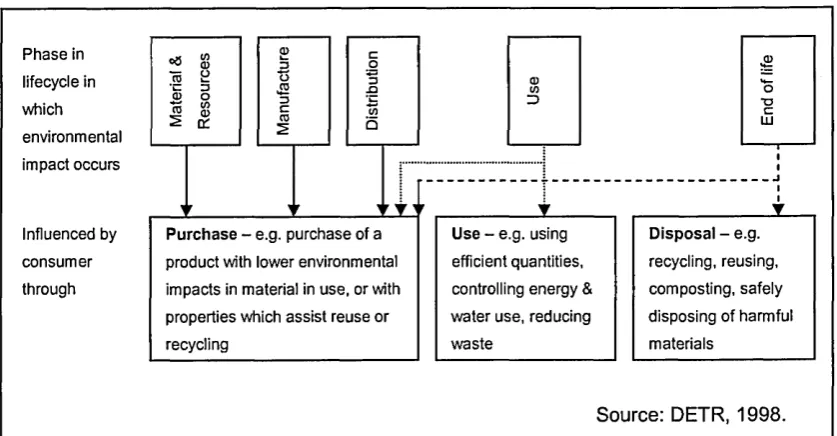
2.2 Influence of consumers on a product during its life cycle 38
3.1 Structure of conceptual framework development 45
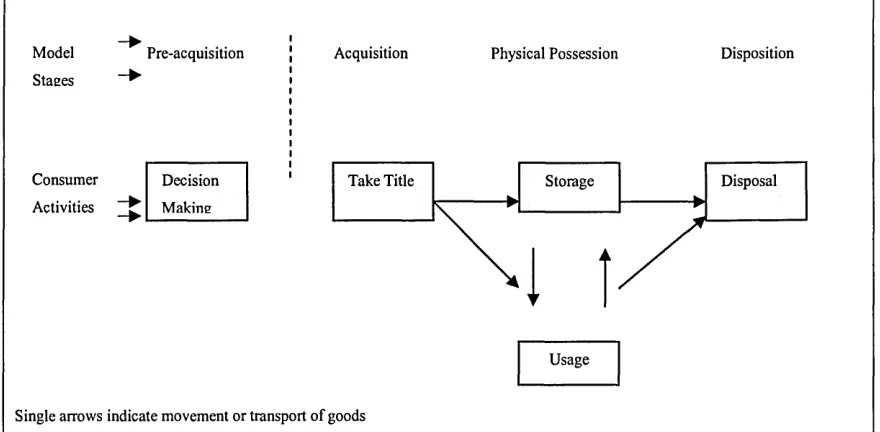
3.2 Consumer Household Logistics System 48
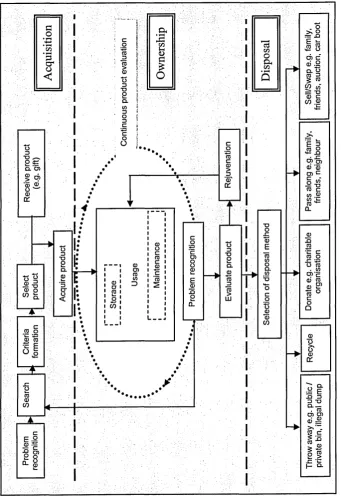
3.3 Framework of the consumption process 59
3.4 Framework of consumers’ influence on product life 66
3.5 Simplified conceptual framework 83
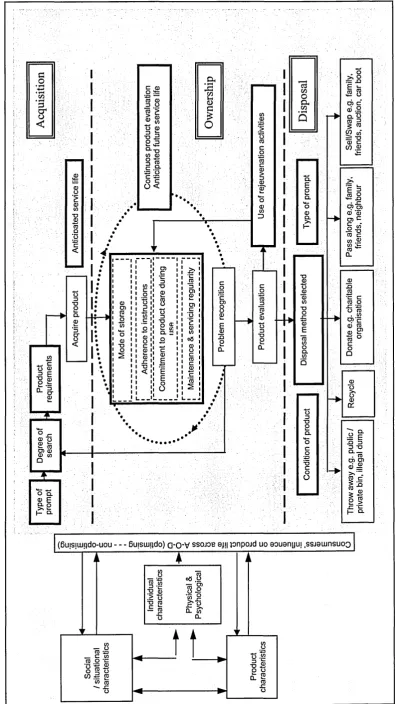
3.6 Framework for studying the factors affecting consumers’ 84
influence on product life
4.1 Structure of research methodology 92
5.1 Structure of questionnaire analysis 148
5.2 Priorities in acquisition 150
5.3 Condition of discarded products 154
5.4 Patterns of optimising consumption 155
5.5 Pie charts of consumption profiles 158
5.6 Product life intentions 162
5.7 Profiling intentions 164
5.8 Consumption and intentions profiles 167
6.1 Structure of interview analysis 182
6.2 Types of consumer optimisation of product life spans on the 214
basis of the relationship between consumer intent and action
6.3 Factors affecting consumers’ influence on product life 223
List of Tables
2.1 Consumer durable ownership 1990 to 2000-01 19 2.2 Provisional categories of product life 27
2.3 Forms of obsolescence 27
2.4 Relative responsibilities of manufacturers and consumers for 38 product life spans
3.1 Components of acquisition 51
3.2 Components of ownership 55
3.3 Components of disposal 58
3.4 Factors influencing product life in acquisition 61 3.5 Factors influencing product life in ownership 63 3.6 Factors influencing product life in disposal 64 3.7 Possible factors affecting consumers’ influence on product life - 81
personal characteristics
3.8 Possible factors affecting consumers’ influence on product life - 82 social / situational characteristics
3.9 Possible factors affecting consumers’ influence on product life - 82 product characteristics
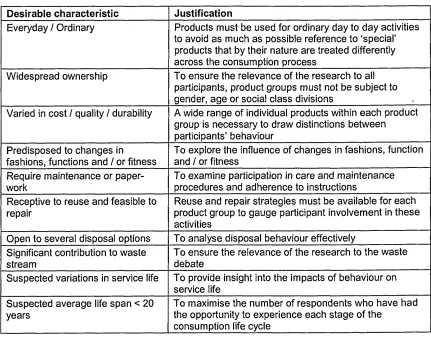
3.10 Heiskanen’s classification by product life extension opportunity 85 3.11 Desirable characteristics for product selection 88 4.1 Steps to ensure credibility of qualitative research 97 4.2 Advantages and disadvantages of different methods of in-depth 107
interviewing
4.11 Allocation of scores for condition and route (within individual’s 133 control)
4.12 Allocation of scores for condition and route (beyond 134
individual’s control)
4.13 Profiles for product category and stage of consumption 135
4.14 Conventions for qualitative analysis 136
4.15 Questionnaire response rate 137
4.16 Age profile 139
4.17 NS-SEC codes of main income earners by current and previous 140
occupation
4.18 Environmental activities undertaken 142
4.19 Summary of ‘applicability’ by stage of consumption and 144
product type
4.20 Demographic characteristics of interview sample 147
5.1 Summary of respondents who answered positively to carrying 152
out a selection of product life extension strategies on their oldest product in each of the three categories
5.2 Profiles of individual's consistency 157
5.3 Variations in consumers’ influence across product category 174
6.1 Interpretation of optimisation within the context of the 182
CHAPTER 1 - INTRODUCTION
1.1
The importance of sustainable consumption
Over the last fifty years there has been substantial growth in product ownership. This trend has been instigated by increasing affluence and associated with increased product diversity, shortening cycles of fashion and rapid technological change (Packard, 1960; OECD, 1982; Bayus, 1988; Kostecki, 1998). The benefits of unprecedented expansion in consumption are widely accepted, but the ability to continue this path indefinitely has been increasingly challenged.
Unsustainable patterns of consumption and production in industrialised countries have been identified as the principal agents of the escalating environmental degradation of the world’s environment (UNCED, 1992; UN, 2002). The negative consequences of the continuous and expanding growth in consumption include; the rapid depletion of the natural resource base, declining air and water quality, land contamination and the creation of excessive waste (Redclift, 1996; UNDP, 1998). Recognition of this damage has led to the emergence of a global political consensus that more sustainable
consumption patterns are required (UNGASS, 1997; OECD, 1998; UN 2002). In 1997, the UN concluded that unless greater action was taken to achieve this, the next quarter century was likely to witness declining standards of living and rising levels of conflict.
One of the popular approaches advocated for achieving more sustainable patterns of production and consumption, is to increase ‘eco-efficiency’, i.e. to improve the efficiency of global production, thereby reducing resource use, and simultaneously enhancing living standards (Schmidt-Bleek, 1993; Weizacker et al, 1998). Many people have expressed concern that this strategy, in isolation, is insufficient, and that more substantial changes are required in patterns of consumer demand (Hansen and Schrader,
1.2
The optimisation of product life spans
Over the past decade there has been increasing academic research exploring the potential of optimisation of product life as a strategy for environmental protection (Stahel and Jackson, 1993; Heiskanen, 1996; van Hinte, 1997 and Kostecki 1998). Within the context of policies for waste management, optimisation is an attractive option as it moves the agenda beyond recycling to resource reduction and reuse (Cooper, 1994a).
In his seminal paper, Cooper (1994a) defines optimal life as the length of time that a product can function effectively prior to its environmental cost exceeding the
environmental gain that could be achieved by its replacement. It is important, therefore, that the optimisation of product life spans is clearly distinguished from maximisation, which involves the extension of product life per se.
The body of research underpinning the study of optimisation of product life spans is relatively underdeveloped and can be traced to several different disciplinary sources. These include the study of:
- The economics of durability in various market structures and in relation to various modes of business operation (e.g. see Bulow, 1986; Mann, 1992 and Goering and Read, 1995).
- Product life cycles from the business perspective, examining the management of product evolution through from design and introduction to eventual abandonment (e.g. see Rink and Swan, 1979; Magnan et al, 1999).
- Product life trends and analysis from a social and environmental perspective (e.g. see Packard, 1960; Cooper, 1994a and b; Heiskanen, 1996; van Hinte, 1997) The first and second categories were largely discounted in the context of this thesis, as they do not consider the influence of the consumer.
lives than could be achieved, impeding repair and disassembly, and failing to stock parts for appropriate lengths of time (Packard, 1960; OECD, 1982; Papanek, 1985 and
Giarini and Stahel, 1989).
Responsibility for product life has, therefore, principally been considered the remit of producers, hence they have been targeted most frequently for providing solutions. This is reflected in both the volume of academic work that focuses on production aspects of product life, and in current regulatory practices. For example, there has been
considerable interest in the potential for enhanced product design to reduce
environmental impacts (e.g. Mackenzie, 1991; Fiksel, 1997) and to enhance durability (van Hinte, 1997). In addition, environmental policy is moving towards product centred solutions, which encompass considerations during design and manufacture of the whole life cycle of the product (Oosterhuis et al, 1996). These solutions imply that design life is the key determinant of product life.
The study of product life has also revealed the influence of relative obsolescence (e.g. OECD, 1982; Hunkin, 1988; Pantzar, 1992; Cooper and Mayers, 2000) (i.e. the replacement of products prior to technical failure on the basis of dissatisfaction or changing needs). It is suggested that consumers increasingly indulge in behaviour that is reducing the service life of products, although there is only limited empirical evidence for this argument. A synthesis of findings from predominantly small-scale, exploratory studies (many of which concern electrical products) suggests that consumers often behave in ways that curtail the life span of products during acquisition, ownership and disposal (Wilkie and Dickson, 1985; Stahel, 1986; Uusitalo, 1986; Hunkin, 1988; Harrell and McConocha, 1992; Mann, 1992; Cooper, 1994b; Cooper and Mayers, 2000). They propose that consumers often replace functional products in response to fashion and technological change, are price sensitive even at the expense of quality, and have lowered their expectations of product life. In addition, the studies suggest that many consumers fail to undertake regular maintenance of products, dismiss repair options, and ignore creative strategies of re-use that would exploit the remaining utility and residual value of products prior to final disposal. It appears, therefore, that
At present, exploration of the possible reasons for such behaviour is limited. Speculative investigations have developed tentative theories which ascribe this to economic and lifestyle factors. For example, Cooper (1994a) and Stahel (1986) have compared the low cost of replacement against the high cost of repair. Linder (1970) and Schor (1992) indicate that increasingly harried lifestyles are leading to an insidious cycle of work and spend, in which there is less time available to carry out maintenance and organise repairs.
These trends suggest that any attempt at promoting increased longevity through eco- design will be ineffectual; if consumers do not act to optimise fully the utility that products offer and if barriers to optimisation of product life by consumers are not recognised and addressed.
The focus of the majority of studies identified is on negative influences that prematurely curtail products’ service lives. Few papers have considered the antithesis, that is, the consumers’ influence in optimising product lives. Examples include work on
consumption restraint (e.g. Shchryar et al, 2001) and conservation (Granzin and Olsen, 1991; De Young, 1996). It is not known whether those people who deliberately
participate in some consumption activities that have environmental benefits, have embraced patterns of consumption that optimise product life.
In order to progress towards sustainable consumption and production, the influence of consumer behaviour upon product life spans and the factors affecting this, need to be better understood. It is this issue that the thesis will address.
1.3
Studying consumers’ influence on product life
In addition to environmental studies of consumption (e.g. Olander and Thogersen, 1995), the disciplinary perspectives that frame and contribute to this thesis include;
- The economic psychology of durability (e.g. Antonides, 1990)
- Marketing and consumer research, particularly research on integrative
consumption processes (e.g. Boyd and McConocha, 1996; Antonides and van Raaij,1998) and replacement behaviour (e.g. Bayus, 1988)
- The sociology of consumption (e.g. Miller, 1995)
- The social psychology of consumption (e.g. Dittmar, 1992)
Much of the research relating specifically to consumer behaviour has been completed in the marketing tradition and focused on the acquisition of products, assessing patterns of choice, search and brand evaluation. Significant attention has also been paid to the communication of meaning through consumption (e.g. Veblen, 1925; Douglas and Isherwood, 1979; Miller, 1987; Belk, 1988, Holt, 1995). In contrast, investigations of the routines of everyday product use and care have been less comprehensive and processes of disposition have received only sporadic consideration (Nicosia and Mayer,
1976; Jacoby et al 1977; Hanson, 1980; Harrell and McConocha, 1992; Roster, 2001).
Overall, the majority of research identified typically sought to understand how products are bought, used, maintained or discarded, rather than being concerned with the entire life span. Several recent publications have urged for more integrative analysis of the consumption process incorporating acquisition, ownership and disposal, in the wider context of consumer research (Boyd and McConocha, 1996; Antonides and van Raaij,
1998), in sustainable consumption research (Heiskanen and Pantzar, 1997) and in relation to the study of the consumers’ influence on product life cycles (Kostecki, 1998; Cooper and Mayers, 2000). Within the latter, it has been recognised that although the design specification and consumer priorities at purchase are the primary determinants of product life spans, consumer behaviour during use and disposal also exert an influence. However, a theoretical framework for exploring life cycles approaches to consumption in the context of environmental sustainability has not yet been clearly established.
Incomplete knowledge of the consumption process as a whole inhibits a full
consumption, it is essential that a life cycle approach to consumption is adopted. The thesis, therefore, employs a life cycle approach.
1.4
The research problem
Collectively the studies outlined above suggest that consumers have a critical role in determining product longevity and consequent waste generation. However, much of the research addressing the consumers’ influence on product life has been isolated to one or two stages of the consumption process. Hence,
—» A new conceptual framework is required for exploring the consumers’ influence on product life using an integrative approach, encompassing acquisition,
ownership and disposal.
In addition, the research reviewed has not identified or classified those activities that a consumer undertakes that may influence product life across acquisition, ownership and disposal. Consequently,
-> A new taxonomy is needed that identifies and classifies activities that constitute the consumers’ influence on product life across the consumption process.
Patterns of the consumers’ influence across the consumption process are unknown. It is suggested that different patterns of consumption in acquisition, ownership and disposal may serve to extend or shorten product life. Individuals, therefore, may consistently extend or shorten product life, or they may make a mixture of choices that are inconsistent in terms of their impact on product life. Thus,
—» A new instrument is required to measure the relative optimisation of different patterns of consumption in order to examine consistency in individual patterns of consumption across the consumption process.
—> New knowledge is necessary concerning the factors affecting consumers’
influence on product life to understand the barriers to the optimisation of product life and more sustainable consumption of products.
The majority of research identified relates to the life spans of electrical goods. This limits understanding of trends and influences on product life for other product categories. Furthermore, Heiskanen (1996) suggests that strategies of product life extension are most contentious for resource using products. Thus,
—> The study of a broader range of products is required.
The research will contribute to a fuller understanding of the consumers’ influence on product life spans across the consumption life cycle. The rationale for the research is, therefore, broader than the need for more sustainable consumption, and can be justified even without this explicit ethical debate.
1.5
Aims and objectives
The principal aims of this thesis are:
To identify how different patterns o f consumption across acquisition, ownership and disposal influence the service life o f domestic products, and to seek
explanations for differences in patterns o f consumption and consequent variations in service life.
conflict, enabling further understanding of constraints upon product life optimisation. The research will also examine whether consumers who have previously integrated some environmental activities into their lifestyle are more likely to optimise their products’ service lives.
The thesis aims are structured into the following specific objectives:
To examine how different patterns of consumption across acquisition, ownership and disposal influence the service life of domestic products, in particular to:
a) Describe how current patterns of consumption across acquisition, ownership and disposal influence the service life of three categories of domestic product.
b) Classify consumers according to shared patterns of consumption that influence service life for the three stages of consumption and for three categories of product. c) Examine how consistent consumers are in their patterns of consumption across
acquisition, ownership and disposal for the three categories of domestic product.
To seek explanations for differences in patterns of consumption and consequent variations in service life, in particular to:
a) Investigate whether those consumers who share similar patterns of consumption are affected by particular demographic, socio-economic or environmental factors. b) Explore whether consumer intentions regarding product life are concordant with the
patterns of consumption that they employ.
c) Identify factors affecting the patterns of consumption selected across the different stages of consumption and between different types of product.
d) Examine factors affecting consistency between patterns of consumption selected across the different stages of consumption and between different types of product. e) Explore factors affecting consistency between consumer intentions regarding
product life and the patterns of consumption selected.
To ascertain the thesis’ contribution to knowledge, in particular to:
a) Present a summary of barriers to consumer optimisation of product life. b) Discuss the implications of the research findings to interested parties.
1.6
Chapter development
The thesis contains seven chapters, sequenced in a systematic manner. The first of these chapters identified the rationale underpinning the research, placing the work in the wider context of the sustainable consumption debate. It highlighted several critical gaps in current knowledge and outlined the aims and objectives chosen to resolve these.
Chapter two provides a critical review of the literature that shapes the thesis. This encompasses the intellectual traditions to which the study links, the historic context of concerns regarding consumption and sustainability, the issue of product life and the controversy of responsibility, and an examination of the consumers’ influence on product life across the consumption process. The chapter concludes that a new conceptual framework is required for structuring the research.
Chapter three defines each of the key research concepts and outlines the development of a conceptual framework for exploring the consumers’ influence on product life. In addition, it establishes the scope of the research, including reflections on the issue of product specificity. The chapter ends with a summary discussion of the fundamental gaps in our existing understanding of the consumers’ influence on product life spans.
Chapter four outlines the research methodology, providing details of the series of decisions and actions regarding the translation of the broad research questions into an effective and viable programme of research. This includes discussion of the research design, reviewing available methods and techniques and justifying the choices made. It continues with a description of the implementation of the research instruments and the preparation and evaluation of the resulting data.
Chapters five and six describe and analyse the data collected. The findings are then discussed in the context of relevant research identified in chapters two and three, and their contribution to knowledge in this field is evaluated.
includes an evaluation of the conceptual framework and the research process,
CHAPTER 2 - LITERATURE REVIEW
2.1
Introduction
This chapter aims to locate the research problem in a tradition of theory and related research, building a framework within which the research is situated and identifying areas of knowledge that the study intends to expand. In addition, it aims to review and critique previous research that relates to the general research question, demonstrating clearly the specific area that has not been adequately explored. This process helps establish the significance of the research for academia, policy and practice.
The chapter is divided into three main sections (see figure 2.1). The first situates the study in the ongoing research discourse identifying the ‘specific intellectual traditions to which the study links’ as advised by Marshall and Rossman (1999 p23). The second examines the research context providing a suitable starting point for the subsequent review of literature on product life, which is followed by an exploration of the specific issue of product life and consumer behaviour. The final section summarises the research problem and identifies the fundamental gaps in our existing understanding of the
impacts of consumer behaviour upon product life, thus providing the justification for the research. The review process illuminates the key issues and assists the construction of the conceptual model in chapter three.
Figure 2.1 Structure of the literature review
Stage 3 - Justification Stage 1 - Context
Stage 2 - Review
Establishes academic and world context (s2.2, 2.3)
Exposes critical gaps in current understanding (2.6)
2.2
Disciplinary approach
This section reviews the intellectual traditions that guide the study. The research problem encompasses two central themes, product longevity and consumption. The disciplinary foundations underpinning research conducted within each of these domains are explored and the academic perspectives most suited for framing this research
question are chosen.
2.2.1 Academic insights on product life
The body of research specifically addressing product life is underdeveloped, attracting sporadic academic attention across five decades. The research available falls into several categories.
The first is concerned with the economics of durability in various market structures and in relation to various modes of business operation. Over time a comprehensive body of knowledge has evolved, frameworks of durability and reliability have been investigated, modelled and critiqued, and theories of obsolescence proposed (for example, see Stone and Rowe, 1960; Bulow, 1986; Mann, 1992, Goering and Read, 1995). Much of this research has centred on the degrees of competition, and in many cases the definition of durability has been limited to one of technical durability, i.e. the life span a product is designed to achieve. This approach ignores the impact of the consumption process and has, therefore, been excluded from the study.
focus on pre-purchase activities such as problem recognition and search, followed by purchase, use and disposal.
Social and environmental academic perspectives structure the final category of research on product life. Early research in this area can be traced back to the 1950’s with the investigation of business dependence on planned obsolescence (Mayer, 1959; Stewart.
1959). Over time with the advent of concerns for resource depletion and waste, investigations have encompassed discussion of the implications of short product life from an environmental angle (Packard, 1960; Papanek, 1985). Over the past decade academics and policy makers have expressed increasing interest in the potential of extending product life as part of a range of activities for tackling environmental problems (Cooper, 1994a; Heiskanen, 1996; van Hinte, 1997). ‘The durable use of consumer products: new options for business and consumption’ edited by Kostecki (1998) has begun the process of drawing together the findings of this research to build a coherent research agenda on product life.
Despite providing a platform upon which to build the research, on the whole the consumers’ influence on product life has been paid relatively little attention. In the context of this research problem it is, therefore, necessary to draw on research, ideas and methods from the domain of consumption more generally.
2.2.2 Academic insights on consumption
There are many ways of conceiving consumption and framing it within a research environment (Campbell, 1998). Historically the subject has been explored using varied perspectives, with a number of academic disciplines extending across the spectrum of social sciences contributing to our understanding of consumers and consumption, including economics, marketing, cultural studies, sociology, psychology, anthropology, and philosophy (Lang and Gabriel, 1995; Miller, 1995; Jackson, 2004). The study of consumer behaviour and consumption is, therefore, diverse and multi-disciplinary. This section attempts to summarise this vast literature, illuminating ideas and theories that have relevance to this research question.
focus of both. Economic theory has come under attack for its dependence on the
assumption that consumers are rational actors, its interpretation of consumption in terms of markets rather than consumer behaviour and its failure to protect the environment (Holbrook, 1987; Daly, 1996; van den Bergh et al, 2000). The need to consider externalities of production and consumption led to the development of environmental economics, which recognises and attempts to resolve the limits of traditional economic models and theory (e.g. Pearce, 1976). However, overall economic theory was
considered to be of limited use to this research.
Historically research in the field of marketing has been commercially driven focusing on understanding the consumer at the point of pre-acquisition and acquisition to provide information that will facilitate increased consumption (see Firat, 2001). This has led to the development of complex theory at the micro level, for example, product selection, brand choice, repeat purchase and information search (Rassuli and Harrell, 1990). The neutrality of the research agenda for marketing is contentious. The narrow and
predominantly economic focus has been criticised for its insularity, leading to the formation of macro marketing and the evolution of social and environmental marketing inquiry (Goldberg et al, 1997, MacFadyen et al, 1999; Peattie, 1992 and 1999).
The discipline of consumer research evolved from the study of marketing. Early research in this field was, therefore, also dominated by the study of acquisition. During the late 1970s and thel980s a number of papers were published which called for the extension of the parameters of this field to include use and disposal (Jacoby et al, 1977; Hanson, 1980) and to embrace more intangible aspects of consumption such as services, ideas and events (Holbrook and Hirschman, 1982). In the late 1980s this need to address the ontology of consumer research reached a hiatus, with several academics calling for clarification and consensus regarding what constitutes consumer research (Holbrook, 1987; Levy 1992). In response there has been a drive to transform the way consumption is studied through the growth of new consumer research, which recognises the need to study consumption in its entirety. Proponents of this approach include Antonides and van Raaij (1998) and Bagozzi et al (2002).
Over time consumer research has developed an increasingly sophisticated understanding of consumption behaviour. In particular, a large number of models of consumer
influence consumption processes. These have progressively illuminated the many determinants of consumer behaviour and the nature of their interrelationships. Many of these models have focused on understanding behaviour through an exploration of individuals’ internal processes and characteristics. Examples include; models of the relationship between attitude and behaviour (Ajzen, 1988) and models of the influence of personal values on behaviour (Schwartz, 1977). Other models have focused on the impacts on individual behaviour of external processes and stimuli such as social norms and incentives (e.g. Geller, 1982). More recently integrative models of consumer behaviour have been developed that incorporate external and internal elements, for example Olander and Thogersen (1995) Stem (2000) and Bagozzi et al (2002). Jackson (2005) provides a detailed overview of these various models of consumer behaviour.
Within sociology, the works of several classical and contemporary theorists refer to the sociological dimensions of consumption. Examples include Veblen’s theory of
conspicuous consumption (1925), Simmel’s investigation of fashion and money (1957) and Baudrillard’s examinations of post modernity. The majority of studies consider the social context of product usage, focusing on consumption as a means of identity construction and communication. Despite such endeavours, Campbell (1995) argues that the history of the sociology of consumption was, until recently, slow to progress.
The discipline of social psychology has an established literature exploring the meanings of possessions (e.g. Douglas and Isherwood, 1979; Csikszentmihalyi and Rochberg- Halton, 1981; McCracken, 1986; Belk, 1988; Dittmar, 1992; Richins, 1994; van Hinte,
Many of these limitations extend into the field of cultural studies. However, an
exception is the diverse investigations undertaken within the domain of ‘material culture
studies’, which use material objects as primary data to examine the ‘beliefs-values, ideas,
attitudes, and assumptions of a particular community or society at a given time... (they study) culture through artefacts’(Prown, 1982 pi). Generally, cultural theorists argue that
individual lifestyle/value approaches are inadequate, maintaining that greater insight can be derived from a collective and historically contextual exploration of consumer
behaviour (e.g. Holt, 1997).
Within the domain of environmental studies, the evolution of academic research
exploring the environmental impacts of consumer behaviour can be traced to the 1970s. Many earlier studies focused on identification of demographic factors that characterised the environmentally active person (e.g. see van Liere and Dunlap, 1980). Over time it was recognised that in order to steer consumers towards environmentally favourable actions there was a need to understand better the motivations and determinants of behaviour. This research is described in greater detail in section 3.2.6. The majority of investigations undertaken focused on consumer behaviour in relation to single issue concerns; for example, energy conservation (e.g. Becker et al, 1981; Neuman, 1986) and the purchase or discard of non durables (e.g. Vining & Ebreo, 1992). A common finding within such research was the inconsistencies arising between stated attitude and behaviour (e.g. Scott and Fern, 1994).
This led to investigations of such conflicts using the ‘attitude-intention-behaviour’ paradigm to identify and assess the factors which inhibit consumers from behaving in accordance with their attitudes. Much of this work was summarised by Olander and Thogersen (1995), who used this alongside theories of consumer behaviour developed in consumer research, for example Ajzen’s ‘Theory of Planned Behaviour’ (1988), Triandis’ ‘Subjective Culture Model’ (1977) and Bagozzi and Warshaw’s ‘Theory of Trying’ (1990) to build a generic framework for understanding consumer behaviour in the context of environmental issues.
During the late 1990s understanding the consumer and consumption behaviour has been increasingly recognised as a critical requirement of the quest for more sustainable development (Jacobs and Ropke, 1999; Jackson, 2004). This has catalysed the
with the broader literature on consumption and conceptualises the enormous
complexities that underlie consumption issues (e.g. Spaargaren and Vilet, 2000; Stem, 2000; Dolan, 2002; Jackson, 2005). Research has drawn attention to the need for greater recognition and study of the influence of habit (Bamberg and Schmidt, 2003), emotion (Steg et al, 2001) and moral beliefs on pro-environmental consumption. In addition, it has highlighted the importance of exploring ordinary and inconspicuous consumption, exposing the possibility that consumers are locked into prevailing patterns of
consumption by a combination of convenience, habit, social norms and institutional contexts (e.g. Shove and Warde, 1997; Sanne, 2002; Shove, 2003).
Applications of models of consumer behaviour within the domain of product life research are scarce.
2.2.3 Anticipated disciplinary framework
The reviews of the different academic contributions to this research field illuminate the necessity to take a multidisciplinary approach to answer this research problem.
This investigation addresses product life and consumption primarily on the grounds of sustainability and environmental studies. The research on sustainable consumption linking environmental impacts with consumption behaviour is in its infancy (Cooper, 1998) but is fast growing (Jackson, 2005). It is widely recognised that environmental issues are complex hybrid problems requiring inputs from several disciplines
(Heiskanen and Pantzar, 1997). It is, therefore, pertinent to explore and incorporate insights from several disciplinary perspectives into this research, drawing on their strengths and learning from their limitations.
2.3
Research Context
This section explores the research setting. It establishes the historic context of the product life debate, charting the development of mass consumption culture and
outlining associated transformations in social expectations. It then outlines the nature of contemporary concerns regarding these changes.
2.3.1 Historic context
al, 1997). Droge et al (1993) highlight three key characteristics of mass consumption culture. The first is the radical division between activities associated with production and consumption, leading to acquisitions via exchange rather than self production. The second is the production and sale of large volumes of standardised mass produced goods to a mass of people which requires that wealth and purchasing power are diffused relatively broadly in society. The third characteristic involves the ceaseless introduction of new products and services.
The factors contributing to the rise of mass consumption society are subject to debate. Some single out the importance of religious changes, specifically the role of puritan movements in providing the capital that catalysed the industrial revolution (e.g. Bocock, 1993). Others identify a range of co-dependent driving forces underpinning
consumption growth including the increasing division of labour, urbanisation,
industrialisation, competition, use of fossil fuels and the appropriation of resources from the South (Ropke, 1999).
It is widely agreed that the move towards mass consumption culture has been characterised by a series of significant transformations in design and production (Pantzar, 1992; Cooper, 1994a). These transformations include; an increased ability to mass produce homogeneous goods and the development of new cheaper synthetic materials, such as plastics, which have enabled considerable changes in the structural composition of products and lowered costs. In addition, research and innovation (e.g. the advent of electronics) have led to a much greater diversity of products, designed to carry out increasingly specialised tasks.
Over time the decline in product costs within industrialised countries led to their
becoming available to a wider range of income groups and the stock of both durable and non-durable products in the average home escalated rapidly during the post war era. By 1992, 99% of households owned at least one refrigerator and one television and over 80% of households had a telephone, washing machine and a freezer (Central Statistical Office, 1993). Table 2.1 displays further increases in consumer durable ownership over the last decade.
households in the UK was 27. On the basis of their findings they estimate that the rate of product ownership (by number of products owned) increased by around 60% between 1993 and 1998.
Table 2.1 Consumer durable ownership 1990 to 2000-01
% households with durable goods
1990 1995/6 2000/1*
Washing machine 86 91 92
Tumble dryer - 50 53
Dish washer - 20 25
Microwave - 70 84
Telephone 87 92 93
Video recorder 61 79 87
CD player - 51 77
* Based on weighted data and including children’s expenditure -- Data not available
Source: ONS, 2002
With the growth of mass consumption there have been huge advances in the standard and quality of life for the majority of industrialised populations. However, despite the record levels of product ownership now attained, evidence suggests that consumer dissatisfaction is rising and consumption expectations are now greater than ever (Lansley, 1994).
A number of researchers have explored factors underlying peoples’ mounting
expectations. Olshavsky (1980) argues that improved communication, rising consumer affluence and the generation of artificial needs by more sophisticated marketing and advertising have been instrumental in escalating the rate of product adoption and raising social expectations. The accelerating rate at which products evolve from being a
Changes in lifestyle have also been pivotal in modifying patterns of consumption. Mounting stress resulting from real and perceived time famine has increased the
consumption of convenience products and labour saving devices (Schor, 1992; Warde et al, 1998). In addition, system complexity encourages the continuation of this trajectory. As physical infrastructure (transport, water, electricity etc.) and production and
consumption frameworks (international purchasing and distribution, advertising,
marketing etc.) have developed, their mutual interaction has resulted in a society locked into prevailing production and consumption patterns. Heiskanen and Pantzar (1997) highlight the importance of understanding consumption systems as a whole.
Further expansion of global mass consumption is forecast (OECD, 1998). Countries that are currently less developed will aspire to the same standard of living as industrialised nations. Whilst social trends within developed societies may escalate levels of
consumption further. Examples of such trends include the increasing number of single person households (due to divorce, decline in marriage, death of a spouse etc) each consuming almost the equivalent of former shared households, and the growing numbers of retired and elderly people with disposable income and an abundance of leisure time. The UK DOE (1995) projected that the number of households in England would increase by 23% between 1996 and 2016, forming an additional 4.4 million households.
2.3.2 Contemporary concerns - critiques of consumer culture
The rise of the consumer society has facilitated significant increases in the quality of life of the populations of the industrialised world. Initially, the ideal of continuous
economic growth through mass consumption remained relatively unquestioned. It was only with the escalation of the mass consumer culture and its intensity over time that the more negative impacts of the consumer lifestyle became apparent and the sustainability of consumption patterns was challenged (Duming, 1992; Droge et al, 1993). Critiques of consumer culture fall into two categories; environmental and socio-economic.
Environmental
Few comprehensive environmental critiques of consumption have been written, key exceptions include papers by Droge et al, 1993 and Cohen, 1998. Duming (1992; p58)
The negative impacts of mass production (and indirectly consumption) were first
highlighted in the 1970s in which the problems of growing waste and resource depletion were given particular attention (e.g. Meadows and Meadows, 1974). During the 1980s attention focused on the pollution created by the processes of production, use and disposal of products and consequent implications for long-term human health such as their influence on degenerative and dietary diseases. By the 1990s environmental critiques had begun to explicitly address consumption at the practical and philosophical level (e.g. Hansen and Schrader, 1997). The intensity of concerns regarding the threat of non renewable resource scarcity and exhaustion has declined but deterioration in
environmental quality resulting from pollution and waste continue to elicit global
political concern (Cooper, 1994b, UNEP 1999). The UK alone creates 28 million tonnes of municipal waste a year which is forecast to grow at a rate of 3% per year (Strategy Unit, 2002).
Socio-Economic
Research has observed how consumption is increasingly moving from functional
purposes towards becoming an elaborate means of identity construction and symbolism, used to express values and indicate affiliation with a particular group or lifestyle (e.g. Dittmar, 1992; Heiskanen and Pantzar, 1997). Kilboume et al (1997) maintain that this results in a situation which they term ‘hyper-consumption’, in which the division between needs and wants becomes progressively blurred. The process of artificially expanding what are deemed necessities is considered imperative to sustain the system of production (Galbraith, 1958). Hence, the social construction of consumer desire is pivotal to the modem economy (Thompson and Holt, 1997). Socio-economic critiques of the mass consumption in capitalist systems highlight how saturated markets force marketing strategies encouraging the rapid exchange of products through fashion, novelty and disposability in order to maintain the system. Csikszentmihalyi (2000 p271) concludes that 'it is the imperative to produce that is dictating the need to consume'.
The prevailing focus on material wealth and material growth in economics is reflected in the assumptions of mainstream economic models (Reisch, 2000). There are
of quality such as price and brand (Burchardt, 2001) and invest in time saving
appliances which frequently and ironically take up more time. Other cultural transitions include loss of home repair skills, rejection of thrift, ever increasing demand for cheaper products and increased relative obsolescence (e.g. Packard, 1960).
The growth of mass consumption has provoked changes in the social fabric and
challenged traditional structures of work, the family and religion. Social interaction has been displaced by increasingly individual lifestyles. Hirsch (1976) explored
dissatisfaction and stress from over consumption, arguing it was related to the pursuit of increasingly scarce positional goods due to mass production. Impulse buying and lack of consumption restraint have been associated with feelings of guilt, anxiety, frustration, loss of control, financial hardships and domestic problems (Rook, 1987; O’Guinn and Faber, 1989) and have considerable psychological consequences (loss of self, alienation, apathy etc.).
Social critiques of consumption do not argue against consumption per se. It is
recognised in most literature that the rites and rituals of consumption have an important role in structuring everyday life (Campbell, 1995) and in meeting our higher needs (Csikszentmihalyi, 2000). It is the nature of how these needs are being met through material intensive consumption, which has been targeted. Studies show that beyond a low threshold material well-being does not correlate with subjective well-being (Inglehart, 1996; Csikszentmihalyi, 1999).
At a more philosophical level, McGregor (1998) expresses concern that the direct experience of the consumer is now too far removed geographically and consciously from the processes of production and distribution so that externalities of their consumption remain concealed. Many household products in daily use are imported from poorer countries with less stringent social and environmental regulations, but consumers are detached from any exploitation of labour or degradation of the
environment that is beyond their individual psyche. This detachment from production and its associated impacts is argued to have led consumers to have a parochial
consumption. With few exceptions (e.g. Vitell et al, 2001) research on consumer ethics has focused on the ethics of production and their implications for consumption choices rather than the ethics of consumers or consumption per se.
The environmental and socio-economic consequences of consumption need intensive international scrutiny in the light of the significant escalation in levels of future
consumption predicted. There is some speculation that dematerialisation will occur as a consequence of a cultural transition in the form of movement towards post material values (Inglehart, 1990). The move to post materialism in the 1970s heralded the arrival of environmental ideas such as deliberately denied materialism, voluntary simplicity and responsible consumption (Fisk, 1973; Elgin, 1981; Prothero, 1990). The advent of the green consumer during the 1980s was also indicative of growing recognition of the importance of consumption to the environmental debate. The philosophy of green consumption was, however, criticised as it allowed consumers to side step the important
contribution to be gained from consuming less (Irvine, 1989). That is, ‘we can not
consume ourselves out of an over-consumption problem’ (Kilboume, 1995). Other
indicators hinting at the advent of a post material culture include transformations in lifestyle such as consumption restraint (Shehryar et al, 2001) anti consumption attitudes (Zavestoski, 2002) and downshifting (i.e. reducing working hours to improve quality of life) (Cooper, 1998). Evidence that a real shift is underway however remains
insubstantial (Lansley, 1994).
The need to tackle the negative social and environmental consequences of consumption encouraged the emergence of the sustainable consumption debate (McGregor, 1998).
2.3.3 Sustainable consumption - the search for solutions
Defining sustainable consumption
The format, characteristics, and implications of sustainable consumption have been explored at a number of international conferences and by numerous non-governmental organisations and academics. This process is still in its infancy and there is little consensus regarding what constitutes an exact definition of sustainable consumption and how it can be achieved (Manoochehri, 2002).
Within this research sustainable consumption is defined as;
‘patterns of consumption through which the purchase and use of goods and services meets people’s basic needs while minimising any environmental degradation. ’
(Cooper, 1998) This, like most interpretations of sustainable consumption within the literature,
stimulates debate. Most critically, it raises the controversial issue of what constitutes ‘people’s basic needs’. The discourse on needs is fraught with conflicts and
complexities (Jackson et al, 2004). In brief, current understanding is structured upon several noteworthy theories including; the hierarchical ordering of needs devised by Maslow (1954, 1968), the two dimensional matrices of needs forwarded by Galtung (1980) and Mallmann (1980) and most recently the more comprehensive categorisation of needs and satisfiers, favoured in this thesis, proposed by Max Neef (1991, 1992).
A key question raised by the objective of sustainable consumption is whether increased resource efficiency is sufficient to achieve this goal, or if a simultaneous reduction in consumption is required. This remains divisive. Such concerns have led to the
This has driven other academics to argue that sustainable consumption may not be achieved unless eco-efficiency is accompanied by substantial changes in the patterns of consumer demand (Heiskanen and Pantzar, 1997; Cooper, 1998) and significant moves towards more sufficient values and lifestyles. Including getting the same welfare out of fewer goods and services (Carley and Spapens, 1998), avoiding those products which add little to welfare (Lintott, 1998), and to the development of new models and theories of desirable behaviour (e.g. Hansen and Schrader, 1997, UNEP, 1999, Reisch, 2000).
A crucial problem which inhibits the progress of sustainable consumption research concerns the lack of coherent data on the environmental and social sustainability of different patterns and levels of consumer demand. Several projects have responded to the demand for empirical measures of the environmental impact of consumption. They include; Material Intensity per Service Unit (MIPS) (Schmidt-Bleek, 1993), ‘ecological footprints’ (Wackemagel and Rees, 1996) and ‘environmental space’ (MacLaren et al, 1998). Attempts to create similar empirical measures of social impacts of consumption are underway (e.g. social accounting in Hockerts, 2001).
System complexity and potential rebound effects make it imperative that the social, environmental and economic implications of strategies for sustainable consumption are researched and understood.
Implementing sustainable consumption
The environmental consequences of mass consumption have created contention
regarding the future viability of continued economic growth (Douthwaite, 1992). There have been proposals which advocate a slow down of the economy, known as steady state economics (Daly, 1992), an economic process which some argue is inevitable and imminent (Fleming, 1994 and 1998). There are a number of critics of steady state economics who castigate the pursuit of low growth as a policy goal. Both North (1995) and Beckerman (1995) argue that global future well being is reliant on sophisticated technological advances, and that this and environmental quality are dependent on consumption and greater growth.
first and most effective option of the waste hierarchy, reducing the quantity of discarded goods can be achieved. They include:
- altering the product service mix in order to improve resource efficiency (e.g. Giarini and Stahel, 1993; Jackson, 1996; Oosterhuis et al, 1996; Schrader, 1996; Rocchi, 1997; Elsen, 1997; White, Stoughton and Feng, 1999), some caution is required because sustainability benefits are not inherent and product service systems must be designed for sustainabiliy (Cooper and Evans, 2000)
- reducing consumer desire, through changing social structures and advocating citizenship rather than consumership (Hansen and Schrader, 1997).
- optimising product life spans (Cooper, 1998; Kostecki, 1998)
The latter is perhaps the more practical option and provides the foundation for this research. Over the past decade research interest in the environmental potential of the strategy of optimisation of product life has grown (Stahel and Jackson, 1993; Cooper, 1994; Heiskanen, 1996; van Hinte, 1997 and Kostecki 1998).
2.4
Exploring product life
This section explores the concept of product life. It provides key definitions, a description of the historical evolution of the product life debate, an overview of the potential of product life optimisation as an environmental strategy and a discussion of the distribution of responsibility for product life across the production and consumption framework.
2.4.1 The'product life'construct
Different product categories are by their nature susceptible to varied product lives. The two main product sub categories are non-durables and durables. The focus of this research is directed at durable products.
Table 2.2 Provisional categories of product life
Technical life The life-span that the product is designed to achieve
Economic life The maximum length of time the product can be used until its total costs (over complete life-cycle) exceed those of purchasing a new one. This is time relative and, therefore, it can not be determined at the time of purchase Actual life in use The actual life-span of the product in use before final discard (even if it
would continue to function effectively)
Psychological life The perceived life-span of a product from the perspective of the individual consumer. This is influenced by their personal preferences, values and attitudes, and more widely by socio-cultural factors
Replacement life The period of ownership by the first owner
Service life The product’s total life in use from the point of sale to the point of discard Optimal life The length of time that a product can function effectively prior to its
environmental cost exceeding the environmental gain that could be achieved by its replacement
Sources: Packard, 1
1997. 960; Ruffin and Tippett, 1975; Cooper, 1994a; Heiskanen, 1996; Granberg,
Obsolescence is the term used to define some form of curtailment of product life. Several forms of obsolescence are identified in the literature; there is some contention with regards to definition (Cooper, 2004). Those selected for use within this study are outlined in table 2.3.
Table 2.3 Forms of obsolescence
(1) PLANNED Deliberate reduction of technical life of products during the design process in order to sustain sales
(2) ABSOLUTE Occurs when goods fail to function on a technical basis, related to product quality, design, inferior materials, production processes, to inadequate care in use and maintenance
(3) RELATIVE A) Obsolescence through dissatisfaction
occurs when improvements in new products (functions / technology) occurs due to changes in styling and fashion
occurs due to economics - relative cost of new product in relation to effectiveness of current product
occurs due to changes in symbolic significance (ability to meet abstract needs).
B) Obsolescence through change in consumer needs
occurs due to changing life circumstances
occurs when changes in complementary goods cause incompatibility Sources: Mayer, 1959; Packard, 1960; Kollman, 1992; Heiskanen, 1996; Granberg, 1997; Kostecki, 1998; Cooper, 2004.
2.4.2 History of the product life debate
[image:41.615.81.522.367.595.2]concerned that the economy was over reliant on superficial product styling changes (Stewart, 1959). This supported the criticism that manufacturers were deliberately introducing superficial modifications to their ‘new’ products as opposed to waiting till they had developed real quality improvements. The theme of planned obsolescence was introduced into lay culture with popularised texts such as Packard’s ‘The Waste
Makers’ (1960) and to a lesser extent in Tofflers’ (1970) ‘Future Shock’. Over time concerns regarding planned obsolescence have grown. Manufacturers have been challenged with suggestions that products are designed with lower technical lives than could be achieved, impeding repair and disassembly and failing to stock parts for appropriate lengths of time (Packard, 1960; OECD, 1982; Papanek, 1985 and Giarini and Stahel, 1989).
Furthermore, consumers are suspected of having gradually reduced their expectations of product life for various product groups and thus psychological product life is believed to have undergone simultaneous decline (Cooper, 1994a). It is suggested, therefore, that actual life in use for many products has been increasingly curtailed.
Empirical evidence to support claims of a trend towards products with shorter life spans is sparse, limited by both geography and the types of product investigated (mostly electrical goods). The earliest research estimating service life was conducted in the US within the discipline of home economics, this work focused on discerning the service life of appliances for the purpose of long term household budgeting (Jaeger and Pennock (1957). Pennock and Jaeger published further work in 1964, expanding the number of durable household products investigated. They found that the service life of five durable household items actually rose over research period (1-3 years). This was a comprehensive study based on 17,500 US households. Ruffin and Tippett (1975) followed up their work and used the same method to determine the service life of seven types of household appliance. No significant differences were found between service lives of appliances observed since the previous studies. However, they did identify a trend in data indicating a shortening service life of products acquired that had been acquired pre-used.
cleaners and washing machines over a five year period. This decline is linked to the impacts of technological progress in designs during this time, such as improved suction.
Concerns regarding declining product life are confirmed to some extent by work exploring product life cycles, which offers useful empirical indication of rates of adoption of innovations and trends in life cycle times. In 1980, research by Olshavsky indicated an overall decrease in the time frame of product life cycles (Olshavsky, 1980).
A further comprehensive study of product life was published by the OECD in 1982. The work drew attention to the complexity of trends in product durability and length of useful life. Their key findings included that there are considerable differences in product retention times across different countries and that there are substantial variations in average useful life by product type. It was also reported that the majority of
manufacturers acknowledged that it was feasible to increase the technical life of most products but this design criterion was not pursued because of other competing variables such as fashion, technology change and efficiency (OECD, 1982).
Following this report the 1980s saw the publication of a number of papers investigating the role of relative obsolescence in declining product life. Box (1981) examined product life trends by product type in the US, showing that different products were susceptible to different forms of obsolescence. It was found that whilst washing machines were susceptible to obsolescence due to product failure, televisions, refrigerators and furniture were more prone to obsolescence due to dissatisfaction.
The growing importance of relative obsolescence was reinforced in Wilkie and
Dickson’s study of laundry and refrigeration appliances in the US (1985). This research