Exploring nursing students’ perspectives on preserving dignity in
care: A mixed methods Q-methodology study
Rosemary F. Mullen
August 2018
A Thesis submitted in fulfilment of the requirements of
Edinburgh Napier University for the award of Doctor of Philosophy
i
Declaration
I declare that this thesis is the result of my own work and has not been submitted for any other academic award.
Rosemary F. Mullen August 2018
ii
Acknowledgments
I would like to thank the nursing students who participated in the study and gave their time so generously. Their depth of feeling on the importance of dignity in care and the role of nurses in preserving it has left a lasting and positive impression on me. I am indebted to my Director of Studies, Professor Angela Kydd, and supervisors, Dr Laura McMillan and Dr Anne Fleming, for their indispensable and expert guidance. Without their diligence, patience, kindness and good-humour I would not have completed this thesis. Truly, ‘We are SO Q’!
Thank you to Edinburgh Napier University (2015–2018) and to the University of the West of Scotland (2013–2015) for supporting me as a part-time research student. I am grateful to Professor Lis Neubeck of Edinburgh Napier University for being such a supportive and encouraging Independent Panel Chair. Many thanks also to my friends and colleagues at the University of the West of Scotland who supported me throughout my studies.
For forgiving messages unreturned, plans changed, meals missed, concerts unheard, films unseen and general grumpiness, I thank my family and friends, especially Brian. I am deeply grateful to my sister Anne for her unstinting and invaluable personal and practical support. This thesis is dedicated to Anne and to my parents, Pat and Eddie.
iii
Table of Contents
Abstract ... 1
1
Chapter 1: Introduction ... 3
1.1 Introduction to Chapter 1... 3
1.2 Motivation for the Study ... 3
1.3 Background... 3
1.4 Chapter Outline ... 6
1.4.1 Chapter 2: Literature Review ... 7
1.4.2 Chapter 3: Methodology ... 8
1.4.3 Chapter 4: Methods – Strand 1... 8
1.4.4 Chapter 5: Results – Strand 1 ... 8
1.4.5 Chapter 6: Methods – Strand 2... 9
1.4.6 Chapter 7: Results – Strand 2 ... 9
1.4.7 Chapter 8: Discussion ... 9
1.4.8 Chapter 9: Conclusion and Recommendations ... 10
1.5 Overview of the Research Design ... 11
1.6 Chapter 1: Conclusion ... 11
2
Chapter 2: Literature Review ... 13
2.1 Chapter 2: Introduction... 13
2.2 The Literature Search ... 14
2.2.1 Personal knowledge ... 15
2.2.2 Snowballing... 16
2.2.3 Protocol-driven ... 17
2.2.4 Characteristics of the literature ... 23
iv
2.2.6 Summary of the literature... 32
2.2.7 Main themes of the literature ... 64
2.3 Theme 1: The Meaning of Dignity ... 69
2.3.1 Dignity as a typology ... 69
2.3.2 Dignity as a concept ... 79
2.3.3 Dignity as a human interaction ... 89
2.4 Theme 2: The Influence of ‘People’ on Dignity in Care ... 92
2.4.1 Staff behaviour ... 92
2.4.2 Patient characteristics ... 96
2.5 Theme 3: The Influence of ‘Place’ on Dignity in Care ... 97
2.5.1 Local context ... 98 2.5.2 Social context ... 100 2.6 Chapter 2: Conclusion ... 104
3
Chapter 3: Methodology... 105
3.1 Chapter 3: Introduction... 105 3.2 Theoretical Framework ... 1053.2.1 The post-positivist paradigm ... 106
3.2.2 The constructivist paradigm ... 108
3.2.3 The transformative paradigm ... 110
3.2.4 The pragmatism paradigm... 112
3.3 Research Design ... 115
3.3.1 Mixed methods: definition ... 115
3.3.2 Mixed methods: rationale ... 117
3.3.3 Mixed methods: challenges ... 122
3.3.4 Mixed methods: design ... 124
v
3.4 Chapter 3: Conclusion ... 129
4
Chapter 4: Methods – Strand 1 ... 130
4.1 Chapter 4: Introduction... 130 4.2 Ethical Considerations ... 130 4.2.1 Autonomy ... 130 4.2.2 Non-maleficence ... 132 4.2.3 Justice ... 134 4.2.4 Beneficence ... 135 4.3 Participant Recruitment ... 135 4.4 Participant Profile ... 136 4.5 Data Management ... 137
4.6 Data Collection in Principle ... 138
4.6.1 Nominal group technique (NGT) ... 138
4.6.2 Photo-elicitation ... 142
4.7 Data Collection in Practice ... 144
4.7.1 Step 1 – introduction ... 145
4.7.2 Step 2 – silent generation of ideas... 146
4.7.3 Step 3 – round robin ... 148
4.7.4 Step 4 – discussion ... 149
4.7.5 Step 5 – voting and ranking ... 149
4.7.6 Step 6 – conclusion ... 150
4.8 Data Analysis... 151
4.8.1 Qualitative content analysis ... 153
4.8.2 Quantitative content analysis ... 157
vi
5
Chapter 5: Results – Strand 1 ... 161
5.1 Chapter 5: Introduction... 161
5.2 Qualitative Content Analysis ... 161
5.2.1 Coding: photo-elicitation ... 161
5.2.2 Coding: NGT ... 164
5.2.3 Coding: combined ... 165
5.2.4 Categories: photo-elicitation ... 167
5.2.5 Categories: NGT ... 170
5.3 Quantitative Content Analysis ... 172
5.3.1 Quantifying: photo-elicitation ... 172
5.3.2 Quantifying: NGT ... 180
5.4 Chapter 5: Conclusion ... 183
6
Chapter 6: Methods – Strand 2 ... 184
6.1 Chapter 6: Introduction... 184
6.2 Introducing Q-methodology ... 184
6.3 Participant Recruitment ... 187
6.4 Selecting the Q-set ... 188
6.4.1 Step 1: Identifying a representative concourse ... 189
6.4.2 Step 2: Selecting the Q-set from the concourse ... 190
6.4.3 Step 3: Evaluating the preliminary Q-set with experts ... 196
6.4.4 Step 4: Piloting and refining the Q-set ... 197
6.5 Data Collection ... 200
6.5.1 Data management ... 200
6.5.2 Conditions of instruction ... 201
6.5.3 Administration of the Q-sort ... 201
vii
7
Chapter 7: Results – Strand 2 ... 204
7.1 Chapter 7: Introduction... 204
7.2 From Q-sorts to Factors: A Summary ... 204
7.3 From Q-sorts to Factors: Further Explanation ... 206
7.3.1 Selecting an approach to factor extraction in Q-methodology... 208
7.3.2 Determining the number of factors to retain ... 209
7.3.3 Rotating the factors ... 217
7.4 From Factors to Factor Arrays: Further Explanation ... 221
7.5 Factor Arrays to Factor Interpretation ... 222
7.5.1 Consensus ... 223 7.5.2 Enabler (Factor 1) ... 226 7.5.3 Caregiver (Factor 2) ... 231 7.5.4 Companion (Factor 3) ... 236 7.5.5 Defender (Factor 4) ... 242 7.6 Chapter 7: Conclusion ... 247
8
Chapter 8: Discussion ... 248
8.1 Chapter 8: Introduction... 248 8.2 Research Question 1 ... 248 8.2.1 Summary ... 248 8.2.2 Commentary ... 249 8.2.3 Key messages ... 255 8.3 Research Question 2 ... 255 8.3.1 Summary ... 255 8.3.2 Commentary ... 256 8.3.3 Key messages ... 260 8.4 Research Question 3 ... 260viii 8.4.1 Summary ... 260 8.4.2 Commentary ... 262 8.4.3 Key messages ... 268 8.5 Contribution to Knowledge ... 268 8.6 Trustworthiness ... 269 8.6.1 Credibility ... 269 8.6.2 Transferability ... 270 8.6.3 Confirmability ... 271 8.6.4 Dependability ... 271
8.7 Strengths and Limitations ... 271
8.7.1 Strengths ... 271
8.7.2 Limitations ... 272
8.8 Chapter 8: Conclusion ... 273
9
Conclusion and Recommendations ... 274
9.1 Chapter 9: Introduction... 274
9.2 Overview of methods and findings... 274
9.3 Recommendations for education ... 275
9.3.1 Ensuring dignity is explicit within curricula ... 276
9.3.2 Educating nursing students to think ... 276
9.3.3 Enabling nursing students to reflect critically on care ... 277
9.3.4 Adopting more creative approaches to learning about dignity ... 277
9.4 Recommendations for practice ... 278
9.4.1 Supporting nursing students in practice ... 279
9.4.2 Supporting learning in practice ... 279
9.4.3 Enabling nursing students to escalate concerns ... 280
ix
9.5.1 Suggestions for further research... 282
9.5.2 Reflection on the study... 282
10
References ... 284
11
Appendices ... 321
11.1 Paper (Mullen et al., 2017a) ... 321
11.2 Conference - oral presentation (Mullen et al., 2017b)... 336
11.3 Conference (Mullen et al., 2016a) ... 340
11.4 Conference (Mullen et al., 2016a) ... 344
11.5 Conference (Mullen, Kydd and McMillan, 2015) ... 348
11.6 Glossary of Q-methodology terminology ... 351
11.7 Ethical approval confirmation letter ... 353
11.8 Participant information sheet for NGT ... 355
11.9 Participant information for Q-sorting procedure ... 357
11.10 Consent form ... 359
11.11 Introduction and contact information ... 360
11.12 Typical follow-up email to potential participants ... 361
11.13 Response booklet used in the NGT ... 362
11.14 Example of recording and ranking during NGT... 363
11.15 ‘Top 5’ statements identified by NGT... 364
11.16 All statements provided by NGT ... 366
11.17 All statements by ‘people’, ‘place’ and category ... 370
11.18 Guide to Q-sorting ... 377
11.19 Example of a completed Q-sort ... 379
11.20 Example of completed post-sort interview schedule ... 380
x
11.22 Complete table of unrotated factor loadings ... 382
11.23 Cumulative communalities matrix for four factors ... 383
11.24 Overview of factor arrays ... 384
xi
List of Publications
Papers
Mullen, R.F., Kydd, A., Fleming, A., & McMillan, L. (2017). Dignity in nursing care: What does it mean to nursing students? Nursing Ethics, XX(X), 1-15. doi:10.1177/0969733017720825 (Appendix 11.1)
Conference proceedings
Mullen, R.F., Kydd, A., Fleming, A. and McMillan, L. (2017). Post-sort Interview in Q-methodology: Exploring nursing student perspectives on the role of the nurse in preserving dignity in care. [Oral Presentation]. Paper presented at the 33rd Annual Q methodology Conference, Glasgow Caledonian University, Glasgow. (Appendix 11.2)
Mullen, R.F., Kydd, A., Fleming, A. and McMillan, L. (2016). Student nurses’ perceptions of dignity: An innovative use of photo-elicitation within a nominal group technique. [Oral Presentation]. Paper presented at the 15th Qualitative Research Methods Conference, Glasgow. (Appendix 11.3)
Mullen, R.F., Kydd, A., Fleming, A. and McMillan, L. (2016). Preserving dignity in care: Exploring nursing students’ perceptions using Nominal Group Technique (NGT) [Oral Presentation]. Paper presented at the Enhancing Nursing Through Educational Research (ENTER) Conference, Edinburgh Napier University, Edinburgh. (Appendix 11.4)
Mullen, R.F., Kydd, A., & McMillan, L. (2015). Q-sample Development Using Nominal Group Technique [Oral Presentation]. Paper presented at the 31st International Conference of the Society for the Scientific Study of Subjectivity, Ancona, Italy. (Appendix 11.5)
xii
List of Figures
Figure 1-1 Research design ... 11
Figure 2-1: Protocol-driven search ... 23
Figure 2-2 The Dignity Encounter (Jacobson, 2009b, p. 4)... 90
Figure 2-3 Dignity promotion and violation (Jacobson, 2009b) ... 91
Figure 3-1 Mixed methods continuum (Teddlie and Tashakkori, 2009) ... 117
Figure 3-2 Research design overview ... 128
Figure 4-1 Ranking and scoring in NGT ... 159
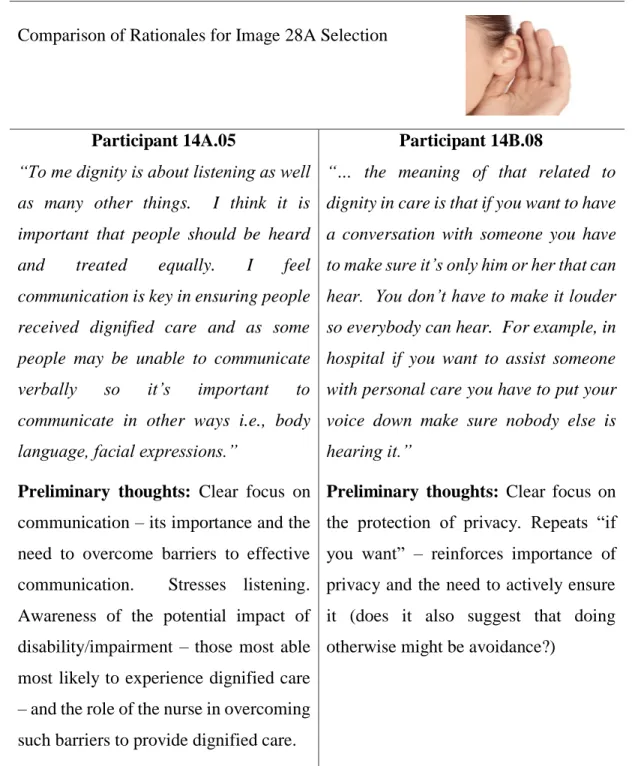
Figure 5-1 Comparison of rationales for image 28A selection... 178
Figure 6-1 Example sorting grid ... 185
Figure 6-2 Four-step approach to selecting the Q-set (Paige and Morin, 2014) .... 189
Figure 7-1 From Q-sorts to factor interpretation ... 206
Figure 7-2 Enabler (Factor 1): Factor array [from Ken-Q (Banasick, 2017)] ... 228
Figure 7-3 Caregiver (Factor 2): Factor array [from Ken-Q (Banasick, 2017)] ... 234
Figure 7-4 Companion (Factor 3): Factor array [from Ken-Q (Banasick, 2017)] . 239 Figure 7-5 Defender (Factor 4): Factor array [Ken-Q (Banasick, 2017)] ... 245
Figure 8-1 Example of photo-elicitation and meaning ... 249
xiii
List of Tables
Table 1-1 Core terminology ... 7
Table 2-1 Literature Review: PEO Illustration ... 19
Table 2-2 Original inclusion and exclusion criteria ... 20
Table 2-3 Articles by methodology ... 24
Table 2-4 Articles by country and/or region ... 25
Table 2-5 Summary of literature retained from protocol-driven search ... 32
Table 2-6 Number of articles contributing to each theme ... 64
Table 2-7 Contribution made to themes by individual articles ... 65
Table 2-8 A typology of dignity (Nordenfelt, 2004) ... 71
Table 2-9 Summary of Walker and Avant (2011)... 81
Table 2-10 Steps of appraisal ... 82
Table 4-1 NGT groups ... 136
Table 4-2 Participant profile: NGT ... 137
Table 4-3 Example of image selection and rationale... 148
Table 4-4 Example of ‘Top 5’ ... 150
Table 4-5 Example of preliminary ideas ... 155
Table 5-1 Example of preliminary coding ... 162
Table 5-2 Example of preliminary codes (Group 14B) ... 163
Table 5-3 Developed codes for photo-elicitation data (all groups) ... 163
Table 5-4 Example of preliminary NGT coding ... 164
Table 5-5 Example of preliminary NGT codes ... 165
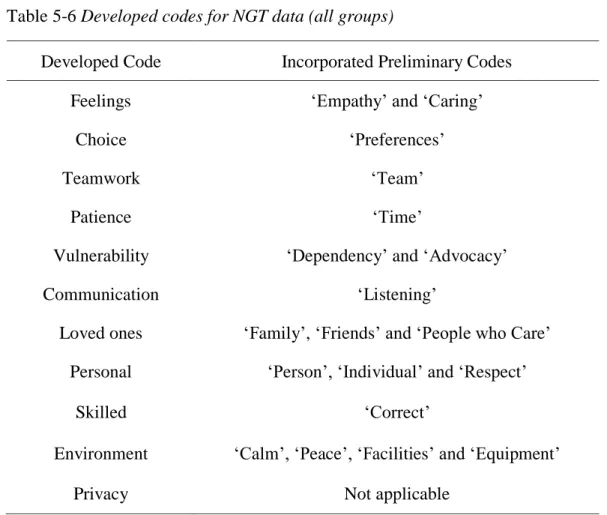
Table 5-6 Developed codes for NGT data (all groups)... 165
Table 5-7 Comparison of developed codes ... 166
Table 5-8 Final developed codes for photo-elicitation and NGT (all groups) ... 167
xiv
Table 5-10 Categories: NGT ... 171
Table 5-11 Frequency of image selection ... 173
Table 5-12 Frequency of categories ... 179
Table 5-13 Number of statements in response to each question ... 180
Table 5-14 Example of modified van Breda (2005) ... 181
Table 5-15 Ranked categories using modified ... 182
Table 6-1 Core terms in Q-methodology (1) ... 187
Table 6-2 Strand 2: Participant profile ... 188
Table 6-3 Rationale for changes to statements in the final Q-set ... 197
Table 6-4 Final Q-set by category ... 198
Table 7-1 Core terms in Q-methodology (2) ... 205
Table 7-2 Example correlation matrix ... 207
Table 7-3 Example unrotated factor loadings ... 210
Table 7-4 Communality ... 211
Table 7-5 Communality range ... 211
Table 7-6 Example calculation eigenvalue ... 213
Table 7-7 Example calculation significant factor loading ... 214
Table 7-8 Example unrotated significant factor loadings... 214
Table 7-9 Calculation unrotated standard error ... 215
Table 7-10 Humphrey’s Rule ... 216
Table 7-11 Summary of extraction criteria ... 216
Table 7-12 Significant Q-sorts by factor ... 219
Table 7-13 Factors by Q-sort ... 220
Table 7-14 Summary of factors by year ... 220
Table 7-15 The four factors... 222
xv
Table 7-17 Consensus statements ... 224
Table 7-18 Enabler (Factor 1) by year group and Q-sort ... 226
Table 7-19 Enabler (Factor 1): Distinguishing statements ... 226
Table 7-20 Enabler (Factor 1): Relative rankings ... 227
Table 7-21 Caregiver (Factor 2) by year group and Q-sort ... 231
Table 7-22 Caregiver (Factor 2): Distinguising statements ... 232
Table 7-23 Caregiver (Factor 2): Relative rankings ... 233
Table 7-24 Companion (Factor 3) by year group and Q-sort ... 237
Table 7-25 Companion (Factor 3): Distinguishing statements ... 237
Table 7-26 Companion (Factor 3): Relative rankings ... 238
Table 7-27 Defender (Factor 4) by year group and Q-sort ... 242
Table 7-28 Defender (Factor 4): Distinguishing statements ... 243
Table 7-29 Defender (Factor 4): Relative rankings ... 244
Table 8-1 Categories and conditions of a dignity encounter ... 252
1
Abstract
Background
A complex and contested concept, dignity is recognised as a significant factor in a person’s experience of care. Variations in the provision of dignity in care are reported in the literature and in the media. Despite growing interest in the potential of nursing education to enhance dignity in nursing care, relatively little is known about what dignity means to nursing students.
Purpose
The purpose of the study was to explore perspectives on preserving dignity in care among nursing students and addressed the following research questions:
1. What meaning do nursing students attach to the term ‘dignity in care’?
2. What are nursing students’ perspectives on the personal and environmental influences on the preservation of dignity in care?
3. What are nursing students’ perspectives on the nurse’s role in preserving dignity in care?
Methods
The study adopted a two-strand mixed methods Q-methodology approach situated within a theoretical framework of pragmatism. Nursing students were recruited from a three-year undergraduate preregistration adult nursing programme in Scotland. A total of 31 nursing students participated in Strand 1 which employed photo-elicitation and Nominal Group Technique (NGT). Qualitative and quantitative content analysis were used to provide insight into perspectives on the meaning of dignity in care and influences on its preservation. A total of 21 nursing students participated in Strand 2 which used Q-methodology to reveal perspectives on the important aspects of the role of the nurse in preserving dignity in care.
Results
The concept of dignity was recognisable and meaningful for the participants. Participants’ understanding of dignity in care and influences on it seem to be rooted in the nature of the nurse-patient relationship and interaction. Four distinct perspectives were identified: Enabler, Caregiver, Companion and Defender. Enabling
2 the role of the person in their own care was the most important aspect of the role of the nurse in preserving dignity in care for the Enabler while for the Caregiver it was the delivery of ‘good’ care. The Companion perspective attached the greatest importance to being with the person, while the Defender identified being courageous in the face of threats to dignity as most important.
Conclusion
This study provides insight into the under-researched area of nursing students’ perspectives on dignity in care. Some consensus among participants was identified in relation to their perspectives on the meaning of dignity in care and the importance of the role of the nurse in preserving it. Four distinct perspectives were also identified, and these illuminated a perception among the participants that the ‘good’ nurse should be able to overcome context. A perception also existed among the participants that strategies to preserve dignity in care are ‘just basic care’ that does not require specific education or training. This contrasts strongly with the participants’ limited reference to the physical environment of care as an important factor in the nurse’s role in preserving dignity in care.
3
1
Chapter 1: Introduction
1.1 Introduction to Chapter 1
Chapter 1 introduces the background to the research study and provides an overview of the research design. To facilitate an understanding of the research design, a brief introduction to Q-methodology and some of its related terminology is also provided. Moreover, an outline of the structure and content of the thesis is provided to help readers navigate through it. In addition, Chapter 1 gives the rationale for decisions regarding the presentation of the thesis and defines key terms.
1.2 Motivation for the Study
I was motivated to conduct the current study in the first instance by reports of nurses’ gross violations of dignity in care, ranging from discourtesy, thoughtlessness and indifference to incompetence, neglect and overt cruelty. These reports acted as a trigger for reflection on what I could do as a nurse and nurse educator in response. Around the same time, and in my role as a lecturer in a large School of Nursing, I became conscious that in practical and written assessments nursing students routinely stated something along the lines of, “I pulled the patient’s curtains to protect their dignity”. This was so standard a statement in hundreds of assessments that I felt compelled to consider whether this was really what dignity meant to nursing students and, indeed, what my own understanding of dignity was.
1.3 Background
Good care is care that promotes the dignity of the human person … (Vanlaere and Gastmans, 2011, p. 172)
The Universal Declaration of Human Rights (United Nations General Assembly, 1948) and the subsequent European Convention on Human Rights (Council of Europe, 1950) identify respect for human dignity as the foundation of all human rights. Moreover, dignity is often identified as the basis of national constitutions and legislation (Baillie and Matiti, 2013; Misztal, 2013; Rothhaar, 2010). In relation to health care, the World Health Organisation’s (WHO) Declaration of Patients’ Rights – commonly referred to as the Amsterdam Declaration – reaffirms the significance of
4 dignity as the basis for human rights and as an objective for health care (World Health Organisation, 1994). Consequently, it seems reasonable for Baillie and Matiti (2013) to state that dignity is enshrined in patients’ rights.
Initiatives designed to promote dignity in care in the United Kingdom (UK) reflect the priority placed upon it (Department of Health, Social Services and Public Health, 2006; NHS Wales, 2015; Scottish Government, 2013; Social Care Institute for Excellence, 2013). Dignity is identified as a key marker of safe and effective nursing care, both nationally and internationally (International Council of Nurses, 2012; Nursing and Midwifery Council, 2015). This priority is also reflected in a wide-ranging ‘Dignity Survey’ of over two thousand members of the Royal College of Nursing (RCN), which found a “high level of dignity awareness ... and a strong commitment to dignity in care” among those who completed the survey (Royal College of Nursing, 2008, p. 6).
Yet these aspirations for dignified care seem very much at odds with the reality portrayed in a range of reports citing a lack of dignity in care settings in the United Kingdom (Care Quality Commission, 2014; Department of Health, 2013a; Independent Commission on Dignity in Care, 2012; Mental Welfare Commission for Scotland, 2014; Older People's Commissioner for Wales, 2011; Patients' Association, 2011; Scottish Government, 2014).
Importantly, the Commission on Dignity in Care states that nursing students must have dignity “instilled into the way they think and act from their very first day” (Independent Commission on Dignity in Care, 2012, p. 35). This recognition of the importance of preparing future nurses, whose conduct is informed by concern for the dignity of those in their care, makes explicit a significant challenge for preregistration nurse education. Perhaps unsurprising then is the growing interest in the potential of preregistration undergraduate nursing education to enhance dignity in nursing care (Royal College of Nursing, 2012; Tadd and Dieppe, 2005; Vynckier et al., 2015), but realising this potential will not be without its challenges.
At the same time, this raises questions about the very nature of dignity, whether it is something that can be ‘instilled’ into people and, if so, how that might be achieved. Most particularly, it presupposes that nursing students “need to have dignity instilled” despite relatively little evidence in relation to the nursing students’ perspectives on
5 dignity and its preservation in care. Moreover, it raises questions about the capacity of nursing students to effect change in care settings.
The tension between aspirations for dignified care and the reality of care for some has been identified as a source of stress for care providers in general (Jakobsen and Sørlie, 2010; Manthorpe et al., 2010; Stenbock-Hult and Sarvimäki, 2011). For nursing students, this tension has been associated with ethical dilemmas experienced while on placement (Comrie, 2012; Erdil and Korkmaz, 2009). Comrie (2012) suggests that student nurses who recognise ethical issues in practice may experience stress as a result of a conflict between their knowledge of what they ‘should’ do and their subsequent actions. Such conflict for nursing students is perhaps most likely in the “impoverished environments” described by Brown et al. (2008, p. 1218); characterised by inadequate care of older people and negative attitudes towards them. McCarthy and Deady (2008, p. 257) strike a more positive note when they assert that this may result in greater awareness and a commitment to “do better next time” when placed in a similarly ‘impoverished’ environment.
While this may be the case for some, it is far from guaranteed, given the diversity of care settings and the variable resilience of individual nursing students (Jackson et al., 2011; Thomas, Jack and Jinks, 2012). Significant organisational, professional, environmental and personal barriers to the promotion of dignity in nursing care have been identified by nursing students (Macaden et al., 2017; Munoz et al., 2017). Reports of the problems nursing students experience trying to overcome these barriers make difficult reading (Cassidy, 2009; Monrouxe et al., 2015; Monrouxe et al., 2014; Rees, Monrouxe and McDonald, 2015). It would be disingenuous to suggest that preregistration nursing education is the panacea for these problems, but it certainly has an important contribution to make (Rolfe, 2014).
In addition, while many theoretical (Nordenfelt and Edgar, 2005; Wainwright and Gallagher, 2008), organisational (Department of Health, 2013a; Independent Commission on Dignity in Care, 2012), professional (Baillie and Gallagher, 2011; Royal College of Nursing, 2008) and personal perspectives (Lohne et al., 2010; Nåden et al., 2013; Slettebø et al., 2009) on dignity have been described, the perspectives of nursing students have received relatively little specific attention. Understanding what dignity means to nursing students may help enhance learning and prepare future nurses who are more able to both preserve dignity and address situations in which dignity is
6 at risk of being violated. This has the potential to make a hugely significant difference to dignified care for all. Consequently, the purpose of this study was to explore nursing students’ perspectives on dignity in care.
1.4 Chapter Outline
This section outlines the structure of the thesis by identifying the purpose and core content of each chapter. Some general points regarding the structure and presentation of the thesis require clarification at the outset.
First, consideration was given to integrating the methods and results for Strands 1 and 2 into combined ‘Methods’ and ‘Results’ chapters; however, they are presented in separate chapters. This decision was made because of the significant differences between each Strand in terms of the nature of the data collected and also in terms of the approaches to data collection and analysis. Separating them seemed to enhance the flow of the thesis and render their contents more readily accessible.
Second, Q-methodology has been described as a methodology in its own right (Ramlo and Newman, 2011; Watts and Stenner, 2012) and consideration was given to discussing it in Chapter 3 (Methodology). The defining characteristics of Q-methodology are, however, its methods of data collection and analysis. Consequently, discussing these in Chapters 6 and 7 as ‘Methods’ and ‘Results’ respectively seemed again to enhance the flow of the thesis and communicate the research process more effectively.
Third, to enhance clarity, consistent terms are used throughout the thesis and these are defined in Table 1-1.
Fourth, numbers between one and nine are written in words while numbers 10 and above are written in numerals. Exceptions are made when the number is part of a title – for example, Year 1, not Year One – or part of a heading – for example, Research Question 1, not Research Question One – or where the number is in a table presenting numeric information.
Fifth, a third-person narrative is used throughout, with the exception of Sections 1.2 and 9.2.2 in which the first person is used because these are the personal thoughts of the researcher.
7 Table 1-1 Core terminology
Term Explanation
Carer Person who gives care to a family member, partner or friend in need as a result of illness or disability (Lathlean, 2006)
Family Persons the patient cares for and who care for them Figure Images or graphics
Patient Person receiving care
Table Numbers, images or text presented in rows and columns The current study The research undertaken for this thesis
The researcher The author of this thesis 1.4.1 Chapter 2: Literature Review
The Literature Review chapter sets the current study in context and identifies the need to explore the perspectives of nursing students on dignity in care by:
• Outlining the search strategy and its results;
• Discussing theoretical perspectives on dignity with a particular focus on the typology of dignity developed by Nordenfelt (2004);
• Critiquing attempts to define dignity in terms of identity, merit or rational capacity, particularly in the context of care;
• Contrasting the use of concept analysis as a means of providing a more holistic understanding of dignity in care;
• Highlighting the role of relationship in preserving dignity in care via a relationship-centred framework developed by Jacobson (2009a); and
• Identifying themes present in the literature as the ambiguous nature of the concept and the personal and contextual influences on dignity in care and the nurse’s role in its preservation.
8 1.4.2 Chapter 3: Methodology
The Methodology chapter provides the rationale for selecting pragmatism as the study’s theoretical framework and mixed methods for its research design by:
• Evidencing the decision-making process around the selection of pragmatism as the paradigm in which to situate the research study;
• Discussing the rationale for describing the research study as a mixed methods and Q-methodology study; and
• Explaining the selection of a modified sequential mixed methods design with reference to the typology described by Teddlie and Tashakkori (2009).
1.4.3 Chapter 4: Methods – Strand 1
The Strand 1 Methods chapter explains the principles and practical application of the selected research methods for Strand 1 by:
• Outlining ethical considerations in relation to participants;
• Detailing the process of participant recruitment and resulting participant profile;
• Outlining data management processes;
• Summarising the principles and practical application of photo-elicitation and Nominal Group Technique (NGT) as data collection methods; and
• Discussing the use of qualitative and quantitative content analysis. 1.4.4 Chapter 5: Results – Strand 1
The Strand 1 Results chapter presents the results of Strand 1, including the development of the data collection tool for Strand 2 by:
• Outlining the principles and practical application of qualitative and quantitative content analysis to code and categorise the photo-elicitation and NGT data; and
• Evidencing the generation of the statements from which the data collection tool for Strand 2 was selected.
9 1.4.5 Chapter 6: Methods – Strand 2
The Strand 2 Methods chapter explains the principles and practical application of the selected research methods for Strand 2 by:
• Detailing the process of participant recruitment and resulting participant profile;
• Evidencing the decision-making process underpinning the selection of the data collection tool for Strand 2;
• Explaining the particular measures taken in Q-methodology to assure the rigour of the research process; and
• Summarising the principles and practical application of data collection in Q-methodology.
1.4.6 Chapter 7: Results – Strand 2
The Strand 2 Results chapter presents the results of Strand 2 by:
• Outlining the principles and practical application of by-person factor analysis to identify shared perspectives; and
• Summarising the participants’ shared perspectives.
1.4.7 Chapter 8: Discussion
The Discussion chapter presents the findings in the context of the evidence-base and the study’s contribution to knowledge by:
• Discussing the findings in relation to each research question in the context of the literature;
• Identifying the study’s contribution to knowledge;
• Summarising strategies to ensure the trustworthiness of the findings; and • Identifying the strengths and limitations of the study.
10 1.4.8 Chapter 9: Conclusion and Recommendations
This chapter concludes the thesis and makes recommendations for education, practice and research by:
• Providing an overview of the study and its findings; • Making recommendations for education and practice;
• Suggesting areas for further research stemming from the study; and • Providing a brief personal reflection on the study.
11
1.5 Overview of the Research Design
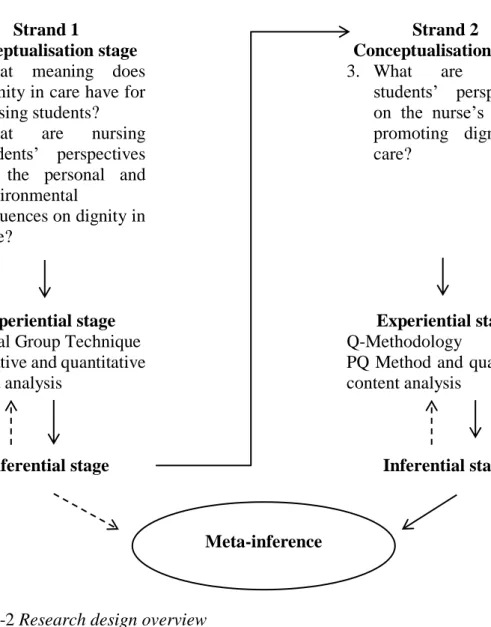
A modified version of the sequential exploratory mixed methods design described by Teddlie and Tashakkori (2009) was used. This consisted of two strands in which the findings from Strand 1 informed the development of the data collection tool used in Strand 2. The first strand of this study – Strand 1 – focused on research questions 1 and 2, while the second strand – Strand 2 – focused on research question 3. Figure 1-1 summarises the research design, which will be discussed in Chapter 3.
Strand 1 Strand 2
Conceptualisation Stage Conceptualisation Stage 1. What meaning do nursing
students attach to the term ‘dignity in care’? 2. What are nursing students’
perspectives on the personal and environmental influences on the preservation of dignity in
care?
3. What are nursing students’ perspectives on the nurse’s role in preserving dignity in care?
Experiential stage Experiential stage
Photo-elicitation and Nominal Group Technique
Q-sorting
By-person factor analysis and content analysis Content analysis
Inferential stage Inferential stage
Meta-Inference Figure 1-1 Research design
1.6 Chapter 1: Conclusion
Chapter 1 has provided the background to the current study and provides an overview of the research design. To facilitate an understanding of the research design, a brief introduction to Q-methodology and some of its related terminology is also provided. Moreover, an outline of the structure and content of the thesis was provided to help readers navigate through it. In addition, Chapter 1 has given the rationale for decisions regarding the presentation of the thesis and defines some key terms. Chapter 2 reviews
12 the literature to set the current study in its theoretical context and identifies a gap in the evidence-base.
13
2
Chapter 2: Literature Review
2.1
Chapter 2: IntroductionIn a narrative review of the literature, Chapter 2 sets the current study in the context of theory and practice and identifies a gap in the evidence-base pertaining to nursing students’ perceptions of dignity in nursing care. The chapter describes how literature was sourced through a combination of personal knowledge, ‘snowballing’ and protocol-driven search approaches. General strengths and limitations of the review are noted, and more specific detail is provided in Section 2.2.5. Three principal themes are identified:
1. The meaning of dignity is complex and contentious,
2. Dignity in nursing care is influenced by staff behaviour and patient characteristics, hereafter referred to as ‘people’ influences, and
3. Dignity in nursing care is influenced by local and social context, hereafter referred to as ‘place’ influences.
The discussion of the meaning of dignity begins with theoretical perspectives and is framed by a typology of dignity described by Nordenfelt (2004). Concept analysis of dignity is examined closely with the intention of bridging the gap between the purely theoretical and the meaning of dignity in nursing care. A framework of dignity in care developed by Jacobson (2009b) is used as a lens through which to view dignity in nursing care and the perspectives of patients, their relatives and healthcare staff. Staff behaviour – communication and dignifying care activities – and patient characteristics – vulnerability and resilience – are considered in relation to the preservation of dignity in care. In contrast, local and social context are considered in relation to the violation of dignity in care; focusing on the physical environment and culture of the care setting and the influence of target-setting and discrimination. The review also identifies some broad recommendations for education, person-centred care and leadership.
Chapter 2 concludes by identifying a lack of evidence in relation to nursing students as a distinct group in terms of what dignity in nursing care means to them and their perspectives of the role of the nurse in preserving dignity in nursing care. This provides the rationale for further research and lays the foundations for the methodological considerations presented in Chapter 3.
14
2.2 The Literature Search
Major influences on the search strategy for the current study were the research questions, the varying relevance of different types of literature – theoretical, research, practice and policy – for different aspects of the review, and the need for the search strategy to accommodate emerging interests.
A clear focus on the research purpose from the outset and throughout the current study was crucial to both the effectiveness of the literature search and the development of the research questions. Initially, exploring the literature helped the research questions to evolve. As the research questions evolved, so too did the search strategy. Once they were more established, the research questions were used to frame the search strategy more concretely. Returning to the research questions during the search process helped the search strategy remain focused but flexible enough to accommodate the evolving understanding. This flexibility was balanced by being mindful of the research purpose and what was reasonable and practicable within the resources of the current study.
The four broad types of literature described by Wallace and Wray (2016) – theoretical, research, practice and policy – all formed part of the literature review. Overlap exists between each type; for example, research, policy and practice literature refer to theoretical literature. Nevertheless, the relevance of each, and hence the search methods used, varied depending on the focus of individual searches. Theoretical literature is defined by Wallace and Wray (2016) as literature that seeks to explain or understand phenomena by developing theories of how they are or might be. Searching this type of literature was particularly helpful to the discussion of theoretical perspectives on dignity. Similarly, searching the research literature – literature that presents findings from primary studies involving data collection (Wallace and Wray, 2016) – was an important means of informing the discussion of personal and professional perspectives on dignity. Of course, in the context of health care, policy literature – such as reports and standards of care and education (Aveyard, 2014) – was another rich source; most especially in relation to the wider social and political context of the current study. Searching the practice literature – including expert opinion and discussion papers (Aveyard, 2014) – played an important role in clarifying key themes and debates in relation to dignity in nursing care.
15 Coughlan, Cronin and Ryan (2013) acknowledge that systematic literature reviews are most often conducted by teams of researchers due to the complexity and time-consuming nature of this process. Consequently, a narrative literature review was performed. Narrative and systematic literature reviews are often distinguished by the extent to which they adopt explicit and rigorous approaches to searching, analysing and synthesising the evidence (Aveyard, 2014; Saltikov, 2012). Bettany-Saltikov (2012, p.11) notes that narrative literature reviews risk being “haphazard and biased”. To counter this risk, the researcher adopted a combination of three methods of literature searching described by Greenhalgh and Peacock (2005): personal knowledge, snowballing and protocol-driven.
2.2.1 Personal knowledge
Personal knowledge is highlighted by Greenhalgh and Peacock (2005) as an important element of an effective search strategy. Certainly, this was the case in the current study. Originally, high profile reports of undignified care in the UK, such as inquiries into care in Mid-Staffordshire NHS Trust (Department of Health, 2010, 2013a) and elsewhere in the UK (Older People's Commissioner for Wales, 2011; Scottish Government, 2014), formed a key role in prompting the current research, but so too did professional networks and personal contacts.
One example is the work of Goffman (Goffman, 1968; Goffman, 1990), which was recommended by the researcher’s Director of Studies. Also, via her Director of Studies, the researcher was invited to visit the Faculty of Health Sciences at Oslo and Akershus University College of Applied Sciences in 2015. While there, she met with several key authors in the field of caring sciences, such as Vibeke Lohne (Lohne et al., 2010; Lohne et al., 2016; Lohne et al., 2014) and Anne Heggestad (Heggestad et al., 2015; Heggestad, Nortvedt and Slettebø, 2013; Heggestad, Nortvedt and Slettebø, 2015). This raised the researcher’s awareness of these authors’ work and the ‘Scandinavian Journal of Caring Sciences’ so that these became part of her forward-tracking systems via citation and journal alerts.
In addition, Professor Ann Gallagher – Professor of Ethics and Care at the University of Surrey – was visiting the Faculty of Health Sciences in Oslo at the same time. This provided the researcher with a valuable opportunity to discuss the current study with her and this heightened the researcher’s understanding of the study’s broader ethical
16 context. Professor Gallagher also raised the researcher’s awareness of authors MacIntyre (MacIntyre, 2007, 2009), Gastmans (Gastmans, 2013; Gastmans and De Lepeleire, 2010) and Sulmasy (Sulmasy, 2013) whose works would all go on to play a significant part in the discussion of dignity in nursing care and lead on to other authors via hand-searching reference lists.
Furthermore, the researcher was invited to attend a faculty staff seminar at which Professor Gallagher presented the ‘Researching Interventions that Promote Ethics in Social Care’ (RIPE) Project (Gallagher and Cox, 2015). This introduced the researcher to care ethics laboratories and, once again, to authors and topics influential in the current study such as Timmermans et al. (2015) and Vanlaere, Coucke and Gastmans (2010). Greenhalgh and Peacock (2005, p. 1064) also highlight the potential value of such “serendipitous discovery” of literature made through a chance contact or while searching for something else. The book ‘Why Things Matter to People’ (Sayer, 2011) – discovered while browsing in the library – is another good example of this process.
The researcher also had the opportunity to present preliminary findings from the photo-elicitation component of the current study at the same seminar. Feedback from those present was encouraging and the researcher was also encouraged to work towards publication and did so (Mullen et al., 2017a). Feedback from the publication’s reviewers motivated the researcher to expand her discussion of the challenges of practice placements reported by nursing students (Levett-Jones and Lathlean, 2009; Monrouxe et al., 2015; Monrouxe et al., 2014; Rees, Monrouxe and McDonald, 2015). 2.2.2 Snowballing
Greenhalgh and Peacock (2005) describe ‘snowballing’ as a search that develops as a study develops by; for example, following references provided in reference lists, and tracking authors and journals that come to be of interest. This strategy was particularly useful in the current study because the researcher’s knowledge of the field developed incrementally during the study and ‘snowballing’ allowed the search strategy to develop in tandem. Hand-searching references from reference lists helped to identify key authors and key themes.
To illustrate; following-up on references in the reference list of Baillie and Gallagher (2011) – sourced via the protocol-driven search – highlighted the significance of key
17 authors. For example, the ‘Dignity and Older Europeans Project’ (European Commission, 2005) highlighted the significance of the author, Win Tadd, who was then searched for in databases, revealing a rich seam of relevant and important work prior to the protocol-driven search. Reports with a specific focus on dignity in care were often sourced via reference lists and included particularly helpful sources, such as the ‘Dignity Survey’ (Royal College of Nursing, 2008), ‘Dignity in Practice’ (Tadd et al., 2011), the ‘Delivering Dignity’ report (Commission on Dignity in Care for Older People, 2012) and the Preventing Abuse and Neglect in the Care of Older Adults (PANICOA) Report (Lupton and Croft-White, 2013). Another illustration of ‘snowballing’ is provided in the discussion of concept analysis where some of the literature – such as Mairis (1994) and Jacelon et al. (2004) – would have otherwise fallen outside of the date limits of the protocol-driven search.
Similarly, using citation tracking in electronic databases was an efficient means of locating literature that cited work by an author of interest or in a field of interest. Journal alerts from especially relevant journals – such as Nursing Ethics – were also helpful in ensuring the search remained as current and comprehensive as possible. With ‘snowballing’, care was taken to minimise the risk of following references too far down avenues that were interesting but not entirely relevant.
2.2.3 Protocol-driven
A protocol driven method of literature searching is used when the search strategy is defined at the beginning of a study (Greenhalgh and Peacock, 2005). This systematic approach is recommended by Aveyard (2014) and involves maintaining a clear focus on the research purpose and careful consideration of the type of literature to be included. Identifying electronic databases, search terms and inclusion and exclusion criteria are all important to this approach (Bettany-Saltikov, 2012). This was the search method most commonly employed in the current study to source research literature.
The primary aims of the protocol-driven search were to identify the evidence-base regarding the meaning of dignity and nursing students’ perspectives on dignity in care. The research questions were used to identify the keywords that formed the basis of individual searches within electronic databases. Identifying keywords, databases and inclusion and exclusion criteria also helped to ensure the search was effective; that is,
18 comprehensive, relevant and credible. The University of the West of Scotland (UWS) Library Catalogue, CINAHL Complete, ScienceDirect, SAGE Journals Online, Wiley Online Library and Taylor & Francis Online were the databases used. Other databases – Health Source: Nursing/Academic Edition, MEDLINE, PsycINFO, SocINDEX with Full Text – were searched contemporaneously with CINAHL Complete.
The ‘Population Exposure Outcomes’ (PEO) framework described by Bettany-Saltikov (2012) was used to help structure the search strategy. This is illustrated in Table 2-1 in relation to searches performed for nursing students’ perceptions of dignity in nursing care.
19 Table 2-1 Literature Review: PEO Illustration
Population Nursing Students Exposure Dignity in Care Outcomes Perceptions
Nursing students in a pre-registration
undergraduate adult nursing programme
Dignity in care in diverse placement settings in relation to ALL adults and place, e.g., older people, persons with dementia or mental health issues, those requiring nursing, residential acute, critical or community care
Perceptions, perspectives, attitudes, experiences, feelings, understandings, meanings, interpretations, views of dignity in care
Not No Exclusions Not
Nursing students in mental health or paediatric programmes, registration or post-qualification programmes Healthcare students in a programme of study leading to registration with the Health Professions Council Medical students, social work students, social care students Perceptions, perspectives, attitudes, experiences, feelings, understandings, meanings, interpretations, views of: • Caring • Compassion • Compassionate care • Respect
Individual searches of the following keywords: ‘dignity’; ‘dignified care’; ‘undignified care’; ‘concept’; ‘nursing students’; ‘perceptions’; and ‘meaning’ – were used in different combinations. Truncation – such as ‘nurs*’ and ‘digni*’ – was used with Boolean operators such as ‘and’ to help ensure the retrieval of relevant data. Synonyms – such as ‘view’ and ‘perception’ for ‘perspective’ were also used for this purpose. The original inclusion and exclusion criteria are summarised in Table 2-2.
20 Table 2-2 Original inclusion and exclusion criteria
Inclusion Criteria Rationale
Books No date limits set for search
Scoping search using ‘Dignity’ as a keyword in the title retrieved 43 items only so dates limits were unnecessary Journals: 2005–2015 Relevance to contemporary practice Unpublished
dissertations
No date limits set for search via EThOS
Scoping search using ‘Dignity’ as a keyword retrieved forty-five items only so dates limits were unnecessary Specific to dignity and dignity in care The focus of the review
English language No resource for translation
Specific to: Adults, nurses and nursing students
Most relevant to participant group and study focus
Theoretical perspectives To provide evidence of the theoretical underpinnings of the concept of dignity
Primary studies, theoretical papers and literature reviews
To provide findings from original work and avoid over-representation of a single study
Priority given to theoretical perspectives and primary studies with a UK and Ireland focus
Most relevant to the participant group and study focus
Exclusion Criteria Rationale
Not anecdotal or opinion pieces or conference abstracts
Outwith the scope of the resources for the review
Not specific to related concepts such as care, caring, compassion, autonomy or vulnerability
The focus of the review was dignity and dignity in care
Not highly specific to a specialised field of adult nursing care
To help ensure that the focus was on dignity in care rather than on dignity in a highly specific field of practice or patient condition
Not about dignity in relation to developments in genetics e.g. transhumanism
Outwith the scope of this review and of limited relevance to the participant group of nursing students
21 For journal database searches, the date range from 2005 to 2015 was chosen because a scoping search indicated that sufficient relevant and credible evidence would be retrieved for the scope of the study. It also helped ensure relevance to contemporary nursing education and practice. No date range limit was applied to searches of the UWS Catalogue for books and ETHOS for unpublished dissertations. This was because scoping searches of these databases using ‘dignity’ as a keyword in the title retrieved relatively low numbers of items which were screened with ease.
More specifically, literature focused primarily on related concepts – such as autonomy, vulnerability and caring – was excluded from the protocol-driven search. The rationale for this was to ensure the analysis focused primarily on dignity and was directed towards core elements of the concept of dignity in care and not on the meaning of related concepts. No geographical limits were set, but only English language abstracts were included, and priority was also given to literature related to the UK because this was the context in which the participants lived and worked. All the original inclusion and exclusion criteria – accompanied by a rationale – are identified in Table 2-2.
One of the exclusion criteria – ‘not highly specific to a specialised field of adult nursing care’ – requires some further explanation, given the specialised nature of most adult nursing care. Indeed, much of the literature regarding dignity in care concerns dignity in the specialised care of persons with dementia or a diagnosis of cancer. Following reflection, a distinction was drawn between articles that provided an insight into dignity in care which was transferable to other adult care contexts and articles that provided insight into dignity in care which was highly specific to specialised care. For example; the findings of a metasynthesis of ten qualitative articles concerning dignity in dementia care by Tranvåg, Petersen and Nåden (2013) provides insight, among other things, into the prevention and management of dementia-related aggression and violence and the use of restraint. After careful consideration this article was excluded as being too specific to specialised dementia care settings while other articles, also involving the care of persons with dementia, were included. This was because the findings of the included studies were relevant to the care of other vulnerable persons in wider care settings. Similar decisions around transferability were made with regard to articles focused on dignity in multiple sclerosis (Lohne et al., 2010), head injury (Slettebø et al., 2009), heart failure (Bagheri et al., 2012), severe
22 physical disability associated with neurological disease or injury (Wadensten and Ahlström, 2009) and cancer (Johnston et al., 2015).
Appraisal tools were used primarily to help the researcher adopt a consistent and systematic approach to the appraisal of each article and documentation of the same. No article was included or excluded based on findings from the appraisal process. Each qualitative research article was appraised using the Critical Appraisal Skills Programme (CASP) Qualitative Research Checklist (Critical Appraisal Skills Programme, 2013a). Similarly, the CASP Systematic Review Checklist (Critical Appraisal Skills Programme, 2013b) was used to appraise each of the literature reviews. The researcher decided to use CASP criteria because of their established use in qualitative research appraisal (Hannes, Lockwood and Pearson, 2010) and her existing familiarity with the tools. The three articles reporting survey findings were appraised using the guidance provided by Parahoo (2014).
In summary, the search strategy encompassed all three of the methods described by Greenhalgh and Peacock (2005) and this enabled the search process to be focused and to accommodate newly acquired evidence. Moreover, searching different types of literature helped inform a broader discussion of theoretical, professional and personal perspectives on dignity in nursing care.
2.2.3.1 Findings from the protocol-driven search
Initial database searching resulted in the retrieval of 627 items of which 539 were excluded following review by title and abstract. The remaining 88 were screened by the application of the inclusion and exclusion criteria to leave a final sample of 51 articles, as shown in Figure 2-1. The broad characteristics of each of the 51 articles are summarised in Table 2-5.
23 Figure 2-1: Protocol-driven search
2.2.4 Characteristics of the literature
The 51 articles retained from the protocol-driven search include eight theoretical papers, three literature reviews – two narrative and one systematic – and three reporting findings from concept analysis studies. Two other articles report findings from secondary analysis of data. Three articles report survey studies combining mainly descriptive statistics with qualitative data (Baillie et al., 2009; Cairns et al., 2013; Kinnear, Victor and Williams, 2015). The remainder describe findings from qualitative research studies. The majority of these are described as hermeneutic, explorative or descriptive in approach, although ethnography, grounded theory and
Protocol-driven (n=627)
Records screened by title and abstract
Excluded (n =539)
Full-text articles assessed (n =88)
Included (n =51)
Excluded (n =37)
24 case study are also represented, as shown in Table 2-3. Each article is outlined in Table 2-5.
Table 2-3 Articles by methodology
Methodology Number of Articles
Hermeneutic Approach 14
Qualitative – Descriptive or Explorative 11
Theoretical Papers 8
Literature Review 3
Concept Analysis 3
Qualitative Case Study 3
Survey 3
Grounded Theory 3
Ethnography 2
Total 51
2.2.4.1 Articles by country and/or region
The countries or regions where studies were conducted are shown in Table 2-4. The methodology category is split along country of origin lines, with all Scandinavian research adopting hermeneutic approaches. Most of the remainder describe the use of qualitative descriptive or explorative approaches. Particularly striking is the prevalence of research into dignity in care originating from Scandinavia and the UK countries of England and Wales. Equally striking is the absence of research from the other UK countries of Scotland and Northern Ireland and the limited volume of research from elsewhere in Europe and from the United States of America (USA). The intention was always to give preference to primary work with a UK focus and only English language literature was retained. Nevertheless, the articles retained are dominated by Scandinavia and the UK. It is possible to speculate that this reflects relatively localised drivers, such as the high profile of caring science in Scandinavia and its significant influence on research described by Arman et al. (2015). Moreover,
25 Dougherty et al. (2011) highlight that, in Sweden, the route to achieving a doctorate is by publication, and this may also contribute to the prevalence of published work with a Scandinavian origin. While the public scandal of Mid-Staffordshire NHS Trust in the UK (Department of Health, 2013a) may reasonably be expected to have influenced research in the UK, the current literature review’s date limit of 2005–2015 means that most of the literature pre-dates this. Awareness of undignified care had been identified earlier (Department of Health, 2006; Seedhouse and Gallagher, 2002), however. In a review of the research strategy of each country in the UK, Nursing Management (2005) notes the move towards more research focused on the patient experience and older person care.
Table 2-4 Articles by country and/or region
Country/Region Number of Articles
UK 19
Scandinavia (Denmark, Norway, Sweden) 15
Spain, Slovakia, Ireland, Sweden, UK and France [from the ‘Dignity and Older Europeans’ Project (European Commission, 2005)] 4 Canada 4 Netherlands 3 Taiwan 4 Portugal 1 Republic of Ireland 1
United States of America 1
Total 51
Note: For theoretical papers, literature review and concept analysis, the country of origin reflects the address of the corresponding author.
26 2.2.5 Strengths and limitations of the literature
Significant features of the literature included in this review is the inclusion of multiple articles from single research projects or studies, the prevalence of qualitative methodologies and ethical considerations. The most notable feature of the research included in this review is the absence of literature specific to nursing students’ perceptions of dignity in nursing care. Particular strengths of the literature reviewed is the rich detail provided by thick descriptions of participants’ views and the depth of insight provided by the use of case study and ethnographic designs. Limitations relate to the lack of differentiation between staff groups which at times meant it was not possible to distinguish between; for example, nurses, nursing students, healthcare assistants and other healthcare workers. Despite the wide range of settings and countries, none of the literature was specific to the Scottish context.
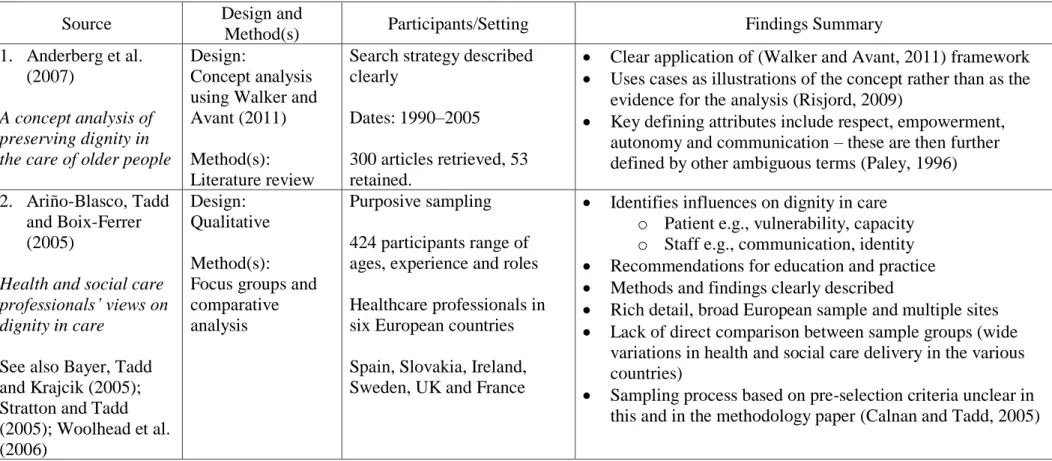
It is worth noting that nine of the 51 articles report findings from larger commissioned studies. Four articles (Ariño-Blasco, Tadd and Boix-Ferrer, 2005; Bayer, Tadd and Krajcik, 2005; Stratton and Tadd, 2005; Woolhead et al., 2006) report findings drawn from the ‘Dignity and Older Europeans Project’ (European Commission, 2005). Another three (Cairns et al., 2013; Kinnear, Victor and Williams, 2015; Kinnear, Williams and Victor, 2014) report findings from a research project exploring the gap between policy and practice in relation to the dignified care of older people. A further two (Calnan et al., 2013; Tadd et al., 2012) report findings drawn from the ‘Dignity in Practice’ (Tadd et al., 2011) project. This project was commissioned and funded by the National Institute for Health Research and adopted by the Department of Health’s PANICOA programme (Lupton and Croft-White, 2013).
Arguably, including more than one article reporting findings from a single research project may mean that its findings are over-represented in a literature review (Jackson et al., 2014). In response, however, it could also be argued that multiple articles from large-scale research projects such as these simply reflect the wealth of their findings. According to Jackson et al. (2014), the inclusion of multiple articles from single research projects may be warranted when each article reports on distinctly different aspects of the research problem and cross-references clearly to the other articles in the series. This was the case in the current literature review because of the range of methods, sites and participant groups involved, and so multiple articles were included.
27 Each of the four articles drawn from the ‘Dignity and Older Europeans Project’ (European Commission, 2005) has a distinct focus. Ariño-Blasco, Tadd and Boix-Ferrer (2005) focus on the perspectives of health care professionals, while Bayer, Tadd and Krajcik (2005) focus on the perspectives of older people. The focus for Stratton and Tadd (2005) is on the public view of dignity and ageing and the focus for Woolhead et al. (2006) is the impact on dignity of communication. Similarly, while both Cairns et al. (2013) and Kinnear, Victor and Williams (2015) report different aspects of the survey component of the larger research project, Kinnear, Williams and Victor (2014) reports on focus group and interview findings. Conversely, another article drawn from the ‘Dignity in Practice’ project (Tadd et al., 2011) – Hillman et al. (2013) – was not included in this review because it underlined rather than added to the other articles from the same project.
Other articles were retained because of their significant contribution to the development of the review themes. Three articles (Jacobson, 2009b, 2009a; Jacobson and Silva, 2010) report findings from a single study, but all were retained because each one focuses on a different aspect of the findings, and the framework the articles described proved so valuable in framing the discussion of influences on dignity in nursing care. Similarly, Baillie (2008) and Baillie (2009) report findings from a single case study described in a doctoral thesis (Baillie, 2007). Again, both articles were retained because one focuses exclusively on findings related to mixed-sex accommodation in hospital, while the other provides a much broader overview of the case study’s findings. Similarly, other articles derived from single research studies – for example, Blomberg et al. (2015) and Willassen et al. (2015) – were also retained because each makes a distinctly different contribution to the area under investigation. Where articles have been drawn from a single research project this has been indicated in Section 2.2.6.
Most of the articles included in this review report on qualitative studies. In addition to descriptive and explorative approaches, grounded theory, case study and ethnography are all represented in this review. All are situated in the constructivist paradigm, which is characterised by the ontological assumption that reality is multiple and subjective (Nicholls, 2009a); not fixed but dynamic, and mentally constructed (Polit and Beck, 2014). This positioning is supported by Creswell and Plano Clark (2011), who note that these mental constructions of reality derive from an individual’s
28 personal experience and social interactions. In order to understand these multiple and subjective realities, the researcher and those being researched need to be close, not separate (Polit and Beck, 2014). The use of the term ‘participant’ rather than ‘subject’ highlights the reciprocal nature of this relationship (Nicholls, 2009b). One of the potential benefits of adopting this stance is the potential to develop a holistic understanding of dignity in care.
The most prevalent methodology is hermeneutic inquiry. Walker (2011) explains that hermeneutic inquiry – also known as interpretive phenomenology – is concerned with meaning and understanding. It is one of the two main variants of phenomenology; the other being descriptive phenomenology (Polit and Beck, 2014). While descriptive phenomenology – developed by Husserl – seeks understanding through the description of the lived experience, interpretive phenomenology seeks understanding through interpretation of that experience (Whitehead, 2004). A crucial difference between descriptive and interpretive phenomenology is the role of the researcher. In the former, the researcher must recognise and remove their pre-existing knowledge and beliefs from the research process – a process known as ‘bracketing’ – so that they do not contaminate the data (Crist and Tanner, 2004). The researcher in the latter, however, regards such ‘bracketing’ of pre-existing knowledge and beliefs as unrealistic (Smythe et al., 2008). In a discussion of the lived experience of using the hermeneutic approach, Smythe et al. (2008, p. 1391) capture this in their statement that “As researchers of this methodology we are never outside our research” but present in it. Each of the articles reporting on studies using this methodology refers to the influence of Gadamer, one of Heidegger’s students (Austgard, 2012). The hermeneutic approach developed by Gadamer hinges on the researcher being very much present in the situation and engaging in dialogue with text or with others (Austgard, 2012).
Hermeneutic methods are used in 14 articles retained for the current literature review to interpret and understand the lived experience of dignity in care. The trustworthiness of the findings is provided by all the articles in the rich detail they include in the form of participants’ own words recorded during individual interviews. Austgard (2012) stresses that such rich detail is included in hermeneutic studies, not merely to enable a reader to enter a participant’s world, but as a crucial means of enhancing the trustworthiness of the data. This is achieved by ensuring that the researchers’