Reflexivity and whole brain thinking : An exploration.
CHAFFERS-JONES, Rosemarie.
Available from Sheffield Hallam University Research Archive (SHURA) at:
http://shura.shu.ac.uk/19436/
This document is the author deposited version. You are advised to consult the
publisher's version if you wish to cite from it.
Published version
CHAFFERS-JONES, Rosemarie. (2006). Reflexivity and whole brain thinking : An
exploration. Doctoral, Sheffield Hallam University (United Kingdom)..
Copyright and re-use policy
Sheffield Hallam University Learning and IT Services Adsetts Centre City Campus
ProQuest Number: 10694317
All rights reserved
INFORMATION TO ALL USERS
The quality of this reproduction is dependent upon the quality of the copy submitted.
In the unlikely event that the author did not send a com plete manuscript and there are missing pages, these will be noted. Also, if material had to be removed,
a note will indicate the deletion.
uest
ProQuest 10694317
Published by ProQuest LLC(2017). Copyright of the Dissertation is held by the Author.
All rights reserved.
This work is protected against unauthorized copying under Title 17, United States C ode Microform Edition © ProQuest LLC.
ProQuest LLC.
789 East Eisenhower Parkway P.O. Box 1346
Reflexivity and Whole brain
Thinking: An Exploration
Rosemarie Chaffers-Jones
A thesis submitted in partial fulfilment of the
requirements of Sheffield Hallam University
for the degree of Doctor of Philosophy
December 2006
Two Collaborating Organisations:
Great North Eastern Railway (GNER)
Copyright 2006 Management Development Solutions
All rights reserved
Contents
Acknowledgements...1
A bstract... 2
Chapter One
Introduction... 4Research Background... 4
The Creation of the Journey... 4
The Thesis... 7
Motivation Behind the Research...10
Past Experience...11
Definitions...15
W hat is Whole Brain Thinking?...15
W hat is Reflexivity?...16
W hat is ‘Whole Brain Reflexivity’? ...18
The Structure...19
Contribution to Knowledge - Making a Synthesis...21
Epistemological Contribution...22
Summary... 22
Chapter Two
Literature Review... 26Introduction... 26
Reflexivity... 39
W hat is Strategic Thinking?... 49
Gaps in the Literature...51
Summary... 52
Chapter Three
Introduction... 56M ethodology... 56
Prior Experience... 57
Designing and Implementing a Case Study...60
Case Study as a Strategy... 61
Research Aims and Q uestions...61
The Hypothesis/Hunch/Supposition...61
The Research Objective... 62
The Research A pproach... 62
Interrelationships... 62
The Primary Research Q uestions...62
Meta Research Questions ...62
Research Proposition... 63
Research Unit of Analysis...63
Research Logic... 64
Framework... 64
Issues with Case Studies...74
Methodological Issues...74
Context Specific Knowledge...74
Ethical Considerations...75
Epistemology Issues... 82
Rationalism, Empiricism and the Enlightenm ent...85
Epistemological Alternatives... 89
Scientific Revolution/Problem Solving...91
Postmodernism... 92
Epistemic Reflexivity... 94
Summary... 97
Chapter Four
Introduction... 99The Route M a p ... 99
The Route Map Toolbox...105
Mind Filters ... 105
V alues... 105
Guidelines ... 105
Career Path...105
Single/Double L oop...105
Comfort Zones...105
Program M odel...106
Priority M odel... 106
Acknowledgment Loop ...106
Success Loop... 106
Setback M odel... 106
Cues for O perating...106
Strategies for Success...107
Emotional Cues for Learning...107
Judgement vs. Evaluation ...107
Strategic T hinking...107
Systems Thinking ...107
S.O.S 107 C.I.A...108
The Glass Screen...108
Reality Check... 108
Summary... 108
Chapter Five
Introduction...112Session O n e ...113
Guidelines for Life...113
Single Double Loop Learning...120
Single Double Loop...122
Secure M odel... 128
Session Two... 129
Review... 129
Secure Statement - Participant ‘A’...130
Secure Statement - Participant ‘IT ...132
Balance in Life...133
Mind Filters ... 134
The Scoring...135
Participant As Profiles...139
Psychological C ontract...140
Acknowledgement Loop M odel...141
Summary... 142
Session Three... 143
Review... 143
Influence... 144
Values... 145
Protection Strategy...147
Learning from Setback ...147
Learning from Success...150
Summary...152
Session Four...152
Review...152
Modelling Strategies for Success...155
T im e... 156
Procrastination...159
Summ ary...161
Session Five... 162
Review... 162
Reflexive Whole Brain Strategic Thinking...164
Process... 165
Synthesis... 166
Analytical... 167
Instinctive... 169
Summ ary...170
Session Six...170
Review...170
Systems Thinking...172
Challenge O n e ...172
Challenge Two: Defining The Tasks... 174
Challenge Three: Communicating Relevant Inform ation...174
Systems Thinking Vs Inexperience Participant F... 178
Reality Check...181
Outcome Progress Check for Participant A ... 182
S.O.S. M odel...184
Summary... 188
Session Seven... 188
Review... 188
Judgment vs. Evaluation...189
Cues for O perating...190
Secure Final Score Check...191
New Outcome for 2006...193
Summary...195
Chapter Six
Introduction...198GNER Using Concept 2.5...201
Session One... 201
Session Two... 203
Session Three... 205
Session Four... 206
Session Five... 208
Session Six... 209
Session Seven...211
Summary... 212
Chapter Seven
GNER Semi-structured Interviews...214Work Still to D o... 214
Overall Challenges Semi-structured Interviews...216
Feedback for Me...217
Feedback from Seniors...218
H.R. D irector... 218
The Senior T & D M anager...218
Participants...219
Summary... 219
Chapter Eight
Smith & Nephew Pic Using Concept 2.5...223Introduction... 223
Session O ne... 223
Session Two... 225
Session Three... 226
Session Four... 228
Session Five... 229
Session Six... 231
Session Seven... 233
Summary... 234
Chapter Nine
Smith & Nephew Pic Semi-structured Interviews... 237Overall Challenges... 237
Work Still to D o... 237
Feedback for M e...239
Feedback from O thers... 240
Summary...240
Chapter Ten
Introduction...242Difficulties Experienced During the Research ...242
The Software... 242
Distance and Part T im e... 243
Em otions... 243
Participants Leaving the Business...243
Style...244
Ethics...244
Summary...245
Chapter Eleven
Introduction... 247Researcher Level Three Reflexivity...247
Mobile Telephones and Bleepers...248
Context... 249
Profile... 250
Gap in the Literature... 254
Perceptions... 255
The Primary Research Questions...256
Meta Research Questions ... 260
The Supposition... 266
Further Research... 266
Contribution to Knowledge... 267
Summary...269
Researcher Level Three Reflexivity - Post Research...271
Appendix A: Table of Figures...274
Appendix B: References... 279
Appendix C: Supporting Reading...288
Appendix D: Letters of Permission...295
GNER Approval... 296
Smith & Nephew Approval... 297
Appendix E: Research Ethics... 298
Research Ethics: 1. Research Involving Human Participants...299
Appendix F: Semi-Structured Interview... 307
Name Participant A’... 308
Appendix G: Individual Mind Filter Profiles...310
Participant B...312
Participant C ...313
Participant D ... 314
Participant E...315
Participant F...316
Participant G ...317
Participant H ...318
Participant 1...319
Participant J... 320
Participant I<...321
Participant L... 322
Participant M ...323
Participant N ... 324
Participant O ...325
Appendix H: Thank You Letter... 326
Acknowledgements
I wish to acknowledge the selfless dedication my parents demonstrated towards their ten children without which none of us would have been able to achieve the way we have across a multitude of disciplines. Their support and encouragement was unquestioning and never faltered no matter what challenge faced them. Their absolute belief that you could achieve whatever you set out to do simply because you were you and were willing to do the work required. To them I give my heartfelt thanks and all my love. I hope that as they watch over me they see me modelling their way of being.
I also wish to acknowledge my children and their partners for all their support and
encouragement. Paul and Anne for being my unwavering ‘technical support’, Stephen and Jo for ensuring I stayed ‘liquid’ and sane throughout the journey, Wendy and Peter for their free hotel with meals included. Debbie and Fergus for sharing their home and their work experiences with me and I thank all of them for their superior B&B accommodation and absolute belief in me. My children are my very best achievement.
Abstract
This thesis details research exploring the synergistic combination of reflexivity and whole brain thinking.
The two theories are not competing theories but nor, at this time, are they seen as mutually synergistic theories. In the thesis these two theories that have been used before by others as separate entities are combined and the synergistic output is built into a Route Map Programme. The thesis explores the events and patterns and themes identified by the participants and the infrastructure supporting those patterns and themes. Multiple longitudinal case studies in two different category businesses are used as the research vehicle. The findings support that the synergistic combination is warranted.
The research focusses on a concern that in many organisations thinking is not encouraged or valued. The hierarchical model of organisation means that many individuals feel unable to contribute their ideas. The time poverty syndrome appears in abundance with individuals so very, very busy they have little time to think deeply.
Thinking that is reactive and uses only an individuals preferred filters will not produce robust personal strategic thinking. It is clear from the findings that time spent being reflexive using the whole brain improves the depth and breadth of personal strategic thinking. Improving the depth and breadth of that thinking creates more robust thinking.
By being whole brain reflexive individuals begin to take back control and build a robust personal career plan. The findings indicate that the participants, all well-educated, high powered, high commitment individuals do know how to learn and they can be good at it providing that:
♦ Sufficient reflexive time is dedicated to the learning ♦ A toolbox of process models is made available to them ♦ That the outcome is set by the individual
It is also clear from the findings that when the individual learns and grows both the individual and the business benefits.
The findings support the meta proposition that when individuals dedicate time to reflexive whole brain thinking the following patterns and themes emerge:
Chapter One
Introduction
In this chapter I provide a background to my research, describe the journey that led to this thesis, outline my interest in the research topic, clarify some key terms and set out my research aims and objectives. I then give an overview of the structure of the thesis.
Research Background
The Creation of the Journey
The journey of this thesis began back in 1993 as the Water Company I worked for was in the throes of privatisation. At that time I was a senior manager in the organisation
responsible for the distribution of potable water to some 4.5 million customers. The end of the restructuring that occurred found me very tired, unsettled and dissatisfied with what the future seemed to hold for me. Redundancies were happening at all levels as people took advantage of the golden handshakes’ and pension opportunities available to them. I was just short of my fiftieth birthday and was lucky enough to be in a position to be able to draw my pension from the age of fifty. As I received a very
good salary that pension would be at a good level and in addition I had twenty years of service logged up which meant I would also be due a reasonable golden handshake. I spent much time pondering what I wanted to do and as I struggled with the paradox of safety versus risk, I had four children all at University at that time and I was the sole provider, synchronicity intervened and the company offered me an opportunity to spend some time with a coach.' I agreed to complete a programme of seven sessions of two hours each and engaging in that process changed my life.
I had the opportunity to sit still’ and ‘think’ about myself for the first time in decades. I became hooked on the concept that if time is spent exploring how you have operated in the past and how you are operating in the present then future aspirations can be successfully delivered. At that time I did not identify the time as reflexive time that came
the company and after a three month break joined the coaching consultancy that had conducted my coaching programme, as an associate. It was a two way benefit driven choice in that I gave the consultancy business experience and in return they ‘coached’ me in coaching. It was from here that the idea of a ‘flow programme’ originated that I later altered to a ‘circular loop.’
Across the next three years I spent time and money learning about the many facets
of ‘coaching.’ I studied Neurological Linguistic Programming1 at many levels both in London and Boulder Colorado USA. I also attended any relevant seminars I could find about the coaching subject including sessions by Tom Peters2. At the same time I was ‘learning by doing’ coaching in companies in the Netherlands and in the U.K. I also took on the role of coaching the new associates recruited into the company and of course I was reading, reading and reading. After three years I left the consultancy and with an associate formed a company working in Asia, Europe and the U.K.
This was where I began putting all the information I had accumulated onto a flip chart to help my search for patterns and themes in order to create a ‘template’ of models to use in the ‘reflexive whole brain’ process. I researched models from many sources such as my work experience and from the many, many courses I attended on many topics including ‘Competencies’, Handling the Media, ‘Managing for Productivity, Inter personal Skills, Leadership, Media and many others. I also went through the usual
three days of psychometric tests that told me I was in the top 14% of the population of the U.K. I completed the usual Belbin3 and Myers Briggs4 profiles and came away with the ‘labels’ for my identity full of enthusiasm only to realise a m onth down the line that
1 Neural Linguistic Programming is the study of what works in thinking, language and behaviour. Knight, S. ‘NLP at Work’ (1995).
2 Peters, T. of the Tom Peters Group Seminars
3 Belbin, M. ’Management Teams Why they Succeed or Fail. Oxford in Butterworth Heinemans
pressure of work’ had taken over again and the learning was on the bookshelf along with my good intentions.
My own work/coaching experience provided a lot of data/models. Some had been created by adapting ideas from reading, some from attending courses and some from
seminars. Some models grew from a two way exchange of ideas with participants in coaching sessions. For example one participant I was coaching had recently completed a Leadership course in The Netherlands and from her input about Veto’ and my input on 'influence’ a model relating to ‘influence/veto’ grew and I later incorporated that model into a Leadership session. Some models were created as part of group sessions that I attended exploring new ideas and concepts.
The Neural Linguistic Programming I did find quite difficult to translate into something that could be done with a C.E.O. or Senior Manager in a business context. ‘Close your eyes’ and ‘clench your buttocks’ may well transpose easily into touchy feely contexts however they do not go down well in the boardroom. I accept that this belief may well have been my perception of how C.E.O’s would respond plus my own filtering preferences. However I did receive feedback that reinforced that belief from a number of sources such as participants and other coaches. From N.L.P. I did use the learning about pacing and matching, about observing, about visualising, about acknowledgement, about state and outcome etc. but dispensed with some of the ‘touchy feely’ things. Neurological levels from N.L.P1. I adapted and found it very useful when working on personal vision with participants.
From Senge I used the concepts of mental models, programming and system thinking. From Ross I used the concepts of the ladder of inference and high gain questions. (Senge,
P., Kleiner, A., Roberts, C., Ross, R., Smith, B. 1994)- From Argyris I took the concept of double loop learning using it specifically for individuals rather than organisationally as he suggests. (Argyris, C. 1994). From N.L.P. I took the importance of acknowledgement
1 Concept 2.5 a computer software program designed to model ideas; previously used by Borredon, L. (1999) ‘Capturing essential meaning’, Career Development ' International, Vol. 5, Issue 4, 20oo:MCB University Press.
of both success and setback.
From Fferrmann, Mintzberg, Sperry, Bacon and Bogan I became intrigued with the concept of thinking using the whole brain. (Herrmann, N. 1996, Mintzberg, H. 1976, Sperry, W. 1981, Bacon, F. i960, Bogan, J. E. 1969 and Leavitt, H. J. 1975b).
From Buzan I took the concept of using pictures/models (mind maps) for review rather than just dialogue and labels in an attempt to encourage participants to develop areas of the brain they had previously considered weak. (Buzan, T. 1991:17).
The concept of time as a resource I collected from the many varied sources of Time Management Gurus.
I collected/amended/created the programme models from these many, many sources across some ten years and my first attempt at creating my own template, to use in the coaching process, held around fifty models some of which were quite complex. Over time as I worked with participants and received feedback from them the number of models was distilled down to twenty core models in the circular loop’ called ‘the Route Map/ This is the programme that all participants utilised in the thesis plus some additional models that are utilised dependent on participant need. Models that were simple and easy to follow were always the models that seemed to achieve the best results. These twenty core models are the switch that turns the light on for real change i.e. connecting at all three levels of the head, the heart and the feet. The models connect the head at an intellectual level, the heart at an emotional level as participants explore their own issues within the models and the feet at the level of behaviour as they get positive results from their action steps. It is this level - the behavioural level - that is hardest to achieve.
The Thesis
The thesis explores the synergy created by combining reflexivity with whole brain thinking. In addition the research aims to identify the infrastructure supporting the
using qualitative, longitudinal multiple case study research involving the findings of 12 months of fieldwork in two companies.
In many organisations thinking is not encouraged or valued. The hierarchical model of organisation means that many individuals feel unable to contribute their ideas. They feel that the ideas they do voice openly are either not passed up the chain (the damp proof syndrome), are undervalued or are taken on and misused without any mention of their originators input. The time poverty syndrome appears in abundance with
individuals so very, very busy they have little time to think deeply. Individuals tend to place the blame for this time issue with a third party i.e. quantity of work and/or lack
of resource.
Improved thinking and via that improved results will not happen unless both the individual and the organisation accept that to be busy is not the route to above average performance. The organisation needs to create a context in which mutual respect and receptive listening is in the very building blocks of the organisation. The individual needs to take ownership of the time issue and begin to explore where their time is spent. How much of their time is spent working on tasks that add value to their role/ outcome and how much is wasted on activity that adds no value.
To enable individuals to take ownership some of that time, which is in such short supply, has to be put aside to enable them to begin to explore how they are operating. Only after reflexively exploring their historic individual operating model can they begin to understand and initiate behavioural changes. Similarly organisations also need to follow the same reflexive path if a supportive context is to be put in place.
Research findings suggest that individuals and organisations are faced with the paradox of giving time up in order to make time.
This is not an easy decision for organisations that are cutting back on resource in order to meet targets or for individuals who already feel overloaded. Individuals need support from the organisation to enable them to take the time they need to participate and they
be able to use unconsciously once they are back in the work place.
In the fieldwork the organisations supported the participants and indeed the chance to join the fieldwork programme was seen as an opportunity by the participants. As researcher I gave an assurance of total confidentiality with no feedback to the organisation. My role was to encourage individuals to dialogue with many people both within and without the organisation as part of their exploratory journey. The programme was with the individual and for the individual. The individual set h/er outcome for the programme not the organisation. As researcher my supposition was that as individuals improved their strategic thinking the individual and the organisation would benefit.
Unsolicited feedback from individuals within and without the programme supported my supposition and the findings are laid out in detail in later chapters.
This research responds to the ‘thinking’ gap that sits on the continuum where, at one end, the surface of understanding and meaning appears to be merely scraped in an effort to get to the market place first. At the other end of the continuum sits inertia where so long is taken in getting to the one right answer that market opportunity is lost to competitors. Working’ across the past decade, with participant executives in varied business sectors around the globe it is clear that in today’s context of speed of execution and response to the market place executives have less and less time to ensure that the strategy they are putting in place can be integrated with their business model and understood plus owned and engaged with by those who will have to deliver it. The casualties at both ends are clear to see - the Chief Executive who ends up with products that the market doesn’t really want and the Chief Executive who fails to
execute his strategy quickly enough and loses his contract. Between the two is an area rich in learning and information.
decaying infrastructure, reporting on a level far exceeding what had been the norm in the public era, dealing with customers, managing emergencies and looking after some 550 employees plus numerous contractors. Added to all this was the implementation of
new technology in many areas, outsourcing direct labour for the first time in the water industry history and moving from the public to the private sector with all that entailed. Yes I was short of time and at some points had as many as 3 ‘bosses’ all asking for my availability and complaining when they did not have it. I have personally experienced most of the situations that the participants in the research programme raised as content.
Motivation Behind the Research
My solution at that point - not one I would now recommend - was to work horrendously long hours at work and to take work home to the point where I had no life other than work. I blamed third parties and yet it was my foot on the accelerator and I could have braked before I eventually stopped altogether but I didn’t and it was the why of that failure to control that led me finally to this piece of research.
Since leaving the water industry over a decade ago I have focused on management development work with individuals. Post reflexivity I now know that, in that work, I was building a bridge - Pierce’s cantilever bridge - plank by plank and each of those planks was put in place instinctively/intuitively. Pierce describes the bridge as ‘A cantilever bridge of induction, held together by scientific struts and ties. Yet every plank of its advance is first laid by retroduction alone, that is to say, by the spontaneous conjectures of instinctive reason; and neither Deduction nor Induction contributes a single new concept to the structure. (Pierce 1934N324 cited in Blaikie, N. 1993:163).
‘W hat evidence do you have that what you tell me is true? W hat papers have you had published? W hat books have you written?’ Asked Client ‘X’ (2000) London.
client references. Why then had I built that particular design of bridge and why had
clients bought in to the extent that they were willing to walk across an untested bridge trusting me to deliver them safely to the other side of the canyon?
Was I having such a personal impact on the work that I was unwittingly steering the result or were individuals across the corporate world being faced with similar challenges and if they were was there a synergistic opportunity if whole brain thinking and reflexivity were combined to build a model for thinking that could be easily transferred across industry and culture.
Clearly for me this phenomenon was an area for research and equally clearly the research needed to be retroductive - 'building in reverse to find the premise that the cluster of conclusions searches for - the multiple possible explanations.’
Reduction was one of Aristotle’s three types of logical reasoning - induction, deduction and reduction. Pierce translated reduction as abduction or retroduction or sometimes hypothesis. (Pierce 1934^324 cited in Blaikie, N 1993:162). Pierce explains that 'Unlike Deductive reasoning which begins with a general statement, a rule, Inductive and Retroductive reasoning are synthetic or ampliative.’ (Pierce 1934^90) cited in Blaikie, N. 1979:164). Bhaskar also used the term retroduction to identify the m anner in which we delve into underlying causal powers ... moving from ‘surface appearances’ to a knowledge of ‘deep’ structures which cannot be obtained through sense experience.’ (Bhaskar, R 1975 cited in Johnson, P and Duberley, J 2000:155).
Past Experience
I have had the privilege and the opportunity to work with individuals in many countries such as Singapore, Taiwan, U.S.A., Holland, Luxembourg and the United Kingdom. The work has spanned many sectors of industry including Insurance, Energy, Water, Oil, M inistry of Defence, Research and Development, Pharmaceuticals, Chemicals and The Media.
sector the patterns and themes of the challenges that individuals face in the corporate
workplace were consistently similar. A key epistemological issue for philosophers in both empiricism and rationalism was in determining how we could escape from within the confines of the human mind and the immediately knowable content of our own thoughts to acquire knowledge of the world outside of us? Empiricists sought to accomplish this through the senses and a posteriori reasoning. Rationalists attempted to use a priori reasoning to accomplish it. A posteriori reasoning depends upon experience or contingent events on the world to provide us with information. A priori reasoning does not depend upon experience to inform it. Empiricists, such as Locke, Berkley and Hume, argued that human knowledge originates in our sensations. Kant
argued that 'The blank slate model of the mind is insufficient to explain the belief about objects that we have. Some components of our beliefs must be brought by the mind to experience/ (McCormick, M 2006:3).
Prior to commencing the field work I held a presupposition that by doing this piece of research I would unearth some different patterns and themes. W hat I actually found was that during the research journey the patterns and themes identified were the same as those that individuals, in my earlier work, had faced in order to succeed in reaching the outcomes they desired.
'Some things cannot be spoken or discovered until we have been stuck, incapacitated or blown off course for a while. Plain sailing is very pleasant but you are not going to explore many unknown realms that way. We articulate the 'truth' in a situation by
carrying the whole experience in our voice and allowing the process to blossom of its own accord. Out of the cross-grain of experience appears a voice that not only sums up the process we have gone through, but allows the soul to recognise in its timbre the colour, texture and complicated entanglements of being alive/ (Whyte, D. 1994:95).
‘Thefirst word, Ah, blossomed into all others, Each of them is true.’ (Whyte, D. 1994:93).
is forged in the highest heat/ Something I now know to be ‘true’ but which earlier in life I did not understand or want to hear. I was receiving feedback but rejecting it.
Feedback as a word has percolated into society’s everyday conversation but has lost its original meaning. Feedback is usually taken to mean a comment about performance, usually unfavourable. W hen someone tells you they wish to give you some feedback,
you do well to brace yourself for some blunt criticism. Confusingly praise is often called feedback, while criticism is often called negative feedback.
Feedback in systems thinking however has a precise meaning - the output of a system re-entering as the input, or the return of information to influence the next step. Your actions have consequences, both recognised and unrecognised, and these consequences influence your next actions. Instead of thinking straight-line cause and effect, systems- thinking is about loops and circles. Feedback defines the relationship between the different parts of a system.
In our daily lives we experience feedback all the time, but it seems to come from ‘out there.’ We do not normally complete the circle and make the connection back to our own actions, usually because of a time lag. The consequences of our actions may take years to return. We experience the results of our actions, which shape our next actions. W hen there is a time delay between the action and the consequences it is hard to learn.
We do not learn from experience unless we connect the action with the feedback. If we cut a finger slicing bread but the feedback of pain took a week to arrive we would probably end up with zero fingers. We would look for an explanation to something that happened shortly before the cut appeared.
‘A system is a perceived whole whose elements ‘hang together’ because they continually affect each other over time and operate towards a common purpose/ (Senge et al
1 9 9 4:9 0).
In the present period of uncertainty and ambiguity some of the anchors participants
senior managers across business nowadays. They may well have descriptive objectives and a role title but rarely certainty as to what is specifically expected of them. Senior managers usually have to create their own version of what the role entails. Add to that the speed of execution required and the complex people, contextual and environmental issues they face and one can begin to speculate that dedicating time to whole brain reflexivity may add value to the individual and through h/er to the organisation in a variety of ways
However doing what W hyte describes as - ‘if looking into a mirror, in a sobering moment of self-assessment' (Whyte, D 1994:236) takes courage and it is much more
than ‘feedback.' It is about making time to be reflexive at the level of self. Exploring what you can see and seeking explanations for what you now see versus what you saw previously. Then of course it also about what you really, really want from life and
whether the reflection you now see will be capable of delivering what you want out of life.
‘The half-turn of your face Toward truth
Is the one movement You will not make After all
having seen it before.
You wouldn't want
to take that path again. A nd have to greet yourself
as you are and tell yourself what it was like to have come so far and all in vain. But most o f all
To remember how it felt again to see
reflected
of abandonment and loss.
A nd have those words spoken inviting you back
the ones you used to say, the ones you loved
when your body was young and you trusted
everything you wanted. Hard to look,
but you know it has to happen and
that it takes
only the half-turn o f your face to scare yourself
to the core. Seeing again
that strange resolve in your new reflection.’ (Whyte, D. 1994:237).
There are a number of faces in the thesis - my own as the participant who, post a session of whole brain reflexivity, realised that it was time once again to take that ‘half turn of my face’ - time to extend my own reflexive understanding of what epistemological
and ontological commitments my ‘reality’ was based upon. The other faces are those of the fifteen participants in the case studies who, for differing reasons all volunteered to extend their reflexive understanding of what ‘reality’ was not only from their own
perspective but also from the perspective of others in the organisation.
Definitions
What is Whole Brain Thinking?
The research of Nobel Prize winner Sperry, plus the work of McLean, Herrm ann and Neethling identified four main thinking styles. The work also identified that all individuals have all four thinking styles to varying degrees. Herrmann added to this work his concept o f‘whole brain thinking' which he began researching during his work at General Electric and continued as head of the Ned Herrman Group. His work is
It is founded on extensive long-term research and on observable evidence that thinking styles can best be described as a coalition of four different thinking selves. The whole brain approach is a set of organising principles of mental processes which demonstrate
how the mental preferences of employees, managers and executives affect their work styles and productivity levels, which ultimately translate into bottom-line results. An
awareness of our thinking styles and those of others involved in work places helps us to take advantage of the strengths we bring and to guard against the excesses we may also tend to exhibit. (Herrmann, N. 1996).
The kind of thinking that has brought us to where we are may not be the thinking that makes giant leaps forward. Equally, the kind of thinking that has created the problem is very unlikely to be the right kind of thinking for solving the problem! We need new ways of thinking but how do we find them? We have a whole brain however the habits that brought us success become reinforced and we fail to notice when they become limiting. We need to understand ourselves so that we can better understand others.
Whole brain thinking is; ‘Understanding and appreciating your own mental uniqueness and the mental individuality of those around you.' ‘Knowing your preferences and your mental options positions you to supplement your existing competencies with needed situational competencies.’ (Herrmann, N. 1996:43).
What is Reflexivity?
The concept of reflexivity as used in the social sciences is described in the literature in a number of ways and as different types of reflexivity.
Reflection/reflecting according to the Oxford English Dictionary (1989) applies to reflected image; mediation; thought; reconsideration.
and themes and thirdly at the level of infrastructure. These three levels are reflexively
explored for awareness of self, awareness of others and awareness of business.
Reflection, on the other hand, I describe as passive thinking’ usually occurring on only one level (my definition).
Lash suggests two forms of cognitive reflexivity structural reflexivity' and self reflexivity.’ ‘Structural reflection refers in which agency, set free from the constraints of social structure, then reflects on the ‘rules’ and the ‘resources’ of such structure; reflects on agency’s social conditions of existence.’ (Lash, S., Beck, U. and Giddins, A.
1993:8,1994:115-116).
Self-reflexivity in which agency reflects on itself.’ Self reflexivity refers to inner reflexivity i.e. self-monitoring of self. (Beck, U., Giddens, A., and Lash, S. 1994:115-116).
Davis and Klaes describe three types;
♦ Epistemic reflexivity - an individualistic reflection on the nature of the subject.
♦ Transcendent reflexivity - drawing attention to the social-historical content of the subject.
♦ Immanent reflexivity - confined to the object of the investigation itself.
Any of these three types/levels can be combined with any of the others. (Davis, J, B. and Klaes, M. 2003:331-332).
For Marcus reflexivity is ‘not so much a methodological matter as an idealogical one that, in turn masks anxiety about a broader but less conceivable postmodernism.’ He describes ‘Essential reflexivity as an integral feature of all discourse; one cannot choose to be reflexive or not in an essential sense -it is always part of language use.’ (Marcus,
G. E. 1998:190).
However he agrees that what is important is how to deal with the fact of reflexivity, how to handle it strategically/ (Marcus, G. E. 1998:190). He goes further and states
that we must be prepared to take what he describes as the null’ form of reflexivity (self-critique) more seriously. (Marcus, G. E. 1998:193). Holland suggests reflexivity involves reflecting on the way in which research is carried out and understanding how the process of doing research shapes its outcomes. (Holland 1999).
In the thesis I use the ‘Whole Brain Reflexive Thinking’ model (page 165) for this specific purpose.
What is ‘Whole Brain Reflexivity’?
By bringing together the two concepts o f‘whole brain thinking’ and ‘reflexivity’ within one framework it will be possible to enable individual participants to;
’Be iteratively reflexive at three levels using systemic whole brain thinking in order to learn before moving forward.’ Level one exploring events, level two exploring for patterns and themes and level three exploring the infrastructure supporting those patterns and themes, (my definition).
The definition can be visualised by referring to ‘The Whole brain Reflexivity’ model (page 19).
The iterative journey begins in the bottom left process quadrant where time is spent exploring the present. The journey then continues moving from left brain to right brain at the same time as moving from the bottom left process quadrant to top right synthesis quadrant where time is spent exploring the ‘new knowledge.’ From here the movement continues on into the top left analytical quadrant where time is spent translating the
themes on into exploring the infrastructure that is supporting the patterns and themes. This model can be seen in action in chapter six in ‘One Participant’s Journey.’
Meaning
Analytical Synthesis
Advocacy and Inquiry Translation Review and Feedpapk New Storyline
L.ev< Lev< Lev<
>ne Events
/\to Patterns and Themes ^toee Infrastructure
Reflexivity
Left Brain -*■ Right Brain
Process Instinctive
New Knowledge
Figure 1: Whole Brain Reflexivity Model.
The Structure
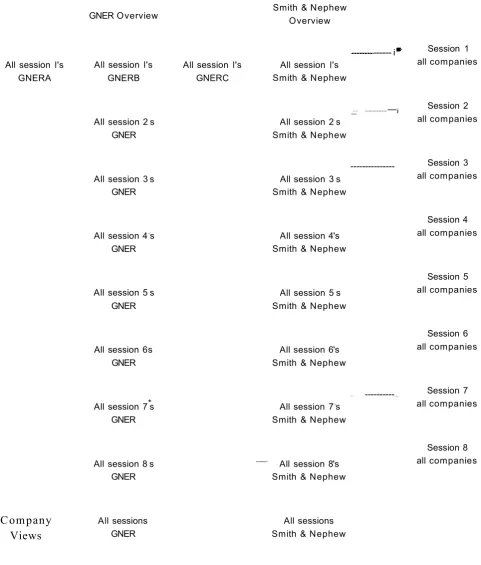
The research process is a cyclical one in which the underlying methodology is a combination of whole brain thinking and reflexivity as demonstrated in Figure 1.
Session Specific Global
All session l's GNERA
Company Views
GNER Overview
All session l's GNERB
Smith & Nephew Overview
■»
All session l's All session l's --- i
GNERC Smith & Nephew
All sessions GNER
<
All session 4 s GNER
All session 4's Smith & Nephew
All session 6s GNER
All session 6's Smith & Nephew
___
All session 8 s GNER
All session 8's Smith & Nephew
All sessions Smith & Nephew
Session 1 all companies
_— ---—j
All session 2 s GNER
All session 2 s Smith & Nephew
Session 2 all companies
---All session 3 s
GNER
All session 3 s Smith & Nephew
Session 3 all companies
Session 4 all companies
All session 5 s GNER
All session 5 s Smith & Nephew
Session 5 all companies Session 6 all companies * > — ---
---All session 7 s GNER
All session 7 s Smith & Nephew
Session 7 all companies
[image:36.614.85.567.115.681.2]Session 8 all companies
Contribution to Knowledge - Making a Synthesis
This heading found the fear in me just as the walker looking at the rickety rope bridge
across the gorge in ‘The Heart Aroused’ found fear (Whyte, D. 1999:47). An original contribution to knowledge is not and does not mean an enormous breakthrough and can in fact be interpreted quite narrowly. It can and indeed should be limited in its scope. In the thesis I am applying tools that have been used before by many people in many ways however the tools have not to date been combined into a simple model that is easily understood and transferable into the modern day hectic chaotic workplace. I intend through the case studies to explore and evaluate the ease of understanding, the ease of use and the transferability of the model. The research combines two theories - reflexivity and whole brain thinking. They are not competing theories but nor are they seen as mutually synergistic theories at this time? W hen they are combined they significantly increase the robustness of the subject matter.
Whole brain thinking is a contentious area and debate continues as to whether there really is a split between the right and the left sides of the brain. It is however an area open for exploring and rich in possibility. I have drawn on the extensive literature available in order to explore this arena of contribution to knowledge.
Phillips and Pugh identified a contribution to knowledge as:
‘Making a synthesis that hasn’t been made before.’ The output from this research will demonstrate that the synthesis between Reflexivity and Whole Brain Thinking is warranted. (Phillips, M. E. and Pugh, D.S. 1994:62).
As this research deepens and broadens other work that will impact on this contribution will emerge and as the task of analysing that enormous quantity of data begins future work has already been identified. For example ‘Iceberg theory’ (see page 40) would
suggest that it would be valuable to explore what the infrastructure is in the organisations that is supporting the context that in turn is impacting on the individuals information processing? W hat is it in the context that causes the change in preferred filters?
in the business context from those they favoured in a personal context. Research findings suggest that as a result the business may lose valuable resource.
Epistemological Contribution
Some time has been spent prior to the fieldwork for this research exploring the four quadrant approach of Johnson and Duberley (2000) to reflexivity.
A subjectivist epistemologically and subjectivist ontologically would place me in the south-east quadrant where postmodernism and some conventionalism is placed. In this quadrant reflexivity is treated variably and can result in both silence and hypereflexivity.’ (Johnson, P. and Duberley, J. 2000:184).
This research seeks to explore if it is the impact/pressure of the contextual situation that creates/constructs’ this impression of 'impossibility’ in synergy with the caveat ‘time poverty’ with additional variables such as core values of safety and security?
Would Scientists if they engaged in Reflexive Whole Brain Thinking understand better and accept more readily the theories of the Social Scientists? Would Social Scientists if they engaged in Reflexive Whole Brain Thinking find a similar situation?
Research findings suggest that when sufficient time is given to whole brain reflexivity the seemingly impossible becomes possible.
Laser technology came about as a result of lots of laboratory work that was not delivering followed by a ‘sit on a park bench’ that allowed the mind to trawl through the a priori and question if they were limiting creativity. The answer was yes and we now have laser technology.
Summary
incremental build up of The Route Map Programme is explained and the feedback that was the motivation for the research for this thesis is discussed. The Contribution to
Knowledge i.e. the synergistic combination of two non-competitive theories is outlined. The use of qualitative multiple longitudinal case studies in two businesses are proffered as the combined methodology and method. The difficulties individuals face when they attempt to input ideas into their businesses are explored and my personal experiences are also displayed. The chapter then goes on to give definitions for the two theories and for the contribution to knowledge’ theory of 'Whole Brain Reflexivity.’
During this research journey I have been forced to face a number of issues about myself as researcher.
Firstly am I impacting on the research merely by being in the room? Secondly have I entered the fieldwork with a set of presuppositions and a predetermined outcome? In later chapters I discuss both these issues. The journey has provided me with a rich data store from the participants and their organisations however that store is very, very full. I have debated long and hard about whether I have chosen the right method of data analysis? Will I lose some of the richness of the data if I utilise the software I have chosen? This issue is explored later in the thesis.
Following this chapter I present a review of literature from which more specific questions emerged in relation to my initial aims and objectives. I then move on to highlight a gap in the literature that the review enabled me to identify. In chapter three I outline my methodology and my method. In chapter four I present the Route Map programme that each participant completed. In chapter five as an aid to understanding the Route Map programme I describe one participant’s journey and explore the new
Chapter Two
Literature Review
Introduction
In this chapter I undertake a comprehensive but not exhaustive literature review. Two main domains of literature are reviewed and the interrelationship between them is
discussed. Firstly Human Information Processing and the movement from left brain or right brain thinking to whole brain thinking. Secondly reflexivity and the varying levels described by different authors are explored. The contribution to knowledge proffered in the thesis is the synergistic combination of these two non-competitive theories. Strategic Thinking is also explored in this chapter as a means of gaining an understanding of what ‘Strategic Thinking’ can mean. In the thesis strategic thinking refers to ‘engaging in shaping and clarifying your individual aspirations to enable review of congruence/conflict with the business aspirations for both the business and the individual.’
In the Route Map Programme participants spend time reflexively thinking about how to leverage their new found knowledge into the business. I am of the opinion that they
Human Information Processing
Researching the literature produced some similarities of opinion and agreement
between various authors on this topic:
♦ we do have a brain
♦ that brain has two distinct parts that can be accessed separately ♦ those two parts use different thinking styles
♦ one part is logical, rational, one part is non logical, emotional ♦ we can access either mode
♦ we usually prefer to access one mode more than another
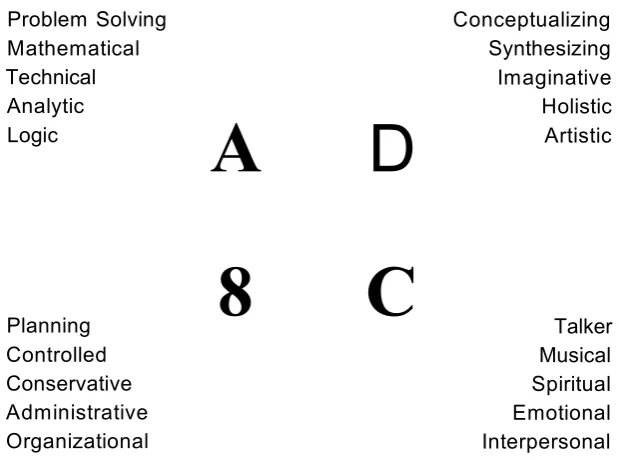
Herrmann for example describes the brain as having two halves or cerebral hemispheres that are connected by some tissue’ (Herrmann, N. 1996:11). The tissue is called the corpus collosum and was the tissue separated in the famous split brain’ operations for epilepsy described by Bogen in 1965. Herrmann goes on to explain that ‘the limbic system is a relatively small, complicated structure, divided into two interconnected halves nestled within each of the cerebral hemispheres.’ (Herrmann, N. 1996:13).
Left Cerebral
Hemisphere Right Cerebral Hemisphere
Left Limbic
System Right Limbic System
The majority of research to date has focussed on the cerebral hemispheres and the
limbic hemispheres both are capable of and involved in thinking. Herrmann describes the four preferences as detailed below.
Problem Solving Mathematical Technical Analytic Logic
Planning Controlled Conservative Administrative Organizational
A
D
8
C
Conceptualizing Synthesizing Imaginative Holistic Artistic
[image:44.613.132.442.90.320.2]Talker Musical Spiritual Emotional Interpersonal
Figure 4: Herrmann Four Hemisphere Preferences - Source Herrmann International @ Herrmann International 2002.
Adams (2003) in his paper describes the four thinking styles discussed on page 33 of the thesis as:
Upper Left Upper Right
♦ Likes working with facts ♦ Seeing the whole
♦ Deals with facts/issues in picture, not detail
a precise and exact way ♦ Likes change & trying new things
♦ Looks at problems in a ♦ Enjoys being busy with several
logical & rational way things at the same time
♦ Likes working with numbers ♦ Has imagination
♦ Interested in technical aspects ♦ Does not readily accept
♦ Performance is im portant “the only right answer”, but
♦ Prefers to analyse facts looks for alternatives
♦ Enjoys a challenge and a risk ♦ Can have a gut-feeling
for new ideas
♦ Can rearrange ideas and put them together into a new whole (synthesising) ♦ Does not always do things
in the same way
Lower Left
♦ prefers traditional thinking (the way I know how)
♦ likes facts to be organized and orderly
♦ likes to work with detail ♦ prefers a stable & reliable
work environment
♦ feels comfortable with procedure ♦ prefers security & safety
to risk risk-taking
♦ facts must be sequential & chronological
♦ the task at hand is important - will complete it on time ♦ likes practical aspects
Lower Right
♦ facts experienced in an emotional way ♦ sympathetic & intuitive
towards people ♦ likes interaction
♦ makes use of figurative language as well as non verbal communication (body language, facial expressions) ♦ feels empathy towards others ♦ problem solving is often an
emotional, not a logical process ♦ shows enthusiasm when
he/she likes a new idea
‘The person with strong lower left preferences would prefer to organize and keep track of essential information. Projects are implemented on time and this person keeps a firm hand on financial matters. Security is a priority.’
‘The person with strong lower right preferences would have a ‘feel’ for people and situations, be able to read the body language of others and enjoy social interaction.’
‘The person with strong upper right principles would tend to see the big picture rather then the detail, recognize hidden possibilities, not always play according to the rules
and act upon a gut-feeling rather than logic for problem solving; this person wants to do his or her ‘own thing.’ (Adams, J 2003:3).
♦ 60% of the population are dominant in any two styles ♦ 30% in any three styles
♦ 7% are single dominant
♦ 3% are whole brained i.e. equally at home with all four styles.’
‘There is no best profile. There are strengths of any profile just as there are challenges
for any profile.’
Barnard in his essay ‘Mind in Everyday Affairs’ published as an appendix to his ‘Functions of the Executive’ ‘found it convenient and significant for practical purposes to consider that these ‘mental processes’ consist of two groups.’ Barnard highlighted the logical and non-logical processes that, woven together, form the decision-making fabric of an organisation. By logical processing Barnard meant ‘conscious thinking that can be expressed in words or other symbols - reasoning. A non-logical process is one that cannot be expressed in words or described as a thought process, but may be recognised in the result as some action, such as a judgement or a decision.’ (Barnard, C. 1. 1938:302).
In Barnard’s view a manager has access to either mode as the situation demands. From my research findings I would go further and suggest that to access a mode the individual requires awareness that that particular mode is called for in that situation. For example when talking to the bank manager about a loan it is im portant to access the logical mode rather than the non-logical mode if the loan is to be secured. Some individuals approaching a bank manager do so from a position of emotion - the loan is im portant to them, is connected into what they want to do next with their life. ‘They may fail to access the very mode that would help them achieve their goal.’ (Barnard, C. I. 1938:302).
Underpinning this research is the understanding that we as individuals are a coalition of four different ‘thinking’ selves and we prefer to use one or more of those selves
of preference can also have visible behavioural consequences. The chances are good that we will do the things that we prefer to do and not do those things that we prefer not to do. In the thesis time is taken to reflexively review the behavioural operating
model that is in situ at the beginning of the programme and the comfort zones plus programmes that sit within that model. In this way individuals become aware of their preferences and the behavioural consequences that result which can be both positive and negative.
Leavitt urges ‘moving in the direction of integrating wisdom and feelings with analysis.’ He suggests that ‘individuals who have this capability are worth a great deal to an organisation'. He further suggests ‘that because management education emphasises the analytical style such integration may be difficult and that an integrated, flexible emphasis would better serve the needs of management education’ (Leavitt, H. J. I975b:20 cited in Taggart, W. and Robey, D. 2001:189).
W hen conceptualising and implementing strategy the consequences of thinking only in a ‘preferred way’ can be costly both in terms of the resistance you meet en-route and the amount of time it takes to execute your strategy.
Taggart & Robey in their article on Human Information Processing state that ‘For hundreds of years humanity has been intrigued by the dual nature of human consciousness. They describe ‘...the dual nature of human consciousness’ as ‘from one perspective people are logical and rational, goal-directed and scientific, technical and analytical. From the other people are mysterious and intuitive, non-logical and subjective, artistic and emotional’ (Taggart, W. and Robey, D. 1981:187). These contrasting terms are most often used to describe differences ‘among’ people.
Recent neuro-physiological research points to the existence of these two ‘types of minds’ within each person. The two hemispheres of each individual brain are processing information in different ways. In the past scientists have concentrated on supposed
two separate theories (MacLean’s and Sperrys) into a four-part model representing the whole thinking brain.’ (Herrmann, N. 1996:15).
'The way we approach our work may be governed by which part of the mind controls our thinking, which in turn may be impacted by the contextual conditions. We all at some point in our working day use both sides of our brains, all four hemispheres. However we prefer to use the hemispheres that have, to date, given us the best results.’ (Hermann, N. 1996).
The findings which are discussed in more detail in later chapters explore this concept as individuals gain awareness of how they have been operating behaviourally and how the context in which they have been operating has impacted their preferred filtering.
Left Cerebral Hemisphere: Analytical
Right Cerebral Hemisphere: Conceptual
Left Limbic System: Organised
Right Limbic System: Humanistic
Figure 5: Whole Brain Model 2, My Interpretation from Herrmann, N (1996).
identified with the left hemisphere/ Formal planning seems to use processes akin to
those identified with the left hemisphere/ (Mintzberg, H. 2000:57,53). He also states that ‘Frederick Taylor’s1 work resulted in a shift of management activities into that of the conscious analysis/ He states that managers and those who work with them need to be careful to distinguish that which is best handled analytically from that which must remain in the realm of intuition, where, in the meantime, we must be looking for the lost keys to management/ (Mintzberg, H. 2000:58).
In more recent work Mintzberg and Gosling explore the different borders that get in the way of management education. ‘The management education classroom should be a teaching place where managers can reflect thoughtfully on their experience.... MBA schools should graduate collaborative managers rather than individual specialists/ Whole brain thinking would describe individual specialists as favouring left side brain behaviours whereas the collaborative managers would favour more right brain behaviours. (Mintzberg, H. and Gosling, J. 2002:64).
Gosling outlines five mindsets - the reflective, the analytical, the worldly, the collaborative and the action mindset which he suggests blend into one integrated learning experience and says that they indicate how managers interpret and deal with the world. Mintzberg asks ‘can you be worldly without the ability to adapt how you process your information? If the business context impacts on how you process information does it not also impact on your worldliness? Should the business be aware of its ‘mindsets’ i.e. the context it is encouraging’? All three of these questions are explored in the thesis. Gosling and Mintzberg describe ‘mind set’ as an attitude, a
frame of mind that opens up new vistas. (Gosling, S. and Mintzberg, H. 2003:56)
M intzberg's Five Managerial Minsets Overlain onto the w hole brain m odel Five ways in w hich managers interpret and deal w ith the w orld
M apping Organisations M anaging Context
Analytical Synthesising
The analytical mindset The w orldly m indset
M anaging Change
The action m indset The collaborative m indset Process/doing Instinctive
M anaging Self M anaging Relationships
Figure 6: Mintzberg’s Five Managerial Mindsets.
Gosling and Mintzberg states change to be successful cannot follow some mechanistic
schedule of steps ... There is no such thing as a straight line.’ (Gosling, J. and Mintzberg, H. 2003:62). In the thesis the participant drives the progress along the ‘Route Map’ chooses the stopping places and the route.
Leonard and Strauss in their article ‘Getting the Whole Organisation brain to work’ make a number of key points: ’Organizations must innovate or fall behind.’ This is difficult, since different ideas, perceptions and ways of processing foster innovation.
This creative abrasion can be a productive process when understood and managed properly. Managers have various responses to this phenomenon. Some avoid conflict
Leonard and Strauss also state that ‘The best way for a manager to assess thinking styles is to use an established diagnostic instrum ent as an assessment tool. A well- tested tool is both more objective and more thorough than the impressions of even the most perceptive manager? Managers who use diagnostic instruments find that their
employees accept the results and use them to improve their processes and behaviours.' (Leonard, D and Strauss, S. 1997:113). There are a number of diagnostics such as Belbin or Myers Briggs Type Indicator that can be used to interpret thinking styles however in most cases the diagnostic delivers a ‘label’ as a result. Individuals leave the room with an additional label to the ones they had when they entered the room. Not particularly helpful if what you are trying to achieve is more awareness of self ‘as is.’
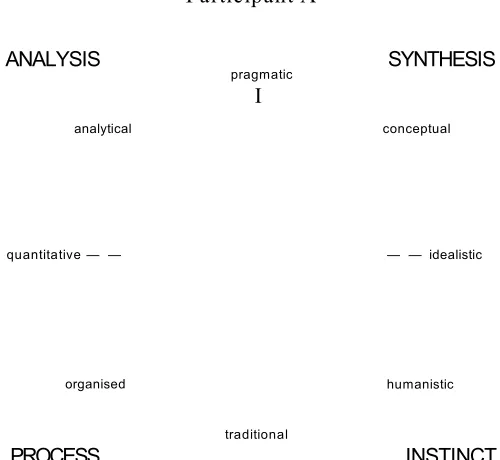
In the thesis a diagnostic is used to evaluate individual preferred and non preferred thinking. The diagnostic is not a scientifically ‘valid’ diagnostic in that there are no hidden checks and balances to sift the genuine entries from the false entries. My supposition is that the participants genuinely want to understand how they are filtering information and as a result they complete the diagnostic honestly. I did not share this information with participants however it was satisfying to note the congruence of the results with previous results. The diagnostic results are delivered as two ‘shapes.’ One shape is the preferred thinking result personally and one shape is the preferred thinking result in a business context. The model below shows an example of the output results for Participant A.
Your current preferences
Participant A
ANALYSIS SYNTHESIS
pragmatic
I
analytical conceptual
quantitative — — — — idealistic
organised humanistic
traditional
[image:53.612.160.410.49.279.2]PROCESS INSTINCT
Figure 7: Current Business Preferences.
Being EXPLORING
DEPENDABLE , What's New
Thinking 1 Trusting
RATIONALITY ' INTUITION
Figure 8: Current Personal Preferences.
I emphasise that the diagnostic has no scientific validity. The questions were deemed to be rational/analytical, organised/process, conceptual/synthesis, feeling/instinct via perception (mine and others) it has however withstood the test of time and lots of
participants feedback. The diagnostic is used solely as a facilitative tool to demonstrate the preferred thinking style and to explore any congruence or variance between the two shapes.
Herrmann and Sperry raise the question, 'Should you aspire to be whole brained with equal preference for thinking in all four hemispheres’? Herrmann answers ‘No. The world would be a very dull place indeed.’ He suggests that ‘everybody’s objective should be to be as situationally whole brained as possible.’ (Herrmann, N. 1996:38). This would mean that you retained the advantage of your dominant preference for everyday situations but that you would not be limited by that preference causing you to filter out some vital information. In the thesis findings suggest that it is the ability to adapt our thinking situationally that is a key driver to achieving a successful outcome.
Herrm ann also questions whether we are genetically programmed and again he answers no. He concludes ‘we are the product of both nature and nurture and that for most of us it is the nurture aspect that predominates.’ (Herrmann, N. 1996:34). If we are as he suggests not limited by our genetic inheritance then the learning that takes place as we journey through life can enhance our ability to choose preferences situationally. In the thesis findings suggest that the positive learning experiences that deliver good results can also limit our situational adaptiveness as they reinforce a way of working that may not be effective in all situations and can lead to filtering out of im portant data.
‘Substantial clinical evidence has grown out of Bogan’s work with ‘split brain’ patients beginning in the early 1960’s. In this surgery, as explained by Bogan, patients suffering
the left hemisphere, which is responsible for speech cannot name the object since the image of the spoon cannot be communicated from the right to the left hemisphere for conversion to words. ‘The patient knows with ‘one m ind’ what the object is but cannot verbally express it with the other mind. A variety of evidence has made it clear that one hemisphere of the cerebrum is sufficient to sustain an individuals personality or mind.’ Bogen wrote ‘we may conclude that the individual with two intact hemispheres has the capacity for two distinct minds/ (Bogen, 1969:157). In the thesis one of the aims was to enable individuals to become aware of those two distinct minds.
Reflexivity
Reflexivity is an emergent theme and in the process of this literature search I found the word used in many different senses such that confusion was easier to find than understanding. In the thesis reflexivity concerned with movement and with being reflexive on a number of different levels. On the level of self, on the level of others and on the level of business. In addition the researcher is reflexive about self and about the way in which the research is carried out.
Reflexivity involves reflecting on the way in which research is carried out and understanding how the process of doing research shapes its outcomes. Holland (1999).
Holland suggests that, ‘human sciences have been infused with a new sense of flexibility and uncertainty concerning knowledge and learning/ This emergent theme he suggests ‘comes in from many disciplines and specialities, there is inevitably some confusion as to the basis of this new sensibility and similarly as regards its application/
(Holland, R. 1999:463). There are however also those who argue reference the negative attributes of reflexivity. For example reflexivity has been argued to be ‘self-defeating and potentially devastating for the sociology of scientific knowledge/ (Davis, J, B. and Klaes, M. 2003:329).
scrutinise. This can lead to situations of deadlock which is contrary to the whole idea of reflexivity/ (Alverson, M. and Skoldberg, K. 2003). By deadlock they explain that the quantitative approach of focussing on procedures and techniques may underrate the need for reflection. On the other hand there are risks involved in too big an emphasis on the need for reflection leading to hyper-reflexivity. The thesis proposes that taking a whole brain approach would enable the required balance to emerge.
‘In the methodology of social sciences reflexivity is frequently discussed as a problem’ which threatens to undermine the research efforts of the social scientist/ (Lentin, R. 2005:7) suggests that we beware, push reflexivity and it becomes objectivity/
Beck meanwhile distinguishes reflexivity from reflection by suggesting that reflection
refers to a subject’s more or less con