PERCEPTION AND PROGRESS OF MAGGOT THERAPY: A
PROSPECTIVE STUDY IN MOROCCO
M. R. Sefrioui1*, S. Ibnourras2, M. Boui3, S. Elhamzaoui4, Y. Cherrah5 and S. Derraji5
1
Central Sterilization Service, Military Teaching Hospital Mohamed V, Rabat Morocco.
2
Faculty of Medicine and Pharmacy, Rabat Morocco.
3
Dermatology Service, Military Teaching Hospital Mohamed V, Rabat Morocco.
4
Microbiology Service, Military Teaching Hospital Mohamed V, Rabat Morocco.
5
Laboratory of Pharmacology-Toxicology, Faculty of Medicine and Pharmacy, Mohamed V
University, Rabat Morocco.
ABSTRACT
Introduction: The use of antibiotics after the Second World War was a
significant medical event because of the high healing potential of
bacterial infections. However, infections due to multi-drug resistant
bacteria are increasing worldwide and have become a major public
health problem. This urges us to look for alternative methods such as
maggot therapy, which has been proven to have incredible
effectiveness in the management of several pathologies such as diabetic
foot and infections due to multi-drug resistant bacteria. However, the
introduction of Maggot therapy into the therapeutic arsenal requires a
perception study among physician prescribers and patients. Therefore,
the aim of our study is to understand the place of the maggot therapy in the current stake of
fight against the multi-resistant infections and to study its perception among Moroccan
physician prescribers and patients. Subjects and Methods: A prospective study was carried
out, covering a 5 month period, from 10 July 2017 to 13 December 2017. It focused on 321
patients suffering from different injuries and 103 physician prescribers interviewed in various
hospital settings from three regions in Morocco. The results were exploited using computer
software, survey and statistical data analysis, the Sphinx plus V.5. Results: Only 25% of the
301 interviewed physician prescribers were aware of the maggot therapy during the study
period. After outlining the benefits of larval treatment, 95% of them agree to handle and even
use, it in many cases, as an alternative to conventional treatments. Moreover, we also noted
Article Received on 28 Dec. 2017,
Revised on 17 Jan. 2018, Accepted on 07 Feb. 2018,
DOI: 10.20959/wjpr20184-11134
*Corresponding Author
M. R. Sefrioui
Central Sterilization Service, Military Teaching Hospital Mohamed V, Rabat Morocco.
that 66.5% of the 321 interviewed patients accepted treatment with maggot therapy. The
young and male population is the most courageous for this type of treatment with a sex ratio
of 2.19. Conclusions: The maggot therapy is an old technique that has proven its
effectiveness in the management of several pathologies, particularly the diabetic foot and
infections due to multi-drug resistant bacteria. Nowadays, this technique is starting to be
reintegrated in several countries. The study of the perception of the maggot therapy is an urge
to improve its progress among the therapeutic arsenal in the world and in Morocco as well.
KEYWORDS: Maggot therapy - Lucilia sericata - Bacterial resistance.
INTRODUCTION
The appearance of antibiotics after the Second World War was a significant medical event
because of the high healing potential of bacterial infections. However, antibiotic resistance
and the lack of marketing of new antibiotic molecules have limited the treatment of a number
of diseases and condemned several patients to a therapeutic impasse. This has sparked a new
interest in alternative methods including maggot therapy. In the years 1990/1995, simplicity,
efficiency and low toxicity led physicians to accept this type of treatment of pleasures around
the world.[1] Maggot therapy, or larvothérapie in French, is a therapeutic technique that relies
on the use of larvae of the greenfly, Lucilia sericata or Phaenicia sericata for therapeutic
purposes. In effect their larvae feed exclusively on dead or necrotic tissue, unlike other
species that also feed on healthy tissue, which is harmful because they can be the cause of
disease or infection.[2][3][4]
Larval therapy uses sterile larvae, it is a form of artificially induced myiasis in a well
controlled clinical situation. The effects of larvae on wounds can be divided into three general
mechanisms: debridement, antimicrobial effect and stimulation of wound healing.[4]
Debridement involves ridding the wound surface of necrotic tissue and fibrin. The
antimicrobial effect is obtained by the secretion of bactericidal substances: Allantoin,
Phenylacetic acid and Phenylacetaldehyde.[5] The larvae have a mechanical action and ensure
a decrease in the bacterial load adhering to necrotic tissue. The passage of bacteria thus
absorbed into the digestive tract of the larvae seems to be fatal.[6] Stimulation of healing is
achieved by increased proliferation of fibroblasts in the presence of different secretions of the
larvae. The goal of the maggot therapy is to take advantage of the ability of the larvae to
Currently, larval therapy is universally recognized and can be used to treat chronic, long, and
infected wounds that have not previously responded to conventional treatment. Such wounds
are generally characterized by the presence of necrotic tissue, an underlying infection and
poor healing.
In Morocco, the introduction of maggot therapy into the therapeutic arsenal requires a
perception study among prescribers and Moroccan patients. The objective of our investigation
is to understand the place of the maggot therapy in the current stake of fight against the
multi-resistant infections and to study its perception among the prescribers and the Moroccan
patients.
Photo N°1: Treatment of an Infected
Wound by Maggot Therapy[7]
Photo N°2: Treatment using Maggot
therapy[8]
MATERIALS AND METHODS
It is a prospective, descriptive and analytical study spread over a period of 5 months, from 10
July 2017 to 13 December 2017, carried out in three regions of Morocco: the
Souss-Massa-Drâa region, the Casablanca-Settat region and the Rabat-Salé-Zemmour-Zaer region.
The criteria for inclusion of our survey are all prescribing physicians whatever their
specialties. Also included in our study are all adult subjects, men or women, over the age of
15 and coming to see a doctor in the hospitals and also without any medical consultation.
Exclusion criteria are non-prescribers and the population under 15 years of age.
The perception of maggot therapy, in the prescribers and the Moroccan patients, is studied
paper format. The second, intended for prescribers, is written in French only and comes in
two forms. Either in paper format, manually filled by the prescriber directly on site. Either in
digital format formulated by "Google Form" and completed online by prescribers. The vast
majority of questions are dichotomous.
The prescribing physicians 'and patients' questionnaires were used with Sphinx plus V.5
computer software. It is software for investigation and analysis of statistical data.
RESULTS
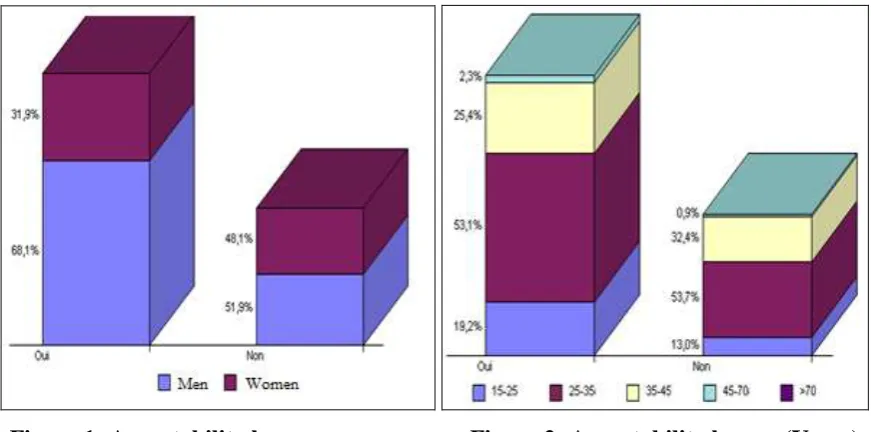
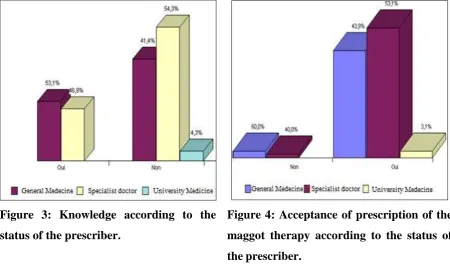
Our study has a population of 321 patients of which 62.6% are men and 37.4% are women,
with a sex ratio of 1.67. Among all our patients, the age group 25-35 years is predominant
with a rate of 53.3%, followed by the age group 3545 years (27.7%), then the age group 15
-25 years (17.1%) and the 45-70 age group (1.9%). The results of our survey reveal that 66.4%
of our subjects immediately accept treatment with maggot therapy with a predominance of
male sex (68.1%). The 25-35 age group is the one that most commonly accept treatment with
maggot therapy, both in men (53.1%) than in women (53.7%). Figure 1 shows the
acceptability of maggot therapy by sex and Figure 2 shows the acceptability of maggot
[image:4.595.80.516.441.657.2]therapy according to the age group of the subject.
Figure 1: Acceptability by sex Figure 2: Acceptability by age (Years)
Of all our patients, 33.6% refuse first-line larval treatment. Of these, 77.7% accept this
treatment when prescribed by their doctor and 22.3% refuse this type of treatment even if it is
prescribed by the attending physician. Of these 22.3%, almost all patients (99.8%) accept
During our survey, 103 prescribing physicians were interviewed in various hospital settings
(University Hospital Centers (CHU), Regional Hospital Centers (RHC), private sector
doctors). Of the prescribing physicians surveyed, 58% are general practitioners, 40% are
specialists and 2% are university doctors. Only 25% of the prescribers surveyed know about
maggot therapy. Figure 3 shows the knowledge of the maggot therapy according to the status
of the prescriber.
Our survey also reveals that of the 103 prescribing physicians surveyed, 95.1% are willing to
prescribe maggot therapy for their patients. It is the specialist physicians who make up the
vast majority (53.1%). Figure 4 shows the acceptability of prescription of maggot therapy
according to the status of the physician. Of the prescribers favoring Larvalotherapy, 81.5% of
the doctors are ready to prescribe it only as therapeutic alternatives and 18.5% of the
prescribers accept it routinely in clinical practice.
Figure 3: Knowledge according to the
status of the prescriber.
Figure 4: Acceptance of prescription of the
maggot therapy according to the status of
the prescriber.
DISCUSSION
Our results are very similar and almost superimposable to those of an observational study at
the Dermatology Department of the R. Picqué Army Teaching Hospital, Bordeaux, led by
Professor Pascal Toussaint through retrospective questionnaires. To evaluate the initial
perception of the maggot therapy. According to this study, 86% of patients immediately
accept treatment with maggot therapy, compared to only 14% who refuse it.[9] Our study also
[image:5.595.71.522.347.616.2]ratio of 2.19. The 25-35 age group represents 53.1% of this population. This shows that the
young and male population is the most courageous for this type of treatment. The majority of
patients who initially refused larval treatment eventually accept it if prescribed by their
attending physician. Almost all patients (99.8%) accept it if it is the last therapeutic
alternative. This shows the primary role of prescribing physicians in explaining to Moroccan
patients the benefit of this technique because of its effectiveness and the absence of
significant adverse effects.[10]
The study showed that 75% of Moroccan prescribers did not know about maggot therapy.
Specialist doctors are the most concerned with a rate that exceeds 50%. The lack of this
technique in current therapeutic practices and the lack of continuous training are all factors
that prevent the development of larval therapy in Morocco.
The emergence of the phenomenon of bacterial resistance in Morocco[11] is probably the
major factor that pushes the majority of Moroccan prescribers to accept this type of treatment
for their patients. Indeed, after a presentation of the benefits of this type of treatment to
prescribing physicians, 95% agree to handle it and prescribe it. The vast majority of
physicians (81.5%) accept larval treatment as an alternative to conventional treatments
because of an increase in the therapeutic impasse due to bacterial resistance and particularly
the diabetic foot superinfected by stage-resistant germs. amputation.
The study revealed that 94% of Moroccan prescribing doctors are ready to convince their
patients to withdraw and 91% agree to advise their fellow prescribers. These positive data are
favorable to the introduction of maggot therapy into the therapeutic arsenal in Morocco.
The relationship Patients / Prescribers plays an undeniable role for the success of the
re-emergence of this ancestral technique. According to Professor Pascal Toussaint's study, all the
patients subjected to this type of treatment are ready to repeat this technique in case of new
ulcers.[9]
CONCLUSION
Larval therapy, ancestral technique, has been abandoned in favor of antibiotic therapy. This
technique for which there are few benefit / cost studies deserves to be known, since it allows,
in particular indications, to ensure rapid, selective debridement and with a satisfactory
Today this technique must be reintegrated into the therapeutic arsenal because of their
incredible effectiveness in the management of several pathologies such as diabetic foot and
multi-resistant infections.
BIBLIOGRAPHIC REFERENCES
1. Nigam, Y., et al., Maggot Therapy: The Science and Implication for CAM Part I—History
and Bacterial Resistance. Evidence-based Complementary and Alternative Medicine,
2006; 3(2): 223-227.
2. Robinson, W.a.V.H.N., The role of surgical maggots in the disinfection of osteomyelitis
and other infected wounds. Bone Joint Surg Am, 1933; 15: 409-412.
3. Wollina U, K.K., Herold C, Looks A. J Biosurgery in wound healing - the renaissance of
maggot therapy. Eur Acad Dermatol Venereol, 2000: 14: 285-9.
4. Win Fleischmann, M.G., Ronald Sherman, MAGGOT THERAPY - A Handbook of
Maggot-Assisted Wound Healing. THIEME.
5. Sherman, R.A., Maggot Therapy Takes Us Back to the Future of Wound Care: New and
Improved Maggot Therapy for the 21st Century. Journal of Diabetes Science and
Technology, 2009; 3(2): 336-344.
6. McKeever, D.C., The Classic: Maggots in Treatment of Osteomyelitis: A Simple
Inexpensive Method. Clinical Orthopaedics and Related Research, 2008; 466(6):
1329-1335.
7. Bonn, D., Maggot therapy: an alternative for wound infection, The Lancet, Volume 356,
Issue 9236, September 2000, DOI: 10.1016/S0140-6736(05)72870-1
8. Maggot Therapy: The Science and Implication for CAM Part I—History and Bacterial
Resistance - Scientific Figure on ResearchGate. Available from:
https://www.researchgate.net/Wound-following-three-applications-of-maggots-The-wound-is-completely-free-of-slough-and_6998074 [accessed 26 Jan, 2018]
9. Database of larvotherapie : http://www.e-plastic.fr/pdf/plaies/larvotherapie.
10.A. Parne s, K.M.L., Larval therapy in wound management.
11.S. Serragui, S.D., F. Mahassine, Y. Cherrah, Résistance bactérienne : états des lieux au