Clinical Ophthalmology 2017:11 1407–1416
Clinical Ophthalmology
Dove
press
submit your manuscript | www.dovepress.com 1407
O r i g i n a l r e s e a r C h
open access to scientific and medical research
Open access Full Text article
Changes in macular parameters in different types
of amblyopia: optical coherence tomography study
Manal ali Kasem amani e Badawi
Department of Ophthalmology, Faculty of Medicine, Mansoura Ophthalmic Center, Mansoura University, Mansoura, egypt
Purpose: The purposes of this study were to investigate the changes in macular parameters
(thickness, volume) and peripapillary retinal nerve fiber layer (RNFL) thickness (RNFLT) in different cases of amblyopia versus the normal fellow eyes using optical coherence tomography (OCT) and to estimate the relationship of OCT changes with various defined patients’ parameters.
Design: This is a prospective, observational, cross-sectional case series.
Methods: The method involved measuring the peripapillary RNFLT, macular thickness, and
macular volume via spectral domain (OCT) in different types of amblyopia and comparing with the other fellow eyes. This study was conducted at the Mansoura Ophthalmic Center. Results: A total of 64 patients with different types of amblyopia were included. The mean central macular thickness (CMT) was 196.2±50.03 µm in the amblyopic eyes versus 167±12.76 µm in the fellow eyes (P=0.000), the mean average macular thickness was 265.80±12.77 µm in the amblyopic eyes versus 259.10±3.09 µm in the fellow eyes (P=0.000), the mean macular volume was 7.59±0.32 mm3 in the amblyopic eyes versus 7.34±0.071 mm3 in the fellow eyes (P=0.002), and the mean global RNFLT was 97.00±11.60 µm in the amblyopic eyes versus 78.50±13.05 µm in the fellow eyes (P=0.029). There was a discrepancy between the different amblyopic types. Age and the axial length were the only independent variables that statistically significantly correlated with the CMT.
Conclusion: The unilateral amblyopic eyes were prone to have a higher CMT and thicker global RNFL compared to those of the sound fellow eyes. Retinal variations between different types of the amblyopia differ from one type to another. The age could be considered as a predictor of the disease worsening and treatment prognosis. Further studies are required to emphasize these results.
Keywords: amblyopia, strabismus, anisometropia, optical coherence tomography
Introduction
Amblyopia is known as unilateral- or bilateral-reduced best-corrected visual acuity (BCVA) in response to abnormal visual stimulus throughout a critical period of development of the visual areas in the brain. Yet, some studies found a strong associa-tion between the amblyopic eye and cellular atrophy in the lateral geniculate nucleus (LGB).1–3 Modern advances in neuroanatomy and neurophysiology have reopened the
possibility that there is some retinal dysfunction in amblyopia.4 The retina is
consid-ered a motivating region for studying amblyopia and is still under investigation. The retinal alteration in the amblyopic eyes has not been clarified yet.5 Amblyopia might
affect the postnatal maturation process of the retinal ganglion cells (RGCs), resulting in RGC reduction and abnormalities.6
Correspondence: amani e Badawi Department of Ophthalmology, Faculty of Medicine, Mansoura Ophthalmic Center, Mansoura University, Mansoura, 60 elgomhoria st, Dakahlia governorate 35516, egypt
Tel +20 10 0381 8271
email [email protected]
Journal name: Clinical Ophthalmology Article Designation: Original Research Year: 2017
Volume: 11
Running head verso: Kasem and Badawi
Running head recto: Changes in macular parameters in different types of amblyopia DOI: http://dx.doi.org/10.2147/OPTH.S143223
Clinical Ophthalmology downloaded from https://www.dovepress.com/ by 118.70.13.36 on 21-Aug-2020
For personal use only.
Number of times this article has been viewed
This article was published in the following Dove Press journal: Clinical Ophthalmology
Dovepress Kasem and Badawi
Optical coherence tomography (OCT) is a noncontact and non-invasive high-resolution imaging technology of the retinal layers.7 There have been various attempts to
investi-gate the structural changes in the macula and retinal nerve fiber layer (RNFL) of amblyopic eyes.8,9
So far, the study of macular and RNFL variations in amblyopic eyes is still an interesting research topic due to the diverse published results10–14 and the lack of evident
asso-ciation between these changes and the patients’ parameters. Hence, this study was aimed to compare the variations in macular parameters (central thickness, average thick-ness, macular volume) and parapapillary RNFL thickness (RNFLT) in different cases of Egyptian amblyopic eyes versus the normal fellow eyes using spectral-domain OCT. In addition, it aimed to estimate the relationship of OCT variations with different defined patients’ parameters (age, sex, BCVA, spherical equivalent [SE] refractive error, and axial length [AL]).
Patients and methods
The study was designed as a prospective, observational, cross-sectional study, which was conducted from April 2013 to April 2014 at the Mansoura Ophthalmic Center, Mansoura University, Egypt.
ethical consideration
The study was registered and reviewed by the ethics commit-tee of Faculty of Medicine, Mansoura University. Approval from the Institutional Review Board was obtained and the study adhered to the Declaration of Helsinki (institutional review board [IRB]: R/16.10.41). Written informed consents were obtained from all patients or their parents after the nature of the study was well discussed.
subjects
inclusion and exclusion criteria
All cooperating patients with unilateral moderate amblyopia (visual acuity [VA] ranged from 0.3 to 0.1) and strabismic, anisometropic, and deprivational amblyopia with central fixation were included. Uncooperative patients, mixed amblyopia patients, patients with severe amblyopia with poor or eccentric fixation (VA ,0.1), mentally retarded patients, and patients with any structural abnormalities of the eye, either congenital or acquired, were excluded.
Methodology
All enrolled patients underwent a complete history taking, including ocular history, general history, and family history;
a comprehensive eye examination was performed, including slit lamp examination, cover test, prism bar cover test, assess-ment of ocular moveassess-ments, and fundus examination using indirect ophthalmoscope. Cycloplegic autorefraction was determined by Canon auto refractometer (Canon CR-30; Canon, Inc., Huntington, NY, USA) and then assured by cycloplegic retinoscopy. Errors of refraction were converted into the SE. The SE was elucidated as the algebraic sum of spherical power plus half of the cylinder power in diopter (D). Monocular distance VA was tested (uncorrected and BCVA) using a Snellen chart and then converted into a decimal nota-tion. The VA was tested by the single symbol presentanota-tion. Unfortunately, there were no facilities to use amblyopia VA charts. All patients tested by the same chart and in the same situation. Amblyopia was defined as BCVA ,20/40 or 6/12 in the affected eye, not attributed to any underlying structural abnormality of the eye or visual pathway, together with two or more lines on Snellen chart difference between the two eyes. Anisometropic amblyopia was assigned as the cause if there was at least $1.0 D hyperopic differ-ence in SE refraction between the two eyes in the absdiffer-ence of strabismus, $3.0 D myopic difference in SE refraction between the two eyes in the absence of strabismus or $1.5 D astigmatic difference in SE refraction between the two eyes in the absence of strabismus. Strabismic amblyopia was assigned as the cause if heterotropia was present or there was a history of previous strabismus surgery without ani-sometropia. Stimulus deprivation amblyopia was assigned as the cause if congenital cataract, ptosis, corneal opacities, or other media opacities obstructed vision. Mixed amblyopia was assigned as the cause, if any, of preceding causes, were present in combination.15
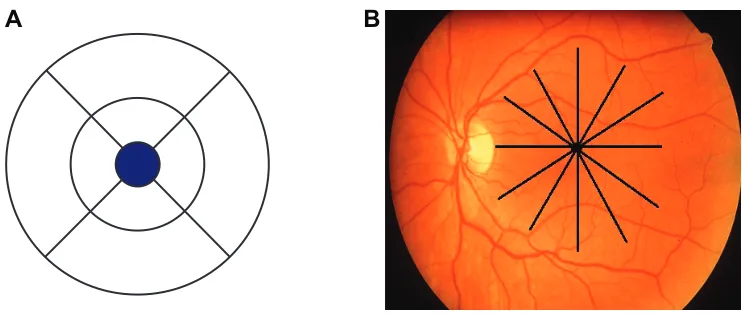
Macular imaging was accomplished with an OCT device (Topcon 3D-1000 Mark II; Topcon Medical Systems, Inc., Oakland, NJ, USA). A cube 6 mm ×6 mm in length fixed on the macular area was scanned with a resolution of 128–512 µm. Pupillary dilation to a diameter of at least 5 µm was done before the scanning. Internal fixation was used for all patients. Foveal fixation was assured by observing the retina via the infrared monitoring camera. The high-density type with a typical 2 µm deep and 6 µm wide image was performed for macular scans. A 6 µm macular thick-ness map centered on the foveola that divided the macula into nine regions was used (Figure 1).16 The quantitative
assessment was performed by the use of the color-coded graph and the numerical map. The 6 µm ring was divided into three rings, with the central ring corresponding to the fovea (1 µm diameter), the middle ring corresponding to the
Clinical Ophthalmology downloaded from https://www.dovepress.com/ by 118.70.13.36 on 21-Aug-2020
Dovepress Changes in macular parameters in different types of amblyopia
perifovea (2 µm diameter), and the outer ring corresponding to the parafovea (3 µm diameter; Figure 2). Central macu-lar thickness (CMT; foveal thickness) was defined as the average macular thickness in the central 1 µm,16,17 average
macular thickness was defined as the mean of thicknesses in nine regions,18 and macular volume was defined as the sum
of volumes in all nine regions. RNFLT was scanned with a diameter of 3.4 µm around the optic disk. The software measured the mean thickness values for each quadrant (supe-rior, infe(supe-rior, temporal, and nasal) and the average global thickness of RNFL. The scanning was done on the normal eye first and then repeated on the amblyopic eye in the same visit. To ensure more accuracy, all the OCT scans were taken by the second author. Well-focused and good-quality scans
with a signal strength of .20 were only included, and poor quality or decentered scans were excluded.
The AL was measured by a Nidek’s ultrasound device (Nidek US-4000; Nidek Medical Products, Inc., Fremont, CA, USA). Three readings were taken, and the average AL was cal-culated in micrometers (µm) and used as an actual initial AL.
Data collection
BCVA, AL, SE, CMT, average macular thickness, macular volume, and RNFLT in different quadrants were collected from the amblyopic eyes and the fellow eyes as well as the age and the sex of all participants were collected.
statistical analysis
Statistical analysis was performed using SPSS program version 20 (IBM Corporation, Armonk, NY, USA). All vari-ables were displayed in mean ± standard deviation. A paired
t-test (two-tailed) was conducted to compare the mean of study
outcomes between the amblyopic eyes and the other fellow eyes. The association between the macular parameters and RNFLT and the defined patients’ parameters (age, sex, BCVA, AL, SE) was estimated by the linear regression test. To adjust the effect of SE on AL, the correlation using linear regression test between AL and SE was performed with a predicting equation to get “adjusted AL”. The normality of study vari-ables was tested by the histograms and P–P plots. The P-value of #0.05 was considered as statistically significant.
Results
Demographic data and grouping
of the patients
A total of 64 patients were included whose age ranged between 7 and 32 years. The mean age was 13.3±3.7 years.
$
%
Figure 1 (A) The macular diameter map in mm with 9 regions centered around the foveal thickness (blue circle). (B) The macula with six radial lines centered on the fovea, each line equally oriented from the other (30 degrees between).
P
P P
Figure 2 schematic illustration of the macular map showing three concentric rings, with the central ring corresponding to the fovea (1 µm diameter), the middle ring corresponding to the perifovea (2 µm diameter), and the outer ring corresponding to the parafovea (3 µm diameter).
Clinical Ophthalmology downloaded from https://www.dovepress.com/ by 118.70.13.36 on 21-Aug-2020
Dovepress Kasem and Badawi
In all, 35 patients were females and 29 were males. The patients were classified into three main groups: strabismic amblyopia (22 patients), anisometropic amblyopia (30 patients), and deprivation amblyopia (12 patients). The anisometropic group was subdivided into three subgroups: myopic anisometropia (10 patients), hyperopic anisometropia (14 patients), and astigmatic anisometropia (six patients; Table 1).
Comparison of the mean macular
thickness and rnFlT in amblyopic
eyes versus the normal eyes
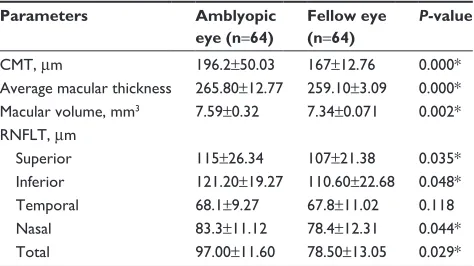
The mean macular thickness (central thickness, average thickness, and macular volume) and the mean RNFLT in all patients versus the fellow eyes are presented in Table 2. There was a statistically significant difference between the amblyopic eyes and the fellow eyes (P,0.05). Figures 3 and 4 represent the differences between the amblyopic and fellow eyes.
Parameters of strabismus amblyopic
group
Regarding the strabismus group, the mean BCVA was 0.3±0.1 and the mean SE was +0.5±0.75 D. In the strabismus group, there was a predominance of esotropia (18 cases)
versus exotropia (four cases). The mean CMT and macular volume among this group were significantly higher than those of the fellow eyes (P=0.033 and P=0.047, respectively), while the average macular thickness showed an insignificant increase in amblyopic eyes (P=0.084). In addition, there was a significant difference in the global RNFLT values (Table 3).
Parameters of deprivational amblyopic
group
Among the deprivational group, the mean BCVA was 0.1±0.1 and the mean SE was +1.0±0.6 D. The cases of depriva-tional amblyopia (12 patients) were as follows; nine cases had unilateral congenital cataract; they were operated after 2 years of age. There were three cases with severe ptosis (two cases were congenital and one case with posttraumatic third nerve palsy). The mean CMT showed a significant variance between the amblyopic eyes and the fellow eyes (P=0.021), while the average macular thickness, macular volume, and the global RNFLT showed an insignificant difference (Table 4).
Table 1 Demographic data of the patients
Demographic N=64
sex 35 females
29 males age, range (mean ± sD), years 7–32 (13.3±3.7) Types of amblyopia strabismic (22 cases)
Visual deprivation (12 cases) anisometropic (30 cases) • Myopic anisometropia (10 cases) • hyperopic anisometropia (14 cases) • anisometropic astigmatism (6 cases)
Table 2 Mean macular thickness and the mean parapapillary rnFlT in all groups
Parameters Amblyopic eye (n=64)
Fellow eye (n=64)
P-value
CMT, µm 196.2±50.03 167±12.76 0.000*
average macular thickness 265.80±12.77 259.10±3.09 0.000* Macular volume, mm3 7.59±0.32 7.34±0.071 0.002*
rnFlT, µm
superior 115±26.34 107±21.38 0.035*
inferior 121.20±19.27 110.60±22.68 0.048*
Temporal 68.1±9.27 67.8±11.02 0.118
nasal 83.3±11.12 78.4±12.31 0.044*
Total 97.00±11.60 78.50±13.05 0.029*
Notes: Test used: paired t-test (two tailed). *Significant at ,0.05.
Abbreviations: RNFLT, retinal nerve fiber layer thickness; CMT, central macular thickness.
P
$PEO\RSLF
H\HV 1RUPDOIHOORZH\HV
6XSHULRU ,QIHULRU 7HPSRUDO 1DVDO 7RWDO
Figure 4 The difference in rnFlT in both amblyopic eyes and the normal fellow eyes. Abbreviation: RNFLT, retinal nerve fiber layer thickness.
P
$PEO\RSLF
H\HV 1RUPDOIHOORZH\HV
&07 $YHUDJHPDFXODUWKLFNQHVV
Figure 3 Mean macular thickness in the amblyopic eyes and the fellow normal eyes. There was a significant higher thickness in amblyopic eyes.
Abbreviation: CMT, central macular thickness.
Clinical Ophthalmology downloaded from https://www.dovepress.com/ by 118.70.13.36 on 21-Aug-2020
Dovepress Changes in macular parameters in different types of amblyopia
Parameters of anisometropic amblyopic
group
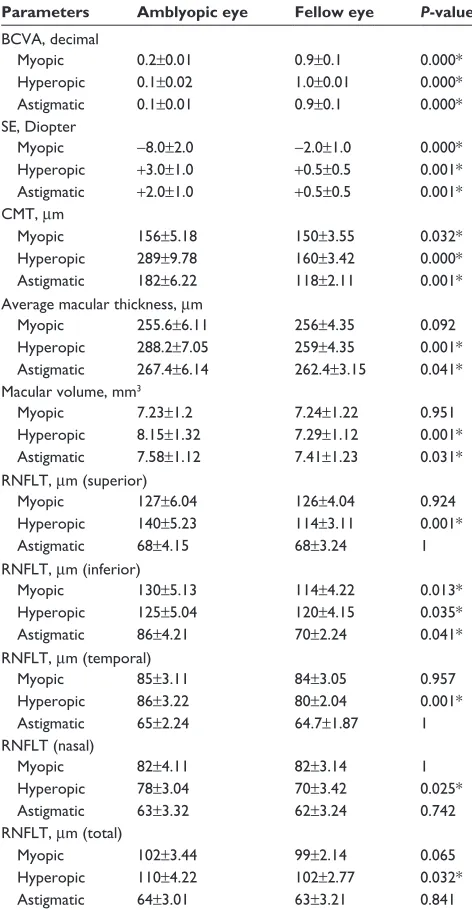
In the anisometropic group, the mean BCVA was 0.2±0.01, 0.1±0.02, and 0.1±0.01 in myopic, hyperopic, and astig-matic anisometropic subgroups, respectively. The mean SE in the previous three subgroups (myopic, hyperopic, and astigmatic) was -8.0±2.0 D, +3.0±1.0 D, and +2.0±1.0 D, respectively (Table 5).
In the myopic anisometropic subgroup, only the mean CMT was significantly higher in the amblyopic eyes, while the other macular values and the global RNFLT showed non-significant differences. In the hypermetropic anisometropic subgroup, there was a significant variation in all macular values and the global RNFLT in amblyopic eyes comparing with those in the fellow normal eyes. Lastly, in the astigmatic anisometropic subgroup, the mean CMT reported a signifi-cant increase, while there was not a signifisignifi-cant difference
in the total RNFLT. All details of the measured values and their P-values are displayed in Table 5.
linear regression analysis
Mean al and the effect of seLinear regression analysis performed between AL and SE showed a significant correlation (P=0.000, B=0.489, adjusted
R2=0.227, 95% confidence interval [CI] =0.173–0.460). The
linear regression model was displayed by the equation AL (adjusted) =21.626+0.316 (SE). The mean adjusted AL was 22.36±1.79 (Figure 5).
Table 3 Parameters in the strabismic amblyopic group
Parameters Amblyopic eye (n=22)
Fellow eye (n=22)
P-value
BCVa, decimal 0.3±0.1 0.9±0.11 0.000*
se, Diopter +0.5±0.75 +0.25±0.12 0.125
CMT, µm 184±7.78 181±3.65 0.033*
average macular thickness 262.8±7.63 262.4±3.32 0.084 Macular volume, mm3 7.55±1.2 7.41±1.1 0.047*
Parapapillary rnFlT, µm
superior 117±7.24 115±1.34 0.010*
inferior 139±10.25 134±1.45 0.000*
Temporal 70.2±9.25 70±10.05 0.945
nasal 82±9.25 81.8±10.05 0.071
Total 105±9.22 104±8.23 0.021*
Notes: Test used: paired t-test (two tailed). *Significant at P,0.05. Data presented as mean ± sD.
Abbreviations: BCVA, best-corrected visual acuity; SE, spherical equivalent; CMT, central macular thickness; RNFLT, retinal nerve fiber layer thickness.
Table 4 Parameters in the visual deprivational amblyopic group
Parameters Amblyopic
eye (n=12) Fellow eye (n=12) P-value
BCVa, decimal 0.1±0.1 0.84±0.1 0.001*
se, Diopter +1.0±0.6 +5.0±0.25 0.000*
CMT, µm 170±2.25 165±1.78 0.021*
average macular thickness 255±2.22 255.7±2.22 0.721 Macular volume, mm3 7.43±1.2 7.35±1.2 0.076
Parapapillary rnFlT, µm
superior 127±7.04 115±8.23 0.01*
inferior 126±9.23 115±9.23 0.01*
Temporal 72.3±8.15 72±8.15 0.782
nasal 84.4±7.15 83.4±9.11 0.142
Total 103±8.23 102±8.23 0.214
Notes: Test used: paired t-test (two tailed). *Significant at P,0.05.
Abbreviations: BCVA, best-corrected visual acuity; SE, spherical equivalent; CMT, central macular thickness; RNFLT, retinal nerve fiber layer thickness.
Table 5 Parameters in the anisometropic amblyopic group
Parameters Amblyopic eye Fellow eye P-value BCVa, decimal
Myopic 0.2±0.01 0.9±0.1 0.000*
hyperopic 0.1±0.02 1.0±0.01 0.000*
astigmatic 0.1±0.01 0.9±0.1 0.000*
se, Diopter
Myopic -8.0±2.0 -2.0±1.0 0.000*
hyperopic +3.0±1.0 +0.5±0.5 0.001*
astigmatic +2.0±1.0 +0.5±0.5 0.001*
CMT, µm
Myopic 156±5.18 150±3.55 0.032*
hyperopic 289±9.78 160±3.42 0.000*
astigmatic 182±6.22 118±2.11 0.001*
average macular thickness, µm
Myopic 255.6±6.11 256±4.35 0.092
hyperopic 288.2±7.05 259±4.35 0.001*
astigmatic 267.4±6.14 262.4±3.15 0.041*
Macular volume, mm3
Myopic 7.23±1.2 7.24±1.22 0.951
hyperopic 8.15±1.32 7.29±1.12 0.001*
astigmatic 7.58±1.12 7.41±1.23 0.031*
rnFlT, µm (superior)
Myopic 127±6.04 126±4.04 0.924
hyperopic 140±5.23 114±3.11 0.001*
astigmatic 68±4.15 68±3.24 1
rnFlT, µm (inferior)
Myopic 130±5.13 114±4.22 0.013*
hyperopic 125±5.04 120±4.15 0.035*
astigmatic 86±4.21 70±2.24 0.041*
rnFlT, µm (temporal)
Myopic 85±3.11 84±3.05 0.957
hyperopic 86±3.22 80±2.04 0.001*
astigmatic 65±2.24 64.7±1.87 1
rnFlT (nasal)
Myopic 82±4.11 82±3.14 1
hyperopic 78±3.04 70±3.42 0.025*
astigmatic 63±3.32 62±3.24 0.742
rnFlT, µm (total)
Myopic 102±3.44 99±2.14 0.065
hyperopic 110±4.22 102±2.77 0.032*
astigmatic 64±3.01 63±3.21 0.841
Notes: Test used: paired t-test (two tailed). *Significant at P,0.05. Data presented as mean ± sD.
Abbreviations: BCVA, best-corrected visual acuity; SE, spherical equivalent; CMT, central macular thickness; RNFLT, retinal nerve fiber layer thickness.
Clinical Ophthalmology downloaded from https://www.dovepress.com/ by 118.70.13.36 on 21-Aug-2020
Dovepress Kasem and Badawi
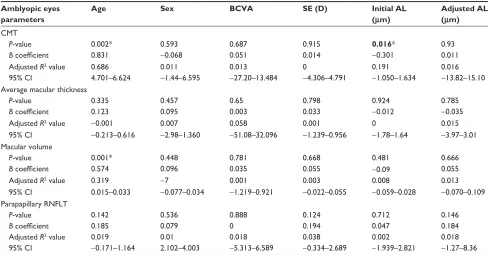
Linear regression between the OCT findings and the previously defined patients’ parameters
The details are shown in Table 6. The age and the initial AL were the only independent variables that statistically significantly correlated to the CMT. The age was positively
correlated to the CMT in amblyopic eyes (P=0.002, B=0.831, adjusted R2=0.686, 95% CI =4.701–6.624; Figure 6). The
initial AL was negatively correlated to the CMT (P=0.016,
B=-0.301, adjusted R2=0.191, 95% CI =-1.050–1.634;
Figure 7), while after adjustment of AL, linear regression between the adjusted AL and CMT in amblyopic eyes showed an insignificant correlation (P=0.930, B=0.011, adjusted
R2=0.016, 95% CI =-13.82–15.10; Figure 8). The linear
regression analysis between the age and CMT in normal eyes showed an insignificant inverse relation (P=0.073, B=-0.390, adjusted R2=0.111, 95% CI =-1.44−0.070; Figure 9).
Discussion
Amblyopia is known as a disease occurring during the devel-opment and maturation period of the visual pathway between the retina and the central neurons. It has various impacts on different neural levels of the visual pathway; however, the definite site of its influence is still under inquiry.19 Some
investigators hypothesized that the alterations in the LGB neurons and the visual cortex might be the primary sites of the amblyopic impact.2,3 With advances in imaging technology,
interest has emerged to study the differences in the retinal structure in amblyopia.20,21
In the current study, there was a significant difference in both macular thickness and global RNFLT between the amblyopic eye and the other normal fellow eye. Furthermore, $/
6(
2EVHUYHG /LQHDU
Figure 5 Correlation of initial al and se with 95% Ci of the regression line. P=0.000, B=0.489, adjusted R2=0.227, 95% Ci =0.173–0.460. The linear regression model: al (adjusted) =21.626+0.316 (se).
Abbreviations: AL, axial length; SE, spherical equivalent; CI, confidence interval.
Table 6 Correlations between the OCT findings and patients’ parameters in amblyopic eyes
Amblyopic eyes parameters
Age Sex BCVA SE (D) Initial AL
(µm)
Adjusted AL (µm) CMT
P-value 0.002* 0.593 0.687 0.915 0.016* 0.93
B coefficient 0.831 -0.068 0.051 0.014 -0.301 0.011
adjusted R2 value 0.686 0.011 0.013 0 0.191 0.016
95% Ci 4.701–6.624 -1.44–6.595 -27.20–13.484 -4.306–4.791 -1.050–1.634 -13.82–15.10
average macular thickness
P-value 0.335 0.457 0.65 0.798 0.924 0.785
B coefficient 0.123 0.095 0.003 0.033 -0.012 -0.035
adjusted R2 value -0.001 0.007 0.058 0.001 0 0.015
95% Ci -0.213–0.616 -2.98–1.360 -51.08–32.096 -1.239–0.956 -1.78–1.64 -3.97–3.01
Macular volume
P-value 0.001* 0.448 0.781 0.668 0.481 0.666
B coefficient 0.574 0.096 0.035 0.055 -0.09 0.055
adjusted R2 value 0.319 -7 0.001 0.003 0.008 0.013
95% Ci 0.015–0.033 -0.077–0.034 -1.219–0.921 -0.022–0.055 -0.059–0.028 -0.070–0.109
Parapapillary rnFlT
P-value 0.142 0.536 0.888 0.124 0.712 0.146
B coefficient 0.185 0.079 0 0.194 0.047 0.184
adjusted R2 value 0.019 0.01 0.018 0.038 0.002 0.018
95% Ci -0.171–1.164 2.102–4.003 -5.313–6.589 -0.334–2.689 -1.939–2.821 -1.27–8.36
Notes: Test used: linear regression. *Significant at P,0.05.
Abbreviations: OCT, optical coherence tomography; BCVA, best-corrected visual acuity; SE, spherical equivalent; D, diopter; AL, axial length; CMT, central macular thickness; CI, confidence interval; RNFLT, retinal nerve fiber layer thickness.
Clinical Ophthalmology downloaded from https://www.dovepress.com/ by 118.70.13.36 on 21-Aug-2020
Dovepress Changes in macular parameters in different types of amblyopia
we found a strong positive correlation between the patient’s age and changes in CMT in the amblyopic eyes, while in the normal fellow eyes, there was an insignificant inverse correlation. In addition, the initial AL (without adjustment) was significantly inversely correlated with CMT, but after adjustment, this correlation faded.
The retinal involvement in the amblyopic process is up till now controversial.3 Diverse experimental studies have
revealed retinal microstructures changes in amblyopic eyes such as degradation of RGCs,22 a decline in the nucleolar
volume in the cytoplasmic area of RGCs,23 thinning in the
internal plexiform layer with a decreased number of the bipolar synapses,24 and a reduction in the density of Müller fibers.25
Regarding the electroretinogram (ERG) evaluation of the human amblyopic eye, there was a remarkable reduction $PEO\RSLF&07
$JH
2EVHUYHG /LQHDU
Figure 6 Correlation of the age and CMT in amblyopic eyes with 95% Ci of the regression line (P=0.002, B=0.831, adjusted R2=0.686, 95% Ci =4.701–6.624). Abbreviations: CMT, central macular thickness; CI, confidence interval.
$PEO\RSLF&07
$/
2EVHUYHG /LQHDU
Figure 7 Correlation of the initial al and CMT in amblyopic eyes with 95% Ci of the regression line (P=0.016, B=-0.301, adjusted R2=0.191, 95% Ci =-1.050–1.634). Abbreviations: AL, axial length; CMT, central macular thickness; CI, confidence interval.
Amblyopic CMT
Adjusted AL
22.00 150.00
200.00 250.00 300.00
23.00 24.00 25.00
Observed Linear
Figure 8 Correlation of the adjusted al and CMT in amblyopic eyes with 95% Ci of the regression line (P=0.930, B=0.011, adjusted R2=0.016, 95% Ci =-13.82–15.10). Abbreviations: AL, axial length; CMT, central macular thickness; CI, confidence interval.
Normal CMT
Age
190.00
180.00
170.00
160.00
150.00
5.00 10.00 15.00 20.00 25.00 30.00 35.00
Observed Linear
Figure 9 Correlation of the age and CMT in normal fellow eyes with 95% Ci of the regression line (P=0.073, B=-0.390, adjusted R2=0.111, 95% Ci =-1.44–0.070). Abbreviations: CMT, central macular thickness; CI, confidence interval.
Clinical Ophthalmology downloaded from https://www.dovepress.com/ by 118.70.13.36 on 21-Aug-2020
Dovepress Kasem and Badawi
and disturbed retinal response toward the pattern stimuli in the amblyopic eyes.26,27 This presumed and might support
the amblyopic changes at the retinal level. On the contrary, others found insignificant changes in the pattern of ERG in the amblyopic eyes.28,29
Currently, the retinal changes in various unilateral ambly-opic types were evaluated using the OCT scans. There was a significant increase in the macular thickness and macular volume in all amblyopic eyes comparing to the other fellow eyes. This corroborated with the previous studies,9,12 while
other researchers reported no significant variations in the macular thickness10,30,31 or RNFLT10,11,30,31 in amblyopic eyes.
When comparing the foveal thickness in the strabismic amblyopic eyes, the current results reported higher values than the normal eyes, which emphasized those of previous studies.20,32,33 In contrast, other studies found an insignificant
difference between the amblyopic eyes and the normal eyes in the strabismic group.34,35 In addition, we observed that the
same difference was found in the total RNFLT in this group (strabismic amblyopia), which was corresponding to other findings20,35 and in contrast to others.34,36
The precise cause of the increased RNFLT in the amblyopia is unclear, but it may be due to the influence of the amblyopia on the retinal postnatal maturation with a decrease in the RGCs. This might produce an increase in the RNFLT measured via OCT.37 So, it supposedly stated that the
postnatal changes would lead to a similar effect on the normal macular maturation as well, including Henle’s fibers move-ment far away from the foveola with a reduction in the foveal diameter and an increase in the measurable foveal thickness.33
This assumption could explain some of the anatomic changes existing in the retina of the amblyopic eyes.37
Concerning the visual deprivational amblyopia, there were few studies that reported the changes in this type. Kim et al38 did not find a considerable variance in deprivational
amblyopic eyes compared to the normal eyes regarding the macular thickness, while they found thicker nasal RNFL in the amblyopic eyes. The present results were in contrast to this finding: there was a significant increase in the foveal thickness and the superior and inferior RNFLT. This dif-ference in the results may be due to the measuring of the eccentric parafoveal area accidentally rather than the central foveal area.39 This issue was of concern to the authors, and
any patient with eccentric fixation was excluded from the study and the central foveal location was being confirmed during the macular scanning.
Numerous previous studies have dealt with the changes in anisometropic amblyopia with different results.40–43 In the
present study, the hypermetropic amblyopic eyes exhibited a thicker CMT, thicker average macular thickness, and higher macular volume than the normal eyes. These findings are in agreement with the previous results of different studies, which formerly demonstrated a greater macular thickness in hypermetropic-affected eyes.14,40,41 In contrast to these results,
other studies reported that the difference in the macular thickness between the hypermetropic amblyopic and the normal eyes was negligible.13,32,42,43 The same higher values regarding RNFLT
were found in hypermetropic amblyopic eyes with a significant difference from the normal eyes. These results are parallel to some studies8,37,44 and contrast to the other ones.13,32,42,43
The current findings in myopic eyes were consistent with Pang et al.12 They reported a statistically significant higher
CMT in the amblyopic eyes versus the normal fellow eyes. In addition, the RNFL values in the present study did not dem-onstrate a significant difference between the myopic amblyo-pia and the other normal eyes. Previous studies concluded the minimal influence of the myopia, mainly mild degrees on the macular thickness.45,46 However, further evaluation is
needed to ascertain if the macular thickness changes are due to amblyopia, myopia, or both. The discrepancy between all the mentioned studies presumably is a consequence of diver-sity in the OCT devices, measurement inaccuracy, varied races, and different ages of the participants.
Currently, the main interesting finding is the relationship of age to the CMT changes. A positive significant linear relationship between the age and the macular thickness sug-gested that the greater the age, the higher the thickness of the macula and thus the increase in the amblyopia impacts. This means that the age could be considered as an independent factor of the disease worsening and a predictor of treatment prognosis that can help in the clinical implementation of amblyopia treatment modalities.
However, in the normal eyes, there was no such signifi-cant positive correlation between the age and the CMT as in amblyopic eyes. We could not demonstrate this correla-tion; on the contrary, there was a statistically insignificant inverse correlation.
There were contradictory results concerning age’s rela-tion to CMT changes in normal eyes; some reports were in agreement with the current findings showing no significant correlation,16,47 while others observed a significant
correla-tion, either positive indicating an increase in the CMT with the age48,49 or negative referring to a decrease in the CMT
with the age.50,51
The current study reported a significant positive corre-lation between AL and SE. An inverse significant recorre-lation
Clinical Ophthalmology downloaded from https://www.dovepress.com/ by 118.70.13.36 on 21-Aug-2020
Dovepress Changes in macular parameters in different types of amblyopia
between the initial AL and CMT was found; however, the mean AL had no significant correlation with CMT in the linear correlation model when adjusted by SE. In other words, the SE of our study population had a significant effect on the AL. We thought that the adjustment of AL by SE might lead to statistically accurate results. This was in disagreement with Araki et al;52 they reported a significant correlation between
the AL and CMT changes, which might be owing to the relatively small sample size (21 subjects with less differ-ence in the mean SE among the study subjects). By contrast, Kok et al53 concluded consistent results with our findings;
they did not find an abnormal relation between the AL and CMT in amblyopic eyes. We did not find a significant rela-tionship between refractive errors and the macular thickness or macular volume. This might be due to the exclusion of extreme errors or severe amblyopia from the study. This was in agreement with the conclusions of Rajavi et al.54 However,
to substantiate these results, a survey with a large sample size will be required including severe amblyopia.
The limitation of the present study was a relatively small sample size, whereas the broad age range (7–32 years), control group of the fellow eyes, and the correlation between the OCT parameters with different patients’ characteristics, especially age and AL, were considered points of strength, which will further amend our assimilation in this area.
Conclusion
The eyes with unilateral amblyopia were prone to have a higher CMT and thicker global RNFL when compared to the normal fellow eyes. Retinal thickness variations between different types of the amblyopia differ from one type to another. Owing to our findings, the age appeared to be an independent factor of CMT variations in amblyopic eyes and has to be taken into consideration during the treatment course of the amblyopia. Further studies are needed to clarify and confirm these findings.
Disclosure
The authors report no conflicts of interest in this work.
References
1. Von Norden GK, Crawford ML. The lateral geniculate nucleus in human strabismic amblyopia. Invest Ophthalmol Vis Sci. 1992;33(9): 2729–2732.
2. Asper L, Crewther D, Crewthei SG. Strabismic amblyopia. Part 2. Neural processing. Clin Exp Optom. 2000;83(4):200–211.
3. Hess RF, Thompson B, Gole G, Mullen KT. Deficient responses from the lateral geniculate nucleus in humans with amblyopia. Eur J Neurosci. 2009;29(5):1064–1070.
4. Hess RF. Amblyopia: site unseen. Clin Exp Optom. 2001;84(6):321–336.
5. Firat PG, Ozsoy E, Demirel S, Cumurcu T, Gunduz A. Evaluation of peripapillary retinal nerve fiber layer, macula and ganglion cell thickness in amblyopia using spectral optical coherence tomography.
Int J Ophthalmol. 2013;6(1):90–94.
6. Lempert P. Optic nerve hypoplasia and small eyes in presumed amblyopia. J AAPOS. 2000;4(5):258–266.
7. Hee MR, Izatt JA, Swanson EA, et al. Optical coherence tomography of the human retina. Arch Ophthalmol. 1995;113(3):325–332. 8. Yoon SW, Park WH, Baek SH, Kong SM. Thicknesses of macular
retinal layer and peripapillary retinal nerve fiber layer in patients with hyperopic anisometropic amblyopia. Korean J Ophthalmol. 2005; 19(1):62–67.
9. Huynh SC, Samarawickrama C, Wang XY, et al. Macular and nerve fiber layer thickness in amblyopia: the Sydney Childhood Eye Study.
Ophthalmology. 2009;116(9):1604–1609.
10. Kee SY, Lee SY, Lee YC. Thicknesses of the fovea and retinal nerve fiber layer in amblyopic and normal eyes in children. Korean J
Ophthalmol. 2006;20(3):177–181.
11. Repka MX, Kraker RT, Tamkins SM, et al. Retinal nerve fiber layer thickness in amblyopic eyes. Am J Ophthalmol. 2009;148(1):143–147. 12. Pang Y, Goodfellow GW, Allison C, Block S, Frantz KA. A prospective
study of macular thickness in amblyopic children with unilateral high myopia. Invest Ophthalmol Vis Sci. 2011;52(5):2444–2449.
13. Tugcu B, Araz-Ersan B, Kilic M, Erdogan ET, Yigit U, Karamursel S. The morpho-functional evaluation of retina in amblyopia. Curr Eye
Res. 2013;38(7):802–809.
14. Al-Haddad CE, El Mollayess GM, Mahfoud ZR, Jaafar DF, Bashshur ZF. Macular ultrastructural features in amblyopia using high-definition optical coherence tomography. Br J Ophthalmol. 2013;97(3):318–322. 15. Repka MX, Beck RW, Holmes JM, et al. A randomized trial of patch-ing regimens for treatment of moderate amblyopia in children. Arch
Ophthalmol. 2003;121(5):603–612.
16. Chan A, Duker JS, Ko TH, Fujimoto JG, Schuman JS. Normal macular thickness measurements in healthy eyes using stratus optical coherence tomography. Arch Ophthalmol. 2006;124(2):193–198.
17. Sull AC, Vuong LN, Price LL, et al. Comparison of spectral/Fourier domain optical coherence tomography instruments for assessment of normal macular thickness. Retina. 2010;30(2):235–245.
18. Faghihi H, Faghihi S, Ghassemi F, et al. Measurement of normal macular thickness using cirrus optical coherence tomography instrument in Iranian subjects with normal ocular condition. Iran J Ophthalmol. 2013;25(2):107–114.
19. Szigeti A, Tátrai E, Szamosi A, et al. A morphological study of retinal changes in unilateral amblyopia using optical coherence tomography image segmentation. PLoS One. 2014;9(2):e88363.
20. Dickmann A, Petroni S, Salerni A, Dell’Omo R, Balestrazzi E. Uni-lateral amblyopia: an optical coherence tomography study. J AAPOS. 2009;13(2):148–150.
21. Al-Haddad CE, Mollayess GM, Cherfan CG, Jaafar DF, Bashshur ZF. Retinal nerve fibre layer and macular thickness in amblyopia as measured by spectral-domain optical coherence tomography. Br J Ophthalmol. 2011;95(12):1696–1699.
22. Von Norden GL, Crawford ML, Middleditch PR. Effect of lid suture on retinal ganglion cells in Macacamulatta. Brain Res. 1977;122(3): 437–444.
23. Rasch E, Swift H, Riesen AH, Chow KL. Altered structure and compo-sition of retinal cells in darkreared mammals. Exp Cell Res. 1961;25: 348–363.
24. Fifkova E. Effect of visual deprivation and light on synapses of the inner plexiform layer. Exp Neurol. 1972;35(3):458–469.
25. Weiskrantz L. Sensory deprivation and the cat’s optic nervous system.
Nature. 1958;181(4615):1047–1050.
26. Li JD. A pattern-ERG study of amblyopia. Zhonghua Yan Ke Za Zhi. 1989;25(3):138–140.
27. Dahlke C, Dodt E. Amblyopic eyes produce an abnormal electroretino-gram in pattern presentation with the on-off technique. Ophthalmologe. 1994;91(2):176–180.
Clinical Ophthalmology downloaded from https://www.dovepress.com/ by 118.70.13.36 on 21-Aug-2020
Clinical Ophthalmology
Publish your work in this journal
Submit your manuscript here: http://www.dovepress.com/clinical-ophthalmology-journal Clinical Ophthalmology is an international, peer-reviewed journal covering all subspecialties within ophthalmology. Key topics include: Optometry; Visual science; Pharmacology and drug therapy in eye diseases; Basic Sciences; Primary and Secondary eye care; Patient Safety and Quality of Care Improvements. This journal is indexed on
PubMed Central and CAS, and is the official journal of The Society of Clinical Ophthalmology (SCO). The manuscript management system is completely online and includes a very quick and fair peer-review system, which is all easy to use. Visit http://www.dovepress.com/ testimonials.php to read real quotes from published authors.
Dovepress
Dove
press
Kasem and Badawi
28. Gottlob I, Welge-Lüssen L. Normal pattern electroretinograms in amblyopia. Invest Ophthalmol Vis Sci. 1987;28(1):187–191. 29. Deline PJ, Weissenbruch C, Berendschot TT, Norren DV. Photoreceptors
function in unilateral amblyopia. Vision Res. 1998;38(4):613–617. 30. Walker RA, Rubab S, Voll AR, Erraguntla V, Murphy PH. Macular and
peripapillary retinal nerve fibre layer thickness in adults with amblyopia.
Can J Ophthalmol. 2011;46(5):425–427.
31. Yassin SA, Al-Tamimi ER, Al-Hassan S. Macular and retinal nerve fiber thickness in recovered and persistent amblyopia. Int Ophthalmol. 2015;35(6):833–842.
32. Dickmann A, Petroni S, Perrotta V, et al. A morpho-functional study of amblyopic eyes with the use of optical coherence tomography and microperimetry. J AAPOS. 2011;15(4):338–341.
33. Agrawal S, Singh V, Singhal V. Cross-sectional study of macular thickness variations in unilateral amblyopia. J Clin Ophthalmol Res. 2014;2(1):15–17.
34. Altintas O, Yüksel N, Ozkan B, Caglar Y. Thickness of the retinal nerve fiber layer, macular thickness, and macular volume in patients with strabismic amblyopia. J Pediatr Ophthalmol Strabismus. 2005; 42(4):216–221.
35. Alotaibi AG, Al Enazi B. Unilateral amblyopia: optical coherence tomography findings. Saudi J Ophthalmol. 2011;25(4):405–409. 36. Colen TP, de Faber JT, Lemij HG. Retinal nerve fiber layer thickness
in human strabismic amblyopia. Binocul Vis Strabismus Q. 2000;15(2): 141–146.
37. Yen MY, Cheng CY, Wang AG. Retinal nerve fiber layer thickness in uni-lateral amblyopia. Invest Ophthalmol Vis Sci. 2004;45(7):2224–2230. 38. Kim YW, Kim SJ, Yu YS. Spectral-domain optical coherence tomog-raphy analysis in deprivational amblyopia: a pilot study with unilateral pediatric cataract patients. Graefes Arch Clin Exp Ophthalmol. 2013; 251(12):2811–2819.
39. Leone J, Koklanis K, Georgievski Z, Wilkinson R. Macular and retinal nerve fibre layer thickness in strabismus and anisometropic amblyopia.
Binocul Vis Strabismus Q. 2008;23(4):227–234.
40. Andalib D, Javadzadeh A, Nabai R, Amizadeh Y. Macular and retinal nerve fiber layer thickness in unilateral anisometropic or strabismic amblyopia. J Pediatr Ophthalmol Strabismus. 2013;50(4):218–221. 41. Yalcin E, Balci O. Peripapillary retinal nerve fiber layer and foveal
thickness in hypermetropic anisometropic amblyopia. Clin Ophthalmol. 2014;12(8):749–753.
42. Wang BZ, Taranath D. A comparison between the amblyopic eye and normal fellow eye ocular architecture in children with hyperopic anisometropic amblyopia. J AAPOS. 2012;16(5):428–430.
43. Yakar K, Kan E, Alan A, Alp MH, Ceylan T. Retinal nerve fibre layer and macular thicknesses in adults with hyperopic anisometropic amblyopia. J Ophthalmol. 2015;2015:946467.
44. Wu SQ, Zhu LW, Xu QB, Xu JL, Zhang Y. Macular and peripapillary retinal nerve fiber layer thickness in children with hyperopic anisome-tropic amblyopia. Int J Ophthalmol. 2013;6(1):85–89.
45. Wakitani Y, Sasoh M, Sugimoto M, Ito Y, Ido M, Uji Y. Macular thickness measurements in healthy subjects with different axial lengths using optical coherence tomography. Retina. 2003;23(2):177–182. 46. Wu PC, Chen YJ, Chen CH, et al. Assessment of macular retinal
thickness and volume in normal eyes and highly myopic eyes with third-generation optical coherence tomography. Eye (Lond). 2008;22(4): 551–555.
47. Manassakorn A, Chaidaroon W, Ausayakhun S, Aupapong S, Wattananikorn S. Normative database of retinal nerve fiber layer and macular retinal thickness in a Thai population. Jpn J Ophthalmol. 2008; 52(60):450–456.
48. Duan XR, Liang YB, Friedman DS, et al. Normal macular thickness measurements using optical coherence tomography in healthy eyes of adult Chinese persons: the Handan Eye Study. Ophthalmology. 2010; 117(8):1585–1594.
49. Hashemi H, Khabazkhoob M, Yekta A, Emamian MH, Nabovati P, Fotouhi A. The distribution of macular thickness and its determinants in a healthy population. Ophthalmic Epidemiol. 2017;23:1–9. 50. Song WK, Lee SC, Lee ES, et al. Macular thickness variations with
sex, age, and axial length in healthy subjects: a spectral domain–optical coherence tomography study. Invest Ophthalmol Vis Sci. 2010;51(8): 3913–3918.
51. Wei WB, Xu L, Jonas JB, et al. Subfoveal choroidal thickness: the Beijing eye study. Ophthalmology. 2013;120(1):175–180.
52. Araki S, Miki A, Yamashita T, et al. A comparison between amblyopic and fellow eyes in unilateral amblyopia using spectral-domain optical coherence tomography. Clin Ophthalmol. 2014;8:2199–2207. 53. Kok PH, de Kinkelder R, Braaksma-Besselink YC, et al. Anomalous
relation between axial length and retinal thickness in amblyopic children. J AAPOS. 2013;17(6):598–602.
54. Rajavi Z, Moghadasifar H, Feizi M, et al. Macular thickness and amblyopia. J Ophthalmic Vis Res. 2014;9(4):478–483.
Clinical Ophthalmology downloaded from https://www.dovepress.com/ by 118.70.13.36 on 21-Aug-2020