Practice-centred approach to research in design
RUST, C., RODDIS, J. and CHAMBERLAIN, C.
Available from Sheffield Hallam University Research Archive (SHURA) at:
http://shura.shu.ac.uk/972/
This document is the author deposited version. You are advised to consult the
publisher's version if you wish to cite from it.
Published version
RUST, C., RODDIS, J. and CHAMBERLAIN, C. (2000). Practice-centred approach to
research in design. In: Proceedings Of Design Plus Research Conference,
Politecnico Di Milano, May 2000.
Copyright and re-use policy
Rust, C. Chamberlain, P. Roddis, J. (2000a) A Practice-Centred Approach To Research In Industrial Design Proceedings Of Design Plus Research Conference, Politecnico Di Milano, May 2000
A Practice- Centred Approach to Research in I ndustrial Design
Chris Rust, Reader in Design [email protected]
Professor James Roddis Head of Applied Research [email protected]
Paul Chamberlain Principal Lecturer in Design [email protected]
Sheffield Hallam University
Art and Design Research Centre Psalter Lane
Sheffield S11 8UZ, UK
+44 114 225 2706 (Chris Rust)
+44 114 225 2669 (Research Administrator) +44 114 225 2603 fax
Abstract
This paper gives an overview of practice-centred research programmes at Sheffield
Introduction
This paper describes research by practitioner academics who need to maintain the
currency of their knowledge and experience and wish to engage in substantial creative work. Their approach sets out to provide practical benefits to the community and the economy, to be complementary to professional practice and to give the creative disciplines of Design a voice and role in the academic community.
The authors wish to distinguish between their research and professional practice. Design has a long tradition of practitioner teachers who ensure that education is informed by current practice and recent professional experience. This is appropriate for part-time teachers who have a separate design employment but teachers who work full-time in education also need to maintain currency and many have engaged in professional consultancy work for this reason.
This approach can be problematic, especially in today’s commercial and academic climates. The timescales and pressures of design projects are difficult to reconcile with the demands of increasingly structured teaching programmes and university-based designers have been seen as having an unfair commercial advantage over other designers, leading to unwelcome tensions.
During the 1990’s, Schools of Art and Design in the United Kingdom had an increasing incentive to develop research activity and the authors saw this as an opportunity to reconcile some of the problems described above. They did not wish to put aside creative practice and engage in traditional research but they saw that research provided an appropriate structure for designers working within a university.
The programmes evolved from individuals discovering research questions which could be addressed through a combination of creative work and conventional research. It is possible now to construct a post-hoc argument for the methods adopted, but it is important to note that there was no road map to guide the development of this approach and that designers might not have welcomed one.
Principles
The concept of research through creative practice used in this paper was proposed by Professor Christopher Frayling1 in a definition which was subsequently expanded by Bruce Archer2:
It can be useful to distinguish between research about practice; research for the purposes of practice; and research through practise...there are circumstances where the best or only way to shed light on a proposition…..is to attempt to construct something...calculated to explore, embody or test it.
The key principle is therefore an investigation carried out through design, the subject matter being generally external to design, as will be seen from the examples below. Other features are multi-disciplinary collaboration using design to open up new research questions,
Features of the Research Programmes
Research described here has all taken place within the Art and Design Research Centre (ADRC) at Sheffield Hallam University. A central feature of the ADRC is that there are no artificial boundaries between active researchers and other academics. All staff are encouraged to take part in research (most make some practical contribution to research programmes even if they do not have their own projects) and all staff are expected to take an active role in teaching and course development.
The ADRC employs a number of graduate researchers, some are enrolled on research degrees but others are employed to carry out practical creative work, gaining professional experience and a bridge to employment in industry rather than a route to an academic career. Practice-centred projects are very time-intensive and the practice of employing researchers with creative skills, who work collaboratively with senior staff and share ownership of projects, is a central feature.
The environment for practice-based research is a studio/workshop sited within the main workshop complex used by all Design students. Design teaching programmes emphasise experimental making, the workshops are a very important part of the school and this approach has become central to practice-based research.
All programmes are based on collaboration with specialists and partners outside the University. Frequently, research questions arise from dialogues between researchers and potential collaborators. For example work on vibro-acoustic therapy started because a local hospital had a specialist unit for this work. Collaboration with them on a design project for undergraduates led to recognition of opportunities for a more substantial investigation.
The use of creative work to demonstrate new opportunities appears to have a catalytic effect and research questions addressed in a Design context have created opportunities for direct participation by or complementary research by other specialists. Most programmes also lead to evaluation/exploitation by businesses and opportunities for design/development of commercial products.
Research Programmes
Vibro-Acoustic Therapy for People with Profound Sensory Disability(Chamberlain)
This therapy (known as Snoezelen) has depended on expensive fixed installations, which inhibit availability of the therapy and limited opportunities for clinical research. To address this need it was necessary to identify a new approach that would provide the same effects in a more accessible form and the first stage of the work was to investigate the requirements for lightweight, portable equipment.
Research with psychologists, educators and carers (funded by a Health Authority, and schools for deaf people in UK and Finland) led to production and evaluation of a series of hypothetical designs for therapeutic equipment. A requirement for a socially acceptable, ergonomically effective, versatile and economic “family” of products was identified.
Evaluation by research partners and Sibelius Academy, Helsinki led to design principles from the research being adopted by a manufacturer (Jenx Ltd). This led to a system of products for hospitals and individuals, now in production (Millennium Product Award Dec 1999). These products have provided a basis for developing therapy and teaching approaches in Finland and the UK.
[image:5.595.72.512.342.597.2]
Fig. 1 A system of vibro-sound products for flexible use in home and clinic
Publication of the research3 led to proposals for research into techniques for management of chronic pain using complementary psychological and physiological approaches.
Open-Loop Solutions to Re-use of Waste Glass (Roddis)
Discussions with companies who recycle glass, in the context of changing legislation which will make it very difficult to use landfill for unwanted coloured glass waste, led to a review of ways to re-use this material in high-value products requiring limited energy inputs. The project is supported by the United Kingdom’s largest glass recycling company (Berrymans).
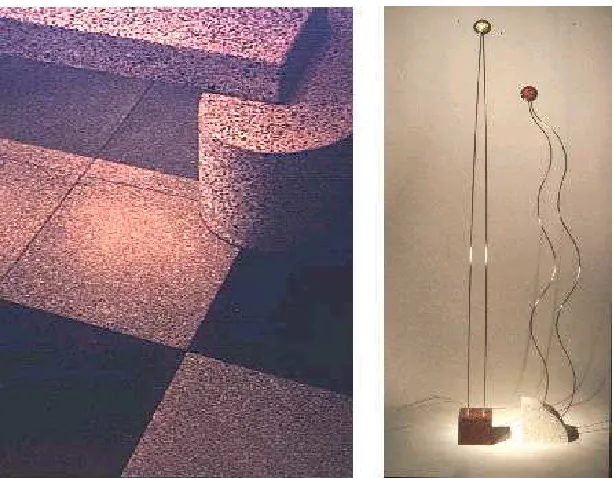
The main proposition of the research was that glass aggregate could provide the principal material for some furniture, architectural and construction products and that this could have advantages from both technical performance and aesthetic points of view. To investigate this, parallel programmes of technical evaluations and exemplar designs were established.
[image:6.595.72.379.308.547.2]A series of designs for furniture products using glass aggregate in a cement or resin matrix were produced and exhibited in the United Kingdom4, Czech Republic5 and the United States6 where the project received an international award for environmentally responsible Design. The work was also published in a Design journal in the Czech Republic7 and at a Furniture Design Conference in Turkey8. In addition the exemplar products were evaluated with a number of architectural practices and, in Finland, with the University of Industrial Arts, Helsinki and Tampera University. The products demonstrated a diversity of ways to use the material as well as a wide range of visual effects available.
Fig. 2 Exemplars – Left: Flooring and Public Seating, Right: Lighting
A parallel programme of technical evaluation and testing established that the approaches adopted were capable providing appropriate performance, that glass preparation costs associated with a cement matrix were uneconomic but that a resin matrix had a good balance of economic and technical performance.
From these activities it was possible to identify commercially viable uses for the material, patents were filed for specific composites and a commercial partner (Resin Building
Analogous Upper Limb Prostheses (Whiteley, Rust)
A designer working on animatronic museum exhibits discovered that there was no source of mechanisms which accurately replicated human motion. His search included a review of prosthetic arm designs and it was recognised that these products were extremely
unsatisfactory. Since the current designs had been in development since the 1960’s, with no substantial improvements it was felt that a completely fresh start was needed.
The research, funded by a medical charity (National Hospital Trust) has included
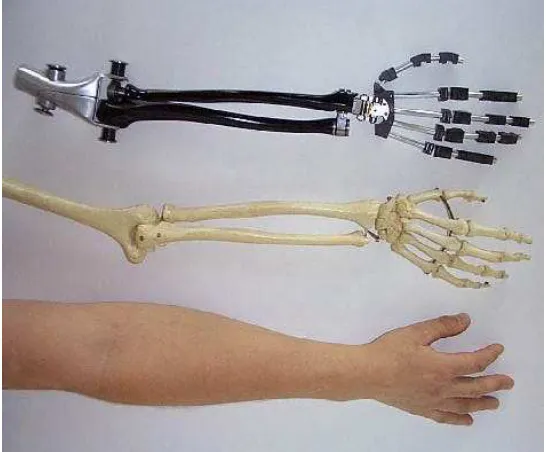
collaborative work with clinical engineers, prosthetists, users, clinicians and manufacturers. The central activity was a programme of creative work, using drawing and making, to gain an understanding of the joints of the hand and arm and develop a series of mechanical
[image:7.595.71.344.260.486.2]analogies for them, including provision for “tendon” routing and attachment. These designs have been incorporated into a prototype arm and some elements patented.
Fig. 3 Prototype arm embodying complete set of joint analogies
Results of the work have been published in Journals9,10 and Conferences11 concerned with Medical Physics and the principles underlying the research have been disseminated through Journals12 and Conferences13,14 concerned with Design.
Continuing work is funded by the UK Arts and Humanities Research Board. It includes an exploration of methods to achieve natural wrist rotation in below-elbow amputees and work on providing powered motion in an analogous manner.
Effect on the Regional Economy
Although APDC offers commercial consultancy services it also acts as a development and exploitation agency for intellectual property from university research. R&D funds from local government and regional development agencies ensure that businesses in the region are able to benefit from the research. APDC also supports “generic” projects which operate on a similar basis to university practice-based research programmes but with a specific focus on economic activities which could be developed in the region.
APDC draws on the experience of Engineering and Materials Research Departments in the Universities but the greater number of staff have Industrial Design backgrounds and it has been found that this provides for a very flexible and responsive approach to the wide range of problems and opportunities arising in the region.
Social Implications
Most practice-centred research in the University has a strong ethical component and, for the researchers, this is the most stimulating aspect of the work. Engagement with a wide community of users and interested parties has allowed research programmes to embody real-world priorities and realisable aims. Similarly an awareness of industrial priorities and opportunities has allowed the projects to develop in directions which will support appropriate production of future products.
“Real” artefacts in user research - In the Vibro-Sound research, it was a natural response for the researchers to embody their response to needs which they had discovered in a series of designs for furniture, rather than in laboratory test-rigs. The usefulness of this approach has been described by Larry Keeley15 who stressed the role of designers in allowing people to experience artefacts which do not yet exist. As a result, partners were able to recognise the implications of the research more easily, and testing was more realistic. The process facilitated the eventual development of commercial products which, in turn, supported continuing research as well as providing useful
products for disabled people and the agencies which support them. The last point cannot be stressed too highly since the most clinical research takes place at a great remove from the consumer marketplace and the challenge of turning research outcomes into socially useful production can be enormous.
Personal engagement with users - Prosthesis research has also required a very wide range of partnerships, for example the key researcher has been an active member of a prosthesis users’ mutual support group for the past 3 years. As well as taking part in formal evaluations, this group has provided the research with a rich set of insights into their lives and experiences and two members, who have engineering experience, are now active partners in the project, testing experimental devices and providing feedback
moderated by technical understanding.
Arguably the research may not benefit many of the people who currently require
prostheses and have adapted themselves to the status quo. However, through becoming involved with the research, the members of the user group report a renewed interest in the potential for better prostheses, having become disenchanted with the existing provision, and there is a strong wish to do something to help people who will need prostheses in future. Ironically, one of the things which has encouraged users to support the project is that the researchers are not doctors or producers of the existing products.
As a result, although the devices produced to date are far from being prototype
products, they embody a high degree of small-scale modularity and eventual methods of production have been considered at every stage. Review by a manufacturer indicates that the concept is suitable for adaptation to a wide range of hands and could reduce the cost of the eventual prosthesis. Thus the research is informed by a very long-term view which supports the needs of people who will need the products. This long term view has been difficult to maintain at times when faced with pressure to adopt short term, pragmatic strategies which would lead more quickly to working products but would, arguably, undermine the eventual success of the research.
Reflecting the whole social problem - The principal concern of the researchers when embarking on the work was that existing prostheses did not provide natural motion. It then became clear from published research and work with the user group that most people were unhappy with the lack of a natural appearance and that there was a universal assumption that a prosthesis could be either cosmetic or functional but never both. Additionally functional limbs were usually hard metal products which were very unsuitable for social situations, especially with children. This issue has been explored with users, employing a compilation of video material from documentary and science-fiction sources to stimulate discussion about expectations and it is apparent that most users wish their prostheses to be both functional and natural looking. The practice-based research approach is demonstrating the potential to achieve that as a result of
maintaining a design vision throughout the programme.
To summarise, a rigorous practice-based approach will always be informed by an
understanding of the whole range of problems experienced by the potential beneficiaries of the research. Designers who are used to managing and balancing complex sets of problems are in a position to maintain a holistic view which can complement the work of researchers in more reductionist disciplines.
Inter-disciplinary Research
All of the research programmes described here are concerned with issues which are more usually associated with science and engineering research. One of the most interesting aspects of the experience has been of working with, and learning from colleagues in other disciplines. Sometimes the designers have met with scepticism but, generally there has been a great deal of interest in what might be achieved by mixing approaches.
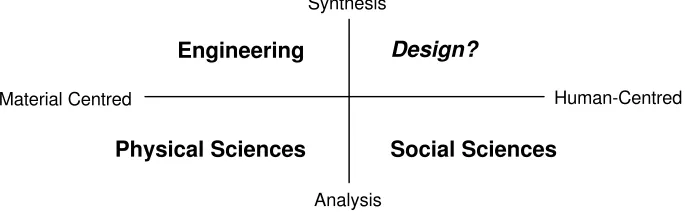
[image:9.595.89.442.584.688.2]John Heskett18 has proposed a view of the different strategic competencies required by a manufacturing business and suggested that there is a gap which could be filled by Design:
Fig. 4 Heskett’s positioning of design in an industrial context.
Human-Centred Material Centred
Analysis Synthesis
Design? Engineering
Basic Scientific
It would be possible to propose a similar model for research, which would be simplistic like all such models, but illustrates the contribution which a practice-centred approach can make in multi-disciplinary research:
Fig. 5 Heskett’s model applied to research
Of course, this model has a large gap called “Humanities” but, as with the business model, it illustrates the potential strength of multi-disciplinary collaborations.
Setting up such collaborations is not straightforward and there are several cases in which potential joint projects have failed to gain impetus, mainly because of large gaps between the preconceptions of the different disciplines. The successful collaborations have usually started with a design-led question and it has seemed to be the case that practice-centred Design research has the capacity to generate stimulating new hypotheses for other
disciplines. A collaborator from the field of medical physics has suggested that scientists are unwilling to recognise the creativity which is evident in the early stages of their own
research, when hypotheses and methods are developed, attaching the greatest importance to later analytical work.
One of the significant benefits of collaboration with other disciplines has been the opportunity to compare different approaches to research, and the Sheffield programmes have benefited greatly from the supportive advice of colleagues who have matched their concern for rigour with a genuine interest in the potential of practice-centred methods to enhance their own research. Much past research concerned with Design has been based on social science or humanities models and it has been helpful to work with physical scientists whose goals are often more directly parallel to those of designers.
It has also become apparent that many science and engineering researchers face similar questions to those which have informed the development of a practice-centred approach in Design. Colleagues have discussed the possibility of developing a practice centred
approach, for example in electronics, where engineers might be given greater freedom to use their inventive talents to address more open questions, rather than seeing the practical, craft skills of electronics as a low value resource used only to support specific analytical activity. This theme has also emerged in connection with research degrees and is discussed below in that context.
Effect on Teaching
The Sheffield research programmes have had an effect on the learning experience of Design students and this was recognised by the recent review by the UK Quality Assurance Agency for Higher Education (QAA) which affirmed that Design teaching at Sheffield was
Human-Centred Material Centred
Analysis Synthesis
Design? Engineering
students to address open questions rather than specific design requirements. For example a recent brief provided detailed information about the technology which a sponsoring company had developed for its existing market and required the students to identify, and design for, completely new markets which the company might exploit. This has led in turn to an increase in the number of student projects which have been adopted for production by sponsoring companies.
This approach has been particularly evident in postgraduate courses, for example the APDC, described above, regularly sponsors Industrial Design students who, over a year, are expected to identify an area of activity with economic potential, develop an understanding of the opportunities, propose concept designs, recruit manufacturing partners who wish to exploit the designs or the ideas behind them and carry the concept designs into production.
Practice-centred research has also helped practitioner academics to develop a better understanding of the disciplines common to all research. This has helped practice staff to participate in teaching and assessment of theoretical studies, particularly research dissertations which had previously been supported by History staff in isolation from the studio programme and a member of the Design practice staff is now assisting in supervision of a PhD student in History of Design.
Arguably many of these benefits could have arisen from staff pursuing more traditional approaches to research and some members of the Design teaching team have done so. Inevitably this requires a compromise and it would be difficult for an individual taking this approach to maintain their currency as a practitioner.
Research Degrees
The question of whether research degrees can be pursued through design practice, and especially whether such degrees should adopt new forms of “thesis”, has proved to be a most contentious area for the Design research community. A natural concern for rigour and parity with other disciplines has led many to conclude that the established practices and forms represent a “Gold Standard” for research degrees and to deviate from that standard is to downgrade the standing of Design as an academic discipline. There is certainly evidence that Doctorates in some other creative disciplines, in some territories, are perceived to be below the general standard for a PhD so the dangers are real.
However it is important to review the definitions of research which underpin all research degrees of good standing and to recognise that the fundamental issues are not of form or specific methods but of enquiry and advancement of knowledge. Here are some definitions from United Kingdom institutions:
The degree of PhD is awarded to recognise the successful completion……of a supervised programme of individual research, development or design, the results of which have been satisfactorily embodied in a thesis (or other presentation) which
(a) demonstrates an understanding of research methods appropriate to the field of study
(b) demonstrates critical investigation and evaluation of the topic of research
(c) Constitutes an independent and original contribution to knowledge
(d) Demonstrates the candidates ability to undertake further research without supervision
(De Montfort University, Leicester. PhD Regulations)
the chosen field, has presented and defended a thesis by oral examination to the satisfaction of the examiners.
(Council for National Academic Awards – regulations for the Polytechnic sector, 1992)
Principles underpinning a PhD Award
i. The submitted work must make a recognisable contribution to knowledge and understanding in the field(s) of study concerned…
ii. The student must demonstrate a critical knowledge of the research methods appropriate to the field of study….
iii. There is a submission – whatever its form – which is subject to an oral examination by appropriate assessors….
(UK Council for Graduate Education19)
Arts and Humanities Research Board20 definition of research:
• It must define a series of research questions that will be addressed, or problems that will be explored……
• It must specify a research context for the questions to be addressed or problems to be explored……
• it must specify a methodology for addressing and answering the research questions…...
The AHRB definition of research provides a distinction between research and practice per se. Creative output may be produced, or practice undertaken, as an integral part of a research process as defined above; but equally, creativity or
practice may involve no such process at all, in which case they would be ineligible for funding from the Board.
These definitions demonstrate a consistent view of the priorities of research and make no attempt to define the form of the “thesis” to be produced in a research degree, nor do they make any reference to specific methodologies. At the start of a new century, and considering the changes that have taken place in academic life during the past century, the authors believe that it would be wise to concentrate on maintaining the rigour of the underlying concepts of research while maintaining an open mind on the new forms of scholarly activity which might evolve to meet the challenges of the future.
3D and 2D work will be an important part of the submission, a permanent document which presents images of all the significant work, closely coupled to a minimal commentary, will probably be the most important part of the “thesis”. This is not the same as an exhibition supported by a commentary or “exegesis” as specified in some prescriptive regimes for practice-based PhD’s as there is a strong wish to allow the artefacts to provide the narrative and the text commentary to have the status that illustrations might have in a classical thesis.
Conclusions
Practice-centred research has the potential to be a stimulating force in the wider academic community and, despite misgivings from some established Design researchers, there is evidence from the authors’ experience that outward-looking researchers in other disciplines welcome the ideas and opportunities which can arise from practice-centred research. It is very important that researchers develop appropriate concepts of rigour and operate within the basic framework for research, which requires a systematic enquiry in pursuit of new knowledge informed by appropriate research questions and an understanding of context.
Such research can have considerable social and economic benefits and can provide new models for design education. It ensures currency of the curriculum and encourages strategic thinking in professional practice. It also ensures that teachers are able to develop in both academic and professional contexts.
Practice-centred research challenges some assumptions made about research degrees but, from reviewing the fundamental issues it appears that there are no insuperable obstacles to developing appropriate practices, providing researchers work within a clear definition of research.
1 Frayling, C. Research in art and design (Royal College of Art, 1993) 2 Archer, B. The Nature of Research, Co-Design, (1995):2, 11.
3 Chamberlain, P. Roddis, R. “Pictures and Conversations: A case study of design-led collaboration in the field of vibro-sound”, Snoezelen 3rd World Congress, Toronto (Oct 1999)
4 Roddis, R. Hewitt, A. Jordan, Chamberlain, P. “Work/Ethics” (Exhibition) Ruskin Gallery, Sheffield (Sept 1994)
5 Roddis, R. Hewitt, A. Jordan, Chamberlain, P. “Exemplar Exhibition” Czech Design Centre, Brno (May 1995) 6 Chamberlain, P. Roddis, R. International Design Resource Awards Exhibition Seattle (Oct 1997)
7 Slater, P. “New Products, New Materials, New Methods, Taking the initiative in Art and Design” Design Trend
(Dec 1995) pub Czech Design Centre
8 Chamberlain, P. Roddis, R. International Furniture Design Conference Istanbul (Oct 1999)
9 Rust, C. Whiteley, G. Wilson, A “The Development of Upper Limb Prostheses Directly Analogous to Real Limbs” Medical and Biological Engineering and Computing 35 (1997):Supplement – Proceedings of World Congress on Medical Physics and Biomedical Engineering, Nice, France.
10 Rust, C. Whiteley, G. Wilson, A. “Using Practice-Led Design Research to Develop an Articulated Mechanical Analogy of the Human Hand” Journal of Medical Engineering and Technology, 22 (1998):5 226-232 11 Whiteley, G. Wilson, A. Rust, C. Erol, R. “Development of Elbow and Forearm Joints for an Anatomically
Analogous Upper-limb Prosthesis” European Medical & Biological Engineering Conference, Vienna (Nov 99) 12 Rust, C. Whiteley, G. “Analogy, Complexity and Holism – Drawing as 3-D Modelling” POINT Art and Design
Research Journal (1998 Autumn/Winter)
13 Rust, C. Whiteley, G. Wilson, A. “Artificial Arms – A Fresh Approach to a very Old Problem” Design Research Society Conference, Birmingham, UK Apr 98
14 Rust, C. Whiteley, G. Wilson, A. Erol, R. “First Make Something – Principled, Creative Design as a tool for multi-disciplinary research in Clinical Engineering” 4th Asian Design Conference, Nagaoka, Japan. Oct 1999 15 Keeley, L. “Generic Design Strategies” Design Renaissance: Selected Papers from the International Design
17 Mather, H. Competitive Manufacturing (Prentice Hall, 1988) 88-89
18 Heskett, J. “The Economic Role of Industrial Design” in The role of Product Design in Post-Industrial Society
(Kent Institute of Art and Design 1998) 79
19 UK Council for Graduate Education Practice-Based Doctorates in the Creative and Performing Arts and Design, (1997) 11-12
20 Arts and Humanities Research Board Guide to the Research Grant Scheme – Research Eligibility
Biographical Note
Chris Rust is Reader in Design in the Art and Design Research Centre at Sheffield Hallam University. He trained originally as an Engineer and worked as a designer and project manager for Dexion Ltd. He took early retirement in his late 20’s and spent several years as an itinerant musician before studying Transport Design at Coventry Polytechnic,
subsequently working as a consultant designer for several years, receiving a British Design Award for his work on electric vehicles for disabled people.
He has taught at several UK Universities for short periods before taking up a permanent post at Sheffield where he has developed research programmes concerned with disability and healthcare. His teaching responsibilities include coordinating the Universities