Original citation:
van den Berg, Hugo A., Ladell, Kristin, Miners, Kelly, Laugel, Bruno, Llewellyn-Lacey,
Sian, Clement, Mathew, Cole, David K., Gostick, Emma, Wooldridge, Linda, Sewell,
Andrew K., Bridgeman, John S. and Price, David A.. (2013) Cellular-level versus
receptor-level response threshold hierarchies in T-Cell activation. Frontiers in
Immunology, Volume 4 . Article number 200. ISSN 1664-3224
Permanent WRAP url:
http://wrap.warwick.ac.uk/56627
Copyright and reuse:
The Warwick Research Archive Portal (WRAP) makes this work of researchers of the
University of Warwick available open access under the following conditions.
This article is made available under the Creative Commons Attribution 3.0 (CC BY 3.0)
license and may be reused according to the conditions of the license. For more details
see:
http://creativecommons.org/licenses/by/3.0/
A note on versions:
The version presented in WRAP is the published version, or, version of record, and may
be cited as it appears here.
Cellular-level versus receptor-level response threshold
hierarchies in T-cell activation
Hugo A. van den Berg1*, Kristin Ladell2, Kelly Miners2, Bruno Laugel2, Sian Llewellyn-Lacey2,
Mathew Clement2, David K. Cole2, Emma Gostick2, Linda Wooldridge2, Andrew K. Sewell2,
John S. Bridgeman2and David A. Price2,3
1
University of Warwick, Coventry, UK 2
Institute of Infection and Immunity, Cardiff University, Cardiff, UK
3Vaccine Research Center, National Institute of Allergy and Infectious Diseases, National Institutes of Health, Bethesda, MD, USA
Edited by:
Nick Gascoigne, Scripps Research Institute, USA
Reviewed by:
Nick Gascoigne, Scripps Research Institute, USA
Edward John Collins, The University of North Carolina at Chapel Hill, USA
*Correspondence:
Hugo A. van den Berg, University of Warwick, Coventry CV4 7AL, UK e-mail: [email protected]
Peptide-MHC (pMHC) ligand engagement by T-cell receptors (TCRs) elicits a variety of cel-lular responses, some of which require substantially more TCR-mediated stimulation than others.This threshold hierarchy could reside at the receptor level, where different response pathways branch off at different stages of the TCR/CD3 triggering cascade, or at the cellu-lar level, where the cumulative TCR signal registered by the T-cell is compared to different threshold values. Alternatively, dual-level thresholds could exist. In this study, we show that the cellular hypothesis provides the most parsimonious explanation consistent with data obtained from an in-depth analysis of distinct functional responses elicited in a clonal T-cell system by a spectrum of biophysically defined altered peptide ligands across a range of concentrations. Further, we derive a mathematical model that describes how ligand density, affinity, and off-rate all affect signaling in distinct ways. However, under the kinetic regime prevailing in the experiments reported here, the TCR/pMHC class I (pMHCI) dis-sociation rate was found to be the main governing factor. The CD8 coreceptor modulated the TCR/pMHCI interaction and altered peptide ligand potency. Collectively, these find-ings elucidate the relationship between TCR/pMHCI kinetics and cellular function, thereby providing an integrated mechanistic understanding of T-cell response profiles.
Keywords: T-cell activation, T-cell cross-reactivity, T-cell receptor
INTRODUCTION
T lymphocyte antigen receptors mediate adaptive immune responses via interactions with disease-associated peptide ligands presented on the surface of target cells by major histocompatibility complex (MHC) molecules. In the case of CD8+
T-lymphocytes (CTLs), which constitute the classical T-cell effector subset, the clonotypically expressed T-cell receptors (TCRs) engage spe-cific peptide-MHC class I (pMHCI) molecules to elicit several functions that are instrumental in eliminating the pathogenic threat (1).
The six hyper-variable complementarity-determining regions (CDRs) of the TCR govern molecular interactions with pMHCI (2). These CDRs confer the specificity of molecular recognition, allowing CTLs to attack diseased cells without causing undue harm to healthy cells (1). Nonetheless, a certain degree of degeneracy within the antigen recognition system is unavoidable (3). Indeed, ample experimental evidence supports the notion that a single TCR clonotype can interact productively with numerous peptide ligands, which typically vary in their ability to elicit different types of cellular response (4–14). Furthermore, some cellular responses are more readily evoked than others (15–18). It seems reasonable to explain this phenomenon by postulating a hierarchy of thresh-olds. Such a hierarchy may reside either at the level of individual TCR/CD3 complexes or at the cellular level. In the former sce-nario, the threshold parameters relate to distinct components of
the TCR triggering process, with different responses being elicited at different stages in the development of a mature signalosome. Essentially, this is the kinetic discrimination model proposed by Rabinowitz et al. (19), whereby early responses require a shorter TCR/pMHCI dwell-time than late responses. This model is logi-cally distinct from the kinetic proofreading model that accounts for the existence of dwell-time thresholdsper se(20).
In the cellular-level scenario, TCR triggering delivers a stereo-typical signal that elicits distinct responses across a single quantita-tive gradient (e.g., concentration of the relevant signaling factor). The contrast between these two scenarios is illustrated diagram-matically in Figure 1. A third possibility is that the hierarchy comprises a combination of both receptor-level and cellular-level modes. It has hitherto been unclear which of these three alternatives prevails in T-cell signaling.
P P P P P P P
P
P P P P
P P P
P P
P P
P P P P
P P
P P
TCR
pMHCI CD8
CD3
R1 R2 R3 R1 R2 R3
[image:3.595.49.553.61.239.2]A B
FIGURE 1 | Two hypotheses on the level of the response hierarchy.(A)
Signaling cascades are initiated at different points along the TCR/CD3 reaction pathway, which includes phosphorylation events and the docking of kinases and linker proteins. Thus, responsesR1,R2, andR3would correspond to distinct values of the TCR triggering threshold, i.e.,T[1]
R <T [2] R <T
[3] R .(B) Cellular integration of signals from the triggered TCRs is shown as a summation (6) box. This signal passes through a non-linear threshold that
determines whether the cell will respond. Here,R1,R2, andR3represent various cellular responses, such as the expression of different cytokine species. Each receives the same integrated signalWas an input, but different values of Ware required to initiate a response. This is depicted schematically by sigmoid curves whose midpoint lies to the left, in the middle, or to the right. These differences correspond to distinct values of the cellular activation threshold, i.e.,W[1]
act<W [2] act<W
[3]
act. These two hypotheses are not mutually exclusive.
Analysis of TCR/pMHCI interaction kinetics demonstrates that functional sensitivity is not dependent on a single biophysical parameter, but rather on the interplay between association rate, dissociation rate, and ligand densities (23, 25, 26). Under the experimental conditions prevailing in the present study, however, the dissociation rate (the reciprocal of the mean dwell-time of the TCR/pMHCI interaction) emerged as the dominant biophys-ical parameter. Moreover, we estimated the extent to which the CD8 coreceptor modulates this parameter using data from par-allel experiments conducted in the absence of an extracellular MHCI/CD8 interaction.
Five distinct cellular responses were investigated: (i) mobi-lization of the degranulation marker CD107a; (ii) secretion of macrophage inflammatory protein 1-β (MIP-1β); (iii) secretion of tumor necrosis factor-α(TNF-α); (iv) secretion of interleukin-2 (IL-interleukin-2); and (v) secretion of interferon-γ (IFN-γ). Measured simultaneously and independently by flow cytometry, the magni-tude of each response was quantified as a function of fluorescence and plotted against peptide concentration. The resulting dose-response curves indicated that the five cellular dose-responses were elicited by pMHCI stimulation according to a pronounced hierar-chy. Analysis of these curves by means of the mathematical model, in conjunction with biophysical data, indicated that the cellular-level response threshold hierarchy hypothesis provides the most parsimonious explanation.
MATERIALS AND METHODS EXPERIMENTAL PROCEDURES Cells and peptide ligands
The CTL clone ILA1 recognizes residues 540–548 (ILAKFLHWL in single-letter amino acid code, abbreviated as ILA) of the human telomerase reverse transcriptase protein presented in the context of the human MHCI allotype HLA-A∗
0201 (HLA-A2). Cell culture
was performed as described previously (27). The altered peptide ligands used in this study are referred to here as 3G, 5Y, 8T, 8E, and 3G8T; these ligands were largely characterized previously (27,28), and display equivalent binding to HLA-A2 (29).
Bioassay
αMIP-1β-PE (BD Pharmingen), αIFNγ-V450 (BD Horizon), αIL-2-allophycocyanin (BD Pharmingen), and αTNFα-PECy7 (BD Pharmingen) for 20 min at 4°C.
Flow cytometry
Stained cell samples were acquired and recorded using a cus-tomized FACS Aria II flow cytometer (BD Biosciences) equipped for the simultaneous detection of 18 fluorescent parameters. Poly-chromatic analyses were conducted using FlowJo software version 9.5.2 (TreeStar Inc.). The following gating tree was applied: (i) single cells were identified based on their light scatter proper-ties; (ii) Boolean gating was carried out to exclude artifacts and fluorochrome aggregates; (iii) viable CD3+
CD19−
events were selected; (iv) outliers were eliminated in a side-scatter versus CD3 display; and (v) gates were set on cells positive for individual functional read-outs. The frequencies and median fluorescence intensity (MFI) values of each functional response were exported for data analysis toExceland onward for simultaneous curve fitting inMathematica.
Surface plasmon resonance
Soluble TCR, derived from the ILA1 CTL clone, was manufac-tured as described previously (32,33). Binding analysis by surface plasmon resonance (SPR) was performed using a BIAcore T100™ equipped with a CM5 sensor chip (34). Biotinylated pMHCI (200– 400 response units) was immobilized to streptavidin, which was chemically linked to the chip surface. The pMHCI was injected at a slow flow rate (10µl/min) to ensure uniform distribution on the chip surface. Combined with the small amount of pMHCI bound to the chip surface, this reduced the likelihood of dissociation rate limiting mass transfer effects. The ILA1 TCR was purified and con-centrated to∼100µM on the day of SPR analysis to reduce the likelihood of TCR aggregation affecting the results. At least 5 serial dilutions were prepared in duplicate and injected over the relevant sensor chips at a flow rate of 45µl/min. All experiments were con-ducted at 25°C. Results were analyzed usingBIAevaluation,Excel,
andOrigin.
THEORY AND DATA ANALYSIS Assumptions
The assumptions of the TCR triggering model are as follows: (i) TCRs on the T-cell surface become “triggered” (i.e., are induced to become signalosomes) during an interaction with a pMHCI lig-and; and (ii) the T-cell accumulates the signals emanating from triggered TCRs over space (cell:cell interface) and time (dura-tion of cell:cell interac(dura-tion), proceeding with a response when this signal exceeds a cellular activation threshold. The mathematical formulation of these assumptions is based on the kinetics of the TCR/pMHCI interaction.
The TCR triggering rate equation
The model describes the kinetics of interactions between TCR and pMHCI molecules in the interface area between a T-cell and an antigen-presenting cell (APC). This area is occupied by TCRs on the T-cell side of the interaction and by pMHCI complexes on the APC side. LetRTbe the total number of TCRs andZT
be the total number of pMHCI molecules. Both are subject to a conservation law:
RT =C+R (1)
ZT =C+Z (2)
where C is the number of TCR/pMHCI complexes, R is the number of TCRs not engaged in a complex (i.e., “free” TCR mol-ecules) andZ is the number of free pMHCI molecules. Kinetic equilibrium is expressed by the law of mass action equation:
konRZ =koffC. (3)
This equation, together with equations (1) and (2), leads to a quadratic inCwith solution
C= RT+ZT+koff/kon
2 1−
s
1− 4RTZT RT+ZT+koff/kon
!
(4) (the other root is irrelevant since it exceeds bothRTandZT). The rate at which TCRs are being triggered can be expressed as the rate at which TCR/pMHCI complexes dissociate times the prob-ability that any given TCR/pMHCI association event results in a triggering of the associated TCR/CD3 complex:
W =koffC Ptrig (5)
whereW denotes the TCR triggering rate andPtrigthe triggering probability for an individual interaction event. Since triggering of a TCR/CD3 complex requires completion of a series of phos-phorylation and docking events, it is reasonable to assume that triggering can only happen if the peptide ligand remains engaged for at least a certain amount of time. This minimum duration is theTCR triggering threshold TR. If the lifetime of the TCR/pMHCI complex is exponentially distributed, the triggering probability is given by:
Ptrig =exp{−koffTR}. (6)
Combined, equations (4–6) yield the general triggering rate equation:
W = koffexp{−koffTR}
2 (RT+ZT+koff/kon)
× 1−
s
1− 4RTZT RT+ZT+koff/kon
!
. (7)
Simple forms in special cases [equations (13–15)] are obtained by using the first-order approximation to the square root in equation (7).
rates for each peptide ligand, measured via SPR. To relate these measurements to the TCR triggering theory, a number of auxiliary assumptions are required. In particular, ifY is the peptide incu-bation concentration, the following proportionality is assumed:
ZT =αY. (8)
If KD is the dissociation constant determined via SPR, the following proportionality is assumed:
koff kon
=κKD. (9)
The proportionality constant κ is required to convert rates as measured via SPR to the 2-dimensional environment of the cell:cell interaction area. To connect the model to data, two com-pound parameters are introduced:ζ=α/κ (dimensionless), and
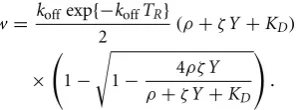
ρ=RT/κ (M). With these parameters, the TCR triggering rate w=W/κ(in M·s−1) assumes a simpler form:
w= koffexp{−koffTR}
2 (ρ+ζY +KD)
× 1−
s
1− 4ρζY
ρ+ζY +KD
!
. (10)
The read-out in the present study is median fluorescence inten-sity (MFI), which is a valid measure of activation in view of its good correlation with the fraction of responding cells. Accord-ingly, the read-outUis assumed to be proportional to the fraction of responding cells. This assumption is validated by response data at the level of individual cells (see Results below). The equation for the read-out is as follows:
U =Umin+(Umax−Umin)P(respond) (11)
whereUmin andUmaxare nuisance parameters associated with the read-out procedure; these parameters take specific values for each type of cellular response and are assumed not to vary across peptide ligands. The probability that a T-cell responds is modeled as follows:
P(respond)=P(wact≤w) (12)
wherewis the scaled TCR triggering rate given by equation (10) andwactis thecellular activation threshold. This latter quantity is assumed to have a log-normal distribution over the population of cells in the experiment. Stochastic variation between the T-cells within the responding population is thus taken into account. The parameters are estimated by simultaneous least-squares fit-ting over the set of available ligands and read-outs. The median of the log-normal distribution provides the estimate ofwact.
Implementation of response hierarchy hypotheses
We examined five different cellular responses and compared three hypotheses: (i) for each type of cellular response, bothTRand
wacthave distinct values; (ii) there is a common value ofTRacross responses, whereaswacthas a different value for each response; and
(iii) there is a common value of wactacross responses, whereas TRhas a different value for each response. As the least-squares fit is carried out simultaneously, these hypotheses can be imple-mented by specifying either common or particular values for these parameters.
RESULTS
KINETIC PARAMETERS AND LIGAND NUMBERS INTERACT TO DETERMINE THE RATE OF TCR TRIGGERING
The triggering equation (7) reduces to various simplified forms, depending on which receptors are kinetically limiting. These forms are of immunological interest since they illuminate the controversy over which kinetic parameter primarily governs T-cell activation. First, if the term koff/kon is much larger than bothRTandZT, which applies when both cells have introduced comparatively low numbers of ligands into the interaction area, the following approximation is accurate:
W =RTZTkonexp{−koffTR} (koff/kon max{RT,ZT}),
(13) that is, the triggering rate will be proportional to both TCR and pMHCI numbers: signaling isaffinity-limited.
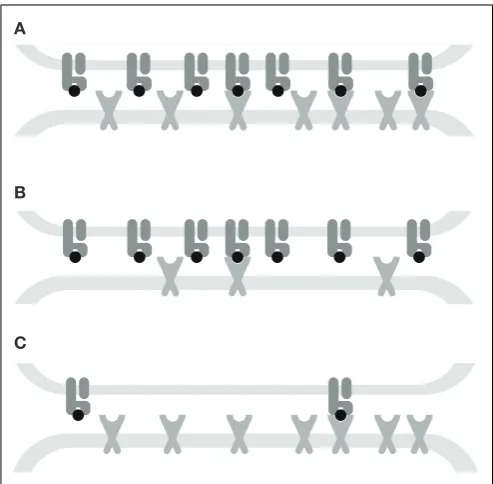
On the other hand, if the cells express numbers of lig-ands in the interaction area that are much larger than the 2-dimensional dissociation constantkoff/kon, there are two further good approximations:
W =RTkoffexp{−koffTR} (koff/konZT) (14)
W =ZTkoffexp{−koffTR} (koff/kon RT); (15)
in the first case, signaling is TCR-limited and in the second, it isMHC-limited. These equations imply that under the receptor-limited regimes, the TCR triggering rate displays an optimum relative tokoffat the pointkoff =TR−1, whereas under the affinity-limited regime,W increases monotonically inkon and decreases monotonically inkoff.
When both RT and ZT are much larger than koff/kon, the TCR triggering rate is proportional to min{RT,ZT} as shown in
Figure 2A, whereas at lower receptor densities,W∝RTZTas per
[image:5.595.96.250.284.339.2]equation (13). The transition between the two regimes happens where the receptor densities traverse the 2-dimensional dissoci-ation constant koff/kon. Thus, depending on receptor densities, the triggering rate may be affected solely by changes inRT(TCR copy numbers),ZT(pMHCI copy numbers), or both. The MHC-limited case corresponds to the serial triggering (serial engage-ment) hypothesis proposed by Valitutti et al. (35–37); however, the present theory is more general in the sense that the serial triggering mechanism arises as a special case.
Figure 2Bshows that the TCR triggering rate increases with bothkonand mean dwell-timekoff−1 whenkon is low (relative to receptor densities; scaling is explained in the legend toFigure 2). However, whenkonincreases, the triggering rate exhibits a weak dependence on kon and a non-monotone dependence on koff, attaining a maximum atkoff=1/TR.
-2 0 2
TCR density (lo
g10)
pMH
CI density (lo g
10)
Mean TC
R/pMHCI in
teractio
n time
TCR/pMH CI ass
ociation rate A
B
T
C
R
tr
ig
g
e
ri
n
g
r
a
te
(
lo
g
1
0)
4
2
0
-2
-4
-2
0 2
4
T
C
R
tr
ig
g
e
ri
n
g
r
a
te
3 2
0 1
[image:6.595.45.292.59.348.2]0.08 0.06 0.04 0.02 0.00 6 4 2 0
FIGURE 2 | TCR triggering rate depends on TCR/pMHCI association and dissociation rates as well as the densities of TCR and pMHCI molecules.
(A)Dependence of the rate of TCR triggering on receptor densities. Quantities are dimensionless: TCR triggering rate is scaled asWT2
Rkon, TCR density is scaled asRTkon/koff, pMHCI density is scaled asZTkon/koff, and koff=1/TRis assumed (this means that the ligand is optimal under MHC-limited conditions).(B)Dependence of the rate of TCR triggering on kinetic parameters. The dependence on the mean TCR/pMHCI interaction time (1/koff) is non-monotone, indicating that a maximally strong agonist must satisfykoff=1/TR. In contrast, the dependence onkonis monotone. Affinity is customarily expressed by the dissociation constantKD=koff/kon. Accordingly, whether or not an improvement of affinity correlates with an enhanced TCR triggering rate depends on where the system is initially located on the surface of the graph, as well as on the relative contributions that changes in association and dissociation rates make to the overall change in affinity. Quantities are dimensionless: TCR triggering rate is scaled as WTR/(RT+ZT), association rate is scaled askonTR(RT+ZT), and the mean lifetime of the interaction is scaled as 1/(koffTR). Here,RT=ZT. Similar qualitative behavior results when the two ligand densities are unequal.
triggering rate per ligand; i.e., a T-cell can be activated by a strong agonist even at low copy numbers whereas a poor agonist may be effective but only at sufficiently high copy numbers. In equation (15), copy numbers are expressed byZTand the intrinsic quality of the ligand is expressed by the quantitykoffexp{−koffTR}. The latter attains a maximum atkoff=1/TR. If the triggering rateW needs to exceed a certain threshold value to activate the T-cell, suf-ficient pMHCI copy numbers can compensate for a suboptimal intrinsic triggering rate. However, increasingZTmay transfer the system into the TCR-limited regime (Figure 2B), under which con-ditions pMHCI density-based compensation cannot be achieved,
cf.equation (14). Moreover, physiological bounds must exist on how many copies can be present in the interaction area and poor
agonists will be unable to activate the T-cell unless unusually high numbers of the ligand are presented (e.g., the cell transcribes very large quantities of the protein).
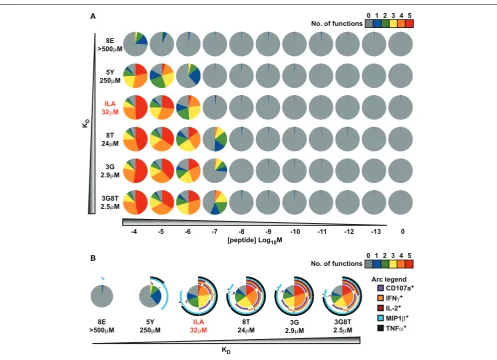
INTERCELLULAR VARIATION IN RESPONSE HIERARCHY THRESHOLDS An overview of the experimental data is provided inFigure 3. In keeping with the avidity effect, the fraction of cells that exhibited at leastndistinct responses (where 1≤n≤5) increased with peptide
concentration; individual ligands differed with respect to the min-imal concentration required to elicitn cellular responses. There was appreciable variability with regard to which functions were elicited, as depicted inFigure 3B, which displays the data obtained at peptide concentrations of 10−6M. The responses generally conformed to the following series:
MIP-1β <CD107a<TNFα <IL-2<IFN-γ
(with the lowest threshold on the left). However, a small propor-tion of cells exhibited a slightly different ordering of threshold values, as would be expected given the natural variability between cells with respect to the threshold value of any one given response. These results indicate that, for each response, there is varia-tion between cells with respect to the cellular threshold value. This supports the assumption made in the sectionConnecting the the-oretical model to experimental observationsabove, namely that the sigmoid dose-response shape of the population-level read-out can be accounted for by postulating a statistical distribution at the cell population level with respect to the cellular threshold for any given response.
THE RESPONSE HIERARCHY RESIDES AT THE LEVEL OF CELLULAR SIGNAL INTEGRATION
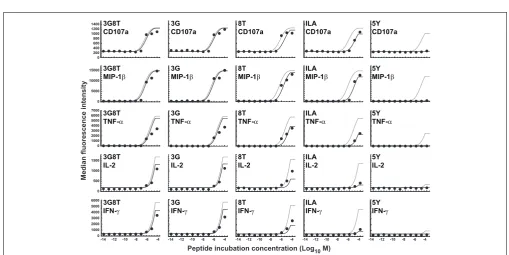
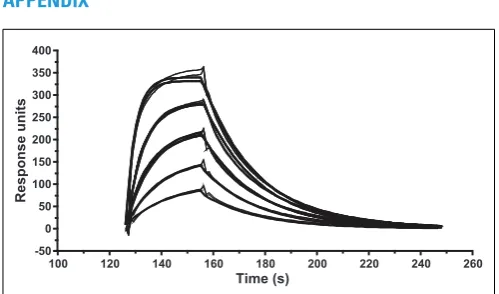
The parameters of the mathematical model were estimated by means of least-squares fitting of model predictions to the data; the biophysical data are summarized inTable 1andFigure A1in the Appendix.Figure 4shows the results of least-squares curve fit-ting for the dual-hierarchy hypothesis, the receptor-level response hierarchy hypothesis, and the cellular-level response hierarchy hypothesis. The goodness-of-fit should be assessed in the light of the parsimoniousness of the model. There is less than one para-meter per curve. This compares favorably to the standard practice of fitting a separate sigmoid model to each curve, which requires three or more parameters per curve. The fit is very good for such extreme parameter-count efficiency.
There is no substantial difference in the quality of fit between the dual-threshold model and the cellular-threshold model, whereas the fit to the receptor-threshold model is consistently less good. Thus, the data are best explained by postulating a hierarchy only at the level of the cellular activation threshold.
8E >500µM
5Y 250µM
ILA 32µM
8T 24µM
3G 2.9µM
3G8T 2.5µM KD
-4 -5 -6 -7 -8 -9 -10 -11 -12 -13 0
[peptide] Log10M
A 0 1 2 3 4 5
No. of functions
B No. of functions0 1 2 3 4 5
Arc legend CD107a+ IFNγ+ IL-2+
MIP1β+ TNFα+ 8E
>500µM
5Y 250µM
ILA 32µM
8T 24µM
3G 2.9µM
3G8T 2.5µM
[image:7.595.49.547.59.419.2]KD
FIGURE 3 | Functional variation at the cell population level in response to six different peptide ligands. The CTL clone ILA1 was stimulated for 6 h with peptide-pulsed C1R-A2 targets as indicated. Five functional read-outs (CD107a, MIP-1β, TNF-α, IL-2, and IFN-γ) were measured via flow cytometry. The 8E peptide was included as an
extremely weak ligand.(A)Overview of functional profiles. Pie chart segments represent the fraction of cells expressing the number of functions indicated in the key.(B)Detailed analysis of functional profiles at [peptide]=10−6
M. Pie charts are extended with arcs defining expressed functions as indicated in the key.
Table 1 | Biophysical parameters.
Ligand On-rate (M−1s−1) Off-rate (s−1) K
D(M)
3G8T 19,500 0.049 2.5×10⁻⁶
3G 16,000 0.047 2.9×10⁻⁶
8T 4,000 0.095 2.4×10⁻⁵
ILA 4,100 0.13 3.2×10⁻⁵
5Y 1,300 0.32 2.5×10⁻⁴
The kinetics of the TCR/pMHCI interaction for the 5Y and 3G8T ligands are reported here for the first time; it should be noted that the 5Y data are subject to a comparatively greater potential measurement error due to their rapidity.
MHCI/CD8 BINDING MODULATES FUNCTIONAL SENSITIVITY
The experiments described above were repeated using C1R-A2null cells as APCs, which cannot productively engage the CD8 corecep-tor (38). It is well-attested that the MHCI/CD8 interaction mod-ulates the TCR/pMHCI association rate (kon), the TCR/pMHCI
dissociation rate (koff), and the receptor-level triggering threshold (TR) (27,38,39). Multipliers can be used to model these effects. For example,koffis replaced throughout byγoffkoffwhereγoff rep-resents the effect of abrogating the MHCI/CD8 interaction and γoff>1 since CD8 stabilizes the TCR/pMHCI interaction (38– 40). The parameter γoff was set to 2.16, the value reported by Wooldridge et al. (38).
Since the prevailing kinetic regime in the experiments described here is MHC limitation, the parameterγonfor the association rate could not be estimated and was set to 1. This leaves a single free parameter,γR, for the data obtained with C1R-A2null APCs. Data fits are shown inFigure 5, withγR=1.14 (the least-squares esti-mate) for the receptor thresholdTR. This value indicates that the MHCI/CD8 interaction decreases the TCR triggering threshold by 13%.
DISCUSSION
[image:7.595.45.294.514.597.2]-12
-14 -10 -8 -6 -4 0 200 400 600 800 1000 1200 1400 5000 10000 15000 0 0 1000 2000 3000 4000 5000 6000 7000 0 500 1000 1500 0 1000 2000 3000 4000 5000 6000 3G8T CD107a 3G8T MIP-1β 3G8T TNF-α 3G8T IL-2 3G8T IFN-γ -12
-14 -10 -8 -6 -4 -12
-14 -10 -8 -6 -4 -14 -12 -10 -8 -6 -4 -14 -12 -10 -8 -6 -4 8T CD107a 8T MIP-1β 8T TNF-α 8T IL-2 8T IFN-γ 3G CD107a 3G MIP-1β 3G TNF-α 3G IL-2 3G IFN-γ ILA CD107a ILA MIP-1β ILA TNF-α ILA IL-2 ILA IFN-γ 5Y CD107a 5Y MIP-1β 5Y TNF-α 5Y IL-2 5Y IFN-γ
Peptide incubation concentration (Log10 M)
[image:8.595.47.550.57.301.2] [image:8.595.42.552.375.630.2]Me d ia n fl u o re s c e n c e i n te n s ity
FIGURE 4 | Dose-response curves for five peptide ligands and five cellular responses. Solid black curves correspond to the dual-threshold model in which both the receptor-level and the cellular-level thresholds have different values for different cellular responses. Solid gray curves
correspond to the receptor-level threshold model in which the receptor-level
thresholds have different values for different cellular responses, but the cellular activation threshold is constant. Dashed curves correspond to the cellular-level threshold model in which the cellular activation thresholds have different values for different cellular responses, but the receptor-level threshold is constant.
3G8T CD107a 3G8T MIP-1β 3G8T TNF-α 3G8T IL-2 3G8T IFN-γ 8T CD107a 8T MIP-1β 8T TNF-α 8T IL-2 8T IFN-γ 3G CD107a 3G MIP-1β 3G TNF-α 3G IL-2 3G IFN-γ ILA CD107a ILA MIP-1β ILA TNF-α ILA IL-2 ILA IFN-γ 5Y CD107a 5Y MIP-1β 5Y TNF-α 5Y IL-2 5Y IFN-γ -12
-14 -10 -8 -6 -4 -14 -12 -10 -8 -6 -4 -14 -12 -10 -8 -6 -4 -14 -12 -10 -8 -6 -4 -14 -12 -10 -8 -6 -4
Peptide incubation concentration (Log10 M)
0 200 400 600 800 1000 1200 1400 5000 10000 15000 0 0 1000 2000 3000 4000 5000 6000 7000 0 500 1000 1500 0 1000 2000 3000 4000 5000 6000 Me d ia n fl u o re s c e n c e i n te n s ity
FIGURE 5 | Dose-response curves for five peptide ligands and five cellular responses in the absence of the MHCI/CD8 interaction. All curves correspond to the cellular-level threshold model in which the cellular activation thresholds have different values for different cellular responses, but the receptor-level threshold is constant. Black curves are the fits to the data
others. In particular, different responses require different levels of stimulation in terms of ligand densities present on the APC sur-face. Such threshold differences might be postulated at the receptor level (different response pathways branch off at different stages in the sequence of signaling events), and/or at the cellular level (the TCR signal received by the T-cell needs to exceed different thresh-old values for different responses). The present study suggests that the cellular-level hypothesis is the most parsimonious explanation consistent with the data. Furthermore, the role of the CD8 core-ceptor as a modulator of T-cell functional sensitivity is confirmed by the present findings, which indicate that the MHCI/CD8 inter-action decreases the TCR/pMHCI dissociation rate as well as the duration of TCR/pMHCI contact required to activate the T-cell.
A key consideration for the interpretation of our results is the standardized nature of the system. Determinative cellular factors, such as TCR density, membrane constituency, and the expression of costimulatory/inhibitory molecules, were fixed across all condi-tions, which means that these extraneous factors can be discounted as discriminative because only ligand nature and concentration varied between stimulations. These built-in controls justify the simplifying assumptions from which the mathematical model was derived.
The present findings certainly do not exclude the existence of a receptor-level hierarchy. Indeed, the co-existence of hierarchies at both the receptor and cellular levels may explain the data equally well. However, the hypothesis that the response hierarchy resides solely at the receptor level is contradicted by the present findings. A threshold hierarchy at the level of cellular activation would imply that the functional responses are located downstream from signal-ing pathways that share a common startsignal-ing point (the triggered TCR or signalosome). Further detailed molecular studies of the CD3-complex phosphorylation cascade would be required to rule out a receptor-level hierarchy definitively.
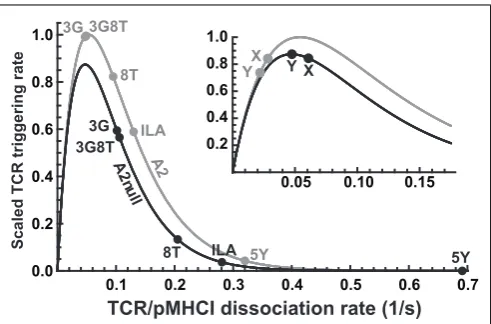
Our mathematical model elucidates the contrasting roles played by the dissociation rate and the affinity constant as determinants of T-cell functional sensitivity, with TCR and pMHCI molecular densities governing the limitation regime under which the kinetics operate. The disappearance of the optimum behavior as the sys-tem moves from the receptor-limited to the affinity-limited regime can be studied experimentally by increasing TCR density. This shift was first predicted by Van den Berg et al. (23) and confirmed experimentally by Gonzales et al. (41). Furthermore, the pattern of dependence onkonandkoffshown inFigure 2Bmay account for the discrepancies between the findings of Kalergis et al. (42), who reported such an optimal dwell-time (=koff−1), and the find-ings of Holler et al. (43), who reported monotone dependence. The shift along thekonaxis may also explain the observations of Irving et al. (26), who observed that affinity modulates the depen-dence onkoff. In the experimental system studied here, the TCR is stimulated under MHC-limited conditions. This means that the optimum-type dependence onkoffprevails. This is shown in
Figure 6, where the calculated TCR triggering rate (at 10−5M) is plotted againstkoff. The effect ofkonis so slight that the curves overlap almost perfectly for the five ligands. Even under MHC-limited conditions, however,kon remains a crucial determinant of functional sensitivity, in view of the fact that the ratio ofkoff and kon determines the transition between affinity-limited and
0.0 0.2 0.4 0.6 0.8 1.0
Sc
a
le
d
T
C
R
tr
ig
g
e
ri
n
g
r
a
te
TCR/pMHCI dissociation rate (1/s)
Y X
3G 3G8T
8T ILA 5Y
A 2
nu ll
A 2 3G 3G8T
Y X 8T
ILA
5Y
0.1 0.2 0.3 0.4 0.5 0.6 0.7
0.2 0.4 0.6 0.8 1.0
[image:9.595.304.550.61.223.2]0.05 0.10 0.15
FIGURE 6 | Differential effects of CD8 modulation on functional sensitivity. TCR triggering rate, scaled with respect to the optimal ligand under MHC-limited conditions, as a function ofkoff, comparing the wild-type MHCI/CD8 interaction (“A2”) to the abrogated MHCI/CD8 interaction (“A2null”). The positions for the five ligands are indicated. The inset shows two hypothetical ligands: “X,” which is unaffected by the absence of the CD8 interaction, and “Y,” which is optimal under the MHC-null condition.
ligand-limited signaling, as illustrated schematically inFigure 7. Thus, the association rate and the dissociation rate play distinct roles in T-cell activation, consistent with reports of dominant effects associated with each of these biophysical parameters under different conditions (24,44); these differences also explain earlier observations on the interplay of kinetic parameters and receptor numbers (41,45,46).
In the presence of the wild-type MHCI/CD8 interaction, the ligands 3G and 3G8T are virtually optimal, whereas abrogation of MHCI/CD8 binding leads to a reduction in functional sensitivity. In virtue of the non-linear character of the curve, the magnitude of the reduction varies considerably across ligands. Two parame-ters (γonandγR) suffice to capture these effects. The ILA ligand evokes a triggering rate approximately one order of magnitude less than optimal under C1R-A2null conditions. Nonetheless, the data show that strongly attenuated but discernible responses can be elicited at sufficiently high presentation levels, in keeping with Wooldridge et al. (14), who reported that a ligand could be physio-logically significant even at an estimated∼2.1 orders of magnitude below the optimal ligand for a responding T-cell clone.
Although all ligands studied here become less potent when presented by C1R-A2null cells, the model predicts that this is not necessarily the case. Indeed, the functional sensitivity to a ligand marked “X” in the inset of Figure 6 is unaffected when the MHCI/CD8 interaction is abrogated. Moreover, ligand “Y” becomes optimal in the absence of the CD8 effect (so that the T-cell has a higher functional sensitivity to this ligand under CD8-null conditions). The existence of such ligands would imply that T-cells can “tune” to distinct cognate ligands by up- or down-regulating their CD8 coreceptors. This effect would greatly amplify the ability of T-cells to reconcile extensive cross-reactivity with the avoidance of self-recognition.
A
B
[image:10.595.45.292.61.303.2]C
FIGURE 7 | Interplay between kinetic parameters and receptor densities.(A)Affinity-limited: the TCR triggering rate is proportional to the densities of both receptors.(B)TCR-limited: the TCR triggering rate is proportional to the TCR density and is monotone decreasing inkoff.(C)
MHC-limited: the TCR triggering rate is proportional to the MHC density and has an optimumkoff. The affinityKD=koff/kongoverns the transitions between these kinetic regimes.
homoclitic ligands, which makes them more challenging to detect and characterize. Nonetheless, work is ongoing to demonstrate the existence of such anomalous ligands, using combinatorial peptide library screening combined with importance sampling (14) in the presence of different extracellular contributions from the CD8 coreceptor (29).
The effect of CD8 on the value of the TCR triggering thresh-old is consistent with the conclusions of Van den Berg et al. (39) and may be due to the association of TCR/CD3 with protein tyro-sine kinases such as p56lck, which expedites the immunoglobulin family tyrosine-based activation motif phosphorylation sequence (47). This agrees with the observation that the CD8αβ hetero-dimer is more potent as a coreceptor than theαα homo-dimer (48, 49), perhaps due to interactions with other signalosome components mediated by the palmitoylated CD8 β chain (50), which interacts with myristoylated p56lck. Docking of CD8 to the TCR/CD3 complex may also be driven by initial activation (51). The kinetics of CD8 binding after TCR/pMHC contact was analyzed previously by Van den Berg and Sewell (52). More recently, Mukhopadhyay et al. (53) developed a model that explic-itly accounts for the interplay between the CD3 phosphorylation cascade and p56lck, ZAP-70, and CD45.
The dissociation rates determined by SPR were assumed to be indicative of the normal interaction in this study. In reality, these values might be more true to the case where the MHCI/CD8 inter-action is absent. Assuming the latter would not dramatically alter the qualitative conclusions of this study, but would lead to a slight
adjustment in the interpretation of the parameter estimates. Most importantly, the value found for the TCR triggering thresholdTR would be adjusted down from 17.46 to 15.26 s.
Values based on SPR experiments are best regarded as 3-dimensional, representative of ligands in solution. However, the TCR/pMHCI interaction takes place in a 2-dimensional envi-ronment, which essentially reduces spatial degrees of freedom of molecular motion and introduces dynamics related to the forces that constrain the molecules to this environment (54). Conse-quently, rate constants may be different in two dimensions as opposed to three dimensions. In particular, 2-dimensional dis-sociation rates can be substantially faster (55). The ratio between the 3-dimensional and 2-dimensional affinities is a length mea-sure, denotedhand called the confinement length (56,57). Wu et al. demonstrated thathis proportional to the range of motion available to the free forms of the interacting ligands along the spatial axis perpendicular to the two parallel membranes. Thus, the intermembrane separation provides an upper bound, and if the ranges of motion do not differ too much, it is reasonable to assume that the confinement length is roughly the same for all mutants involved.
The use of a fixed receptor duration might appear simplistic given the complexity of the events that are required to trigger a TCR/CD3 complex, but the law of large numbers provides indi-rect support for a simple assumption: the true waiting-time-till-triggering is a composite of a large number of stochastic durations which tends to regress it on the mean value. In fact, the number of terms is itself a random variate due to the possibility of alternative routes in the activation pathway of the complex (such processes are termed “compound stochastic”). The complexity illustrated in
Figure 1effectively underpins a simple assumption, viz. that there is a fixed, stereotypical receptor thresholdTR.
The parametersTRandwactare both subject to further modula-tion. By varying the levels of the CD8 coreceptor, surface molecules such as CD45, and cytosolic concentrations of kinases, phospho-rylases, and linker proteins in the immediate vicinity of the CD3 complex, the T-cell can adjust the effective value of the recep-tor triggering thresholdTR(29,30,38,39,58–61). The value of the cellular activation thresholdwactis modulated by costimu-lation (“signal 2”). Moreover, the T-cell can actively modulate its receptiveness to this signal by adjusting the relative levels of CD28 and CD152 (52,62). Furthermore, the maintenance of tol-erance requires continual dynamic tuning of the cellular activation threshold (63, 64). Conceivably, these mechanisms provide an additional “multiplier” that modulateswactover and above the factors that setwactto different values for different responses.
alternative explanation of the intercellular variability. Experimen-tally, the two hypotheses could be distinguished by following an individual T-cell over a series of interactions and responses. If cel-lular thresholds for the various responses remain largely constant, there would be little event-to-event variation according to the for-mer hypothesis; in contrast, the receptor copy number hypothesis would predict considerable event-to-event variation.
In addition, there may be variability with respect to antigen presentation levels across the experimental APC population, due to differential antigen exposure and stochastic effects in anti-gen acceptance from the incubation medium. However, it can be shown that the resulting variance is not such as to make a substantial contribution to overall variability, for instance by following the argument presented in Appendix C of Van den Berg et al. (22).
When the TCR/pMHCI ternary complex dissociates, the cova-lent modifications and multimeric aggregations that the CD3 complex undergoes during the gradual transition to signalosome status are reversed, both by thermal agitation and the action of phosphorylases. In the present model, it has been assumed that this “reset” occurs much more rapidly than the typical time required for the TCR/CD3 complex to encounter the next non-null pMHCI ligand. However, given that the molecules have to drift away from each other through diffusion in the 2-dimensional arena of the T-cell/APC interface, there is a possibility of rapid rebinding to the
samepMHCI molecule before the CD3 complex has had sufficient time to “reset.” This rapid rebinding is equivalent to a diminish-ment of the effective off-rate; a basic model capturing this effect has been proposed by Aleksic et al. (65). Extending the present model with this effect is straightforward in principle, albeit at the cost of an additional parameter. Furthermore, the number of com-plexes with other pMHCI species is ignored in equation (1). This is valid if the vast majority of all other ligands consists of null agonists. An analysis that takes the entire presentation profile (all pMHCI species present) into account can be found in Van den Berg et al. (22,23).
A further aspect of the cellular activation threshold that has been left implicit in the present treatment is the duration of the T-cell/APC interaction. If this contact is initiated att0and is ter-minated att1, the cumulative signal transmitted to the cytosolic
signaling machinery is given by an integral:
Q=
Z t1
t0
W(τ)dτ. (16)
In fact, this quantityQis presumed to be directly compared to a threshold. However, Q/(t1−t0) is proportional to the activation threshold as defined in the present study. Indeed, variability in the duration of the contact is one of the sources of stochasticity under-lying the log-normal response curve used to fit the dose-response curves.
A related phenomenon is that of TCR down-regulation (66–
68), whereby triggered TCRs are gradually removed from the cell surface. This affects the integral in equation (16); Van den Berg et al. (23) discuss how the model can be extended to take this effect into account. TCR down-regulation can in fact be exploited by the T-cell to gauge bothkonandkoffindependently. As indicated in
Figure 2A, if the system starts in the MHC-limited regime, grad-ual removal of TCR molecules will result in a transition to the TCR-limited regime, where a sudden drop of the instantaneous signal results. At the point of change-over,RT≈ZT. This means that the T-cell can, in principle, glean a rough estimate of the bio-physical rate parameterskoffandkonby combining information from the gross signal and the number of down-regulated TCRs at the transition point. This mechanism can only function in the ligand-limited regime, not in the affinity-limited regime.
In conclusion, the present study confirms that a response hier-archy exists with respect to the strength of TCR stimulation required to elicit various cellular responses. Moreover, a combi-nation of experimentation and mathematical modeling indicates that this hierarchy resides at the cellular level rather than at the level of the individual receptor molecules. Functional sensitivity is generally enhanced by the CD8 coreceptor, although the the-ory indicates that the MHCI/CD8 interaction can depress TCR signaling for certain heteroclitic ligands.
ACKNOWLEDGMENTS
This work was supported by the Biotechnology and Biological Sci-ences Research Council (grant BB/H001085/1). The authors are grateful to Brenda Hartman (NIH/VRC) for expert assistance with graphics.
REFERENCES
1. Parham P. The Immune System.
New York: Garland Publishing (2000).
2. Rudolph MG, Stanfield RL, Wil-son IA. How TCRs bind MHCs,
peptides, and coreceptors. Annu
Rev Immunol (2006) 24:419–66.
doi:10.1146/annurev.immunol.23. 021704.115658
3. Mason D. A very high level of
crossreactivity is an essential
feature of the T-cell
recep-tor. Immunol Today (1998) 19:
395–404.
doi:10.1016/S0167-5699(98)01299-7
4. Wraith DC, Bruun B, Fairchild PJ. Cross-reactive antigen recogni-tion by an encephalitogenetic T
cell receptor. J Immunol (1992)
149:3765–70.
5. Bhardwaj V, Kumar V, Geysen HM, Sercarz EE. Degenerate recogni-tion of a dissimilar antigenic pep-tide by myelin basic protein. Impli-cations for thymic education and
autoimmunity. J Immunol (1993)
151:5000–10.
6. Reay PA, Kantor RM, Davis
MM. Use of global amino acid replacements to define the require-ments for MHC binding and T cell recognition of moth cytochrome
c (93–103). J Immunol (1994)
152:3946–3957.
7. Evavold BD, Sloan-Lancaster J, Wilson KJ, Rothbard JB, Allen PM. Specific T cell recognition of
minimally homologous peptides: evidence for multiple endogenous
ligands. Immunity (1995) 2:
655–63.
doi:10.1016/1074-7613(95)90010-1
8. Wucherpfennig KW, Strominger
JL. Molecular mimicry in T
cell-mediated autoimmunity:
viral peptides activate human
T cell clones specific for myelin
basic protein. Cell (1995) 80:
695–705.
doi:10.1016/0092-8674(95)90348-8
9. Ignatowicz L, Rees W, Pacholczyk R, Ignatowicz H, Kushnir E, Kappler J, et al. T cells can be activated by peptides that are unrelated in sequence to their selecting
peptide. Immunity (1997) 7:
179–186.
doi:10.1016/S1074-7613(00)80521-X
10. Hemmer B, Fleckenstein BT,Vergelli M, Jung G, McFarland H, Mar-tin R, et al. Identification of high potency microbial and self lig-ands for a human autoreactive class
II-restricted T cell clone. J Exp
Med(1997)185:1651–1659. doi:10.
1084/jem.185.9.1651
11. Bachmann MF, Speiser DE, Zakar-ian A, Ohashi PS. Inhibition of TCR triggering by a spectrum of altered peptide ligands suggests the mechanism for TCR
antag-onism. Eur J Immunol (1998)
28:3110–9. doi:10.1002/(SICI)
12. Wilson DB, Wilson DH, Schroder K, Pinilla C, Blondelle S, Houghten RA, et al. Specificity and degeneracy of T
cells.Mol Immunol(2004)40:1047–
1055. doi:10.1016/j.molimm.2003. 11.022
13. Ishizuka J, Grebe K, Shenderov E, Peters B, Chen Q, Peng Y, et al. Quantitating T cell cross-reactivity
for unrelated peptide antigens. J
Immunol(2009)183:4337–45. doi:
10.4049/jimmunol.0901607 14. Wooldridge L, Ekeruche-Makinde J,
van den Berg HA, Skowera A, Miles JJ, Tan MP, et al. A single autoim-mune T cell receptor recognizes more than a million different
pep-tides.J Biol Chem(2012)287:1168–
77. doi:10.1074/jbc.M111.289488 15. Valitutti S, Müller S, Dessing M,
Lanzavecchia A. Different responses are elicited in cytotoxic T lym-phocytes by different levels of T
cell receptor occupancy. J Exp
Med(1996)183:1917–1921. doi:10.
1084/jem.183.4.1917
16. Itoh Y, Germain RN. Single cell analysis reveals regulated hierarchi-cal T cell antigen receptor signal-ing thresholds and intraclonal het-erogeneity for individual cytokine
responses of CD4+ cells.J Exp Med
(1997) 186:757–766. doi:10.1084/
jem.186.5.757
17. Hemmer B, Stefanova I, Vergelli M, Germain RN, Martin R. Relation-ships among TCR ligand potency, thresholds for effector function elic-itation, and the quality of early
sig-naling events in human T cells.J
Immunol(1998)160:5807–5814.
18. Price DA, Sewell AK, Dong T, Tan R, Goulder PJR, Rowland-Jones SL, et al. Antigen-specific release of
β-chemokines by anti-HIV-1
cyto-toxic T lymphocytes. Curr Biol
(1998)8:355–8.
doi:10.1016/S0960-9822(98)70138-1
19. Rabinowitz JD, Beeson C, Lyons DS, Davis MM, McConnell HM. Kinetic discrimination in T-cell
activation.Proc Natl Acad Sci U S A
(1996)93:1401–1405. doi:10.1073/
pnas.93.4.1401
20. McKeithan TW. Kinetic proofread-ing in T-cell receptor signal
trans-duction.Proc Natl Acad Sci U S A
(1995)92:5042–5046. doi:10.1073/
pnas.92.11.5042
21. Lanzavecchia A, Iezzi G, Viola A. From TCR engagement to T cell activation: a kinetic view of T cell
behavior.Cell(1999)96:1–4. doi:10.
1016/S0092-8674(00)80952-6 22. van den Berg HA, Rand DA,
Bur-roughs NJ. A reliable and safe T cell repertoire based on
low-affinity T cell receptors.J Theor Biol
(2001) 209:465–486. doi:10.1006/
jtbi.2001.2281
23. van den Berg HA, Burroughs NJ, Rand DA. Quantifying the strength of ligand antagonism in
TCR triggering. Bull Math Biol
(2002) 64:781–808. doi:10.1006/
bulm.2002.0302
24. Bridgeman JS, Sewell AK, Miles JJ, Price DA, Cole DK. Structural and
biophysical determinants ofαβ
T-cell antigen recognition.
Immunol-ogy(2012)135:9–18. doi:10.1111/j.
1365-2567.2011.03515.x 25. van den Berg HA, Rand DA.
Quantitative theories of T-cell
responsiveness. Immunol Rev
(2007) 216:81–92. doi:10.1111/j.
1600-065X.2006.00491.x 26. Irving M, Zoete V, Hebeisen M,
Schmid D, Baumgartner P, Guil-laume P, et al. Interplay between T cell receptor binding kinetics and the level of cognate peptide presented by major histocompati-bility complexes governs CD8+ T
cell responsiveness. J Biol Chem
(2012)287:23068–78. doi:10.1074/
jbc.M112.357673
27. Laugel B, van den Berg HA, Gostick E, Cole DK, Wooldridge L, Boul-ter J, et al. Different T cell receptor affinity thresholds and CD8 core-ceptor dependency govern cyto-toxic T lymphocyte activation and
tetramer binding properties.J Biol
Chem(2007)282:23799–810. doi:
10.1074/jbc.M700976200 28. Melenhorst JJ, Scheinberg P,
Chat-topadhyay PK, Lissina A, Gostick E, Cole DK, et al. Detection of low
avidity CD8+ T cell populations
with coreceptor-enhanced peptide-major histocompatibility complex
class I tetramers.J Immunol
Meth-ods(2008)338:31–9. doi:10.1016/j.
jim.2008.07.008
29. Wooldridge L, Laugel B, Ekeruche J, Clement M, van den Berg HA, Price DA, et al. CD8 controls
T cell cross-reactivity. J Immunol
(2010) 185:4625–32. doi:10.4049/
jimmunol.1001480
30. Purbhoo MA, Boulter JM, Price DA, Vuidepot A-L, Hourigan CS, Dun-bar PR, et al. The human CD8 core-ceptor effects cytotoxic T cell acti-vation and antigen sensitivity pri-marily by mediating complete phos-phorylation of the T cell
recep-tor ζ chain. J Biol Chem (2001)
276:32786–32792. doi:10.1074/jbc.
M102498200
31. Betts MR, Brenchley JM, Price DA, De Rosa SC, Douek DC, Roederer M, et al. Sensitive and viable
iden-tification of antigen-specific CD8+
T cells by a flow cytometric assay
for degranulation.J Immunol
Meth-ods(2003)281:65–78. doi:10.1016/
S0022-1759(03)00265-5
32. Cole DK, Pumphrey NJ, Boulter JM, Sami M, Bell JI, Gostick E, et al. Human TCR-binding affinity is
gov-erned by MHC class restriction.J
Immunol(2007)178:5727–34.
33. Cole DK, Yuan F, Rizkallah PJ, Miles JJ, Gostick E, Price DA, et al. Germ line-governed recognition of a can-cer epitope by an
immunodomi-nant human T-cell receptor.J Biol
Chem(2009)284:27281–9. doi:10.
1074/jbc.M109.022509
34. Cole DK, Rizkallah PJ, Boulter JM, Sami M, Vuidepot A, Glick M, et al. Computational design and crys-tal structure of an enhanced-affinity
mutant human CD8αα
corecep-tor.Proteins(2007)67:65–74. doi:
10.1002/prot.21176
35. Valitutti S, Müller S, Cella M, Padovan E, Lanzavecchia A. Ser-ial triggering of many T-cell recep-tors by a few peptide-MHC
com-plexes.Nature(1995)375:148–151.
doi:10.1038/375148a0
36. Valitutti S, Lanzavecchia A. Ser-ial triggering of TCRs: a basis for the sensitivity and specificity
of antigen recognition. Immunol
Today (1997) 18:299–304. doi:10.
1016/S0167-5699(97)80027-8 37. Valitutti S. The serial engagement
model 17 years after: from TCR
triggering to immunotherapy.Front
Immunol(2012)3:272. doi:10.3389/
fimmu.2012.00272
38. Wooldridge L, van den Berg HA, Glick M, Gostick E, Brenchley JM, Douek DC, et al. Inter-action between the CD8 core-ceptor and MHC class I stabi-lizes TCR-antigen complexes at the
cell surface. J Biol Chem (2005)
280:27491–27501. doi:10.1074/jbc.
M500555200
39. van den Berg HA, Wooldridge L, Laugel B, Sewell AK. Coreceptor CD8-driven modulation of T cell
antigen receptor specificity.J Theor
Biol (2007) 249:395–408. doi:10.
1016/j.jtbi.2007.08.002
40. Luescher IF, Vivier E, Layer A, Mahiou J, Godeau F, Malissen B, et al. CD8 modulation of T-cell antigen receptor-ligand interactions on living cytotoxic T lymphocytes.
Nature(1995)373:353–356. doi:10.
1038/373353a0
41. Gonzales PA, Carreño LJ, Coombs D, Mora JE, Palmeiri E, Goldstein B, et al. T cell receptor binding kinetics required for T cell acti-vation depend on the density of the cognate ligand of the
antigen-presenting cell.Proc Natl Acad Sci U
S A(2005)102:4824–4829. doi:10.
1073/pnas.0500922102
42. Kalergis AM, Boucheron N, Doucey M-A, Palmieri E, Goyarts EC, Vegh Z, et al. Efficient T cell activation requires an optimal dwell-time of interaction between the TCR and
the pMHC complex.Nat Immunol
(2001)2:229–34. doi:10.1038/85286
43. Holler PD, Lim AR, Cho BK, Rund
LA, Kranz DM. CD8−
T cell trans-fectants that express a high affin-ity T cell receptor exhibit enhanced
peptide-dependent activation.J Exp
Med(2001)194:1043–1052. doi:10.
1084/jem.194.8.1043
44. Carreño LJ, González PA, Kalergis AM. Modulation of T cell function by TCR/pMHC binding kinetics.
Immunobiology (2006)211:47–64.
doi:10.1016/j.imbio.2005.09.003
45. Govern CC, Paczosa MK,
Chakraborty AK, Huseby ES.
Fast on-rates allow short dwell time
ligands to activate T cells.Proc Natl
Acad Sci U S A(2010)107:8724–9.
doi:10.1073/pnas.1000966107 46. Dushek O, Aleksic M, Wheeler RJ,
Zhang H, Cordoba S-P, Peng Y-C, et al. Antigen potency and max-imal efficacy reveal a mechanism
of efficient T cell activation. Sci
Signal(2011)4:ra39. doi:10.1126/
scisignal.2001430
47. Arcaro A, Grégoire C, Bakker TR, Baldi L, Jordan M, Goffin L, et
al. CD8β endows CD8 with
effi-cient coreceptor function by cou-pling T cell receptor/CD3 to
raft-associated CD8/p56lckcomplexes.J
Exp Med(2001)194:1485–95. doi:
10.1084/jem.194.10.1485 48. Bosselut R, Kubo S, Guinter T,
Kopacz JL, Altman JD,
Feigen-baum L, et al. Role of CD8β
domains in CD8 coreceptor func-tion: importance for MHC I bind-ing, signalbind-ing, and positive
selec-tion of CD8+T cells in the thymus.
Immunity(2000)12:409–418. doi:
10.1016/S1074-7613(00)80193-4 49. Gangadharan D, Cheroute H. The
CD8 isoform CD8αα is not a
functional homologue of the TCR
co-receptor CD8αβ. Curr Opin
Immunol (2004) 16:264–270. doi:
10.1016/j.coi.2004.03.015 50. Arcaro A, Grégoire C, Boucheron N,
Stolz S, Palmer E, Malissen B, et al. Essential role of CD8
palmitoyla-tion in CD8 coreceptor funcpalmitoyla-tion.J
Immunol(2000)165:2068–2076.
51. Laugel B, Cole DK, Clement M, Wooldridge L, Price DA, Sewell AK. The multiple roles of the CD8 core-ceptor in T cell biology: opportu-nities for the selective modulation
Leukoc Biol(2011)90:1089–99. doi: 10.1189/jlb.0611316
52. van den Berg HA, Sewell AK. Dynamic tuning of T cell recep-tor specificity by co-receprecep-tors and costimulation. In: Molina-París C,
Lythe G, editors. Mathematical
Models and Immune Cell Biology.
Berlin: Springer-Verlag (2011) pp. 47–73.
53. Mukhopadhyay H, Cordoba S-P, Maini PK, van der Merwe PA, Dushek O. Systems model of T cell receptor proximal signaling reveals
emergent ultrasensitivity. PLoS
Comput Biol (2013) 9:e1003004.
doi:10.1371/journal.pcbi.1003004 54. Wu Y, Vendome J, Shapiro L,
Ben-Shaul A, Honig B. Trans-forming binding affinities from three dimensions to two with application to cadherin clustering.
Nature (2011) 475:510–4. doi:10.
1038/nature10183
55. Zarnitsyna V, Zhu C. T cell trigger-ing: insights from 2D kinetics
analy-sis of molecular interactions.Phys
Biol (2012)9:045005. doi:10.1088/
1478-3975/9/4/045005
56. Bell GI. Models for the specific
adhesion of cells to cells.
Sci-ence (1978) 200:618–27. doi:10.
1126/science.347575
57. Bell GI, Dembo M, Bongrand
P. Cell adhesion. Competition
between nonspecific repulsion and
specific bonding.Biophys J (1984)
45:1051–64.
doi:10.1016/S0006-3495(84)84252-6
58. Werlen G, Palmer E. The TCR sig-nalosome: a dynamic structure with
expanding complexity. Curr Opin
Immunol (2002)14:299–305. doi:
10.1016/S0952-7915(02)00339-4 59. Filipp D, Zhang J, Leung BL, Shaw
A, Levin SD, Veillette A, et al. Reg-ulation of Fyn through transloca-tion of activated Lck into lipid rafts.
J Exp Med(2003)197:1221–1227.
doi:10.1084/jem.20022112 60. Maile R, Siler CA, Kerry SE,
Mid-kiff KE, Collins EJ, Frelinger JA. Peripheral “CD8 tuning” dynami-cally modulates the size and respon-siveness of an antigen-specific T
cell pool in vivo.J Immunol(2005)
174:619–627.
61. Park J-H, Adoro S, Lucas PJ, Sarafova SD, Alag AS, Doan LL, et al. ‘Coreceptor tuning’: cytokine
signals transcriptionally tailor
CD8 coreceptor expression to
the self-specificity of the TCR.
Nat Immunol (2007) 8:1049–58.
doi:10.1038/ni1512
62. Collins AV, Brodie DW, Gilbert RJC, Iaboni A, Manso-Sancho R, Stuart DI, et al. The inter-action properties of
costimula-tory molecules revisited.
Immu-nity(2002)17:201–10. doi:10.1016/
S1074-7613(02)00362-X 63. Grossman Z, Paul WE.
Adap-tive cellular interactions in the
immune system: the tunable acti-vation threshold and the signifi-cance of subthreshold responses.
Proc Natl Acad Sci U S A (1992)
89:10365–10369. doi:10.1073/pnas.
89.21.10365
64. van den Berg HA, Rand DA. Dynamics of T cell activation
threshold tuning. J Theor Biol
(2004)228:397–416. doi:10.1016/j.
jtbi.2004.02.002
65. Aleksic M, Dushek O, Zhang H, Shenderov E, Chen J-L, Cerun-dolo V, et al. Dependence of the T cell antigen receptor on the T cell receptor-peptide MHC
confine-ment time.Immunity(2010)32:1–
12. doi:10.1016/j.immuni.2009.11. 013
66. Lauritsen JPH, Christensen MD, Dietrich J, Kastrup J, Ødum N, Geisler C. Two distinct pathways exist for down-regulation of the
TCR.J Immunol (1998)161:260–
267.
67. Liu H, Rhodes M, Wiest DL, Vignali DAA. On the dynamics of TCR:CD3 complex cell surface expression and downmodulation.
Immunity(2000)13:665–675. doi:
10.1016/S1074-7613(00)00066-2 68. Sousa J, Carneiro J. A mathematical
analysis of TCR serial triggering and
down-regulation. Eur J Immunol
(2000)30:3219–3227. doi:10.1002/
1521-4141(200011)30:11<3219: :AID-IMMU3219>3.0.CO;2-7
Conflict of Interest Statement:The authors declare that the research was conducted in the absence of any com-mercial or financial relationships that could be construed as a potential con-flict of interest.
Received: 22 May 2013; accepted: 09 August 2013; published online: 05 Sep-tember 2013.
Citation: van den Berg HA, Ladell K, Miners K, Laugel B, Llewellyn-Lacey S, Clement M, Cole DK, Gostick E, Wooldridge L, Sewell AK, Bridgeman JS and Price DA (2013)
Cellular-level versus receptor-level response
threshold hierarchies in T-cell
acti-vation. Front. Immunol. 4:250. doi:
10.3389/fimmu.2013.00250
This article was submitted to T Cell Biol-ogy, a section of the journal Frontiers in Immunology.
APPENDIX
400
350
300
250
200
150
100
50
0
-50
R
e
s
p
o
n
s
e
u
n
its
Time (s)
[image:14.595.44.294.63.210.2]100 120 140 160 180 200 220 240 260