University of Warwick institutional repository: http://go.warwick.ac.uk/wrap
A Thesis Submitted for the Degree of PhD at the University of Warwick
http://go.warwick.ac.uk/wrap/66778
This thesis is made available online and is protected by original copyright.
Please scroll down to view the document itself.
Unconstrained Face Recognition with Occlusions
by
Xingjie Wei
Thesis
Submitted to the University of Warwick
for the degree of
Doctor of Philosophy
Computer Science
Contents
Acknowledgments v
Declarations vi
Publications vii
Research Training ix
Abstract x
Abbreviations xii
List of Tables 1
List of Figures 3
Chapter 1 Overview 1
1.1 Why face ? . . . 1
1.2 Motivations . . . 2
1.2.1 Face recognition with occlusions: commonly seen problem . . . 3
1.2.2 Face recognition with occlusions: less studied problem . . . 4
1.2.3 Face recognition with occlusions: extensible problem . . . 6
1.3 Objectives . . . 6
1.5 Outline . . . 9
Chapter 2 Literature review 12 2.1 Face recognition by humans: forensic face recognition . . . 12
2.2 Face recognition by computers: automatic face recognition . . . 14
2.2.1 Performance metrics . . . 15
2.2.2 Brief history . . . 16
2.3 Unconstrained face recognition . . . 20
2.3.1 Approaches for handling illumination variations . . . 21
2.3.2 Approaches for handling pose variations . . . 22
2.3.3 Approaches for handling expression variations . . . 23
2.3.4 Approaches for handling low image quality variations . . . 24
2.3.5 Approaches for handling ageing . . . 24
2.4 Face recognition with occlusions . . . 26
2.4.1 Reconstruction based approach . . . 27
2.4.2 Local matching based approach . . . 29
2.4.3 Occlusion-insensitive feature based approach . . . 30
2.5 Challenges for occluded face recognition . . . 31
2.5.1 The presence of occlusions . . . 31
2.5.2 The prior knowledge of occlusions . . . 33
2.6 Databases . . . 34
2.6.1 The AR database . . . 34
2.6.2 The Extended Yale B database . . . 35
2.6.3 The FRGC database . . . 37
2.6.4 The LFW database . . . 37
2.6.5 The TFWM database . . . 40
Chapter 3 Structured sparse representation (SSR) based face recognition 43
3.1 Sparse representation based classification . . . 44
3.2 Structured sparse representation based face recognition . . . 47
3.2.1 Structured sparse representation . . . 47
3.2.2 Structured occlusion dictionary . . . 49
3.3 Combining SSR with illumination insensitive features . . . 53
3.4 Experimental analysis . . . 54
3.4.1 Face identification with randomly located occlusions and extreme illuminations . . . 55
3.4.2 Face identification with facial disguises and non-uniform illumina-tions . . . 59
3.4.3 The effect of cluster size . . . 61
3.5 Summary . . . 61
Chapter 4 Dynamic Image-to-Class Warping (DICW) 63 4.1 Image representation . . . 64
4.2 Modelling . . . 65
4.3 Implementation through Dynamic Programming . . . 71
4.4 Experimental analysis . . . 74
4.4.1 Face identification with randomly located occlusions . . . 76
4.4.2 Face identification with facial disguises . . . 80
4.4.3 Face identification with general occlusions in realistic environments 86 4.5 Discussion . . . 88
4.5.1 The effect of patch size . . . 88
4.5.2 The effect of patch overlap . . . 90
4.5.3 The effect of image descriptor . . . 92
4.5.4 Robustness to misalignment . . . 92
4.5.6 The computational complexity and usability analysis . . . 96
4.6 Further analysis and improvement . . . 98
4.7 Summary . . . 103
Chapter 5 Extension of DICW: fixations and saccades based classification 105 5.1 Background . . . 106
5.2 Fixations and saccades based classification . . . 107
5.3 Experimental analysis . . . 110
5.3.1 Face identification with randomly located occlusions . . . 112
5.3.2 Face identification with facial disguises . . . 113
5.3.3 Face identification with various expressions . . . 114
5.3.4 Discussion . . . 115
5.4 Summary . . . 117
Chapter 6 Conclusions 118 6.1 Contributions and conclusions . . . 119
6.2 Future research directions . . . 120
6.2.1 Investigations in the short-term . . . 121
Declarations
Publications
Book Chapter
1. B. Arbab-Zavar,X. Wei, J.D. Bustard, M.S. Nixon and C.-T. Li,On Forensic Use of Biometrics,Handbook of Digital Forensics of Multimedia Data and Devices, ed. by A. T. S. Ho and S Li, John Wiley & Sons, Inc. 2014 (in press)
Journal
2. X. Wei, C.-T. Li, Z. Lei, D. Yi, Stan Z. Li, Dynamic Image-to-Class Warping for Occluded Face Recognition, IEEE Transactions on Information Forensics and Security, vol. 9, no. 12, pp. 2035-2050, December 2014
3. Y. Guan, X. Wei, C.-T. Li, On the Generalization Power of Face and Gait in Gender Recognition,International Journal of Digital Crime and Forensics, vol. 6, no. 1, pp. 1-8, January 2014
Conference
4. Y. Guan,X. Wei, C.-T. Li, and Y. Keller,People Identification and Tracking through Fusion of Facial and Gait Features,Proceeding of International Workshop on Bio-metrics (BIOMET), 23-24 June 2014, Sofia, Bulgaria
6. Y. Guan,X. Wei, C.-T. Li, G.L.Marcialis, F. Roli and M.Tistarelli,Combining Gait and Face for Tackling the Elapsed Time Challenges,Proceeding of IEEE Interna-tional Conference on Biometrics: Theory, Applications and Systems (BTAS’13), 29 September-2 October 2013, Washington DC, US
7. X. Weiand C.-T. Li,Fixation and Saccade based Face Recognition from Single Image per Person with Various Occlusions and Expressions,Proceeding of IEEE Conference on Computer Vision and Pattern Recognition Workshops (CVPRW’13), 23-28 June 2013, Portland, Oregon, US
8. X. Wei, C.-T. Li and Y. Hu, Face Recognition with Occlusion Using Dynamic Image-to-Class Warping (DICW), Proceeding of IEEE International Conference on Automatic Face and Gesture Recognition (FG’13), 22-26 April 2013, Shanghai, China
9. X. Wei, C.-T. Li and Y. Hu, Robust Face Recognition with Occlusions in both Reference and Query Images,Proceeding of International Workshop on Biometrics and Forensics (IWBF’13), 4-5 April 2013, Lisbon, Portugal
Research Training
1. Transferable Skills courses: Teamworking and Networking, University of Warwick, Coventry, UK, April, 2011.
2. The 7th International Summer School on Pattern Recognition, Plymouth, UK, Septem-ber, 2011.
3. The 9th Summer School for Advanced Studies on Biometrics: Understanding Man-Machine Interactions In Forensics and Security Applications (with grant), Alghero, Italy, June, 2012.
4. Communication & Impact for Female Early Career Researchers Course (with grant), Cumberland Lodge, Great Windsor Park and BBC Broadcasting House, UK, January, 2013.
Abstract
Face recognition is one of the most active research topics in the interdisciplinary areas of biometrics, pattern recognition, computer vision and machine learning. Nowadays, there has been significant progress on automatic face recognition in controlled conditions. How-ever, the performance in unconstrained conditions is still unsatisfactory. Face recognition systems in real-world environments often have to confront uncontrollable and unpredictable conditions such as large changes in illumination, pose, expression and occlusions, which introduce more intra-class variations and degrade the recognition performance. Compared with these factor related problems, the occlusion problem is relatively less studied in the research community.
The overall goal of this thesis is to design robust algorithms for face recognition with occlusions in unconstrained environments. In uncontrollable environments, the oc-clusion preprocessing and detection are generally very difficult. Compared with previous works, we focus on directly performing recognition with the presence of occlusions. We deal with the occlusion problem in two directions and propose three novel algorithms to handle the occlusions in face images while also considering other factors.
recognition. In addition, we further propose a novel methodfixations and saccades based classificationwhen only one single gallery image is available for each subject. It is an ex-tension of DICW and can be also applied to deal with other problems in face recognition caused by local deformations.
Abbreviations
AAM Active appearance model ASM Active shape model AUC Area under ROC curve CCTV Closed-circuit television CMs Coupled mappings
CR Collaborative representation
DCT Discrete cosine transform coefficients DICW Dynamic image-to-class warping DMMA Discriminative multi-manifold analysis DTW Dynamic time warping
EER Equal error rate EGM Elastic graph matching FAR False acceptance rate
FBI Federal bureau of investigation
FERET Facial recognition technology evaluation FRGC Face recognition grand challenge FRR False rejection rate
FRVT Face recognition vendor test
GP Gabor phase
GSRC Gabor-feature based SRC HMM Hidden Markov model
ICA Independent component analysis IGO Image gradient orientation MKD Multi-keypoint descriptors MRF Markov random field
NBNN Naive Bayes nearest neighbour
NIST National institute of standards and technology LARK Locally adaptive regression kernel descriptor LBP Local binary pattern
LDA Liner discriminant analysis LFW Labeled faces in the wild database LHS Local higher-order statistics LLE Locally linear embedding LLN Law of large numbers LPQ Local phase quantization LRC Linear regression classification PCA Principal component analysis PD Partial distance
PIE Pose, illumination and expression PIFS Partitioned iterated function system RLS Regularised least square
SR Super-resolution
SRC Sparse representation based classification SSPP Single sample per person
SSR Structured sparse reconstruction SSS Small sample size
List of Tables
1.1 The categorisation of different sources of occlusions . . . 4
2.1 The categorisation of face recognition methods against occlusions . . . 32
2.2 Three typical occlusion cases . . . 33
2.3 Three types of occluded face images . . . 34
3.1 Identification rates on the Subset 3 of the Extended Yale B database . . . . 58
3.2 Identification rates on the Subset 4 and Subset 5 of the Extended Yale B database . . . 59
3.3 Identification rates on the AR database . . . 60
4.1 Identification results on the AR database without occlusion . . . 83
4.2 Uvs.O: comparison of DICW and the-state-of-the-art methods . . . 84
4.3 Identification rates on the AR-VJ dataset . . . 94
4.4 Area under the ROC curve on the LFW database under unsupervised setting. 96 4.5 Comparison of average runtime . . . 98
4.6 Identification rates of DICW and the improvement scheme on the AR database103 5.1 Identification rates on the FRGC database with single image per person . . 112
List of Figures
1.1 Examples of occluded face images. . . 5
1.2 The structure of the thesis . . . 10
2.1 Face recognition by humans . . . 13
2.2 Framework of an automatic face recognition system. . . 14
2.3 Progression of face recognition accuracy measurements . . . 17
2.4 Performance of face recognition by humans on the LFW database . . . 19
2.5 Face samples of the same individual across ages with appearance variations. 25 2.6 Occlusion problem . . . 27
2.7 Sample images of two sessions from the AR database . . . 36
2.8 Sample images from the Extended Yale B database with randomly located occlusions . . . 38
2.9 Sample images from the FRGC database with randomly located occlusions. 39 2.10 Sample images from the LFW database . . . 40
2.11 Sample images from the TFWM database. . . 41
3.1 An illustration of the sparse representation . . . 48
3.2 An illustration of the cluster structure of occlusion coefficients . . . 50
3.3 Structured sparse representation aided with the structured occlusion dictionary 52 3.4 The comparison between SRC-I and SRC-W . . . 57
3.6 Identification rates of SSR-I with different sizes of occlusion cluster . . . . 62
4.1 The image representation of DICW . . . 64 4.2 Distributions of face image distance of the same and different classes . . . . 66 4.3 Various ways of sequence matching . . . 68 4.4 An illustration of warping path in DTW and the proposed DICW . . . 69 4.5 The illustration of the Image-to-Image and the Image-to-Class matching . . 73 4.6 Sample images from the FRGC database with randomly located occlusions
used in the experiments . . . 76 4.7 Uvs.O: identification results on the FRGC database with different number
of gallery images per subject . . . 78 4.7 Uvs.O: identification results on the FRGC database with different number
of gallery images per subject (con’t) . . . 79 4.8 Ovs.UandOvs.O: identification rates on the FRGC database with
occlu-sions in gallery or/and probe sets . . . 81 4.9 Cropped images from the AR databasewithout occlusiontest . . . 82 4.10 Sample images from the AR database for the occlusion test . . . 83 4.11 Uvs.O: identification results on the AR database with sunglasses and scarf
occlusions . . . 85 4.12 Ovs.UandOvs.O: identification results on the AR database with occlusions
in gallery or/and probe sets. . . 87 4.13 Identification results on the TFWM database . . . 88 4.14 Correct identification rates with respect to the patch size. . . 89 4.15 Identification rates with respect to the overlap ratio comparing with using
the difference patches . . . 91 4.16 Identification rates of using different image descriptors and the difference
4.18 ROC curves of the-state-of-the-art methods and our DICW on the LFW
database. . . 97
4.19 Comparison of classification results by NBNN and DICW . . . 100
4.20 The difference of NBNN and DICW . . . 101
4.21 Failure example by DICW . . . 102
4.22 Random selection and majority voting scheme for improving the perfor-mance of DICW. . . 103
5.1 Illustration of fixations and saccades in human visual perception for a face. 106 5.2 The framework of the FSC . . . 108
Chapter 1
Overview
1.1
Why face ?
With increasing emphasis on national and global security, there is a growing and urgent need for human identification. Biometrics is the science of identifying an individual based on the physiological and behavioural characteristics. It can be traced to 14th century China, where merchants used children’s palm and footprints to distinguish them from one another. The physiological characteristics are related to the shape of the body including face, iris, retina, fingerprint, palmprint, palm vein, hand geometry, DNA, earlobe, etc. The behavioral characteristics are related to the pattern of behaviour of a person such as gait, signature, keystroke dynamics, voice, etc.
highly developed social networks (e.g., Facebook1, Flickr2, Instagram3). The face is almost the most common and familiar biometric trait in daily life. Compared with other biometric traits such as fingerprint and iris, the face has several advantages as listed below that make it one of the most preferred biometric traits for human identification:
• Biological nature: The face is a very convenient biometric characteristic used by
humans in the recognition of people, which makes it probably the most common biometric trait for authentication and authorization purposes. For example, in access control, it is easy for administrators to track and analyse the authorised person from his/her face data after authentication. The help from ordinary users (e.g., administrators in this case) can improve the reliability and applicability of the recognition systems, whereas fingerprint or iris recognition systems require an expert with professional skills to provide reliable confirmation.
• Non-intrusion: Different from fingerprint and iris collections, facial images can
be easily acquired from a distance without physical contact. People feel more comfortable for using faces as identifier in their daily life. A face recognition system can collect biometric data in a user-friendly way, which is easily accepted by the public.
• Less cooperation: Compared with iris and fingerprint, face recognition has
a lower requirement of subject cooperation. In some particular applications such as surveillance, a face recognition system can identify a person without active participation from the subjects.
1.2
Motivations
Face recognition is one of the most active research topics in the interdisciplinary areas of biometrics, pattern recognition, computer vision and machine learning. Nowadays, there has been significant progress on automatic face recognition in controlled conditions
1https://www.facebook.com/ 2
https://www.flickr.com/ 3
[1]. However, the performance in unconstrained conditions is still unsatisfactory. Face recognition systems in real-world environments often have to confront uncontrollable and unpredictable conditions such as large changes in illumination, pose, expression and occlusions, which introduce more intra-class variations and degrade the recognition performance. Compared with the traditional PIE (i.e., pose, illumination and expression) problems, the occlusion related problem is relatively less studied in the research community. As analysed by the works in [2] and [3], occlusions can significantly decrease the performance of face recognition algorithms. We select the occlusion problem as the research topic since it is a common seen, less studied and extensible problem.
1.2.1 Face recognition with occlusions: commonly seen problem
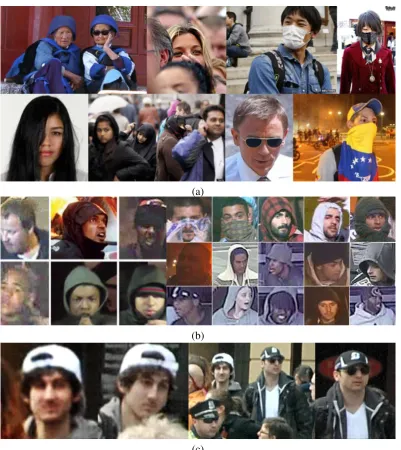
In real-world environments, faces are easily occluded, which decreases the recognition accuracy. Generally speaking, faces can be occluded in passive and active ways. On the one hand, faces capture can be affected by environmental factors such as extreme illumination (responsible for strong shadows), limited field of view (causing partial faces), poor image quality (attributed to cause blurring) and objects in front of the face (e.g., food, mobile phone, others’ faces). These factors are difficult to fully control in real-world environments. On the other hand, faces are usually occluded by the subjects themselves. For example, in the daily life, it is very common that people wear facial accessories such as sunglasses, scarves, hats, masks and veils for personal or cultural reasons (Figure 1.1a). In face recognition scenarios, one can ask the subject to get rid of these accessories when subject cooperation is applicable (e.g., border control). But this will give rise to inconvenience. What is more, in the security/crime related scenarios, people tend to use occlusions to hide their identities and subject cooperation is not applicable at all (e.g., surveillance). Figure 1.1b and Figure 1.1c are some example images captured in theLondon Riotsin 2011 and the
in face images in Table 1.1. The research of the occluded face recognition problem is very important since it widely occurs in both daily life and security related scenarios.
Table 1.1: The categorisation of different sources of occlusions
Type Scenario Occlusion example
Passive
Extreme illumination Strong shadows Limited field of view Partial faces
Poor image quality Blurring, underexposure, overexposure External occlusion Food, mobile phones, pets, others’ faces
Active
Daily facial accessory Sunglasses, scarves, hats, veils Self-occlusion Non-frontal poses, hair, hands Criminal camouflage Masks, sunglasses, caps
Privacy protection Anti-recognition make-up, cosmetics
1.2.2 Face recognition with occlusions: less studied problem
(a)
(b)
[image:25.595.122.524.136.587.2](c)
Figure 1.1: Examples of occluded face images: occluded images in the daily lifea(a), and occluded images in crime scenarios (e.g., London riotsb (b), Boston Marathon bombingsc (c)).
a
Images from the Internet
b
Images from the Metropolitan Police: http://content.met.police.uk/
1.2.3 Face recognition with occlusions: extensible problem
The research on the occlusion problem can help solve other emerging problems in face recognition. There are some emerging uncontrollable factors which will largely affect the face recognition performance such as heavy make-up [6, 7] and plastic surgery [8– 10]. These problems share some similarities with the occlusion problem. For example, they are commonly seen in faces and some of them affect the face locally like occlusions. More importantly, similar to occlusions, these factors are difficult to predict. Collecting sufficient training samples is also not easy since these factors in testing images may be largely different from those in the training data. On the other hand, some local distortions by large expressions such as closed eyes and open mouth can also be seen as occlusions
on the face. Due to these common characteristics, research into occluded face recognition problem can help to design algorithms for dealing with other factors in face recognition.
1.3
Objectives
Note that there are two related but different problems to face recognition with occlusions:
occluded face detectionandoccluded face recovery. The first task is to determine whether a face image is occluded or not [11], which can be used for automatically rejecting the occluded images in applications such as passport image enrolment. This rejection mechanism is not always suitable for face recognition in some scenarios (e.g., surveillance) where no alternative image can be obtained due to the lack of subject cooperation. The second task is to restore the occluded regions in face images [12, 13]. It can recover the occluded areas but is unable to directly contribute to recognition since the identity information can be contaminated during inpainting.
as the corresponding areas of the gallery faces (i.e., reference faces) for recognition. But note that the occlusion types in the training images are the same as those in the testing images. Jia and Mart´ınez [16, 17] used a skin colour based mask to remove the occluded areas for recognition. However, the types of occlusions are unpredictable in practical scenarios. The location, size and shape of occlusions are unknown, hence increasing the difficulty in segmenting the occluded regions from the face images. Currently most of the occlusion detectors are trained on faces with specific types of occlusions (i.e., the training is data-dependent) and hence generalise poorly to various types of occlusions in real-world environments.
The overall goal of this thesis is to design robust algorithms for face recognition with occlusions in unconstrained environments. There are several differences between our work and the above previous works in dealing with the occlusion problem:
1. We focus on performing recognition with the presence of occlusions. As mentioned before, occlusion detection is not always applicable in real-world environments. Recognising a face with occlusions directly is very practical in applications.
2. We consider the case that occlusions also exist in the gallery/training images. Most of the previous works assume that occlusions only occur in probe images. But in practical scenarios, the gallery images can also be contaminated by occlusions. In this thesis we do not make any assumption about the presence of occlusions (i.e., in gallery or probe) and consider that occlusions may occur in both gallery and probe images.
1.4
Main contributions
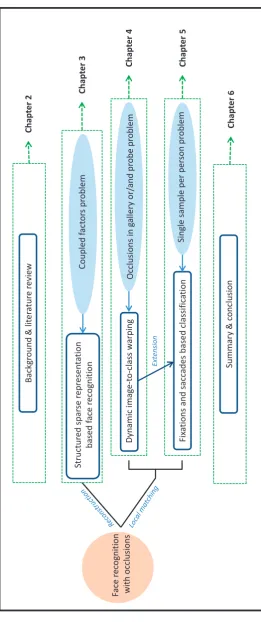
We propose three novel algorithms in two directions (i.e., the reconstruction based and the local matching based, see Figure 1.2) to handle the occlusions in face images when performing recognition. In addition, we also take account of several practical problems (i.e., coupled factors, occlusions in gallery or/and probe sets, thesingle sample per person
(SSPP) problem [18] and theclosed worldproblem [19]) in face recognition and provide solutions to them. The main contributions are summarised in detail as follows.
1. We give an overview of the existing works for face recognition with occlusions. We carefully categorise these approaches and analyse their advantages and disadvantages, which provides a clear big picture of the state-of-the-art techniques. We summarise three occlusion cases which a face recognition system may encounter in the real-world applications but most of the current works do not consider.
2. We propose a reconstruction based method structured sparse representation based face recognition[20] when multiple gallery images are available for each subject. We point out that the non-zeros entries in the occlusion coefficient vector also have a cluster structure and propose a structured occlusion dictionary for better modelling them. In addition, we consider the coupled condition of extreme illuminations and occlusions, which is practical in real-world environments.
3. We propose a local matching based methodDynamic Image-to-Class Warping
(DICW) [21–23] when the number of gallery images per subject is limited. Different from most of the existing works that simply treat occluded face recognition as a recovery problem or just employ the framework for general object classification, DICW considers the inherent structure of the face and our experimental results confirm that the facial order is critical for recognition. This method can be also applied to deal with other object recognition problems where the geometric relationship or contextual information of features should be considered.
[24] for occluded face recognition when only one single gallery images is available for each subject (i.e., the SSPP problem). FSC is inspired by the observations in human visual perception. It is an extension of the aforementioned DICW and can be also applied to deal with other problems in face recognition caused by local deformations (e.g., the facial expression problem).
1.5
Outline
The rest of this thesis is organised as follows. Figure 1.2 shows the structure of the thesis. Chapter 2 first discusses face recognition process performed by both human beings and computers. It then introduces the approaches of unconstrained face recognition and further reviews the state-of-the-art methods for occlusion problems and summarises the current challenges.
Chapter 3 first briefly introduces the sparse representation based classification (SRC) [25] model. Based on that, it explains the proposed approach structured sparse representation based face recognitionin two steps: 1) the structured sparse representation (SSR) and 2) the structured occlusion dictionary. Then, it describes the strategy of the combination of SSR and the robust Weber local descriptor (WLD) [26] to handle coupled factors. At last, it provides the experimental analysis and the discussion for the parameters. Chapter 4 introduces the proposed method Dynamic Image-to-Class Warping
(DICW) step by step, from image representation, modelling to implementation. Three occlusion cases, namely: occlusions in the gallery set only, occlusions in the probe set only, and occlusions in both, are discussed. It confirms the effectiveness of DICW with extensive experimental results and also discusses its robustness to misalignment and other parameters of DICW.
discussions on the parameter.
Chapter 2
Literature review
2.1
Face recognition by humans: forensic face recognition
In the past, before the advent of electronic computers, face recognition was already widely used in forensics. The first attempt we are aware of to identify a subject by comparing a pair of facial photographs was reported in a British court in 1871 [27]. In 1890, the French criminologist Alphonse Bertillon set forth a set of standards for forensic photography. He developed a taxonomy to describe some of the physiological features of the head and face, which is calledportrait parl´e orspoken portrait[28]. The combination of the anthropometric measurements and the spoken portrait developed by Bertillon is called
Bertillonage and was fast adopted by the police and the judicial systems. Figure 2.1 demonstrates a principle of Bertillon’s anthropometry.
In a typical forensic face recognition scenario, a forensic expert is given face images of a suspect (e.g., mug-shot images) and a questioned person (i.e., the perpetrator). The forensic expert will give a value which represents the degree to which these images appear to be of the same person. There are four main categories of face recognition approaches used by the forensic experts [30, 31]: holistic comparison, morphological analysis, anthropometry, and superimposition.
Figure 2.1: Face recognition by humans: an illustration of a principle of Bertillon’s anthropometry. Image is excerpted from [29].
whole by the forensic experts. This is the simplest way and can be performed as a pre-step for other methods.
• Morphological analysis. In morphological analysis, the local features of the face
will be analysed and compared by the forensic experts. They carry out an exhaustive analysis on the similarities and differences in observed faces, trait by trait on the nose, mouth, eyebrows, etc., even the soft traits such as marks, moles, wrinkles, etc. The location and distribution of local facial features are considered but not explicitly measured compared with anthropometry based approaches.
• Anthropometry. Anthropometry refers to the measurement of the human
indi-vidual, which can be used for human recognition. Different from morphological analysis, in face anthropometry, the quantification measurements (e.g., spatial distance and angles) between specific facial landmarks (e.g., the tip of the nose, the centres of the eyes) are used for comparison.
• Superimposition. In superimposition, one face image is overlaid onto another and
the forensic experts need to determine whether there is an alignment and correspondence of the facial features.
Face Detector
Feature
Extractor Matcher
Enrolled database Pre-processing
Face image
Query
Score
Reference
Figure 2.2: Framework of an automatic face recognition system.
Although the mechanism of face recognition by human visual system has not been fully understood yet, researchers are trying to analyse the observations and simulate the strategies in face recognition by humans for designing automatic face recognition algorithms. An human face recognition inspired algorithm is proposed in Chapter 5.
2.2
Face recognition by computers: automatic face recognition
2.2.1 Performance metrics
Face recognition consists of two main experimental modes: identificationandverification
[34]. In identification (i.e., one-to-many search), the face recognition system searches a database for an enrolled gallery sample to match the probe sample. An ordered list of the top
nmost similar matches are returned as the possible identities of the probe according to the similarity scores. The performance of the system in the identification mode is measured in terms ofrank-n identification ratewhich is the rate at which the true association is included in the top n matches. The identification rate usually refers to rank-1 identification rate where the system returns a single match (the best match), as the most probable association with the probe sample. This rate is also called therecognition rate.
On the other hand, verification (i.e., one-to-one check) is the task where the recognition system attempts to confirm an individual’s claimed identity by comparing the probe sample to the individual’s previously enrolled sample. Verification is based on a decision threshold which is set by computing the similarity scores of all sample pairs in the gallery. The threshold is chosen to separate the genuine (i.e., match) similarity scores distribution from the impostor (i.e., non-match) similarity scores distribution and gives the best performance based on one of the following metrics [35]. Here an impostor is a person who submits a sample attempting to claim the identity of another person.
• False acceptance rate (FAR) is the rate at which the comparison between two
different individuals’ samples is erroneously accepted by the system as the true match. In other words, FAR is the percentage of the impostor scores which are higher than the decision threshold.
• False rejection rate(FRR) is the percentage of times when an individual is not
matched to his/her own existing template. In other words, FRR is the percentage of the genuine scores which are lower than the decision threshold.
• Equal error rate(EER) is the rate at which both acceptance and rejection errors
Both identification and verification tasks are used when evaluating general face recognition algorithms. For occluded face recognition, most of the works conduct experiments for the identification tasks since it is more commonly seen in the application scenarios. In the experiments of this thesis we mainly consider the identification task and use rank-1 rate for performance measurement. The verification is considered in Chapter 4 for face pair comparison tasks.
2.2.2 Brief history
In the early time, the main recognition approaches are geometric feature-based methods which rely on measurements between specific facial landmarks. This is similar to the anthropometry based methods mentioned in Section 2.1 in the face recognition by forensic experts. The first attempt to perform automatic face recognition started in 1965 by Chan and Bledsoe [36] in a semi-automated mode where a set of facial features were extracted from the photographs by humans. The first fully automatic face recognition system was presented by Kanade [37] in 1973, which marked a milestone at that time. Before 1990, it was the early stage of face recognition and most of the approaches were justtested in the lab.
Figure 2.3: Progression of face recognition accuracy measurements. Image is excerpted from [45].
[40], the Elastic Graph Matching (EGM) [41], the Hidden Markov Model (HMM) [42], etc. Besides these, the statistical models such as Active Shape Model (ASM) [43] and Active Appearance Model (AAM) [44], which are widely used in face modelling and face alignment, also appeared in this period. Not only where numerous theoretical research works conducted but also commercial applications appeared in this period.
From the late 90s to present, research in face recognition has focused on un-controllable scenarios (e.g., large pose, illumination and expression changes). Locally Linear Embedding (LLE) [46], illumination core model [47], 3D Morphable Model [48], Independent Component Analysis (ICA) [49], Local Binary Pattern (LBP) [50] and Sparse Representation based Classification (SRC) [25] are the representative methods in this period. The performance of automatic face recognition techniques have been evaluated in a series of large-scale tests conducted by the National Institute of Standards and Technology (NIST1). Good examples include, the Facial Recognition Technology evaluation (FERET) [51], the Face Recognition Vendor Test (FRVT) [1] and the Face Recognition Grand
1
Challenge (FRGC) [52]. Over the past decades, there has been significant progress in automatic face recognition. The false reject rate (FRR) of the best performing face recognition algorithm has decreased from 79% in 1993 to 0.3% in 2010 at a false accept rate (FAR) of 0.1% [53] (Figure 2.3).
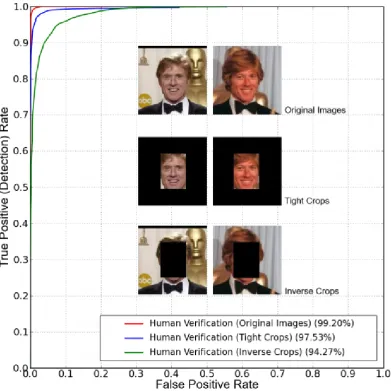
In 2007, a benchmark databaseLabeled Faces in the Wild2for unconstrained face recognition was built. It contains more than 13,000 images (5,749 subjects) of faces collected from the Internet. The only constraint on these faces is that they were detected by the Viola-Jones face detector [55]. The face recognition accuracy by humans on this database is about 97.53% to 99.20% (Figure 2.4). And the accuracy for automatic face recognition algorithms has been improved from about 72.45% [56] in 2007 to more than 97.0% in 2014. Three algorithms/commerical softwares appeared in 2014 achieved the performance very close to or even better than humans (i.e., Face++ [57]: 97.27%,
DeepFace [58]: 97.35% and GaussianFace [59]: 98.52%). These results are very impressive. But currently it is too optimistic to say that the performance of machine is comparable or better than that of humans for face recognition. The images used in those tests are cropped faces excluding the external facial features such as hair and ear. However, humans are able to fully exploit external features and context information for recognition especially in difficult conditions (as shown in Figure 2.4).
During theLondon Riotsin 2011, the London Metropolitan Police used automatic face recognition software in attempting to find the suspects, but in most cases it failed [60]. The poor quality of most CCTV footage makes it almost impossible to trust standard automatic facial recognition techniques. Changes in illumination, image quality, background and orientation can easily fool the face recognition systems (images are shown in Figure 1.1b). In 2013, Klontz and Jain [4] conducted a case study that used the photographs of the two suspects in the Boston Marathon bombings to match against a background set of mugshots. The suspects’ photographs released by the FBI were captured in the uncontrollable environment and their faces were partially occluded by sunglasses and
2
hats (Figure 1.1c). The study showed that current commercial automatic face recognition systems have the notable potential to assist law enforcement. But the matching accuracy was not high enough and more progress must be made to increase the utility in face images taken in unconstrained environments.
Manual face recognition is highly robust to changes in pose and illumination, and also robust across the set of non-rigid face deformations such as expressions and speech movements. Although automatic face recognition techniques are widely used nowadays, there is still a notable gap between their performance and that of humans for face recognition in uncontrollable conditions. In the next section we will briefly introduce the face recognition algorithms for handling variation in illumination, pose, expression, low image quality such as blur and low-resolution, and ageing.
2.3
Unconstrained face recognition
2.3.1 Approaches for handling illumination variations
Due to the 3D structure and various surface reflectance of faces, light sources can cast shading and shadows which accentuate or diminish certain facial features, creating non-uniform illumination on faces. The differences induced by these impact in the facial appearance can be greater than that between individuals. As analysed in [64], there are two categories of approaches for addressing the illumination problem -activeandpassiveways. The active approaches attempt to obtain face images which are invariant to the illumination changes. Usually specific devices such as 3D scanners, thermal cameras, infrared cameras, etc. other than the visible light cameras are required. The 3D shapes and reflectance of the facial surfaces, which are included in the 3D data, are the intrinsic factors of faces. 3D faces are more robust to the illumination changes compared with the 2D images. But they also incur higher computational cost for recognition. A good survey on 3D face recognition can be found in [63]. Thermal images and near-infrared images are more insensitive to large illumination changes as compared to visible light images. An introduction to illumination invariant face recognition using thermal images and near-infrared images is presented in [65] and [66], respectively.
2.3.2 Approaches for handling pose variations
Human beings are able to recognise a person by the face from different views. However, due to the complex 3D structures of faces, the view generalisation is still a tough task for automatic face recognition systems. A survey presented in [75] summarised the works that dealt with the pose problem in the past decades. The main challenge of pose problem is that appearance variations caused by variable poses can be larger than those caused by identity differences. The similarity between two faces from different persons in the same pose can be larger than that of the same person in different poses.
pose variations. Pose estimation is the process of inferring the orientation of a head. An systematic survey on head pose estimation is presented in [88].
2.3.3 Approaches for handling expression variations
Compared with pose and illumination variations, facial appearance changes caused by expressions are morelocalbut moredynamic. Considering that expressions usually cause local distortions of a face, one idea for handling the expression problem is to use only regions less susceptible to expression variations. For example, one can just remove the mouth region for recognition since it changes largely due to expressions. But thisad hoc
strategy generalises poorly to the general, realistic face images. Similar to the multi-view methods for handling pose variations mentioned in Section 2.3.2, another simple way to handle expression variations is to collect different expressions of each subject’s face as the gallery. But the expression variations are more complicated. Because of the diversity of all possible expressions, there are a huge number of face images needed to be collected. Even though the expressions in the probe may still be substantially different from those in the gallery since expression changes are non-rigid and difficult to model.
2.3.4 Approaches for handling low image quality variations
In security-related face recognition applications such as surveillance, usually the face images captured are degraded by low resolution and blur effects. For the low resolution problem, an intuitive solution is the super-resolution (SR) based method [95–99]. SR is a technique for synthesising high-resolution images from low resolution images for visual enhancement. After applying SR, a higher resolution image can be obtained and then used for recognition. One common drawback for SR based face recognition approaches is that SR does not directly contribute to recognition. The identity information may be contaminated by some artifacts attributed to the SR process. Another category of approaches do not apply the SR preprocessing to low resolution images. Popular approaches of this category include: support vector data description (SVDD) [100], coupled mappings (CMs) [101], multi-dimensional scaling [102], class specific dictionary learning [103], etc.
These are two types of effect attributed to the blur problem: focus blur and motion blur. A focus is the point where lights originating from a point on the object converge. When the light from object points is not well converged, a out-of-focus image will be generated by the sensor (e.g., camera) and results in the blur effect. The work in [104] analysed the impact of out-of-focus blur on face recognition performance. On the other hand, motion blur is due to the rapidly object movement or camera shaking. There are two main categories of approaches to improve the quality of the blurred face images: 1) blurred image modelling through subspace analysis [105] or sparse representation [106], and 2) blur-tolerant descriptors which attempt to extract blur insensitive features such as Local Phase Quantization (LPQ) [107, 108] to represent the face images.
2.3.5 Approaches for handling ageing
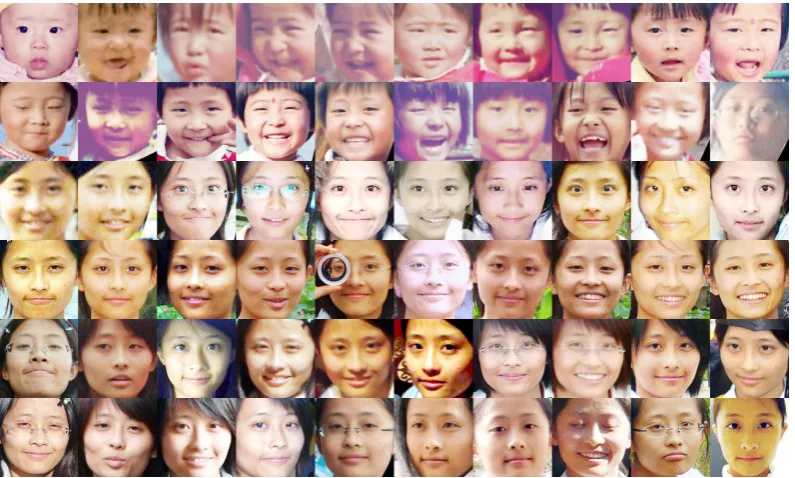
Figure 2.5: Face samples of the same individual across ages with appearance variations.
gallery image of the same subject increases, the accuracy of recognition system generally decreases. Ageing is a complex process that affects both the shape and texture (e.g., skin tone or wrinkles) of a face. From childhood to adulthood, the impact of ageing on facial appearance is mainly shape changes. After adulthood, the impact of ageing is mostly texture changes.
all other aforementioned unconstrained factors as well because those factors also vary as time progresses.
Figure 2.5 shows the face samples of the same individual across different ages. Pose, expression, illumination changes occur when images are taken years apart, which give rise to large appearance changes of the faces. Besides the above unconstrained variations, the performance of face recognition can also be significantly affected by occlusions. The occlusion problem is relatively less studied in the automatic face recognition community. We will discuss this problem in details in the next section.
2.4
Face recognition with occlusions
The difficulty of occluded face recognition is twofold. First, occlusions distort the discriminative facial features and therefore increases the distance between two face images of the same subject in the feature space. As shown in Figure 2.6, the occluded face is actually from the dot class. However, since the eyes are occluded, it looks more similar to the faces from thetriangleclass, which will leads to misclassification. Holistic representation based methods such as Eigenface [38] and Fisherface [39] suffer a significant performance drop since the extracted features are related to all original pixels and can be easily affected even the occlusions are local. Occlusion errors on the original pixels become errors in the feature space and may even become less local.
The second difficulty is, face registration through the alignment of facial landmarks (e.g., the centres of the eyes, the tip of the nose) is needed before performing feature extraction. When facial landmarks are occluded, large registration errors usually occur and degrade the recognition rate. The study in [3] showed that the performance of face recognition approaches rely on the alignment accuracy. Different registration errors lead to different representations of the same face which can cause recognition failures [2].
Figure 2.6: Occlusion problem: occlusions lead to a large distance between faces of the same person. The dots and triangles indicate two different classes. The occluded face belongs to the dot class.
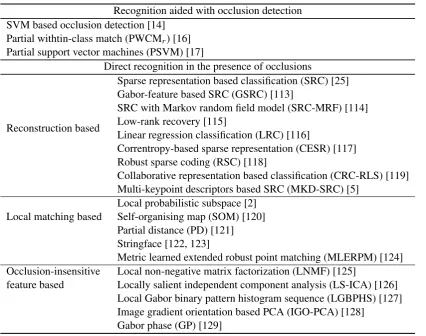
al. [14] trained a SVM classifier to detect the occluded regions in a face image. Jia and Mart´ınez modelled the occluded face recognition as a weighted linear least squares problem treating the occluded pixels asmissing data(Partial within-class match (PWCMr) [16], Partial support vector machines (PSVM) [17]). Their models require a skin colour basedocclusion mask to detect the occluded areas in faces first. As we analysed before, the occlusion detectors are usually trained on specific types of occlusions (i.e., the training is data-dependent) and hence generalise poorly to various types of occlusions in real-world environments. So in this thesis we focus on performing recognition without detecting the occlusions in advance. There are three main categories of approaches for face recognition in the presence of occlusions: 1) reconstruction based approaches, 2) local matching based approaches, and 3) occlusion-insensitive feature based approaches.
2.4.1 Reconstruction based approach
3.1 since our proposed method is based on this model. A clean image is reconstructed from an occluded probe image through a linear combination of gallery images and the basis vectors of an occlusion dictionary. Then the occluded image is assigned to the class with the best reconstruction. Here the best reconstruction means reconstruction with a minimal matching error when comparing the reconstructed image with the probe image. The classification is based on the hypothesis that the most accurate reconstruction for the probe image can be obtained when using the gallery images from the correct class. SRC requires pixel-level alignment of images, which limits its use in practical applications.
There are some works aiming at improving the SRC model for occluded face recognition. Yang and Zhang [113] applied the Gabor feature to the original SRC model, which is coined Gabor-feature based SRC (GSRC), to reduce the size of occlusion dictionary and improve the robustness to occlusions. Zhou et al. [114] used a Markov Random Fields (MRF) model (SRC-MRF) to estimate the contiguous occlusions, which has been proved to be effective in improving SRC’s performance. However, the performance of the SRC-MRF still drops drastically when the probe images are not well aligned. Chenet al.[115] applied the low-rank matrix recovery to decompose the gallery matrix (where each column is an image vector) into a representative basis matrix of low rank and a sparse error matrix. Then the low-rank matrix was used for reconstructing the occluded probe images as in the original SRC. This method is able to handle the occluded images in the gallery set but still requires the gallery images to be well aligned in advance.
Besides those, there are also other methods which follow the similarreconstruction
which models the reconstruction as a sparsity constrained robust regression problem and is more robust to non-Gaussian noise and outliers (e.g., occlusions) than SRC. On the other hand, Zhang et al. [119] argued that the success of SRC actually comes from its collaborative representation over all classes of training samples and proposed the collaborative representation (CR) based classification with the regularised least square (CRC-RLS), which achieves competitive accuracy but with lower complexity than SRC.
A common drawback of reconstruction based methods, is that they usually requires a large number of samples per subject to represent a probe image. Most of them assume that the gallery/training images are captured in well controlled conditions. However, this assumption does not usually hold in real-world scenarios. Another drawback is this category of approaches usually incur a high computational cost [25].
2.4.2 Local matching based approach
With local matching based approaches, a face image is first partitioned into small regions (e.g., overlapping or non-overlapping patches, local facial components, small circles/ellipses), so the affected and unaffected parts of the face can be analysed in isolation. In order to minimise matching errors due to occluded parts, different matching strategies are performed.
advantage of using SOM is that compared with the mixture of Gaussians, it is unsupervised and nonparametric while still being able to eliminate possible noise and outliers. Moreover, based on SOM, Tanet al. [121] further applied the partial distance (PD) for occluded face recognition. It captures the significant partial similarities between face images, which is able to reduce the negative impacts of the unreliable features due to occlusions. Chenet al.
proposed the Stringface [122, 123] which represents a face as a string (of line segments). So matching two faces is done by a string-to-string matching scheme, which is able to effectively find the most discriminative local parts without making any assumption on the distributions of the deformed facial regions affected by occlusions. But this method relies on the accuracy of line segmentation. Wenget al.[124] proposed a metric learned extended robust point matching (MLERPM) method based on the feature set matching. It considers the geometry information of feature sets and is robust to the misalignment of face images. But when dealing with randomly located occlusions, its performance degrades drastically.
The common intuition behind the local matching based approaches is that the facial appearance changes caused by occlusions are local in nature. Only parts of a face are distorted by occlusions while others are less affected and are reliable for recognition. So compared with the reconstruction based methods, local matching based methods are less likely to be able to handle the situation in which more than half of the face is occluded.
2.4.3 Occlusion-insensitive feature based approach
sequence (LGBPHS) [127], are also based on thelocalidea.
The second category of approaches attempt to extract occlusion-insensitive features from face images. Tzimiropouloset al.[128] pointed out that PCA learning in the gradient orientation domain with a cosine-based distance measure helps reduce the effects due to occlusions in face images. The distribution of image gradient orientation (IGO) differences and the cosine kernel provide a powerful way to measure image correlation/similarity when image data are corrupted by occlusions. The face representations learned from the image gradient orientations are relatively invariant to the occlusion effects. Inspired by their work, Zhuet al.[129] further proposed a Gabor phase difference representation for occluded face recognition. They find that the Gabor phase (GP) difference is more stable and robust than gradient orientation to occlusions. Since the forms of occlusions in real-world scenarios are unpredictable, it is difficult to find a suitable representation which is insensitive to various types of occlusions.
Table 2.1 shows the categorisation of approaches in face recognition with occlu-sions. Note that the feature based approaches are not independent of the approaches of the two former categories. A sophisticated face recognition algorithm can combine both robust features and classifiers to handle the occlusion problem. For example, the MKD-SRC [5], which falls in the category of reconstruction based methods, involves the multi-task sparse representation learning. It extracted features from the local areas of a face and encoded these features using multi-keypoint descriptors (MKD) such as SIFT [130] and Gabor [131] based descriptor. These combined strategies make it robust to misalignment and occlusions in face images.
2.5
Challenges for occluded face recognition
2.5.1 The presence of occlusions
Table 2.1: The categorisation of face recognition methods against occlusions
Recognition aided with occlusion detection SVM based occlusion detection [14]
Partial withtin-class match (PWCMr) [16] Partial support vector machines (PSVM) [17]
Direct recognition in the presence of occlusions
Reconstruction based
Sparse representation based classification (SRC) [25] Gabor-feature based SRC (GSRC) [113]
SRC with Markov random field model (SRC-MRF) [114] Low-rank recovery [115]
Linear regression classification (LRC) [116]
Correntropy-based sparse representation (CESR) [117] Robust sparse coding (RSC) [118]
Collaborative representation based classification (CRC-RLS) [119] Multi-keypoint descriptors based SRC (MKD-SRC) [5]
Local matching based
Local probabilistic subspace [2] Self-organising map (SOM) [120] Partial distance (PD) [121] Stringface [122, 123]
Metric learned extended robust point matching (MLERPM) [124] Occlusion-insensitive
feature based
Local non-negative matrix factorization (LNMF) [125]
Locally salient independent component analysis (LS-ICA) [126] Local Gabor binary pattern histogram sequence (LGBPHS) [127] Image gradient orientation based PCA (IGO-PCA) [128]
Gabor phase (GP) [129]
Table 2.2: Three typical occlusion cases
Gallery Probe Scenario Application
Uvs.O: Unoccluded Occluded Access control,
ID management
Facility access, immigration, user registration, online au-thentication
Ovs.U: Occluded Unoccluded Law
enforcement, security, surveillance
Suspect investigation, shoplifter recognition, criminal face retrieval, terrorist alert, CCTV control
Ovs.O: Occluded Occluded
2.5.2 The prior knowledge of occlusions
In the real-world scenarios, there is almost no prior knowledge of occlusions. The type, location, area, texture and shape of occlusions are unpredictable. Some approaches assume that occlusions either occur on the upper half of the face (e.g., sunglasses) or the lower half (e.g., scarf). This prior knowledge is helpful for the recognition on a specific testing dataset (e.g., the AR database [132]) but generalise poorly to general occlusions in real-world environments. When designing a robust algorithm, specific assumptions about the aforementioned factors should be avoided. On the other hand, in real-world environments, occlusions are usually coupled with other factors (e.g., illumination, expression changes). So when conducting experiments to evaluate the effectiveness of an occluded face recognition algorithm, at least three kinds of occluded images should be considered:
1. Images containing real occlusions such as disguises with various textures and shapes.
2. Images containing randomly located occlusions without any prior knowledge of the location.
3. Images taken in natural conditions (e.g., outdoor environments) in which occlusions are coupled with other distorting factors.
Table 2.3: Three types of occluded face images
Type Factor Available database
With natural occlusions Various textures and shapes
AR [132]
With randomly located occlusions
No location prior knowledge
Synthetic occlusions on the stan-dard databases such as Extended Yale B [133], FRGC [52] Natural images Occlusions coupled
with other variations
LFW [134], TFWM [135]
2.6
Databases
Over the past four decades, a large number of face databases have been built to evaluate the effectiveness of face recognition algorithms. Especially for the PIE problems, specific databases have been designed, which promote the development of face recognition algorithms for these factors. However, there are very few databases to support research into the occlusion related problems. As analysed in Section 2.5.2, at least three types of occluded face images should be considered when evaluating the effectiveness of face recognition algorithms. In this section we will introduce the databases according to the three types of occluded images as shown in Table 2.3.
2.6.1 The AR database
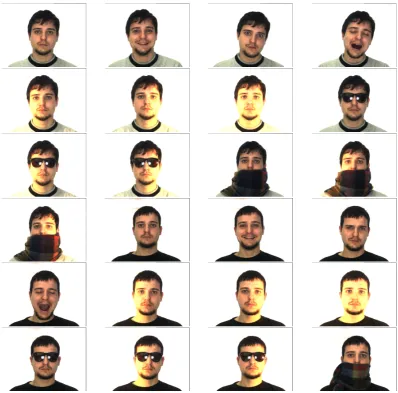
The AR database is one of the very few databases which contain real occlusions and are open to the public. It contains over 4,000 colour images of 126 subjects’ faces (70 men and 56 women). These images (Figure 2.7) suffer from different variations in facial expressions, illumination conditions and occlusions (i.e., sunglasses and scarves). They were taken under strictly controlled conditions. No restrictions on wear (clothes, glasses, etc.), make-up, hair style, etc. were imposed to subjects. For each subject, 26 images in total were taken in two sessions (two weeks apart). For each session (13 images), the descriptions of images are as follows:
2. Smile
3. Anger
4. Scream
5. Left light on
6. Right light on
7. All side lights on
8. Wearing sun glasses
9. Wearing sun glasses and left light on
10. Wearing sun glasses and right light on
11. Wearing scarf
12. Wearing scarf and left light on
13. Wearing scarf and right light on
The limitations of the AR database are that it only contains two types of occlusions, i.e., sunglasses and scarf, and the location of the occlusion is either on the upper face or lower face. As a result, researchers also simulate occlusions (e.g., randomly located occlusions) using images from the standard databases such as the Extended Yale B database [133] and the FRGC database [52] to evaluate their proposed methods. The schemes for generating the synthetic occlusions vary across works, so in the next sub-sections we will only introduce the most popular one which is well accepted by the public.
2.6.2 The Extended Yale B database
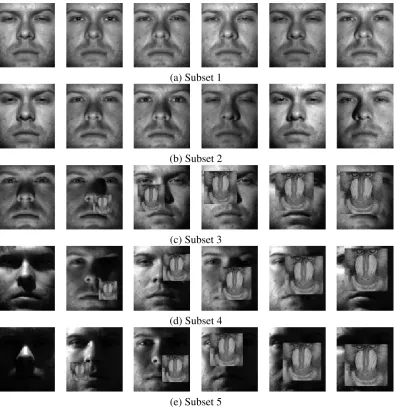
ambient (background) illumination was also captured. The images are grouped into four subsets according to the lighting angle with respect to the camera axis. The Subset 1 and Subset 2 cover the angular range 0◦ to 25◦, the Subset 3 covers 25◦ to 50◦, the Subset 4 covers 50◦to 77◦, and the Subset 5 covers angles which are larger than 78◦.
In order to simulate different levels of contiguous occlusions, the most used scheme [25] is to replace a randomly located square patch from each test image with a baboon image which has similar texture with the human face. The location of the occlusion is randomly chosen. The sizes of the synthetic occlusions vary in the range of 10% to 50% of the original image (Figure 2.8).
2.6.3 The FRGC database
The Face Recognition Grand Challenge (FRGC) database [52] contains 8,014 images from 466 subjects in difference sessions. For each subject in each session, there are four controlled still images, two uncontrolled still images, and one 3D image. In our experiments we only use the still images. These images contain variations such as illumination and expression changes, time-lapse, etc. The controlled images were full frontal facial images taken under two lighting conditions (two or three studio lights) and with two facial expressions (smiling and neutral). The uncontrolled images were taken in varying illumination conditions; e.g., hallways, atria, or outdoors. Each set of uncontrolled images contains two expressions, smiling and neutral.
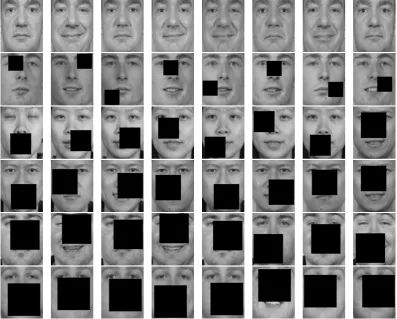
To simulate the randomly located occlusions, one can replace a randomly located square patch from each image with a black block as discussed in [17]. The location of the occlusion is randomly chosen. The size of the black block varies in the range of 10% to 50% of the original image (Figure 2.9).
2.6.4 The LFW database
(a) Subset 1
(b) Subset 2
(c) Subset 3
(d) Subset 4
[image:58.595.124.520.190.598.2](e) Subset 5
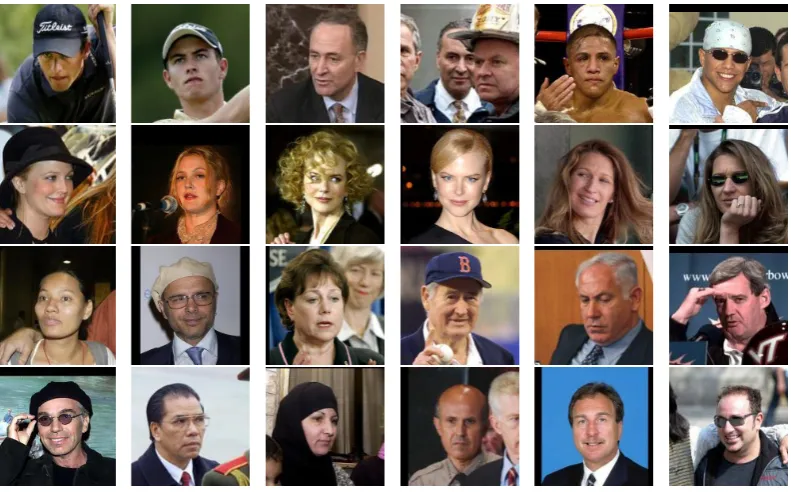
Figure 2.10: Sample images from the LFW database: first and second row: six matched pairs from six subjects, and third and forth row: six non-matched pairs from twelve subjects.
Section 2.2.2, it contains 13,233 face images of 5,749 subjects collected from the Internet. These images are captured in uncontrollable environments and contain large variations in pose, illumination, expression, time-lapse and various types of occlusions. The only constraint on these faces is that they were detected by the Viola-Jones face detector [55]. Each face has been labelled with the name of the subject pictured. 1,680 of the subjects pictured have two or more distinct images in the database. The task of face verification under the LFW database’s protocol is to determine if a pair of face images belongs to the same subject or not (Figure 2.10).
2.6.5 The TFWM database
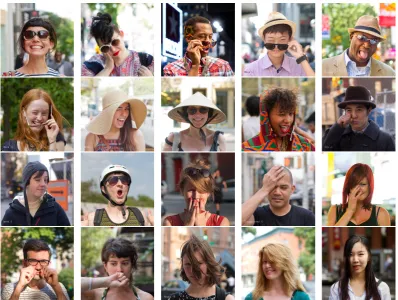
Figure 2.11: Sample images from the TFWM database.
The database has more than 2,000 images of more than 230 subjects. It contains frontal view faces of strangers on the streets with uncontrollable lighting. The sources of occlusions include glasses, sunglasses, hat, hair and hand on the face. These images are captured in natural and arbitrary conditions. Besides occlusions, these images also contain expression, pose and head rotation variations (Figure 2.11).
2.7
Summary
Chapter 3
Structured sparse representation
(SSR) based face recognition
In this chapter, we introduce the reconstruction based method to deal with occlusion related problems. As mentioned in Chapter 2, sparse representation based classification (SRC) [25] represents a probe image as a linear combination of a minimal number of gallery images. In this chapter, we propose the structured sparse reconstruction (SSR) based approach considering thestructured sparsity[136]. Face images from the same class/subject span a sub-space in a high-dimensional feature space. These images from the same class can be seen as aclusterin the whole gallery set. In the SSR model, a probe image is represented as a linear combination of a minimal number of clusters. Compared with SRC which represents an image using gallery images from all classes, SSR represents an image by just involving the images from the most probable classes, which is more suitable for classification. To better model occlusions, a structured occlusion dictionary is proposed. Our work points out that the non-zeros entries in the occlusion coefficient vector also have a cluster structure because occlusions appear in regions in an image and the occluded pixels are spatially contiguous.
In this chapter we consider the coupled condition of extreme illuminations and occlusions for face recognition. There are two observations for doing so: 1) strong shadows under extreme illuminations can be seen as partial occlusions on the face, and 2) as pointed out by the work in [47], face images in an illumination condition can be reconstructed from a linear combination of face images taken with different lighting directions. So the illumination and occlusion problems can be solved in the same reconstruction based framework. We adopt an illumination insensitive Weber local descriptor (WLD) [26] in the SSR model. It not only makes our method strongly resist the illumination changes, but also eliminates the shadows that are used to be modelled as sparse error. All of these can reduce the representation errors and help to produce better classification results.
The rest of this chapter is organised as follows. Section 3.1 briefly introduces the SRC model. Section 3.2 explains the proposed approach in two steps: 1) the SSR and 2) the structured occlusion dictionary. And then, Section 3.3 describes the strategy of combining the SSR and the robust WLD [26]. To evaluate the effectiveness of the proposed approach, extensive experiments are conducted and the results are reported in Section 3.4. Finally, Section 3.5 concludes this chapter. Note that symbols used are only valid within this chapter.
3.1
Sparse representation based classification
applications is presented in [140].
The sparse representation based classification (SRC) for face recognition proposed in [25] represents a probe face image in an over-complete dictionary whose base elements are the gallery face images themselves. SRC assumes that sufficient gallery samples are available for each class so the probe sample can be well represented by a linear combination of the gallery samples from the same class. Then the probe sample will be classified as the class with the minimal representation residual.
Arranging a set ofni gallery images fromi-th class as columns of a matrixXi = [xi,1, ...,xi,ni], the whole gallery setX ∈R
m×nis the concatenation ofngallery images
from allCclasses:
X = [X1, ...,Xi, ...,XC] = [x1,1, ...,x1,n1, ...,xi,1, ...,xi,ni, ...,xC,1, ...,xC,nC] (3.1)
where each column ofX is an image vector of lengthmandn=n1+...+ni+...+nC. A probe imagey∈Rmis represented as a linear combination of gallery images:
y=Xα (3.2)
whereα ∈Rnis a coefficient vector whose entries are zero1except those associated with the gallery images from the class ofy. It can be similarly denoted as:
α= [α1, ...,αi, ...,αC] = [α1,1, ..., α1,n1, ..., αi,1, ..., αi,ni, ..., αC,1, ..., αC,nC] (3.3)
whereαiis the set of coefficients associated with thei-th class.
Generally, a probe image can be well represented only by the images from its class, so the coefficient vector α just contains a small number of non-zero entries. Thus, this sparse vectorαencodes the identity ofywhich can be obtained by solving the following
1
optimisation problem:
ˆ
α= arg min
α ∥α∥0 subject to y=Xα (3.4)
where ∥·∥0 is the l0-norm which corresponds to the number of non-zero elements in a
vector. Assuming that the underlying subspace for each class is low-dimensional and the number of gallery images is sufficient (i.e.,m < n), the system of equations y = Xα
is underdetermined. The problem (Equation 3.4) of finding the sparsest solution of such a underdetermined system of linear equations is NP-hard [141]. Fortunately, the theory of sparse representation and compressed sensing reveals that if α is sparse enough, the solution of thel0-minimisation problem in (3.4) can be obtained by replacing thel0-norm
withl1-norm [142, 143]:
ˆ
α= arg min
α ∥α∥1 subject to y=Xα (3.5)
where∥·∥1indicates thel1-norm which is the sum of the absolute value for each element in
a vector.
Considering the occlusions in a face image, an occluded probe image y′ is represented using the linear model modified from (3.2) as:
y′=Xα+e (3.6)
where ande∈Rmis the occlusion error. For implementation, (3.6) is rewritten as:
y′ = [ X I ][ α αe
] =Bω (3.7)
wheree = Iαe ∈ Rm andαe is the corresponding coefficient vector for the occlusions.