RESEARCH ARTICLE
DECREASE AND RESTORATION OF JUMP TEST PERFORMANCE FOLLOWING A COMBINED
EXERCISE-BASED TRAINING SESSION AMONG STUDENTS PLAYING BASKETBALL
1
Paula Kleber Tchiegang Nana,
2Jean-Marie Falola,
1Issiako Bio Nigan,
1,*Polycarpe Gouthon,
1
Kocou Basile Nouatin,
2Barnabé Akplogan,
2Eudia Koussihouèdé and
1
Brigitte Affidéhomé Tonon
1
Laboratory of «
PSA and Motricity
», National Institute of Youth, Physical Education and Sport (INJEPS),
University of Abomey-Calavi (Republic of Benin), 01 PO Box 169 Porto-Novo
2
Laboratory of Biomechanics and Performance (LABIOP), National Institute of Youth, Physical Education and
Sport (INJEPS), University of Abomey-Calavi (Republic of Benin), 01 PO Box 169 Porto-Novo
ARTICLE INFO ABSTRACT
The use of training sessions which combine with strength exercises and sprints (CO training sessions) to improve the Repeated Sprint Ability (RSA) requires that athletes manage well recovery times. This study aimed therefore at measuring the decrease in performance at jump tests, induced by a CO training session and estimating the level of restoration reached after 48 hour-recovery period. Seventeen students playing basketball (20.8 ± 3.7 years) took part in this study carried out using a 2 x 5 experimental design, with a control training session made up of traditional basketball exercises (TR), and after seven days, came a CO. The Squat Jump (SJ), counter movement jump using arms or not (CMJ and CMJA), Reactivity Jump (RJ) were carried out before, at the end, six hours, 24 hours and 48 hours after each session. The CO session induced the decrease in performance by 12.7%, 12.3%, 6.7% and 22.9% (p < 0.05), respectively for SJ, CMJ, CMJA and RJ, without a complete recovery of the muscular capacities after the 48 hour-resting period. After the TR session, the modifications in jump performances recorded were all non-significant (p > 0.05). A CO training session caused a decrease in the performance of jump tests, like that induced by a strength training complex session. After a 24 hour-resting, the Reactivity Index (RI) was closed to the initial value, but 48 hours after, the restoration of the other muscular parameters was incomplete in the studied basketball players.
Copyright © Polycarpe Gouthon, et al., This is an open access article distributed under the Creative Commons Attribution License, which permits unrestricted use, distribution, and reproduction in any medium, provided the original work is properly cited.
INTRODUCTION
Basketball is a sports game which requires mainly the anaerobic metabolism in the players (Changela and Bhatt, 2012). The game is indeed made up of short and intense actions like sprints, rebounds, shooting in race, lay up shoots intercepted by resting periods (Gore, 2000) which can be very short during time outs or prolonged during the playing sequences. The satisfaction of the physical and physiological requirements associated with these actions implies that the players have good mental, physical and physiological capacities. Among these qualities are speed, strength or muscular power, coordination capacities, the capacity of fast recovery between workouts (Rampinini et al., 2007) and mainly the repeated sprints ability (RSA), pointed out by many authors (Dawson, 2012; Bishop et al., 2011; Buchheit, 2010). The RSA is indeed more and more recognized as a critical
*Corresponding author: Polycarpe Gouthon,
Laboratory of « PSA and Motricity », National Institute of Youth, Physical Education and Sport (INJEPS), University of Abomey-Calavi (Republic of Benin), 01 PO Box 169 Porto-Novo
performance factor in sports game particularly in basketball (Dawson, 2012). Since the work of Fitzsimons et al. (1993), many studies helped to better formulate its definition, understand its major determinants and develop tests for its’ assessment in sports game practitioners (Bishop et al., 2011; Buchheit et al., 2010a, 2010b). The question related to designing the most relevant test for assessing the RSA in sports game by taking into account specificities of the playing grounds and the game patterns during the matches, remains current. Some studies were also devoted to the strategies of development and improvement of the RSA in athletes or active people (Bishop et al., 2011; Edge et al., 2006). A review of these studies by Bishop et al. (2011) revealed two main strategies, both based on the development of the principal capacities determining the RSA, i.e. the maximum speed in isolated sprint and the strength of the lower limbs. According to the first strategy, the development of the RSA is obtained by developing separately each factor during training sessions. The second strategy proposes to combine during the same training session, sprint bouts and muscular reinforcement. It is however useful to accompany the statement of strategies in this form,
ISSN: 0975-833X
International Journal of Current Research Vol. 5, Issue, 12, pp.3828-3834, December, 2013
INTERNATIONAL JOURNAL OF CURRENT RESEARCH
Article History:
Received 10thSeptember, 2013 Received in revised form 27thOctober, 2013
Accepted 15thNovember, 2013 Published online 02ndDecember, 2013
Key words: Basketball, Fatigue, Recovery,
Repeated sprints ability, Jump test,
Training session.
RESEARCH ARTICLE
DECREASE AND RESTORATION OF JUMP TEST PERFORMANCE FOLLOWING A COMBINED
EXERCISE-BASED TRAINING SESSION AMONG STUDENTS PLAYING BASKETBALL
1
Paula Kleber Tchiegang Nana,
2Jean-Marie Falola,
1Issiako Bio Nigan,
1,*Polycarpe Gouthon,
1
Kocou Basile Nouatin,
2Barnabé Akplogan,
2Eudia Koussihouèdé and
1
Brigitte Affidéhomé Tonon
1
Laboratory of «
PSA and Motricity
», National Institute of Youth, Physical Education and Sport (INJEPS),
University of Abomey-Calavi (Republic of Benin), 01 PO Box 169 Porto-Novo
2
Laboratory of Biomechanics and Performance (LABIOP), National Institute of Youth, Physical Education and
Sport (INJEPS), University of Abomey-Calavi (Republic of Benin), 01 PO Box 169 Porto-Novo
ARTICLE INFO ABSTRACT
The use of training sessions which combine with strength exercises and sprints (CO training sessions) to improve the Repeated Sprint Ability (RSA) requires that athletes manage well recovery times. This study aimed therefore at measuring the decrease in performance at jump tests, induced by a CO training session and estimating the level of restoration reached after 48 hour-recovery period. Seventeen students playing basketball (20.8 ± 3.7 years) took part in this study carried out using a 2 x 5 experimental design, with a control training session made up of traditional basketball exercises (TR), and after seven days, came a CO. The Squat Jump (SJ), counter movement jump using arms or not (CMJ and CMJA), Reactivity Jump (RJ) were carried out before, at the end, six hours, 24 hours and 48 hours after each session. The CO session induced the decrease in performance by 12.7%, 12.3%, 6.7% and 22.9% (p < 0.05), respectively for SJ, CMJ, CMJA and RJ, without a complete recovery of the muscular capacities after the 48 hour-resting period. After the TR session, the modifications in jump performances recorded were all non-significant (p > 0.05). A CO training session caused a decrease in the performance of jump tests, like that induced by a strength training complex session. After a 24 hour-resting, the Reactivity Index (RI) was closed to the initial value, but 48 hours after, the restoration of the other muscular parameters was incomplete in the studied basketball players.
Copyright © Polycarpe Gouthon, et al., This is an open access article distributed under the Creative Commons Attribution License, which permits unrestricted use, distribution, and reproduction in any medium, provided the original work is properly cited.
INTRODUCTION
Basketball is a sports game which requires mainly the anaerobic metabolism in the players (Changela and Bhatt, 2012). The game is indeed made up of short and intense actions like sprints, rebounds, shooting in race, lay up shoots intercepted by resting periods (Gore, 2000) which can be very short during time outs or prolonged during the playing sequences. The satisfaction of the physical and physiological requirements associated with these actions implies that the players have good mental, physical and physiological capacities. Among these qualities are speed, strength or muscular power, coordination capacities, the capacity of fast recovery between workouts (Rampinini et al., 2007) and mainly the repeated sprints ability (RSA), pointed out by many authors (Dawson, 2012; Bishop et al., 2011; Buchheit, 2010). The RSA is indeed more and more recognized as a critical
*Corresponding author: Polycarpe Gouthon,
Laboratory of « PSA and Motricity », National Institute of Youth, Physical Education and Sport (INJEPS), University of Abomey-Calavi (Republic of Benin), 01 PO Box 169 Porto-Novo
performance factor in sports game particularly in basketball (Dawson, 2012). Since the work of Fitzsimons et al. (1993), many studies helped to better formulate its definition, understand its major determinants and develop tests for its’ assessment in sports game practitioners (Bishop et al., 2011; Buchheit et al., 2010a, 2010b). The question related to designing the most relevant test for assessing the RSA in sports game by taking into account specificities of the playing grounds and the game patterns during the matches, remains current. Some studies were also devoted to the strategies of development and improvement of the RSA in athletes or active people (Bishop et al., 2011; Edge et al., 2006). A review of these studies by Bishop et al. (2011) revealed two main strategies, both based on the development of the principal capacities determining the RSA, i.e. the maximum speed in isolated sprint and the strength of the lower limbs. According to the first strategy, the development of the RSA is obtained by developing separately each factor during training sessions. The second strategy proposes to combine during the same training session, sprint bouts and muscular reinforcement. It is however useful to accompany the statement of strategies in this form,
ISSN: 0975-833X
International Journal of Current Research Vol. 5, Issue, 12, pp.3828-3834, December, 2013
INTERNATIONAL JOURNAL OF CURRENT RESEARCH
Article History:
Received 10thSeptember, 2013 Received in revised form 27thOctober, 2013
Accepted 15thNovember, 2013 Published online 02ndDecember, 2013
Key words: Basketball, Fatigue, Recovery,
Repeated sprints ability, Jump test,
Training session.
RESEARCH ARTICLE
DECREASE AND RESTORATION OF JUMP TEST PERFORMANCE FOLLOWING A COMBINED
EXERCISE-BASED TRAINING SESSION AMONG STUDENTS PLAYING BASKETBALL
1
Paula Kleber Tchiegang Nana,
2Jean-Marie Falola,
1Issiako Bio Nigan,
1,*Polycarpe Gouthon,
1
Kocou Basile Nouatin,
2Barnabé Akplogan,
2Eudia Koussihouèdé and
1
Brigitte Affidéhomé Tonon
1
Laboratory of «
PSA and Motricity
», National Institute of Youth, Physical Education and Sport (INJEPS),
University of Abomey-Calavi (Republic of Benin), 01 PO Box 169 Porto-Novo
2
Laboratory of Biomechanics and Performance (LABIOP), National Institute of Youth, Physical Education and
Sport (INJEPS), University of Abomey-Calavi (Republic of Benin), 01 PO Box 169 Porto-Novo
ARTICLE INFO ABSTRACT
The use of training sessions which combine with strength exercises and sprints (CO training sessions) to improve the Repeated Sprint Ability (RSA) requires that athletes manage well recovery times. This study aimed therefore at measuring the decrease in performance at jump tests, induced by a CO training session and estimating the level of restoration reached after 48 hour-recovery period. Seventeen students playing basketball (20.8 ± 3.7 years) took part in this study carried out using a 2 x 5 experimental design, with a control training session made up of traditional basketball exercises (TR), and after seven days, came a CO. The Squat Jump (SJ), counter movement jump using arms or not (CMJ and CMJA), Reactivity Jump (RJ) were carried out before, at the end, six hours, 24 hours and 48 hours after each session. The CO session induced the decrease in performance by 12.7%, 12.3%, 6.7% and 22.9% (p < 0.05), respectively for SJ, CMJ, CMJA and RJ, without a complete recovery of the muscular capacities after the 48 hour-resting period. After the TR session, the modifications in jump performances recorded were all non-significant (p > 0.05). A CO training session caused a decrease in the performance of jump tests, like that induced by a strength training complex session. After a 24 hour-resting, the Reactivity Index (RI) was closed to the initial value, but 48 hours after, the restoration of the other muscular parameters was incomplete in the studied basketball players.
Copyright © Polycarpe Gouthon, et al., This is an open access article distributed under the Creative Commons Attribution License, which permits unrestricted use, distribution, and reproduction in any medium, provided the original work is properly cited.
INTRODUCTION
Basketball is a sports game which requires mainly the anaerobic metabolism in the players (Changela and Bhatt, 2012). The game is indeed made up of short and intense actions like sprints, rebounds, shooting in race, lay up shoots intercepted by resting periods (Gore, 2000) which can be very short during time outs or prolonged during the playing sequences. The satisfaction of the physical and physiological requirements associated with these actions implies that the players have good mental, physical and physiological capacities. Among these qualities are speed, strength or muscular power, coordination capacities, the capacity of fast recovery between workouts (Rampinini et al., 2007) and mainly the repeated sprints ability (RSA), pointed out by many authors (Dawson, 2012; Bishop et al., 2011; Buchheit, 2010). The RSA is indeed more and more recognized as a critical
*Corresponding author: Polycarpe Gouthon,
Laboratory of « PSA and Motricity », National Institute of Youth, Physical Education and Sport (INJEPS), University of Abomey-Calavi (Republic of Benin), 01 PO Box 169 Porto-Novo
performance factor in sports game particularly in basketball (Dawson, 2012). Since the work of Fitzsimons et al. (1993), many studies helped to better formulate its definition, understand its major determinants and develop tests for its’ assessment in sports game practitioners (Bishop et al., 2011; Buchheit et al., 2010a, 2010b). The question related to designing the most relevant test for assessing the RSA in sports game by taking into account specificities of the playing grounds and the game patterns during the matches, remains current. Some studies were also devoted to the strategies of development and improvement of the RSA in athletes or active people (Bishop et al., 2011; Edge et al., 2006). A review of these studies by Bishop et al. (2011) revealed two main strategies, both based on the development of the principal capacities determining the RSA, i.e. the maximum speed in isolated sprint and the strength of the lower limbs. According to the first strategy, the development of the RSA is obtained by developing separately each factor during training sessions. The second strategy proposes to combine during the same training session, sprint bouts and muscular reinforcement. It is however useful to accompany the statement of strategies in this form,
ISSN: 0975-833X
International Journal of Current Research Vol. 5, Issue, 12, pp.3828-3834, December, 2013
INTERNATIONAL JOURNAL OF CURRENT RESEARCH
Article History:
Received 10thSeptember, 2013 Received in revised form 27thOctober, 2013
Accepted 15thNovember, 2013 Published online 02ndDecember, 2013
Key words: Basketball, Fatigue, Recovery,
Repeated sprints ability, Jump test,
by concrete recommendations related to the characteristics of the working and recovery sequences. In fact, these characteristics concern recovery and working times during training sessions, as well as the times necessary to ensure the restoration of the muscular function after the training sessions. Such recommendations which must be based on experimental data collected in each specific environment are unfortunately not available. It is however allowed that an intense training session is followed by a decrease in the physical performance capacity induced by exhaustion/fatigue. For example, Lattier et al. (2004) observed an average decrease of 7% of the voluntary maximal power during isometric contractions executed after a very intense exercise. The first fundamental problem to solve is thus to know the impact of each type of training session which aims at developing the RSA, on the muscular capacities of the lower limbs in amateur basketball player. The challenge is therefore to know at which restoration level of the muscular function the players are, 48 hours after intense training sessions. This delay is indeed usually considered as sufficient for recovering after a training session based on muscular reinforcement without high loads. This study was therefore carried out in order to: 1) measure in students playing basketball, the decrease in jump test performance after a training session based on combined exercises of sprint bouts, interval-training and muscular reinforcement; 2) appreciate in the same players, the rate of restoration of the muscular capacities reaches after a 48 hour-resting period.
MATERIAL AND METHODS
Experimental approach of the problem
It was an experimental study, carried out in Porto-Novo (Republic of Benin) using a 2 × 5 design. The same players took part one week apart, in a random order, in two training sessions, the first based on combined exercises (CO) and the second (TR) which was used as control, organized with classical basketball exercises. Anthropometric measurements and four jump tests were carried out before, just at the end, six hours, 24 hours and 48 hours after each training session (Figure 1). During the week preceding the study, the players undertook the jump tests, the 30-15 Intermittent Fitness Test (30-15 IFT) of Buchheit (2005), simulated each one of the two training sessions, in order to cancel the training effect. Three days before the first session, the players passed the 30-15 IFT for VO2max assessment. Each training session was organised in the morning, between 7H 30 and 10 H 30, after a 48 hour-resting period, i.e. without physical exercise.
Participants
The study sample was composed of 17 students in Sciences and Technics of Physical and Sportive Activities (STPSA) attending basketball specialty courses in the National Institute of Youth, Physical Education and sport named INJEPS. The following inclusion criteria were to be considered: to be a male player; to have been practicing basketball for at least twelve months. All the participants gave their written informed consent, after they have been informed of the goals of the study its design and interest for athletes. The study was carried out according to the recommendations of the Declaration of
Helsinki (WMA, 1964), which was approved by STPSA Scientific Committee of the University of Abomey-Calavi.
Jump tests
The performance of the players in Squat Jump (SJ), Counter Movement Jump (CMJ), Counter Movement Jump with the use of arms (CMJB) and reactivity jump (RJ), were measured, using the Myotest® apparatus (Myotest SA, Sion/ Switzerland), the validity and reliability of which were evaluated (Comstock et al., 2011). The instructions of the manufacturer regarding each test development were strictly respected. For the first three tests, each player undertook five repetitions while seeking to reach the maximum jump height. After five repetitions, a double beep announces the end of the test. The results automatically computerised are digitally posted after the test and represent the average of the best three heights reached. The height of jump (in cm) for SJ, CMJ and CMJB was recorded as the performance achieved, while for RJ, the contact time (Tc) on the ground and the Index of Reactivity (IR) were recorded. The IR was calculated, using the formula IR = Tv/Tc, in which Tv represents the time of take-off and Tc, the contact time on the ground.
Other measurements
Digital thermometers MT 101R (Hangzou Sejoy, China) and a multifunction Meteostar apparatus (thermometer, hygrometer, and altimeter) were used to measure respectively the rectal Temperature (Tr) and the exposure/radiant temperature during the tests and training sessions. The heart rate at rest (HRr), during and after each training session, was measured using FT4 heart rate monitors (Polar, Finland).
Training sessions
The CO and TR sessions, as well as the tests were undertaken at exposure temperatures (radiant) varying respectively from 28 °C to 33 °C and 28 °C to 32 °C, with relative humidity also varying from 52% to 60% and 62% to 65%. The training session based on combined exercises (CO). This session organised in two parts, was the first of a training block aiming at developing the repeated sprints ability (RSA). In addition to the traditional basketball exercises, it was made up of exercises targeting the simultaneous development of several determining factors of RSA, namely trace speed, force (explosive and plyometric) of the lower limbs and VO2max. The complex exercises of muscular reinforcement were thus combined with those of sprint bouts and race in interval-training. The first part which took 60% of the total time was made up of bouts of short sprint, muscular reinforcement of the lower limbs and interval-training race. The exercises were initially carried out as a circuit repeated four times (sprint at maximum speed on 20 m, 8 jumps over hedges of 40 cm, 8 multi-jumps, 8 side step-jumps, exercise of sleeving/casing of the trunk of 10 s on the left and on the right). At the end of these four repetitions and after 5 min of passive recovery, the interval-training race (15-15 at 100% of Vmax30-15IFT) was organised in two series of 5 repetitions. The second part (30% of the training time), was devoted to traditional basketball (shoots in race and lay-up, mini games, total game). There was a 10 minute-warm up at the beginning of the session, as well as a 5 min-cooling down in the end.
The traditional training session (TR)
This session is regarded as the first of a training block aiming at improving technical qualities of the players in attack play. It was made up of specific basketball drills, after a 10 minute-warm up. The main part which lasted 100 min included four workouts. The first one was a technical circuit constituted of fundamental individual attack technics, carried out during 30 min. The second one which lasted 20 min was devoted to the concept of corridors occupation on the basketball ground. The third workout consisted in mini games playing (3 players against 3) for 20 min with the objective of achieving as many counter-attacks/fast breaks as possible. The total basketball game (5 players against 5 during 12 min x 2) was the fourth workout. A 2 min-recovery and rehydration was allowed between two exercise bouts, and a 5 min-cooling down was undertaken at the end of the session.
Statistical analysis
The results were processed using the software Statistica (version 5.97). A two ways analysis of variance (ANOVA), i.e. type of training session × time of measurement, was carried out to seek the interactions. A one way ANOVA (time of measurement) was then used to compare the mean values per training session and when ANOVA was significant, the HSD of Tukey post hoc test was used for multi-comparisons. The Student t test for independent samples was used to compare the mean differences between the CO and TR sessions. The level of significance of the statistical tests was set at p < 0.05.
RESULTS
Biometric and physiological characteristics of the players
The studied basketball players are 20.8 ± 3.7 years old, with respective height and weight of 175.4 ± 8.9 cm and 66.1 ± 7.9 kg. They train on average 5 ± 1 hour per week since 6 ± 3 years. Their mean VO2max30-15IFT was 52.6 ± 2.8 mL/min/kg.
There was no significant difference between HRr of CO and TR (59 ± 7 bpm vs 57 ± 8 bpm, p = 0.571). The quantities of water drunk by players during CO and TR was non-significant (1926.4 ± 635.9 mL vs 1661.7 ± 630.8 mL, p = 0.231), whereas they respectively lost 1.3% and 1.1% of their weight during the training sessions. Sleeping time at night varied from 7 to 8 hours 30 minutes the day before training sessions, and from 8 to 8 hours 30 minutes during the 24 hour-recovery period. Tr increased more after CO than after TR (4.9% vs 2.4%, p < 0.001). It remained high six hours later for both CO (p < 0.001) and TR (p < 0.01) without a significant difference between the two sessions (p > 0.05). The HRw (Table 1) also increased at the end of sessions, and remained higher for CO six hours later (p = 0.034).
Changes in the jump test performances at the end of the training session
At the end of CO, jump heights for SJ, CMJ, RJ (index of reactivity), decreased respectively by 12.7% (p = 0.021), 12.3% (p = 0.021) and 22.9% (p = 0.036). The modifications were non-significant for TR (p > 0.05) and lower than that of CO (p < 0.05), whatever the test (Table 2).
Changes in the jump test performances during the 48 hour-recovery
[image:3.595.78.519.540.608.2]The height jump at SJ measured six hours after the end of CO remained at 87.3% of the resting value (p = 0.018), but 48 hours later, it rose up to 87.9% (p = 0.03). It remained 12.1% of the initial jump height at SJ to be restored (Figure 2). The performance at CMJ rose from 87.1% of the value before CO (six hours after the end) to 88.4% (p = 0.033) 48 hours later, so that it remained 11.6% to be restored (Figure 3). The modifications recorded 48 hours after TR were non-significant for both SJ and CMJ (p > 0.05). During the 48 hour-recovery, no time effect was highlighted neither for CO, nor for TR (Figure 4), concerning CMJB performance. The modifications recorded during the recovery period were not different from the CO and the TR (p > 0.05). Concerning the RI, the players
Table 1. Training session-induced modifications in physiological parameters
Combined session (CO) Traditional session (TR)
Water loss (%) Rectal T° (°C) HR (bpm) Water loss (%) Rectal T° (°C) HR (bpm)
Before 36.7 ± 0.3 59 ± 7 36.7 ± 0.1 57 ± 8
In the end - 1.3 38.5 ± 0.6*** 165 ± 6*** - 1.1 37.6 ± 0.3*** ††† 164 ± 7*** 6 hours later + 0.3 37.3 ± 0.3*** 73 ± 7*** - 0.8 37.2 ± 0.2** 68 ± 5*** †
24 hours later + 1.8 36.4 ± 0.2 55 ± 7 - 0.5 36.5 ± 0.3 58 ± 8 48 hours later + 1.2 36.7 ± 0.2 57 ± 8 - 0.4 36.7 ± 0.2 56 ± 9 In the end: that is at the end of the training session; HR : heart rate ; T° : temperature ; ** : difference with the initial value, significant at p < 0.01 ; *** : difference with the initial value, significant at p < 0.001; †: difference with combined session, significant at p < 0.05 ;
†††: difference with combined session, significant at p < 0.001.
Table 2. Training session-induced modifications in jump test performances
Combined session (CO) Traditional session (TR) Before In the end ∆1 (%) Before In the end ∆2 (%)
Height of SJ (cm) 34.9 ± 3.7 30.5 ± 4.8 - 4.3 ± 3.6 (- 12.7%)* 33.6 ± 4.6 31.8 ± 5.6 - 1.7 ± 2.5 (-5.4%)†
Height of CMJ (cm) 41.8 ± 5.4 36.7 ± 4.3 - 5.0 ± 2.9 (- 12.3%)* 39.4 ± 4.9 39.1 ± 5.3 - 0.3 ± 1.2 (-0.8%)†††
Height of CMJB (cm) 49.2 ± 6.2 45.9 ± 6.1 - 3.2 ± 2.8 (- 6,7%) 48.1 ± 5.9 48.3 ± 5.8 + 0.2 ± 1.6(+ 0.4%)†††
RI 3.5 ± 0.7 2.7 ± 0.6 - 0.78 ± 0.75 (22.9%)* 3.4 ± 0.5 3.5 ± 0.6 + 0.0 ± 0.5(+ 2.9%)††
[image:3.595.82.518.664.726.2]H: hour ; * : difference with mean value before the training session, significant at p < 0.05.
Figure 2. Changes in the height of squat jump during the 48 hour-recovery period following training sessions, in basketball players
[image:4.595.301.554.273.419.2]H : hour
Figure 3. Changes in the height of counter movement jump during the 48 hour-recovery period following training sessions, in basketball players
]
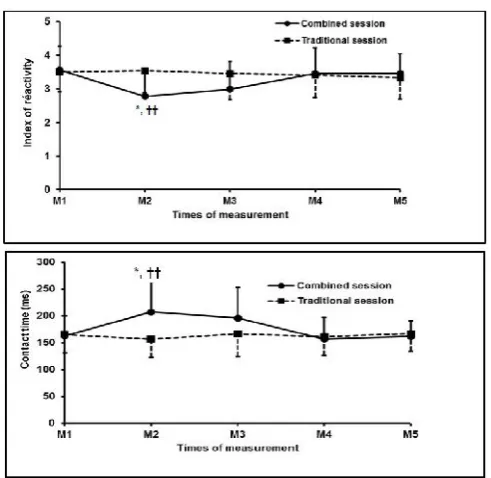
recovered up to 83.9% (p = 0.151) of the initial value six hours later, and to 97.1% (p = 0.992) 48 hours after CO, so that it remained nothing more but 2.9% to restore. Six hours after CO, Tc decreased from 120.2% (p = 0.235) of the initial value to 96.3% (p = 0.995) 24 hours later and rose again to 99.4% (p = 0.999) after 48 hours of recovery. Thus, 24 hours after CO,
[image:4.595.39.286.273.424.2]H : hour
Figure 4. Changes in the height of counter movement jump with arms during the 48 hour-recovery period following training sessions, in
basketball players
M1 : before the session ; M2 : at the end of the session ; M3 : after six hour-recovery ; M4 : after 24 hour-hour-recovery ; M5 : after 48 hour-hour-recovery ; * : difference with value before session, significant at p < 0.05; ††: difference between the combined session and the classical one significant at p < 0.01.
Figure 5. Changes in the index of reactivity (a) and the contact time (b) at the reactivity jump during the 48 hour-recovery period training session among students playing basketball
Measures made at test and retest : anthropometric measures : height and weight ; cardiac parameters : resting heart rate (HRr), heart rate at the end of the session
[image:4.595.306.552.461.700.2](HRw) ; thermal parameter : rectal temperature; jump tests : Squat Jump (SJ), Counter Movement Jump (CMJ), counter movement jump with the use of arms (CMJB), Reactivity Jump (RJ) ;other measures : ambient temperature, relative humidity, water drunk ; M1: measures before the session ; M2 : measures at the end of the session; M3 : measures made six hours later; M4 : measures made 24 hours later ; M5 : measures made 48 hours later.
[image:4.595.40.290.488.645.2]Tc was 3.7% lower than the initial value, but after 48 hour-recovery, it was just 0.6% lower. The modifications observed during 48 hours of recovery did not differ from the CO and the TR (p > 0.05), concerning the two variables of RJ (Figure 5).
DISCUSSION
This study related to basketball players whose mean VO2max30-15 IFT was 52.6 ± 2.8 mL/min/kg. This value corresponds to the range values of 50 - 60 mL/min/kg recorded in professional basketball players (Mc Ardle et al., 1996; Mc Innes et al., 1995). It is consequently reasonable to think that the players used in this study have on average a good level of aerobic fitness. Compared with that reported by Esco and Williford (2011) which was 46.2 ± 6.9 mL/min/kg, the value recorded in our series appears higher. The mean heart rate measured before each training session is on the other hand in the range of values awaited in sportsmen, in comparison with the usual lower than 60 bpm resting values reported in athletes. Our data are thus largely lower than the 73 ± 2 bpm reported by Deshmukh (2013) in a group of 18 to 25 years old students playing basketball and volley-ball. The control of heart rate and energy expenditure was undertaken during exercises but due to failure of the material, only the HRw, regarded as relatively near to reality was presented. At the end of the CO session, Tr increased by 4.9% vs 2.4% for the TR session. This result is all the more normal as the CO session was more intense than the TR one and is more likely to induce an increase of rectal temperature, even a hyperthermia (Banzet et al., 2012).
This non expected increase in the rectal temperature observed at the end of both sessions, is associated with the thermal stress imposed to the body by the heat produced by the muscular contractions and the hot and humid environment. Indeed, it should be noticed that during CO and TR sessions, the temperature of exposure reached 32 – 33 °C, with a relative humidity of 65%. Under these conditions of increased thermal stress, thermolysis appears difficult and body temperature is likely to rise fast (Coyle and Gonzalez-Alonso, 2001; Gonzalez-Alonso et al., 1995, Montain et al., 1992). A decrease of body weight at the end, corresponding respectively to 1.3% and 1.1% of the values recorded before the CO and TR sessions was observed. This decrease could be regarded as light, in comparison with the relatively hot environment in which the sessions were undertaken and their duration over one hour. It should however be noticed that a dehydration even corresponding to a loss of 1% to 2% of the body weight compromises the body physiological mechanisms and inflects performance (Casa et al., 2000).
The assessment of the players’ hydric status before each training session would have allowed asserting that most of them were in a dehydration state before training. It was not the case and this parameter must be taken into account in the next study designs. The fact that weight has not returned to the initial value after a 48 hour-recovery, whatever the training session, supports this assumption and arises the problem of players’ rehydration after the training sessions and games played in a hot environment. The players recorded a decrease in their SJ and CMJ performance of 12.7% and 12.3% after the CO session. It is well-known that the capacity of the muscles to generate force-speed decreases after an intense training
session (Miles et al., 1997). Reductions of jump performance of 8.4%, i.e. lower than those observed in this study, were recorded after a resistance training session (Byrne and Eston, 2002) and even after a series of five training sessions (Ronglan et al., 2006). The reduction of jump height at CMJ recorded in this study rounding the 12.6% is observed by Delextrat et al. (2012) in Spanish female basketball players and closed to the 11.9% reported in a group of women subjected to a session of plyometry (Jakeman et al., 2010). The CO session was made up inter alia, of sprint bouts and plyometric exercises, which were therefore necessarily eccentric. The decrease in jump performance recorded at the end of the session can then be associated with muscular lesions caused by the abrupt and intense contractions required by multi-jumps and bounds/leaping treads realised at maximum speed (Clarkson and Hubal, 2002). The main indirect markers of these muscular lesions and exercise-induced inflammatory process (Pyne, 1994) are creatinekinase, C-reactive protein (CRP) and myoglobin (Clarkson and Newham, 1995). The performance of CMJB dropped by 6.7% at the end of the CO session (almost the half of that of SJ), probably because the contribution of the arms to the achievement of the jump was not affected by the fatigue/tiredness caused by the workload.
Indeed, the muscles of the upper limbs were much requested by the exercises undertaken during the 120 minutes of training. The weak/little performance reduction of about 5.4% for SJ and 0.8% for CMJ at the end of the session corresponds to that recorded after a soccer game in professional players (Zemkova and Hamar, 2009), but contrary to the data of Abian-Vicén et al. (2012) which observed an increase of jump height of about 4.5% following a basketball match. At the end of the CO session, the index of reactivity (IR) lowered by 23%, whereas an increase of about 3% was found after the TR. The decrease in IR is justified by the increase of 27.3% in the contact time (Tc), since the more IR raises, the more Tc drops (Flanagan and Comyns, 2008). This increase in Tc is associated with the deterioration of the transmission of the nerve impulse at the time of the coupling eccentric/concentric, because of the fatigue induced by the intensity of the session. It is possible that the losses in electrolytes and other minerals like magnesium and calcium with sudation, due to exercise in a hot environment, negatively influence the transmission of the nerve impulse (Lattier et al., 2004). It is indeed known that the imbalance of the ionic concentrations consecutive to a muscular activation -induced fatigue causes a decrease of excitability in the muscles and consequently a drop of their strength (Allen et al., 2008).
of Eston et al. (2003) who noticed that it often remains to restore 10 to 15% after 72 hour-recovery following exercise-induced muscle damage. Earlier, Hortobagyi et al. (1991) and Chambers et al. (1998) too have reported the same observation after an ultra-marathon, following an intense plyometric exercise. It should be recognized that the participants in this study do play at the level of university. They are therefore moderately trained and not accustomed to this kind of training session involving muscular reinforcement. This moderate training level, associated with inexperience, constitute factors likely to explain the long duration of performance restoration (for explosive and plyometric contractions) of the most requested muscles (Bishop et al., 2008; Sayers and Clarkson, 2001; Tomlin et al., 2001; Costill et al., 1979).
The index of reactivity (IR), as well as the contact time (Tc) during the test of reactivity jump (RJ) have not varied significantly during the 48 hour-recovery, whatever the training session. The weaker Tc is, the higher and better is the IR. The value of the IR to be restored after the CO session is low, in comparison with those of the SJ and CMJ. After the 24 hour-recovery, IR had been indeed restored at more than 97%. The assumption according to which the players did not produce their maximum performance during the first test prior to the CO session cannot however be rejected, even though the mean value recorded at the end of the session was significantly lower. The interest of such a report lies in the fact that IR accounts for rebound and inter-muscular coordination of the lower limbs qualities and that these qualities were already restored after 24 hour-recovery. These results are interesting as well for trainers as for players, since the IR presents good correlations with sprint performance and is an effective tool for preparation to competition (Harrison and Bourke, 2009; Mc Clymont, 2003).
Limitation of The Study
These results would have been of greater interest if the indirect markers of the muscular damage associated with very intense and/or eccentric exercises had been assessed. It is the same for the urinary specific gravity which would allow knowing the hydric status of the players and its variation during the study period. Assessing the urinary electrolytes would also contribute to a better comprehension of the mechanisms underlying muscular fatigue induced by the combined session based on sprint bouts, muscular reinforcement and interval-training. These parameters and those related to food (calcium, magnesium, potassium, carbohydrates, etc.) must also be integrated into the designs of next studies on the same topic, to improve their heuristic quality and the possibilities of practical application.
Conclusion
This research aimed at assessing the impact of a training session based on combined exercises (CO) and targeting the improvement of the Repeated Sprints Ability (RSA) on jump performance loss and knowing the rate of restoration after 48 hours of rest. At the end of this study, it appeared that: 1) a training session which combines short sprints, muscular reinforcement and interval-training (VO2max), induced a decrease in capacity of the most requested muscles, comparable with that of a session constituted of only muscular
reinforcement exercises; 2) the 48 hour-resting period generally planned for the players recovery after an intense resistance training session was not sufficient for the complete restoration of the muscular capacities after this type of training. The trainers of sports games, particularly those of basketball may take into account these results to organize the specific training blocks aiming at developing the ability of repeated sprints. The early recovery (24 hours later) of the reactivity index, which accounts for the muscular qualities used during the basketball game (during offensive and defensive rebounds), constitutes new information brought by this research. It is however urgent to know whether the ability of repeated sprints is more developed after a training block based on the use of combined exercises, than after another one using separately sprint-based sessions, muscular reinforcement and interval-training.
Acknowledgments
The authors thank the basketball players and the Professors of INJEPS who agreed to take part in the study, and others who have authorized its implementation during the training sessions. We warmly thank Mr. Moukouyou Eric, who allowed us to use gracefully his Myotest’s for this study. We also thank the persons in charge of the Fitness and cardiovascular Center VITA FORM of Porto-Novo, for their technical support during training sessions designing and statistical data processing.
REFERENCES
Abián-Vicén, J., Del Coso, J., González-Millán, C., Salinero, J.J. and Abián, P. 2012. Analysis of dehydration and strength in elite badminton players. PLoS ONE., 7(5): 1-8. Allen, D.G., Lamb, G.D. and Westerblad, H. 2008. Skeletal
muscle fatigue: Cellular Mechanisms Physiol Rev., 88(1): 287-332.
Banzet, S., Koulmann, N. and Bourdon L. 2012. Activité physique et hyperthermie. Médecine et Armées., 40(3) : 207-216.
Bishop, D., Girard, O. and Mendez-Villanueva, A. 2011. Repeated-Sprint Ability - Part II: Recommendations for Training. Sports Med., 41(9): 741-756.
Bishop, PA., Jones, E. and Woods, AK. 2008. Recovery from training: a brief review: brief review. J Strength Cond Res., 22(3):1015-1024.
Buchheit, M. 2005. Le 30-15 Intermittent Fitness test: un nouveau test de terrain spécifiquement dédié aux joueurs de sport collectif pour la détermination d’une vitesse maximale aérobie intermittente. Approche du handball, N° 87 Juin : 27-34.
Buchheit, M., Mendez-Villaneuva, A., Quod, M., Quesnel, T. and Ahmaidi, S. 2010. Improving acceleration and repeated sprint ability in well-trained adolescent handball players: speed vs sprint interval training. Int J Sports Physiol Perform., 5(2): 152: 164.
Buchheit, M., Mendez-Villanueva, A, Simpson, BM. and Bourdon, P.C. 2010b. Repeated-sprint sequences during youth soccer matches. Int J Sports Med., 31(10): 709-716. Buchheit, M., Mendez-Villanueva, A., Simpson, B.M. and
Byrne, C. and Eston, R. 2002. The effect of exercise-induced muscle damage on isometric and dynamic knee extensor strength and vertical jump performance. J Sports Sci., 20(5): 417-425.
Casa, D.J., Armstrong, L.E., Hillman, S.K., Montain, S.J., Reiff, R.V., Rich, B.S.E., Roberts, W.O. and Stone, J.A. 2000. National Athletic trainers’ Association position statement: fluid replacement for athletes. J Athl Training, 35(2): 212-224.
Chambers, C., Noakes, T.D., Lambert, E.V. and Lambert, M.I. 1998. Time course of recovery of vertical jump height and heart rate versus running speed after a 90-km foot race. J Sports Sci., 16(7): 645-651.
Changela, P.K. and Bhatt, S. 2012. The correlational study of the vertical jump test and Wingate cycle test as a method to assess anaerobic power in high school basketball players. Int J Sci Res Pub., 2(6):1-6.
Clarkson, P.M. and Hubal, M.J. 2002. Exercise-induced muscle damage in humans. Am J Phys Med Rehabil., 81 (11 Suppl): S52-69.
Clarkson, P.M. and Newham, D.J. 1995. Associations between muscle soreness, damage, and fatigue. Adv Exp Med Biol., 384:457-469.
Comstock, B.A., Solomon-Hill, G., Flanagan, S.D., Earp, J.E., Luk, H.Y., Dobbins, KA, et al. 2011. Validity of the Myotest in measuring force and power production in the squat and bench press. J Strength Cond Res., 25(8): 2293-2297.
Costill, D.L., Coyle, E.F., Fink, W.F., Lesmes, G.R. and Witzmann, F.A. 1979. Adaptations in skeletal muscle following strength training. J Appl Physiol., 46(1): 96-99. Coyle, E.F. and Gonzalez-Alonso, J. 2001. Cardiovascular
drift during prolonged exercise: New perspectives. Exerc SportsSa Rev., 29(2): 88-92.
Dawson, B. 2012. Repeated-sprint ability: where are we? Int J Sports Physiol Perform., 7(3):285-289.
Delextrat, A., Trochym, E. and Calleja-González, J. 2012. Effect of a typical in-season week on strength jump and sprint performances in national-level female basketball players. J Sports Med Phys Fitness., 52(2): 128-136. Deshmukh, S.V. 2013. Comparison of selected physiological
variables between basketball and volleyball male players. Int Indexed Refereed J., 5(49): 11-13.
Edge, J., Hill-Haas, S., Goodman, C. and Bishop, D. 2006. Effects of resistance training on H+ regulation, buffer capacity and repeated sprints. Med Sci Sports Exerc., 38(11): 2004-11.
Esco, M.R. and Williford, H.N. 2011. Cardiovascular autonomic modulation in collegiate male basketball players. J Exer Physiol Online., 14(1):35-42.
Eston, R., Byrne, C. and Twist, C. 2003. Muscle function after exercise-induced muscle damage: Considerations for athletic performance in children and adults. J Exerc Sci Fitness., 1(2):85-96.
Fitzsimons, M., Dawson, B., Ward, D. and Wilkinson, A. 1993. Cycling and Running test of repeated sprint ability. Austral J Sci Med Sport., 25(4):82-87.
Flanagan, E.P and Comyns, T.M. 2008. The use of contact time and the reactive strength index to optimize fast stretch-shortening cycle training. Strength Cond J., 30(5): 32-38.
Gonzalez-Alonso, J., Mora-Rodrigez, R., Below, P.R. and Coyle, E.F. 1995. Dehydration reduces cardiac output and increases systemic and cutaneous vascular resistance during exercise. J Appl Physiol., 79: 1487-1496.
Gore, C.J. 2000. Physiological tests for elite athletes. 2nd edition. Champaign Illinois: Human Kinetics, 546 p. Harrison, A.J. and Bourke, G. 2009. The effect of resisted
sprint training on speed and strength performance in male rugby players. J Strength Cond Res., 23: 275-283.
Hortobagyi, T., Lambert, N.J. and Kroll, W.P. 1991. Voluntary and reflex responses to fatigue with stretch-shortening exercise. Can J Sports Sci., 16(2): 142-150.
Jakeman, J.R., Byrne, C. and Eston, R.G. 2010. Lower limb compression garment improves recovery from exercise-induced muscle damage in young, active females. Eur J Appl Physiol., 109(6):1137-1144.
Lattier, G., Millet, G.Y., Martin, A. and Martin, V. 2004. Fatigue and recovery after high-intensity exercise. Part I: neuromuscular fatigue. Int J Sports Med., 25(6): 450-456. Mc Ardle, W.D., Katch, F.I. and Katch, V.L. 1996. Exercise
physiology. 4th Edition. Baltimore, MD: Williams & Wilkins.
Mc Innes, S.E., Carlson, J.S., Jones, C.J. and McKenna, M.J. 1995. The physiological load imposed on basketball players during competition. J Sports Sci., 13(5): 387-397. McClymont, D. Use of the reactive strength index (RSI) as a
plyometric monitoring tool. Available at: http://
coachesinfo.com/index.php?option=com_content&view=articl e&id=146:rugby-rsi&catid=47:rugby-general<emid=77 Miles, M.P., Ives, J.C. and Vincent, K.R. 1997.
Neuromuscular control following maximal eccentric exercise. Eur J Appl Physiol., 76(4): 368-74.
Montain, S.J. and Coyle, E.F. 1992. Influence of graded dehydration on hyperthermia and cardiovascular drift during exercise. J Appl Physiol., 73: 1340-1350.
Pyne, D.B. 1994. Exercise-induced muscle damage and inflammation: a review. Aust J Sci Med Sport., 26(3-4): 49-58.
Rampinini, E., Bishop, D., Marcora, S.M., Ferrari Bravo, D., Sassi, R. and Impellizzeri, F.M. 2007. Validity of simple field tests as indicators of match-related physical performance in top-level professional soccer players. Int J Sports Med., 28(3): 228-235.
Ronglan, L.T., Raastad, T. and Borgesen, A. 2006. Neuromuscular fatigue and recovery in elite female handball players. Scand J Med Sci Sports., 16(4): 267-273. Sayers, S.P. and Clarkson, P.M. 2001. Force recovery after
eccentric exercise in males and females. Eur J Appl Physiol., 84(1-2):122-126.
Sesboüé, B. and Guincestre, J.Y. 2006. Mise au point: La fatigue musculaire. Ann Réadapt Méd Phys., 49(6)257-264. Tomlin, D.L. and Wenger, H.A. 2001. The relationship between aerobic fitness and recovery from high intensity intermittent exercise. Sports Med., 31(1): 1-11.
World Medical Association. 1964. The World Medical Association’s declaration on ethical principles for medical research involving humans subjects, as adopted by the 18ème WMA General Assembly (Helsinki, Finnland).
Zemková, E. and Hamar, D. 2009. The effect of soccer match induced fatigue on neuromuscular performance. Kinesiology., 41(2):195-202.