http://wrap.warwick.ac.uk
Original citation:
Alpern, Steve and Chen, Bo, Dr. (2014) Who should vote first on a small heterogeneous sequential jury?
Permanent WRAP url:
http://wrap.warwick.ac.uk/60677
Copyright and reuse:
The Warwick Research Archive Portal (WRAP) makes this work by researchers of the University of Warwick available open access under the following conditions. Copyright © and all moral rights to the version of the paper presented here belong to the individual author(s) and/or other copyright owners. To the extent reasonable and practicable the material made available in WRAP has been checked for eligibility before being made available.
Copies of full items can be used for personal research or study, educational, or not-for-profit purposes without prior permission or charge. Provided that the authors, title and full bibliographic details are credited, a hyperlink and/or URL is given for the original metadata page and the content is not changed in any way.
A note on versions:
The version presented here is a working paper or pre-print that may be later published elsewhere. If a published version is known of, the above WRAP url will contain details on finding it.
Who Should Vote First
on a Small Heterogeneous Sequential Jury?
Steve Alpern Bo Chen∗
Warwick Business School, University of Warwick Coventry, CV4 7AL, United Kingdom
May 25, 2014
Abstract
We consider a heterogeneous jury which must decide on a verdict of A or B (such as guilty or innocent) by a sequential majority vote. Jurors have private information in the form of integer signals, where positive signals indicate A is more likely and negative signals that B is more likely. A juror’s strategy is a threshold (depending on previ-ous voting, if any), where a juror votes A if his signal is higher than his threshold. Each juror’s signal distribution is linear, with slope called his “ability”, so that higher ability jurors are more likely to guess correctly between A and B. Using integer programming meth-ods we show that the probability that a three-person jury comes to a correct verdict is maximized when the middle-ability juror votes first. In general, optimizing jurors must vote strategically, but when A and B are equiprobable and the abilities (b, c, a) in the voting order sat-isfya < b < c, all jurors can vote naively for the alternative that has higher probability at time of voting. Our results have implications for larger juries and for optimizing line calls in sports such as tennis and badminton.
Keywords: jury — sequential voting — voting order — group decision
1
Introduction
A group of agents (jurors) must decide between two states of Nature, A
and B (such as guilty or innocent). Their verdict is by majority rule in a sequential open vote, also known as “roll call” voting, and their common
aim is to maximize the probability that their verdict is correct. As the jurors have different “abilities” (or expertise, judgement, eyesight, etc.) to determine the correct state, the voting order might make a difference.
The main interest of this paper is to determine an optimal voting order, in terms of the set of abilities of the jurors. For reasons of a combinatorial nature, our techniques (integer programming) are restricted mainly to small juries. We find that, with three jurors of differing expertise, it is best to have the one of middle-level expertise vote first, and the order of the last two does not matter. On the other hand, when the alternatives are equally likely, and the voting sequence is middle ability followed by highest ability and finally lowest ability, all the jurors can afford to vote naively for the alternative which they deem most likely at the time of voting. These results apply as well to the last three jurors to vote in a larger jury.
In our model theability of a juror is specified by the nature of his private information, in terms of the distribution of hissignal within a set of ten odd values from −9 to +9, with higher values indicating A and lower ones B. We assume a linear distribution where the slope is proportional to a juror’s ability a. Thus ability a = 0 is a horizontal line where every signal in the whole range comes equiprobably, and has no information content, while maximum ability a = 4 is most likely to give signals with high absolute values, with the most useful information. A strategy profile for the jury specifies how large a signal (his threshold) each juror requires in order to vote A. Individual thresholds depend on the prior voting sequence, if any. Thresholds are jointly optimized using integer programming or dynamic programming, as a function of the ability sequence of the jurors and thea priori probability of alternative A.
In our model of heterogeneous juries, jurors cannot optimize their deci-sions by simply assuming that they are pivotal. They must observe previous voting because it matters which jurors in the voting sequence have voted for
A, not simply that half the other jurors have so voted.
result in [8] on increased wrong conviction rate when unanimous voting is required (compared to majority), is found in our model only when the jurors have the highest ability.
A recently published treatise on collective decision making [10] presents an extensive analysis of juries, discussing juror “quality” (including low qual-ity due to drunkenness) and voting order. For the latter, several examples of historical anti-seniority rules are explicitly laid out. The historical impor-tance of voting order is illustrated as far back as a Roman trial described by Cicero, where the defendant was given choice of open sequential voting or secret ballot. With his choice of the former, the order of voting proved seriously detrimental to his case: he was convicted by a majority of two.
The question of optimal ordering of heterogeneous experts or jurors is implicit in many rules of behavior. In tennis or badminton, the A/B call of In or Out is first made by a linesman and then can be overcalled by the umpire. A discussion of the optimal order of experts is given in [9], citing examples where courts follow either anti-seniority (increasing “ability” in our terminology) or seniority orders; respectively the ancient Sanhedrin and the contemporary American Supreme Court. Our model is simpler than other models in the literature in that our agents care only about the common good (getting the right verdict), rather than their own reputations, getting their preferred verdict, or minimizing their costs in obtaining quality signals. Thus we are concerned with simple optimization, rather than equilibria, and our analysis is not game theoretic.
We add a final note regarding our restriction to small jury size. Our methods of discrete optimization use integer programming to determine op-timal threshold profiles for every fixed voting order. Since thresholds depend on previous voting, and the number of previous voting profiles potentially seen by thekth juror alone is 2k−1,the number of threshold types (for just
generally to the last three jurors in the voting order.
The methodology adopted in this paper is neither experimental nor de-ductive. Rather we use computer based programming (integer programming or dynamic programming) to determine the set of optimal threshold profiles for eacha priori probability of stateAand each (ordered) sequence of juror abilities, and then exhaustive search to obtain comparative general results which hold for all or specified parameters. We use exact calculations (with fractional probability values) based on Mathematica. Hence these general results, which we call Propositions, have no proofs. The ones with true deductive proofs are called Theorems.
2
The model
There are two states of Nature,AandB (such asguilty andinnocent), with thea priori probability θ of A. The symmetric caseθ = 1/2 is referred to asof neutral alternatives. A group of n agents (jurors) attempts to decide the true state of Nature by amalgamating their private information through sequential voting towards a verdictV of A or B. Their common aim is to maximize the probabilityQ that their collective verdict is the actual state of Nature.
We model the voting problem Γ = Γm,nin terms of the minimum number
of votesm(out ofn) required for a verdict ofA. We are primarily concerned with majority voting, where n is odd and a majority of m = (n+ 1)/2 is sufficient for either alternative. We shall also sometimes relate our problem to one ofunanimous voting Γn,n (for sayA), where one of the alternatives
requires a unanimous vote. The agents will make their votes strategically (depending onθ, previous voting, and their private information). The jurors differ in theirability to discern the state of Nature, so the voting order may matter.
2.1 Signals and thresholds
We model the private information of theith juror to vote as asignal sidrawn
from a fixed signal set S ={−9,−7, . . . ,−1,+1, . . . ,+7,+9} consisting of ten odd numbers. Positive signals will tend to indicate that A is true; negative signals, B. A higher positive signal gives a higher conditional probability ofA, so is considered stronger. Similarly for negative signals.
When juror k comes up to vote, he votes A if his signal sk is above a
earlier juror,j= 1, . . . , k−1. That is
vk=A if and only if sk> τk.
When there aren= 3 jurors, the threshold vectorτ has five coordinates for majority voting:
τ = (τ1, τ2(B), τ2(A), τ3(AB), τ3(BA))
= (v, w, x, y, z),
as τ(AA) and τ(BB) can be ignored since a majority has already been reached. Since signal indices are odd, we index the thresholds T by even numbers: T = {−10,−8, . . . ,+10}. Note that threshold −10 is a certain
vote for A and +10 is a certain vote for B. For example, given signal vector s = (s1, s2, s3) = (1,−3,5) and threshold vector (strategy profile) τ = (2,−4,6,−8,10), the voting sequence is v1 = B (because s1 = 1 <
2 = τ1), v2 =A (because s2 =−3 > τ2(v1) = τ2(B) = −4), and v3 =B
(because juror 3 always votes B after BA as that threshold is +10). The voting sequenceBAB determined by sand τ thus gives a majority verdict
V =V(BAB) ofB.
2.2 Signal distributions and juror abilities
We now discuss the process by which individual jurors receive their private information in the form of signals. If Nature is in stateA(resp.B), positive (resp. negative) signals should be more likely than negative (resp. positive) signals. Moreover, we want to have probabilities of A and B increase with signal strength, measured by the absolute value ofs∈ S. The simplest such signal distributions are two linear functions f and g on S respectively for
A and B with absolute values of their slopes proportional to juror’s ability
a ∈ Ω = {0,1,2,3,4}. Hence a juror with a higher ability is more likely to guess the correct state of Nature. Specifically, a juror of ability a ∈ Ω receives signals∈ S with probability
{
fa(s) = 101 +a
( s 360
)
, if Nature is A;
ga(s) =fa(−s), if Nature is B.
Note that a juror of ability a = 0 essentially has no private information as f0(s) = g0(s), so any signal he receives is equally likely to come from A or B. Also note that the maximum ability is chosen as a = 4 so that
The cumulative distribution functions Fa and Ga, corresponding to the
probability densitiesfa and ga, determine the probabilities that a juror of
ability a will vote B. In particular, noting that thresholds are necessarily even, we have,
Pr [Event1] =Fa(2j) = (5 +j)
( 1 10−
a(5−j) 360
)
,
Pr [Event2] =Ga(2j) = (5 +j)
( 1 10 +
a(5−j) 360
) ;
where Event1 (resp. Event2) denotes the event that, given the state of Na-ture isA(resp. B), a juror of abilityawith thresholdτ = 2j votesB. The significance of the ability parameter is easily demonstrated in the context of a jury of one. Here, a juror of ability a, faced with neutral alternatives, maximizes the probabilityQa of giving the right verdict by using a neutral
threshold ofτ1 = 0 with
Q(a) = Ga(0)
Fa(0) +Ga(0)
.
Hence
(Q(0), Q(1), Q(2), Q(3), Q(4)) = ( 1 2, 41 72, 23 36, 17 24, 7 9 )
≈(0.50,0.57,0.64,0.71,0.78).
2.3 Probability of correct verdict
Suppose we have three jurors of abilities a, b, c in order of voting. If we know their thresholds τ = (v, w, x, y, z), then for each state of Nature we can evaluate the probability of all voting sequences and consequently the probability Q that the verdict is the actual state of Nature, that is, the probability it is correct. If Nature is in state A, then the three voting sequencesAA,ABAandBAAlead to a correct verdict; if Nature is in state
B, then this holds for BB, BAB and ABB. For example, the probability that Nature is in stateAand the voting sequence isABAis given byθ(1−
Fa(v))Fb(x) (1−Fc(y)). More generally, we can writeQas the sum of the
six possible ways of getting a correct verdict as follows:
Q(θ;a, b, c;v, w, x, y, z) =
θ((1−Fa(v))(1−Fb(x)) + (1−Fa(v))Fb(x)(1−Fc(y))
+Fa(v)(1−Fb(w))(1−Fc(z))) + (1−θ)(Ga(v)Gb(w)
For a fixed order in which jurors of different abilities may vote, we jointly optimize their thresholds and call the optimal probability of correct verdict
¯
Q= ¯Q(θ;a, b, c). We solve the following integer program:
¯
Q(θ;a, b, c) = max
v,w,z,y,z∈T Q(θ;a, b, c;v, w, x, y, z).
Denote by ¯τ = ¯τ(θ;a, b, c) = (¯v,w,¯ x,¯ y,¯ z¯) any optimal (strategic) threshold profile. The evaluation of ¯Qfor the case of three jurors may also be carried out via dynamic programming. For large juries, our discrete approach is not feasible, but some observations extended from the casen= 3 are mentioned later. Corresponding to our discrete signals, thresholds and juror abilities, we consider thea priori probabilityθ∈ {0.1, . . . ,0.9}.
In contrast to the optimal (strategic) threshold profile ¯τ, it is useful to consider what is callednaive voting, with naive thresholds ˜τ = (˜v,w,˜ x,˜ y,˜ z˜) and correctness probability ˜Q=Q(θ;a, b, c; ˜τ). Naive voting is best defined recursively. The first juror votesA if his subjective probability of A, given
a priori probability θ and his private information s1, is at least 1/2. For θ = 1/2, this means that his naive threshold is 0. Suppose that the first
k−1 jurors have chosen naive thresholds and the voting has gone in some sequence (v1, v2, . . . , vk−1). Then the kth juror votes naively if he votes for
the more likely state of Nature, given all this information and his signal
sk. His naive threshold ˜τk(v1, v2, . . . , vk−1) is the even number between the
lowest (odd-numbered) signal for which he votesAand the highest for which he votes B. Thus ˜τ can be computed recursively (for any number of voters
n). An interesting question is when (if ever) is ˜τ = ¯τ and hence ˜Q = ¯Q. That is, when is naive voting optimal? This will be partially addressed in Proposition 5.
We note that instead of optimizing the probabilityQof a correct verdict, we could specify positive costs C1 and C2 for verdict V =A when Nature
is B or verdictV =B when Nature is A, and then minimize the expected cost. It turns out that our qualitative results in this case are not different from the caseC1 =C2, which is identical to maximizing Q.
3
Optimal thresholds and need for strategic voting
a1\a2 0 1 2 3 4
[image:9.595.126.541.131.200.2]0 (0,−10,10,0,0) (0,−10,10,0,0) (0,−10,10,0,0) (0,−6,6,2,−2) (0,−4,4,2,−4) 1 (0,−10,10,−2,2) (0,−10,10,−2,2) (2,−8,10,−2,0) (0,−6,6,0,0) (0,−4,2,2,−2) 2 (0,−10,10,−2,2) (0,−10,10,−2,2) (0,−8,8,−2,2) (0,−4,4,0,0) (0,−2,2,2,−2) 3 (0,−10,10,−4,4) (0,−10,10,−4,4) (0,−10,10,−4,4) (0,−4,4−2,2) (0,0,2,0,−2) 4 (0,−10,10,−6,4) (0,−10,10,−6,6) (0,−8,8,−4,4) (0,−2,2−2,2) (0,0,0,0,0)
Table 1: Optimal thresholds after (−, B, A, AB, BA) for voting order (a1, a2,4) with
θ= 1/2
For illustrative purposes we have listed in Table 1 an optimal threshold profile for each jury with a final voter of ability 4. Of particular interest (to be discussed below) are the zero threshold profile for homogeneous abilities (4,4,4), the skewed (asymmetric) profile for (1,2,4), and the extreme (±10) thresholds for the second voter in the bold profiles.
3.1 Homogeneous jurors
Apart from sequential voting, our model includes two elements not ordinarily found in the literature: multiple (rather than binary) signals and heteroge-neous jurors (of differing abilities). It is the latter assumption that creates the rich and counterintuitive flavor of our model. This can be easily demon-strated by simply calculating the five homogeneous thresholds uniquely as ¯
τ(1/2, a, a, a) = (0,0,0,0,0) for all abilities a∈Ω (except that the unique-ness does not hold for abilitya= 0 for an obvious reason), as indicated in Table 1 for the case ofa= 4. That is, each juror votes A exactly when he receives a positive signal. We can rephrase this as the following elementary observation.
Proposition 1 Facing neutral alternatives, homogeneous jurors can vote optimally by voting naively without observing previous votes, as if they were voting in a secret (or simultaneous) ballot.
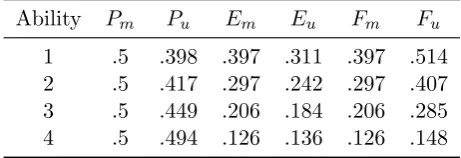
Thus when jurors are homogeneous, each can indeed vote as if they are the pivotal voter, and ignore any prior voting that they witness. Further-more, we have the following simple results concerning conviction rate and verdict errors when compared with unanimous voting system Γ3,3, which are
further detailed in Table 2.
when compared with unanimous voting rule. On the other hand, majority rule has a lower rate of wrong conviction for the highest-ability jury (a= 4), but otherwise a higher rate (for a <4).
We note that the lower rate of wrong conviction for majority rule was a major finding of [8].
Ability Pm Pu Em Eu Fm Fu
[image:10.595.189.420.219.298.2]1 .5 .398 .397 .311 .397 .514 2 .5 .417 .297 .242 .297 .407 3 .5 .449 .206 .184 .206 .285 4 .5 .494 .126 .136 .126 .148
Table 2: Comparison of voting rules for homogeneous jurors: strategic sequential ma-jority (m) vs. unanimous (u): P conviction rate, E rate of conviction error, F rate of acquittal error
3.2 Symmetric strategy profiles
Table 1 gives some optimal profiles for the neutral alternative caseθ= 1/2, where there is an obvious symmetry between the two states of Nature, A
andB. To exploit this symmetry, we define the transposition function given by ˆA = B and ˆB = A. We can extend this to partial voting histories
v = (v1, v2, . . . , vk−1), where vi ∈ {A, B}, 1 ≤i ≤k−1 and k = 1, . . . , n,
by defining ˆv = (ˆv1,ˆv2, . . . ,vˆk−1) and to thresholds by ˆτ(v) =−τ(ˆv). For
example, if profile τ votes A after previous voting B with signal s2 > 4,
then ˆτ votes B after previous voting A with signal s2 < −4. Clearly for θ = 1/2 the profiles τ and ˆτ yield the same correctness probability Q. Thus if τ is optimal for some ability parameters, so is ˆτ. Thus optimal solutions come in pairs (just like conjugate pairs for quadratic equations). We call a profile τ symmetric if τ = ˆτ, or equivalently if τ(v) = −τ(ˆv) for all voting historiesv. In particular, for symmetric thresholds τ we have
τ1 = τ(no history) = −τ1, i.e., τ1 = 0. One question we may naturally
ask is whether for neutral alternatives θ = 1/2 there is always an optimal threshold ¯τ that is symmetric.
To answer this question, look at the entry in Table 1 for the optimal threshold for abilities (1,2,4): (2,−8,10,−2,0). The transposed threshold is of course also optimal, but these are the only two. So in particular there is no optimal threshold profile for (1,2,4) with first coordinate τ1 = 0, no
optimization problem, the first juror must skew his vote to either B (by requiring a signal more than 2 to vote A) or to A (requiring a signal less than −2 to vote B). Given this example, it is perhaps surprising to note the following general result, which says that such skewing is not necessary for particular voting orders.
Proposition 3 If θ = 1/2, the jurors’ abilities are labeled a ≤ b ≤ c and the juror of middle ability bvotes first, then there is an optimal threshold τ¯
that is symmetric.
In Table 1 we have listed a symmetric threshold profile whenever one of these is optimal, and note that for the ability ordering (2,1,4) where the middle ability juror votes first, there is indeed a symmetric threshold. We will see later that voting orders with middle-ability jurors first are of more special interest.
3.3 Two yokels and a boffin
Some special combinations of abilities{a, b, c} lead to particularly intuitive results. Suppose the jurors have abilitiesa, b < c, where two of the jurors have low abilities compared with the third. With no offense intended we call the situationtwo yokels and a boffin (2Y1B), when an optimal strategy (threshold profile) has the second yokel always vote opposite to the first one, thus canceling out his vote. Such situations are highlighted in bold in Table 1 with the second yokel’s thresholds (−10,10). This leaves the real decision up to the boffin. However, in some cases the boffin may obtain useful information from the vote of the first yokel.
With strategic voting, the optimal thresholds for voter 2 (second row and first column of Table 1) require him to always vote the opposite of voter 1. This leaves the verdict up to the boffin, juror 3, of ability 4. Clearly it is better for the boffin of ability 4 to make the decision than the yokel of ability 1, an improvement from 0.57 to at least 0.78 as calculated at the end of the section on signals distributions and juror abilities. Of course in some cases (where he gets a weak signal), the boffin may improve further by taking into account the vote of the first voter.
When we are in the 2Y1B situation, the vote of the second yokel carries no information; but the vote of the first yokel does (if his ability is not 0). If the boffin votesafter the first yokel, he can go with the first yokel’s vote if his own signal is very small, say±1. (This argument would be even cleaner if we allowed a neutral signal of 0). So in order for the boffin to obtain useful information from the smart yokel, we need two conditions:
• The smart yokel must vote before the complete yokel, and • The smart yokel must vote before the boffin.
Hence the only ordering in which the boffin can make use of the infor-mation contained in the smart yokel’s vote is:
• The smart yokel votes first.
Note that in our example this means that the juror of middle ability votes first in the optimal ordering. This turns out to be true generally.
3.4 One complete yokel
We conclude this section with the analysis of a special case that will have applications later. Thea prioriprobability ofAis an arbitraryθ. The three abilities of the jurors, in voting order, are a,0, b, where a, b > 0. That is, the middle voter is a complete yokel. Suppose that juror 1 votesA. If juror 2 votesA, the verdict isAand the last juror never gets to vote. Clearly the jury can do at least as well if juror 2 votesB and leaves the voting up to the last juror, because the last juror can always vote A and do the same as in the previous case. (Of course if the subjective probability ofA for the last juror is less than 1/2 he can vote B and do better.) The same reasoning applies if juror 1 votes B. We can also check this argument by establishing via integer programming that
¯
Q(θ, a,0, b) = max
or equivalently ( ¯w,x¯) = (−10,10). Summarizing this last argument, we have shown the following lemma.
Lemma 4 For any θ and positive abilities a andb, the voting ability order
(a,0, b) has optimal thresholds for the second juror of ( ¯w,x¯) = (−10,10). That is, he always votes against the fist juror.
4
Main results
In this section we present our main results on the optimal voting orders for jurors of differing abilities (Proposition 5).
Given a set of abilities {a, b, c} for three jurors, with a ≤ b ≤ c, what voting order maximizes the probability ¯Q of obtaining the correct verdict, and how much is this optimal probability? Our approach is to calculate ¯Q
for various orderings of the jurors and attempt to spot patterns of optimality. We then check these patterns by exhaustive search over all voting orders and values ofθ to see where they hold.
To give the reader a small taste of the pattern recognition problem, Table 3 provides some results about how the verdict correctness probability
¯
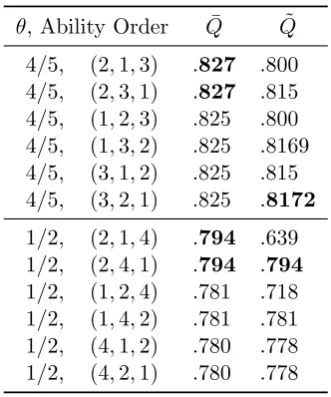
Q and the corresponding optimal threshold profile are dependent on the voting order of the three jurors of different (unordered) abilities{1,2,3}and {1,2,4}. As some patterns only appear in the alternative-neutral case ofθ= 1/2 we take this and 4/5 for oura prioi probability ofA. Some observations from Table 3 that we have calculated to hold for general parameters are stated in our main results below:
Proposition 5 For the majority voting problem Γ = Γ2,3 of three jurors with linear signal distributions, a priori probability θ of A and an arbitrary set of three juror abilities a, b, c∈Ω labeled so that a≤b≤c, we have
1. The probabilityQ¯ of a correct verdict is maximized when the middle-ability juror votes first. The order of the last two jurors does not affect Q. Thus the two optimal orderings are¯ (b, a, c) and (b, c, a).
2. When jurors vote naively, it is always optimal for the weakest to vote last. Thus the optimal ordering is either(b, c, a) or (c, b, a).
θ, Ability Order Q¯ Q˜
4/5, (2,1,3) .827 .800 4/5, (2,3,1) .827 .815 4/5, (1,2,3) .825 .800 4/5, (1,3,2) .825 .8169 4/5, (3,1,2) .825 .815 4/5, (3,2,1) .825 .8172
1/2, (2,1,4) .794 .639 1/2, (2,4,1) .794 .794
[image:14.595.222.388.127.326.2]1/2, (1,2,4) .781 .718 1/2, (1,4,2) .781 .781 1/2, (4,1,2) .780 .778 1/2, (4,2,1) .780 .778
Table 3: Comparison of ability orders
4.1 Overrules in tennis
As an application of Proposition 5, we consider the problem faced by the tennis line-calling jury consisting of a linesman and umpire. Here, ability might be related to eyesight, concentration and blinking rate. Signals might depend on more immediate phenomena such as sun position, player position (blocking view) and weather. The linesman votes first (A “In” orB “Out”) and then the umpire can overrule. In practice, the umpires are instructed to overrule only when very sure of the call, but we analyze the problem in terms of the linesman/umpire team maximizing the probability of a correct verdict, in line with our previous analysis. To conform to our earlier nota-tion, we always have the umpire vote (A or B), even if he is agreeing with the linesman. The umpire determines the verdict. If we have two people of different abilities (e.g., unequal eyesight), what roles should we assign them to? It turns out that by introducing a third referee, who is blind and votes after the linesman and before the umpire, and requiring a majority verdict, we can reduce the tennis problem to our earlier context.
Proof. Consider the three-person jury majority game Γ with ability or-dering (a,0, b), where a complete yokel votes in the second position. By Lemma 4, we know that the yokel will optimally vote against the first ju-ror, leaving the verdict up to the third juror. Thus the tennis jury game is equivalent to this majority game Γ. From Proposition 5 we know that the middle ability juror should vote first in Γ, whose ability in the set {a,0, b}
is the weaker ofaand b. Hence the linesman should be the juror of ability min{a, b} and the umpire should have ability max{a, b}.
5
Larger juries
We now show how some results for three jurors can be used to analyze larger juries of n > 3 jurors. Note that with unanimous voting (for say A), each juror i (of ability ai) has a single threshold strategy τi = τi(A, A, . . . , A)
as for the other voting sequences the verdict is already decided. So the probability Q of getting the correct verdict (with a priori probability θ of
A) with unanimous voting is given by
Q=θ∏ni=1(1−Fai(τi)) + (1−θ) (1− ∏n
i=1(1−Gai(τi))).
Observe that this is the same formula as for the case ofsimultaneous unan-imous voting for B, when each juror simply compares their private signal
si to their threshold τi (regardless of other jurors’ votes). Therefore,
vot-ing order does not matter. Consequently, we have the following elementary result.
Theorem 7 In sequential unanimous voting, the voting order of the jurors does not affect the correctness probabilityQ.
Now consider sequential majority voting when n = 3. After the first vote by juror 1, the subproblem faced by jurors 2 and 3 is either Γ2,2 on
unanimous voting for A (if juror 1 chose B) or Γ1,2 on unanimous voting
forB (if juror 1 chose A). So in either case Theorem 7 demonstrates that the voting order of the last two jurors does not matter. This “explains” the similar observation for linear signals demonstrated computationally in Proposition 5. We will state this result more generally in the last part of Theorem 8.
Next consider the majority voting problem Γm,n= Γk+1,2k+1when
difference d (necessarily even) between the number of votes for A and B. Consider the subproblem faced by the last three jurors. If |d| ≥ 4 then the verdict is already settled. If d = 0, then each alternative has received
k−1 votes, so the remaining subproblem is Γ2,3, the same as the
major-ity voting problem for three jurors (with some ex ante probabilmajor-ityθ′ forA, which depends on the prior voting sequence), which as we showed in part 1 of Proposition 5 is best handled for linear signals with the middle-ability juror voting first. Finally, if |d| = 2 then, depending on the sign ofd, the subproblem is a unanimous voting problem for one of the alternatives, and by Theorem 7, the voting order does not matter. So the ordering is either irrelevant or should be middle ability first, leading to the following theorem.
Theorem 8 Consider sequential majority voting with an odd number of jurors having linear signals. In an optimal voting order, the last three to vote should be ordered with the middle-ability voter first. More generally, for any signal distributions, the order of the final two jurors does not affect the optimal probability of a correct verdict.
We observe that actually our argument proves a stronger version of the above proposition, namely that even after observing the first n−3 votes, we would never want to change the order of the last three from an ordering with the middle ability first.
6
Concluding remarks
Using a simple model of sequential voting, with three heterogeneous jurors differentiated by their ability to discern the true state of Nature, we show that the probability of reaching the correct verdict is maximized when the middle-ability juror is the first to vote. This ordering applies as well to the relative abilities of the last three jurors in a larger jury. We also show that the jurors can afford to vote naively between equiprobable alternatives if and only if the voting order of abilitiesa < b < c is (b, c, a), which is shown to be the unique optimal order when restricted to naive voting.
References
[1] Condorcet, M.J.A.N.C. (1785).Essai sur l’Application de l’Analyse `a la Prababilit´e des Decisions Rendues `a la Pluralit´e des Voix(Impr. Royale, Paris); reprinted (1972) (Chelsea, New York).
[2] Feddersen, T. and Pesendorfer, W. (1999). Elections, information ag-gregation, and strategic voting. Proceedings of the National Academy of Sciences 96(19): 10572–10574.
[3] Easley, D. and Kleinberg, J. (2010). Networks, Crowds and Markets. Cambridge University Press.
[4] Feddersen, T.J. and Pesendorfer, W. (1997). Voting behaviour and in-formation agregation in elections with private inin-formation. Economet-rica 65 (5): 1029–1058.
[5] Dekel, E. and Piccione, M. (2000). Sequential voting procedures in sym-metric binary elections. Journal of Political Economy 108 (1): 34–55.
[6] Scharfstein, D. and Stein, J. (1990). Herd behavior and investment.
American Economic Review 80 (3): 465–479.
[7] Ottaviani, M. and Sorensen, P. (2001). Information aggregation in de-bate: who should speak first? Journal of Public Economics 81 (3): 393–421.
[8] Feddersen, T. and Pesendorfer, W. (1998). Convicting the innocent: The inferiority of unanimous jury verdicts under strategic voting. Amer-ican Political Science Review 92(1): 23–35.
[9] Ali, S., Goeree, J., Kartik, N., and Palfrey, T.R. (2008). Information amalgamation by voting. American Economic Review: Papers & Pro-ceedings 98 (2): 181–186.
[10] Jon Elster (2013).Securities Against Misrule: Juries, Assemblies, Elec-tions. Cambridge University Press, New York. ISBN 978-1-107-03173-9, 324 pages.