MISTRAL: A Statistical Machine Translation Decoder for Speech Recognition
Lattices
Alexandre Patry, Philippe Langlais
RALI – DIRO Universit´e de Montr´eal {patryale,felipe}@iro.umontreal.ca
Abstract
This paper presentsMISTRAL, an open source statistical machine translation decoder dedicated to spoken language translation. While typical machine translation systems take a written text as input,MISTRALtranslates word lattices produced by automatic speech recog-nition systems. The lattices are translated in two passes using a phrase-based model. Our experiments reveal an improvement inBLEU
when translating lattices instead of sentences returned by a speech recognition system.
1.
Introduction
Automatic Speech Recognition systems (ASR) are intended to recognize a text that was spoken by a performer and Ma-chine Translation systems (MT) are intended to translate written texts from one language to the other. It thus seems natural to put those systems together when translating spo-ken languages.
It is unfortunately not always that simple because written and spoken texts are not as similar as we may think. Spoken language transcriptions present many problems to a tradi-tionalMTsystem. First, it contains many disfluencies (rep-etitions, hesitations and other artifacts). Second, it is not easy to recover the structural elements of the message such as punctuation marks, sentence and paragraph boundaries or capitalization. The system presented in this work aims at solving a third problem, namely the robustness of theMT
system regarding recognition errors made by theASR sys-tem.
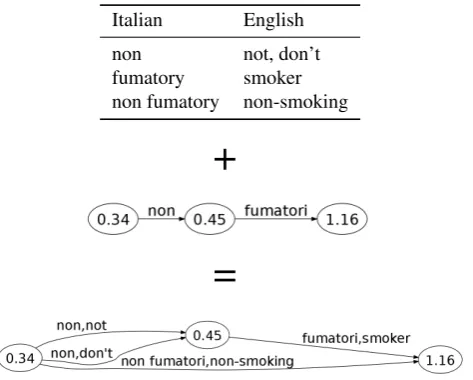
Most speech recognition systems do not convert an audio signal to text greedily one word at a time. They rather gen-erate a lattice where edges correspond to words and nodes to boundaries between words (see Figure 1). ASRsystems return the sentence associated with the best path between the source and the sink nodes, which correspond to the be-ginning and ending of the audio signal. A recognition error happens when a spoken word is unknown to the system or when the wrong path is selected.
In this work, we presentMISTRAL, a statisticalMTsystem designed to translate lattices produced byASRsystems. The motivation for lattice translation is the hope that the knowl-edge embedded in theMTsystem will help theASRsystem to reduce its recognition errors (Ney, 1999).
Word lattices have already been translated by systems based on finite state transducers (Saleem et al., 2004; Matusov et al., 2005; Zhang et al., 2005; Mathias and Byrne, 2006). Our decoder manipulates the same kind of lattices as finite state transducers, but it allows a finer control on pruning policies and it eases the recovery of aggregated informa-tions like individual feature function values.
Translating only the sentence returned by theASRsystem is not optimal, but translating a lattice requires a dedicated decoder. A compromise is to translate an n-best list of sen-tences extracted from the lattice and then select the best
Figure 1: A lattice of words where nodes are labelled with time and edges with words.
translation (Zhang et al., 2004; Quan et al., 2005). Most of the sentences of a given list will be very similar, so trans-lating each of them independently is more computationally expensive than translating a lattice where common parts are factored.
Bertoldi et al. (2007) present an algorithm translating con-fusion networks. Concon-fusion networks are lattices where each node has at most one predecessor and one successor. Their algorithm deals with non-monotone efficiently trans-lations because word boundaries are the same for all the sentences in a given confusion network. On the other hand, another system must be created and tuned to convert word lattices into confusion networks.
The decoder presented in this work was initially devel-oped for theInternational Workshop on Spoken Language Translation (IWSLT) (Fordyce, 2007; Patry et al., 2007). It is a phrase-based system (Koehn et al., 2003) trans-lating lattices in two passes. The first pass simultane-ously recognizes and translates the source sentence and the second pass rescores a list of top-ranked translations obtained from the first pass. MISTRAL is licensed under the Gnu General Public License1 and is available from
http://smtmood.sourceforge.net.
Other open source decoders translating lattices have been developed. While MISTRAL uses lattices for spoken
re-considered group contains new translations, meaning that at least one partial translation was in the same time slice before and after it was extended. If it is the case, the group is explored again, otherwise the next group is considered. A group is pruned in two steps. The so-called histogram pruning, which keeps only a fix number of translations, is applied in the former step. The remaining translations are checked for recombination in the latter step. Two or more translations can be recombined if their future path and scores are identical. This happens when they correspond to the same node in the lattice, their last source words are the same and their last target words are the same (because of the language models).
3.3. Second pass
Some feature functions require more computation than oth-ers. The IBM model 1 feature function considers all the pairs of source and target words of a translation. It thus makes recombination possible only for identical transla-tions pointing at the same node in the lattice. Other fea-ture functions limiting recombinations are language mod-els, because they require the recombined translations to be suffixed by the same words.
In order to use these features without increasing the decod-ing time too much, we consider them only in the second pass, which rescores a list of translations produced in the first pass.
4.
Experiments
In this section, we evaluateMISTRAL on a wide range of configurations and compare the best configuration against a fair baseline.
4.1. Data
We evaluatedMISTRALon the corpus that was provided for theIWSLT2007 Italian-English shared task. This corpus is composed of Italian spontaneous conversations in the travel domain and their English translations. It is divided in train (IN-DOMAIN) and development (DEV) sections containing respectively 19,722 and 996 sentence pairs. Lattices are provided only for theDEVcorpus. These lattices are scored with an acoustic model and a language model.
Because the IN-DOMAINcorpus is small, we also trained our models on the Italian-English section of the proceed-ings of the European Parliament (EUROPARL), which con-tains more than 928,000 sentence pairs (Koehn, 2005). Be-fore training, we lowercased all the material and we re-moved the punctuation marks, since our lattices do not con-tain any.
We trained one translation table onIN-DOMAINand another onEUROPARLusing thegrow-diag-finalheuristics (Koehn et al., 2003), which extracts phrase pairs from a word align-ment that was produced byGIZA++ (Och and Ney, 2000). Knowing that the corpora contain many dates and numbers, we manually created a third translation table made of trans-lations for days, months and numbers.
For all the experiments, the first pass is tuned on the first 300 sentences of DEV, the second pass on the following 300 sentences and the evaluation metrics are computed on the remaining 396 sentences.
4.2. Evaluation
One specificity of lattice translation compared to typical
MT is the generation of the source sentence along with the target sentence. We compare the source sentences ex-tracted from the lattices with the original transcriptions us-ing word-error-rate (WER) and the target with the reference translations usingBLEU(Papineni et al., 2001). Both scores take a value between zero and one, but reported figures are multiplied by 100 to enhance readability.
4.3. Feature Functions
The following feature functions are used in the first pass:
• ASRscores.
• Two English and two Italian trigrams trained on the
IN-DOMAINandEUROPARLcorpora.
• The number of words in the source and in the target sentences.
• The number of phrases in the translation.
• The translation probability of the phrases in both trans-lation directions estimated by relative frequencies.
• The lexical weighting of the phrases in both translation directions. Lexical weighting estimates the probability of a phrase at the word alignment level (Koehn et al., 2003).
• Three binary functions associating a pair of phrases with its origin (IN-DOMAIN,EUROPARLor manually created).
and the following feature functions are added for the second pass:
• Two English and two Italian 4-grams trained on the
IN-DOMAINandEUROPARLcorpora.
• Four IBM model 1 translation scores from models trained on IN-DOMAIN and EUROPARL corpora in both translation directions.
The weights of the different feature functions are optimized on BLEU using the downhill simplex algorithm (Press et al., 1992). All the weights are initialized to 0.1 except the weights ofASRfeatures, which get a higher values in order to start with good source sentences.
Lattice 1st Pass 2nd Pass
WER BLEU WER BLEU ASRscores 49.33 10.87 49.36 10.99 posterior 12.58 16.51 12.78 18.20 posterior, pruned 12.24 19.00 12.24 19.76
Table 1: Evaluation of translations produced using ASR
scores and posterior probability on full and pruned lattices.
4.4. Word Lattices
As the lattices inDEV are scored with an acoustic model and a language model, those are the ASR scores that we consider at first. The results, which are presented in Ta-ble 1, are quite deceptive with aWERof 49.36 and aBLEU
of 10.99. A closer look at the data reveals that the acous-tic score fluctuates a lot and sort of shadows all the other scores.
In order to reduce the variance of ASR scores, we aug-mented each edge with its posterior probability using the
lattice-toolutility packaged in theSRILM toolkit (Stolcke, 2002). The posterior probability of an edge is computed by summing the scores of all the paths containing the edge normalized over the sum of the scores of all the paths in the lattice (Wessel et al., 2000). When posterior probability is the onlyASRscore, WER decreases to 12.78 andBLEU
increases to 18.20.
Word lattices typically encode many low-probability paths. Because translations of bad source sentences are of no in-terest, we investigated whether pruning the lattice is a good strategy. We did a third experiment where we pruned the edges having a posterior probability smaller than one per-cent of the posterior probability of the best edge starting from the same node. Translating pruned lattices improves
BLEU (see Table 1) and decreases the average number of edges per spoken word from 360 to 2.7. It also reduces the decoding time by seven.
In all the experiments of this section, only the 10 best trans-lations of groups spanning 0.1 second are considered and the second pass rescores 2000 translations.
As pruned lattices scored with posterior probabilities yield the bestBLEUand the bestWER, results presented in further sections are obtained from those lattices.
4.5. Pruning
MISTRAL groups together partial translations that cover similar portion of audio signal and only considers the top-ranked candidates of each group (see section 3.2). In this section, we vary the duration of time slices and the number of translations extended per second. For example, when groups duration is 0.1 second and 10 translations are con-sidered for each group, we say that 100 translations are ex-tended per second. The evaluation of the first pass is pre-sented in Figure 3 and the evaluation of the second pass in Figure 4.
Since many figures are very close, it is somehow delicate to draw strong conclusions. We can nonetheless observe general trends in the results. One trend we observe is that the second pass generally improvesBLEU without
16 17 18 19 20
0.1 sec. 0.5 sec. 1 sec. 2 sec.
BLEU
Groups duration
50 trans./sec. 100 trans./sec. 500 trans./sec. 1000 trans./sec.
Figure 3: Comparison of different pruning configurations on the first pass.
16 17 18 19 20
0.1 sec. 0.5 sec. 1 sec. 2 sec.
BLEU
Groups duration
50 trans./sec. 100 trans./sec. 500 trans./sec. 1000 trans./sec.
Figure 4: Comparison of different pruning configurations on the second pass.
ing too much WER, which vary between 11.89 and 12.50 for all the experiments. We also observe that the four best
BLEUscores are obtained when the groups are conditioned on short time intervals (0.1 or 0.5 second).
An unexpected result is that extending more translations can worsen the objective measure. This might be explained by the tuning algorithm that got stuck in a bad local opti-mum.
In the sequel, groups are conditioned on time intervals last-ing 0.1 second and only the 10 best translations of each group are extended.
4.6. N-Best Lists
Both the tuning algorithm and the second pass take an n-best list as input. Figure 5 presents the evaluation ofMIS
-TRALwhen the size of the n-best lists varies.
While 100 translations do not seem to be enough for tuning and rescoring, 500 and more yield comparable figures. As it obtains the best BLEU, we set the size of n-best lists to 2000 for the comparison with the baselines in the following section.
4.7. Lattice vsASROutput
16 17 18 19 20
100 500 1000 2000 5000
BLEU
N−Best size
1st Pass 2nd Pass
Figure 5: Comparison of n-best lists of different sizes.
Source 1st Pass 2nd Pass
WER BLEU WER BLEU
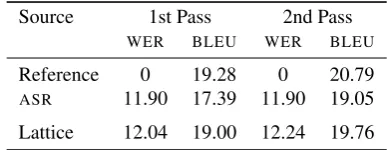
Reference 0 19.28 0 20.79
ASR 11.90 17.39 11.90 19.05 Lattice 12.04 19.00 12.24 19.76
Table 2: Comparison of MISTRAL when it translates the reference transcription, the sentences returned by theASR
system and the lattices.
the ASRsystem and translations from the reference tran-scription provided by the organizers of the IWSLT shared task. Results are presented in Table 2.
TheASRsentences are obtained using the viterbi algorithm on the lattices with a weight of 10 for the language model and weights of one for the acoustic model and the word penalty. BecauseMISTRALtakes lattices as input,ASR out-put and reference transcriptions are converted into lattices where each word has an arbitrary duration of one second. All configurations are tuned and rescored with n-best lists of size 2000. Lattices are translated with 10 groups per sec-ond and only the 10-best translations of each group are con-sidered. Translations of reference transcriptions andASR
output are grouped by their number of translated words and only the 100-best translations of each group are considered. Our starting hypothesis is that translating lattices should improve translation quality because the translation model should help theASRsystem to reduce its recognition errors. Indeed, translation quality improved according to BLEU, but this is not corroborated with a decreasingWER. A qual-itative evaluation reveals that many differences between the
ASRoutput and the sentences recognized byMISTRALare due to insertion or deletion of small words that do not con-vey much information (likes`ı,ilor `e). We thus think the
BLEUimprovement is in part explained by the added flexi-bility of lattice translation, which can distort a little bit the source sentences to make them easier to translate.
To validate our implementation, we translated theASR out-put and the reference transcriptions withMOSES(Koehn et al., 2007). When given the same parameters, bothMISTRAL
andMOSESproduce exactly the same translations.
5.
Conclusion
We presented and evaluated MISTRAL, a decoder for spo-ken language translation. To the best of our knowledge,
MISTRAL, which is available at http://smtmood. sourceforge.net, is the first open source decoder ded-icated to the translation of lattices produced by anASR sys-tem.
In our experiments, translating pruned lattices yields bet-terBLEUscores than translating the best sentences returned by an ASRsystem. To our surprise, this improvement was not corroborated by an improvement inWERas we initially tough. While those results are encouraging, they still need to be confirmed on a larger dataset and on other language pairs.
MISTRALis a good baseline system for spoken language translation and a good starting point to create more sophis-ticated lattice decoders. Our future work will be oriented toward the addition of new feature functions, the handling of non-monotone translations and the translation of arbi-trary lattices.
6.
References
Nicola Bertoldi, Richard Zens, and Marcello Federico. 2007. Speech translation by confusion network decod-ing. InProceedings of the 32nd IEEE International Con-ference on Acoustics, Speech, and Signal Processing (ICASSP), Honolulu, Hawaii, USA, April.
Josep M. Crego and Jos´e B. Mari˜no. 2007. Extending MARIE: an N-gram-based SMT decoder. In Proceed-ings of the 45th Annual Meeting of the Association for Computational Linguistics Companion Volume Proceed-ings of the Demo and Poster Sessions, pages 213–216, Prague, Czech Republic, June. Association for Compu-tational Linguistics.
Cameron Shaw Fordyce. 2007. Overview of the iwslt 2007 evaluation campaign. In Proceedings of IWSLT 2007, Trento, Italy, October.
Philipp Koehn, Franz Josef Och, and Daniel Marcu. 2003. Statistical phrase-based translation. InNAACL ’03: Pro-ceedings of the 2003 Conference of the North American Chapter of the Association for Computational Linguis-tics on Human Language Technology, pages 48–54, Mor-ristown, NJ, USA. Association for Computational Lin-guistics.
Philipp Koehn, Hieu Hoang, Alexandra Birch, Chris Callison-Burch, Marcello Federico, Nicola Bertoldi, Brooke Cowan, Wade Shen, Christine Moran, Richard Zens, Chris Dyer, Ondrej Bojar, Alexandra Constantin, and Evan Herbst. 2007. Moses: Open source toolkit for statistical machine translation. In Proceedings of the 45th Annual Meeting of the Association for Compu-tational Linguistics Companion Volume Proceedings of the Demo and Poster Sessions, pages 177–180, Prague, Czech Republic, June. Association for Computational Linguistics.
Philipp Koehn. 2005. Europarl: A parallel corpus for sta-tistical machine translation. In2nd Workshop on EBMT of MT-Summit X.
speech translation. In IEEE Conference on Acoustics, Speech and Signal Processing.
E. Matusov, S. Kanthak, and H. Ney. 2005. On the in-tegration of speech recognition and statistical machine translation. InProceedings of the 9th European Confer-ence on Speech Communication and Technology (Inter-speech), September.
Hermann Ney. 1999. Speech translation: coupling of recognition and translation. InProceedings of ICASSP. F. J. Och and H. Ney. 2000. Improved statistical alignment
models. In Conference of the Association for Compu-tational Linguistic (ACL), pages 440–447, Hong Kong, China, October.
Franz Josef Och, Daniel Gildea, Sanjeev Khudanpur, Anoop Sarkar, Kenji Yamada, Alex Fraser, Shankar Ku-mar, Libin Shen, David Smith, Katherine Eng, Viren Jain, Zhen Jin, and Dragomir Radev. 2004. A smor-gasbord of features for statistical machine translation. In Daniel Marcu Susan Dumais and Salim Roukos, edi-tors,HLT-NAACL 2004: Main Proceedings, pages 161– 168, Boston, Massachusetts, USA, May. Association for Computational Linguistics.
Kishore Papineni, Salim Roukos, Todd Ward, and Wei-Jing Zhu. 2001. Bleu: a method for automatic evaluation of machine translation. InACL ’02: Proceedings of the 40th Annual Meeting on Association for Computational Linguistics, pages 311–318, Morristown, NJ, USA. As-sociation for Computational Linguistics.
Alexandre Patry, Fabrizo Gotti, and Philippe Langlais. 2006. MOOD: A modular object-oriented decoder for statistical machine translation. In5th LREC, pages 709– 714, Genoa, Italy, May.
Alexandre Patry, Philippe Langlais, and Fr´ed´eric B´echet. 2007. MISTRAL: A lattice translation system for IWSLT 2007. In Proceedings of IWSLT 2007, Trento, Italy, October.
William H. Press, Saul A. Teukolsky, William T. Vetterling, and Brian P. Flannery. 1992. Numerical Recipes in C: The Art of Scientific Computing. Cambridge University Press, New York, NY, USA.
H.V. Quan, M. Federico, and Cettolo M. 2005. Integrated n-best re-ranking for spoken language translation. In In-terspeech 2005 - Eurospeech - 9th European Conference on Speech Communication and Technology.
S. Saleem, S.-C. Jou, S. Vogel, and T. Schultz. 2004. Using word lattice information for a tighter coupling in speech translation systems. InProc. ICSLP, Jeju Island, Korea, Oct.
A. Stolcke. 2002. SRILM - an extensible language model-ing toolkit. InProceedings of ICSLP, Denver, Colorado, Sept.
Frank Wessel, Ralf Schl¨uter, and Hermann Ney. 2000. Using posterior word probabilities for improved speech recognition. In IEEE International Conference on Acoustics, Speech, and Signal Processing, pages 1587– 1590, Istanbul, Turkey, June.
Ruiqiang Zhang, Genichiro Kikui, Hirofumi Yamamoto, Taro Watanabe, Frank Soong, and Wai Kit Lo. 2004. A unified approach in speech-to-speech translation:
inte-grating features of speech recognition and machine trans-lation. InCOLING ’04: Proceedings of the 20th inter-national conference on Computational Linguistics, page 1168, Morristown, NJ, USA. Association for Computa-tional Linguistics.