“The art of communication
is the language of leadership”
LEADERSHIP AND NON-VERBAL BEHAVIOR
Abstract
Due to globalization, growing competition and more complex environments,
organizational success is crucial for companies to stay competitive. One important factor of organizational success is effective leadership, and an essential determinant of effective leadership is the communicative behavior that the leaders display. Leaders influence their followers by means of communication, and especially non-verbal behavior is an important part of human communication. Therefore, it is important to gain a more in-depth
understanding of the non-verbal behaviors that are associated with the effectiveness of leaders. However, not much is known about the impact of non-verbal behavior of leaders on leadership effectiveness; and especially not much is known about which specific non-verbal
behaviors might strengthen the verbal messages of leaders. Therefore, this study aims to answer the question which non-verbal behaviors support leader effectiveness during different verbal behaviors in an organizational context. In order to answer that question, a quantitative multi-method, cross-sectional study was conducted. To get insight in the non-verbal behavior that leaders display during social interactions with their followers, we made use of a video-observation methodology, which included the systematic coding of both verbal and non-verbal leader behavior on the basis of a pre-set codebook. The data were collected in a large public organization in the Netherlands. In addition, questionnaires were filled in by the employees to get insight into the perceived leader effectiveness.
Subsequently, a regression analysis has been performed. The results showed that the
frequent display of lowered eyebrows during task-oriented behaviors significantly decreased leadership effectiveness. A more frequent display of open smiles, looking towards the group and open palms during relation-oriented behaviors did not significantly influence leadership effectiveness, and neither did a frequent use of open palms or closed palms or a less frequent use of downward palms during task-oriented behavior.
TABLE OF CONTENTS
Introduction 1
Theoretical Background 3
Effective Leadership 4
Verbal Behavior 4
Relation-oriented behaviors and leadership effectiveness 5 Task-oriented behaviors and leadership effectiveness 5
Non-verbal Behavior 6
Non-verbal Cues 7
Hand Gestures 7
Hand gestures, verbal behavior and leadership effectiveness 8
Facial Expressions 9
Facial expressions, verbal behavior and leadership effectiveness 9
Eye Gaze 10
Gazing, verbal behavior and leadership effectiveness 10
Research Design and Methods 13
Research Design 13
Respondents 13
Procedure 14
Non-verbal Leader Behavior 14
Task- and Relation-Oriented Behavior 14
Leader Effectiveness 15
Control Variables 15
Data Analysis 15
Results 16
Descriptive Statistics 16
Correlations 17
Regression 21
Discussion 24
Scientific Implications 27
Practical Implications 27
LEADERSHIP AND NON-VERBAL BEHAVIOR
Conclusion 30
References 31
Appendix A 39
Appendix B 43
Introduction
In today’s economy organizations increasingly have to deal with globalization, growing competition and more complex, continually changing environments (Brooks, Weatherston & Wilkinson, 2011). As a consequence, in order to sustain their competitive advantage,
companies focus more and more on their intellectual capital instead of relying on their physical and capital assets. This results in a mounting interest in organizational behavioral research to identify levers for the intellectual capital that lead to organizational success (Halawi, Aronson & McCarthy, 2005; Dinh et al., 2014). One of the levers identified to enhance organizational performance is effective leadership (e.g. Feser, Mayol & Srinivasan, 2015; Khan & Anjum, 2013; Müller & Raich, 2005; Yukl, 2013; Yukl, Gordon & Tabler, 2002; Irving &
Longbotham, 2007).
Research has found that leadership effectiveness depends strongly on the leader’s social influence, which ensues from communicating and interacting with the followers (Engle & Lord, 1997). This interaction takes place by displaying behaviors that can be divided into verbal and non-verbal behaviors, which occur simultaneously (Bonaccio, O’Riley, O’Sullivan &
Chiocchio, 2016). Until now, research has only focused on either verbal behavior or non-verbal behavior in the context of leadership effectiveness (e.g. Duncan & Fiske, 2015). When leaders interact with followers they display certain verbal behaviors is to ensure that tasks are being carried out in a way that leads to reaching the team’s objectives (Derue, Nahrgang, Wellman, & Humphrey, 2011). Literature in the fields of management, leadership and personnel psychology shows that leaders can display a range of verbal behaviors. A much-used classification is that of Gary Yukl, who distinguishes between task-oriented behaviors and relation-oriented behaviors (Yukl, O’Donnell & Taber, 2009). The value of this classification lies in its integrative
approach to capture a full range of verbal leader behaviors. It combines the efforts of leaders to ensure that goals are met in a timely fashion in combination with the behaviors that support the followers’ well-being, good teamwork and cooperation (Yukl, O’Donnell & Taber, 2009), which in turn affect their productivity and team effectiveness (Chiocchio, Forgues, Paradis & Iordanova, 2011; Schmidt, Welch & Wilson, 2000; Kozlowski & Bell, 2003, LePine et al.,
2008). The framework implies that both relation- and task oriented behaviors are related to important workplace outcomes such as leadership effectiveness. Relation-oriented
LEADERSHIP AND NON-VERBAL BEHAVIOR 2
Wellman & Humphrey, 2011), and research has shown that task-oriented behaviors are associated with effective leadership (e.g. Boyatzis, 1982; Komaki, 1986; Komaki, Desselles & Bowman, 1989).
However, face-to-face communication in the workplace environment cannot only be reduced to verbal behavior. When looking at leadership effectiveness and communication, non-verbal behavior also needs to be taken into account (Archer & Akert, 1977), since non-verbal behaviors can be repeated, substituted, complemented, accented or contradicted by non-verbal behaviors (Bonaccio, O’Riley, O’Sullivan & Chiocchio, 2016). It is known that during leader-follower interactions, non-verbal signals count for 65%-93% of how the message that the receiver gets from the sender is being interpreted, thus only receiving verbal cues could lead to
a different interpretation of the message (Bonaccio, O’Reilly, O’Sullivan & Chiocchio, 2016). This means that not only the words that are spoken are important to deliver a message, but also for a great deal how they are being said. In general, non-verbal signals are five times as strong as verbal signals, since the body frequently reveals the real feelings of the sender, which are often communicated subconsciously (Oomkes & Garner, 2003). Research showed that the non-verbal cues used in social interactions (e.g. looking at the watch too often or laughing at the opponent in a discussion too often) can be more important for the evaluation of the speaker by his followers than the actual content of the speech (Maurer & Reinemann, 2007). In the
workplace, when leaders interact with followers, they can send a strong message when they use non-verbal triggers and encode and react upon the cues they receive from the followers.
Therefore, it is important that leaders use their non-verbal signals effectively when
communicating with their followers (Irving & Longbotham, 2007; Darioly & Mast, 2014). Surprisingly, literature on non-verbal behavior in the context of leadership effectiveness is scarce. Even though we know that it plays an important role, not much is known about the impact of non-verbal behavior on effective leadership (Darioly & Mast, 2014; Engel, 2016; Talley & Temple, 2015).
From all the above, it becomes clear that verbal behavior is related to non-verbal
behavior. It is something that, in the setting of face-to-face communication, cannot be separated from each other in order to interpret a message fully (Archer & Akert, 1977). This
demonstrates the importance of investigating these two categories of leader behaviors (verbal and non-verbal) together. Subsequently, knowing which non-verbal behaviors have an
It is important to understand how leaders can functionally use non-verbal behavior when displaying task- and relation oriented behavior as research showed that the use of effective non-verbal behavior leads to enhanced trust in leader-follower connections, stimulates desired responses from the followers and gives hints about how to meet team objectives (Burgoon, Burk & Pfau, 1990; Yukl, 2013; Bellou & Gkorezis, 2016). Several calls in the leadership and organizational behavior research point to the need to examine non-verbal behavior on a micro level and train leaders in the use of their non-verbal behavior to ultimately achieve higher leadership effectiveness (Darioly & Mast, 2014). Additionally, the non-verbal cues can help the leaders to get attention and to exert influence over their followers (Burgoon, Burk & Pfau, 1990). In order for the leaders to make use of non-verbal behavior effectively when
communicating with their followers either on a relation-oriented or task-oriented basis, the leaders need to be aware of their verbal and non-verbal behavior, which can both be trained (Towler, 2003; Frese, Beimel & Schoenborn, 2003). Based on the results of this study, implications on how non-verbal behavior should be used by leaders during specific verbal behaviors at staff meetings in organizational settings can be drawn. Therefore, both research and HR-professionals are in need of more insights into the relation between non-verbal and verbal leadership behaviors and their influences on leadership effectiveness, which this study aims to help understanding.
As stated above, non-verbal behavior often happens subconsciously and is therefore difficult to assess using surveys. In order to gain more insight into the usage of non-verbal behavior, this research adopts a multi-method design, including video-observation and coding of both verbal and non-verbal behavior. By doing so, this research gives more objective insight into which non-verbal behaviors enhance leader effectiveness during task- and relation oriented verbal behavior. It contributes to the existing literature by examining which combinations of verbal and non-verbal behavior are related to leader effectiveness.
In general, this study helps to identify more concrete levers that determine the effectiveness of leaders in organizations.
Theoretical background
In order to get a better understanding of the terms used in this paper the following section will first define the concepts of effective leadership and verbal behaviors followed
by the definition of non-verbal behavior including the individual non-verbal cues
LEADERSHIP AND NON-VERBAL BEHAVIOR 4
Effective leadership
In an organizational setting, more and more work is done in teams (Gordon, 1992). In most contemporary organizations we still see a formal leader – follower hierarchical structure. Almost all teams have at least one leader that guides the team and is responsible for its performance (Zaccaro, Rittman & Marks, 2001). Although there are many different definitions of leadership effectiveness (Yukl, 2013), there is some overlap in the elements of the definitions. For example, Noureddine (2015, p. 65) defines effective leadership as “the ability to influence, motivate, and direct others to achieve goals”, whilst Yukl (2012, p.66) describes it as “influencing and facilitating individual and collective efforts to accomplish shared objectives”. Commonly used instruments for measuring leadership effectiveness are
judgments of peers, followers and supervisors (Hogan, Curphy & Hogan, 1995) such as the multifactor leadership questionnaire (MLQ) developed by Bass and Avolio (1995). In the MLQ, leadership effectiveness is defined as the leader’s ability to effectively lead the team, to satisfy work related needs of the followers, to contribute to and meet organizational goals and to represent the team’s interest in higher hierarchical levels (Bass & Avolio, 1995). The overlap between the different definitions lies mostly in the influencing of subordinates in order to achieve a shared goal, which is a key activity in the management responsibility of a leader (Yukl, 2013). Therefore, the underlying definition of effective leadership in this study is that of Bass and Avolio (1995).
Verbal behavior
Verbal behavior is a form of communication that is expressed in a linguistic form. It enables people to discuss, inquire, inform and argue (Behrendt, Matz & Görlitz, 2017). As mentioned above, leaders influence their followers by performing certain behaviors, such as monitoring tasks, providing directions or feedback and encouraging team members (Yukl, O’Donnell & Taber, 2009). A much-used classification for these behaviors is the division into task-oriented behaviors and relation-oriented behaviors.
Research has shown that both task- and relation oriented behaviors relate with leader effectiveness. Empirical evidence showed for example, that relation-oriented behaviors such as inspirational motivation, thus stating an attractive and encouraging vision, and
individualized consideration, meaning the providing of support, encouragement and
coaching, lead to a higher leadership effectiveness (Sadeghi & Pihie, 2012). However, the perception of whether task-oriented behavior or relation-oriented behavior is more important
prefer task-oriented behaviors and rate them to be the better indicator of leadership effectiveness (Turner & Müller, 2005), whereas followers mostly rate relation-oriented behaviors as being a predictor of leadership effectiveness (Hoogeboom & Wilderom, 2015).
Relation-oriented behaviors and leadership effectiveness
Relation-oriented behaviors focus on the quality of the relationship between leaders and followers (Brown, 2003) and support the accomplishment of shared objectives by increasing the coordinated engagement of the team members (Behrendt, Matz & Göritz, 2017) as well as the identification of employees with their work units and the enhancement of commitment to the objectives (Yukl, 2008). They contain showing respect for individual
group members, being friendly and treating all group members equally (Yukl, O’Donnell & Taber, 2009). Leaders that display much relation-oriented behaviors are being described as empowering, participative and democratic (Derue, Nahrgang, Wellman & Humphrey, 2011). For the conceptualization of relation-oriented behaviors the classification of Hoogeboom and Wilderom (2015) was used. They divide relation-oriented behaviors in asking for ideas, agreeing, being friendly, providing positive feedback, encouraging and showing personal interest.
Relation-oriented leadership behaviors are related to the followers’ satisfaction with the leader, can enhance follower performance and, most importantly for this research, enhance leadership effectiveness (Yukl, Gordon & Taber, 2002). Leaders are being perceived as more effective when they show personal interest and consideration for the needs and feelings of their followers, provide praise, recognition and positive feedback for the followers’ achievements and contributions and encourage them to learn, as well as empowering their followers, all of which are considered relation-oriented behaviors (Hoogeboom & Wilderom, 2015; Yukl, Gordon & Taber, 2002).
Task-oriented behaviors and leadership effectiveness
Task-oriented behaviors focus on the accomplishment of shared objectives
(Behrendt, Matz & Göritz, 2017). Leaders that display task-oriented behavior are engaging in “short-term planning, scheduling of work activities, determining resource and staff requirements, assigning tasks, clarifying objectives and priorities, emphasizing the
importance of efficiency and reliability, directing and coordinating activities (and)
LEADERSHIP AND NON-VERBAL BEHAVIOR 6
2011). The objective of task-oriented behaviors is therefore to efficiently and reliably work in order to reach team and organizational goals (Yukl, Gordon & Taber, 2002). According to the conceptualization of Hoogeboom and Wilderom (2015), task-oriented behaviors can be divided into clarifying, task monitoring, enforcing, structuring and providing direction.
Task-oriented behaviors are besides higher follower performance especially related to leadership effectiveness (Yukl, Gordon & Taber, 2002). Research found that leaders were more effective when they were planning and structuring aspects such as meeting, budgets or schedules, clarifying plans, policies and role expectations, as well as monitoring the work progress, follower performance or project success, all of which are considered to be task-oriented behaviors (Hoogeboom & Wilderom, 2015; Yukl, Gordon & Taber, 2002).
Non-verbal behavior
Research on leadership effectiveness revealed several factors that influence the effectiveness of leaders. One significant factor on leadership effectiveness that has been identified is the non-verbal behavior that the leader displays during those staff meetings (Poel, Poppe & Nijholt, 2008). Ambady and Rosenthal (1998) define non-verbal
communication as information that can be interpreted by any means other than language, e.g. gestures, facial expressions, touching, posture, or even the pitch, speed or volume of the spoken words. People constantly display non-verbal behaviors during interactions and communication (Bonaccio et al., 2016).
In terms of leadership effectiveness, literature has shown that the non-verbal behavior of a leader influences the effectiveness of the leader (Darioly & Mast, 2014). For instance, previous research has shown that leaders who are gazing towards the group and using positive hand gestures such as open hand gestures were perceived as supportive, which is an element of effective leadership, and more attractive than leaders who look away from the group and display defensive hand gestures such as downward facing hands. The latter were perceived as non-supportive and less attractive by their followers (Remland et al., 1983; Kaiser, Hogan & Craig, 2008; Talley, 2012).
Literature divides non-verbal behavior into different areas of non-verbal behavior: gestures (i.e. upward facing palms, downward facing palms), touching behavior (i.e. self-touching, object touching), facial expressions (i.e. open smile, lip corners down) and eye
We have now been exploring the relations between task- and relation-oriented behaviors with leadership effectiveness and describing non-verbal behavior. The following section will depict the individual non-verbal cues and describe how they are related to task- and relation-oriented behavior and can thereby strengthen the effects of verbal behavior on leadership effectiveness.
Non-verbal cues Hand gestures
Individuals tend to follow leaders who they perceive as capable, immediate and charismatic (Bonaccio et al., 2016), which leaders can express by using non-verbal behavior
in order to communicate and express themselves effectively (Bass, 1998; Tskhay, Xu, & Rule, 2014). For a message to be communicated correctly, previous research identified hand gestures as extremely important during human interactions (Krauss, Dushay, Chen &
Rauscher, 1995). In this study the classification of Knapp et al. (2014) was used. It is a fine-grained basis for mapping hand gestures that sub-divided the hand gestures into seven different types of hand gestures according to Kendon’s (2004) continuum: (1) Object touch, (2) Self-touch head, (3) Self-touch body, (4) upward facing (open) palms, (5) downward facing (closed) palms, (6) mixed palms and (7) clasped hands.
The object-touching refers to hand gestures that include actions such as holding a pen or grabbing a cup of coffee, during communication (Hartman, 2004). They can either help to communicate information, e.g. by touching objects spoken about, or they can distract the follower if objects are being touched when they do not belong to the topic, e.g. when a speaker constantly plays with a pen without using it (Poyatos, 1983). The term self-adaptor refers to hand gestures that include touching the own body. They can be divided into self-touch at the head area and self-self-touch at other bodily areas (Neff, Toothman, Bowmani, Tree & Walker, 2011).
Upward/forward facing palm gestures are gestures that reveal the palm to the followers, thus facing either upwards or forwards (in this paper also referred to as “open palms”). They can contribute to effective positive communication and express confidence, communicate trust and have a positive impact on the information retrieval (Kendon, 2004; Fradet, 2017), whereas the downward/inward facing palm gestures (with the palms hidden
LEADERSHIP AND NON-VERBAL BEHAVIOR 8
having one upward/forward facing palm and one downward/inward facing palm or palms that face each other. These gestures are in general more related to the downward palm gestures, and subsequently indicate the display of power. However, in contrast to the downward palm gestures, mixed palms are more associated with power in knowledge instead of power about others (Weinschenk, 2012).
Finally, the clasped hands gesture means that one hand is holding the other hand. This gesture can also have two different communicative meanings. It can either display discomfort and insecurity when displayed in combination with other non-verbal cues (e.g. closed posture, playing around with the fingers) (Cummings, 2011), or confidence (when displayed in a resting pose) (Chris, 2013).
Hand gestures, verbal behavior and leadership effectiveness
Research has shown that leaders who display the open palm gesture are perceived as more effective and are able to gain more trust and therefore exert a positive influence on their followers (Kendon, 2014). Trust in turn is important for creating an open and safe environment for the employees where they feel comfortable to speak up (Edmondson, Kramer, & Cool, 2004), which is consecutively important for the verbal behavior of asking for ideas, as a leader who communicates openness and trustworthiness encourages the employees to share their ideas. Since the display of open palms seems to support relation-oriented behaviors, which, as stated above, are related to leadership effectiveness, we expect that the display of open palms during relation-oriented behaviors leads to a higher
effectiveness of the leader.
Literature also suggests that hand gestures are not only important for relation-oriented behaviors but also for task-relation-oriented behaviors. Speakers have more difficulties to produce speech if they are not allowed to gesture, which illustrates the importance of hand gestures for strengthening and clarifying information for the listeners (Jackob, Roessing, & Petersen, 2011; Rimé, Schiaratura, Hupet, & Ghysselinckx, 1984). Furthermore, hand gestures exert a structuring influence for controlling discourses (Rimé, 1982) and frequently accompany direction-giving (Cassell, Kopp, Trepper, Ferriman, & Striegnitz, 2007).
Moreover, Kendon (2004) and Fradet (2017) found that upward or forward facing palms can, amongst other things, have a positive impact on the information retrieval and can
open palms supports task-oriented behaviors, which are related to leadership effectiveness. Hence, during task-oriented behaviors we expect that the display of upward palms enhances leadership effectiveness.
However, there is also reason to presume that hand gestures can have a negative influence on task-oriented behaviors. Leaders who display capability, immediacy and charisma are more likely to be followed by others (Bonaccio et al., 2016), and hand gestures can help to express these attributes (Bass, 1998; Tskhay, Xu, & Rule, 2014). However, literature shows that downward facing hand gestures display distance or a defensive attitude (Kendon, 2004; Talley, 2012), which is in direct contradiction to the attribute of immediacy. Creating distance or a defensive attitude however might hamper the successful directing and
coordinating of activities, which have been classified as task-monitoring behaviors. As stated above, task-monitoring behaviors are an antecedent of leadership effectiveness. Therefore, we expect that the display of downward facing palms during task-oriented behaviors has a negative effect on leadership effectiveness.
Facial expressions
The face can have various different expressions. Ekman and Friesen (1978)
developed the Facial Action Coding System (FACS) to measure facial expressions, which focuses mainly on the muscle movement of the mouth and the eyebrows. Studies show that the mouth movements (e.g. whether a leader smiles or not) have a significant impact on the non-verbal communication of leaders. Smiling individuals are generally rated more warm and likable, but are also perceived as lower in dominance (Keating et al., 1981; Edinger & Patterson, 1983). Otta et al. (1994) also found that displaying an open smile has a positive influence on the perception of leadership. Different eyebrow movements or positions also have an impact on the perception of leadership: raised eyebrows are indicating power and dominance (Hall, Coats & LeBeau, 2005), but also surprise (Knapp et al., 2014). Lowered eyebrows indicate fear, anger, pain and confusion (Valstar, Pantic, Ambadar & Cohn, 2006; Williams, 2002; Cunningham, Kleiner, Bülthoff & Wallraven, 2004).
Facial expressions, verbal behavior and leadership effectiveness
Research has shown that a person that smiles is being perceived as more positively
LEADERSHIP AND NON-VERBAL BEHAVIOR 10
friendly interactions (Brannigan & Humphries, 1972; Cheyne, 1976; Otta & Sarra, 1990). Since being friendly has been identified as a relation-oriented behavior that contributes to a higher effectiveness of a leader, it can be expected that when a leader matches relation-oriented behavior with smiling, this will support a higher leader effectiveness. Therefore, during relation-oriented behaviors we expect the display of open smiles has a positive effect on leadership effectiveness.
Also, research has found that the display of lowered eyebrows is perceived as a display of confusion (Cunningham, Kleiner, Bülthoff, & Wallraven, 2004). Since task-oriented behavior contains behaviors such as monitoring, structuring and providing direction (Hoogeboom & Wilderom, 2015), which presume clarity of the task at hand, it can be
assumed that signs of confusion do not support task-oriented behaviors. Moreover, research has shown that intense expressions, such as fear and anger, of negative emotions such as lowered eyebrows have a significant negative effect on leadership effectiveness and team performance themselves (Cole, Walter & Bruch, 2008). Therefore, we assume that the display of frowning during task-oriented behaviors has a negative effect on leadership effectiveness.
Eye gaze
Gazing behavior, including functional looking behavior, looking towards the group and looking away from the group, generally indicates that the person displaying the behavior pays attention to the person that he or she communicates with (Montague & Asan, 2014). Although direct gazing behavior is associated with dominance (Dovido & Ellyson, 1982), in the context of leadership gazing behavior is positively related to the perception and
expression of leadership (Darioly & Mast, 2014).
Gazing, verbal behavior and leadership effectiveness
Literature suggests that leaders are making eye contact with their followers
especially at the end of a statement in order to encourage them to speak up and to create an open climate (Darioly & Mast, 2014). Also, eye gaze can be a good indication of interest, or the lack thereof (Miller, 1988) and is being used for communicating friendliness and
affiliation (Carli, Martin, Leatham, Lyons & Tse, 1993). Since showing personal interest and
encouraging have been identified as relation-oriented behaviors that lead to a higher
eye contact with the followers during relation-oriented behaviors increases the leader’s effectiveness.
Research has shown that maintaining eye contact is not only important for relation-oriented behaviors, but also for task-relation-oriented behaviors. As already stated above, leaders are making eye contact with their followers especially at the end of a statement in order to encourage them to speak up (Darioly & Mast, 2014). This is assumed to be helpful during the task-oriented behavior of clarifying, since this gives the employees the possibility to speak up and ask questions. In this way, the leader can make sure that the followers received the correct information and that there are no further uncertainties about the task at hand (Darioly & Mast, 2014). Since looking towards the group seems to support task-oriented
behaviors, which are an antecedent for leadership effectiveness, it can be expected that looking towards the group and maintain eye contact with the followers during task-oriented behaviors has a positive influence on leadership effectiveness.
These implications lead to the following hypotheses:
Effects of non-verbal behavior on leadership effectiveness during relation-oriented behaviors:
Hypothesis 1a: A more frequent display of smiling during relation-oriented behaviors leads
to higher leadership effectiveness
Hypothesis 1b: A more frequent display of looking towards the group during
relation-oriented behaviors increases leadership effectiveness
Hypothesis 1c: A more frequent display of the open palms gesture during relation-oriented
behaviors leads to higher leadership effectiveness
Effects of non-verbal behavior on leadership effectiveness during task-oriented behaviors:
Hypothesis 2a: A more frequent display of the open palms gesture during task-oriented
behaviors increases leadership effectiveness
Hypothesis 2b: A more frequent display of closed palms during task-oriented behaviors
decreases leadership effectiveness.
Hypothesis 2c: A more frequent display of lowered eyebrows during task-oriented behaviors
Research design and methods Research design
In order to answer the research question, a cross-sectional quantitative study has been set up. The research adopted a multi-method design, including (1) video observations of non-verbal behaviors, (2) questionnaires and (3) video observations of non-verbal behaviors. This method has been used to give more insight in the use of verbal- and non-verbal behaviors and its effects on leadership effectiveness. By means of coding the data sixteen independent
variables related to non-verbal behavior were measured by coding the videotapes. Additionally, one dependent variable (leader effectiveness) has been measured by means of a questionnaire. The task-oriented and relation-oriented verbal behaviors were also measured by coding the
videos.
Respondents
The participants that took part in this research were leaders of work teams in a large public organization in the Netherlands. Both observational and survey data were collected from 101 team leaders and 1266 followers of teams that were randomly sampled from regularly occurring staff meetings. From all recorded videos 44 videos were selected in which the non-verbal behaviors (i.e. eye-gaze) of the leaders could be seen clearly, meaning that the resolution of the videos was sufficient and the camera angles adjusted in a manner which allowed the coders to see all relevant non-verbal behaviors. From all 44 selected teams 488 followers filled in the questionnaire, from which 454 questionnaires were filled in completely. Incomplete data were not taken into account in this study. 77.8% of the leaders were male and 22.2% female with an average age of 50.45 years (SD = 8.62) an average job tenure of 22.44 years (SD = 14.95) and an average team tenure of 2.57 years (SD = 4.82).
Regarding the followers, who filled in the questionnaires on leadership effectiveness, 62.9% of the respondents were male and 30.1% female with an age average of 49.53 (SD = 9.90), an average job tenure of 24.792 (SD = 13.36) and an average team tenure of 3.58 years (SD = 4.59).
The length of the video-recorded meetings ranged from 49 minutes to 212 minutes. In total 1320 minutes of meeting time has been coded. We chose to code the first 30 minutes of the meetings of each of the 44 videos, as 30 minutes give a good insight into the behaviors of
LEADERSHIP AND NON-VERBAL BEHAVIOR 14
Procedure
In order to get permission to record the team meetings within the organization, the team leaders were telephoned individually by one of the field researchers and then given information about the video-observation method and the survey request. Additionally, the leaders were invited on a voluntary basis to join an information meeting where they could get more
information about the setting and survey procedure. During the video-observed meeting three cameras were installed at fixed places before the leaders and followers entered the rooms. During the meetings no video-technicians were present in order to reduce obtrusiveness. The questionnaires to evaluate leader effectiveness were distributed to the followers and
subsequently filled in directly after the meetings. In total 475 employees filled in the
questionnaire, whereof 471 were filled in completely, which is an average percentage of 86% of the members per team, which is distinctly above the criteria of 50% (Wageman, Hackman & Lehman, 2005). We were able to retrieve such a high response rate because hard-copy surveys were used that were directly collected after the meeting.
Non-verbal Leader behavior
The non-verbal behaviors of leaders were objectively coded using videotapes that were recorded in a large public Dutch organization. The coding scheme that was developed in order to measure hand gestures, facial expressions and eye-gaze can be found in Appendix A. Regarding the touching gestures only non-functional and therefore distracting active manipulations of objects were coded as object touching.
To ensure a reliable outcome, two different independent coders that have been trained in the use of the coding scheme and coding software and in coding the different behaviors prior to the coding. During the whole coding procedure the sound of the videos was turned off to ensure that the coders could merely concentrate on the non-verbal behavior. Subsequently they have coded the durations and the frequencies of the non-verbal behaviors during the first 30 minutes of every meeting. Later, the results of both coders have been tested for reliability. The Inter-rater reliability from all videos was above 80% and Cohen’s Kappa was continuously above .80.
Task- and relation-oriented leader behavior
scheme can be found in Appendix B. A similar coding procedure as the non-verbal behaviors was used to code the verbal behaviors.
The verbal behaviors that have been classified as oriented behaviors are task-monitoring, enforcing, structuring the conversation and providing direction.
The behaviors that were classified as relation-oriented behaviors are asking for ideas, agreeing, being friendly, providing positive feedback, encouraging and showing personal interest.
Leader effectiveness
The effectiveness of the leaders was measured by a questionnaire that was filled in by
the members of the teams. The leader effectiveness has been measured by using four manifest effectiveness indicators (α = .89)that were retrieved from the Multifactor Leadership
Questionnaire (MLQ) 5X-Short package that was developed by Bass and Avolio (1995). Questions were for example “The leader leads our team effectively” and “The leader is effective in meeting organizational requirements”. The respondents were asked to answer the statements in the questionnaire using a scale ranging from 1 (strongly disagree) to 7 (strongly agree). The complete questionnaire can be found in Appendix C.
For the analysis, aggregated scores for leadership effectiveness have been used on team level since we wanted to know how the non-verbal behavior of the leaders influences the teams’ perception of leadership effectiveness. A high degree of reliability was found between the measurements.
Control variables
According to the research of Avolio and Bass (1995) and Liden, Stilwell and Ferris (1996), the two variables age and gender could also influence leadership effectiveness. Therefore, these two variables were chosen as control variables in this research.
Data analysis
To analyze the influence of the independent variables on the dependent variable and therefore to be able to make a statement about their association with leader effectiveness, first the outcomes from the questionnaires have been fed into the computer program SPSS for
LEADERSHIP AND NON-VERBAL BEHAVIOR 16
Hendriksen, Jansen & Jansen, 2000; Spiers, 2004). The video-coded data of the non-verbal behaviors have then been synchronized with the coded data of the verbal behaviors (relation-oriented and task-(relation-oriented) and subsequently exported to SPSS. Due to differences in duration of verbal behaviors in the videos (in some cases the leaders were listening to presentations for a majority of the video), the relative percentages of the verbal- and non-verbal behaviors have been computed and subsequently used for analysis.
To test the hypotheses, two regression analyses were performed. The first regression analysis shows how leadership effectiveness increased or decreased proportional to the use of the non-verbal behaviors during relation-oriented behavior. The second regression analysis gives insight in the effects of non-verbal cues during task-oriented behaviors on leadership
effectiveness.
Results
The purpose of this paper was to examine which combinations of verbal and non-verbal behavior are related to leader effectiveness.
Descriptive statistics
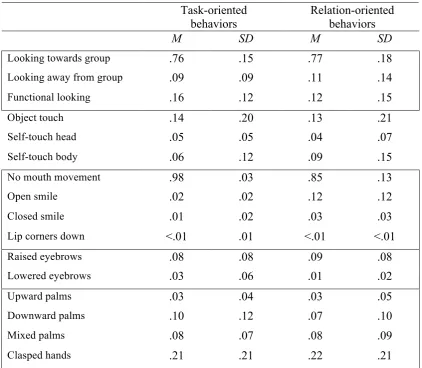
In order to give more insights into the use of non-verbal behaviors during specific verbal behaviors, we will first look at the descriptive statistics (means and standard deviation) from the full sample of all 44 analyzed leaders in Table 1. It appeared that the leaders overall spent a lot of time displaying no mouth movement (during task-oriented behaviors: M = .98, SD = .03; during relation-oriented behaviors: M = .85, SD = .13) and looking towards the group
(during task-oriented behaviors: M = .76, SD = .15; during relation-oriented behaviors: M = .77, SD = .18). The least displayed of the analyzed non-verbal behaviors during task- and relation-oriented behaviors was lowered eyebrows (during task-oriented behaviors: M = .03, SD = .06; during relation-oriented behaviors: M = .01, SD = .02). During task-oriented
behaviors the leaders also displayed only scarcely open smiles (M = .02, SD = .02), but the leaders displayed open smiles more often while they engaged in relation-oriented behavior (M = .12, SD = .12). Upward palms were also used only scarcely during both task- and
Table 1
Means and standard deviations of the non-verbal behaviors during the two verbal behaviors (represented in relative percentages)
Task-oriented behaviors
Relation-oriented behaviors
M SD M SD
Looking towards group .76 .15 .77 .18
Looking away from group .09 .09 .11 .14
Functional looking .16 .12 .12 .15
Object touch .14 .20 .13 .21
Self-touch head .05 .05 .04 .07
Self-touch body .06 .12 .09 .15
No mouth movement .98 .03 .85 .13
Open smile .02 .02 .12 .12
Closed smile .01 .02 .03 .03
Lip corners down <.01 .01 <.01 <.01
Raised eyebrows .08 .08 .09 .08
Lowered eyebrows .03 .06 .01 .02
Upward palms .03 .04 .03 .05
Downward palms .10 .12 .07 .10
Mixed palms .08 .07 .08 .09
Clasped hands .21 .21 .22 .21
Note. The Variables within the boxes are mutually exclusive among each other and can therefore not occur at the same time during the meeting.
Correlations
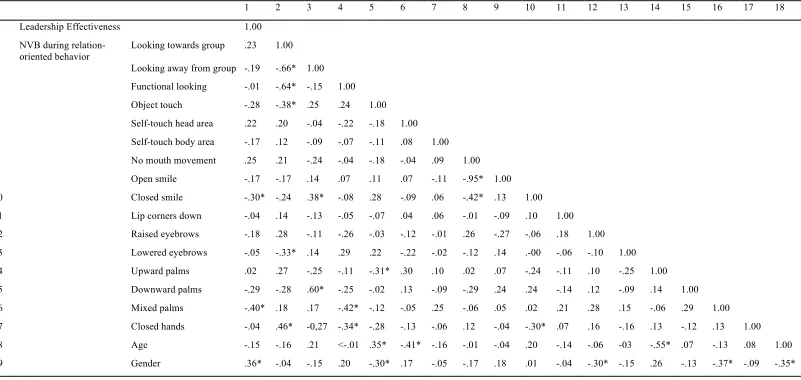
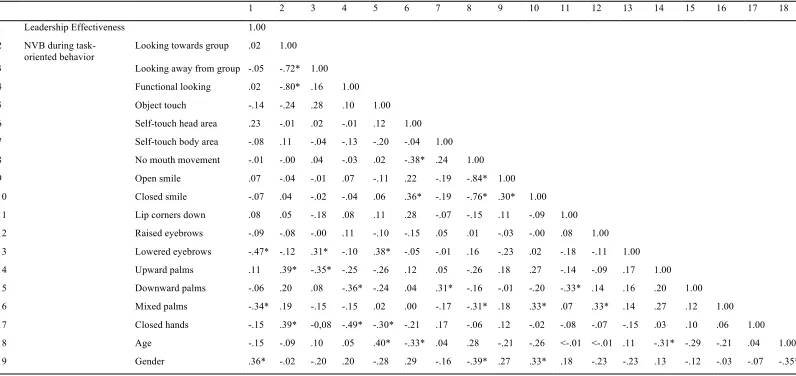
Table 2 and Table 3 show the correlations between the different variables and their significance. In these tables all measured variables were taken into account to give a complete overview of the association between leader effectiveness, non-verbal behavior and verbal behavior. The correlations give an initial overview of the associations between leader effectiveness and non-verbal behaviors during task- and relation-oriented behavior.
LEADERSHIP AND NON-VERBAL BEHAVIOR 18
control variable gender was positively correlated to leadership effectiveness during relation-oriented behaviors (r = .36, p < .05). This indicates that, as the display of closed smiles and mixed palms during relation-oriented behaviors increases, the effectiveness of the leaders decreases and vice versa. Since the male gender was fed into SPSS as “1” and the female gender as “2”, the correlation concerning the gender indicates that the factor “woman” increases leadership effectiveness, whereas “man” decreases leadership effectiveness during relation-oriented behaviors. Table 3 shows that lowered eyebrows (r = -.47, p < .05) and mixed palms (p = -.34, p < .05) during task-oriented behaviors are significantly negatively correlated to leadership effectiveness, whereas the control variable gender was also during task-oriented behavior positively correlated to leadership effectiveness (r = .36, p < .05). This indicates that,
as the display of lowered eyebrows and mixed palms during task-oriented behaviors increases, the effectiveness of the leaders decreases and vice versa, and also the factor “woman” increases leadership effectiveness, whereas “man” decreases leadership effectiveness during
task-oriented behaviors. Furthermore, it is notable that both coded eyebrow movements (raised and lowered eyebrows) are (non-significantly) negatively correlated to leadership effectiveness both during task- and relation-oriented behaviors.
Regarding hypotheses 1a, 1b and 1c, where we looked at the impacts of displaying open smiles, looking towards the group and open palms during relation-oriented behaviors on
leadership effectiveness, the correlation testing showed a positive trend only between looking towards the group and leadership effectiveness. The correlation approached significance on a significance level of p < .10 (r = .23, p = .11).
In case of hypotheses 2a, 2b, 2c and 2d, where we were looking at the impacts of displaying open palms, closed palms, lowered eyebrows and looking towards the group during task-oriented behaviors on leadership effectiveness, the correlation testing only showed a significant negative trend between lowered eyebrows and leadership effectiveness (r = -.47, p < .01).
Finally, age showed a significant negative correlation with open palms during both task- and relation-oriented behaviors (during task-oriented behaviors: r = -.31, p = .04; during
Table 2
Pearson Correlations between all variables during relation-oriented behaviors
1 2 3 4 5 6 7 8 9 10 11 12 13 14 15 16 17 18
1 Leadership Effectiveness 1.00
2 NVB during relation-oriented behavior
Looking towards group .23 1.00
3 Looking away from group -.19 -.66* 1.00
4 Functional looking -.01 -.64* -.15 1.00
5 Object touch -.28 -.38* .25 .24 1.00
6 Self-touch head area .22 .20 -.04 -.22 -.18 1.00
7 Self-touch body area -.17 .12 -.09 -.07 -.11 .08 1.00
8 No mouth movement .25 .21 -.24 -.04 -.18 -.04 .09 1.00
9 Open smile -.17 -.17 .14 .07 .11 .07 -.11 -.95* 1.00
10 Closed smile -.30* -.24 .38* -.08 .28 -.09 .06 -.42* .13 1.00
11 Lip corners down -.04 .14 -.13 -.05 -.07 .04 .06 -.01 -.09 .10 1.00
12 Raised eyebrows -.18 .28 -.11 -.26 -.03 -.12 -.01 .26 -.27 -.06 .18 1.00
13 Lowered eyebrows -.05 -.33* .14 .29 .22 -.22 -.02 -.12 .14 .-00 -.06 -.10 1.00
14 Upward palms .02 .27 -.25 -.11 -.31* .30 .10 .02 .07 -.24 -.11 .10 -.25 1.00
15 Downward palms -.29 -.28 .60* -.25 -.02 .13 -.09 -.29 .24 .24 -.14 .12 -.09 .14 1.00
16 Mixed palms -.40* .18 .17 -.42* -.12 -.05 .25 -.06 .05 .02 .21 .28 .15 -.06 .29 1.00
17 Closed hands -.04 .46* -0,27 -.34* -.28 -.13 -.06 .12 -.04 -.30* .07 .16 -.16 .13 -.12 .13 1.00
18 Age -.15 -.16 .21 <-.01 .35* -.41* -.16 -.01 -.04 .20 -.14 -.06 -03 -.55* .07 -.13 .08 1.00
19 Gender .36* -.04 -.15 .20 -.30* .17 -.05 -.17 .18 .01 -.04 -.30* -.15 .26 -.13 -.37* -.09 -.35*
LEADERSHIP AND NON-VERBAL BEHAVIOR 20
Table 3
Pearson Correlations between all variables during task-oriented behaviors
1 2 3 4 5 6 7 8 9 10 11 12 13 14 15 16 17 18
1 Leadership Effectiveness 1.00
2 NVB during task-oriented behavior
Looking towards group .02 1.00
3 Looking away from group -.05 -.72* 1.00
4 Functional looking .02 -.80* .16 1.00
5 Object touch -.14 -.24 .28 .10 1.00
6 Self-touch head area .23 -.01 .02 -.01 .12 1.00
7 Self-touch body area -.08 .11 -.04 -.13 -.20 -.04 1.00
8 No mouth movement -.01 -.00 .04 -.03 .02 -.38* .24 1.00
9 Open smile .07 -.04 -.01 .07 -.11 .22 -.19 -.84* 1.00
10 Closed smile -.07 .04 -.02 -.04 .06 .36* -.19 -.76* .30* 1.00
11 Lip corners down .08 .05 -.18 .08 .11 .28 -.07 -.15 .11 -.09 1.00
12 Raised eyebrows -.09 -.08 -.00 .11 -.10 -.15 .05 .01 -.03 -.00 .08 1.00
13 Lowered eyebrows -.47* -.12 .31* -.10 .38* -.05 -.01 .16 -.23 .02 -.18 -.11 1.00
14 Upward palms .11 .39* -.35* -.25 -.26 .12 .05 -.26 .18 .27 -.14 -.09 .17 1.00
15 Downward palms -.06 .20 .08 -.36* -.24 .04 .31* -.16 -.01 -.20 -.33* .14 .16 .20 1.00
16 Mixed palms -.34* .19 -.15 -.15 .02 .00 -.17 -.31* .18 .33* .07 .33* .14 .27 .12 1.00
17 Closed hands -.15 .39* -0,08 -.49* -.30* -.21 .17 -.06 .12 -.02 -.08 -.07 -.15 .03 .10 .06 1.00
18 Age -.15 -.09 .10 .05 .40* -.33* .04 .28 -.21 -.26 <-.01 <-.01 .11 -.31* -.29 -.21 .04 1.00
19 Gender .36* -.02 -.20 .20 -.28 .29 -.16 -.39* .27 .33* .18 -.23 -.23 .13 -.12 -.03 -.07 -.35*
Regression
In order to examine which combinations of verbal and non-verbal behavior are related
to leader effectiveness, the hypotheses were tested with a linear regression analysis. The
models that were used in this research displayed that only the predictors that were analyzed
during task-related behavior were significantly accountable for the variability in the outcomes
(p= .04), but not the predictors during relation-oriented behavior (p = .22). The variability of
leadership effectiveness could be predicted by the non-verbal behavior that was used during
task-oriented behavior with 30%. During relation-oriented behavior, the variability of
leadership effectiveness could be predicted by the use of non-verbal behavior with only
17%.
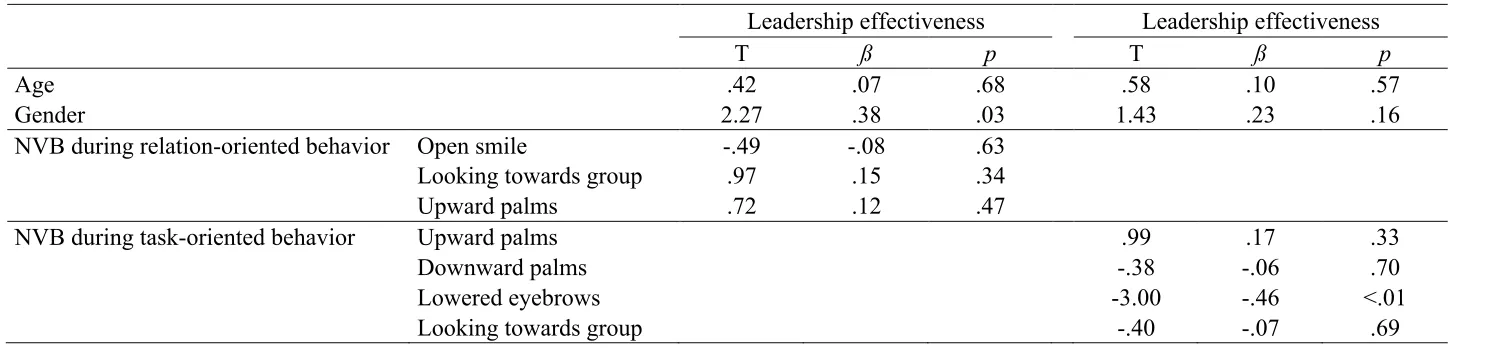
The results of the regression analysis can be found in Table 4. The first multiple
regression analysis was employed to ascertain the prediction of leadership effectiveness from
open smiles, looking towards the group and displaying open palms during relation-oriented
verbal behaviors. The regression model is not significant (R² = .17, F(5, 37) = 1.48, p = .22),
which means that the results of this analysis cannot adequately be differentiated from
fortuitousness. Therefore, this model cannot be seen as a sufficient predictor of leadership
effectiveness.
The first hypothesis suggested that the frequent display of open smiles during
relation-oriented verbal behaviors increases leadership effectiveness. The regression analysis did not
confirm the hypothesis. Surprisingly, it became clear that the use of open smiles during
relation-oriented behaviors did decrease the perceived leadership effectiveness, though not
significantly (ß < -.08, p = .63). The second hypothesis suggested that leaders would be
perceived as more effective the more they are looking towards the group during
relation-oriented behaviors. The results from the regression analysis showed that looking towards the
group during relation-oriented behaviors did not significantly increase leadership effectiveness
(ß = .17, p = .28). Regarding the third hypothesis the analysis showed that a frequent use of
open palms also does not increase the perceived leadership effectiveness significantly (ß = .12,
p = .47). These results show that leaders who displayed more open smiles, looked more towards
the group or displayed open palms more during relation-oriented behaviors were not more or
less effective than the leaders who did not frequently display these behaviors. Regarding the
control variables the analysis showed that age did not have a significant influence on leadership
effectiveness in this model (ß = .07, p = .68), which means that the age of the leaders did not
increase or decrease their effectiveness during relation-oriented behaviors. Gender however did
LEADERSHIP AND NON-VERBAL BEHAVIOR 22
that women were generally rated higher in leadership effectiveness when engaging in
relation-oriented behaviors then men.
In the second analysis, the influence of using open palms, closed palms, displaying
lowered eyebrows and looking towards the group during task-oriented behaviors was tested and
the model was found to be significant (R² = .30, F(6, 35) = 2.44, p = .04), which means that this
model can be used to predict leadership effectiveness.
The fourth hypothesis (H2a) was that the frequent use of open palms during
task-oriented behaviors would increase the effectiveness of the leaders. The results of the regression
analysis showed that displaying open palms during task-oriented behavior did not significantly
increase leadership effectiveness (ß = .17, p = .33). The fifth hypothesis (H2b) suggested that
displaying closed palms during task-oriented behaviors would have a negative influence on
leadership effectiveness. The regression analysis displayed that this hypothesis had to be
rejected, too (ß = -.06, p = .70). The sixth hypothesis (H2c) suggested that displaying lowered
eyebrows during task-oriented behaviors decreases leadership effectiveness. The regression
analysis confirms the hypothesis; it showed that the display of lowered eyebrows during
task-oriented behaviors significantly decreased leadership effectiveness (ß = -.46, p < .01).
Regarding the last hypothesis (H2d), the regression analysis showed that looking towards the
group during task-oriented behavior did not significantly increase leadership effectiveness. In
fact, the analysis surprisingly indicated a negative (non-significant) effect (ß = -.07, p = .69).
These results demonstrate that leaders who displayed more open palms, closed palms or looked
more towards the group during task-oriented behaviors were not more or less effective than the
leaders who did not frequently display these behaviors. However, leaders who displayed less
lowered eyebrows during task-oriented behaviors were more effective than those who
frequently frowned. As in the first model, age did not have a significant influence on leadership
effectiveness during task-oriented behavior (ß = .10, p = .57). In contrast to the first model,
gender did not show a significant influence on leadership effectiveness here either (ß = .23,
p = .16). This means that neither the age nor the gender of the leaders increases or decreases
Table 4
Multiple regression test statistics
Leadership effectiveness Leadership effectiveness
T ß p T ß p
Age .42 .07 .68 .58 .10 .57
Gender 2.27 .38 .03 1.43 .23 .16
NVB during relation-oriented behavior Open smile -.49 -.08 .63
Looking towards group .97 .15 .34
Upward palms .72 .12 .47
NVB during task-oriented behavior Upward palms .99 .17 .33
Downward palms -.38 -.06 .70
Lowered eyebrows -3.00 -.46 <.01
LEADERSHIP AND NON-VERBAL BEHAVIOR 24
Discussion
Effective Leadership is crucial for organizations to help them achieve their goals,
enhance organizational performance (e.g. Feser, Mayol & Srinivasan, 2015; Yukl, 2013; Irving
& Longbotham, 2007) and to deal with issues such as growing competition and more complex,
continually changing environments (Brooks, Weatherston & Wilkinson, 2011). Research has
already come to know a lot about leadership effectiveness and how non-verbal behavior and
verbal behavior studied in isolation can, each in their own way, enhance the effectiveness of
leaders. Yet, there is still a lack of scientific knowledge about the connection between verbal
and non-verbal behaviors, the effectiveness of discriminating clearly between non-verbal
behaviors during task- and relation-oriented behaviors and the combinations of verbal- and
non-verbal behaviors that have an influence on leadership effectiveness (e.g. Darioly & Mast,
2014; Duncan & Fiske, 2015; Engel, 2016; Talley & Temple, 2015). However, since leadership
effectiveness is essential for organizational success, research should be investigating the
specific behaviors that leaders should be displaying in order to become more effective.
For the present study 44 team meetings from a large public organization in the
Netherlands were video-recorded with the focus on determining if certain non-verbal leader
behaviors displayed during task- and relation-oriented verbal behaviors lead to a higher
leadership effectiveness, or in other words which non-verbal behaviors make leaders more
effective during task- and relation-oriented behaviors. The correlations, though not significant,
indicate that there might be differences as for whether a non-verbal behavior might increase or
decrease leader effectiveness during task- and relation-oriented behaviors. These findings
highlight the importance of the classification of task- and relation-oriented behaviors (Yukl,
O’Donnell & Taber, 2009) in combination with the non-verbal behaviors, since leadership
effectiveness seemed to increase while the display of some non-verbal behaviors increased
during task-oriented behaviors, whereas leadership effectiveness seemed to decrease as the
display of the same non-verbal behaviors increases during relation-oriented behaviors. Yet,
these correlations have to be studied more extensively in order to obtain cogent results.
However, regarding the hypotheses, six out of the seven hypotheses in this research had
to be rejected. The use of open smiles, the display of open palms and looking towards the group
during relation-oriented behaviors were not significantly related to leadership effectiveness.
This is surprising since previous research (Scharlemann et al., 2011), who found that smiling
increases trust in a leader on a relational basis, led us to assume that open smiles during
relation-oriented behavior would increase leadership effectiveness. A possible explanation for
contraction of the muscles around the eyes, can only be deliberately imitated by a minority of
people and is therefore seen as a “real” smile, and a “false” smile that includes only the muscles
around the mouth (Gunnery, Hall & Ruben, 2013). These two types of smiles have shown to
have different impacts in different situations, e.g. as a response to positive or negative stimuli
(Soussignan, 2002). In this paper we did not make a difference between smiles that are
reactions to different types of stimuli, such as pleasant and unpleasant, neither did we include
the differences in smiling (Duchenne smile and false smile) behavior in the video analysis, but
it is possible that the followers did perceive the smiles of the leaders as “false” smiles.
Also, the open palms gesture did not increase leadership effectiveness during
relation-oriented behaviors contrary to what we expected based on existing literature (e.g. Kendon,
2014; Talley & Temple, 2015), that has found that open palms are positive, trust-evoking,
openness communicating gestures. A possible explanation for this result could be the context of
the meeting. In most of the analyzed videotapes the leaders were sitting on a chair at a table,
which might have influenced their motion range and therefore the use of hand gestures as well
as the followers’ perception of the leader. Research from Schwartz, Tesser and Powell (1982)
suggests that the position of the leader (e.g. higher elevation versus lower elevation and sitting
versus standing) has an influence on the followers’ perception of dominance. For future
research it is therefore suggested to also take the context of the meeting into account.
Furthermore, looking towards the group did not increase leadership effectiveness during
relation-oriented behaviors. This finding is also not in line with what was expected based on
existing literature on eye contact and trustworthiness (e.g. Carli, Martin, Leatham, Lyons &
Tse, 1993; Macrae, Hood, Milne, Rowe, & Mason, 2002; Mason, Hood, & Macrae, 2004). A
reason for this result could be found in the paper of Carli, LaFleur and Loeber (1995), who
wrote that a social style of non-verbal communication includes “moderately high but not
constant eye contact” (p. 3). This could lead to the assumption that, if too much gazing
behavior is being displayed, it might be perceived as an intriguing non-verbal stimulus (see for
example Ellsworth, 1975), so that it would not be useful to test a linear regression with eye
gaze.
Also, the display of open and closed palms and looking towards the group during
task-oriented behaviors were not significantly related to leadership effectiveness, even though
existing literature suggested a positive effect of open palms and looking towards the group and
a negative effect for closed palms (Kendon, 2004; Fradet, 2017; Talley, 2012; Darioly & Mast,
2014). As already stated above, these results might be influenced by the context of the recorded
LEADERSHIP AND NON-VERBAL BEHAVIOR 26
Looking towards the group also did not have an effect on leadership effectiveness during
task-oriented behaviors. A reason for this might be similar to what was already described above, that
a gaze that is too long might be perceived as intriguing and therefore does not support the trust
in the leader, which is also needed for task-oriented behaviors, anymore (Ellsworth, 1975;
Carli, LaFleur & Loeber, 1995).
Only the fifth hypothesis (H2c) could be confirmed in this research. The analysis
showed that leaders that displayed lowered eyebrows during task-oriented behaviors performed
poorer, thus the fewer times leaders displayed lowered eyebrows, the more effective they were.
This result is consistent with the findings of Cunningham, Kleiner, Bülthoff and Wallraven
(2004), who found that frowning is being perceived as a display of confusion, which we
assumed to be counterproductive for leadership effectiveness, and decreases the effectiveness
of leaders as an expression of negative emotions (Cole, Walter & Bruch, 2008).
Another interesting point is that regarding the control variables gender appeared to have
a significant influence on relation-oriented behaviors. It appears that female leaders are being
perceived more effective by their followers when engaging in relation-oriented behaviors than
the male leaders. Therefore, it would be interesting for future research to also differentiate
between gender when analyzing the impacts of non-verbal and verbal behavior on leadership
effectiveness.
All in all, it could be that that the facial expressions of leaders have to be identified
more accurately for a study like the present one in order to get meaningful results. There are
papers that suggest a wide variety of facial expressions that could be taken into account for
analyses (e.g. Kanade, Tian & Cohn, 2000). So, for future research it might be useful to analyze
more micro-behaviors to be able to make a more precise statement about which non-verbal
behaviors can increase leadership effectiveness during task- and relation-oriented behaviors.
Another explanation for the results of this study might be that either the verbal or the
non-verbal behavior has an effect on the perceptions of leadership effectiveness on its own and that
combining the verbal behavior with the non-verbal behavior does not strengthen the effects as
thought. Since we found that the display of lowered eyebrows during task-oriented behavior
does have an effect on the perception of leadership effectiveness, but lowered eyebrows are
strongly associated with leadership effectiveness themselves (e.g. Cole, Walter & Bruch, 2008,
Riggio & Riggio, 2010; Trichas & Schyns, 2012; Visser, 2013), it might lead to the conclusion
that non-verbal behavior and verbal behavior already are strong predictors of leadership
effectiveness separately. Last but not least, it might be helpful to cluster the non-verbal
more precise insight in the combinations of verbal- and non-verbal behavior and their effect on
perceived leadership effectiveness.
Scientific Implications
Numerous studies have pointed out the importance of non-verbal behavior and verbal
behavior for leadership effectiveness. Through its multi-method approach, this study added
insights to the scarce literature that combines both verbal and non-verbal behavior as predictors
of leadership effectiveness, especially by the identification of one specific non-verbal behavior
of leaders that, when displayed during a certain verbal behavior, has an impact on the
perception of leadership effectiveness. At the same time this paper serves as a starting point for
future research in this field.
Practical Implications
As for the practical implications, organizations that thrive for advancement should pay
more attention to both the verbal and non-verbal sides of leadership, for instance by training
their leaders in awareness and use of verbal and non-verbal behaviors. Even though there are
various studies that display that non-verbal abilities can be trained (e.g. Towler, 2003; Frese,
Beimel, & Schoenborn, 2003), research also suggests a big gap between research findings and
practitioners’ beliefs about effective practices (Rynes, Colbert, & Brown, 2002). The current
study contributed to this gap by using field data to get as close to the practice at work as
possible. Awareness of the contribution of non-verbal behaviors for leadership effectiveness
has been found to be beneficial for organizations (Darioly & Mast, 2014). Based on the results
of our analyses we recommend that organizations incorporate more focus on non-verbal
behaviors and awareness of verbal behaviors during leadership development training,
especially on avoiding frowning during task-oriented behaviors, since it influences the
perceptions of leadership effectiveness of the followers (Talley & Temple, 2015). Therefore,
leaders should be informed about the negative impact for leadership effectiveness when they
display lowered eyebrows during task-oriented behaviors and acquainted to prevent frowning
during task-oriented behaviors to improve their effectiveness. In order to make a
recommendation about the effectiveness of the other non-verbal behaviors during task- and
LEADERSHIP AND NON-VERBAL BEHAVIOR 28
Limitations and Future Research
In this research we used a multi-method design including video observations of staff
meetings and minute coding of the verbal- and non-verbal behavior as well as questionnaires to
assess the leadership effectiveness. This multi-method design made this research rather unique,
since this is a reasonably objective measurement of non-verbal behavior compared to a
questionnaire, which provides insight in perceptions (e.g. Baesler & Burgoon, 1987; Douglas,
O’Flaherty & Snow, 2000). However, it should be noted that the data was collected from one
company, comprising 44 leaders working in a public sector.
Additionally, we analyzed team leaders, but not line managers or CEO’s. Therefore, for
future research it is suggested to conduct a larger scale research with more leaders from
different companies and different hierarchical positions in order to get meaningful and reliable
results. A larger sample would lead to more representative outcomes, and since leaders in
different companies and different hierarchical positions might be on different training levels
(e.g. Dalakoura, 2010), we expect the outcomes to be more distinct. Adding more companies to
the research would also help the research to produce more meaningful results since it would
add to the heterogeneity in the participants. This could be important since different companies
might have different hierarchical structures or different ways of training their leaders.
Additionally, even after training together there was still a fair amount of disagreement
between the two coders. The discussion after each video showed that the disagreements were
mostly due to differences in precision, meaning that one coder coded leader behaviors that were
only displayed for milliseconds, whereas the other coder did not consider extremely short
displays of behavior. This issue was solved mainly by coding very precisely. However,
especially the length of the displayed non-verbal behavior might have had an influence on
follower perception of leadership effectiveness. It is possible that the followers did not perceive
non-verbal behavior as such if only displayed for milliseconds, or the other way round, that
non-verbal behaviors that were being displayed “too long” had a different influence on
leadership effectiveness (e.g. Carli, LaFleur & Loeber, 1995).
Moreover, the extreme values in the descriptive statistics were remarkable (e.g. no
mouth movement occurred during 98% of the time that task-oriented behaviors were shown
whereas lip corners down was displayed in less than 1% of the time during both task- and
relation-oriented behaviors). A reason for this could be that some non-verbal behaviors were
difficult to see, e.g. slight eyebrow movements or gazing behavior, which might have therefore
been coded less frequently than other, more visible non-verbal behaviors. To be able to observe
with the human eye, it is suggested that future research includes technology, e.g. FaceReader
from Noldus (Lewinski, den Uyl & Butler, 2014).
Furthermore, the measurement of leadership effectiveness was fairly subjective. The
followers were asked to fill in a questionnaire rating the effectiveness of their leaders, which
obviously makes it a subjective perception. However, the followers’ opinions may be biased,
and it is possible that the followers have a different concept of leadership effectiveness than
line managers or chief executives as research from Turner and Müller (2005) and Hoogeboom
and Wilderom (2015) indicates, who found that leaders generally rate task-oriented behaviors
to be the better indicator of leadership effectiveness (Turner & Müller, 2005), whereas
followers mostly rate relation-oriented behaviors as predictors of leadership effectiveness
(Hoogeboom & Wilderom, 2015). Therefore, it is suggested that future research includes more
and objective measurements of leadership effectiveness, such as goal attainment or expert
ratings.
Finally, the setup of the meeting rooms and the course of the meetings are likely to have
influenced the use of non-verbal behavior of the leaders. Most leaders were sitting at a table
throughout the video, which might have given the leaders other options to display non-verbal
behavior, especially with hand gestures and object touch, as compared to the leaders that were
standing or sitting on a table. Additionally, the position of the leader influences the perception
of dominance (Schwartz, Tesser & Powell, 1982), which in turn might have had an impact on
the followers’ ratings of leadership effectiveness (Hoffman, Woehr, Maldagen-Youngjohn &
Lyons, 2011; Judge, Bono, Ilies & Gerhardt, 2002). The tables also made coding more difficult,
since the leaders could have their hands under the table or behind a laptop, which made their
hands invisible for the coders, and partially also the followers. Therefore, in order to learn more
about the effects of non-verbal behavior, it is suggested that future research includes a setting
that encourages leaders to display more non-verbal behavior, for example by analyzing leaders
that are standing throughout the meetings, to get more significant results.
Another interesting point for future research to look into is the use of non-verbal
behavior during task- and relation-oriented behaviors. While the present research focused on
how non-verbal cues in combination with verbal behavior can influence leadership
effectiveness, it would also be interesting to see whether there is an actual difference in the use
of non-verbal behavior during task- and relation-oriented behaviors. Following this thought, it
would also be interesting to research whether effective leaders make clear distinctions in their
non-verbal behavior when engaging in task- or relation-oriented behaviors as compared to less