SeismicAnalysisofa Multi-Storey Building using Steel Braced Frames
MohdAtif Khan
1, Faheem Ahmad Khan
2, Bilal Siddiqui
31
MTech Student, Department of Civil Engineering, BBD University, Lucknow.
2,3
Assistant Professor, Department of Civil Engineering, BBD University, Lucknow.
---***---
Abstract – The main concern in the high rise buildingis their lateral stability i.e. they provide stability during seismic activity without any major destruction .Bracing is one of the horizontal force resisting system.An attempt is made to analyze the response of G+14 storied RC multi-storey building due to the application of different bracing system such as X, V, inverted V bracing and to find the best bracing system during earthquake. ETABs software is used for modeling and analyzing the building. The building is taken in Zone III and analyzed with Time History analysis method. Various parameters such as storey drift, storey displacement, fundamental time period and storey stiffness are studied. From the study it was concluded that building with bracing perform better during seismic activity as compared with building without bracing. Among all the different bracing, X bracing is the best bracing system to reduce the responses during seismic activity.
KeyWords:Time History Analysis, Storeydrift, Storey displacement, Time period, Storey stiffness.
1.
INTRODUCTIONGenerally, it is recognized that seismic design of buildings should satisfy at least two fundamental requirements. First, the structure must behave elastically and protect relatively brittle non-structural components against minor earthquake ground shaking. Therefore, a structure should have sufficient strength and elastic stiffness to limit structural displacements, such as interstorey drift. Second, the structure must not collapse in a major earthquake. For this case, significant damage of the structure and non-structural components is acceptable. In order for a structure not to collapse and thereby minimize the loss of life, it must have large energy dissipation capacity during large inelastic deformations. In general, structural systems which exhibit stable hysteretic loops perform well under the large inelastic cyclic loadings characteristics of major earthquakes. Such stable hysteretic characteristics of a structure can be obtained provided that the structural members and joints are designed to possess sufficient ductility.
In Seismic Analysis, we come to know that earthquakes are the most volatile, disturbing and unpredictable of all natural disasters, in which it is very difficult to save life and engineering properties. Care has to take for each step of construction of a building from foundation part.
When earthquakes take place, a building undergoes dynamic motion. Because of subjected to inertia forces that may act in the opposite direction to speeding up of earthquake excitations. These inertia forces normally called seismic loads dealt by assuming forces external to the building. To overcome these problems, we need to identify the seismic performance of multi-storey buildings during various horizontal force resisting systems. This is because to make sure that the high rise buildings withstand during earthquake events. Hence, can save as many lives as possible. During earthquake the performance of a structure depends on many factors such as stiffness,
adequate lateral strength, simple and regular
configurations etc.
2.
OBJECTIVEThe objective of this research is focused on the technique which areused to study the seismic behaviour of R.C buildings with seismic zone III of India using bracing system. The whole design was carried out in ETABs which covers all aspects of structural engineering. More specifically, the salient objectives of this research are:
1) To perform a comparative study of the various
seismic parameters.
2) Comparison among building with X, V
bracing,inverted V bracing and without bracing on the basis of storey displacement, storey drift,storey stiffness & fundamental time period.
3) To propose the best suitable technique for seismic
analysis.
In this paper, an RC multi-storey residential building isstudied for earthquake using Time history method in the ETABs software. This analysis is carried out by considering seismic zone III, and for this zone, the behaviour assesses by taking the medium soil. A different response for displacements, storey drift and other parameters are plotted for zone III for medium type of soil.
3.
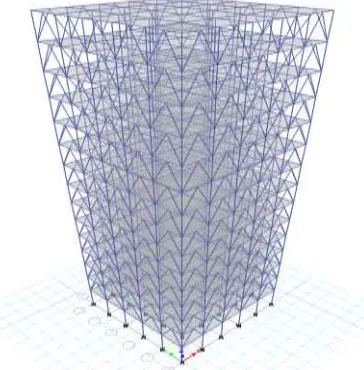
STRUCTURALMODELINGFor the purpose of this study,a RC framed (G+14) multistory building having same floor plan with 6 bays of 3m each along longitudinal direction and along transverse direction as shown in figure 1. Four models with different
types of bracings wereselectedinordertodetermine
thebehaviourofstructuralsteelduringseismicactivity. The
load cases considered in the seismic analysis are as per IS 1893:2002 (part 1). Figure 1 and 2 shows the geometrical configuration of the building. The model
was prepared for bare frame and with
[image:2.596.338.531.87.260.2]differentbracingsystems.Table1givesthematerialproperti es ofthemembers.
Figure 1: Plan of Building without Bracing.
Figure 2: A 3D View of Building without Bracing.
Figure 3:- 3D View of Building with X- Bracing.
[image:2.596.44.257.164.322.2]Figure 4:- 3D View of Building with V- Bracing
[image:2.596.344.526.297.482.2]Figure 5:- 3D View of Building with Inverted V- Bracing.
Table 1: Material and Section Properties
1. Building Type Residential building
2. No. of storeys G+14
3. Bottom storey height 3.5m
4. Total height 45.5m
5. Floor height 3m
6. Size of column 300mm*400mm
7. Size of beam 230mm*300mm
8. Thickness of slab 150mm
9. Masonry wall
thickness 250mm
10. Seismic zone III
11. Grade of concrete M20
12. Grade of steel Fe250
13. Unit weight of
concrete 25KN/m
3
14. Unit weight of PCC 24 KN/m3
15. Unit weight of brick 20 KN/m3
16. Unit weight of plaster 21 KN/m3
[image:2.596.56.259.367.538.2]18. Parapet wall load 7KN/m
19. Live load 3 KN/m2
20. Roof load 2.5 KN/m2
21. IS Code for concrete IS 456:2000
22. IS Code for
earthquake IS 1893:2002 (part I)
Building is analalyzed on the basis of Various load combinations in the limit state of design for reinforced concrete structures as per IS 1893:2000(part1).
3.1 ETABs Overview
ETABs is used for seismic analysis and to study the behaviour of multistorey building with and without bracing are compared with different parametres of analysis.Complete analysis including structural modeling is performed in this software.
The analysis has been done by using ETABs software which involves following steps:-
1. Defining dimensions of the plan
2. Defining the members and material properties
3. Assigning loads and load combinations
4. Run and check model to find errors
5. Run analysis
6. Extract results and discuss
4.
METHOD OFANALYSIS4.1 Time History Analysis
Time history analysis is the study of the dynamic response of the structure at every addition of time, when its base is exposed to a particular ground motion. Static techniques are applicable when higher mode effects are not important. This is for the most part valid for short, regular structures. Thus, for tall structures, structures with torsional asymmetries, or no orthogonal frameworks, a dynamic method is needed. In linear dynamic method, the structures is modeled as a multi degree of freedom (MDOF) system with a linear elastic stiffness matrix and an equivalent viscous damping matrix. The seismic input is modeled utilizing time history analysis, the displacements and internal forces are found using linear elastic analysis. The playing point of linear dynamic procedure as for linear static procedure is that higher modes could be taken into account.
In order to study the seismic behaviour of RC multi-storey building under lateral forces with or without bracing, dynamic analysis is required. The ETABs software is used to perform linear time history analysis.
4.2Parameters considered for analysis
1. Storey drift
2. Storey displacement
3. Fundamental time period
4. Storey stifness
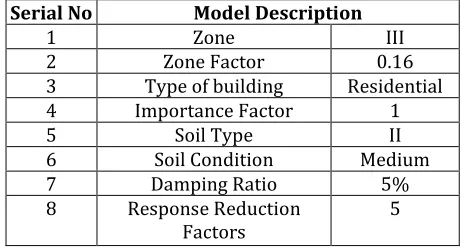
[image:3.596.317.549.172.297.2]The seismic data is taken according to the IS 1893:2002 for the Zone III.
Table 2:Seismic Data
Serial No Model Description
1 Zone III
2 Zone Factor 0.16
3 Type of building Residential
4 Importance Factor 1
5 Soil Type II
6 Soil Condition Medium
7 Damping Ratio 5%
8 Response Reduction
Factors 5
5. RESULTS
5.1 Storey drift
It is the relative displacement of one level relative to other level above or below. According to IS 1893:2002 (part 1),thestoreydrift should not exceed 0.004 times of relative storey height.
5.1.1Max. Storeydrift(mm) comparison in X direction the table and the graph below shows the comparison of various bracing with bare frame in terms of storey drift in X direction.
No of
story WITHOUT BRACING BRACING X BRACING V V BRACING INVERTED
Story15 0.734 0.584 0.751 0.659
Story14 1.051 0.632 0.826 0.745
Story13 1.351 0.673 0.892 0.82
Story12 1.608 0.706 0.945 0.882
Story11 1.822 0.729 0.985 0.929
Story10 1.995 0.743 1.011 0.961
Story9 2.131 0.746 1.023 0.977
Story8 2.232 0.738 1.021 0.979
Story7 2.302 0.72 1.004 0.966
Story6 2.343 0.691 0.973 0.938
Story5 2.359 0.652 0.928 0.896
Story4 2.352 0.603 0.87 0.84
Story3 2.321 0.536 0.784 0.755
Story2 2.238 0.528 0.81 0.806
Story1 1.94 4.55 2.981 2.91
[image:3.596.298.569.468.661.2]5.1.2Max. Storeydrift(mm) comparison in Y direction-the table and graph below shows direction-the comparison of different bracing system with bare frame in terms of storey drift in Y direction.
No.of story
WITHOUT
BRACING BRACING X BRACING V
INVERTED V BRACING
Story15 0.743 0.649 0.771 0.606
Story14 1.109 0.701 0.849 0.687
Story13 1.445 0.747 0.917 0.758
Story12 1.731 0.783 0.97 0.816
Story11 1.969 0.808 1.01 0.861
Story10 2.163 0.822 1.035 0.891
Story9 2.316 0.825 1.045 0.908
Story8 2.431 0.817 1.042 0.91
Story7 2.511 0.797 1.024 0.899
Story6 2.561 0.765 0.992 0.874
Story5 2.584 0.721 0.946 0.835
Story4 2.583 0.667 0.888 0.783
Story3 2.562 0.589 0.807 0.707
Story2 2.523 0.6 0.815 0.731
Story1 2.512 3.17 4.14 4.199
Max. Storeydrift(mm) comparison in Y-direction-
5.2 Storey Displacement
It is the diplascement of each storey with respect to ground level. According to IS 1893 (part1) :2002 the
max value of diplacement is 1/250 times of storey height
with respet to ground.
5.2.1 Max.Storey displacement (mm) comparison in x direction-the table and graph below shows the comparison of various bracing system with bare frame in terms of storey displacement in X direction.
NO OF STORE Y WITHOU T BRACING X BRACIN G V BRACIN G INVERTE D V BRACING
Story15 28.779 13.832 15.751 15.063
Story14 28.045 13.247 15 14.404
Story13 26.993 12.615 14.174 13.659
Story12 25.643 11.942 13.283 12.838
Story11 24.035 11.236 12.338 11.957
Story10 22.213 10.506 11.353 11.028
Story9 20.218 9.764 10.341 10.068
Story8 18.086 9.018 9.318 9.09
Story7 15.854 8.28 8.297 8.111
Story6 13.552 7.56 7.293 7.145
Story5 11.21 6.869 6.319 6.206
Story4 8.851 6.217 5.391 5.31
Story3 6.499 5.613 4.521 4.47
Story2 4.178 5.078 3.737 3.715
Story1 1.94 4.55 2.981 2.91
Max. Storey displacement (mm) comparison in x
direction-5.2.2Max.Storey displacement (mm) comparison in Y direction-the table and graph below shows the comparison of various bracing system with bare frame in terms of storey displacement in Y direction.
NO OF
STORYS WITHOUT BRACING BRACING X BRACING V
INVERTED V BRACING
Story15 31.742 13.461 17.25 15.465
Story14 30.999 12.811 16.48 14.859
Story13 29.89 12.11 15.63 14.171
Story12 28.445 11.363 14.714 13.413
Story11 26.715 10.581 13.743 12.597
Story10 24.745 9.773 12.733 11.737
Story9 22.582 8.95 11.698 10.846
Story8 20.267 8.125 10.653 9.938
Story7 17.836 7.308 9.611 9.028
Story6 15.325 6.512 8.588 8.129
Story5 12.764 5.747 7.596 7.256
Story4 10.18 5.026 6.65 6.421
Story3 7.597 4.359 5.762 5.638
Story2 5.035 3.77 4.955 4.93
Story1 2.512 3.17 4.14 4.199
Max. Storey displacement (mm) comparison in Y
direction-5.3 Fundamental time
periods-According to IS 1893:2002 it is the first(longest) modal time period of vibration.
5.3.1Fundamental time period (S) comparison-The table and the graph below shows the comparison of various bracing system with bare frame in terms of fundamental time period.
MODAL WITHOUT BRACING BRACING X BRACING V
INVERTED V BRACING
Modal 1 2.113 0.993 1.104 1.079
Modal 2 1.891 0.89 0.959 0.986
Modal 3 1.764 0.644 0.675 0.691
Modal 4 0.697 0.326 0.366 0.362
Modal 5 0.619 0.297 0.316 0.332
Modal 6 0.583 0.139 0.17 0.182
Modal 7 0.404 0.134 0.169 0.169
Modal 8 0.355 0.13 0.145 0.162
Modal 9 0.343 0.085 0.112 0.111
Modal
10 0.284 0.084 0.095 0.108
Modal
11 0.247 0.073 0.086 0.098
Modal
12 0.24 0.063 0.083 0.083
Fundamental time period (S) comparison
5.4 Storey stiffness
As per IS 1893:2002 the lateral stiffness is less than 70 percent of that in the storey above or less than 80 percent of average lateral stiffness of the three storey above.
5.4.1Max.Storey stifness (kN/m) comparison in x direction-the table and graph below shows direction-the comparison of various bracing system with bare frame in terms of storey stiffness in X direction.
NO OF
STOREY WITHOUT BRACING BRACING X BRACING V V BRACING INVERTED
Story15 82225.893 201749.63 165111.89 179165.8
Story14 113846.64 373293.98 306364.7 316707.3
Story13 126534.47 501809.39 412105.18 411757.6
Story12 133531.57 601861.5 494022.47 481678
Story11 138074.29 683217.72 560090.31 536175.6
Story10 141383.28 752901 616125.72 581487.3
Story9 144031.15 816253.48 666559.5 621892.3
Story8 146339.62 877773.32 715104.71 660695.7
Story7 148514.22 941771.95 765284.54 700841.2
Story6 150703.98 1013015.1 820943.82 745401.4
Story5 153036.45 1097900.6 887210.06 798351.3
Story4 155659.05 1203792.2 969674.53 863782
Story3 159033.88 1366816.7 1098192.5 968549.9
Story2 165553.96 1392896.2 1102921.2 911152.3
Story1 191139.93 161702.39 259663.03 252550.7
Max.Storey stifness (kN/m) comparison in x direction- 0
10 20 30 40
Sto
ry
15
Sto
ry
12
Sto
ry
9
Sto
ry
6
Sto
ry
3
M
ax.S
tor
y
Disp
lace
m
en
t
Story
WITHOUT BRACING
X BRACING
V BRACING
0 0.5 1 1.5 2 2.5
Mo
d
al
1
Mo
d
al
3
Mo
d
al
5
Mo
d
al
7
Mo
d
al
9
Mo
d
al
11
FU
N
D
A
M
EN
TA
L
TIME
PE
R
IO
D
S
MODAL
WITHOUT BRACING
X BRACING
V BRACING
5.4.2Max.Storey stifness (kN/m) comparison in Y direction-the table and graph below shows the comparison of various bracing system with bare frame in terms of storey stiffness in Y direction.
NO OF
STOREY WITHOUT BRACING BRACING X BRACING V
INVERTED V BRACING
Story15 72684.213 202627.23 163480.93 177941.84
Story14 96586.265 375344.8 291989.22 313435.62
Story13 105880.63 504836.59 382069.79 406758.85
Story12 111006.47 605800.18 448897.84 475112.96
Story11 114314.96 687972.52 501129.39 528233.64
Story10 116709.24 758416.06 544362.17 572292.24
Story9 118614.25 822505.88 582445.61 611505.59
Story8 120267.07 884780.63 618311.46 649109.94
Story7 121817.56 949601.85 654481.54 687972.12
Story6 123372.44 1021775.5 693444.68 731076.42
Story5 125018.23 1107918.2 738182.25 782244.12
Story4 126826.98 1214374.3 791565.06 845682.99
Story3 128924.25 1386994.3 870299.17 944067.29
Story2 131374.3 1366867.2 850370.28 916639.61
Story1 132134.35 258920.79 161354.81 159764.65
Max.Storey stifness (kN/m) comparison in Y direction-
6. CONCLUSION
From the above study and results several conclusions can be drawn such as:
1) Building with bracing is more earthquake
resistance than building without bracing.
2) Steel bracing can be used to strengthen or
retrofit the existing structures.
3) Displacements and Drifts are reduced in
Building with bracing as compared to building without bracing.
4) X bracing is more effective as compared with
other bracing for storey drift in x as well as y directions.
5) X bracing is also more effective in x and y
direction as compared to other bracing for storey displacement.
6) The fundamental time period can be also
reduced with bracing. Again the X bracing performed better in terms of fundamental time period it gives the lesser value of time period as compared with other bracing.
7) For storey stiffness X bracing is more effective
in both x and y direction as compared with other bracing system.
8) Hence, in comparison to X, V and inverted V
bracing, X bracing is the most effective bracing system of all.
REFERENCES
1. A.H.Salmanpour (2008), “Seismic reliability of
concentrically braced steel frames”,WCEE.
2. S.Sabouri-Ghomi (2008)“ Concept improvement of
behavior of X bracing systemby using Easy going steel”, WCEE.
3. E. M.Hines (2010), “Eccentric Braced Frames
System Performance” ASCE.
4. SandaKoboevic (2012), “Seismic performance of
low to moderate heighteccentrically braced steel frames designed for north American seismic condition”ASCE.
5. Pooja.B.Suryawanshi (2016),“Analysis of seismic
Design steel Braced Frame”,ISSN: 2349-784X, Vol. 02, Issue 11 May 2016.
6. Swethasunil (2017), “Seismic study of multi-storey
RC building with differentbracing”, IJIRSET, ISSN:23198753,Vol.6, Issue 5 May 2017.
7. IS: 1893 (Part 2): 2016 Criteria for Earthquake
Resistant design of structures.
8. IS:456: 2000 Plain and Reinforced concrete.
BIOGRAPHY
Mr. MohdAtif khan was born in 1996 in Bareilly city. He received his Bachelor of Technology degree in civil engineering from BabuBanarasi Das University, Lucknow in 2017. Now He is pursuing his Master of Technology in
Structural Engineering from
BabuBanarasi Das University, Lucknow 0
200000 400000 600000 800000 1000000 1200000 1400000 1600000
S
tory
sti
fn
ess
Story
WITHOUT BRACING
X BRACING
V BRACING
INVERTED V BRACING
0 500000 1000000 1500000
St
o
ry
15
St
o
ry
12
Sto
ry
9
Sto
ry
6
Sto
ry
3
S
tor
y S
tif
n
ess
Story
WITHOUT BRACING
X BRACING
V BRACING