2011
I.F.W. van den Berg S0209317
Masterthesis Psychology
Specialization Work and Organization
Graduation committee: dr. H.A. van Vuuren dr. H. Boer
Acknowledgement
This research project is the closing of my master psychology at the University of Twente. To reach this end of my study it took a lot of motivation. It has not been easy to accomplish the stages of research and it was sometimes difficult to persist to the end. At the same time, motivation is a subject which appeals to me. A question I ask myself very often is ‘Why are people behaving like they do?’ Beside it, I find it interesting why some individuals are more committed than other individuals. To get an answer on these questions I investigated the relation between motivation and commitment among university teachers.
Abstract
Background: Employee commitment is a crucial element to increase job performance. An
important predictor of this type commitment is motivation, which motivates employees to spend time and energy in the organization. Because of this fact, there is a growing interest in understanding the relationship between motivation and commitment.
Despite plenty of research on the subjects of motivation and commitment, linkages between different forms of motivation and different foci of commitment are hardly investigated
Aim: Present research aims to explore possible relationships between intrinsic motivation,
extrinsic motivation and two forms of commitment: occupational commitment and
organizational commitment. These two forms of commitment could be separated within three types of commitment: affective, normative and continuance.
Method: An online English questionnaire was used to collect data from 162 respondents.
These respondents were university teachers of several departments of one participating university.
Results: This research shows that there is negative relation between intrinsic motivation and
affective commitment to the organization which is partially mediated by work engagement. With regard to extrinsic motivation and normative commitment to both the organization and occupation, the results are positive, but not significant. The coefficients of the relations between extrinsic motivation and continuance commitment to both the organization and the occupation are consistent with the hypotheses, which predicted a positive result.
Conclusion: This research shows the first results on the relation between the several types of
Samenvatting
Achtergrond: Toewijding van werknemers is een cruciaal onderdeel in het verhogen van
baanprestatie. Een belangrijke voorspeller van dit type toewijding is motivatie, dat werknemers motiveert om tijd en energie te besteden in de organisatie. Hierdoor is er een groeiende interesse ontstaan in het begrijpen van de relatie tussen motivatie en toewijding. Ondanks veel onderzoek naar de onderwerpen motivatie en toewijding blijven relaties tussen verschillende vormen van motivatie en verschillende foci van toewijding nauwelijks
onderzocht.
Doel: Dit onderzoek heeft tot doel de mogelijke relaties te ontdekken tussen intrinsieke
motivatie, extrinsieke motivatie en twee vormen van toewijding: toewijding naar het beroep en toewijding naar de organisatie. Deze twee vormen van toewijding kunnen onderscheiden worden in drie types toewijding: affectief, normatief en continuïteit.
Methode: Een online Engelse vragenlijst is gebruikt om data te verzamelen van 162
respondenten. Deze respondenten zijn universiteitsleraren van verschillende afdelingen van een deelnemende universiteit.
Resultaten: Dit onderzoek laat zien dat er een negatieve relatie is tussen intrinsieke motivatie
en affectieve toewijding naar de organisatie, welke gedeeltelijk wordt gemedieerd door bevlogenheid. Met betrekking tot extrinsieke motivatie en normatieve toewijding naar zowel de organisatie als het beroep zijn de resultaten positief, maar niet significant. De coëfficiënten van de relaties tussen extrinsieke motivatie en continuïteit toewijding naar zowel de
organisatie als het beroep zijn overeenkomstig met de hypothesen, welke een positieve resultaat voorspelden.
Conclusie: Dit onderzoek laat de eerste resultaten zien van de relatie tussen de verschillende
Table of contents
1 Introduction ... 6
1.1 Scientific relevance ... 7
2 Motivation and commitment ... 9
2.1 Motivation ... 9
2.1.1 Self-determination theory ... 10
2.1.2 Intrinsic motivation ... 11
2.1.3 Extrinsic motivation ... 11
2.2 Commitment ... 12
2.2.1 Organizational commitment (ORC) ... 13
2.2.2 Occupational commitment (OCC) ... 15
2.2.3 Commitment foci ... 16
2.3 Work engagement ... 17
3 Method... 19
3.1 Sample ... 19
3.2 Measures... 19
4 Results ... 21
5 Discussion & Conclusion ... 28
6 Recommendations ... 30
Literature ... 32
1 Introduction
The present study is an effort to draw a meaningful relationship between intrinsic motivation, extrinsic motivation, and two forms of commitment: occupational commitment (OCC) and organizational commitment (ORC). Despite plenty of research on the subjects of motivation and commitment, linkages between different forms of motivation and different foci of commitment are hardly investigated. Consequently the two forms of literature remain under investigated in the organizational psychology literature. (Meyer, Becker & Vandenberghe, 2004). Present research aims to study the possible relations between intrinsic motivation and extrinsic motivation and the two forms of commitment.
In today’s rapidly changing economy, the worldwide competition continues to increase. For that reason, companies are searching for more efficient ways to rise their productivity. In this increasingly competitive market, it is not sufficient to cut down costs by making use of new technologies or lower-wage employees. To rise productivity, it is
important to make use of the skills of employees (George & Jones, 2008). Murphy & Saal (1990) investigated the relation between job performance and productivity, which resulted in a positive relation. Thus, it is of importance for companies to seek ways to rise job
performance.
According to Matthieu & Zajac (1990), a crucial element to increase job performance is employee commitment. They conducted a meta-analysis in which others’ ratings and output measures are used as performance criteria. Although the relation between commitment and job performance is weak, Mowday et al. (1982) stated that commitment levels influence performance. Besides job performance, a commited workforce gives benefits to an
individual, in terms of job satisfaction and role effectiveness, which in turn gives benefits to the organization (Meyer, Becker & Vandenberghe, 2004). According to Matthieu & Zajac (1990), these benefits are organizational effectiveness, reduced absenteeism and extra role behavior
This study will focus on two foci of commitment: organizational commitment and occupational commitment. Where OCC received less attention, ORC is the most widely researched focus amongst the work commitment foci because of the important consequences for organizations. Allen and Meyer (1990) define organizational commitment as “a
likely)”. Occupational commitment can be defined as “the attachment of an employee to his or her occupation or profession” (Morrow, 1983).
Motivation functions as an important predictor of commitment by motivating employees to spend time and energy in the organization (Mowday, Steers & Porter, 1979). Because of this fact, there is a growing interest in understanding this relationship between motivation and commitment. Spector (2006) defines motivation as ‘an internal state that induces a person to engage in particular behaviours’. It also reflects an intention to act according to the self-determination theory (Deci & Ryan, 1985). This theory makes a distinction between two forms of motivation: intrinsic motivation and extrinsic motivation. When someone is intrinsically motivated he or she performs an activity for its own sake. In contrast, extrinsic motivation is related to motives outside the activity it-self (e.g. a reward).
Commitment is different from motivation, as Scholl (1981) defined it as ‘a stabilizing force that acts to maintain behavioral direction when expectancy/equity conditions are not met or do not function’. This definition implies a complex relation between motivation and
commitment, which needs further investigation.
This leads to the following research question:
‘What is the underlying relation between motivation and commitment?’
1.1 Scientific relevance
Linkages between different forms of motivation and different foci of commitment appear to evolve independently in the organizational psychology literature (Meyer, Becker &
about the interrelations between the two forms of motivation (internal and external) and the two foci of commitment (OCC and ORC).
Integrating motivation and commitment theory has two important benefits. First, it broadens our understanding of commitment as an important element in the process of motivation, as it functions as an energizing force in this process (Meyer, Becker & Vandenberghe, 2004). Secondly, it gives further insight in how motivation indirectly
influences behavior by commitment. Ultimately it can make a contribution to existing theories about job performance, which in turn can make production and efficiency better. Matthieu & Zajac (1990) developed an integrative model regarding the antecedents, correlates and consequences of organizational commitment. They state that motivation correlates with organizational commitment, where high levels of motivation are correlated with high levels of commitment.
Another concept, related to organizational commitment, concerns work engagement. This concept is characterized by high levels of energy and a strong identification with work and possibly has an influence on the relation between motivation and commitment.
Present research will be aimed at the possible relation between intrinsic motivation, extrinsic motivation and the two forms of commitment. Also the possible mediating role of work engagement between motivation and commitment will be examined. Examining the
2 Motivation and commitment
In the following section, the variables motivation and commitment will be described. After the outlines of these variables, the hypotheses have been developed on the basis of relevant literature.
2.1 Motivation
Motivation can best be defined as ‘an internal state that induces a person to engage in
particular behaviours’ (Spector, 2003). The field of motivation arose in an attempt to answer the question why people behave as they do. It also addresses what energizes and directs the behavior of people. To organize the findings of the field of motivation, several motivational theories are developed. These theories take into account the nature of people and the factors that are the driving force of action. Motivation theories can be divided into mechanistic theories and organismic theories. Where the mechanistic theories sees an individual as passive, organismic theories sees the individual as active in his behavior. The last theory states that individuals act on the energy provided by intrinsic needs and physiological drives. This assumption is derived from drive theories. These theories emphasize the role of drives in the explanation of behavior. Freud (1914) became a pioneer in developing theory regarding human motivation. His drive theory stated that behavior is motivated by a drive. According to Freud (1917) sex and aggression are two important drives. Whereas Freud mentioned two drives, Hull (1943) categorizes four drives. These drives are thirst, hunger, the avoidance of pain and sex.
Maslow built further on the work of Freud and Hull and became famous for his well-known theory regarding human motivation. He designed a needs pyramid in which he
distinguished the following five needs: physiological needs, safety needs, love needs, esteem needs and the need for self-actualization physiological needs (Maslow, 1943). The
2.1.1 Self-determination theory
In the first decades of the twentieth century the focus was on behavior as a consequence of a drive. Less attention was given to choices and intention in motivation theory. Several
theorists, like Nunberg (1939), elaborated on the work of Freud and introduced the concept of self-regulation. This concept encompasses the extent to which an individual is driven by internal goals. To achieve these goals, several cognitive processes are involved.
Lewin (1936) was one of the cognitive theorists studying these processes to explain the direction of behavior.
A few decades later, several theorists compared intrinsic and extrinsic motives in an individual’s behavior, which leads them to study the concept of self-determination (Lepper, Greene & Nisbett, 1973). Deci & Ryan (1985) attenuated that ‘cognitive theories have had an important influence on the field of motivation by directing attention to the concept of choice’. The self-determination theory (SDT) focuses on the motivation preceding on the choice of an individual. According to this theory, the motivation for showing behavior comprises an intention to act. Self-initiation or external inducements predict this intention to act, which can be divided into two forms; intrinsic motivation and extrinsic motivation.
Where intrinsic motivation concerns the inherent drive to seek new challenges and
possibilities, extrinsic motivation captures the need to attain a separable outcome (Ryan & Deci, 2000)
Meyer & Herscovitch (2001) derived the concept of goal regulation from the self-determination theory. Although this concept resembles self-self-determination, these terms are not equivalent. Meyer, Becker & Vandenberghe (2004) define goal regulation as ‘a motivational mindset reflecting the reasons for, and purpose of, a course of action being contemplated or in progress.’ Meyer & Herscovitch showed the impact of this new concept in their model of workplace commitments. They state that goal regulation influences goal choice, which start the goal mechanisms which result in particular behavior. In addition to this, Meyer, Becker and Vandenberghe (2004) state that the addition of goal regulation helps in explaining the predicting role of motivation with regard to work behavior. Although they state that the role of motivation as a predictor has to be investigated, they present motivation as a consequence in their research. There still is little known about the predicting role of motivation with regard to commitment. To investigate the role of motivation, the two most important types of
2.1.2 Intrinsic motivation
From the 1970’s several authors studied the concept of intrinsic motivation. Very first, Lawler (1969) defined this concept ‘as the degree to which a job holder is motivated to perform well because of some subjective rewards or feelings that he expects to receive or experience as a result of performing well.’ In this way an individual performs well in his or her job to satisfy the higher order needs, which will ultimately lead to intrinsic motivation. External rewards play no role with regard to behavior in this definition of intrinsic motivation.
Although this definition was quite effective in the early 1970’s, it did not take into account psychological processes underlying behaviors. To give a more vast definition of intrinsic motivation, Deci (1975) suggested that an individual also has the need to feel competent and self-determining. When an individual is intrinsically motivated, he or she experiences feelings of competence. As can be seen in the preceding paragraph, people feel self-determined when their own choice causes their behavior.
Deci (1971) also suggests that rewards decrease the frequency of behavior. This finding led to several studies with regard to the influence of rewards on intrinsic motivation. With Ryan (Deci & Ryan, 1985), he developed a research paradigm which implies that verbal feedback tends to increase intrinsic motivation, whereas expected tangible rewards tend to reduce it.
For intrinsic motivation, not the reward but the behavior itself is important. According to Amabile, Hill, Hennessey & Tighe (1994), intrinsically motivated behavior is self-initiated: someone undertakes an activity for its own sake. The activity-itself is interesting and results in feelings of accomplishment and self-fulfillment. Someone might go to work because he or she likes to learn new things regarding to the job, for instance. They state that elements of
intrinsic motivation include competence, curiosity, enjoyment, interest, self-determination and task involvement.
2.1.3 Extrinsic motivation
Although the theory regarding to extrinsic motivation has received less attention, the view is more elaborated. Where extrinsic motivation was only based on external reinforcements formerly, nowadays the theory is more elaborated by the addition of cognitive assessment (Lepper & Green, 1978). Lazarus (1991) argued that people could not have an affective reaction on a stimulus without a cognitive appraisal of the stimulus. This means that a cognitive assessment of a situation precedes extrinsic motivation.
Deci and Ryan (1985) distinguish the following different types of extrinsic motivation which can be aligned along a continuum: amotivation, external, introjected, identified and integrated. On the one end is amotivation, which means that there is no intention to act. Amotivation is followed by external regulation in which individuals perform an activity to get a reward. The next type of extrinsic motivation is introjected regulation in which behavior is regulated through self-worth. Next is identified regulation, which means that someone is performing an activity for the reason of identification with its value. The last one concerns integrated regulation, in which the identification with the value of an activity becomes part of the sense of self of an individual (Ryan & Connell, 1989).
Amabile et al. (1994) define extrinsic motivation as ‘the motivation to work primarily in response to something apart from the work itself, such as reward or recognition or the dictates of other people’. In short: an activity is performed to attain a certain outcome. For example, when someone only is performing his job for the money (Ryan & Deci, 2000).
2.2 Commitment
In the existing literature about commitment, there have been made several definitions of this construct. To give a concise definition of commitment, Allen & Meyer (1990) considered it to be “a psychological state that binds an individual to the organization.’ The strength of this psychological state depends on the involvement, loyalty and belief in organizational values of employees. Commitment in general is defined by Meyer & Herscovitch (2001) as ‘a force that binds an individual to a course of action that is of relevance to a particular target’. Shiverick & Janelle (2009) define commitment as ‘a measure of the alignment of the employee’s motivations with the mission of the organization; in other words, to what degree does the employee feel that he or she is making a positive contribution to the ultimate outcome?’
inferred of his side bets theory in which someone stays within the organization because of value (e.g. money or time) that would be lost when he or she leaves this organization. Besides the side bets, an employee also takes into account the alternatives. When an employee has a lack of alternatives, he or she is more likely to stay committed to the organization.
Commitment is an important construct in improving employee performance according to Mowday, Porter & Dubin (1974). They mentioned that high commitment leads to high performance of employees. Moreover, commitment acts as an indicator of organizational effectiveness and is a predictor of turnover (Steers, 1977).
Meyer, Allen and Smith (1993) stress the importance of a multidimensional approach to the concept of commitment and demonstrated the importance of different forms of
commitment. These other forms include commitment to the work group, to the manager, to the union and to other entities. Their research showed that ‘the prediction of various behaviors (e.g. turnover intention and responses to dissatisfaction) can be improved by considering commitment to both the organization and the occupation’ (Meyer, Allen & Smith, 1993).
During the end of the 20th centurythe employee commitment concept has been widely researched, which leads to differentfoci of this concept. The most widely researched focus of commitment concerns organizational commitment (ORC).
2.2.1 Organizational commitment (ORC)
In the organizational literature, there exist several definitions of organizational commitment. There can be made a distinction between definitions that focus on behaviors and attitudes. At first we can define commitment in terms of behavior. According to Mowday, Steers, Porter (1979), this definition focuses on ‘overt manifestations of commitment’ in which individuals ‘choose to link themselves to the organization’. Organizational commitment could also be defined in terms of an attitude, which means that the goals of employees and those of the organization are congruent. Porter and Smith (1970) defined organizational commitment as ‘the relative strength of an individual’s identification with and involvement in a particular organization’.
Three related factors characterize organizational commitment: ‘(1) a strong belief in and acceptance of the organization’s goals and values; (2) a willingness to exert considerable effort on behalf of the organization; and (3) a strong desire to maintain
organization (i.e. makes turnover less likely)’ Brown (1996) defines ORC as ‘dedication to and support of the organization (or referent unit beyond that associated with job expectations and rewards).’ As can be seen in aforementioned terms, commitment includes a form of support.
During the 70’s a growing interest in the concept of organizational commitment emerged. Commitment is an important construct in the clarification of employee behavior within organizations (Horn, Katerberg & Hulin, 1978; Porter, Steers, Mowday & Boulian, 1974; Mowday, Porter & Dubin, 1974). Several authors studied the topic of ORC (Hall & Schneider, 1972; Mowday, Porter, & Dubin, 1974; Kanter, 1977), but Mowday, Steers and Porter (1979) were the first authors who carried out a systematic research to ORC. To operationalize this construct, they developed the Organizational Commitment Questionnaire (OCQ) which measures employee commitment to work organizations. An example of a question concerns: ‘I find that my values and the organization’s values are very
similar’(Mowday, Steers and Porter, 1979).
Meyer and Allen (1984) state that the measurement of the concept ORC not fully comprehenses the theory, because it mainly consists of affective commitment. To fully conceptualize commitment, a change in the conceptualization of commitment is required. Allen & Meyer (1990) state that ORC consists of three types of commitment. They integrated these types into a three-component model of commitment. These types could be described as affective, continuance and normative commitment. When an employee shows an emotional attachment to the organization, this has been mentioned as affective organizational
commitment (AOC). This emotional attachment is characterized by the identification with the organization’s goals and values (Mowday, Steers & Porter, 1979). Continuance organizational commitment (COC) is based on the costs that are associated with leaving the organization. This type can be described as feelings of obligation to stay within the organization and was also described by Becker (1960) as a perceived lack of alternatives. When an employee is influenced by significant others (e.g. friends and family) and organizational practices to show loyalty to the organization, he or she shows normative organizational commitment (NOC). These significant others put normative pressures on the employee to act in line with the organization’s expectations (Wiener, 1982).
Besides the explication of organizational commitment, several scientists determined the consequences and antecedents of this construct. Organizational commitment (ORC) is the most widely researched focus amongst the employee commitment foci becauseof the
organizational effectiveness, reduced absenteeism, competitiveness and extra role behavior (Meyer and Allen, 1997). The development of ORC is influenced by early work experiences. When these work experiences are consistent with the expectations of the employee, job satisfaction is high and employees have an influence on decisions, ORC is greater (Meyer and Allen, 1987). Other antecedents of ORC can be categorized in four categories; job
characteristics, personal needs, role states and work experiences (Mathieu & Hamel, 1989).
2.2.2 Occupational commitment (OCC)
Occupational commitment (OCC) is another focus of employee commitment and can be referred to the attachment of an employee to his or her occupation or profession (Morrow, 1983). Lee, Carswell & Allen (2000) defined an occupation as ‘an identifiable and specific line of work that an individual engages in to earn a living at a given point in time’ Examples of specific occupations are doctors, professors or bankers. They conceptualize OCC as ‘a psychological link between a person and his or her occupation that is based on an affective reaction to that occupation. A strong OCC leads to a stronger identification with, and more positive feelings to one’s occupation, compared with a weak OCC.
During the last decades, OCC has become more important, which suggest that it is not only important to look at ORC, but also at OCC. There are several reasons why OCC is an important construct. Because of higher education levels, more specialized work and organizational change, OCC becomes more important to people (Burris, 1983).
Organizational strategies like outsourcing and downsizing has caused uncertainty within employees. These organizational restructurings and the increased job insecurity leads
employees to reassess their commitment targets (Blau, 2003). They commit themselves to the occupation they are practicing, as they believe this is a part of their career over which they can exert control (Meyer, Allen & Topolnytsky, 1998; Lee, Carswell & Allen, 2000;
McAuley, Zeitz & Blau, 2006). Besides the importance for employees and employers, it is of scientific relevance to extend the insight in the field of work commitment.
Occupationally committed workforce has been regarded important not only for the organizations but for the societies on the whole. The fact is that occupational change is associated with higher ‘costs’ such as additional needed training and human capital
Lee, Carswell and Allen (2000) stated a positive relationship between OCC and job involvement, job satisfaction and creativity at work . Moreover they have found a positive relationship between OCC and employee performance. Campbell (1995) pointed out that a committed workforce tends to have higher performance quality standards and are more motivated to achieve these standards than a less committed workforce. OCC could also increase performance by acquiring more relevant knowledge and skills. For example, when someone follows long-term education. Indirectly, OCC is associated with occupational and organizational turnover intentions, which implies a central role of attitude towards the job regarding to OCC (Lee, Carswell and Allen, 2000; Blau and Lunz, 1998). Besides research regarding to employee commitment as a predictor, this term is also referred as a consequence of several characteristics. These characteristics could belong to someone personally, the job or the organization.
The three component model of Meyer and Allen (1991) can also be applied to occupational commitment. These types could be described as affective occupational commitment (APC), continuance occupational commitment (CPC) and normative
occupational commitment (NPC). Lee, Carswell and Allen (2000) report that APC contains a strong identification and positive feelings of the individual with his or her occupation.
According to Meyer, Allen and Smith (1993) a person with high CPC shows a strong
psychological bond with the occupation because of possible disadvantages when leaving the occupation. NPC includes feelings of obligation to stay in the occupation.
2.2.3 Commitment foci
Meyer and Allen (1991) noted that the three types of commitment (affective, normative and continuance) consist of three separable psychological manifestations. At first, affective commitment consists a desire, continuance commitment implies a need and normative commitment contains an obligation.
Meyer and Herscovitch (2001) made a distinction between the antecedents of affective, normative and continuance commitment. They propose that these antecedents variables could be used to examine the development of commitment and recommend to conduct research on the influence of motives on multiple commitments.
To create the desire which characterizes affective commitment, an individual has to show identification and involvement. An important aspect of intrinsic motivation includes
Hypothesis 1a: Intrinsic motivated employees show more affective commitment to their
organization than extrinsic motivated employees
Hypothesis 1b: Intrinsic motivated employees show more affective commitment to their
occupation than extrinsic motivated employees
2.3 Work engagement
Psychological research has brought up much knowledge about the behavior of people in the last century. Within this research there was much attention to negative phenomena like
depression and burnout. Instead of these negative psychological phenomena, Seligman (1999) motivated researchers to do research regarding to positive psychological phenomena. Main point was that human qualities deserve as much attention as human shortcomings. The psychological trend which arose is called the positive psychology. This discipline studies human power and optimal functioning. One of the subjects within the positive psychology which has deserved much more attention concerns work engagement (Bakker, 2009).
Work engagement can best be described as a positive state of ultimate satisfaction consisted of three characteristics: vigor, dedication and absorption (Schaufeli & Bakker, 2001). At first, vigor is related to feeling strong and having energy to continue to work long. Dedication refers to a strong involvement to work. Finally, absorption is related to being fully immersed in the job and forgetting everything else around.
Like commitment, work engagement can bring competitive advantage to
organizations. This is because employees who are energetic, dedicated and absorbed by their work offer an added value to the organization. Moreover work engagement positively
influences employee performance because engaged employees show positive emotions, a good health, creation of job resources and the transfer of engagement to their collegues. (Bakker & Schaufeli, 2008).
The first hypotheses state a possible relation between intrinsic motivation and affective commitment. To investigate whether the relation between intrinsic motivation and affective commitment is mediated by work engagement, the following hypotheses were developed:
H2a: Work engagement acts as a mediator in the relation between intrinsic motivation and
affective commitment to the organization.
H2b: Work engagement acts as a mediator in the relation between intrinsic motivation and
affective commitment to the occupation.
To investigate the influence of extrinsic motivation on commitment, the commitment profiles were further analyzed. When a person shows normative commitment, he or she feels an obligation to remain within the organization/occupation. Normative committed employees may be motivated to sacrifice their interests for the organization. This motivation does not come from within, but from external forces, which implies that there could be a relationship between extrinsic motivation and normative commitment. This leads to the following hypotheses:
H3a: Extrinsic motivated employees show more normative commitment to their organization
than intrinsic motivated employees
H3b: Extrinsic motivated employees show more normative commitment to their occupation
than intrinsic motivated employees
Continuance commitment includes a need to continue a course of action, which originates from the investments of an individual. This possibly implies that a person is extrinsically motivated to perform a course of action. To investigate the possible relation between extrinsic motivation and continuance commitment, the following hypotheses were developed:
H4a: Extrinsic motivated employees show more continuance commitment to their
organization than intrinsic motivated employees
H4b: Extrinsic motivated employees show more continuance commitment to their occupation
3 Method
3.1 Sample
The hypotheses were tested using data collected from university teachers. Among these teachers are professors, assistant professors, associate professors and PhD candidates, which are the target population in this research. This target population will be called teachers from now on. All other scientists who do not give lessons are not excluded in this study. The purpose was to recruit at least 200 teachers who would like to participate in this research.
An online English survey was developed to collect data from university teachers. To get a list of all professors, assistant professors, associate professors and PhD candidates the secretariats of the departments were contacted. The surveys were distributed by email to 1358 university teachers. To get a higher response rate, there were sent several follow-ups.
3.2 Measures
3.2.1. Dependent variables
To measure organizational commitment, the affective, continuance and normative
organizational commitment scales of Allen & Meyer (1990) were used. Respondents have to indicate the degree of their agreement or disagreement with each statement at a Likertscale (1; strongly disagree, 5; strongly agree). ‘I really care about the fate of this organization’ is an example of an item measuring organizational commitment.
Occupational commitment was measured by Meyer et al.’s (1993) three-component (affective, continuance and normative) occupational commitment scale. All items could be answered on a five-point Likertscale (1= completely disagree, 5 = completely agree). ‘This is the ideal vocation for a life work’ is an example of an item measuring occupational
commitment.
3.2.2 Independent variables
To measure intrinsic and extrinsic motivation, a twenty-item scale (Amabile et al., 1994) was used. ‘What matters most to me is enjoying what I do’ is an example of an item measuring intrinsic motivation. An example of an item with regard to extrinsic motivation is ‘ I am strongly motivated by the money I can earn’. The answer categories range from 1 (strongly disagree) to 5 (strongly agree).
3.2.3 Demographic variables
4 Results
4.1 Sample
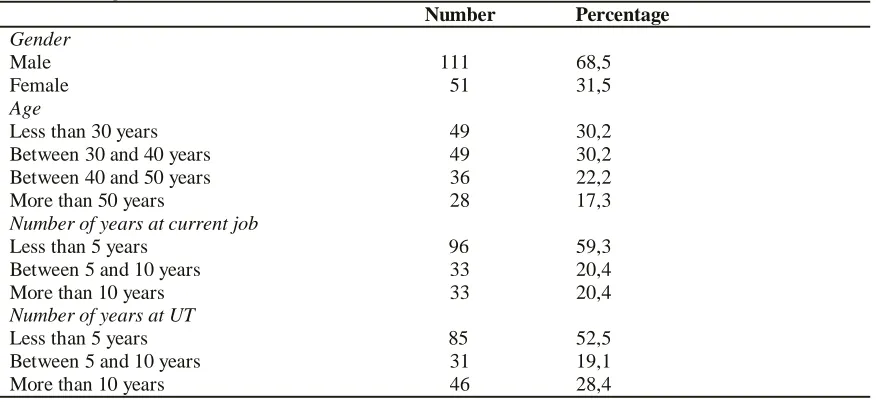
In total 212 professors, assistant professors, associate professors and PhD candidates filled in the questionnaire, which gives a response rate of 16%. Because of missing answers, only 162 from the 212 people were included in this research. A summary of all sample characteristics can be found in table 1.
The complete sample consisted of 111 men and 51 women, of which the greatest part is younger than 40 years. The majority of the respondents are less than 5 years operative, on both the university as in their profession. Possibly most of the respondents are PhD
[image:21.595.66.504.376.577.2]candidates, which explains why the questionnaire is filled in by young scientific professionals which have a short organizational tenure.
Table 1
General data respondents
Number Percentage
Gender
Male 111 68,5
Female 51 31,5
Age
Less than 30 years 49 30,2 Between 30 and 40 years 49 30,2 Between 40 and 50 years 36 22,2 More than 50 years 28 17,3
Number of years at current job
Less than 5 years 96 59,3 Between 5 and 10 years 33 20,4 More than 10 years 33 20,4
Number of years at UT
Less than 5 years 85 52,5 Between 5 and 10 years 31 19,1 More than 10 years 46 28,4
Table 2
Means, standard deviations, reliabilities and correlation coefficients among the variables (N = 162)
Variables M SD (1) (2) (3) (4) ( 5) (6) (7) (8) (9) (10) (11) (12)
(1) Intrinsic motivation 3.96 .40 .74
(2) Extrinsic motivation 3.01 .52 -.19* .77
(3) Affective ORC 2.97 .75 -.17* .09 .82
(4) Normative ORC 2.44 .58 -.18* .10 .44** .81
(5) Continuance ORC 2.88 .80 -.25** .22** .29** .08 .71
(6) Affective OCC 3.89 .73 .07 -.09 .16* .12 .08 .87
(7) Normative OCC 2.30 .81 -.24** .09 .23 .56** .22** .07 .80
(8) Continuance OCC 2.69 .76 -.19* .17* .20 .13 .64** .12 .29** .85
(9) Work engagement (a) 2.16 .93 .45** -.01 .24* .11 -.09 .17* -.07 -.06 .82
(10) Gender (b) 1,31 .47 -.07 .13 -.15 -.05 -.01 -.06 -.17* -.11 -.01 -
(11) Age (c) 2.27 1.07 .08 -.20* .12 .05 .09 .33** .06 .20* .26** -.27** -
(12) Occupational tenure (d) 1.61 .81 .02 -.21** .06 .03 .08 .28** .03 .18* .14 -.23** .78** - (13) Organizational tenure (e) 1.76 .87 .03 -.20** .09 .01 .10 .30** .00 .21** .11 -.23** .75** .87**
Note. Scale reliabilities are on the diagonal. ** p<.01.
* p<.05.
(a) Never = 0; Almost never = 1; Rarely =2; Sometimes =3; Often = 4; Very often = 5; Always = 6 (b) Man = 1; woman = 2
(c) Less than 30 years = 1; Between 30 and 40 years = 2; Between 40 and 50 years = 3; More than 50 years = 4 (d) Less than 5 years = 1; Between 5 and 10 years = 2; More than 10 years = 3
(e) Less than 5 years = 1; Between 5 and 10 years = 2; More than 10 years = 3
4.2 Relation of intrinsic motivation and affective commitment
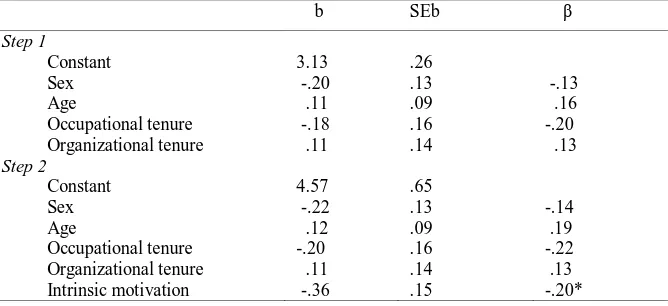
To test the first hypothesis Intrinsic motivated employees show more affective commitment to
their organization than extrinsic motivated employees, a linear regression analysis is applied,
using an alpha level of 0.05 (see table 3). Regression analysis is useful in predicting scores on the dependent variable on the basis of scores on the independent variable (Kaplan &
[image:23.595.70.404.256.409.2]Saccuzzo, 2009).
Table 3:
Hierarchical regression analyses of intrinsic motivation on organizational affective commitment (ORCA)
Note: R2= .04 for Step 1: ∆ R2 = .04 for Step 2 (ps < .05). * p <.05, ** p < .01.
As opposed to the hypothesis, the linear regression showed a significant negative relation (-.20) between intrinsic motivation and affective commitment to the organization (ORCA). To describe the direction and magnitude of the relation, correlation analyses are executed which can be found in table 2. The results of the correlation analysis with regard to intrinsic motivation and ORCA also demonstrate a significant negative relation (-.17). This implies that high scores on intrinsic motivation are associated with low scores on ORCA. As there is a significant negative relationship between intrinsic motivation and ORCA, it will be sensible to see whether there is a positive relationship between extrinsic motivation and ORCA. The results of the correlation analysis show a positive relationship between extrinsic motivation and ORCA, although it is not significant (see table 2).
With regard to the second hypothesis Intrinsic motivated employees show more
affective commitment to their occupation than extrinsic motivated employees, there was used
a linear regression analysis once again, using an alpha level of 0.05 (see table 4).
b SEb β
Step 1
Constant 3.13 .26
Sex -.20 .13 -.13
Age .11 .09 .16
Table 4:
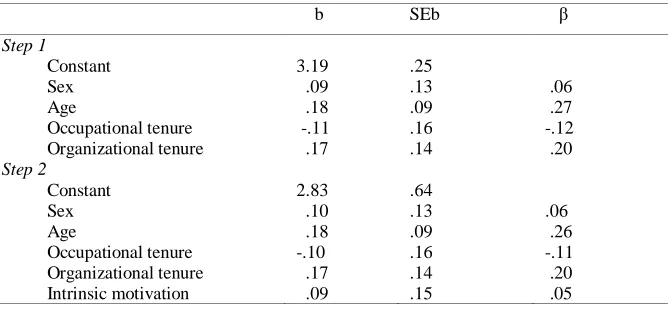
Hierarchical regression analyses of intrinsic motivation on occupational affective commitment (OCCA)
Note: R2= .12 for Step 1: ∆ R2 = .12 for Step 2 (ps < .05). * p <.05, ** p < .01.
The linear regression showed a weak positive relation (.05) between intrinsic motivation and affective occupational commitment (OCCA). After describing the linear regression, a
correlation analysis was executed to describe the direction and magnitude of the relationship. As can be seen in table 2, the results of the correlation analysis demonstrate also a weak positive correlation of .07. In contrast to this, the results of the correlation analysis with
regard to extrinsic motivation show a negative relation. It is important to note that all the results of the correlation and regression analyses are not significant, which means that one has to be careful with making judgements.
4.3 The role of work engagement
To test the hypothesis Work engagement acts as a mediator in the relation between intrinsic
motivation and affective commitment to the organization, mediator analyses are executed
[image:24.595.63.405.614.666.2]which can be found in the following table.
Table 5:
Mediation analysis of work engagement on the relation between intrinsic motivation and ORCA
Note: * p <.05, ** p < .01
b SEb β
Step 1
Constant 3.19 .25
Sex .09 .13 .06
Age .18 .09 .27
Occupational tenure Organizational tenure Step 2 Constant Sex Age Occupational tenure -.11 .17 2.83 .10 .18 -.10 .16 .14 .64 .13 .09 .16 -.12 .20 .06 .26 -.11 Organizational tenure Intrinsic motivation .17 .09 .14 .15 .20 .05
b SEb β
Constant 4.74 .59
The mediation analysis shows a significant result with regard to work engagement (.35). The result with regard to intrinsic motivation is also significant, but negative (-.32), which means that both intrinsic motivation and work engagement have a significant influence on affective commitment to the organization (ORCA). This implies that there is a partial mediation of work engagement between intrinsic motivation and ORCA.
It is not possible to test the last hypothesis Work engagement acts as a mediator in the
relation between intrinsic motivation and affective commitment to the occupation. This is
because the relation between intrinsic motivation and affective commitment to the occupation is not significant. A mediation analysis can only be executed if the regression coefficient is significant.
4.4 Relation of extrinsic motivation and normative commitment
To test the third hypothesis Extrinsic motivated employees show more normative commitment
to their organization than intrinsic motivated employees, a linear regression analysis is
[image:25.595.72.404.428.584.2]applied, using an alpha level of 0.05 (see table 5).
Table 6:
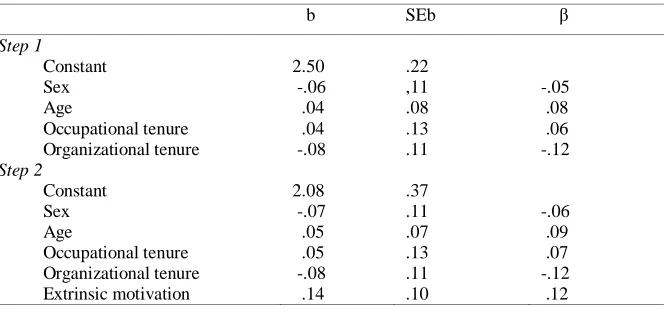
Hierarchical regression analyses of extrinsic motivation on organizational normative commitment (ORCN)
Note: R2= .01 for Step 1: ∆ R2= .02 for Step 2 (ps < .05). * p <.05, ** p < .01.
The linear regression showed a positive relation (.12) between extrinsic motivation and normative commitment to the organization (ORCN), although it is not significant. The results of the correlation analysis with regard to intrinsic motivation and ORCN also demonstrate a not significant positive correlation (.10).
In contrast to this, the correlation between intrinsic motivation and ORCN was significantly negative (-.18), which implies that high scores on intrinsic motivation are associated with low scores on ORCN and reversed.
b SEb β
Step 1
Constant 2.50 .22
Sex -.06 ,11 -.05
Age .04 .08 .08
With regard to the fourth hypothesis Extrinsic motivated employees show more normative
commitment to their occupation than intrinsic motivated employees , there was used a linear
[image:26.595.75.396.166.327.2]regression analysis once again, using an alpha level of 0.05 (see table 6).
Table 7:
Hierarchical regression analyses of extrinsic motivation on occupational normative commitment (OCCN)
Note: R2 = .03 for Step 1: ∆ R2 = .05 for Step 2 (ps < .05). * p <.05, ** p < .01.
The results of the regression analysis demonstrate a not significant positive relationship (.12) between extrinsic motivation and normative commitment to the occupation (OCCN). To complement the linear regression, a correlation analysis was executed.
Where the correlation analysis showed a not significant positive relation (,09) between extrinsic motivation and OCCN, the relation between intrinsic motivation and OCCN is negative and significant (-.24). This significant negative relation means that high scores on intrinsic motivation are associated with low scores on OCCN and reversed.
4.5 Relation of extrinsic motivation and continuance commitment
To test the fifth hypothesis Extrinsic motivated employees show more continuance
commitment to their organization than intrinsic motivated employees, a linear regression
analysis is applied, using an alpha level of 0.05.
As can be seen in table 7, the linear regression showed a significant positive relation (.25) between extrinsic motivation and continuance commitment to the organization (ORCC). The results of the correlation analysis with regard to extrinsic motivation and ORCC
demonstrate also a significant positive correlation of (.22). This means that high scores on extrinsic motivation are associated with high scores on ORCC.
With regard to intrinsic motivation and ORCC, the results show a significant negative correlation of -.25, which implies that high scores on intrinsic motivation are associated with low scores on ORCN and reversed (see table 2).
b SEb β
Step 1
Constant 2.68 .29
Sex -.28 .15 -1.88
Age .07 .09 .69
Table 8
Hierarchical regression analyses of extrinsic motivation on organizational continuance commitment (ORCC)
Note: R2 = .02 for Step 1: ∆R2= .06 for Step 2 (ps < .05). * p <.05, ** p < .01.
With regard to the sixth hypothesis Extrinsic motivated employees show more continuance
commitment to their occupation than intrinsic motivated employees , there was used a linear
regression analysis once again, using an alpha level of 0.05 (see table 8).
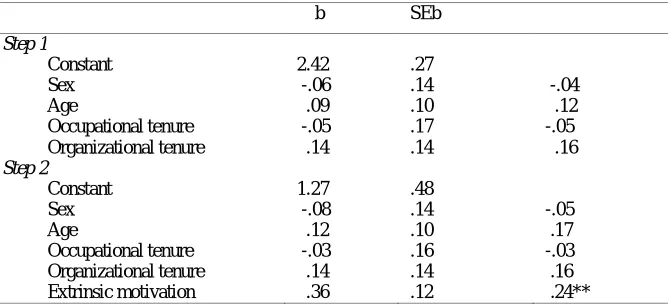
Both regression as correlation showed a significant positive relation (.24 and .17) between extrinsic motivation and continuance occupational commitment (OCCC), which implies that high scores on extrinsic motivation are associated with high scores on OCCC. With regard to intrinsic motivation and OCCC, the results of the correlation analysis
demonstrate a significant negative correlation of -.19.It is meant that high scores on intrinsic motivation are associated with low scores on OCCC and reversed.
Table 9:
Hierarchical regression analyses of extrinsic motivation on occupational continuance commitment (OCCC)
Note: R2 = .05 for Step 1: ∆ R2 = .05 for Step 2 (ps < .05). * p <.05, ** p < .01
b SEb β
Step 1
Constant 2.55 .28
Sex .08 .14 .05
Age .08 .10 .11
Occupational tenure Organizational tenure Step 2 Constant Sex Age Occupational tenure -.05 .07 1.35 .05 .09 .00 .18 .15 .48 .14 .10 .17 -.05 .08 .03 .12 .00 Organizational tenure Extrinsic motivation .06 .38 .15 .13 .07 .25**
b SEb β
Step 1
Constant 2.42 .27
Sex -.06 .14 -.04
Age .09 .10 .12
[image:27.595.70.405.518.672.2]5 Discussion & Conclusion
The results of the regression analysis and correlation analysis do not support all the hypotheses of this study and will be discussed one by one.
The hypothesis Intrinsic motivated employees show more affective commitment to
their organization than extrinsic motivated employees was rejected because of a significant
negative relation. A possible explanation for this significant negative relation is that
organizational commitment may be a multiple construct. Bartels, Pruyn, de Jong and Joustra (2007) point out that identification with the organization exists of more concrete
organizational levels. According to Bartels et al. (2007), one can identify oneself not only with the organization but also with the work group or department. The results of the study present that perceived external prestige has a positive influence on organizational
identification as a whole. Another explanation may be that intrinsic motivation encompasses more than undertaking an activity for its own sake (Amabile et al. 1994). It also may consist of more elements, which may also be the case in organizational commitment.
As the results of testing the hypothesis Intrinsic motivated employees show more
affective commitment to their occupation than extrinsic motivated employees are not
significant, the hypothesis had to be rejected. Although ORCA and OCCA share the affective part of commitment, the coefficients of the first hypotheses were contradictory. A reason for this may be that the respondents did not make a distinction between organizational
commitment and occupational commitment. They may filled in the part with regard to their organization similar as to their occupation.
A mediation analyses was executed to test the hypotheses Work engagement acts as a mediator in the relation between intrinsic motivation and affective commitment to the
organization Although there is a partial mediation of work engagement between intrinsic
motivation and ORCA, the hypothesis had to be accepted. A possible explanation for this partial mediation may be that there may be other mediators or moderators who have an influence on this relationship.
A mediation analysis can only be executed if the regression coefficient is significant. As the regression coefficient is not significant with regard to Work engagement acts as a mediator in the relation between intrinsic motivation and affective commitment to the
The hypothesis Extrinsic motivated employees show more normative commitment to
their organization than intrinsic motivated employees had to be rejected, as the result is not
significant. To test the influence of extrinsic motivation on normative commitment to the
occupation (OCCN), the hypothesis Extrinsic motivated employees show more normative
commitment to their occupation than intrinsic motivated employees was formed. Regression
and correlation analyses show positive not significant results, which leads to the rejection of the hypothesis. A reason for the insignificant results with regard to extrinsic motivation may be that extrinsic motivation exists of more types. The Organismic Integration Theory describes four
types to show how extrinsically motivated behaviour is regulated (Deci and Ryan, 1985).
The hypothesis Extrinsic motivated employees show more continuance commitment to
their organization than intrinsic motivated employees had to be accepted, as the regression and
correlation analyses are positive. In line with this data, the relation between extrinsic motivation
and continuance commitment to the organization is also positive and significant. This supports the
hypothesis Extrinsic motivated employees show more continuance commitment to their
6 Recommendations
This research explored the relationship between motivation and commitment, which has implications for the management of universities. Besides that, the results of this research will form an occasion for other scientists to further investigate the impact of motivation on commitment
6.1 Practical recommendations
To get and retain committed employees, it is important to know how the preceding
motivational processes show their influence. A possibility to get an insight into the motives of an applicant is to take an assessment, which contains several tests and simulations. These tests can be related to intelligence or personality and will give a complete view of the applicant. To get an insight into the work attitude, a work simulation can be applied during the assessment.
To retain committed employees, it is important to get an insight into the motives of an employee is to ask him or her in a function conversation what the motivation is to perform the job. When the management has an insight into the motives of their employees, it will be necessary to use this information by making decisions with regard to human resource management. The decision to chose particular human resource tools will be based on the motives of the employees. For example, if someone is motivated to develop oneself it might be useful to offer training courses. Or if someone is triggered to work harder when there are bonuses in the prospect, the management can implement rewards into the human resource strategy.
6.2 Future research recommendations
Besides the practical implications there are some recommendations for future research.
At first, it will be useful to research whether organizational commitment is a multiple construct.
This type of commitment might have more concrete organizational levels, for example the work
group or department. Besides more research into organizational commitment, it is necessary to
further investigate the intrinsic motivation. This construct may also exist of more elements. More
Second, as this research is executed in the university setting only it is recommended to do more research in other settings, for example in the private sector. Markovits, Davis, Fay and van Dick (2010) state that ‘employees in the public and private sectors experience different working conditions and employment relationships. Therefore, it can be assumed that their attitudes toward their job and organizations, and relationships between them, are different.’ The results support this assumption because of a stronger relation between satisfaction and both affective as normative commitment among public sector employees.Replicating this research on other settings than this particular university, makes the results more generalisable.
Third, an interesting topic to further investigate is commitment foci. Meyer and Herscovitch (2001) used the three commitment components affective, normative and
continuance to create eight commitment profiles. These combinations consist of profiles with one high commitment component, two high commitment components, all high commitment components and all low commitment components. Carson, Carson, Roe, Birkenmeier and Philips(2009) make the following distinction between commitment profiles;, organizationist, careerists, uncommitted and dually committed. According to Tsoumbris and Xenikou (2010), there are four commitment profiles which consistently emerge in the literature: the non-committed, the high-non-committed, the affective-normative dominant and the continuance dominant profile. All the information with regard to the several commitment profiles is too abundant to investigate it in this research, which paves the way for other scientists to do research on the commitment profiles in relation to motivation
Finally, there are some recommendations which are based on the observed limitations during the research. For some people it was not clear if they belong to the target group, as it concerns both professors and PhD’s. To overcome this problem, a question has to be
formulated which makes a distinction between the different types of teachers. Sources of non-response are aversion of questionnaires and inability to answer the questionnaire. Further, respondents indicate that many questions look the same. They hardly distinguish between the questions with regard to the organization and occupation. This could be improved by making a more clear distinction between the questions relating to the organization and questions relating to the occupation. The respondents also indicate that many questions exist of one or two negations. This will lead to more difficulty in answering the question, which could be improved by the use of more positive wording. Finally, it is important to note that the low response rate can have an influence on the reliability of the results. The application of all these
Literature
Allen, N.J & Meyer, J.P. (1996). Affective, Continuance, and Normative Commitment to the
Organization: An Examination of Construct Validity. Journal of Vocational Behavior, 49 , 252–276.
Allen, N.J. & Meyer, J.P. (1990). The measurement and antecedents of affective, continuance and
normative commitment to the organization. Journal of Occupational Psychology, 63 , 1-18.
Amabile, T.M., Hill, K.G., Hennessey, B.A. & Tighe, E.M. (1994, Vol. 66, No. 5). The Work Preference
Inventory: Assessing Intrinsic and Extrinsic Motivational Orientations. Journal of Personality and Social
Psychology , 950-967.
Bakker, A.B. & Demerouti, E. (2009). Work engagement and performance: The role of conscientiousness.
Working paper, Erasmus Universiteit Rotterdam.
Bakker, A.B., Schaufeli, W.B., Leiterc, M.P. & Taris, T.W. (2008) Work engagement: An emerging
concept in occupational health psychology. Work &Stress, Vol. 22, No.3, July-September, 187-200
Barney, J.B. (1986). Organizational culture: Can it be a source of sustained competitive advantage?
Academic Management Review, 11 , 656-665.
Bartels, J., Pruyn, A., de Jonge, M. & Joustra, I. (2007). Multiple organization identification levels and the
impact of perceived external prestige and communication climate. Journal of Vocational Behavior, Vol. 28,
2, 173-190.
Becker, H.S. (1960). Notes on the concept of commitment. The American Journal of Sociology , 32-40.
Becker, T.E. (1992). Foci and basis of commitment: are the distinctions worth making? Academy of
Management Journal, 35 , 232-244.
Bedeian, A. Kemery, E. & Pizzolatto, A. (1991). Career commitment and expected utility of present job as
predictors of turnover intentions and turnover behavior. Journal of Vocational Behavior, 39 , 331-343.
Blau, G. & Lunz, M. (1998). Testing the Incremental Effect of Professional Commitment on Intent to
Leave One's Profession beyond the Effects of External, Personal and Work-Related Variables. Journal of
vocational behavior,52 , 260-269 .
Blau, G. (2003). Testing for a four-dimensional structure of occupational commitment. Journal of
Occupational and Organizational Psychology, 76 , 469–488.
Blau, G.J. (1985). The measurement and prediction of career commitment. Journal of Occupational
Psychology, 58 , 277-288.
Brown, R.B. (1996). Organizational Commitment: Clarifying the Concept and Simplifying the Existing
Construct Typology. Journal of Vocational Behavior, 49 , 230-251.
Burris, B.H. (1983). The human effects of unemployment. Social problems, 31 , 96-110.
Carson, K.P., Carson, P.P., Roe, C.W., Birkenmeier, B.J. & Philips, J.S. (1999). Four commitment profiles
and their relationship to empowerment, service recovery and work attitudes. Public Personnel
Management, 28, 1-13.
Chang, H.T., Chi, N.W. & Miao, M.C. (2007). Testing the relationship between three-component organizational/occupational commitment and organizational/occupational turnover intention using a
Chiaburu, D. S. & Harrison, D.A. (2008, Vol. 93, No. 5). Do Peers Make the Place? Conceptual Synthesis
and Meta-Analysis of Coworker Effects on Perceptions, Attitudes, OCBs, and Performance. Journal of
Applied Psychology , 1082–1103.
Connelly, C.E. & Gallagher, D.G. (2004). Emerging Trends in Contingent Work Research. Journal of
Management;30 (6) , 959-983.
Connelly, C.E. & Colloway, E.K. (2003). Predictors of employees' perceptions of knowledge sharing cultures. Leadership & Organization Development Journal, 24 , 294-301.
Coyle-Shapiro, J.A.M. & Kessler, I. (2002). Contingent and non-contigent working in local government: contrasting psychological contracts. Public administration, 80 (1) , pp. 77-101.
Cropanzano, R. & Mitchell, M.S. (2005). Social Exchange Theory: An Interdisciplinary Review. Journal of
Management, 31 , 873-900.
Cropanzano, R. & Mitchell, M.S. (2005). Social Exchange Theory: An Interdisciplinary Review. Journal of
Management, 31, 873-900
Davis-Blake, A. Broschak, J.P. & George, E. (2003). Happy Together? How Using Nonstandard Workers
Affects Exit, Voice, and Loyalty among Standard Employees. The Academy of Management Journal,
Vol.46, No. 4 , 475-485.
De Moura, G.R., Abrams, D., Retter, C., Gunnarsdottir, S. & Ando, K. (2009). Identification as an organizational anchor: How identification and job satisfaction combine to predict turnover intention.
European Journal of Social Psychology, 39 , 540-557.
Deci, E.L. & Ryan, R.M. (2002). Handbook of self-determination research. Rochester, NY: University of
Rochester Press.
Deci, E.L. (1975). Intrinsic motivation. New York: Plenum Press.
Deci, E. L. & Ryan, R.M. (1985). Intrinsic motivation and self determination in human behavior. New York: Plenum.
Eisenberger, R. Hutchinson, S. & Sowa, D. (1986). Perceived organizational support. Journal of Applied
Psychology,71 , 500-7.
Falk, A. & Fischbacher, U. (2006). A theory of reciprocity. Games and economic behavior, Vol 54, 293-315.
Freud, S. (1917). Mourning and Melancholia. New York: The Macmillan Company.
Freud, S. (1914). Psychopathology of Everyday Life. New York: The Macmillan Company.
Galup, S. Saunders, C., Nelson, R.E. & Cerveny, R. (1997). The use of temporary staff and managers in a
local government environment. Communication research, 24 , 698-730.
George, J.M. & Brief, A.P. (1992). Feeling gooed-doing good: A conceptual analysis of the mood at work-organizational spontaneity relationship. Psychological Bulletin, 112 , 310-329.
George, J. M. & Jones, G.R. (2008). Understanding and Managing Organizational Behavior. New Jersey:
Pearson Apprentice Hall.
Greenberger, E., Goldberg, W.A., Hamill, S., O'Neill, R. & Payne, C. (1989). Contributions of a supoortive
work environment to parents' well-being and orientation to work. Annual Journal Communication
Hall, D.T., Schneider, B. & Nygren, H.T. (1972). Correlates of organizational identification as a function of
career pattern and organizational type. Administrative Science Quarterly, 17, 340-350.
Herzberg, F. (1987). One more time: How do you motivate employees? Harvard Business Review,
September-October , 109-120.
Horn, P.W., Katerberg, R. & Hullin, C.L. (1943) Principles of Behavior. New York:
Appleton-Century-Crofts
Hull, C. (1943). Principles of Behavior . New York: Appleton-Century-Crofts .
Igbara, M. & Guimaraes, T. (1999). Exploring Differences in Employee Turnover Intentions and Its
Determinants Among Telecommuters and Non-Telecommuters. Journal of management information
systems, 16 , 147-164.
Kanter, R.M. (1968). Commitment and social organization: A study of commitment mechanisms in utopian
communities. Armerican Sociological Review, 33 , 499-517.
Kanter, R.M. (1977). Men and women of the corporation. New York: Basic Books.
Kaplan, R.M. & Saccuzzo, D.P. (2009). Psychological testing. Belmont: Wadsworth.
Kiesler, C.A. (1971). The psychology of commitment: Experiments linking behavior to belief. San
Francisco, CA: Academic Press.
Kirchmeyer, C. (1995). Managing the work-nonwork boundary: an assessment of organizational responses.
Human Relations,48 , 515-536.
Koster, F. & Sanders, K. (2007). Serial solidarity: the effects of experiences and expectations on the
co-operative behaviour of employees. International Journal of Human Resource Management 18:4, April ,
568-585.
Lawler, E. E. (1969). Job design and employee motivation. Personnel Psychology, 22 , 426-435.
Lazarus, R. (1991). Progress on a cognitive motivational relational theory of emotion. The American
psychologist, 46 , 819 -834.
Lee, K., Carswell, J.J. & Allen, N.J. (2000). A meta-analytic review of occupational commitment:
Relations with person and work related variables. Journal of Applied Psychology, 85 , 799-811.
Lepper, M. & Greene, D. (1978). Overjustification research and beyond:Toward a means-ends analysis of intrinsic and extrinsic motivation. In M. &. Lepper, The hidden costs of reward (pp. 109-148). Hillsdale, NJ: Erlbaum.
Lewin, L. (1936). Principles of topological psychology. McGraw-Hill book company, inc.: New York and
London.
Markovits, Y., Davis, A.J., Fay, D. & van Dick, R. (2010) The Link Between Job Satisfaction and
Organizational Commitment: Differences Between Public and Private Sector Employees. International
Public Management Journal, 177-196.
Maslow, A.H. (1943). A theory of human motivation. Psychological Review. 50 , 370-396.
Mathieu, J.E. & Hamel, K. (1989). A Causal Model of the Antecedents of Organizational Commitment
Mathieu, J.E. & Zajac, D.M. (1990). A Review and Meta-Analysis of the Antecedents, Correlates, and
Consequences of Organizational Commitment. Psychological Bulletin, 108 , 171-194.
Mayer, R.C, Davis, J.H. & Schoorman, F.D. (1995). An integrative model of organizational trust. Academic
Management Review. 20 , 709-734.
Mc Lean Parks, J., Kidder, D.L. & Gallagher, D.G. (1998). Fitting square pegs into round holes: Mapping
the domain of contingent work arrangements onto the psychological contract. Journal of Organizational
Behavior, 19 , 697-730.
Mc Auley, B.J., Zeitz, G. & Blau, G. (2006). Testing the 'push-pull' theory of work commitment among
organizational professionals. The Social Science Journal, 43, 571-596.
Meyer, J.P. & Allen, N.J. (1987) A longitudinal analysis of the early development and consequences of
organizational commitment. Canadian Journal of Behavioral Science, April, 1-17.
Meyer, J.P. & Allen, N.J. (1991). A three-component conceptualization of organizational commitment.
Human Resource Management, 1, 61-89.
Meyer, J.P. & Allen, N.J. (1997). Commitment in the workplace: Theory, research and application.
Advanced topics in organizational behavior. CA: Sage: Thousand Oaks.
Meyer, J.P. & Herscovitch, L. (2001). Commitment in the workplace: Toward a general model. Human
Resource Management Review, 11 , 299-326.
Meyer, J.P. & Allen, N.J. (1984). Testing the side-bet theory of organizational commitment: some
methodological considerations. Journal of Applied Psychology, 69 , 372-378.
Meyer, J.P., Allen, N.J. & Topolnytsky, L. (1998). Commitment in a changing world. Canadian
Psychology, 39, 83-93.
Meyer, J.P., Allen, N.J. & Smith, C.A. (1993). Commitment to organizations and occupations - extension
and test of a 3-component conceptualization. Journal of Applied Psychology, 538-551.
Meyer, J.P., Becker, T.E. & Vandenberghe, C. (2004). Employee Commitment and Motivation: a
Conceptual Analysis and Integrative Model. Journal of Applied Psychology, 89 , 991-1007.
Morrow, P.C (1983). Concept redundancy in organizational research: The case of work commitment.
Academy of Management Review,8 , 486-500.
Morrow, P.C., McElroy, J.C., Laczniak, K.S. & Fenton, J.B. (1999). Using absenteeism and performance to
predict employee turnover: early detection through company records. Journal of Vocational behavior, 55 ,
358-374.
Mowday, R.T., Porter, L.W. & Steers, R.M. (1982). Employee-organizational linkages. New York:
Academic Press.
Mowday, R.T., Porter, L.W. & Dubin, R. (1974). Unit performance, situational factors, and employee
attitudes in spatially seperated work units. Organizational Behavior and Human Performance, 231-248.
Mowday, R. T., Steers, R.M. & Porter, L.W. (1979). The measurement of organizational commitment.
Journal of Vocational Behavior,14 , 224-247.
Murphy, K.R. & Saal, F.E. (1990). Job performance and productivity. Psychology in organizations: