A requirements specification of an information system to support
planned and unplanned use of shared meeting rooms
10-07-2012
Master Thesis
Matthijs Vermeij
Graduation Committee
Prof. dr. J. van Hillegersberg
Dr. P. van Eck
External Supervisors
Management Summary
This report describes the research done for the school of Management and Governance at the University of Twente. The goal of this research is to provide recommendations for the key requirements specification of an information system that supports planned and unplanned use of the shared meeting rooms at the Ravelijn building, by employees and students of the school of Management and Governance. This report describes how the research has been performed as well as the results obtained.
Research lens choice
We have chosen to perform this research using Commons literature as a research lens. The reason for this choice is as follows: during the research setup we were discussing in which direction to take this research. The problem was that at that point in time, the school of management and Governance was still housed in the old building, where the way meeting rooms were shared was very different on two points: students were not allowed to use the rooms and employees had larger offices in which they could hold meetings. Therefore we assumed that the need for those rooms in the old building was simply less critical than in the new situation, where both students and employees use the rooms, and the building is designed in such a way (smaller offices) that use of the shared meeting rooms is promoted. This means that the new situation places different demands on the system than the old system. As we wanted the requirements for the new system to minimize pitfalls that might reduce the usability of the system, we started looking for best practices in literature. From this preliminary research we found an interesting set of theories: Commons theories. These theories provide insight in how shared resources can be successfully managed, and what typical processes occur in those successful settings. We reason that the Commons literature therefore can provide us with a useful context to deliver recommendations for requirements specifications for the information system.
The shared meeting rooms can be categorized as a Commons; they fulfill the a) low excludability and b) highly subtractability characteristics that define Common-pool resources. Firstly, the shared meeting rooms can be used by anyone; the policy of the school of Management and Governance is that the shared meeting rooms should be available to all students and employees to use (it is therefore hard to exclude an individual from using the rooms). Secondly, when an individual uses a shared meeting room, it is unavailable for another individual to use (high subtractability).
Current situation – Part I
Problems identified
We have identified a number of problems in the current situation that need to be solved in order to let the current situation be able to support both planned and unplanned use of the shared meeting rooms. We have based these problems upon interviews with stakeholders, observations and problems found in Commons literature. We have identified four main categories of problems:
Current role of the information system is not suitable to record both planned and unplanned use of the shared meeting rooms)
Information in the reservation database is not up to date and not necessarily congruent with the real world
Reservation process is cumbersome for employees Reduced efficiency in supply of resource
These problems are caused by the root problems, which can be seen in the table below:
o Cancellations are not communicated to reception
o Reservation swaps by secretaries are generally not communicated to Reception
o Contact information of the reservee is not consistently stored in the database
o Room designation changes are handled in such a way that reservations are lost.
o No-Shows are not recorded in the system
o Meetings that take extra time (or less time) are not recorded into the system
o Functional Beneficiaries can only access reservation information / room availability via reception, they cannot quickly access this information themselves
o No digital confirmation is sent to reservee of room
o Unplanned use of the shared meeting rooms is not recorded in the Outlook Agenda
o Functional Beneficiaries cannot reserve rooms in the Outlook system themselves
o Extra facilities for a meeting have to be reserved separately.
o Functional Beneficiary: Reception is not always available when trying to make a reservation
o Monitoring process is done not often enough to provide information that may help reduce collective action problems
o Ineffective institute to regulate behavior
Best practices
Commons
Firstly, we have looked at Commons literature to identify three levels of analysis, operational, collective choice and constitutional choice. For each of these levels we have identified the elements that are relevant from an information system perspective: relevant actors, processes and artifacts.
The operational level is about the actions of individuals that directly affect the physical world. [Ost90] The collective choice level defines the rules that are used in the operational level; for example the do’s and don’ts with regard to appropriation or provision). *Ost08] The constitutional choice level is about defining the rules for the collective choice level. [Ost08] These collective choice level rules then in turn help define the operational choice levels. What can be done at a higher level will depend on the capabilities and limits of the rules at that level and at a deeper level. [Ost08] We also have chosen to slightly deviate from the typology of the three levels of analysis as it allows for a more logical categorization of certain actor roles (monitor, enforcer, and arbiter). We use these actors, processes and artifacts as a basis for the processes our information system is going to support.
Secondly, we have discussed best practices for Commons, i.e. those factors that allow Commons to endure over longer periods of time. We have used the Design principles as proposed by Ostrom [Ost90]. These principles are: Clearly defined boundaries, Congruence between appropriation and local conditions, Collective choice arrangements, Monitoring, Graduated sanctions, Conflict-resolution mechanism, Minimal recognition of rights to organize, and for Common-pool resources that are part of larger systems: Nested Enterprises.
The design principles are relevant for our Information system in two ways, first of all any insights in new processes or actors or artifacts have been included in our analysis of the actors, processes and artifacts that we will use as a basis for the IT requirements. Secondly, the design principles make clear that organizational changes are required as well: the school of Management and Governance needs to think about the implementation of the collective choice arrangement and operational rules used.
Best practices ICT systems
To further improve our knowledge base for the desired information system, we have looked at best practices for relevant ICT systems in the market. We have studied three cases: Spitsmijden, Microsoft and ROC Friese Poort. The first case is Spitsmijden where we see a Commons situation that uses technology to monitor the use of appropriators in a Commons. The second case is ROC Friese Poort where we see the application of monitoring technology in a school of environment to handle the unplanned use of meeting rooms. The third case is Microsoft where we see how this company has arranged for its employees to reserve rooms in their office near Schiphol.
ROC Friese Poort has shown us that monitoring technology for unplanned use can consist of using the lighting system to identify whether someone is in a room or not. This allows the system to know whether a room is in use, without the user having to do anything. In turn, the accuracy with regard to room availability of the system improves, and makes the system more valuable for the people at the school.
Microsoft is the third case we have researched. The Microsoft room reservation system is part of a larger service called the hospitality team. The hospitality team takes care of all facilities for their employees and any guests they may have (ranging from Wi-Fi, to parking passes, to catering). Microsoft has decided to functionally split up rooms in two categories: rooms that can be reserved, and rooms that are meant for unplanned use. The rooms that can be reserved are reserved via the hospitality team, and are also meant for more formal meetings (hence the hospitality team). Each of those meeting rooms has a wall-mounted display near the room to show people the reservations for that day, Outlook and an exchange server is used to record the room reservations. The rooms for unplanned use have no dedicated information system; people have to physically walk by the room to see whether it is available.
Current situation Pt. 2
After we had researched the Commons best practices we needed to revisit the current situation, as a number of new processes were identified that we needed to further investigate, to get a better feel of the requirements for the new Information system.
We see that on an operational level the monitoring processes, enforcement processes and arbitration processes are at most informally available. This is understandable as there is no policy with regard to management of the resource as a Commons (that is to reduce problems of overuse or waste of resources). Therefore the first step for the school of Management and Governance should be to improve upon the first three Commons best practices: better define the boundaries of the resource, improve monitoring and then improve the congruence between appropriation and provision. In other words, management should first know what the resource is, and who the users are. Then the information system should support the monitoring of the usage of those users. Finally, while the right monitoring information is being generated, management of the school of Management and Governance should implement a collective choice arrangement to design better operational rules to reduce the problems of overuse and waste of resource.
Stakeholder wishes
Finally management is interested in getting better insight in the actual usage of rooms. He also finds it very important that the system should fit the way of working of the people at the faculty. He would rather have a lower occupancy rate and an improvement of the employee satisfaction than a lot of stress and a high absenteeism [Sch10]
Recommendations
Our study resulted in the following key requirements based on Commons theory, best practices ICT systems and stakeholder interviews. First of all the system consists of two parts: an organizational part and ICT part. For the organization we recommend that:
Organizational requirements
Org R1. School of Management and Governance must resolve differences between Facilitair Bedrijf’
policy and internal Policy.
Org R2. Appropriation must be fair for the individuals involved
Org R3. The school of Management and Governance must implement a formal collective choice
arrangement to prescribe, invoke, evaluate and apply the operational rules.
Org R4. the school of Management must improve monitoring
Org R5. Graduated Sanctions must be implemented to enforce operational rules
Org R6. Conflict resolution mechanism must be implemented
By following these requirements we expect that the school of Management and Governance can improve the efficiency in supply of the resource, in turn allowing for better planned and unplanned use of the shared meeting rooms. We also propose a set of operational rules to improve monitoring and reduction of waste of resources through no-shows, see table 14 and 15.
ICT requirements
We provide the requirements of the ICT system in the following form: functional requirements (what should the system do), nonfunctional requirements (warrant the usability of the system), suggested technology to support use of the system.
Functional requirements
For the actual ICT system we recommend that it should support the following functionality, which we provide in depth descriptions of in chapter 8.
ICT R1. View room availability
ICT R2. Check in (let the system know that you are using the room)
ICT R3. Reserve a room
ICT R4. Check out (free up the room in the system for other people to use)
ICT R5. Monitoring of usage (no-shows, record of no check in, record of no check out)
ICT R6. Enforcement of operational rules (notification of rule violation to enforcer)
rules)
ICT R8. Report conflict by student or employee to reception desk
Additionally the system should support the following functionality:
ICT R9. An ICT administrator should be able to add, delete, remove users, and set user rights
ICT R10. The ICT system should support a link to Radius in order to let the UT wide user credentials to
be used as log-in credentials for the ICT system.
ICT R11. The ICT system should support creation, editing and removal of an operational rule.
Suggested Technology
A. Wall Mounted tablet for each of the 36 shared meeting rooms, linked to the system, displaying room information, and supporting check-in functionality.
B. Movement sensor in each shared meeting room, linked to the reservation system to monitor actual usage of that room. This allows the system to detect the presence of possible free-riders C. Support of mobile devices such as smart phones and tablets to reserve rooms. This makes it
easier for people to reserve rooms.
D. A separate computer near reception for people to see which rooms are available, where their meeting is, and to reserve a room. This makes it easier for authorized appropriators without reservation rights, currently students, to see which rooms are available without having to ask reception desk. Reception desk can still have a degree of control, as they can see the computer and see which students make use of the computer.
Quality Requirements
Q R1. The system should contain up to date (within 5 minutes) information about the status of
reservation rooms. This requirement ensures that the system is actually useable with regard to unplanned meetings, where it is important to be able to quickly find rooms. We have chosen to use a five minute window.
Q R2. The system should be available both during and outside office hours to people who want to
reserve shared meeting rooms
Preface
Without a doubt, performing this research and writing this thesis have made it to the number one spot of my top three of “most proud to have achieved” (the other two being, losing 30 kilograms of weight and having been part of development of the, unfortunately no longer existing, website i-dance.com). I wish to thank everyone who I met, worked with, and who has inspired me in the last three years. In no particular order:
Jos en Pascal, thank you for the opportunity to learn from you and the patience you have shown me throughout the project.
Frank, thank you for your critical insights. I did not always enjoy hearing them, but in retrospect they were just what I needed.
Ton, I have really enjoyed our talks and learning from you; always making sure to keep in mind that the subjectieve beleving is a positive one. Thank you!
Lucas, Robin and Esther, thank you for the great time in room 304. Lucas, thank you for helping me in capturing concepts that I found difficult to grasp alone.
To my family: Baaf, Birgitta, Annemiek and Reijer: thank you for always supporting me and helping me through the rough patches of this research!
To Zerko, man, a great big thanks to you. Let’s make sure we keep playing urban games for the rest of our lives.
To Chris, Oni, Chris2 and Rob, thank you for taking the time and providing me with insights, and nudging me in the right direction when it needed to be.
To Jeroen, thank you for the support you’ve given me and the effort you’ve spent reviewing my thesis. To Bernadet, thank you for making me feel calm and in control during the more difficult parts of writing my thesis. I feel lucky to have made the last part of this journey together with you.
To everyone else, thank you for your insights with regard to the shared rooms and the time you’ve freed up to help with this research.
Index
Management Summary ... 2
1 Introduction ... 15
1.1 Faculty Management and Governance at University Twente ... 15
2 Research approach... 17
2.1 Research Lens choice ... 17
2.2 Objectives ... 18
2.3 Research Questions ... 19
2.4 Research approach ... 20
2.5 Scope ... 22
3 Stakeholder analysis ... 23
3.1 Default Onion Model ... 23
3.2 Stakeholders at School of Management and Governance ... 25
3.2.1 The system layer ... 26
3.2.2 Containing System ... 27
3.3 Wider environment ... 28
3.4 Conclusion Stakeholder Analysis ... 30
4 Current situation ... 31
4.1 Shared meeting rooms in context... 31
4.2 Processes... 32
4.2.1 An employee reserves a room him/herself ... 33
4.2.2 An employee reserves a room via a secretary ... 35
4.2.3 Student reserves a shared meeting room via reception ... 36
4.2.4 Unplanned use of room ... 38
4.2.5 Swap reservation ... 38
4.2.6 Cancel reservation ... 40
4.2.7 Monitoring ... 40
4.3 Technology shared meeting Rooms ... 40
4.3.1 Technical Infrastructure ... 40
4.3.3 Technology UT ... 42
4.4 Conclusion ... 42
5 Problem description ... 43
5.1 Problems as experienced by stakeholders ... 43
5.2 Observations ... 47
5.3 Problems with Commons reported in literature ... 47
5.4 Problem bundle ... 51
5.5 Conclusion ... 53
6 Desired Components... 54
6.1 Commons introduction ... 54
6.1.1 Commons origins ... 54
6.1.2 Commons defined ... 55
6.1.3 Characteristics Commons ... 56
6.1.4 Commons Governance ... 56
6.1.5 Commons Analysis ... 57
6.2 Commons - Operational level ... 59
6.2.1 Actors ... 59
6.2.2 Processes ... 61
6.2.3 Common-pool resource ... 62
6.3 Commons - Collective choice level ... 66
6.3.1 Actors ... 67
6.3.2 Processes ... 68
6.3.3 Operational rules ... 69
6.4 Commons - Constitutional Choice level ... 70
6.4.1 Actors ... 71
6.4.2 Processes ... 72
6.4.3 Collective choice arrangement ... 73
6.5 Commons - Best practices... 74
6.5.1 Design principles sustainable Commons ... 74
6.5.2 Relevance of design principles ... 77
6.6 Best Practices IT ... 79
6.6.2 ROC Friese Poort ... 80
6.6.3 Microsoft ... 81
6.7 Conclusion ... 82
7 Current situation Part II – A Commons perspective ... 84
7.1 Operational choice level ... 84
7.1.1 Access the Commons ... 85
7.1.2 Maintenance of the resource ... 86
7.1.3 Arrange for provision ... 86
7.1.4 Enforcement ... 86
7.1.5 Distribute property rights ... 86
7.1.6 Conflict resolvement ... 86
7.1.7 Feedback to collective choice level ... 86
7.1.8 Common Pool Resource ... 86
7.2 Collective choice level ... 89
7.2.1 Operational rules ... 89
7.3 Constitutional choice world ... 91
7.4 Ravelijn & Best practices Commons ... 92
7.4.1 Boundaries ... 92
7.4.2 Congruence between appropriation and provision and local conditions ... 92
7.4.3 Collective choice arrangement ... 93
7.4.4 Monitoring ... 93
7.4.5 Graduated sanctions ... 93
7.4.6 Conflict-resolution mechanism ... 93
7.4.7 Minimal recognition of rights to organize ... 93
7.4.8 Nested Enterprises ... 94
7.5 Conclusion ... 94
8 Requirements Specification ... 95
8.1 Stakeholder Wishes ... 95
8.1.1 Secretaries ... 95
8.1.2 Students ... 96
8.1.3 Employees ... 96
8.1.5 Management ... 96
8.2 Organizational Requirements ... 96
8.2.1 Org R1: School of Management and Governance must resolve differences between Facilitair Bedrijfs’ policy and internal Policy. ... 97
8.2.2 Org R2: Appropriation must be fair for the individuals involved ... 97
8.2.3 Org R3: the school of Management and Governance must implement a formal collective choice arrangement to prescribe, invoke, evaluate and apply the operational rules. ... 98
8.2.4 Org R4: the school of Management must improve monitoring ... 98
8.2.5 Org. R5: Graduated Sanctions must be implemented to enforce operational rules ... 98
8.2.6 Org R6: Conflict resolution mechanism must be implemented ... 99
8.3 Recommended Operational Rules ... 99
8.4 Requirements information system ... 104
8.4.1 Business goals... 104
8.4.2 System limits ... 104
8.4.3 Task Descriptions ... 109
8.4.4 View room availability ... 109
8.4.5 Check-in ... 110
8.4.6 Reserveroom ... 112
8.4.7 Check-out ... 113
8.4.8 Monitoring ... 114
8.4.9 Enforcement ... 117
8.4.10 Management information ... 117
8.4.11 Report Conflict ... 119
8.4.12 Notification of Conflict ... 120
8.4.13 Change in shared meeting room pool ... 120
8.4.14 Additional functional requirements... 121
8.4.15 Required technology ... 121
8.4.16 Quality Requirements ... 122
8.5 Conclusion ... 122
9 Validation ... 124
9.1 Specifications Requirements ... 124
9.1.2 Employee ... 124
9.1.3 Management ... 125
9.1.4 Authorized viewer #1 ... 126
9.1.5 Authorized Viewer #2 ... 127
9.2 Research validation ... 127
9.2.1 Design as an artifact ... 128
9.2.2 Problem relevance ... 128
9.2.3 Design evaluation ... 128
9.2.4 Research contributions ... 129
9.2.5 Research Rigor ... 129
9.2.6 Design as a search process ... 129
9.2.7 Communication of research ... 129
9.3 Conclusions ... 129
10 Conclusions ... 131
10.1 Research Contributions ... 131
10.2 Research lens choice ... 132
10.2.1 Reflection on the research lens choice ... 133
10.3 Answers to the research questions ... 134
10.4 Recommendations ... 140
10.4.1 Organizational requirements ... 141
10.4.2 ICT requirements ... 141
10.5 Validation ... 142
10.6 Research limitations ... 143
10.7 Future research ... 144
References ... 146
Appendix A. Dictionary ... 149
Appendix B. Overview reservable rooms University Twente ... 151
Appendix C. Stakeholder Questionnaires ... 152
Appendix D. Stakeholder Interview answers ... 155
Appendix E. Problems encountered by Stakeholders (mapped) ... 170
Appendix F. Requirements (pre validatition version) ... 171
Appendix H. Individual choice model ... 175
Appendix I. Requirements levels... 177
Appendix J. Interview Microsoft ... 179
15/185
1
Introduction
This report describes the research done for management of the school of Management and Governance at University of Twente. The goal of this research is to provide recommendations for the requirements specification of an information system that supports planned and unplanned use of the shared meeting rooms at the Ravelijn building by employees and students of the school of Management and Governance. This report describes how the research has been performed as well as the results obtained.
1
Our report is structured as follows. In chapter 2 we discuss the goals and approach of the research itself. Chapter 3 provides a discussion of the stakeholder analysis. Chapter 4 discusses the current situation with regard to the shared meeting rooms. Chapter 5 discusses the problems experienced by stakeholders and found in literature. Chapter 6 discusses the desired components of a requirements system that aims to support dynamic use of shared meeting rooms, based upon best practices from experts and literature. In chapter 7 we present the second part of the current situation, where we approach the the school of Management and Governance from a Commons perspective. In chapter 8 we provide the stakeholder wishes and requirements specification, which is based upon the results in the previous chapters. Chapter 9 discusses the validation process and results of the design process and research. Finally, chapter 10 provides conclusions about the research performed, including limitations and suggestions for future research.
1.1
Faculty Management and Governance at University Twente
In this chapter we introduce the school of Management and Governance at University Twente, the organization for which our research has been performed. We also introduce the object of research: the faculty owned shared meeting rooms in the Ravelijn building at the University campus.
In 2009 the school of Management and Governance (MB) of University of Twente (UT) finalized the plans to move into a new building at the UT campus. After the fire in 2002 the faculty had been scattered throughout the campus, separating students from their professors. The new building, Ravelijn, brings the faculty together again; there is space allocated for both employees doing research as well as the education of the students. Ravelijn has been built with a specific philosophy in mind: a flexible organization in a flexible building; where people are motivated to meet each other and be part of a stimulating learn-, live- and work environment. [PvE06]
In order to realize this philosophy of flexibility, Ravelijn offers thirty six meeting rooms that are available to both employees and students, free of charge. The rationale behind this setup is that by having smaller offices, most of them without conference tables, employees are motivated to meet in meeting rooms rather than in their own offices. These shared meeting rooms can be divided up into several different types of rooms based upon size, shown below in Table 1.
1As a general note, to improve readability of the text we use the term him and he as an abbreviation of him or
16/185
Type Size (in persons) Number of rooms Other notable
characteristics
Oval VIP Room 40 1 Can only be reserved for VIP worthy events Meeting room A 16 2 One of these rooms has
a video conferencing set up
Meeting room B 8 21 Meeting room C 6 11 Meeting room D 5 1
Table 1 Specification of the shared meeting room pool at Ravelijn
Currently Outlook Calendar is used to record reservations of these shared meeting rooms; however management of the school of Management and Governance is not satisfied with the way this system currently works, they feel the system does not provide support for the desired organizational flexibility. Unplanned or last-minute meetings are common practice at Ravelijn. For example, a student drops by a professor to seek advice, or, an employee uses a shared meeting room to make a phone call in a quieter environment. In both situations, a shared meeting with is a useful place to have such a meeting in. Generally the people using the shared meeting rooms for unplanned meetings do not reserve the room for that meeting via reception; they simply go sit in the room if it is available. The unplanned meetings are not monitored or recorded, resulting in a discrepancy between the information stored in the Outlook Calendar and the real world. Management wants an information system that supports both in-advance bookings and last-minute use of the meeting rooms, supporting the philosophy of a flexible organization in a flexible building.
17/185
2
Research approach
This chapter describes the details of the research performed. First of all we discuss the reasoning behind the chosen research lens. Next we discuss the objectives of the research. Thirdly, we provide the main research questions and the sub research questions that help to answer the main question. Fourthly, we discuss the approach taken to the research. Finally we provide the scope of this research.
2.1
Research Lens choice
We have chosen to perform this research using Commons literature as a research lens. The reason for this choice is as follows: during the research setup we were discussing in which direction to take this research. The problem was that at that point in time, the school of management and Governance was still housed in the old building, where the way the shared meeting rooms was very different on two points: students were not allowed to use the rooms and employees had larger offices in which they could hold meetings. Therefore we assumed that the need for those rooms in the old building was simply less critical than in the new situation, where both students and employees use the rooms, and the building is designed in such a way (smaller offices) that use of the shared meeting rooms is promoted. This means that the new situation places different demands on the system than the old system. Now as we wanted the requirements for the new system to minimize pitfalls that might reduce the usability of the system, we started looking for best practices in literature. From this preliminary research we found an interesting set of theories: Commons theories.
Commons theory stems from a classic problem discussed by Hardin, called the tragedy of the Commons. In a nutshell the tragedy of the Commons is about how a resource that is shared by a group of people is vulnerable to enclosure, overuse and social dilemmas. We discuss this classical problem in more detail in Chapter 6. The main issue in this dilemma as proposed by Hardin is that each individual is motivated to selfishly use the resource, as the gains are entirely for that individual, while the costs are shared between all the individuals who contribute to maintaining the resource. As these goods are easily accessible, it is difficult to exclude people from using that resource [Har68]. This leads to two problems: overuse and free-riders, as well as other collective action problems. We discuss the collective action problems in more detail in chapter 5. The point is that overuse, free-riders and other collective action problems can pose serious issues for the perceived usefulness (and sustainability) of Commons resources.
The shared meeting rooms at Ravelijn can be considered a Common good, as they possess two important characteristics: it is difficult to exclude people from using the shared meeting rooms, and the use of the shared meeting rooms is subtractable (when one person uses a room, it is no longer available to another individual to use). We discuss these two characteristics in more detail in chapter 6.
18/185
requirements of the desired information system by the management of the school of Management and Governance. By combining best practices, stakeholder wishes and insights from commons theory, our requirements will are likely to be able to handle the collective action problem of meeting room reservations.
2.2
Objectives
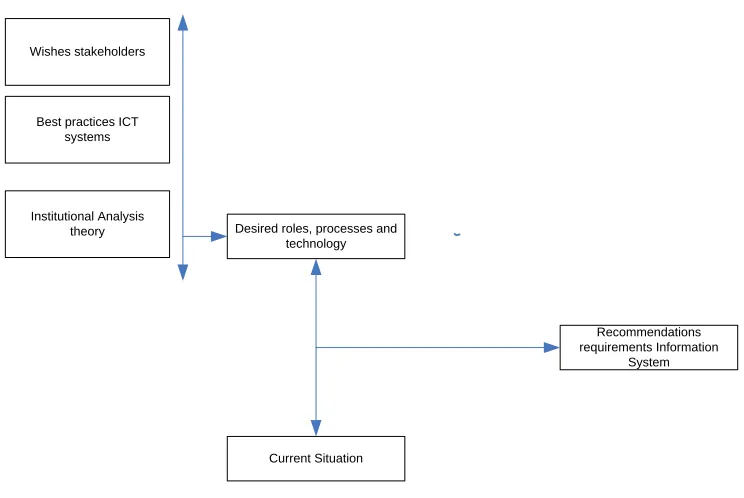
The objective of this research is to design key requirements of an information system that support both planned and unplanned use of the shared meeting rooms in Ravelijn. We have performed this research for the school of Management and Governance by making explicit the factors that currently limit planned and unplanned use of the shared meeting rooms, create insight in the desired components and confront the current and desired situation to create a set of key requirements for the information system.
To this purpose we perform a stakeholder analysis, study best practices in the market and analyze Commons literature.
This objective statement described above can be schematically seen in the research model, Figure 1. The approach discussed by Verschuren and Doorewaard to develop a research model has been used in this research. [Ver98] The benefit of a research model is that it gives a global oversight of the goal of the research and the steps needed to achieve that goal [Ver98]. The research model has been revisited several times during the research due to a better delineation of the scope.
Recommendations requirements Information
System
Current Situation Desired roles, processes and
technology Wishes stakeholders
Best practices ICT systems
[image:18.612.120.492.420.669.2]Institutional Analysis theory
19/185
For this research we have made the choice to approach the desired situation not purely as a computer-based information system, but rather take a broader approach, by investigating the requirements for an information system. The difference is that an information system is defined as interrelated components working together to collect, process, store, and disseminate information to support decision making, coordination, control, analysis and visualization in an organization [Lau02]. A computer-based information system (CBIS) is an information system that relies on computer hardware and software for processing and disseminating information [Lau02]. The difference is that an information system does not necessarily uses computers, while a CBIS system does. This means that our recommendations are not limited to an ICT system but includes other components, such as people roles and processes that need to be present in the organization as well. The reason is that we think that the desired situation of flexibility does not merely come from only a new ICT system, but needs changes in the way people currently interact with the rooms as well (organizational changes). We discuss these problems, their causes and consequences in more detail in chapter 5.
2.3
Research Questions
In this section we discuss the problem statement and the research questions. Based upon the objective discussed in the previous section the following problem statement has been defined:
What are the requirements for an information system to support planned and unplanned use of the MB owned shared meeting rooms in Ravelijn?
According to Wieringa and Heerkens this problem statement is a world problem as the purpose of this problem statement is to change the world. [HW06] That is, MB management is interested in a set of requirements to develop or buy (and implement) an IT system. The consequence of a problem being a world or a knowledge problem is the approach on how to solve the problem. Practical problems can be solved through the engineering cycle, while knowledge problems require research. [WH06]
In order to help solve the problem statement the following knowledge questions have been defined: 1. Who are the stakeholders for this project?
2. What is the current situation with regard to use and monitoring of usage of shared meeting rooms at MB?
3. What are the problems in the current situation that prevent the information system to support planned and unplanned use of the resource?
a. What are the problems according to stakeholders? b. What are the problems found during observations?
c. What problems can be found in institutional analysis literature?
4. What are the desired roles, processes and technology for an information system to support planned and unplanned use of the shared meeting rooms?
a. What best practices for information systems to support use of a shared resource can be learned from Institutional analysis literature?
20/185
5. What actors, processes and artifacts should be put in place within the current situation, taking the Commons framework as a reference?
6. How well does the organization in the current situation score with regard to current application of the identified best practices for Commons?
2.4
Research approach
[image:20.612.101.508.369.652.2]There are three typical kinds of projects, each has a different approach [OF04], and these are: mathematical research project, a design research project and an empirical research project. A mathematical research project’s goal is to define hypotheses and proving the theorems. A design research project’s goal is to create a specification or prototype that can be tested, based on a problem definition, and has rigor through the used methodologies and theoretical foundations. An empirical research project’s goal is to define a theoretical framework and formulating hypotheses, collecting test data, analyze and interpret the data and formulate conclusions and recommendations based on the data [OF04]. This research fits the design research project the most as the goal is to create a set of requirements, i.e. an artifact is created. Therefore we have used the framework to perform information systems research, as proposed by Hevner et al. [HMP04]. The authors provide guidelines on how to provide relevance and rigor to information systems research projects. Their research framework can be seen in Figure 3.
21/185
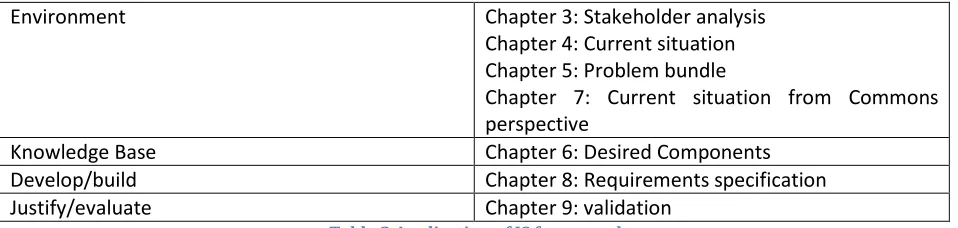
Our application of the framework and the corresponding chapters in this report can be seen in Table 2 below.
Environment Chapter 3: Stakeholder analysis
Chapter 4: Current situation Chapter 5: Problem bundle
Chapter 7: Current situation from Commons perspective
Knowledge Base Chapter 6: Desired Components
Develop/build Chapter 8: Requirements specification
[image:21.612.67.546.112.226.2]Justify/evaluate Chapter 9: validation
Table 2 Application of IS framework
Firstly we have researched the environment of our research. We have performed a stakeholder analysis, and interviewed relevant stakeholders, to make explicit the processes and technology in the current situation, as well as any problems the stakeholders currently experience with regard to the usage of the shared meeting rooms. Secondly, we have performed a literate study to make explicit the problems that management could reasonably expect from a Commons’ theory perspective. Thirdly we have combined the insights of the stakeholder analysis, informal observations and the literature study into a problem bundle. This problem bundle provides us with causality between the problems found, and provides us with an ordering of the business needs with regard to the desired system. Chapter 3 provides the stakeholder analysis. Chapter 4 describes the current situation. Chapter 5 discusses the problem bundle. Secondly, we have researched best practices in Commons situations by performing a literature study. We have investigated best practices in comparable ICT systems by holding interviews with experts in the market. This provides us with the knowledge base to provide recommendations for the desired system. Chapter 6 discusses the best practices found.
Thirdly, we have combined the insights from the business needs analysis and the knowledge base via a qualitative analysis into a set of key requirement for the desired system. The development/build step has consisted of using a requirements analysis method to transform the acquired knowledge, business and theories, into a domain level requirements specification. The reason for a domain level requirements specification is that it provides enough detail for management MB to see the effects of the knowledge base used, without locking them into a specific vendor. This gives management the freedom to develop the solution in-house, start negotiations with software houses, or investigate whether there are now software packages that might comply with the suggested requirements. Chapter 8 provides the requirements specification of the system as well as an analysis of the desires of the stakeholders.
22/185
Finally, we provide the conclusions including the limitations of this research and suggestions for future research.
2.5
Scope
In order to keep the project manageable it is important to define what will and will not be investigated. This section discusses the scope of the research.
Firstly, this research focuses only on the MB owned meeting rooms; all other types of rooms at Ravelijn and the campus of Twente University are outside the scope of this research.
Secondly, this research only aims to change and improve upon problems in the operational world. We acknowledge that the collective and constitutional world are influenced by the operational world, but consider these worlds to be a given, rather than a variable. Specifically the choice and possible optimal configuration of the collective choice arrangement is outside the scope of this research. You can find a more in depth discussion of the three worlds in chapter 6.
Thirdly, this research will not go deep into specific technical aspects such as what programming patterns to be used in case MB decides to develop a system for room-reservations. Rather a set of domain level requirements will be provided describing what kind of functionality should be available in the system. The resulting requirements will be a start for a package solution or detailed design of a custom developed system.
23/185
3
Stakeholder analysis
The first step in the problem analysis is to define the relevant stakeholders for this project. This allows us to know which persons we need to interview to identify the problems experienced with regard to the current situation.
In this research we use the onion model approach as proposed by Alexander and Robertson [AR04]. The reason for this approach is that the onion model takes into account a very broad definition of the term stakeholder. In the onion model a stakeholder is not simply an end-user of the system; as Alexander and Robertson put it: “a stakeholder is someone who gains or loses something as a result of the project” [AR04]. Therefore by using this approach to modeling stakeholders, we are able to get a more comprehensive view on the problems and wishes, of the stakeholders, present in the school of Management and Governance.
Firstly we present the default onion model as proposed by Alexander and Robertson. Secondly we apply this general model to the shared meeting room system situation at Ravelijn for the school of Management and Governance.
3.1
Default Onion Model
[image:23.612.157.456.361.665.2]The default onion model can be seen in Figure 4 below.
24/185
The model consists of four layers; the kit, the system, the containing system and the wider environment. The further away a layer is from “The Kit”, the less the stakeholders in that layer are involved with the daily operations relevant to the system. The Kit is the center of the model and represents the system under development. The System layer consists of The Kit and its human operators and the standard operating procedures or rules governing its operation. The containing system consists of The System and any human beneficiaries. The wider environment consists of the Containing System and any other stakeholders [AR04]. Alexander and Roberts discuss that the default onion model can be adjusted to the specific situation. Not every stakeholder role has been modeled, only those that generally exist in a project [AR04]. The figure below, Figure 5, gives a short description of each of the stakeholder roles.
The System
Normal Operator: this stakeholder gives routine commands and monitors outputs from the
product.
Operational Support: the stakeholder role that advises the normal operator on how to use the
system.
Maintenance Operator: this stakeholder role involves the people who maintain the product,
diagnose and fix faults.
The containing system
Functional Beneficiary: this stakeholder role benefits from the result or output created by the
system.
Purchaser: the stakeholder role that is responsible for having the system developed.
Interfacing System: stakeholder roles responsible for neighboring systems that have electronic
or other interfaces to the product.
Product Champion: role responsible for initiating development of the Product, for obtaining
funding for it, and for protecting the development from ‘political’ pressures and funding cuts. The role requires positional power within the purchasing organization (e.g. the company creating a mass-market product).
The Wider Environment
Financial Beneficiary: any role that can benefit financially from the product.
Hostile Agent: any stakeholder role that actively seeks to hinder or harm the product.
Regulator: any role responsible for regulating the quality, safety, cost or other aspects of the
Product. For example, aviation authorities, health and safety executives, rail regulators, radio regulators, financial service authorities
Negative Stakeholders: any stakeholder role that could be harmed by the product, physically,
financially or legally.
Developer: any of the roles directly involved in the development of the product e.g. , engineer,
25/185
Consultant: any of the many roles (marketing expert, software expert, business analyst,
management specialist, etc.) involved in supporting some aspect of Product development, characteristically from outside the development organization. Internal consultancy is possible but problematic, as it is hard to speak out in the face of ‘political’ pressure within the organization
Political Beneficiary: any role that can benefit in terms of power or prestige from the
development of the product.
Figure 5 Standard Onion stakeholder roles (Adopted from [AR04] and [AL05])
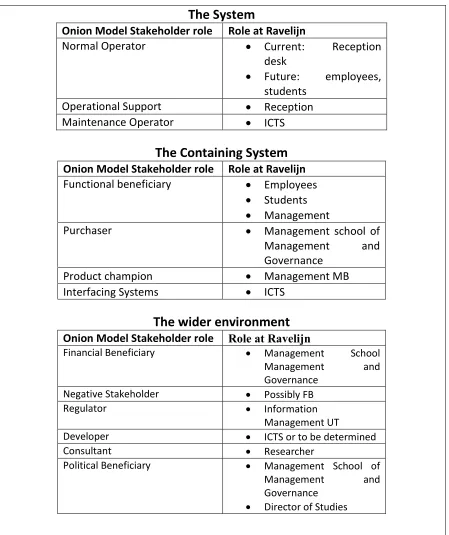
3.2
Stakeholders at School of Management and Governance
26/185
The System
Onion Model Stakeholder role
Role at Ravelijn
Normal Operator
Current:
Reception
desk
Future:
employees,
students
Operational Support
Reception
Maintenance Operator
ICTS
The Containing System
Onion Model Stakeholder role Role at Ravelijn
Functional beneficiary
Employees
Students
Management
Purchaser
Management school of
Management
and
Governance
Product champion
Management MB
Interfacing Systems
ICTS
The wider environment
Onion Model Stakeholder role
Role at Ravelijn
Financial Beneficiary Management School
Management and
Governance
Negative Stakeholder Possibly FB
Regulator Information
Management UT
Developer ICTS or to be determined
Consultant Researcher
Political Beneficiary Management School of
Management and
[image:26.612.69.518.67.602.2]Governance Director of Studies
Table 3 Stakeholders for the information system under development
3.2.1
The system layer
On the system level the following stakeholder roles from the Onion model have been identified: normal
27/185
Onion Model Stakeholder role
Role at Ravelijn
Normal operator
Current: Reception
Future:
employees,
students
Operational Support
Current: Reception
Maintenance operator
ICTS
Table 4 the system layer stakeholders
In the current situation there is one role at Ravelijn that falls under the Normal Operator role, and that is the reception. This party has exclusive access to the system to make reservations and view availability of the rooms. However, in the future situation it is possible that the roles that fall under the Functional Beneficiary role may become Normal Operators. Therefore we have made the choice to include employees and students as Normal Operators as well.
The second stakeholder role is Operational Support, which is currently represented at Ravelijn by reception. When a new person joins the team of receptionists, the more experienced employees provide training to that person in how to work with the system. As a side note, should employees and students become Normal Operators in the future situation, the instantiation of this stakeholder role at Ravelijn should be re-evaluated. It may be undesirable to have the receptionist provide support to every individual in Ravelijn.
The third role at the system layer is that of Maintenance Operator. This role is filled at Ravelijn by ICTS. ICTS is a central organization of University Twente that provides IT facilities and support. It has a department at Ravelijn to provide IT support, which includes the support needed to keep the current room reservation system running.
3.2.2
Containing System
In the containing system layer we have identified roles at Ravelijn for each of the four default Onion model stakeholder roles. No additional stakeholder roles in the containing system layer have been found. The results of the analysis can be seen in Table 5.
Onion Model Stakeholder role
Role at Ravelijn
Functional Beneficiary
Employees
Students
Management
Purchaser
Management School
of Management and
Governance
Product Champion
Director of Studies
school
of
Management
and
Governance
Interfacing Systems
ICTS
28/185
The Functional Beneficiary is represented at Ravelijn by two different roles: employees and students. The term employee is a collection for all the different types of employees that are present at Ravelijn. From a system perspective there is an important distinction to make in the following three types of employees:
Secretaries: who reserve rooms for other people
Other reserving employees: people who only reserve rooms for themselves. The school of Management and Governance has two types of employees, depending on the nature of their work: supporting and managerial personnel and scientific personnel. Management: employees who do not necessarily reserve rooms themselves, but are interested in management information about the usage of the shared meeting rooms.
The difference between these three types of employees is first of all the type of information they need. Secretaries need to be able to reserve rooms for other people, while the other reserving employees only need to be able to reserve rooms for meetings they are themselves included in. Thus these two types of employees need information that allows them to make a reservation decision. The third type, management, is more interested in aggregated information about the shared meeting rooms, for example occupancy.
The second role at Ravelijn of Functional Beneficiaries is students, who can currently make use of the rooms, but cannot reserve the rooms in advance at all. Students can claim a room by going to reception and check whether there is a room available at that point in time, if so, they can claim it.
The Purchaser role is represented at Ravelijn by Management School of Management and Governance. Management decides whether the faculty will invest in a new system and makes arrangements for payment.
The Product Champion role is represented at Ravelijn by one of the directors of studies of the school of Management and Governance. The assignment to research requirements for a new system has been issued by one of the director of studies and he has been the person to provide initial scoping for the project.
The Interfacing Systems role is represented at Ravelijn by ICTS. ICTS is responsible for making sure that the necessary IT components can work with each other to provide the IT services as requested by the faculty.
3.3
Wider environment
In the wider environment layer the following Onion Model stakeholder roles have been identified: Financial Beneficiary, Negative Stakeholders, Regulator, Developer, Consultant and Political Beneficiary. The corresponding roles at Ravelijn can be found in Table 6.
Onion Model Stakeholder role Role at Ravelijn
29/185
Management and
Governance
Negative Stakeholder Possibly FB
Regulator Information
Management UT
Developer ICTS or to be determined
Consultant Researcher
Political Beneficiary Management School of
Management and
Governance Director of Studies
Table 6 Stakeholders Wider Environment
The first role to discuss is that of Financial Beneficiary. It is hard to define who might benefit financially from this system, due to the nature of the system. The system is going to support daily activities; in itself the system does not generate profit. However, the system does provide indirect benefits by being able to support a more efficient and/or effective way of working. This in turn might be able to provide better information with regard to demand for the resource, and may enable management to more cost efficiently manage the use of the rooms. Therefore we have defined management as the financial beneficiary of this project.
The negative stakeholder may be represented in this project by Facilitair Bedrijf. Facilitair Bedrijf is an organization at University Twente which has received the responsibility from College van Bestuur to provide all facility related services. These services range from catering to logistics to being involved with the building of new buildings and renting buildings to faculties. Facilitair Bedrijf also develops plans to accommodate expected future demand for infrastructures at University Twente. During this research Facilitair Bedrijf proposed a new plan to College van Bestuur to create a university wide pool of rooms, which would include the shared meeting rooms at Ravelijn [Fb09]. From this plan it became clear that the current way the rooms are used, may change in the future. These changes would be University wide, making rooms in buildings accessible for each faculty, which is currently not the case. Thus the current policies with regard to how and by whom rooms can be used may change significantly, which in turn may change the requirements for an information system. However, in this research the choice has been made to take the current policies as a given, although noting that this may change in the future. Now, this does not make Facilitair Bedrijf necessarily a negative stakeholder, but it does increase the likelihood as the scope of this system may not match the desired future policies as proposed by Facilitair Bedrijf.
The Regulator role is represented in the current situation by the department of Information Management. This organization is responsible for making sure that existing and new strategies are supported through ICT at University of Twente. This includes that the organization wants to make sure that new ICT developments fit well into the existing ICT infrastructure.
30/185
school of Management and Governance will contract an external party to perform the development of the new system.
The Consultant role for this project is the researcher who is performing this research project.
The Political Beneficiary role is in this case the director of Studies at the school of Management and Governance as he was the person to initiate the project. Management School of Management and Governance is also a party that is likely to benefit in terms of power or prestige, as a well working system could be used as a success story to motivate other faculties to use a similar system.
3.4
Conclusion Stakeholder Analysis
31/185
4
Current situation
This chapter provides an answer to the second sub question “What is the current situation with regard to use and monitoring of usage of shared meeting rooms at MB?” We have interviewed the following stakeholders from The System layer: normal operators and operational support. We have also interviewed stakeholders from the containing system layer: functional beneficiaries, product champions and interfacing systems. The results of these interviews can be found in Appendix F. These interviews have been held to gain a better understanding of the current situation: the people, processes and technology, with regard to the MB owned shared meeting rooms in Ravelijn.
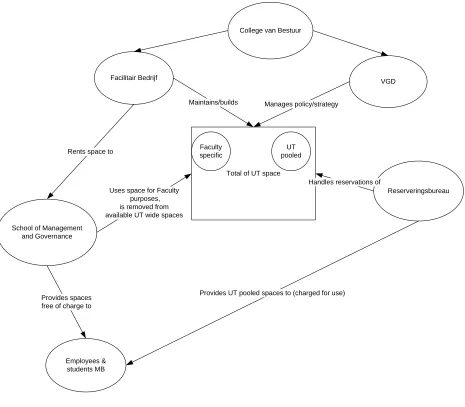
4.1
Shared meeting rooms in context
32/185
College van Bestuur
VGD Facilitair Bedrijf
Total of UT space
School of Management and Governance
Reserveringsbureau Rents space to
Employees & students MB Provides spaces free of charge to
Provides UT pooled spaces to (charged for use) Maintains/builds Manages policy/strategy
Handles reservations of Uses space for Faculty
purposes, is removed from available UT wide spaces
UT pooled Faculty
[image:32.612.76.541.71.478.2]specific
Figure 6 UT Infrastructure, involved parties and responsibilities
4.2
Processes
We have found five different processes with regard to the reservation and use of the shared meeting rooms: reservation of a room, unplanned use of a room, planned use of a room, cancel reservation, swap reservation and monitoring of room occupancy. Next we discuss these processes in detail, including who performs these processes, and finally we provide an overview of the technology used in these processes.
33/185
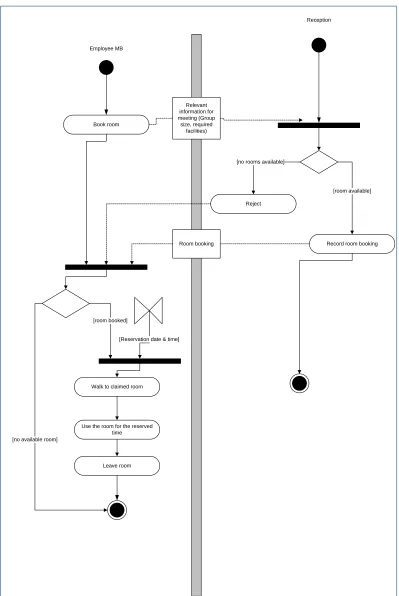
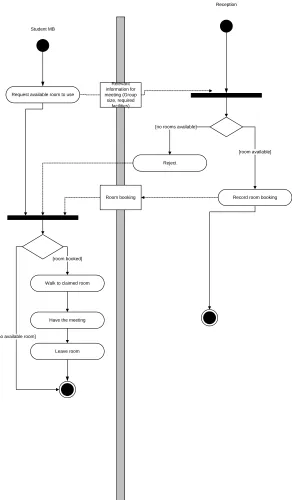
used in each step. A black circle is the start point or trigger of the activity. A rounded square denotes a specific activity performed. A square is an information object and shows which information is sent to another party/object. A horizontal black bar is a wait sign for inputs to have arrived before the next activity can be undertaken. A Black circle with another circle around it is the end point of the entire activity. A grey vertical bar is a swim lane to make clear that there are multiple people/roles performing steps. A dotted line is to indicate that an information object or step is going across swim lanes to another role. A filled line is to indicate the flow of steps. An hourglass indicates an event triggered by the occurrence of a date/ time.
4.2.1
An employee reserves a room him/herself
The first process we discuss is the most simple reservation process that is performed at Ravelijn: In this process the employee makes reservations for shared meeting rooms himself, see Figure 7 below. In this process an employee has direct contact with reception desk. The employee contacts the reception via e-mail, telephone or physically walks to the reception desk at the entrance of Ravelijn. The employee communicates the wishes for the reservation; reception checks whether there is a room available. If so, the room is booked by reception into the Outlook calendar. Otherwise the employee might change his/her wishes, or look for another room at the campus. When the reservation is made, the employee may write the reservation down in his/her own agenda. This is the end of the reservation process.
34/185
Figure 7 Employee reserves shared meeting room
Employee MB
Book room
Record room booking Reception
Relevant information for meeting (Group size, required
facilities)
Reject [no rooms available]
[room available]
Walk to claimed room
Use the room for the reserved time
Leave room [room booked]
Room booking
[no available room]
35/185
4.2.2
An employee reserves a room via a secretary
This process is the second reservation process that typically occurs at Ravelijn. In this process, an employee has a secretary who handles room reservations for that employee, see Figure 8 below.
36/185
Figure 8 Secretary reserves room for employee
4.2.3
Student reserves a shared meeting room via reception
The third process is about how students use the shared meeting rooms, see Figure 9 below. A student is allowed to use the shared meeting rooms, but cannot reserve the rooms in advance. Students are only allowed to use rooms that are available at that moment in time. The student can reserve the room as follows.
The student goes to reception to see whether there are shared meeting rooms available. Reception checks on the desktop computer whether a room is available that satisfies the needs the student might have (room size, facilities such as beamer). If there is a room available, the student can reserve that room (to be used immediately). Officially this room use should be recorded in Outlook, but reception
Employee MB
Request for room reservation
Record room booking Reception
Relevant information for meeting (Group size, required
facilities)
Reject [no rooms available]
[room available]
Walk to claimed room
Use the room for the reserved time
Leave room
[room booked]
[Reservation date & time]
Put reservation in agenda of employee Secretary
Book room
Notify employee of rejection
37/185
[image:37.612.166.458.120.620.2]desk does not consistently record the usage. After the room has been claimed for the student, he/she can walk to the room and use it.
Figure 9 Student has a meeting in a shared meeting room Student MB
Request available room to use
Record room booking Reception
Relevant information for meeting (Group size, required
facilities)
Reject [no rooms available]
[room available]
Walk to claimed room
Have the meeting
Leave room [room booked]
Room booking
38/185
4.2.4
Unplanned use of room
This process entails the unplanned use of a room. In this case an individual circumvents reception entirely and simply checks whether there is a room available, if a room is available, he goes to sit there and use the room. Examples of triggers for this process include ad hoc meetings of professors with students, telephone calls that need to be made in a quiet environment or individuals who simply ignore the formal procedure of reserving a room via reception. As can be seen, no record is made of this type of use in the Outlook system at the reception desk.
Walk to a shared meeting room
Use the room
[image:38.612.240.370.210.462.2]Leave room Individual
Figure 10 Unplanned use of room
4.2.5
Swap reservation
During interviews with the secretaries we found that secretaries swap reservations with other secretaries. This process can be schematically seen in Figure 11 below.
39/185
Figure 11 Secretary swaps reservation
Secretary
Reservation information
Secretary
Check if it is possible to trade reservation
[trade is possible]
[trade is not possible] Give reservation to secretary &
remove meeting from own agenda Reservation
information
40/185
4.2.6
Cancel reservation
It may occur that a person who has made a reservation is not able to make use of that reservation, for example, the meeting was cancelled, traffic issues or illnesses. Some people inform reception when such an event occurs, to cancel the reservation which has been made. Reception can then remove the reservation from the system, freeing up the room for someone else to use. During interviews it was mentioned that this act of courtesy is very easy to forget. Not reporting cancellations results in the Outlook calendar not being congruent with the real world; consequently reception may think a room is reserved, when it is actually free to be used.
4.2.7
Monitoring
Management is interested in the occupancy rate of the building. In the current situation this rate is measured periodically. Every once in a while a student is hired to walk by each shared meeting room, to record whether the room is in use at that point in time.
4.3
Technology shared meeting Rooms
In this section we discuss the technology employed with regard to the usage and monitoring of the shared meeting rooms at Ravelijn. Firstly we discuss the hardware used in the technical infrastructure section. Secondly, we discuss the communication structure and thirdly we provide a brief overview of other related technology available at University Twente.
4.3.1
Technical Infrastructure
The technical infrastructure with regard to the reservation system is as follows: a desktop computer is physically located at the reception desk. This desktop computer runs Microsoft Outlook software. In Outlook a user profile has been made for each shared meeting room. Reception employees enter reservations into Outlook Agenda to record that the room has been reserved. The appointment information is currently only accessible at the reception desktop computer. The reception desk also has a desktop phone to receive incoming calls and is accessible via e-mail.
With regard to monitoring of the use of the shared meeting rooms, the technology used is low-tech: a piece of paper and a pen is used to write down which rooms are in use.
4.3.2
Communication Structure
41/185
Figure 12 Reservation related communication structure
42/185
4.3.3
Technology UT
Reserveringsbureau is the department that handles reservations of all pooled rooms on the university campus: for example lecture halls, congress rooms and other rooms that are shared by all faculties on the university. Reserveringsbureau uses a program called ZBS to record reservations of lecture halls. The department uses another software package called Planon to handle all maintenance calls, and reservations of pooled non lecture halls (congress rooms, pooled meeting rooms). Reserveringsbureau is in the process of replacing ZBS with Syllabus Plus, which features better roster functionality.
ZBS has a database as lecture rooms, while Planon has a database of all pooled rooms that exist on University Twente, including the lecture rooms in ZBS. However, there is no coupling of information between ZBS and Planon. When Reserveringsbureau needs information about the availability of lecture rooms, they need to access ZBS; this cannot be done in Planon.
Furthermore, each faculty, like MB, has rooms that are only available to that specific faculty. These rooms are managed by each faculty separately, with each faculty using separate software. In this research we have not investigated which software each other faculty specifically uses. None of these systems are currently coupled with each other. If you would want to reserve a faculty owned room at a faculty, you would need to contact reception for that specific building. If you want to reserve a pooled room, such as a lecture hall, you would need to contact Reserveringsbureau. To conclude, the availability Information about all the rooms on the UT is stored in several places, depending on what type of room it is, it is either recorded at Reserveringsbureau or at a faculty proprietary system.
4.4
Conclusion
43/185
5
Problem description
In this chapter we answer the question, what are the problems in the current situation that prevent the
information system to support planned and unplanned use of the resource? To answer this question we
have investigated three sub questions: a) what are the problems according to stakeholders? B) What are the problems found during observations? C) What problems can be found in institutional analysis literature? We discuss the answers to these three sub questions first. Finally, we combine the problems found into one problem bundle. We use a problem bundle to identify the causal relationships between the problems. The problem bundle therefore allows us to identify the root problems that need to be solved in the new information system, in order to be able to support planned and unplanned use of the shared meeting rooms.
5.1
Problems as experienced by stakeholders
This section answers the sub question: What are the problems in the current situation according to the
stakeholders? To answer this question we have interviewed people who fulfill the stakeholder roles in
The System and containing system layer of the Onion Stakeholder Model, as discussed in chapt
![Figure 3 IS Research framework (Adopted from [HVP04])](https://thumb-us.123doks.com/thumbv2/123dok_us/1187373.641903/20.612.101.508.369.652/figure-research-framework-adopted-hvp.webp)
![Figure 4 Onion Model (Adopted from [AR04])](https://thumb-us.123doks.com/thumbv2/123dok_us/1187373.641903/23.612.157.456.361.665/figure-onion-model-adopted-from-ar.webp)