DOI: 10.4236/jcc.2017.58006 June 30, 2017
Maurice Tchoupé Tchendji1, Rodrigue D. Djeumen2, Marcellin T. Atemkeng3
1Department of Mathematics and Computer Science, Faculty of Sciences, University of Dschang, Dschang, Cameroon 2Department of Mathematics and Computer Science, Faculty of Sciences, University of Douala, Douala, Cameroon 3Department of Physics and Electronics, Rhodes University, Grahamstown, South Africa
Abstract
Complex structured documents can be intentionally represented as a tree struc-ture decorated with attributes. Ignoring attributes (these are related to semantic aspects that can be treated separately from purely structural aspects which inter-est us here), in the context of a cooperative edition, legal structures are characte-rized by a document model (an abstract grammar) and each intentional repre-sentation can be manipulated independently and eventually asynchronously by several co-authors through various editing tools that operate on its “partial rep-licas”. For unsynchronized edition of a partial replica, considered co-author must have a syntactic document local model that constraints him to ensure minimum consistency of local representation that handles with respect to the global model. This consistency is synonymous with the existence of one or more (global) intentional representations towards the global model, assuming the current local representation as her/their partial replica. The purpose of this pa-per is to present the grammatical structures which are grammars that pa-permit not only to specify a (global) model for documents published in a cooperative man-ner, but also to derive automatically via a so call projection operation, consistent (local) models for each co-authors involved in the cooperative edition. We also show some properties that meet these grammatical structures.
Keywords
Structured Documents, Documents Models, Grammars, Cooperative Edition, Structured Edition, Projections, Views, Partial Replicas
1. Introduction
With the rise of XML technologies and Web services, structured documents have become important tools for the publication and exchange of information bet- ween most often heterogeneous and remote applications. The ever-increasing How to cite this paper: Tchoupé, M.T.,
Rodrigue, D.D. and Atemkeng, M.T. (2017) A Stable and Consistent Document Model Suitable for Asynchronous Cooperative Edi-tion. Journal of Computer and Communi-cations, 5, 69-82.
https://doi.org/10.4236/jcc.2017.58006 Received: May 10, 2017
Accepted: June 27, 2017 Published: June 30, 2017 Copyright © 2017 by authors and Scientific Research Publishing Inc. This work is licensed under the Creative Commons Attribution International License (CC BY 4.0).
http://creativecommons.org/licenses/by/4.0/
70
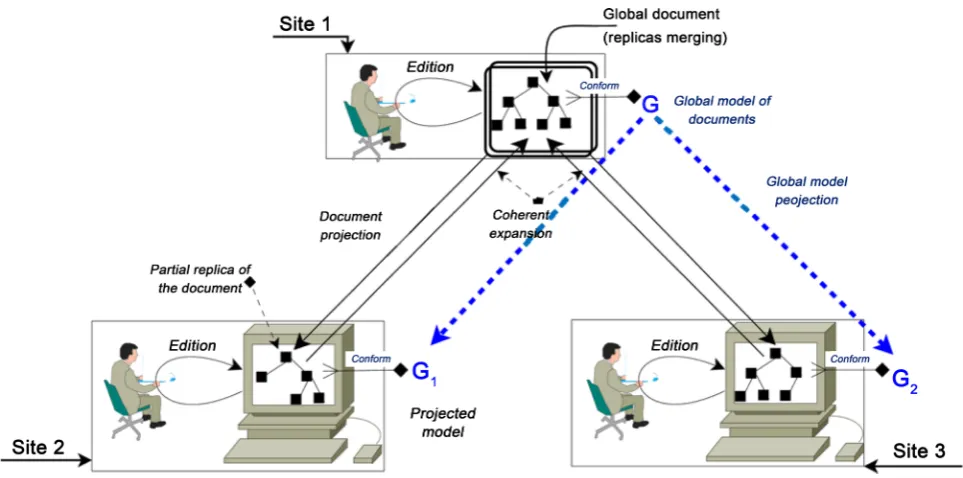
power of communication networks in terms of throughput and security as well as efficiency is concern, has revolutionized the way of such documents are edited. Indeed, to the classical model of an author editing his document locally and autonomously, was added the (asynchronous) cooperative editing in which, several authors located on geographically distant sites, coordinate to edit asynch- ronously the same structured document (Figure 1).
Cooperative structured editing is a research field related to computer- supported cooperative work—CSCW [1], which Baecker, et al. in [2] defined as a set of activities performed on computers and coordinated by a group of collaborative entities. Structured cooperative publishing is a hierarchically orga- nized group publishing work, that operates according to a schedule involving deadlines and task sharing (coordination). When it is asynchronous, each of the participating co-authors in the edition has on its site, a replica of the structured document (intentionally represented as an abstract tree) on which he acts. It is generally preferable for safety reasons1, efficiency2, … that this copy is only a partial replica of the global document, i.e. consisting only of parts of the document containing relevant information related to the considered co-author. In this case, in order to minimize the inconsistencies that can be introduced in the partial replica when locally edited, and to ensure that at the end of edition (or at specific times), the different contributions will be structurally merged [3] [4], each co-author must have on his publishing local site a local document model (a grammar) which is consistent with the global model. Intuitively, a local document model is consistent with respect to the global model, when any partial document t’ that is conform to him is the partial replica of at least one document t conform to the global model.
The central issue addressed in this paper can be simply presented by means of an example of unsynchronized cooperative structured editing process (Figure 1). In fact, one can easily imagine an editing process in which several authors work together to produce a pluri-disciplinary book and such that, according to its own field of expertise, everyone contribute to more or less disjointed parts of the same document.
It may be interesting for these authors to specify previously (may be together) the overall hierarchical structure of the document via a grammatical model; we call thereafter global model of the document. From it are derive for each of the co-authors a dedicated (local) model called thereafter local model. This local model can be regarded as a “view” on the global model and obtained by means of a projection operation performed on it, which retains on the global model only syntactic categories with a demonstrated interest for the considered author.
For example, Figure 1 present an overview of the cooperative edition distributed on three sites. Site 1 is dedicated to the edition and the merging of 1For a given co-author, some parts of the document may contain sensitive information. It is prefera-ble that he is not even informed of the presence of this information in the document. As we shall see later, the projection operation will resolve this confidentiality problem.
71
Figure 1. The desynchronized cooperative editing of partial replicas of a structured document.
the (global) document according to the (global) document model G hosted on him. On G, two projections are made to obtain G1 and G2, the local models hosted by site 2 and 3 an used for syntactically constrain the desynchronized edition of the partial replicas of the global document on the sites 2 (resp. site 3). Note that, documents published on these sites can be saved (serialized) then restored by parsing. The overall document is subsequently obtained from the site 1 by performing a consistent expansion3 of the various documents published on sites 2 and 3.
The purpose of this paper is to propose a generic document model allowing to specify syntactically both the global model and derived local models, which are consistent with the global model.
In order to do this, we propose the grammatical structures (a subset of the extended context free grammars) as well as a projection operation which allows to derive from a grammatical structure (global model) and a set of syntactic categories relevant to a given co-author, a local grammatical structure dedicated to him.
Organization of the manuscript: Section 2 presents some concepts and definitions used thereafter. Section 3 presents the grammatical structures, the projection algorithm on grammatical structures and some features of this model. Section 4 is devoted to the conclusion.
2. Preliminaries
72
to the sequence of terminal and non-terminal that constitute the right hand side of productions in classical context free grammar. More formally, an extended context free grammar =
(
S P,)
is given by a finite set of syntactic categories S, a finite set of production rules P written as s→Ps such that, s∈S ands
P is a regular expression defined on S.
The dependency graph D of grammar is a graph whose set of node tags is included in S and, for all rules s→Ps in P, there is an arrow from
s
tob
, for allb
in a word belonging to the language denoted by Ps and termed L( )
Ps . An ECFG is said to be non recursive if and only if D isacyclic, and recursive if not.
A document t conforms to a grammar and we write t∴, if it is a derivation tree of this grammar: it’s the case if for any t node n labeled s∈S and with children nodes n1,,nm labeled respectively s1,,sm, si∈S, the word s1sm∈L
( )
Ps .2.2. View, Projection, Partial Replica and Consistency
The derivation tree giving a (global) representation of a structured document published cooperatively, makes visible all the grammar’s grammatical symbols. As mentioned in Section 1 above, a coauthor handling such a document using a structured dedicated editor of his area of expertise, do not necessarily have access to all of these grammatical symbols; only a subset of them correspond to syntactic categories perceptible as such by this tool: hence the notion of “view”
[4]. A view V , is a subset of grammatical symbols (V ⊆S). Intuitively, they are symbols associated with visible syntactic categories in the considered representation (derivation tree).
Each view V is associated with a projection operation noted πV
( )
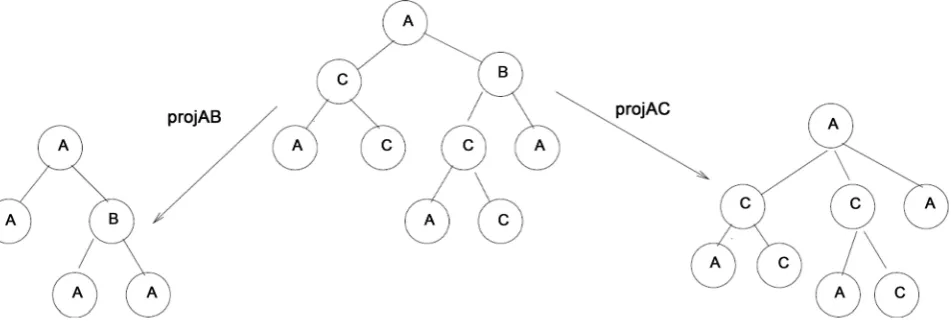
t , on derivation trees t which erases nodes labeled by invisible symbols while retaining the subtree structure. Partial replication is the result of the projection of a document (derivation tree) with respect to a given view. For example, in theFigure 2 from the global document t in the center, and views V1=
{
A B,}
and{
}
2 ,
V = A C on the alphabet S=
{
A B C, ,}
, we have on the left the partial replica tV1=πV1( )
t , and on the right the partial replica tV2 =πV2( )
t .The edition type considered in this paper is asynchronous. On a site i hosting a document model Vi on which a partial replica tVi is updated with
i i
V
t ∴V, we will say that
i V
t is consistent vis-a-vis a global model , and we write tVi if and only if a document t∴ exists and
( )
i i
tV =πV t . Also, a local model Vi is consistent vis-a-vis a global model if and only if
,
i i
t t
∀ ∴V ∃ ∴ such that ti=πVi
( )
t .2.3. Some Definitions and Notations
Let =
(
S P,)
be an extended context free grammar, X Xi, j∈S, α ∈S*,⊆
V S a view, t a derivation tree for (t∴),D the dependency graph of and p∈P a production rule.
73
Figure 2. One document (center) and two partial replicas obtained by projections.
is said to be finite type if and only if D is non recursive. is said to be finite type with respect to V if the restriction of dependency graph D on symbols which belongs to V is not recursive.
We note nt t
( )
⊆S the t’s set nodes labels, and root t( )
the t’s root node label.The notation “ p@X →α ” means that “p has the form X →α ”. We introduce function lhs p
( )
(resp. rhs p( )
) which returns the symbol (resp. the symbols) in left hand side (resp. right hand side) of his argument p, a production rule. For example, if p@X0→X1Xn, lhs p( )
=X0 (resp. rhs p( ) {
= X1,,Xn}
).Also, p X
[
1 α1,,Xn αn]
means the substitution in the right hand side of p ofall occurrences of each symbols Xi∈S by the corresponding αi. For example, with p X: 0→aX bX cX1 1 5, α =1 X X2 3, p X
[
1 α1]
={
X0 →aX X bX X cX2 3 2 3 5}
.(
, Ai)
L is the language generated by grammar from symbol Ai∈S.
3. A Document Model Stable by Projection Operation,
for Cooperative Asynchronous Edition
In this section, we present grammatical structures which are a particular form of non-recursive extended context free grammars (ECFG). Indeed, to make the projection (defined below, Section 3.2) possible, it is not permitted to have in this model, recursive grammar symbols5. The grammatical structures will then be models for documents of bounded depths (consequence of the non- recursivity of the symbols) but of unbounded widths. Moreover, they will allow to specify in a homogeneous way both the global model for the global document and the local models for its various partial replicas.
3.1. Defining (Abstract) Grammatical Structures A grammatical structure =
(
S P,)
is given as:• a set S of non recursive grammatical symbols, and
74
− *
@
q A→B (i.e. A is build up by a list of B)
We recall that an equivalent ECFG can be evidently be derived from a grammatical structure.
3.2. Projection of a Grammatical Structure
Let =
(
S P,)
be a grammatical structure, V ⊆S a view; let also \=
V S V be the complementary of V in S. The view V projection on , termed πV
( )
is the grammatical structure V =(
S PV, V)
where:• PV is obtained from P by successive rewriting of symbols in V in terms of those in V , then, by substituting properly the result (of this rewriting) in the subset of rules P having symbols in V on the left hand side: ∀ ∈p PV, @p X0→X1Xn or
* 0 1
@ , i , 0
p X →X X ∈SV ≤ ≤i n.
• = ∪ new
V
S V S : syntactic categories of the projected grammar contains symbols of the view with enventually new symbols introduce for structuring purpose belonging to set Snew. As the process of obtaining the production rules of the projected model proceed by successive rewriting of symbols which did not belong to the view, it can occur during the rewriting process of some symbols that, new symbols being added for format purpose (or decomposition) in order to bring some rules back to the form of the production rules adopted for the grammatical structures6 (cf. Section 3.1). The algorithm for deriving PV and SV proceeds in two steps:
Step 1: consider the subset Prodν ⊆P of ’s rules which left hand side does not belongs to the view
(
Prodν ={
p∈P, lhs p( )
∈V}
)
and transformthem by successive rewriting to rules like X′ →β , an acceptable rule of grammatical structure, with X′ =lhs p
( )
, and β containing only SV symbols. Hence Pν set is given as:{
}
{
}
{
( )( )
(
)
}
1 1 1 1 2 1
*
1 1 2 1
| | , with : , , ,
@ , , , , .
n n k k k
k k k i i i i
P A A u v w v v w v
p A v A v v A v v A w A
ν
ν
µ µ µ µ +
+ = → ∈ = = ∃ → ∈ ∈ ∈ V
V V L (1)
Indeed, Pν can be considered as production rules of a concrete context free grammar ν with ν =V S∪ new as non terminal symbols and V as terminal symbols; then ν =
(
V S∪ new, , V Pν)
.From Equation (1), one easily deduces that Pν is in fact the union of the rewriting of the productions of having a symbol belonging to V in her left hand side. Thus, for every symbol Xi′ belonging to V , if we note
( )
iPν X′ the set obtained by rewriting rules of having Xi′∈V as left hand side, we have Pν = ∪Pν
( )
Xi′ with Xi′∈ν . Recall that, symbols in V are considered as terminal symbols when rewriting.Algorithm 1 describes the construction process of Pν
( )
Xi′ , Xi′∈ν . Let’s emphasis that, for effective construction of Pν = ∪Pν( )
Xi′ , Xi′∈ν , the different 6For example a form of rule like *0 1 2
:
p X →X X can be obtained after successive rewriting of a rule; this is not an acceptable form of rule. So a new restructuring symbol 1
X is created and rule p
is decompose in two new rules as follow 1 1: 0 2
75
Algorithm 1. Construction of Pν
( )
Xi′ ={
p X: i′→β,∀Xj∈β,Xj∈V}
.sets Pν
( )
Xi′ , Xi′∈ν should be built according to the topological sorting of thei
X
dependency graph: a symbol is evaluated after evaluation of symbols fromwhich it depends.
Step 2: Consider the subset Prodν ⊆P of ’s rules, with view symbols in left hand side (Prodν =
{
p∈P, lhs p( )
∈V}
7); for every rule in this set, replaceall occurrences of V elements in right hand side, by their right hand side counterpart in Pν , this by all means; we finally obtain the set PV of production rules of the projected grammatical structure.
{
}
{
}
{
( )( )
(
)
}
1 1 1 1 2 1
*
1 1 2 1
| | , with : , , ,
@ , , , , .
n n k k k
k k k i i i i
A A u v w v v w v
p A v A v v A v v A w ν A
µ µ µ µ +
+
= → ∈ = =
∃ → ∈ ∈ ∈
V
P V
V V L (2)
As for Pν (Equation (1)), we deduce from Equation (2) that Pν is the reunion of the sets obtained by rewriting the productions of having symbols
i
X belonging to V in their left hand side, by using
P
ν ; that sets is denoted( )
Xiν
P . Thus, PV = ∪Pν
( )
Xi with Xi∈V . The construction of( )
Xi , Xi∈V
P V is described in Algorithm 2 below.
Algorithm 3 purpose is to construct p X
[
1′ ′α1,,Xm′ αm′]
. It explicitlypresents when restructuring symbols are created (line 5) and when they are explicitly used (line 5 and line 8) in generated productions rules.
3.3. Grammatical Structures Properties
Let be a grammatical structure, and V a view; satisfies properties below:
Property 1: πV
( )
is a grammatical structure (stability property); thisproperty is guaranteed by Algorithm 3.
7Note that Prod Prod
76
Algorithm 2. Construction of
{
: , , , new}
i i
p X α X X α X
= → ∈ ∀ ∈ ∈ ∪
V
P V V S .
Algorithm 3. Construction of
{
p X[
1′ ′α1,,Xm′ αm′]
, , αi′∈rhs p( )
′ p′∈Pν( )
Xi′}
.Property 2: if t∴ then
(
πV( )
t ∴πV( )
)
.Property 3: if tV′ is a local update of a replica tV such that tV′ ∴πV
( )
, then(
∃ ∴t , tV′ =πV( )
t)
(consistency property).We present below, the proof of the Property 2. The proof of Property 3 can be obtained from the proof of Theorem 3.3 given in [7].
Proof. Let t∴ be such that πV
( )
t =tV; let’s show that tV∴πV( )
. In order to do this, if we consider an internal node n of tV labeled Ai, with its k children, n1,,nk labeled A1,,Ak; it suffices to show that the word1 k
AA belongs to the language denoted by the grammar V, admitting the symbol Ai axiom i.e. A1Ak∈L
(
V,Ai)
.77
is a leaf in the subtree in which it appears, and the A ii, =1,,k are labels of the root nodes (Figure 5) of other subtrees of type tν or, 3) n and some of his children are in the same subtree and the other are each one in their own subtree (Figure 6). Three case studies are therefore to be considered.
Case 1: n n, ,1,nk belong to the same subtree tj such that nt t
( )
j ⊆V . Inthis case, according to the construction algorithm of P
V, A1Ak∈L
(
,Ai)
[image:9.595.207.541.320.590.2]and therefore to L
(
V,Ai)
.Figure 3. A document (a), its partitioning ((b), (c)) and one of its projections (d).
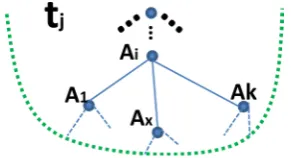
Figure 4. Case where an inner node n and its children n1,,nk belong to the same
[image:9.595.301.447.617.696.2]78
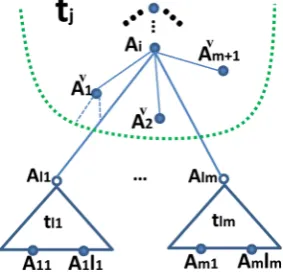
Figure 5. Case of labeled Ai leaf node n of subtree tj (nt t
( )
j ⊆V ), with all its [image:10.595.289.459.68.256.2]children belonging to subtrees of another type.
Figure 6. Case of an internal node n labeled Ai of a subtree tj such that nt t
( )
j ⊆Vwith some of its children belonging to subtrees of another type.
Case 2: Node n labeled Ai is a leaf node of a subtree tj such that
( )
jnt t ⊆V . Let
1, , m
l l
A A be labels of m children of n in t. n has therefore been developed using a
’s production rule of one of the two forms Ai→B*,with B∉V; or Ai→A1Ak with Aj∉V, 1,j= ,k. We develop below the second form, the treatment of the first being similar.
There is therefore m sub-terms of t, says 1, ,
m
l l
t t , whose roots are respectively labeled by Al1,,Alm and such that nt t
( )
lj ∈V. According to thePν’s building process8, we can partition the word A1Ak in m sub-words:
1 2
1 k 11 1l 21 2l j1 jlj m1 mlm
AA =A A A A A A A A
with
(
)
1
1 , 1, , i.e. 1 ,
j j j j
m
l j jl j jl l
l l k
A +ν A A j m A A ν A
+ + =
⇒ = ∈
L
As 1
(
,)
m
l l i
A A ∈L A , A1Ak∈L
(
ν,Ai)
according to the constructionprocess of the productions rules of V (modulo restructuring symbols).
8Reminder: the non-terminals of ν are rewritten by the production rules of P
[image:10.595.303.445.306.444.2]79
building process, we can partition the word A1Ak in 2m+1 sub-words:
1 2
1 k 1 11 1l 2 21 2l m m1 mlm m 1
AA =A Aν A A Aν A A Aν A Aν+
with
*
1 2 1 1
, 1 1
i
m m
A i m
l l l A A k
ν
ν ν
+
∈ ≤ ≤ +
+ + + + + + =
V
and such that
(
)
1 , i.e. 1 ,
j j j j
l j jl j jl l
A ⇒+ν A A A A ∈L ν A . As Aj1Ajlj∈L
(
ν,Alj)
,1≤ ≤j m, we have
(
)
1 2 1 2
1 2 m 1 1 11 1 2 21 2 1 m 1 ,
i l l m l m l l m m ml m i
A ⇒A A A Aν ν A A Aν ν+ ⇒A Aν A A Aν A A Aν A Aν+ ∈ A
L V
and then, A1Ak∈L
(
V,Ai)
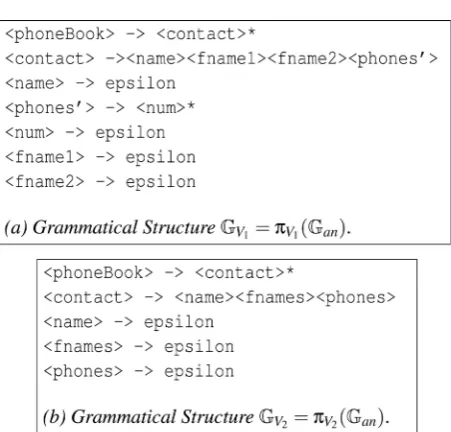
. 3.4. Illustration: Grammatical Structures for the Cooperative Writing of a Small Phone Book
Some of the concepts and algorithms presented in the previous sections are illustrated in this section by considering a simplified case of cooperative writing of a small phone book.
Suppose that two employees of an organization want to cooperate in writing a phone book for their organization. One entry of the book is given by the name (Name), two first names (Fname1 and Fname2), the mails addresses (Emails) and phones numbers (Phones).
A corresponding grammatical structure an describing this phone book is given in the Figure 7. Let us assume that there are two views:
{
}
1 , , , 1, 2,
V = phoneBook contact name fname fname num and
{
}
2 , , , ,
V = phoneBook contact name fnames phones for each of the respective
employees. By applying the Algorithm 2, we have in Figure 8(a) (resp. Figure 8(b)), the grammatical structure V1 (resp. V2) resulting from view V1
(resp. view V2) projection on an. Note that in V1, phone’ is a structuring
symbol.
4. Conclusion
80
Figure 7. A grammatical Structure an of a phone book.
Figure 8. Two local models resulting from the projection on global model of Figure 7 according to view V1 (a) and view V2 (b).
of version managing like CVs for unstructured documents (textual merge) [13]. In the case of structured editing, all co-authors have the same document model and the merging of complete replicas relies on this model (syntactic merging software) [14] [15]. We were interested in this paper to an innovative case—we did not find any study that was done in this direction—in which the co-authors act on partial replicas of the overall document and each with a local model allowing him to validate locally updates made on its (partial) local replica. We proposed as a document model in this context, grammatical structures allowing both to specify the model for the global document, and local models - for partial replicas—dedicated to each co-author. Furthermore, we have defined a projection operation to automatically derive the local models (grammatical structures) of documents from the global one.
[image:12.595.261.487.218.434.2]81 [2] Baecker, R.M., Grudin, J., Buxton, W.A.S. and Greenberg, S. (1995) Readings in
Human-Computer Interaction: Towards the Year 2000. 2nd Edition, Morgan Kaufmann Publishers, Inc., Burlington.
[3] Mens, T. (2002) A State-of-the-Art Survey on Software Merging. Journal of IEEE Transactions on Software Engineering, 28, 449-462.
https://doi.org/10.1109/TSE.2002.1000449
[4] Badouel, E. and Tchoupé, M. (2008) Merging Hierarchically Structured Documents in Workflow Systems, Proceedings of the Ninth Workshop on Coalgebraic Methods in Computer Science (CMCS 2008), Budapest. Electronic Notes in Theoretical Computer Science, 203, 3-24. https://doi.org/10.1016/j.entcs.2008.05.017
[5] Brüggemann-Klein, A. and Wood, D. (1998) One-Unambiguous Regular Languag-es. Information and Computation, 142, 182-206.
https://doi.org/10.1006/inco.1997.2695
[6] Baecker R.M., Cristiana C. and Rosu, D. (2004) On Validation of XML Streams Us-ing Finite State Machines. Proceedings of the Seventh International Workshop on the Web and Databases, Paris, 17-18 June 2004, 85-90.
[7] Badouel, E. and Lamine, M. (2014) Opacité des artefacts d’un système workflow. Revue ARIMA, 17, 177-196.
[8] Berlage, T. and Genau, A. (1993) A Framework for Shared Applications with Repli-cated Architectures. Proceedings of the Conference User Interface Systems and Technology, 17, 249-257.
[9] Balasubramaniam, S. and Pierce, B.C. (1998) What Is a File Synchronizer? Pro-ceedings of the 4th Annual ACM/IEEE International Conference on Mobile Com-puting and Networking (MOBICOM), Dallas, 25-30 October 1998, 98-108.
https://doi.org/10.1145/288235.288261
[10] Wilm, J. and Frebel, D. (2015) Real-World Challenges to Collaborative Text Crea-tion. DChanges’14 Proceedings of the 2nd International Workshop on (Document) Changes: Modeling, Detection, Storage and Visualization, Fort Collins, 16 Septem-ber 2014, Article ID: No. 8.
[11] Decouchant, D., Quint, V., Riveill, M. and Vatton, I. (1993) Griffon: A Cooperative, Structured, Distributed Document Editor. Bull-IMAG, Grenoble.
[12] Fish R.S., Kraut, R.E., Leland, M.D.P. and Cohen, M. (1988) Quilt: A Collaborative Tool for Cooperative Writing. Proceedings of Conference on Office Information Systems, Palo Alto, 23-25 March 1988, 30-37.
https://doi.org/10.1145/45410.45414
[13] Berliner, B. (1990) CVS II: Parallelizing Software Development. The Advanced Computing Systems Professional and Technical Association (USENIX), Prisma, Inc., Colorado Springs, 22-26.
Man-82
agement: Selected Papers SCM-4 and SCM-5. In: Estublier, J., Ed., ACM, New York, 153-172.
[15] Fontaine, R.L. (2002) Merging Xml Files: A New Approach Providing Intelligent Merge of Xml Data Sets. The Pennsylvania State University, Philadelphia.
Submit or recommend next manuscript to SCIRP and we will provide best service for you:
Accepting pre-submission inquiries through Email, Facebook, LinkedIn, Twitter, etc. A wide selection of journals (inclusive of 9 subjects, more than 200 journals)
Providing 24-hour high-quality service User-friendly online submission system Fair and swift peer-review system
Efficient typesetting and proofreading procedure
Display of the result of downloads and visits, as well as the number of cited articles Maximum dissemination of your research work
Submit your manuscript at: http://papersubmission.scirp.org/