http://www.scirp.org/journal/ajps ISSN Online: 2158-2750 ISSN Print: 2158-2742
RGxE: An R Program for Genotype x
Environment Interaction Analysis
Mahendra Dia
1, Todd C. Wehner
1*, Consuelo Arellano
21Department of Horticultural Science, North Carolina State University, Raleigh, USA 2Statistics Department, North Carolina State University, Raleigh, USA
Abstract
Genotype x environmental interaction (GxE) can lead to differences in per-formance of genotypes over environments. GxE analysis can be used to ana-lyze the stability of genotypes and the value of test locations. We developed an Rlanguage program (RGxE) that computes univariate stability statistics, de-scriptive statistics, pooled ANOVA, genotype F ratio across location and en-vironment, cluster analysis for location, and location correlation with average location performance. Univariate stability statistics calculated are regression slope (bi), deviation from regression (S2d), Shukla’s variance (σi2), S square
Wricke’s ecovalence (Wi), and Kang’s yield stability (YSi). RGxE is free and
intended for use by scientists studying performance of polygenic or quantita-tive traits over multiple environments. In the present paper we provide the RGxE program and its components along with an example input data and outputs. Additionally, the RGxE program along with associated files is also available on GitHub at https://github.com/mahendra1/RGxE,
http://cucurbitbreeding.com/todd-wehner/publications/software-sas-r-project/ and http://cuke.hort.ncsu.edu/cucurbit/wehner/software.html.
Keywords
Genotype x Environment Interaction, R Programming Language, RGxE, Univariate, Multivariate
1. Introduction
Genotype x environmental interaction (GxE) refers to the modification of ge-netic factors by environmental factors, and to the role of gege-netic factors in de-termining the performance of genotypes in different environments. GxE can occur for quantitative traits of economic importance and is often studied in plant and animal breeding, genetic epidemiology, pharmacogenomics and con-How to cite this paper: Dia, M., Wehner,
T.C. and Arellano, C. (2017) RGxE: An R Program for Genotype x Environment Interaction Analysis. American Journal of Plant Sciences, 8, 1672-1698.
https://doi.org/10.4236/ajps.2017.87116
Received: March 31, 2017 Accepted: June 20, 2017 Published: June 26, 2017
Copyright © 2017 by authors and Scientific Research Publishing Inc. This work is licensed under the Creative Commons Attribution International License (CC BY 4.0).
servational biology research. The traits include reproductive fitness, longevity, height, weight, yield, and disease resistance.
Selection of superior genotypes in target environments is an important objec-tive of plant breeding programs. A target environment is a production environ-ment used by growers [1] [2] [3] [4] [5]. In order to identify superior genotypes across multiple environments, plant breeders conduct trials across locations and years, especially during the final stages of cultivar development. GxE is said to exist when genotype performance differs over environments. Performance of genotype can vary greatly across environment because of the effect of environ-ment on trait expression. Cultivars with high and stable performance are diffi-cult to identify, but are of great value [6] [7].
Since it is impossible to test genotypes in all target environments, plant breeders do indirect selection using their own multiple-environment trials, or test environments. GxE reduces the predictability of the performance of geno-types in target environments based on genotype performance in test environ-ments [8]. An important factor in plant breeding is the selection of suitable test locations, since it accounts for GxE and maximizes gain from selection [9]. An efficient test location is discriminating, and is representative of the target envi-ronments for the cultivars to be released. Discriminating locations can detect differences among genotypes with few replications. Representative locations make it likely that genotypes selected will perform well in target environments [9].
The analysis of variance (ANOVA) is useful in determining the existence, size and significance of GxE. In order to determine GxE for a group of elite cultivars, genotypes are often considered to be fixed effects and environments random. However, for the purpose of estimating breeding values using best linear un-biased prediction (BLUP), genotypes are considered to be random and environ-ments fixed. Some statisticians consider genotypes random effect, provided that the objective is to select the best ones [10]. If GxE is significant, additional sta-bility statistics can be calculated.
Several statistical methods have been proposed for stability analysis. These methods are based on univariate and multivariate models. The present paper focuses on univariate models for the analysis of stability measured using R pro-gramming, so a brief description of each stability measure is provided below.
The most widely used methods are univariate stability models based on re-gression and variance estimates. According to the rere-gression model, stability is expressed in terms of the trait mean (M), the slope of regression line (bi) and the
sum of squares for deviation from regression
( )
2 dS . High mean of a genotype
performance is a precondition of stability. The slope (bi) of regression indicates
the response of genotype to the environmental index, which is derived from the average performance of all genotypes in each environment. If bi is not
signifi-cantly different from unity, the genotype is adapted in all environments. A bi
yielding environments. A bi less than unity provides a measure of greater
resis-tance to environmental change (above average stability), and therefore increas-ing specificity of adaptability to low yieldincreas-ing environments.
The variance parameters that measure stability statistics include stability eco-valence
( )
2i
W proposed by [11], stability variance
( )
2 iσ proposed by [12], and yield stability (YSi) proposed by [13].
Ecovalence stability index
( )
2 iW of a genotype is its contribution to the GxE
squared and summed across all environments. Since the value of 2 i
W is
ex-pressed as a sum of squares, a test of significance for Wi2 is not available. [12]
proposed an unbiased estimate
( )
2 iσ of the variance of GxE plus an error term associated with genotype. Shukla’s stability variance
( )
2i
σ is a linear combina-tion of Wricke’s ecovalence
( )
2i
W . Shukla’s stability statistic measures the
con-tribution of a genotype to the GxE and error term, therefore a genotype with low σi2is regarded as stable. According to [13], Wi2 and σi2 are equivalent in ranking
genotypes for stability.
The [14] stability statistic (YSi) is a nonparametric stability procedure in
which both the mean (M) and [12] stability variance
( )
2 iσ for a trait are used as selection criteria. This method gives equal weight to M and 2
i
σ . According to this method, genotypes with YSi greater than the mean YSi are considered stable
[14] [15] [16].
Genotype F ratio for each test location and correlation of test location with average location are important measures of location value. When the mean of all genotypes are equal, then the F ratio will be close to 1. If analysis of variance is run by location, then high genotype F ratio indicates high discriminating ability for that location. High and significant value of Pearson correlation of each tion with the mean of all locations indicates strong representation of mean loca-tion performance.
asso-ciated files is also available on GitHub at https://github.com/mahendra1/RGxE, http://cucurbitbreeding.com/todd-wehner/publications/software-sas-r-project/ and http://cuke.hort.ncsu.edu/cucurbit/wehner/software.html.
2. General Features and Functionality of the RGxE Program
2.1. Overview of the RGxE Program
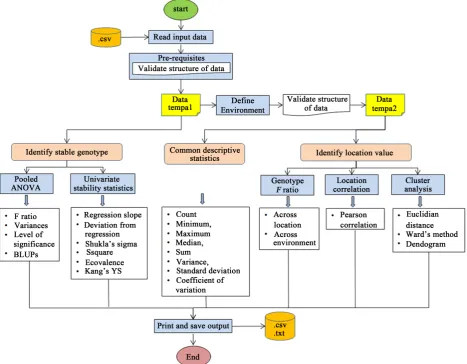
RGxE is a user friendly and annotated R program that will allow user to analyze genotype stability and evaluate test location value of balanced mult-location rep-licated trial data. This program generates output (.csv or .txt) into the same folder from where it reads input dataset and Console window of helper applica-tion “R studio” [18] of R statistical software [19]. A schematic representaapplica-tion of RGxE is presented in Figure 1. Below are the key components of RGxE program which user can independently run.
2.2. Installing and Loading Packages
[image:4.595.66.534.348.712.2]RGxEuses dplyr [20], tidyr [21], broom [22], agricolae [23], lme4 [24], afex [25], cluster [26], and grDevices [19] packages. The dplyr, tidyr, broom, agri-
colae, lme4, afex, cluster, and grDevices packages are available from the Com-prehensive R Archive Network (CRAN), therefore they can be installed as any other packages, by simply typing:
install.packages("dplyr") install.packages("tidyr") install.packages("broom") install.packages("agricolae") install.packages("lme4") install.packages("afex") install.packages("cluster") install.packages("grDevices")
Once installed, the packages have to be loaded before they can be used. This can be done through the library() or require() command, as shown below.
library(tidyr) library(dplyr) library(sqldf) library(lme4) library(afex) library(broom) library(agricolae) library(cluster) library(grDevices)
2.3. Input Data and Validation
RGxE starts with user-entered field to read input data. Instructions on user ene-tered fields are presented in Supplemental Material. The user is required to set current working directory using setwd(), which is input data file location, and pass input data file name. RGxE requires an input data file in .csv (comma sepa-rated value) format. Highlighted fields are user entered in the code shown below for Windows and iOS (Mac) operating system, respectively.
setwd("E:/PhD Research Work/PhD Articles") #### For Windows user ####
tempa<- read.csv("RGxEInputData2_2016_02_15.csv", header = TRUE)
#### For iOS or Mac user ####
file.name <- "E:/PhD Research Work/PhD Articles/RGxEInputData2_2016_02_15.csv"
out.name <- "E:/PhD Research Work/PhD Articles/GxEROutput.csv"
tempa<- read.csv(file.name)
re-quired not to change the column names as program takes same variable name for the analysis. Dependent variable in example input data is yield (Mg∙ha−1) of
watermelon. Hereafter, a word “genotype” is used to indicate cultigen, cultivar, variety or genotype. RGxE validates the structure of input data, with below ar-guments, so that correct column types (numeric, logical, factor, or character) are used for statistical analysis.
tempa$YR<- as.factor(tempa$YR) tempa$RP<- as.factor(tempa$RP) tempa$LC<- as.factor(tempa$LC) tempa$CLT<- as.factor(tempa$CLT) tempa$Trait<- as.numeric(tempa$Trait)
To access the structure of data, the str() command can be used. str(tempa)
'data.frame': 400 obs. of 5 variables:
$ YR : Factor w/ 2 levels "2009","2010": 1 1 1 1 1 1 1 1 1 1 ...
$ LC : Factor w/ 5 levels "CI","FL","KN",..: 3 3 3 3 3 3 3 3 3 3 ...
$ RP : Factor w/ 4 levels "1","2","3","4": 1 1 1 1 1 1 1 1 1 1 ...
$ CLT : Factor w/ 10 levels "CalhounGray",..: 3 1 9 2 5 4 7 10 6 8 ...
$ Trait: num 56.2 74.2 32.6 74.2 64.8 ...
Top 6 rows of example input data can be viewed using head() command. head(tempa)
YR LC RP CLT Trait 1 2009 KN 1EarlyCanada 56.236 2 2009 KN 1CalhounGray 74.167
3 2009 KN 1 StarbriteF1 32.601 4 2009 KN 1CrimsonSweet 74.167
5 2009 KN 1GeorgiaRattlesnake 64.794 6 2009 KN 1 FiestaF1 70.907
2.4. Genotype Stability Statistics
2.4.1. Analysis of Variance (ANOVA)
In multi-location replicated trial data, combined ANOVA is performed with the objectives to identify the significance of different effects; estimate and compare mean for levels of fixed factors; and estimate the size of genotype and GxE va-riance components. The ANOVA model comprises four factors: genotype (CLT), location (LC), year (YR), and replication or block (RP) nested within lo-cations and year. The response of the genotype i in the location j, year k and rep-lication r is presented as:
(
)
Response
Error
i j k r j k i j
i k j k i j k ijkr
m CLT LC YC RP LC YR CLT LC
CLT YR LC YR CLT LC YR
= + + + + ∗ + ∗
where m = grand mean. Depending on the objectives of the analysis, the geno-type, location and year are defined as random or fixed effect, which gives five different ANOVA models (Table 1). The genotype is random when the aim is to estimate variance components, genetic parameters, genetic gains expected from selection or different breeding strategies etc. Conversely, genotype is fixed factor when aim is to make comparison of test material for selection or recommenda-tion. Similarly, location is considered as random when the main interest is to es-timate variance components for sites that are representative of the relevant pop-ulation within target region. Location is fixed when interest is to make explicit comparison of one level another and each location represents a well-defined area with relative to crop management. The year and replication are usually treated as random factor.
Different combinations of random and fixed effects in ANOVA model have implications for the expectations of mean square (MS) values with the possible modification of the error term to be adopted in the F test. Therefore, sometimes the F test is not as straightforward as the ratio between two mean squares.
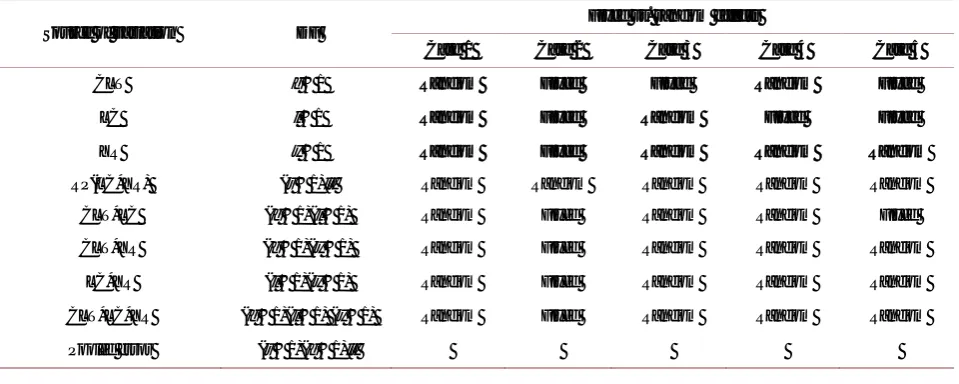
RGxE computes five different cases of ANOVA: • case 1: CLT, YR, LC and RP–all random
• case 2:CLT, YR and LC – fixed; RP–random • case 3:CLT–fixed; LC, YR and RP–random • case 4: LC–fixed; CLT, YR and RP–random • case 5: CLT and LC–fixed; YR and RP–random
[image:7.595.61.541.551.743.2]For random effect RGxE computes estimates of variance components using lmer() function of lme4 package. The significance of random effects is com-puted using likelihood ratio test to attain p-values. Likelihood is the probability of the data given a model. The logic of the likelihood ratio test is to compare the likelihood of two models with each other. The model without the factor that you are interested in (null model) is compared with model with the factor that you are interested in (full model) using anova() function. It gives a Chi-Square
Table 1. ANOVA models including the factors genotype (CLT), location (LC), year (YR), and replication (RP) for multi-location replicated trials across years in a randomized complete block design.
Source of variation DF Fixed vs. random effects
Case 1 Case 2 Case 3 Case 4 Case 5
CLT g − 1 Random Fixed Fixed Random Fixed
LC l − 1 Random Fixed Random Fixed Fixed
YR y − 1 Random Fixed Random Random Random
RP(LC*YR) (r − 1)ly Random Random Random Random Random
CLT*LC (g − 1)(l − 1) Random Fixed Random Random Fixed
CLT*YR (g − 1)(y − 1) Random Fixed Random Random Random
LC*YR (l − 1)(y − 1) Random Fixed Random Random Random
CLT*LC*YR (g − 1)(l − 1) (y − 1) Random Fixed Random Random Random
value, the associated degrees of freedom and p-value. According to Wilk’s theo-rem, the negative two times the log likelihood ratio of two models approaches a Chi-Square distribution with k degrees of freedom, where k is number of ran-dom effects tested. RGxE create user defined anova_lrt() function to com- pute likelihood ratio test and it is stored in ANOVA model Case I code.
The type III sum of squares (SS), MS, Fvalue of fixed effects are computed by fitting model in anova() function of lme4 package. The significance (p-value) of fixed effects is computed using mixed() function of afex package. The mixed() function computes type III like p-values using default method via Kenward-Roger approximation for degrees of freedom.
To identify each experimental unit (EU) uniquely a distinct value must be as-signed to EU. RGxE assign a distinct value to each combination of replication (RP) nested within location (LC) x year (YR) and use this new term (RPid) in model. After installing and calling packages, user can independently compute five different ANOVA models while feeding input data (tempa) in below code. User friendly output is generated in “data.frame” class using dplyr and tidyr packages.
##################################################### ###################
## ANOVA: Compute analysis of variance ##
##################################################### ###################
#Generate unique id for replication for anova
tempa$RPid<-as.factor(paste(tempa$YR, tempa$LC, tem-pa$RP, sep="."))
##################################################### ###################
### ANOVA Case 1: CLT, YR, LC and RP - All Random ###
##################################################### ###################
#full model
fit.f1<-lmer(Trait~ 1 + (1|YR) + (1|LC) + (1|CLT) + (1|YR:LC) +
(1|YR:CLT) + (1|LC:CLT) + (1|YR:LC:CLT) + (1|RPid), data=tempa)
#model summary
summary1 <- summary(fit.f1) #variance of random factors
variance<- as.data.frame(summary1$varcor) #drop rownames
rownames(variance) <- NULL
rename(sov=grp, Variance=vcov, stddev=sdcor) #Type 3 test of hypothesis
#Type III Wald chisquare tests anova(fit.f1, type="III") #Type 1 test of hypothesis
anova(fit.f1, type="marginal", test="F") #model fitness
anovacase1 <- plot(fit.f1,
main="Model fitness Case 1: CLT, YR, LC and RP - All Random", xlab="Predicated Value", ylab="Residual")
#LRT - likelihood ratio test for computing significance of random effect
#create function (anova_lrt) for Likelihood ratio test, where parameters
#a=outputdatasetname; example-anova1r #b=full model name; example-fit.f1 #c=reduced model name; example-fit.f1r
#d=effect name; example- "RPid", NOTE: call it in quotation
anova_lrt<- function (a,b,c,d){ #level of significance
a <-anova(b,c)
#convert anova into data frame a <- data.frame(a)
#convert rownames into column a$name<- rownames(a)
# droprownames rownames(a) <- NULL
a <- a %>% filter(name=="b") %>%
mutate(sov=d) %>% select(sov, Pr_Chisq = starts_with("Pr..Chisq."))
# return the result return(a)
}
#null model for YR
fit.f1y<-lmer(Trait~ 1 + (1|LC) + (1|CLT) + (1|YR:LC) + (1|YR:CLT) +
(1|LC:CLT) + (1|YR:LC:CLT) + (1|RPid), data=tempa)
#level of significance #call function anova_lrt
anova1y <- anova_lrt(anova1y,fit.f1,fit.f1y,"YR") #null model for LC
(1|YR:CLT) +
(1|LC:CLT) + (1|YR:LC:CLT) + (1|RPid), data=tempa)
#level of significance #call function anova_lrt
anova1l <- anova_lrt(anova1l,fit.f1,fit.f1l,"LC") #null model for CLT
fit.f1c<-lmer(Trait~ 1 + (1|YR) + (1|LC) + (1|YR:LC) + (1|YR:CLT) +
(1|LC:CLT) + (1|YR:LC:CLT) + (1|RPid), data=tempa)
#level of significance #call function anova_lrt
anova1c <- anova_lrt(anova1c,fit.f1,fit.f1c,"CLT") #null model for YR:LC
fit.f1yl<-lmer(Trait~ 1 + (1|YR) + (1|LC) + (1|CLT) + (1|YR:CLT) +
(1|LC:CLT) + (1|YR:LC:CLT) + (1|RPid), data=tempa)
#level of significance #call function anova_lrt
anova1yl <- anova_lrt(anova1yl,fit.f1,fit.f1yl,"YR:LC") #null model for YR:CLT
fit.f1yc<-lmer(Trait~ 1 + (1|YR) + (1|LC) + (1|CLT) + (1|YR:LC) +
(1|LC:CLT) + (1|YR:LC:CLT) + (1|RPid), data=tempa)
#level of significance #call function anova_lrt
anova1yc <- anova_lrt(anova1yc,fit.f1,fit.f1yc,"YR:CLT") #null model for LC:CLT
fit.f1lc<-lmer(Trait~ 1 + (1|YR) + (1|LC) + (1|CLT) + (1|YR:LC) +
(1|YR:CLT) +
(1|YR:LC:CLT) + (1|RPid), data=tempa) #level of significance
#call function anova_lrt
anova1lc <- anova_lrt(anova1lc,fit.f1,fit.f1lc,"LC:CLT") #null model for YR:LC:CLT
fit.f1ylc<-lmer(Trait~ 1 + (1|YR) + (1|LC) + (1|CLT) + (1|YR:LC) +
(1|YR:CLT) +
#call function anova_lrt anova1ylc <-
anova_lrt(anova1ylc,fit.f1,fit.f1ylc,"YR:LC:CLT") #null model for RP
fit.f1r<-lmer(Trait~ 1 + (1|YR) + (1|LC) + (1|CLT) + (1|YR:LC) +
(1|YR:CLT) +
(1|LC:CLT) + (1|YR:LC:CLT), data=tempa) #level of significance
#call function anova_lrt
anova1r <- anova_lrt(anova1ylr,fit.f1,fit.f1r,"RPid") #Merge anova and level of significance
anova1 <- bind_rows(anova1y, anova1l)%>% bind_rows(anova1c)%>%
bind_rows(anova1yl)%>% bind_rows(anova1yc)%>% bind_rows(anova1r)%>%
bind_rows(anova1lc)%>%bind_rows(anova1ylc) anova1 <- as.data.frame(anova1)
#Merge final output
anova_randall<- variance1%>% left_join(anova1 , by ="sov")
anova_randall$Pr_Chisq[anova_randall$stddev == 0] <- NA #Print final output
print(anova_randall)
sov VariancestddevPr_Chisq
YR:LC:CLT 49.72994 7.051946 8.894184e−03 LC:CLT 0.00000 0.000000 NA RPid 73.91368 8.597306 4.145811e−07
YR:CLT 0.00000 0.000000 NA YR:LC 57.81311 7.603494 7.872463e−02 CLT 111.69687 10.568674 1.386709e−03 LC 699.56950 26.449376 9.083568e−03 YR 0.00000 0.000000 NA Residual 327.52638 18.097690 NA
Where sov = source of variance, stddev = standard deviation, Pr_Chisq = Chi-Square probability
In this example, the estimate of variance of random effects location x genotype (LC:CLT), year x genotype (YR:LC) and year (YR) is zero. It represent overfit-ted model, meaning model is more complex than the data can support. Random effect variance estimated as zero is common with those random effects that have too few or small number of levels. The alternate option is to use Markov Chain Monte Carlo (MCMC) simulation using MCMCglmm package to get probabili-ty of random effects.
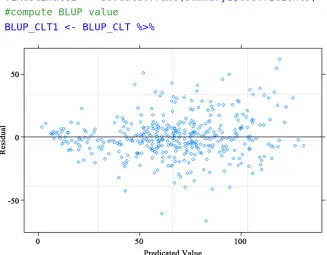
print(anovacase1), where x-axis is model predicted value and y-axis is re-sidual value (Figure 2). The uniform distribution of fitted rere-siduals on both side of the reference line (value = 0) confirms the goodness of fit.
The best linear unbiased predictor (BLUP) of random effects can be extracted using ranef() function of lme4 package. BLUPs are estimates of random ef-fects. They allow us to account environmental factors in our model and missing data; and can be used for making selection. BLUP tend to “shrunk” towards the population mean relative to their fixed effects estimates. RGxE computes BLUP of individual genotypes and generate user friendly output in “data.frame” class using dplyr and tidyr packages (see below code).
#Compute BLUP for CLT
#BLUP - Best linear unbiased predictor randeffect1 <- ranef(fit.f1)
#BLUP for clt
BLUP_CLT <- as.data.frame(randeffect1$CLT) #convert rownames into column
BLUP_CLT$genotype<- rownames(BLUP_CLT) #drop rownames
rownames(BLUP_CLT) <- NULL #rename variable name
BLUP_CLT <- BLUP_CLT %>% select(genotype,Blup = starts_with("(Intercept)"))
#return estimate of fixed effect from full model summary to compute BLUP
fixestimate1 <- as.data.frame(summary1$coefficients) #compute BLUP value
[image:12.595.212.540.444.699.2]BLUP_CLT1 <- BLUP_CLT %>%
mutate(Blup = Blup + fixestimate1$Estimate) #final output for BLUP for cultivars
BLUP_CLT1 <- as.data.frame(BLUP_CLT1) #Print final output
print(BLUP_CLT1) genotypeBlup
CalhounGray 76.255 CrimsonSweet 62.535 EarlyCanada 59.840
FiestaF1 77.283 GeorgiaRattlesnake 70.710 Legacy 68.417 Mickylee 61.300
Quetzali 58.744
StarbriteF1 83.422 SugarBaby 51.169
Where BLUP = best linear unbiased predictor
Similarly, remaining four cases of ANOVA model can be independently computed using code presented in Supplemental Material.
2.4.2. Descriptive Statistics
A new additional variable environment (ENV) is created and quality check of missing value is performed in dataset “tempa2” using dplyr package. Environ-ment is location-year combination, which is highlighted is below code. RGxE va-lidates structure of dataset “tempa2” as it serves input data for descriptive and other statistics (Figure 1).
#Compute environment - Location by year combination tempa2 <- tempa %>%
mutate (ENV = paste(LC,YR, sep='-')) %>% #remove missing records
na.omit() #validate data
tempa2$YR <- as.factor(tempa2$YR) tempa2$RP <- as.factor(tempa2$RP) tempa2$LC <- as.factor(tempa2$LC) tempa2$CLT <- as.factor(tempa2$CLT) tempa2$ENV <- as.factor(tempa2$ENV) tempa2$Trait <- as.numeric(tempa2$Trait)
Top 6 rows of input data ‘tempa2’ can be viewed using head() command. head(tempa2)
YR LC RP CLT TraitRPid ENV 1 2009 KN 1EarlyCanada 56.236 2009.KN.1 KN-2009 2 2009 KN 1CalhounGray 74.167 2009.KN.1 KN-2009
5 2009 KN 1GeorgiaRattlesnake 64.794 2009.KN.1 KN-2009 6 2009 KN 1 FiestaF1 70.907 2009.KN.1 KN-2009 Descriptive statistics including count, minimum (min), maximum (max), mean, sum, median, variance (var), standard deviation (sd), and coefficient of variation (cv) are computed using dplyr package. Using tidyr package results of descriptive statistics are transposed in user friendly layout so that researchers can interpret them easily (see Supplemental Material for descriptive statistics outputs). RGxE generates following descriptive statistics.
• Trait mean over genotype and environment • Trait mean and sd over genotype and year
• Trait mean, cv, sd and sum over genotype and location • Trait mean, sd, and sum over genotype, location and year • Trait mean over genotype, location and replication • Trait mean over location and year
• Trait mean over location and replication
• Trait count, min, max, mean, sum, median, var, and sd over location • Trait count, min, max, mean, sum, median, var, and sd over year • Trait count, min, max, mean, sum, median, var, and sd over genotype • Trait count, min, max, mean, sum, median, var, and sd over environment
2.4.3. Univariate Stability Statistics
Among univariate stability statistics, RGxE generates output of regression slope (bi), deviation from regression (S2d), Shukla’s sigma (σi2), ssquares, Wricke’s
ecovalence (Wi) and Kang’s statistics (YSi). RGxE regresses the response of
ge-notype against the environmental index to compute regression slope (bi),
devia-tion from regression (S2
d), T-test on regression slope (H0: bi = 1) and F-test on
deviation from regression (H0: S2d = 0). The level of significance of T-test and
F-test is computed using lm() function of R [19], and dplyr and tidyr packages. The level of significance at 0.05, 0.01 and 0.001 is represented by “*”, “**”, “***”; respectively. Environmental index is average performance of all genotypes in each environment. Stability.par() function of agricolae package is used to compute Shukla’s sigma (σi2), ssquares, Wricke’s ecovalence (Wi) and Kang’s
statistics (YSi). For selection of stable genotype, user can independently compute
univariate stability statistics while feeding required input data (tempa2) in be-low code. Top 6 rows of input data “tempa2” is presented in section 4.2 de-scriptive statistics.
##################################################### ###################
## Compute univariate stability statistics - regression analysis ##
##################################################### ###################
#Compute regression (slope) and deviation from regression
dsterm<- tempa2 %>%
group_by (ENV, RP, YR, LC) %>%
summarize (ENVTrait = mean(Trait,na.rm=FALSE)) dst02 <- tempa2 %>%
left_join(dsterm, by=c("ENV", "RP")) %>% #Left join on multiple columns
arrange (CLT) %>%
rename (YR= YR.x, LC = LC.x ) #fit model
fit_model<- dst02 %>%
group_by(CLT) %>% #group regression analysis by cultivar do (model=lm(Trait~ENVTrait + ENV + RP, data=.))
#parameter estimates
paramlm<- as.data.frame(fit_model %>% tidy(model)) glancelm<- as.data.frame(fit_model %>% glance(model)) augmentlm<- as.data.frame(fit_model %>% augment(model)) outmsed<- lapply(fit_model$model, anova) #anova output outmsed2 <- as.data.frame(do.call(rbind, outmsed)) #convert list into data.frame
#convert rownames into column outmsed2$SOV <- rownames(outmsed2) # droprownames
rownames(outmsed2) <- NULL
#remove numeric values from string of rownames using function gsub
outmsed2 <- outmsed2 %>% mutate(SOV = gsub("\\d+","",SOV)) #extract unique cultivar name and merge to outmsed2 dataset
genotypes<- dst02 %>% select(CLT) %>% distinct (CLT) %>% arrange(CLT)
#Stack 4 times to match number of rows with outmsed2 dataset
genotypes1 <- genotypes %>%bind_rows(genotypes) %>% bind_rows(genotypes) %>% bind_rows(genotypes) %>% arrange(CLT)
#attach list of cultivars to outmsed2 outmsed3 <- as.data.frame(outmsed2 %>% bind_cols(genotypes1))
#transpose outmsed3
outmsed4 <- outmsed3 %>%
select (CLT, SOV, MS = starts_with("Mean")) %>% #rename variables
MSDS <- outmsed4 %>%
spread (SOV, MS) %>% #transpose using library tidyr arrange (CLT)
#Transpose degress of freedoms for F-test FDS3 <- outmsed3 %>%
filter (SOV != "RP")%>% select (CLT, SOV, Df) %>%
spread (SOV, Df) %>% #transpose using library tidyr rename (DF_ENVTrait = ENVTrait, DF_Residuals = Resi-duals,
DF_ENV = ENV)
#Subset parameters - paramlm dataset REGCOEFGS <- paramlm %>%
filter (term == "ENVTrait") %>% select (-statistic, -p.value)
#Test and level of significance of regression and deviation from regression
#Merge MSDS, FDS3, REGCOEFGS
slope<- MSDS %>% inner_join (REGCOEFGS, by = "CLT") %>% inner_join (FDS3, by = "CLT") %>%
rename (MSE = Residuals, LREGMS=ENVTrait, DEVLMS = ENV, BI= estimate, STDERR = std.error)
#test significance levels slope1 <- slope %>%
mutate (T_H01 = (BI-1)/STDERR , #Null Hypothesis for slope = 1
PT_H01 = 2*pt(-abs(T_H01), DF_Residuals), F_DEVREG=DEVLMS/MSE, #NULL HYPOTHESIS: PREDICTED-ACTUAL = 0
PF_HO0= 1-pf(F_DEVREG, DF_ENV, DF_Residuals)) #add legend for level of significance
slope2 <- slope1 %>%
mutate (SIG_SLOPE = ifelse(PT_H01 <= 0.001, "***", ifelse(PT_H01 <= 0.01, "**",
ifelse(PT_H01 <= 0.05, "*","")))) %>%
mutate (SIG_DEVREG = ifelse(PF_HO0 <= 0.001, "***", ifelse(PF_HO0 <= 0.01, "**",
ifelse(PF_HO0 <= 0.05, "*","")))) #final regression output
options(digits=5)
univariate2 <- slope2 %>%
mutate (SLOPE = paste(BI,SIG_SLOPE, sep=""),
##################################################### ###################
# Compute univariate stability statistics - shukla, ecovalence, YS #
##################################################### ###################
#Compute Shukla, WrickeEcovalense, Kangs YS repno<- tempa2 %>%
summarise (total_rep = n_distinct(RP)) #count total number of rep
dstgl<- tempa2 %>% group_by (CLT, LC) %>%
#Summarize genotype performance across locations summarize (Trait = mean(Trait,na.rm=FALSE))
dstgl1 <- dstgl %>%
spread (LC, Trait) #transpose values
#convert into data frame so that row containing structure information is deleted
dstgl2 <- as.data.frame(dstgl1) #create rownames
rownames(dstgl2) <- dstgl2[ ,1] shukla<- dstgl2[,-1]
#compute MS error term
tempa3 <- glm(Trait ~ LC + YR + LC:YR + RP %in% (LC:YR) + CLT + CLT:LC +
CLT:YR + CLT:LC:YR, family = gaussian , data= tempa2 )
#model summary
summary1 <- summary.glm(tempa3) #Error SS
error_ss<- as.data.frame(summary1$deviance) error_ss1 <- error_ss %>%
#rename variable
select (Deviance = starts_with("summary"), every-thing())
#Error DF
error_df<- as.data.frame(summary1$df.residual) error_df1 <- error_df %>%
#rename variable
select (Df = starts_with("summary"), everything()) #MS of error
mse1 <- as.data.frame(error_ss1/error_df1) mse<- mse1 %>%
rename (MS = Deviance)
# MSError is used populated from ANOVA univariate1a <- stability.par(shukla, rep= repno$total_rep , MSerror=mse$MS,
alpha=0.1, main="Genotype")
#pool results into individual columns univariate1b <- univariate1a$statistics #create column genotype from rownames
univariate1b$genotype <- rownames(univariate1b) rownames(univariate1b) = NULL #remove rownames
names(univariate1b) [3] <- "significane_sigma" #
rename duplicate name dot
names(univariate1b) [5] <- "significane_s2" # rename
duplicate name dot
names(univariate1b) [2] <- "sigma" # rename
names(univariate1b) [4] <- "ssquare" # rename
univariate1c <- univariate1a$stability #create column genotype from rownames
univariate1c$genotype <- rownames(univariate1c) rownames(univariate1c) = NULL #remove rownames
names(univariate1c) [8] <- "legend" # rename
varia-ble ... to legend #Merge
univariate1d <- univariate1b %>%
inner_join (univariate1c , by = "genotype") %>%
# deselect all columns between Yield and Stab.rating select (-Yield: -Stab.rating) %>%
# arrange the column order for final output select (CLT=genotype, Mean, sigma,
significane_sigma, ssquare,
significane_s2, Ecovalence,YSi, legend) #Final stability statistics
#Merge Univariate2 and Univariate1d univariate<- univariate2 %>%
inner_join(univariate1d, by = "CLT") %>%
mutate (SIGMA=paste(sigma,significane_sigma, ""), SIGMA_SQUARE=paste(ssquare,significane_s2, ""),
YS_Kang =paste(YSi,legend, "")) %>%
select (Genotype = CLT, Mean, SLOPE, DEVREG, SIGMA, SIGMA_SQUARE,Ecovalence, YS_Kang)
print(univariate)
CalhounGray 77.349 1.32 124.67 61.35 ns 15.76 ns 279.75 10 +
CrimsonSweet 62.013 1.36 1450.04*** 439.12 ns 567.99 ns 1488.64 4
EarlyCanada 59.000 0.32* 686.25* 253.23ns 285.37 ns 893.77 2
FiestaF1 78.498 1.58 657.87 300.29 ns 385.99 ns 1044.35 11 +
GeorgiaRattlesnake 71.151 0.92 220.06 52.21 ns 44.86 ns 250.52 8 +
Legacy 68.588 1.13 428.07 287.39 ns 262.49 ns 1003.10 7 +
Mickylee 60.632 0.59 705.48* 188.11 ns 195.13 ns 685.37 3
Quetzali 57.775 0.97 96.53 82.81 ns 86.10 ns 348.42 1
StarbriteF1 85.360 1.29 221.14 157.24 ns 78.37 ns 586.61 12 +
SugarBaby 49.307 0.50* 332.18* 264.19ns 308.43 ns 928.84 -1
Where SLOPE = regression slope, DEVREG = deviation from regression, SIGMA = Shukla’s sigma, SIGMA_SQUARE = ssquares, Ecovalence = Wricke’s ecovalence, YS_Kang = Kang’s statistics, ns = non-significant, + = indicate stable genotype according to Kang’s stability statistics
2.5. Location Value Statistics
Input data “tempa2” is used to calculate genotype F ratio across location and environment; correlation of location with average location performance; and lo-cation cluster analysis.
2.5.1. Genotype F Ratio across Location and Environment; and Correlation among Location and Average Location
RGxE computes analysis of variance by location using lm() function to get the genotype F values across location. When the mean of all genotypes are equal then the F ratio will be close to 1. The high genotype F value indicates high dis-criminating ability for that location. Similarly, Pearson’s test of correlation of locations with average location is computed using cor.test() function of R built in stats package [19]. Function cor.test() provide level of significance of correlation and the level of significance at 0.05, 0.01 and 0.001 is represented by “*”, “**”, “***”; respectively. RGxE generates user friendly output for geno-type F ratio across location and environment; and correlation of location with average location performance using dplyr and tidyr packages as shown in below code.
## Compute location statistics - genotype F ratio across ##
## location and environment; location correlation ##
##################################################### #################
#Location values
#F-value of genotype across location #fit model
fit_modellc<- tempa2 %>%
group_by(LC) %>% #group regression analysis by location do (model1=lm(Trait~CLT + YR + CLT:YR + RP%in%YR , data=.))
#parameter estimates
paramlmlc<- as.data.frame(fit_modellc %>% tidy(model1)) glancelmlc<- as.data.frame(fit_modellc %>%
glance(model1))
augmentlmlc<- as.data.frame(fit_modellc %>% augment(model1))
outmsedlc<- lapply(fit_modellc$model1, anova) #anova output
#convert list into data.frame
outmsedlc2 <- as.data.frame(do.call(rbind, outmsedlc)) #convert rownames into column
outmsedlc2$SOV <- rownames(outmsedlc2) #drop rownames
rownames(outmsedlc2) <- NULL
#remove numeric values from string of rownames using function gsub
outmsedlc2 <- outmsedlc2 %>% mutate(SOV = gsub("\\d+","",SOV))
#extract unique location name and merge to outmsedlc2 dataset
location<- dst02 %>% select(LC) %>% distinct (LC) %>% arrange(LC)
#Extract gentype F value for each location locvalue<- outmsedlc2 %>%
filter(SOV == "CLT") %>%
select (FRatioGenotype = starts_with("F value")) %>% bind_cols (location) %>% select (LC, FRatioGenotype) locvalue<- as.data.frame (locvalue)
#Correlation between location and average location for each genotype
glcmean1 <- tempa2 %>% group_by (CLT, LC) %>%
summarize (glcmean = mean(Trait,na.rm=FALSE)) %>% as.data.frame(select (CLT, LC, glcmean))
#compute genotype mean across all location -average location
gmean1 <- tempa2 %>% group_by (CLT ) %>%
summarize (gmean = mean(Trait,na.rm=FALSE)) %>% as.data.frame(select (CLT, gmean))
#merge location mean with average location for each genotype
lgmean<- glcmean1 %>%
left_join(gmean1, by="CLT") %>% arrange(LC) %>% select (-CLT)
#compute correlation with level of significance lcgcorr<- lgmean %>%
group_by(LC) %>%
do(tidy(cor.test(.$glcmean, .$gmean, method = c("pearson"))))
lcgcorr1 <- lcgcorr %>%
select (LC, Corr_Value = starts_with ("estimate"), Pvalue = starts_with("p.value"))
#post process correlation value lcgcorr2 <- lcgcorr1 %>%
mutate (SIG_CORR = ifelse(Pvalue<= 0.001, "***", ifelse(Pvalue<= 0.01, "**",
ifelse(Pvalue<= 0.05, "*",""))))
#concatenate p value symbol with correlation value lcgcorr3 <- lcgcorr2 %>%
mutate (LocCorrelation=paste(Corr_Value,SIG_CORR, sep="")) %>%
select (LC, LocCorrelation)
lcgcorr3 <- as.data.frame(lcgcorr3) #Final location value table for output #compute location mean
Locmean<- tempa2 %>% group_by (LC ) %>%
summarize (Trait = mean(Trait,na.rm=FALSE))%>% select (LC, Mean = starts_with("Trait"))
Locmean<- as.data.frame(Locmean)
#merge all location value outputs for print LocationValue<- Locmean %>%
inner_join(lcgcorr3, by = "LC") %>% rename (Location = LC)
print(LocationValue)
Location Mean FRatioGenotypeLocCorrelation CI 61.040 4.1804 0.95***
FL 100.153 2.2579 0.86**
KN 63.786 4.6964 0.90*** SC 82.685 6.8813 0.88*** TX 27.173 2.9966 0.89***
WhereFRatioGenotype = genotype F ratio, LocCorrelation = correlation of location with average location
##################################################### ###################
### F-value of genotype across environmen ##
##################################################### ###################
#fit model
fit_modelen<- tempa2 %>%
group_by(ENV) %>% #group regression analysis by location do (model2=lm(Trait~CLT + RP , data=.))
#parameter estimates
paramlmen<- as.data.frame(fit_modelen %>% tidy(model2)) glancelmen<- as.data.frame(fit_modelen %>%
glance(model2))
augmentlmen<- as.data.frame(fit_modelen %>% augment(model2))
outmseden<- lapply(fit_modelen$model2, anova) #anova output
#convert list into data.frame
outmseden2 <- as.data.frame(do.call(rbind, outmseden)) #convert rownames into column
outmseden2$SOV <- rownames(outmseden2) # droprownames
rownames(outmseden2) <- NULL
#remove numeric values from string of rownames using function gsub
outmseden2 <- outmseden2 %>% mutate(SOV = gsub("\\d+","",SOV))
#extract unique environment name and merge to outmseden2 dataset
environment<- dst02 %>% select(ENV) %>% distinct (ENV) %>% arrange(ENV)
locvalue2 <- outmseden2 %>% filter(SOV == "CLT") %>%
select (FRatioGenotype = starts_with("F value")) %>% bind_cols (environment) %>% select (ENV, FRatioGenotype) locvalue2 <- as.data.frame (locvalue2)
print(locvalue2)
ENV FRatioGenotype CI-2009 2.4015 CI-2010 3.3665 FL-2009 2.6914 FL-2010 1.7231 KN-2009 1.9999 KN-2010 6.3971 SC-2009 2.8729 SC-2010 8.0454 TX-2009 2.5003 TX-2010 1.4619
Where ENV = environment, FRatio Genotype = genotype F ratio
2.5.2. Location Cluster Analysis
Hierarchical cluster analysis for location relatedness is computed using hclust() function of R built in stats package [19]. The arguments passed to hclust() function include Euclidean distance computed from dist() func-tion and Ward’s method. Funcfunc-tion dist() of R built in stats package [19] computes and return the distance matrix between rows of a data matrix. Tree or dendogram of cluster analysis is generated using plot() function, of R built in graphics package [19], as shown in below code.
##################################################### ###################
### Compute cluster analysis of location ###
##################################################### ###################
#location cluster analysis #Euclidean distance
#Ward Hierarchical Clustering #trait mean over location mean_l<- tempa2 %>%
group_by (LC ) %>%
summarize (Trait = mean(Trait,na.rm=FALSE)) mean_l1 <- as.data.frame(mean_l)
clusterdata<- mean_l1 %>% select (Trait) clusterdata<- na.omit(clusterdata)
distance matrix
hcluster<- hclust(d=distance, method="ward.D")
locationcluster<- plot(hcluster, labels=mean_l1$LC) #
display dendogram
3. Final Output
After all computation is over, RGxE clears the Console Window of R studio then saves the output using sink() function along with the system date and time using Sys.time() function of R built in base package [19]. RGxE auto saves the output (output name = “RGxEOutput”) in folder which is defined in-setwd() command in the beginning of the program. Program gives user op-tion to save results in .csv (RGxEOutput.csv) or .txt (RGxEOutput.txt) format. Output, in .txt format, from sample input data generated by RGxE is presented in Supplemental Material. Additionally, RGxE prints the output in Console Window of R studio.
4. Result Interpretation
Interpretation of univariate stability statistics is presented in Supplemental Ma-terial. Additionally, studies published on genotype stability [27] and location value [28] used SASGxE program [17], which is equivalent to RGxE program. Similarly, research study on stability of watermelon fruit quality traits used RGxE program [29]. Thus, these studies can serve as source of RGxE output in-terpretation. Also, interpretation of RGxE and SASGxE program is available at available at http://cuke.hort.ncsu.edu/cucurbit/wehner/software.html.
References
[1] Dia, M., Weindorf, D., Thompson, C., Cummings, H., Cacovean, H. and Rusu, T. (2009) Spatial Distribution of Heavy Metals in the Soils of Erath County, Texas. Studia Universitatis Babes-Bolyai, Geographia, No. 2, 99-114.
[2] Li, Y., Gibson, J.M., Jat, P., Puggioni, G., Hasan, M., West, J.J., Vizuete, W., Sexton, K. and Serre, M. (2010) Burden of Diseases Attributed to Anthropogenic Air Pollu-tion in the United Arab Emirates: Estimates Based on Observed Air Quality Data. Science of the Total Environment, 408, 5784-5793.
https://doi.org/10.1016/j.scitotenv.2010.08.017
[3] Jat, P. and Serre, M.L. (2016) Bayesian Maximum Entropy Space/Time Estimation of Surface Water Chloride in Maryland Using River Distances. Environmental Pol-lution, 219, 1148-1155. https://doi.org/10.1016/j.envpol.2016.09.020
[4] Weindorf, D.C., Sarkar, R., Dia, M., Wang, H., Chang, Q., Haggard, B., McWhirt, A. and Wooten, A. (2008) Correlation of X-Ray Fluorescence Spectrometry and Inductively Coupled Plasma Atomic Emission Spectroscopy for Elemental Deter-mination in Composted Products. Compost Science & Utilization, 16, 79-82.
https://doi.org/10.1080/1065657X.2008.10702361
[5] Weindorf, D., Rinard, B., Zhu, Y., Johnson, S., Haggard, B., McPherson, J., Dia, M., Spinks, C. and McWhirt, A. (2008) High Resolution Soil Survey of Capulin Volcano National Monument, New Mexico. Soil Horizons, 49, 55-62.
[6] Dia, M., Wehner, T.C., Hassell, R., Price, D.S., Boyhan, G.E., Olson, S., King, S., Da-vis, A.R., Tolla, G.E., Bernier, J., Juarez, B., Sari, N., Solmaz, I. and Aras, V. (2012) Stability of Fruit Yield in Watermelon Genotypes Tested in Multiple US Environ-ments. Proceedings of the Xth EUCARPIA Meeting on Genetics and Breeding of Cucurbitaceae, Antalya, Turkey, 15-18 October 2012, 84-88.
[7] Dia, M., Wehner, T.C., Hassell, R., Price, D.S., Boyhan, G.E., Olson, S., King, S., Da-vis, A.R., Tolla, G.E., Bernier, J., Juarez, B., Sari, N., Solmaz, I. and Aras V.(2012) Mega-Environment Identification for Watermelon Yield Testing in the USPro-ceedings of the Xth EUCARPIA Meeting on Genetics and Breeding of Cucurbita-ceae, Antalya, Turkey, 15-18 October 2012, 385-390.
[8] Kumar, R., Dia, M. and Wehner, T.C. (2013) Implications of Mating Behavior in Watermelon Breeding. HortScience, 48, 960-964.
[9] Yan, W., Pageau, D., Frégeau-Reid, J. and Durand, J. (2011) Assessing the Repre-sentativeness and Repeatability of Test Locations for Genotype Evaluation. Crop Science, 51, 1603-1610. https://doi.org/10.2135/cropsci2011.01.0016
[10] Smith, A.B., Cullis, B.R. and Thompson, R. (2005) The Analysis of Crop Cultivar Breeding and Evaluation Trials: An Overview of Current Mixed Model Approaches. Journal of Agricultural Science, 143, 449-462.
https://doi.org/10.1017/S0021859605005587
[11] Wricke, G. (1962) Evaluation Method for Recording Ecological Differences in Field Trials. Z Pflanzenzücht, 47, 92-96.
[12] Shukla, G.K. (1972) Genotype Stability Analysis and Its Application to Potato Re-gional Trails. Crop Science, 11, 184-190.
[13] Kang, M.S., Miller, J.D. and Darrah, L.L. (1987) A Note on Relationship between Stability Variance and Ecovalence. Journal of Heredity, 78, 107.
https://doi.org/10.1093/oxfordjournals.jhered.a110322
[14] Kang, M.S. (1993) Simultaneous Selection for Yield and Stability in Crop Perfor-mance Trials: Consequences for Growers. Agronomy Journal, 85, 754-757.
https://doi.org/10.2134/agronj1993.00021962008500030042x
[15] Mekbib, F. (2003) Yield Stability in Common Beans (Phaseolus vulgaris L.) Geno-types. Euphytica, 130, 147-153.
[16] Fan, X.M., Kang, M., Chen, H., Zhang, Y., Tan, J. and Xu, C. (2007) Yield Stability of Maize Hybrids Evaluated in Multi-Environment Trials in Yunnan, China. Agronomy Journal, 99, 220-228. https://doi.org/10.2134/agronj2006.0144
[17] Dia, M., Wehner, T.C. and Arellano, C. (2016) Analysis of Genotype × Environ-ment Interaction (G × E) Using SAS Programming. Agronomy Journal, 108, 1838- 1852. https://doi.org/10.2134/agronj2016.02.0085
[18] RStudio Team (2015) RStudio: Integrated Development for R. RStudio, Inc., Bos-ton, MA (Computer Software v0.98.1074). http://www.rstudio.com/
[19] R Core Team (2015) R: A Language and Environment for Statistical Computing. R Foundation for Statistical Computing, Vienna, Austria.
http://www.R-project.org/
[20] Wickham, H. and Francois, R. (2015) dplyr: A Grammar of Data Manipulation. R Package Version 0.4.3. http://CRAN.R-project.org/package=dplyr
[21] Wickham, H. (2016) tidyr: Easily Tidy Data with ‘spread()’ and ‘gather()’ Functions. R package Version 0.4.1. http://CRAN.R-project.org/package=tidyr
R Package Version 1.2-3. http://CRAN.R-project.org/package=agricolae
[24] Bates, D., Maechler, M., Bolker, B. and Walker, S. (2015) Fitting Linear Mixed-Ef- fects Models Using lme4. Journal of Statistical Software, 67, 1-48.
https://doi.org/10.18637/jss.v067.i01
[25] Singmann, H., Bolker, B. and Westfall, J. (2015) afex: Analysis of Factorial Experi-ments. R Package Version 0.15-2. http://CRAN.R-project.org/package=afex [26] Maechler, M., Rousseeuw, P., Struyt, A. and Hubert, M. (2015) cluster: Cluster
Analysis Basics and Extensions. R Package Version 2.0.1.
[27] Dia, M., Wehner, T.C., Hassell, R., Price, D.S., Boyhan, G.E., Olson, S., King, S., Da-vis, A.R. andTolla, G.E. (2016) Genotype × Environment Interaction and Stability Analysis for Watermelon Fruit Yield in the U.S. Crop Science, 56, 1645-1661.
https://doi.org/10.2135/cropsci2015.10.0625
[28] Dia, M., Wehner, T.C., Hassell, R., Price, D.S., Boyhan, G.E., Olson, S., King S., Da-vis, A.R. and Tolla, G.E. (2016) Values of Locations for Representing Mega-Envi- ronments and for Discriminating Yield of Watermelon in the U.S. Crop Science, 56, 1726-1735. https://doi.org/10.2135/cropsci2015.11.0698
[29] Dia, M., Wehner, T.C., Perkins-Veazie, P., Hassell, R., Price, D.S., Boyhan, G.E., Olson, S., King, S., Davis, A.R., Tolla, G.E., Bernier, J. and Juarez, B. (2016) Stability of Fruit Quality Traits in Diverse Watermelon Cultivars Tested in Multiple Envi-ronments. Horticulture Research, 3, Article No. 16066.
Supplemental Material
The supplemental material available online includes the RGxE program, instruc-tions for user enetered field needed in RGxE program, independent module of ANOVA model case 2 to 5 (Table 1), interpretation of univariate stability statis-tics, example input data and output from example input data generated from RGxE program. Additionally, interpretation of univariate and multivariate sta-tistical analysis is provided in [17].
http://cucurbitbreeding.com/wp-content/uploads/2016/05/RGxE17Suppleme nt.pdf
List of Abbreviations
AMMI = Additive main effects and multiplicative interaction model ANOVA = Analysis of variance
BLUP = Best linear unbiased prediction CLT = Cultigen or genotype
CRAN = Comprehensive R Archive Network CSV = Comma Separated Value
CV = Coefficient of variation DF = Degrees of freedom
ENV = Environment (location - year combination) EU = Experimental unit
GGE = Genotype main effects plus Genotype x environmental interaction ef-fect model
GxE = Genotype x environmental interaction H0 = Null hypothesis
LC = Location Max = Maximum
MCMC = Markov Chain Monte Carlo Min = Minimum
MS = Mean square
RGxE = R program for the analysis of genotype stability and location value RP = Replication
RPid = Replication id, which is an experimental unit Sd = Standard deviation
SS = Sum of square Var = Variance YR = Year
bi = Regression slope
2 d
S = Deviation from regression
2 i
σ = Shukla’s variance Wi = Wricke’secovalence
YSi = Kang’s yield stability
Submit or recommend next manuscript to SCIRP and we will provide best service for you:
Accepting pre-submission inquiries through Email, Facebook, LinkedIn, Twitter, etc. A wide selection of journals (inclusive of 9 subjects, more than 200 journals)
Providing 24-hour high-quality service User-friendly online submission system Fair and swift peer-review system
Efficient typesetting and proofreading procedure
Display of the result of downloads and visits, as well as the number of cited articles Maximum dissemination of your research work
Submit your manuscript at: http://papersubmission.scirp.org/