Reference Point Based TR-PSO for Multi-Objective
Environmental/Economic Dispatch
Ahmed Ahmed El-Sawy1, Zeinab Mohamed Hendawy2, Mohamed A. El-Shorbagy2 1Department of Mathematics, Faculty of Science, Qassim University, Buraydah, KSA
2Department of Basic Engineering Science, Faculty of Engineering, Menoufiya University, Shibin El-Kom, Egypt Email: [email protected]
Received March 2,2013; revised April 2, 2013; accepted April 9, 2013
Copyright © 2013 Ahmed Ahmed El-Sawy et al. This is an open access article distributed under the Creative Commons Attribution License, which permits unrestricted use, distribution, and reproduction in any medium, provided the original work is properly cited.
ABSTRACT
A reference point based multi-objective optimization using a combination between trust region (TR) algorithm and par- ticle swarm optimization (PSO) to solve the multi-objective environmental/economic dispatch (EED) problem is pre- sented in this paper. The EED problem is handled by Reference Point Interactive Approach. One of the main advan- tages of the proposed approach is integrating the merits of both TR and PSO, where TR has provided the initial set (close to the Pareto set as possible and the reference point of the decision maker) followed by PSO to improve the qual- ity of the solutions and get all the points on the Pareto frontier. The performance of the proposed algorithm is tested on standard IEEE 30-bus 6-genrator test system and is compared with conventional methods. The results demonstrate the capabilities of the proposed approach to generate true and well-distributed Pareto-optimal non-dominated solutions in one single run. The comparison with the classical methods demonstrates the superiority of the proposed approach and confirms its potential to solve the multi-objective EED problem.
Keywords: Environmental/Economic Dispatch; Trust Region; Particle Swarm Optimization; Multi-Objective
Optimization
1. Introduction
With the increase in the environmental awareness and the passage of environmental regulations, the environmental constraints are having a significant impact on the opera- tion of power systems. Traditional economic dispatch to minimize the fuel cost is inadequate when environmental emissions are also to be included in the operation of power plants.
The purpose of EED problem is to figure out the opti- mal amount of the generated power for the fossil-based generating units in the system by minimizing the fuel cost and emission level simultaneously, subject to vari- ous equality and inequality constraints including the se- curity measures of the power transmission/distribution. Various optimization techniques have been proposed by many researchers to deal with this multi-objective pro- gramming problem with varying degree of success.
Different techniques have been reported in the litera- ture pertaining to EED problem. In Ref. [1] the problem has been reduced to a single objective problem by treat- ing the emission as a constraint with a permissible limit. This formulation, however, has a severe difficulty in get-
ting the trade off relations between cost and emission. Alternatively, minimizing the emission has been handled as another objective in addition to usual cost objective. A linear programming-based optimization procedure in which the objectives are considered one at a time was presented in Ref. [2]. Unfortunately, the EED problem is a highly non-linear and a multimodal optimization prob- lem. Therefore, conventional optimization methods that make use of derivatives and gradients, in general, not able to locate or identify the global optimum. On the other hand, many mathematical assumptions such as analytic and differential objective functions have to be given to simplify the problem. Furthermore, this ap- proach does not give any information regarding the trade-offs involved.
cannot be used to find Pareto-optimal solutions in prob- lems having a non-convex Pareto-optimal front. In addi- tion, there is no rational basis of determining adequate weights and the objective function so formed may lose significance due to combining non-commensurable ob- jectives. To avoid this difficulty, the ε-constraint method for multi-objective optimization was presented in Ref. [6]. This method is based on optimization of the most preferred objective and considering the other objectives as constraints bounded by some allowable levels. These levels are then altered to generate the entire Pareto-op- timal set. The most obvious weaknesses of this approach are that it is time-consuming and tends to find weakly non-dominated solutions.
Goal programming method was also proposed for multi-objective EED problem [7]. In this method, a target or a goal to be achieved for each objective is assigned and the objective function will then try to minimize the distance from the targets to the objectives. Although the method is computationally efficient, it will yield an infe- rior solution rather than a non-inferior one if the goal point is chosen in the feasible domain. Hence, the main drawback of this method is that it requires a priori knowledge about the shape of the problem search space.
The recent direction is to handle both objectives si- multaneously as competing objectives instead of simpli- fying the multi-objective problem to a single objective problem [8-10]. The use and development of heuristics- based multi-objective optimization techniques have sig- nificantly grown. Since they use a population of solu- tions in their search, multiple Pareto-optimal solutions can, in principle, be found in one single run. These mod- els can be efficiently used to eliminate most of the diffi- culties of classical methods [11,12].
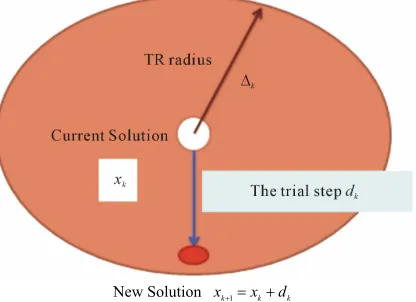
In this paper we present a reference point based multi- objective optimization using a combination between TR algorithm and PSO to solve the multi-objective EED problem. It is a new algorithm that performs TR as de- terministic search and PSO as random search. TR method generate steps with the help of a quadratic model of the objective function, define a region around the current iterate within which they trust the model to be an ade- quate representation of the objective function, and then choose the step to be approximate minimizer of the model in this region. If a step is not acceptable, they reduce the size of the region and find a new minimize. In general, the direction of the step changes whenever the size of the TR is altered [13]. To see the idea of TR, consider the unconstrained optimization problem
minimize
n
x f x (1)
where f x
is a nonlinear continuous differentiable function in n. For a known iterate
k
x the TR method determines subsequent iterate using
1 ,
k k k
x x d (2) where k is trial step determined by minimizing a local quadratic (approximating) model of f at
d
k
x (TR sub- problem) given by
T 1 Tminimize
2 subject to ,
k k k
k
q d f f d d H d
d
k
(3)
where Hk is Hessian of f x
or approximate to it, and k 0 is the TR radius. Using the ratio
0
,k k
k
k k k
k
f x f x d
r
q q d
(4) traditional TR methods evaluate an agreement between the model and the objective function. The trial step k is accepted whenever k is greater than a positive con- stant. This leads us to the new point k 1 k k
d r
x x d , and
the TR radius is updated. Otherwise, the TR radius must be diminished and the sub-problem (3) must be solved again [14]. Figure 1 shows the mechanism of TR algo-
rithm.
Because of the boundedness of the TR, TR algorithms can use non-convex approximate models. This is one of the advantages of TR algorithms comparing with line search algorithms. TR algorithms are reliable and robust, they can be applied to ill-conditioned problems, they have very strong convergence properties, and have been proven to be theoretically and practically effective and efficient for unconstrained and equality constrained op- timization problems [15-17]. Also, the TR algorithm has proven to be a very successful globalization technique for nonlinear programming problems with equality and inequality constraints [18,19].
For multi-objective optimization problems, Kim and Ryu [20] developed an iterative algorithm for bi-objec- tive stochastic optimization problems based on the TR method and investigated different sampling schemes. Their algorithm does not require any strong modeling
[image:2.595.321.529.569.720.2]New Solution xk1xkdk
assumptions, and has great potential to work well in various real-world settings. El-Sobky [21] used the TR algorithm in solving an interactive approach for multi- objective optimization problems; where an active set strategy is used together with a reduced Hessian tech- nique to convert the single objective optimization prob- lem with quality and inequality constraints to equality constrained optimization problem and the computation of the trial step to two easy TR sub-problems similar to those for the unconstrained case.
1 t i x
i P
PSO is an evolutionary computational (EC) model which is based on swarm intelligence. PSO is developed by Kennedy and Elberhart [22] who have been inspired by the research of the artificial livings. Similar to EC techniques, PSO is also an optimizer based on population. The system is initialized firstly in a set of randomly gen- erated potential solutions, and then performs the search for the optimum one iteratively. Whereas the PSO does not possess the crossover and mutation processes used in EC, it finds the optimum solution by swarms following the best particle. Compared to EC, the PSO has much more profound intelligent background and could be per- formed more easily. Based on its advantages, the PSO is not only suitable for science research, but also engineer- ing applications, in the fields of EC, optimization and many others.
The basic PSO algorithm is constructed as follows: consider a swarm of N particles or birds. For particle i, it is originally proposed that the position xi is updated in the following manner:
1
t t t i i i 1
x x v
t i
(7) with the velocity t 1 calculated as follows:
i v
1
1 1 2 2 .
t t t
i i i i g
v wv c r p x c r p x (8)
Here, subscript t indicates a pseudo-time increment. i represents the best ever position of particle i at time t, with
p
g
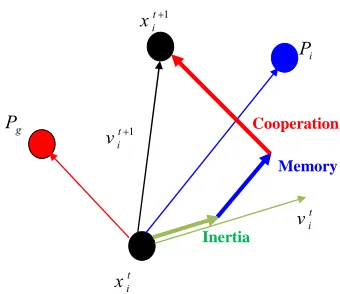
p representing the global best ever position in the swarm at time t. 1 and 2 represent uniform ran- dom numbers between 0 and 1. Figure 2 shows the de-
scription of velocity and position updates of a particle for a two-dimensional parameter space.
r r
Multi-objective optimization has been one of the most studied application areas of PSO algorithms. Number of approaches have been utilized and/or designed to tackle multi-objective optimization problems using PSO. A comprehensive survey of the state-of-the-art in Multi- objective (MO) particle swarm optimizers can be found in [23] where different techniques reported in Multi-ob- jective PSO development have been categorized and discussed.
From previous review, we want to integrate the merits of both TR and PSO in a new algorithm for solving EED problem; where TR has provided the initial set (close to
t i v
Memory
Inertia
Cooperation
t i x g
P t 1
[image:3.595.338.508.82.229.2]i v
Figure 2. Description of velocity and position updates in particle swarm optimization for a two dimensional pa- rameter space.
the Pareto set as possible and the reference point of the decision maker) followed by PSO to improve the quality of the solutions and get all the points on the Pareto fron- tier. Simulation results are presented for the standard IEEE 30-bus system. The effectiveness and potential of the proposed approach to solve the multi-objective EED problem are demonstrated.
2. Environmental/Economic Dispatch (EED)
The EED involves the simultaneous optimization of fuel cost and emission objectives which are conflicting ones. The deterministic problem is formulated as described below.
2.1. Objective Functions
2.1.1. Fuel Cost Objective
The classical EED problem of finding the optimal com- bination of power generation, which minimizes the total fuel cost while satisfying the total required demand can be mathematically stated as follows [5]:
2
1
1 1
$ h
n n
Gi i Gi i i Gi i Gi
i i
f P C P a b P c P
(9)where Ct: total fuel cost
$ h , i: is fuel cost of generator i, : fuel cost coefficients of gen- erator i, Gi: power generated (p.u.) by generator i, andn: number of generators.
C
, , , i i Gi i
a b P c P
2.1.2. Emission Objective
2 NO 2 1
exp ton h
x Gi
n
i i Gi i Gi i i Gi i
f P E
P P P
(10)where i, , , ,i i i i: coefficients of the ith generator’s NOxemission characteristic.
2.2. Constraints
The optimization problem is bounded by the following constraints.
2.2.1. Power Balance Constraint
The total power generated must supply the total load de- mand and the transmission losses:
1
0
n
Gi D loss i
P P P
(11)where D
P P
: total load demand (p.u.), and loss
The transmission losses are given by [24]: : transmission losses (p.u.).
1 1 n n
loss ij i j i j ij i j i j i i
P A PP Q Q B Q P P
Q
(12)where
, ,
cos , sin ;
i Gi Di i Gi Di
ij ij
ij i j ij i j
i j i j
P P P Q Q Q
R R
A B
VV VV
where
n: number of buses;
Rij: series resistance connecting buses i and j;
Vi: voltage magnitude at bus i; i
: voltage angle at bus i;
Pi: real power injection at bus i, and
Qi: reactive power injection bus i.
2.2.2. Maximum and Minimum Limits of Power Generation
The power generated PGi by each generator is constrained between its minimum and maximum limits, i.e.:
min max min max
min max ,
, 1, , .
Gi Gi Gi Gi Gi Gi
i i i
P P P Q Q Q
V V V i n
,
where
PGi min: minimum power generated, and
PGi max: maximum power generated.
2.2.3. Security Constraints
A mathematical formulation of the security constrained EELD problem would require a very large number of constraints to be considered. However, for typical sys- tems the large proportion of lines has a rather small pos-
sibility of becoming overloaded. The EED problem should consider only the small proportion of lines in vio- lation, or near violation of their respective security limits which are identified as the critical lines. We consider only the critical lines that are binding in the optimal solu- tion. The detection of the critical lines is assumed done by the experiences of the decision maker. An improve- ment in the security can be obtained by minimizing the following objective function.
max1 k j G Gi j j T P
S f P
T
(13)where
Ti(PG): the real power flow; max
i
T : the maximum limit of the real power flow of the
jth line; and
k: the number of monitored lines.
The line flow of the jth line is expressed in terms of the control variables PGs, by utilizing the generalized generation distribution factors (GGDF) [25]and is given below:
1 n
j G ij
i
T P D P
Gi (14)where Dij is the generalized GGDF for line j, due to gen- erator i. For secure operation, the transmission line load-ing Sl is restricted by its upper limit as:
max, 1, , ;
l l l
S S l n
where nl is the number of transmission line.
3. Multi-Objective Optimization
Multi-objective optimization (also called multicriteria optimization, multiperformance or vector optimization) can be defined as the problem of finding a vector of de- cision variables which satisfies constraints and optimizes a vector function whose elements represent the objective functions. These functions form a mathematical descrip- tion of performance criteria which are usually in conflict with each other. Hence, the term “optimize” means find- ing such a solution which would give the values of all the objective functions acceptable to the designer [26]. The general minimization problem of objectives can be mathematically stated as:
q
minimize : , 1, 2, , subject to: 0, 1, 2, , , 0, 1, 2, , ,
j i
e
f x f x j q
C x i p
C x e m
(15)
sion variable space. The multi-objective optimization pro- blem then reduces to finding an x such that fi(x) is opti- mized. Since the notion of an optimum solution in multi-objective optimization problem is different com- pared to the single objective optimization problem, the concept of Pareto dominance is used for the evaluation of the solutions. This concept formulated by Vilfredo Pareto is defined as [27]:
Definition 1. (Dominance Criteria [28]). For a prob-
lem having more than one objective function (say, fj, , ), any two solution xa and xb can have one of two possibilities, one dominates the other or none dominates the other. A solution xa is said to dominate the other solution xb, if both the following condition are true
1, ,
j q q1
The solution xa is no worse (say the operator de- notes worse and denotes better) than xb in all ob- jectives, or f xj
a f xj
b for all j1, , q ob- jectives. The solution xa is strictly better than xb in at least one objective, or f xj
a f xj
b for at least one
1, ,
.j q
If any of the above condition is violated, the solution
xa dose not dominates the solution xb.
Definition 2. (Pareto optimal solution). x* is said to be
a Pareto optimal solution of multi-objective optimization problem if there exists no other feasible x such that, fi(x) ≤ fi(x*) for all and fi(x) < fi(x*) for at least one objective function
1, ,
j q
j
f .
4. Reference Point Based TR/PSO Approach
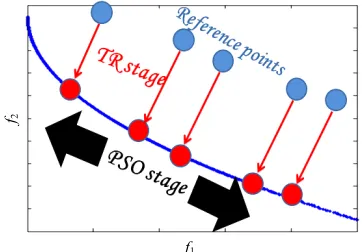
In this section, the proposed algorithm is presented. The proposed algorithm contains three stages initialization stage, TR stage (used to obtain a point on the Pareto frontier), and PSO stage (is applied to get all the points on the Pareto frontier). The mechanism of the proposed algorithm in the objective space is shown in Figure 3.
4.1. Initialization Stage
4.1.1. Initialization
Initialize N reference points in the search space, TR pa- rameters, and PSO parameters.
4.1.2. Reference Point Method
The reference point interactive approach of Wierzbickiis [28] is very simple and practical for multi-objective op- timization problems. Before the solution process starts, some information is given to the decision maker about the problem. The goal is to achieve Pareto-optimal solu- tion closest to a supplied reference point. Moreover, the reference point approach works with only one reference point at a time [29]. However, the decision maker may be interested in exploring the preferred regions of Pareto- optimality for multiple reference points simultaneously.
f1
[image:5.595.333.514.86.212.2]f2
Figure 3. The mechanism of the proposed algorithm in the objective space.
With the above principles of reference point approaches and difficulties with the classical methods, we use a methodology by which a set of Pareto-optimal solutions near a supplied set of reference points will be found, thereby eliminating the need of any weight vector and the need of applying the methodologies again and again.
Given a reference point for a q-objective optimization problem of minimizing
f x1
, , f xq
with x be- longs to the search space, the following optimization model is solved [28]:
1
1 minimize :
subject to: 0, 1, 2, , , 0, 1, 2, , ,
p
q p
j j
j
i
e
f x f x z
C x i l
C x e m
(16)
where the parameter p can take any value between 1 and ∞. When p = 2 is used, a Euclidean distance of any point in the objective space from the reference point z is minimized.
4.2. TR Stage
This section is devoted to presenting the detailed descrip- tion of TR algorithm for solving problem (16). The pro- posed TR algorithm combines ideas from Byrd [30], Omojokun [31], and El Alem [32]. Following Dennis et al. [33], we define the indicator matrix W x
p p ,whose diagonal entries are
1 if 0, 0 if 0.
i i
i C x w x
C x
(17) Using this matrix, the Problem defined in Equation (16) can be transformed to the following equality constrained optimization problem:
T minimize
subject to 1 2 0, 0.
i i
e f x
C x W x C x C x
The above problem can be rewritten as:
minimize
subject to 0,
f x
h x (19) The Lagrangian function associated with problem de- fined in (19) is given by
,
T
k k k k k
L x f x h x
; (20) where k is the Lagrange multiplier vector associ- ated with equality constraint h x
k .The reduced Hessian approach is used to compute a trial step k. In this approach, the trial step k is de- composed into two orthogonal components; the normal component and the tangential component . The trial step dk has the form
d d d t k d n k n t
k k k k, where k
d d Z d Z
is a matrix whose columns form an orthonormal basis for the null space of h x
k T.We obtain the normal component by solving the following TR sub-problem:
n k d
T 21 minimize
2
subject to ,
n
k k
n k
h x h x d
d
(21)
for some
0,1 .The tangential component is computed by solving the following TR sub-problem:
T TT
2 2
1
min : ,
2
subject to: ,
n t t
k x k k k k k k k
t n
k k k
T t
Z L x H d d d Z H Z d
Z d d
(22) To test the step, we compare the actual reduction in moving from xk to xkdk versus the predicted re- duction. The actual reduction is defined as:
2
21 1 1
, ,
k
k k k k k k k
Ared
L x L x r h x h x
.
(23) The predicted reduction is defined as:
T T T T 2 2 T 1 , 2 +k x k k k k k k
k k k k
k k k k k
Pred L x d d H d
h x h x d
r h x h x h x d
; (24)
where is a parameter usually called the penalty parameter, and
0
r
1
.k k k
If
Aredk Predk
0, where is a small fixed constant, then the step is rejected. In this case, the radius of the TR is decreased by setting
0 0,1
3 k dk
,
where 3
0,1 , and another trial step is computed. If
Ared Predk k
2; where 20, then the step1
k k k
x x d is accepted and set the TR as
1 min max, max min, 1
k k
;
where 1
0,1 and another trial step is computed. If 0
Aredk Predk
2, then the step xk1 xk dk
1 k, min is accepted and set the TR as , and another trial step is computed.
max
k
Finally, the algorithm is terminated when either 1
k
d or T
2, k x k k
Z L h for some 1, 20. 4.3. PSO Stage
In this stage a homogeneous PSO for multi-objective optimization problem (see [34]) is proposed with a de- creasing constriction factor to restrict velocity of the par- ticles and control it [35-37]. In homogeneous PSO one global repository concept is proposed for choosing pbest
and gbest, this means that each particle has lost its own identity and treated simply as a member of social group. The procedure of the PSO stage is as follows.
Step 1: Initialization
All non-dominated points (which obtained by applying TR stage) chosen as particles position t
i x .
PSO parameters such as velocity i, inertia weight w and learning rates c1 and c2 are set up.
t v
Store non-dominated particles in Pareto repository. If the specific constraint doesn’t exist for a repository, the size of the repository is unlimited.
Step 2: Evaluation
Evaluate the multi-objective fitness value of each par- ticle and save it in a vector form.
Step 3: Floating
Two optimal solutions are chosen randomly for pbest
and gbest from the repository.
Determine the new position of each particle with Equations (7) and (8).
Step 4: Repairing of particles
Where the particle i starts at position t i
x with velocity in the feasible space, the new position
t i
v t1
i
x depends
on velocity t1 i
v , so we introduce a modified constriction
factor (i.e., decreasing constriction factor)
2 2 ; 2
(25)
where, is the age of the infeasible particle (i.e., how long it is still infeasible) and it is increased with the number of failed trials to keep the feasibility of the parti- cle. The relation between the modified constriction factor and the age of the infeasible particle is shown in Figure 4.
Figure 4. Relation between the modified constriction factor and the age of the infeasible particle.
1 .
t t t
i i i
1
x x v (26)
Step 5: Selection and update the repository
Check the Pareto optimality of each particle. If the fit-ness value of the particle is non-dominated when it com-pared to the Pareto optimal set in a repository, save it into the Pareto repository.
In the Pareto repository, if a particle is dominated from new one, then discard it.
Step 6: Repeat
Repeat again step 2 to step 5 until the number of gen- eration reaches to given t. The pseudo code of the pro- posed algorithm showing in Figure 5.
5. Implementation of the Proposed
Approach
Simulations were performed on the standard IEEE 30- bus 6-generator test system. The single-line diagram of this system is shown in Figure 6. The proposed algo-
rithm have been implemented in MATLAB environment. We have kept the proposed approach parameters same in all problems as is shown in Table 1 (see [35,38]).
The power system is interconnected by 41 transmis- sion lines and the total system demand for the 21 load buses is 2.834 p.u. Fuel cost and NOx emission coeffi- cients for this system are given in Tables 2 and 3 respec-
tively.
[image:7.595.59.287.84.263.2]6. Results and Discussions
Figure 7 present the graphical results of our approach
and ε-dominance based multi-objective genetic algorithm (MOGA) [39] for the EED problem after 200 genera- tions.
From the figure, it can be deduced that the algorithm is capable of obtaining the Pareto front for the EED prob-
Initialize parameters for TR and PSO
TR parameters 1, , , , , ,2 0 1 2 3 0, max,min PSO parameters vi, , , w c c1 2
Construct the reference point model of EED problem
TR algorithm
While the stopping criterion is not met
Compute the normal component of the trial step The tangential component of the trial step is calculated Compute the trial step (the sum of normal and tangential component)
Test the new trial step
Endwhile
PSO algorithm.
While number of iterations not met
Set the solution (non-dominated solution) obtained by TR in a repository (particles positions)
Chosen randomly pbest and gbest from the repository. Update particles velocity and position
Repair the unfeasible particle Evaluate fitness of particle swarm Selection and update the repository
Endwhile
Figure 5. The pseudo code of the proposed algorithm.
[image:7.595.311.539.402.705.2]Table 1. The parameter adopted in the implementation of the proposed algorithm.
Parameter Value Parameter Value
N 50 max 10
5
0
1
, 2 10−4 min 10−3
0
0 PSO iteration 200
1
2 w 0.6
2
0.25 c1 2.8
3
0.25 c2 1.3
0
[image:8.595.57.287.119.385.2] C1,1.5 min 10
Table 2. Fuel cost coefficients.
Unit i ai bi ci PGi min PGi max
1 10 200 100 0.05 0.50
2 10 150 120 0.05 0.60
3 20 180 40 0.05 1.00
4 10 100 60 0.05 1.20
5 20 180 40 0.05 1.00
[image:8.595.55.285.423.544.2]6 10 150 100 0.05 0.60
Table 3. NOx Emission coefficients.
Unit i α β γ ξ λ
1 4.091e−2 −5.554e−2 6.490e−2 2.0e−4 2.857 2 2.543e−2 −6.047e−2 5.638e−2 5.0e−4 3.333 3 4.258e−2 −5.094e−2 4.586e−2 1.0e−6 8.000 4 5.326e−2 −3.550e−2 3.380e−2 2.0e−3 2.000 5 4.258e−2 −5.094e−2 4.586e−2 1.0e−6 8.000 6 6.131e−2 −5.555e−2 5.151e−2 1.0e−5 6.667
lem as verified by the minimum of each objective and points obtained by ε-dominance based MOGA. In ε- dominance based MOGA. There are gaps between the nondominated solutions which make the curve non- smooth. In other words, we can say that the proposed algorithm outperformed ε-dominance based MOGA in both distribution and spread.
The best fuel cost and best NOx emission obtained by the proposed approach as compared to non-dominated sorting genetic algorithm (NSGA) [8], niched Pareto- genetic algorithm (NPGA) [9], strength Pareto-evolu- tionary algorithm (SPEA) [10], NSGA-II [40] and ε- dominance-based MOGA [39] are given in Tables 4 and 5. It is observed that the proposed approach finds better
minimum fuel cost and emission level than the other
ε-dominance based MOGA
The proposed algorithm
Figure 7. Pareto-optimal front for the EED problem.
evolutionary algorithms.
Table 6 reports the computational results, which de-
clare that this work may be very valuable for on-line op- eration of power systems when environmental constraints are also need to be considered.
It has been shown that the proposed algorithm can ob- tain the Pareto front of the problem and it is therefore ideal for solving the multi-objective EED optimization problem which has conflicting objectives from the fact that the multi-objective approach yields multiple Pareto- optimal solutions in a single simulation run whereas mul- tiple runs are required for the single objective approach with weighted objectives. Another advantage is that the simulation results prove superiority of the proposed ap- proach to those reported in the literature, where it com- pletely covers and dominates all Pareto-set found by the other approaches. Finally, the reality of using the pro- posed approach to handle on-line problems of realistic dimensions has been approved due to small computa-
Table 4. Best total $/h fuel cost.
NSGA NPGA SPEA NSGA-II based MOGA ε-dominance Proposed approach
PG1 0.1168 0.1245 0.1086 0.1182 0.1739 0.11852
PG2 0.3165 0.2792 0.3056 0.3148 0.3578 0.31212
PG3 0.5441 0.6284 0.5818 0.5910 0.5311 0.51886
PG4 0.9447 1.0264 0.9846 0.9710 0.9790 1.011
PG5 0.5498 0.4693 0.5288 0.5172 0.4429 0.50446
PG6 0.3964 0.39993 0.3584 0.3548 0.3725 0.36902
Best cost 608.245 608.147 607.807 607.801 606.4533 600.1647
[image:9.595.63.538.296.460.2]Emission 0.21664 0.22364 0.22015 0.21891 0.2028 0.2042
Table 5. Best total ton/h NOx emission.
NSGA NPGA SPEA NSGA-II based MOGA ε-dominance Proposed approach
PG1 0.4113 0.3923 0.4043 0.4141 0.3885 0.37495
PG2 0.4591 0.4700 0.4525 0.4602 0.4984 0.58224
PG3 0.5117 0.5565 0.5525 0.5429 0.5167 0.47498
PG4 0.3724 0.3695 0.4079 0.4011 0.4502 0.43399
PG5 0.5810 0.5599 0.5468 0.5422 0.5205 0.49171
PG6 0.5304 0.5163 0.5005 0.5045 0.5005 0.47613
Best emission 0.19432 0.19424 0.19422 0.19419 0.1882 0.1843
Cost 647.251 645.984 642.603 644.133 642.8976 638.5540
Table 6. Computation results for the proposed approach.
System Total iteration CPU time (s)
30-Bus system 200 22.5
7. Conclusions
In this paper, the multi-objective EED problem has been solved using Reference Point Based TR/PSO approach. In this approach, we introduced an integration between TR and PSO to improve the quality of the founded solu- tions, and also to ensure faster convergence to the Pareto optimal solution. TR has provided the initial set (close to the Pareto set as possible and the reference point of the decision maker) followed by PSO to improve the quality of the solutions and get all the points on the Pareto fron- tier. The algorithm has been run on the standard IEEE 30-bus system.
The following are the significant contributions of this paper:
The proposed technique has been effectively applied to solve the EED considering two objectives simultane-
ously.
Simulation results prove superiority of the proposed approach to those reported in the literature.
The non-dominated solutions in the obtained Pareto- optimal set are well distributed and have satisfactory diversity characteristics.
The proposed algorithm does not have any restric- tions on the number of the Pareto optimal solutions found; where it keeps track of all the feasible solu- tions found during the optimization.
Also, the present work addresses an important task of combining TR methodology with PSO to not find a single optimal solution, but to find a set of solutions near the desired region of DM’s interest.
The proposed approach is efficient for solving multi- objective optimization where multiple Pareto-optimal solutions can be found in one simulation run.
The most important aspect of the proposed approach is that any number of objectives can be considered.
[image:9.595.58.285.489.527.2]high efficiency of TR method, can overcome the li- mitation of trust region method and solve efficiently a class of multi-objective applications.
REFERENCES
[1] S. F. Brodesky and R. W. Hahn, “Assessing the Influence of Power Pools on Emission Constrained Economic Dis- patch,” IEEE Transactions on Power Systems, Vol. 1, No. 1, 1986, pp. 57-62. doi:10.1109/TPWRS.1986.4334844 [2] A. Farag, S. Al-Baiyat and T. C. Cheng, “Economic Load
Dispatch Multiobjective Optimization Procedures Using Linear Programming Techniques,” IEEE Transactions on Power Systems, Vol. 10, No. 2, 1995, pp. 731-738. doi:10.1109/59.387910
[3] C. S. Chang, K. P. Wong and B. Fan, “Security-Con- strained Multiobjective Generation Dispatch Using Bicri- terion Global Optimization,” IEE Proceedings Genera- tion, Transmission & Distribution, Vol. 142, No. 4, 1995, pp. 406-414. doi:10.1049/ip-gtd:19951806
[4] J. X. Xu, C. S. Chang and X. W. Wang, “Constrained Multiobjective Global Optimization of Longitudinal In- terconnected Power System by Genetic Algorithm,” IEE Proceedings Generation, Transmission & Distribution, Vol. 143, No. 5, 1996, pp. 435-446.
doi:10.1049/ip-gtd:19960418
[5] J. Zahavi and L. Eisenberg, “Economic-Environmental Power Dispatch,” IEEE Transactions on Systems, Man,
and Cybernetics SMC, Vol. 5, No. 5, 1985, pp. 485-489. doi:10.1109/TSMC.1975.5408370
[6] Y. T. Hsiao, H. D. Chiang, C. C. Liu and Y. L. Chen, “A Computer Package for Optimal Multi-Objective VAR Planning in Large Scale Power Systems,” IEEE Transac- tions on Power Systems, Vol. 9, No. 2, 1994, pp. 668-676. doi:10.1109/59.317676
[7] B. S. Kermanshahi, Y. Wu, K. Yasuda and R. Yokoyama, “Environmental Marginal Cost Evaluation by Non-Infe- riority Surface,” IEEE Transactions on Power Systems, Vol. 5, No. 4, 1990, pp. 1151-1159.
doi:10.1109/59.99365
[8] M. A. Abido, “A novel Multiobjective Evolutionary Al- gorithm for Environmental/Economic Power Dispatch,”
Electric Power Systems Research, Vol. 65, No. 1, 2003, pp. 71-81. doi:10.1016/S0378-7796(02)00221-3
[9] M. A. Abido, “A Niched Pareto Genetic Algorithm for Multiobjective Environmental/Economic Dispatch,” Elec- tric Power Systems Research, Vol. 25, No. 2, 2003, pp. 97-105. doi:10.1016/S0142-0615(02)00027-3
[10] M. A. Abido, “Environmental/Economic Power Dispatch Using Multiobjective Evolutionary Algorithms,” IEEE Transactions on Power Systems, Vol. 18, No. 4, 2003, pp. 1529-1537. doi:10.1109/TPWRS.2003.818693
[11] K. Deb, “Multi-Objective Optimization Using Evolution- ary Algorithms,” Wiley, New York, 2001.
[12] C. M. Fonsecam and P. J. Fleming, “An Overview of Evolutionary Algorithms in Multiobjective Optimization,”
Evolution Computing, Vol. 3, No. 1, 1995, pp. 1-16. doi:10.1162/evco.1995.3.1.1
[13] F. Wang, K. Zhang, C. Wang and L. Wang, “A Variant of Trust-Region Methods for Unconstrained Optimization,”
Applied Mathematics and Computation, Vol. 203, No. 1, 2008, pp. 297-307. doi:10.1016/j.amc.2008.04.049 [14] M. Ahookhosh, K. Amini and M. R. Peyghami, “A Non-
monotone Trust-Region Line Search Method for Large- Scale Unconstrained Optimization,” Applied Mathemati- cal Modelling, Vol. 36, No. 1, 2012, pp. 478-487. doi:10.1016/j.apm.2011.07.021
[15] M. Ahookhosh and K. Amini, “A Nonmonotone, Trust Region Method with Adaptive Radius for Unconstrained Optimization Problems,” Computers & Mathematics with Applications, Vol. 60, No. 3, 2010, pp. 411-422.
doi:10.1016/j.camwa.2010.04.034
[16] Z. Shi and J. Guo, “A New Trust Region Method for Un- constrained Optimization,” Journal of Computational and Applied Mathematics, Vol. 213, No. 2, 2008, pp. 509-520. doi:10.1016/j.cam.2007.01.027
[17] J. Zhang, K. Zhang and S. Qu, “A Nonmonotone Adap- tive Trust Region Method for Unconstrained Optimiza- tion Based on Conic Model,” Applied Mathematics and Computation, Vol. 217, No. 8, 2010, pp. 4265-4273. doi:10.1016/j.amc.2010.10.043
[18] B. El-Sobky, “A Global Convergence Theory for an Ac-tive Trust Region Algorithm for Solving the General Nonlinear Programming Problem,” Applied Mathematics and Computation, Vol. 144, No. 1, 2003, pp. 127-157. doi:10.1016/S0096-3003(02)00397-1
[19] Y. Ji, K. Zhang, S. Qu and Y. Zhou, “A Trust-Region Method by Active-Set Strategy for General Nonlinear Optimization,” Computers & Mathematics with Applica- tions, Vol. 54, No. 2, 2007, pp. 229-241.
doi:10.1016/j.camwa.2007.02.003
[20] S. Kim and J. Ryu, “A Trust-Region Algorithm for Bi- Objective Stochastic Optimization,” Procedia Computer Science, Vol. 4, 2011, pp. 1422-1430.
doi:10.1016/j.procs.2011.04.153
[21] B. El-Sobky, “An Active-Set Trust-Region Algorithm for Solving Constrained Multi-Objective Optimization Prob- lem,” American Mathematical Society, Vol. 6, 2012, pp. 1599-1612.
[22] J. Kennedy, R. C. Eberhart and Y. Shi, “Swarm Intelli- gence,” Morgan Kaufmann, San Francisco, 2001. [23] M. R. Sierra and C. C. Coello, “Multi-Objective Particle
Swarm Optimizers: A Survey of the State-of-the-Art,”
International Journal of Computational Intelligence Re- search, Vol. 2, No. 3, 2006, pp. 287-308.
[24] D. Hazarika and P. K. Bordoloi, “Modified Loss Co- efficients in the Determination of Optimum Generation Scheduling,” IEEE Proceedings, Vol. 138, No. 2, 1991, pp. 166-172.
[25] W. Y. Ng, “Generalized Generation Distribution Factors for Power System Security Evaluations,” IEEE Transac- tions on Power Apparatus and Systems, Vol. 100, No. 3, 1981, pp. 1001-1005. doi:10.1109/TPAS.1981.316635 [26] C. A. C. Coello, “An Updated Survey of GA-Based Mul-
tiobjective Optimization Techniques,” ACM Computing Surveys, Vol. 32, No. 2, 2000, pp. 109-143.
[27] V. Pareto, “Cours d’Économie Politique, Volume I and II,” F. Rouge, Lausanne, 1896, p. 97.
[28] K. Miettinen, “Nonlinear Multiobjective Optimization,” Kluwer Academic Publishers, Boston, 1999.
[29] A. M. J. Skulimowski, “Classification and Properties of Dominating Points in Vector Optimization,” Mathemati- cal Methods of Operations Research, Vol. 58, 1989, pp. 99-112.
[30] R. Byrd, “Robust Trust Region methods for Nonlinearly Constrained Optimization,” A Talk Presented at the Sec- ond SIAM Conference on Optimization, Houston, 1987. [31] E. Omojokun, “Trust-Region Strategies for Optimization
with Nonlinear Equality and Inequality Constraints,” Ph.D. Thesis, Department of Computer Science, Univer- sity of Colorado, Boulder, 1989, pp. 57-87.
[32] M. El-Alem, “A Robust Trust-Region Algorithm with a Non-Monotonic Penalty Parameter Scheme for Con- strained Optimization,” SIAM Journal on Optimization, Vol. 5, No. 2, 1995, pp. 348-378. doi:10.1137/0805018 [33] J. Dennis, M. El-Alem and K. Williamson, “A Trust-
Region Approach to Nonlinear Systems of Equalities and Inequalities,” SIAM Journal on Optimization, Vol. 9, No. 2, 1999, pp. 291-315. doi:10.1137/S1052623494276208 [34] S. K. Hwang, K. Koo and J. S. Lee, “Homogeneous Par-
ticle Swarm Optimizer for Multi-Objective Optimization Problem,” ICGST International Journal on Artificial In- telligence and Machine Learning, 2006.
[35] W. F. Abd-El-Wahed, A. A. Mousa and M. A. El-Shor- bagy, “Integrating Particle Swarm Optimization with Ge- netic Algorithms for Solving Nonlinear Optimization Pro- blems,” Journal of Computational and Applied Mathe- matics, Vol. 235, No. 5, 2011, pp. 1446-1453.
doi:10.1016/j.cam.2010.08.030
[36] A. A. Mousa, M. A. El-Shorbagy and W. F. Abd El-Wa- hed, “Local Search Based Hybrid Particle Swarm Opti- mization for Multiobjective Optimization,” International Journal of Swarm and Evolutionary Computation, Vol. 3, 2012, pp. 1-14. doi:10.1016/j.swevo.2011.11.005
[37] A. A. Mousa and M. A. El-Shorbagy, “Enhanced Particle Swarm Optimization Based Local Search for Reactive Power Compensation Problem,” Applied Mathematics, Vol. 3, No. 10A, 2012, pp. 1276-1284.
[38] R. Fletcher, “Practical Methods of Optimization,” 2nd Edition, John Wiley and Sons, Chichester, 1987.
[39] M. S. Osman, M. A. Abo-Sinna and A. A. Mousa, “An ε- Dominance-Based Multiobjective Genetic Algorithm for Economic Emission Load Dispatch Optimization Prob- lem,” Electric Power Systems Research, Vol. 79, No. 11, 2009, pp. 1561-1567. doi:10.1016/j.epsr.2009.06.003 [40] R. Ah King, H. Rughooputh and K. Deb, “Evolutionary
![Figure 7 present the graphical results of our approach and ε-dominance based multi-objective genetic algorithm (MOGA) [39] for the EED problem after 200 genera- tions](https://thumb-us.123doks.com/thumbv2/123dok_us/7766361.715061/7.595.311.539.402.705/figure-graphical-results-approach-dominance-objective-algorithm-problem.webp)