http://www.scirp.org/journal/ns Natural Science, 2017, Vol. 9, (No. 4), pp: 67-91
https://doi.org/10.4236/ns.2017.94007 67 Natural Science
Pse-in-One 2.0: An Improved Package of Web Servers for
Generating Various Modes of Pseudo Components of DNA,
RNA, and Protein Sequences
Bin Liu1,2,3, Hao Wu1, Kuo-Chen Chou3,4,5
1School of Computer Science and Technology, Harbin Institute of Technology Shenzhen Graduate School, Shenzhen, China; 2Key Laboratory of Network Oriented Intelligent Computation, Harbin Institute of Technology Shenzhen Graduate School, Shenzhen, China; 3Gordon Life Science Institute, Bostom, Massachusetts, USA; 4Center for Informational Biology, University of Electronic Science and Technology of China, Chengdu, China; 5Center of Excellence in Genomic Medicine Research (CEGMR), King Abdulaziz University, Jeddah, KSA
Correspondence to: Bin Liu, [email protected]; Kuo-Chen Chou, [email protected] Keywords: Pseudo Components, DNA Sequences, RNA Sequences, Protein Sequences
Received: April 10, 2017 Accepted: April 25, 2017 Published: April 28, 2017 Copyright © 2017 by authors and Scientific Research Publishing Inc.
This work is licensed under the Creative Commons Attribution International License (CC BY 4.0). http://creativecommons.org/licenses/by/4.0/
ABSTRACT
Pse-in-One 2.0 is a package of web-servers evolved from Pse-in-One (Liu, B., Liu, F., Wang, X., Chen, J. Fang, L. & Chou, K.C. Nucleic Acids Research, 2015, 43:W65-W71). In order to make it more flexible and comprehensive as suggested by many users, the updated package has incorporated 23 new pseudo component modes as well as a series of new feature analysis approaches. It is available at http://bioinformatics.hitsz.edu.cn/Pse-in-One2.0/. Moreover, to maximize the convenience of users, provided is also the stand-alone version called “Pse-in- One-Analysis”, by which users can significantly speed up the analysis of massive sequences.
1. INTRODUCTION
With the avalanche of biological sequences generated in the post-genomic age, one of the most chal-lenging problems in computational biology today is how to effectively formulate the sequence of a biolog-ical sample (such as DNA, RNA or protein) with a discrete model or a vector that can effectively reflect its sequence pattern information or capture its key features concerned. This is because almost all the existing machine-learning algorithms, such as “Neural Network” or NN algorithm [1-3] “Support Vector Ma-chine” or SVM algorithm [4-12] “Nearest Neighbor” or NN algorithm [13, 14] and “Random Forest” algo-rithm [15-22] can only handle vectors but not sequence samples as elucidated in a review paper [23]. Un-fortunately, if using the sequential model,
i
.e
., the model in which all the samples are represented by their original sequences, it is hardly able to train a machine learning model that can cover all the possible cases concerned, as elaborated in [24].https://doi.org/10.4236/ns.2017.94007 68 Natural Science
approach [25] or PseAAC (pseudo amino acid composition) approach [26-28] or Chou’s PseAAC [29-32] was proposed. Ever since the concept of Chou’s PseAAC [29-31] was proposed, it has rapidly penetrated into many biomedicine and drug development areas [33, 34] and nearly all the areas of computational proteomics [35-212].
Because it has been widely and increasingly used, and also because it would be a trend and future di-rection to establish user-friendly and publically accessible web-servers for various analysis methods as pointed out in [213], four powerful web-servers were established; they are “PseAAC” [214], “Pse-AAC-Builder” [29], “propy” [30] and “PseAAC-General” [32]. The former three are for generating various modes of Chou’s special PseAAC; while the 4th one for those of Chou’s general PseAAC [28, 108] includ-ing not only all the special modes of feature vectors for proteins but also the higher level feature vectors such as “Functional Domain” mode (see Eqs.9-10 of [108], “Gene Ontology” mode (see Eqs.11-12 of 108), and “Sequential Evolution” or “PSSM” mode (see Eqs.13-14 of [108].
Encouraged by the successes of using PseAAC to deal with protein/peptide sequences, the concept of PseAAC has been extended to cover DNA/RNA sequences as well via the PseKNC (Pseudo K-tuple Nu-cleotide Composition) approach [215-223]. Meanwhile, four publically accessible web-servers [215, 217,
224, 225] were developed for generating various pseudo components or feature vectors for DNA/RNA se-quences as well.
Particularly, recently a very powerful web-server called Pse-in-One [226] has been established that can be used to generate any desired pseudo components or feature vectors for protein/peptide and DNA/RNA sequences according to the need of users’ studies.
Since then some novel pseudo component modes have been proposed for dealing with various prob-lems in proteomics and genome analysis [7, 10-12, 18-22, 221, 227-263]. In order to incorporate these new and important developments into the Pse-in-One package, an updated version called “Pse-in-One 2.0” has been established.
2. RESULTS AND DISCUSSION
Compared with the original one, the updated version has the following new features and functions.
2.1. Modes of Pseudo Components
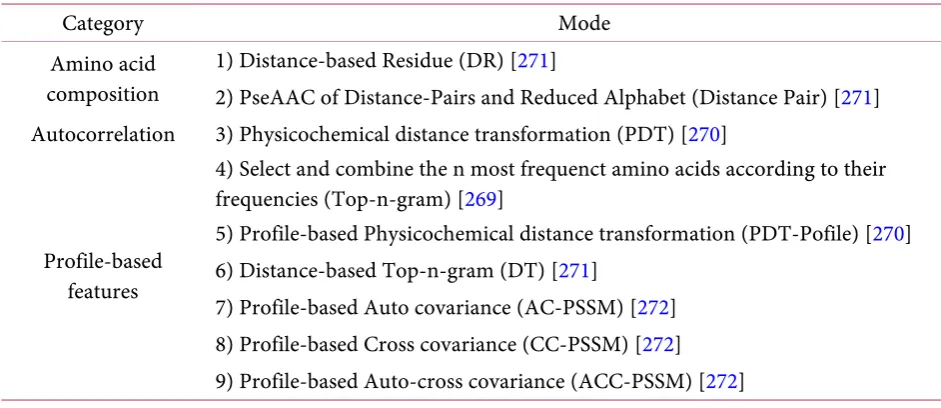
Added in are a total of 23 new pseudo component modes, of which 6 for DNA sequences (Table 1), 8 for RNA sequences (Table 2), and 9 for protein sequences (Table 3). These new modes reflect the recent developments of the pseudo components, particularly in extending the coverage scope to those features derived from (1) RNA secondary structures, and (2) the multiple sequence alignments and profiles. As a consequence, Pse-in-One 2.0 covers a total of 51 different features, of which 20 for DNA sequences, 14 for RNA sequences, and 17 for protein sequences. The overall structure can be reflected via the following three sub web-servers.
PseDAC-General is for generating the feature vectors of DNA sequences. It contains three catego-ries: nucleotide composition, nucleotide autocorrelation, and pseudo nucleotide composition. Of the 6 new modes, 3 are added into the first category, including IDKmer [224], Mismatch [264], and Subse-quence[265]; while the other 3 are added to the second category, including Moran autocorrelation, Geary autocorrelation, and Normalized Moreau-Broto autocorrelation [217].
https://doi.org/10.4236/ns.2017.94007 69 Natural Science
Table 1. List of the 6 new modes for DNA sequences.
Category Mode
Nucleic acid composition
1) increment of diversity (IDKmer) [226, 270, 291]
2) The occurrences of kmers, allowing at most m mismatches (Mismatch) [264, 265, 292]
3) The occurrences of kmers, allowing non-contiguous matches (Subsequence) [265, 292, 293]
Autocorrelation
4) Moran autocorrelation (MAC) [268, 294] 5) Geary autocorrelation (GAC) [217, 295]
[image:3.595.54.522.285.486.2]6) Normalized Moreau-Broto autocorrelation (NMBAC) [217, 296]
Table 2.List of the 8 new modes for RNA sequences.
Category Mode
Nucleic acid composition
1) The occurrences of kmers, allowing at most m mismatches (Mismatch) [264, 265, 292]
2) The occurrences of kmers, allowing non-contiguous matches (Subsequence) [265, 292, 293]
Autocorrelation
3) Moran autocorrelation (MAC) [217, 294] 4) Geary autocorrelation (GAC) [217, 295]
5) Normalized Moreau-Broto autocorrelation (NMBAC) [217, 296]
Predicted structure composition
6) Local structure-sequence triplet element (Triplet) [266] 7) Pseudo-structure status composition (PseSSC) [226]
[image:3.595.56.527.521.725.2]8) Pseudo-distance structure status pair composition (PseDPC) [10]
Table 3. List of the 8 new modes for protein sequences.
Category Mode
Amino acid composition
1) Distance-based Residue (DR) [271]
2) PseAAC of Distance-Pairs and Reduced Alphabet (Distance Pair) [271] Autocorrelation 3) Physicochemical distance transformation (PDT) [270]
Profile-based features
4) Select and combine the n most frequenct amino acids according to their frequencies (Top-n-gram) [269]
5) Profile-based Physicochemical distance transformation (PDT-Pofile) [270] 6) Distance-based Top-n-gram (DT) [271]
https://doi.org/10.4236/ns.2017.94007 70 Natural Science
Mismatch [264] and Subsequence [265]; and 3 are added into the autocorrelation category,
i
.e
., Moran autocorrelation, Geary autocorrelation, and Normalized Moreau-Broto autocorrelation [268].PseAAC-General is designed to generate the feature vectors for protein sequences. For this sub web-server, we have created a special category called “profile-based” category, into which 6 new modes are added; they are “top-n-gram” [269], “PDT-Profile” [270], “DT” [271], “AC-PSSM”, “CC-PSSM” and “ACC-PSSM” [272]. The top-n-gram combines the
n
most frequent amino acids in each amino acid fre-quency profile; PDT-Profile is the abbreviation for “Profile- based physicochemical distance transforma-tion” and it is similar to PDT except that PDT-Profile extracts the evolutionary information from the fre-quency profile; DT is the abbreviation for “distance-based Top-n-gram” and this method extends Top-n-gram by considering the distances between Top-n-gram pairs; AC-PSSM, CC-PSSM and ACC-PSSM incorporate the position-specific score matrix (PSSM) into the methods of AC, CC and ACC [272, 273]. These profile-based methods can significantly improve the protein remote homology detection [7, 8], protein fold recognition and so forth. Moreover, added into the amino acid composition category are 3 new modes: they are “DR” [274], “Distance Pair” [271], and “PDT” [270]. DR is the abbreviation for “Distance-based Residue”. It is sequence-based method, in which the generated feature vector for protein sequence is based on the distance between residue pairs and has shown better performance for protein remote homology detection. “Distance Pair” method incorporates the amino acid distance pair coupling information and the amino acid reduced alphabet profile into the general pseudo amino acid composition (PseAAC) [108] vector, which is very useful for analysing DNA-binding proteins [15, 170, 189, 275]. PDT is the abbreviation for “physicochemical distance transformation”, which can incorporate considerable sequence-order information or important patterns of protein/peptide sequences into Pseudo components [28], which is very useful for conducting various proteome analyses [17, 23, 215-217, 224, 225, 231, 235,276-289] and genome analysis as well [216, 218, 220, 223, 229, 255, 277, 290].
For more information about the three sub-webservers, see Supporting information S1.
2.2. New Facility
Added into the updated version is also a new facility called “Pse-in-One-Analysis”, by which the feature vectors for the input DNA, RNA, or protein sequences can be automatically generated according to the selected modes and parameters. And the results will be sent to the users via their e-mail addresses. The users can also see the result by revisiting the link concerned. Moreover, provided are also the feature vec-tor visualization and the predicted RNA secondary structure visualization functions, which are very useful for the feature analysis and interpretation. See Supporting Information S2 for detailed information in this regard.
The stand-alone version of Pse-in-One 2.0 is available. Users can easily download it into their own computer for conducting high throughput analysis of massive biological sequences.
By means of the new facility Pse-in-One-Analysis or Pse-Analysis [254], all the tedious jobs in de-veloping a predictor, such as selecting optimal features and parameters as well as evaluating anticipated prediction quality, can be automatically fulfilled by the computer as elaborated in [254]. It will save scien-tists a lot of time, one big step forward to realize the dream of using robots or computers to conduct ge-nome/proteome analyses.
2.3. New Kits
Newly provided in Pse-in-One 2.0 are also some useful kits, including automatic notification of re-sults by e-mail, RNA secondary structure visualization, etc. Meanwhile, some bugs have been fixed to make the web-server work more smoothly and fully consistent.
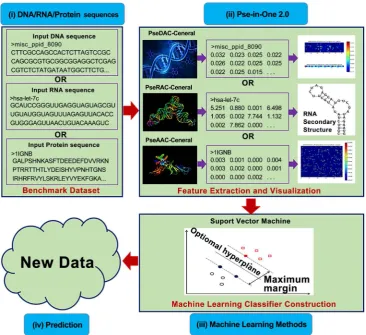
A flowchart of Pse-in-One 2.0 is given in Figure 1.
3. CONCLUSION
https://doi.org/10.4236/ns.2017.94007 71 Natural Science
Figure 1. The flowchart of Pse-in-One 2.0. The first two steps are imple-mented in Pse-in-One 2.0 webserver. The last two steps are impleimple-mented in Pse-in-One-Analysis. The output of the webserver can be directly used as the input of Pse-in-One-Analysis package.
powerful than the former. In comparison with the 2015 version that has been widely used in bioinformat-ics and computational biology and biomedicine within a very short period of time, the new version is even more powerful for conducting various genome analyses and proteome analyses. Science is rapidly devel-oping, particularly in life science. Once having new and important developments, the future version for the Pse-in-One series will be announced via a publication or web-page.
ACKNOWLEDGEMENTS
This work was supported by the National Natural Science Foundation of China (No. 61672184), the Natural Science Foundation of Guangdong Province (2014A030313695), Guangdong Natural Science Funds for Distinguished Young Scholars (2016A030306008), and Scientific Research Foundation in Shenzhen (Grant No. JCYJ 20150626110425228).
SUPPORTING INFORMATION
Supporting Information S1. Pse-in-One 2.0 Description. This document describes totally 51 dif-ferent modes, including 20 modes for DNA sequences, 14 modes for RNA sequences, and 17 modes for protein sequences. The document is available at
https://doi.org/10.4236/ns.2017.94007 72 Natural Science
Supporting Information S2. Pse-in-One 2.0 User’s Manual. This document describes how to use Pse-in-One-Analysis, including installation, function description, commands and methods description. The document is available at
http://bioinformatics.hitsz.edu.cn/Pse-in-One2.0/static/download/Pse-in-One%202.0_manual.pdf.
REFERENCES
1. Feng, K.Y., Cai, Y.D. and Chou, K.C. (2005) Boosting Classifier for Predicting Protein Domain Structural Class. Biochemical & Biophysical Research Communications (BBRC), 334, 213-217.
https://doi.org/10.1016/j.bbrc.2005.06.075
2. Cai, Y.D. and Chou, K.C. (1999) Artificial Neural Network for Predicting Alpha-Turn Types. Analytical Bio-chemistry, 268, 407-409. https://doi.org/10.1006/abio.1998.2992
3. Thompson, T.B., Chou, K.C. and Zheng, C. (1995) Neural Network Prediction of the HIV-1 Protease Cleavage Sites. Journal of Theoretical Biology, 177, 369-379. https://doi.org/10.1006/jtbi.1995.0254
4. Feng, P.M., Chen, W., Lin, H. and Chou, K.C. (2013) iHSP-PseRAAAC: Identifying the Heat Shock Protein Families Using Pseudo Reduced Amino Acid Alphabet Composition. Analytical Biochemistry, 442, 118-125. https://doi.org/10.1016/j.ab.2013.05.024
5. Chen, W., Feng, P.M., Lin, H. and Chou, K.C. (2013) iRSpot-PseDNC: Identify Recombination Spots with Pseudo Dinucleotide Composition. Nucleic Acids Research, 41, e68. https://doi.org/10.1093/nar/gks1450 6. Xiao, X., Wang, P. and Chou, K.C. (2012) iNR-PhysChem: A Sequence-Based Predictor for Identifying Nuclear
Receptors and Their Subfamilies via Physical-Chemical Property Matrix. PLoS ONE, 7, e30869. https://doi.org/10.1371/journal.pone.0030869
7. Chen, J., Long, R., Wang, X.L., Liu, B., Chou, K.C. (2016) dRHP-PseRA: Detecting Remote Homology Proteins Using Profile-Based Pseudo Protein Sequence and Rank Aggregation. Scientific Reports, 6, 32333.
https://doi.org/10.1038/srep32333
8. Liu, B., Zhang, D., Xu, R., Xu, J., Wang, X., Chen, Q., Dong, Q. and Chou, K.C. (2014) Combining evolutionary Information Extracted from Frequency Profiles with Sequence-Based Kernels for Protein Remote Homology Detection. Bioinformatics, 30, 472-479. https://doi.org/10.1093/bioinformatics/btt709
9. Liu, B., Fang, L., Wang, S., Wang, X., Li, H. and Chou, K.C. (2015) Identification of microRNA Precursor with the Degenerate K-Tuple or Kmer Strategy. Journal of Theoretical Biology, 385, 153-159.
https://doi.org/10.1016/j.jtbi.2015.08.025
10. Liu, B., Fang, L., Liu, F., Wang, X. and Chou, K.C. (2016) iMiRNA-PseDPC: microRNA Precursor Identification with a Pseudo Distance-Pair Composition Approach. Journal of Biomolecular Structure and Dynamics (JBSD), 34, 223-235. https://doi.org/10.1080/07391102.2015.1014422
11. Liu, B., Fang, L., Long, R., Lan, X. and Chou, K.C. (2016) iEnhancer-2L: A Two-Layer Predictor for Identifying Enhancers and Their Strength by Pseudo k-Tuple Nucleotide Composition. Bioinformatics, 32, 362-369. https://doi.org/10.1093/bioinformatics/btv604
12. Liu, B., Wang, S., Long, R. and Chou, K.C. (2017) iRSpot-EL: Identify Recombination Spots with an Ensemble Learning Approach. Bioinformatics, 33, 35-41. https://doi.org/10.1093/bioinformatics/btw539
13. Cai, Y.D. and Chou, K.C. (2004) Predicting Subcellular Localization of Proteins in a Hybridization Space. Bio-informatics, 20, 1151-1156. https://doi.org/10.1093/bioinformatics/bth054
14. Chou, K.C. and Cai, Y.D. (2006) Prediction of Protease Types in a Hybridization Space. Biochem Biophys Res Comm (BBRC), 339, 1015-1020.
https://doi.org/10.4236/ns.2017.94007 73 Natural Science Random Forest with Grey Model. PLoS ONE, 6, e24756.
16. Kandaswamy, K.K., Chou, K.C., Martinetz, T., Moller, S., Suganthan, P.N., Sridharan, S. and Pugalenthi, G. (2011) AFP- Pred: A Random Forest Approach for Predicting Antifreeze Proteins from Sequence-Derived Properties. Journal of Theoretical Biology, 270, 56-62. https://doi.org/10.1016/j.jtbi.2010.10.037
17. Jia, J., Liu, Z., Xiao, X. and Chou, K.C. (2015) iPPI-Esml: An Ensemble Classifier for Identifying the Interactions of Proteins by Incorporating Their Physicochemical Properties and Wavelet Transforms into PseAAC. Journal of Theoretical Biology, 377, 47-56. https://doi.org/10.1016/j.jtbi.2015.04.011
18. Jia, J., Liu, Z., Xiao, X., Liu, B. and Chou, K.C. (2016) iSuc-PseOpt: Identifying Lysine Succinylation Sites in Proteins by Incorporating Sequence-Coupling Effects into Pseudo Components and Optimizing Imbalanced Training Dataset. Analytical Biochemistry, 497, 48-56. https://doi.org/10.1016/j.ab.2015.12.009
19. Jia, J., Liu, Z., Xiao, X., Liu, B. and Chou, K.C. (2016) pSuc-Lys: Predict Lysine Succinylation Sites in Proteins with PseAAC and Ensemble Random Forest Approach. Journal of Theoretical Biology, 394, 223-230.
https://doi.org/10.1016/j.jtbi.2016.01.020
20. Jia, J., Liu, Z., Xiao, X., Liu, B. and Chou, K.C. (2016) iCar-PseCp: Identify Carbonylation Sites in Proteins by Monto Carlo Sampling and Incorporating Sequence Coupled Effects into General PseAAC. Oncotarget, 7, 34558-34570.
21. Qiu, W.R., Sun, B.Q., Xiao, X., Xu, D. and Chou, K.C. (2016) iPhos-PseEvo: Identifying Human Phosphorylated Proteins by Incorporating Evolutionary Information into General PseAAC via Grey System Theory. Molecular Informatics.https://doi.org/10.1002/minf.201600010
22. Qiu, W.R., Sun, B.Q., Xiao, X., Xu, Z.C. and Chou, K.C. (2016) iPTM-mLys: Identifying Multiple Lysine PTM Sites and Their Different Types. Bioinformatics, 32, 3116-3123. https://doi.org/10.1093/bioinformatics/btw380 23. Chou, K.C. (2015) Impacts of Bioinformatics to Medicinal Chemistry Medicinal Chemistry, 11, 218-234.
https://doi.org/10.2174/1573406411666141229162834
24. Chou, K.C. and Shen, H.B. (2007) Review: Recent Progresses in Protein Subcellular Location Prediction. Ana-lytical Biochemistry, 370, 1-16. https://doi.org/10.1016/j.ab.2007.07.006
25. Chou, K.C. (2000) Prediction of Protein Subcellular Locations by Incorporating Quasi-Sequence-Order Effect. Biochem Biophys Res Comm (BBRC), 278, 477-483.
26. Chou, K.C. (2001) Prediction of Protein Cellular Attributes Using Pseudo Amino Acid Composition. PROTEINS: Structure, Function, and Genetics (Erratum: ibid.), 43, 246-255.
27. Chou, K.C. (2005) Using Amphiphilic Pseudo Amino Acid Composition to Predict Enzyme Subfamily Classes. Bioinformatics, 21, 10-19. https://doi.org/10.1093/bioinformatics/bth466
28. Chou, K.C. (2009) Pseudo Amino Acid Composition and Its Applications in Bioinformatics, Proteomics and System Biology. Current Proteomics, 6, 262-274. https://doi.org/10.2174/157016409789973707
29. Du, P., Wang, X., Xu, C. and Gao, Y. (2012) PseAAC-Builder: A Cross-Platform Stand-Alone Program for Ge-nerating Various Special Chou’s Pseudo Amino Acid Compositions. Analytical Biochemistry, 425, 117-119. https://doi.org/10.1016/j.ab.2012.03.015
30. Cao, D.S., Xu, Q.S. and Liang, Y.Z. (2013) Propy: A Tool to Generate Various Modes of Chou's PseAAC. Bioin-formatics, 29, 960-962.
31. Lin, S.X. and Lapointe, J. (2013) Theoretical and Experimental Biology in One—A Symposium in Honour of Professor Kuo-Chen Chou’s 50th Anniversary and Professor Richard Giegé’s 40th Anniversary of Their Scien-tific Careers. J. Biomedical Science and Engineering (JBiSE), 6, 435-442.
https://doi.org/10.4236/ns.2017.94007 74 Natural Science 32. Du, P., Gu, S. and Jiao, Y. (2014) PseAAC-General: Fast Building Various Modes of General Form of Chou's
Pseudo Amino Acid Composition for Large-Scale Protein Datasets. International Journal of Molecular Sciences, 15, 3495-3506. https://doi.org/10.3390/ijms15033495
33. Zhong, W.Z. and Zhou, S.F. (2014) Molecular Science for Drug Development and Biomedicine. Intenational Journal of Molecular Sciences, 15, 20072-20078.
34. Zhou, G.P., Zhong, W.Z. (2016) Perspectives in Medicinal Chemistry. Current Topics in Medicinal Chemistry, 16, 381-382. https://doi.org/10.2174/156802661604151014114030
35. Guo, Z.M. (2002) Prediction of Membrane Protein Types by Using Pattern Recognition Method Based on Pseudo Amino Acid Composition. Master Thesis, Bio-X Life Science Research Center, Shanghai Jiaotong Uni-versity, Shanghai.
36. Chou, K.C. and Cai, Y.D. (2003) Predicting Protein Quaternary Structure by Pseudo Amino Acid Composition. Proteins: Structure, Function, and Genetics, 53, 282-289. https://doi.org/10.1002/prot.10500
37. Chou, K.C. and Cai, Y.D. (2003) Prediction and Classification of Protein Subcellular Location: Sequence-Order Effect and Pseudo Amino Acid Composition. Journal of Cellular Biochemistry (Addendum, ibid. 2004, 91, 1085), 90, 1250-1260.
38. Pan, Y.X., Zhang, Z.Z., Guo, Z.M., Feng, G.Y., Huang, Z.D. and He, L. (2003) Application of Pseudo Amino Acid Composition for Predicting Protein Subcellular Location: Stochastic Signal Processing Approach. Journal of Protein Chemistry, 22, 395-402. https://doi.org/10.1023/A:1025350409648
39. Chou, K.C. and Cai, Y.D. (2004) Predicting Subcellular Localization of Proteins by Hybridizing Functional Do-main Composition and Pseudo Amino Acid Composition. Journal of Cellular Biochemistry, 91, 1197-1203. https://doi.org/10.1002/jcb.10790
40. Wang, M., Yang, J., Liu, G.P., Xu, Z.J. and Chou, K.C. (2004) Weighted-Support Vector Machines for Predicting Membrane Protein Types Based on Pseudo Amino Acid Composition. Protein Engineering, Design, and Selec-tion, 17, 509-516. https://doi.org/10.1093/protein/gzh061
41. Cai, Y.D. and Chou, K.C. (2005) Predicting Enzyme Subclass by Functional Domain Composition and Pseudo Amino Acid Composition. Journal of Proteome Research, 4, 967-971. https://doi.org/10.1021/pr0500399
42. Cai, Y.D., Zhou, G.P. and Chou, K.C. (2005) Predicting Enzyme Family Classes by Hybridizing Gene Product Composition and Pseudo Amino Acid Composition. Journal of Theoretical Biology, 234, 145-149.
https://doi.org/10.1016/j.jtbi.2004.11.017
43. Gao, Y., Shao, S.H., Xiao, X., Ding, Y.S., Huang, Y.S., Huang, Z.D. and Chou, K.C. (2005) Using Pseudo Amino Acid Composition to Predict Protein Subcellular Location: Approached with Lyapunov Index, Bessel Function, and Chebyshev Filter. Amino Acids, 28, 373-376. https://doi.org/10.1007/s00726-005-0206-9
44. Liu, H., Yang, J., Wang, M., Xue, L. and Chou, K.C. (2005) Using Fourier Spectrum Analysis and Pseudo Amino Acid Composition for Prediction of Membrane Protein Types. The Protein Journal, 24, 385-389.
https://doi.org/10.1007/s10930-005-7592-4
45. Shen, H.B. and Chou, K.C. (2005) Using Optimized Evidence-Theoretic K-Nearest Neighbor Classifier and Pseudo Amino Acid Composition to Predict Membrane Protein Types. Biochemical & Biophysical Research Communications (BBRC), 334, 288-292.
46. Shen, H.B. and Chou, K.C. (2005) Predicting Protein Subnuclear Location with Optimized Evidence-Theoretic K-Nearest Classifier and Pseudo Amino Acid Composition. Biochemical and Biophysical Research Communi-cations (BBRC), 337, 752-756.
https://doi.org/10.4236/ns.2017.94007 75 Natural Science https://doi.org/10.1016/j.jtbi.2005.05.035
48. Chen, C., Tian, Y.X., Zou, X.Y., Cai, P.X. and Mo, J.Y. (2006) Using Pseudo Amino Acid Composition and Support Vector Machine to Predict Protein Structural Class. Journal of Theoretical Biology, 243, 444-448. https://doi.org/10.1016/j.jtbi.2006.06.025
49. Chen, C., Zhou, X., Tian, Y., Zou, X. and Cai, P. (2006) Predicting Protein Structural Class with Pseudo Amino Acid Composition and Support Vector Machine Fusion Network. Analytical Biochemistry, 357, 116-121. https://doi.org/10.1016/j.ab.2006.07.022
50. Du, P. and Li, Y. (2006) Prediction of Protein Submitochondria Locations by Hybridizing Pseudo Amino Acid Composition with Various Physicochemical Features of Segmented Sequence. BMC Bioinformatics, 7, 518. https://doi.org/10.1186/1471-2105-7-518
51. Mondal, S., Bhavna, R., Mohan Babu, R. and Ramakumar, S. (2006) Pseudo Amino Acid Composition and Mul-ti-Class Support Vector Machines Approach for Conotoxin Superfamily Classification. Journal of Theoretical Biology, 243, 252-260. https://doi.org/10.1016/j.jtbi.2006.06.014
52. Shen, H.B., Yang, J. and Chou, K.C. (2006) Fuzzy KNN for Predicting Membrane Protein Types from Pseudo Amino Acid Composition. Journal of Theoretical Biology, 240, 9-13. https://doi.org/10.1016/j.jtbi.2005.08.016 53. Wang, S.Q., Yang, J. and Chou, K.C. (2006) Using Stacked Generalization to Predict Membrane Protein Types
Based on Pseudo Amino Acid Composition. Journal of Theoretical Biology, 242, 941-946. https://doi.org/10.1016/j.jtbi.2006.05.006
54. Xiao, X., Shao, S.H., Ding, Y.S., Huang, Z.D. and Chou, K.C. (2006) Using Cellular Automata Images and Pseudo Amino Acid Composition to Predict Protein Subcellular Location. Amino Acids, 30, 49-54.
https://doi.org/10.1007/s00726-005-0225-6
55. Xiao, X., Shao, S.H., Huang, Z.D. and Chou, K.C. (2006) Using Pseudo Amino Acid Composition to Predict Protein Structural Classes: Approached with Complexity Measure Factor. Journal of Computational Chemistry, 27, 478-482. https://doi.org/10.1002/jcc.20354
56. Zhang, S.W., Pan, Q., Zhang, H.C., Shao, Z.C. and Shi, J.Y. (2006) Prediction Protein Homo-Oligomer Types by Pseudo Amino Acid Composition: Approached with an Improved Feature Extraction and Naive Bayes Feature Fusion. Amino Acids, 30, 461-468.
57. Zhou, G.P. and Cai, Y.D. (2006) Predicting Protease Types by Hybridizing Gene Ontology and Pseudo Amino Acid Composition. PROTEINS: Structure, Function, and Bioinformatics, 63, 681-684.
https://doi.org/10.1002/prot.20898
58. Chen, Y.L. and Li, Q.Z. (2007) Prediction of Apoptosis Protein Subcellular Location Using Improved Hybrid Approach and Pseudo Amino Acid Composition. Journal of Theoretical Biology, 248, 377-381.
https://doi.org/10.1016/j.jtbi.2007.05.019
59. Ding, Y.S., Zhang, T.L. and Chou, K.C. (2007) Prediction of Protein Structure Classes with Pseudo Amino Acid Composition and Fuzzy Support Vector Machine Network. Protein & Peptide Letters, 14, 811-815.
https://doi.org/10.2174/092986607781483778
60. Lin, H. and Li, Q.Z. (2007) Predicting Conotoxin Superfamily and Family by Using Pseudo Amino Acid Com-position and Modified Mahalanobis Discriminant. Biochemical and Biophysical Research Communications, 354, 548-551. https://doi.org/10.1016/j.bbrc.2007.01.011
61. Lin, H. and Li, Q.Z. (2007) Using Pseudo Amino Acid Composition to Predict Protein Structural Class: Ap-proached by Incorporating 400 Dipeptide Components. Journal of Computational Chemistry, 28, 1463-1466. https://doi.org/10.1002/jcc.20554
https://doi.org/10.4236/ns.2017.94007 76 Natural Science Composition to Predict Protein Subnuclear Localization: Approached with PSSM. Pattern Recognition Letters, 28, 1610-1615. https://doi.org/10.1016/j.patrec.2007.04.001
63. Shi, J.Y., Zhang, S.W., Pan, Q., Cheng, Y.-M. and Xie, J. (2007) Prediction of Protein Subcellular Localization by Support Vector Machines Using Multi-Scale Energy and Pseudo Amino Acid Composition. Amino Acids, 33, 69-74. https://doi.org/10.1007/s00726-006-0475-y
64. Zhang, T.L. and Ding, Y.S. (2007) Using Pseudo Amino Acid Composition and Binary-Tree Support Vector Machines to Predict Protein Structural Classes. Amino Acids, 33, 623-629.
https://doi.org/10.1007/s00726-007-0496-1
65. Zhou, X.B., Chen, C., Li, Z.C. and Zou, X.Y. (2007) Using Chou's Amphiphilic Pseudo Amino Acid Composi-tion and Support Vector Machine for PredicComposi-tion of Enzyme Subfamily Classes. Journal of Theoretical Biology, 248, 546-551. https://doi.org/10.1016/j.jtbi.2007.06.001
66. Diao, Y., Ma, D., Wen, Z., Yin, J., Xiang, J. and Li, M. (2008) Using Pseudo Amino Acid Composition to Predict Transmembrane Regions in Protein: Cellular Automata and Lempel-Ziv Complexity. Amino Acids, 34, 111-117. https://doi.org/10.1007/s00726-007-0550-z
67. Ding, Y.S. and Zhang, T.L. (2008) Using Chou's Pseudo Amino Acid Composition to Predict Subcellular Loca-lization of Apoptosis Proteins: An Approach with Immune Genetic Algorithm-Based Ensemble Classifier. Pat-tern Recognition Letters, 29, 1887-1892. https://doi.org/10.1016/j.patrec.2008.06.007
68. Fang, Y., Guo, Y., Feng, Y. and Li, M. (2008) Predicting DNA-Binding Proteins: Approached from Chou's Pseudo Amino Acid Composition and Other Specific Sequence Features. Amino Acids, 34, 103-109.
https://doi.org/10.1007/s00726-007-0568-2
69. Jiang, X., Wei, R., Zhang, T.L. and Gu, Q. (2008) Using the Concept of Chou's Pseudo Amino Acid Composi-tion to Predict Apoptosis Proteins Subcellular LocaComposi-tion: An Approach By Approximate Entropy. Protein & Pep-tide Letters, 15, 392-396. https://doi.org/10.2174/092986608784246443
70. Jiang, X., Wei, R., Zhao, Y. and Zhang, T. (2008) Using Chou's Pseudo Amino Acid Composition Based on Ap-proximate Entropy and an Ensemble of AdaBoost Classifiers to Predict Protein Subnuclear Location. Amino Acids, 34, 669-675. https://doi.org/10.1007/s00726-008-0034-9
71. Li, F.M. and Li, Q.Z. (2008) Using Pseudo Amino Acid Composition to Predict Protein Subnuclear Location with Improved Hybrid Approach. Amino Acids, 34, 119-125. https://doi.org/10.1007/s00726-007-0545-9 72. Li, F.M. and Li, Q.Z. (2008) Predicting Protein Subcellular Location Using Chou's Pseudo Amino Acid
Compo-sition and Improved Hybrid Approach. Protein & Peptide Letters, 15, 612-616. https://doi.org/10.2174/092986608784966930
73. Lin, H. (2008) The Modified Mahalanobis Discriminant for Predicting Outer Membrane Proteins by Using Chou's Pseudo Amino Acid Composition. Journal of Theoretical Biology, 252, 350-356.
https://doi.org/10.1016/j.jtbi.2008.02.004
74. Lin, H., Ding, H., Guo, F.-B., Zhang, A.Y. and Huang, J. (2008) Predicting Subcellular Localization of Mycobac-terial Proteins by Using Chou’s Pseudo Amino Acid Composition. Protein & Peptide Letters, 15, 739-744. https://doi.org/10.2174/092986608785133681
75. Nanni, L. and Lumini, A. (2008) Genetic Programming for Creating Chou's Pseudo Amino Acid Based Features for Submitochondria Localization. Amino Acids, 34, 653-660. https://doi.org/10.1007/s00726-007-0018-1 76. Shi, J.Y., Zhang, S.W., Pan, Q. and Zhou, G.P. (2008) Using Pseudo Amino Acid Composition to Predict
Pro-tein Subcellular Location: Approached with Amino Acid Composition Distribution. Amino Acids, 35, 321-327. 77. Xiao, X., Lin, W.Z. and Chou, K.C. (2008) Using Grey Dynamic Modeling and Pseudo Amino Acid
https://doi.org/10.4236/ns.2017.94007 77 Natural Science https://doi.org/10.1002/jcc.20955
78. Xiao, X., Wang, P. and Chou, K.C. (2008) Predicting Protein Structural Classes with Pseudo Amino Acid Com-position: An Approach Using Geometric Moments of Cellular Automaton Image. Journal of Theoretical Biolo-gy, 254, 691-696. https://doi.org/10.1016/j.jtbi.2008.06.016
79. Zhang, G.Y. and Fang, B.S. (2008) Predicting the Cofactors of Oxidoreductases Based on Amino Acid Composi-tion DistribuComposi-tion and Chou’s Amphiphilic Pseudo Amino Acid ComposiComposi-tion. Journal of Theoretical Biology, 253, 310-315. https://doi.org/10.1016/j.jtbi.2008.03.015
80. Zhang, G.Y., Li, H.C., Gao, J.Q. and Fang, B.S. (2008) Predicting Lipase Types by Improved Chou's Pseudo Amino Acid Composition. Protein & Peptide Letters, 15, 1132-1137.
https://doi.org/10.2174/092986608786071184
81. Zhang, S.W., Chen, W., Yang, F. and Pan, Q. (2008) Using Chou's Pseudo Amino Acid Composition to Predict Protein Quaternary Structure: A Sequence-Segmented PseAAC Approach. Amino Acids, 35, 591-598.
https://doi.org/10.1007/s00726-008-0086-x
82. Zhang, S.W., Zhang, Y.L., Yang, H.F., Zhao, C.H. and Pan, Q. (2008) Using the Concept of Chou's Pseudo Amino Acid Composition to Predict Protein Subcellular Localization: An Approach by Incorporating Evolutio-nary Information and von Neumann Entropies. Amino Acids, 34, 565-572.
https://doi.org/10.1007/s00726-007-0010-9
83. Zhang, T.L., Ding, Y.S. and Chou, K.C. (2008) Prediction Protein Structural Classes with Pseudo Amino Acid Composition: Approximate Entropy and Hydrophobicity Pattern. Journal of Theoretical Biology, 250, 186-193. https://doi.org/10.1016/j.jtbi.2007.09.014
84. Chen, C., Chen, L., Zou, X. and Cai, P. (2009) Prediction of Protein Secondary Structure Content by Using the Concept of Chou’s Pseudo Amino Acid Composition and Support Vector Machine. Protein & Peptide Letters, 16, 27-31. https://doi.org/10.2174/092986609787049420
85. Ding, H., Luo, L. and Lin, H. (2009) Prediction of Cell Wall Lytic Enzymes Using Chou's Amphiphilic Pseudo Amino Acid Composition. Protein & Peptide Letters, 16, 351-355. https://doi.org/10.2174/092986609787848045 86. Du, P., Cao, S. and Li, Y. (2009) SubChlo: Predicting Protein Subchloroplast Locations with Pseudo Amino Acid
Composition and the Evidence-Theoretic K-Nearest Neighbor (ET-KNN) Algorithm. Journal of Theoretical Bi-olology, 261, 330-335.
87. Gao, Q.B., Jin, Z.C., Ye, X.F., Wu, C. and He, J. (2009) Prediction of Nuclear Receptors with Optimal Pseudo Amino Acid Composition. Analytical Biochemistry, 387, 54-59. https://doi.org/10.1016/j.ab.2009.01.018
88. Georgiou, D.N., Karakasidis, T.E., Nieto, J.J. and Torres, A. (2009) Use of Fuzzy Clustering Technique and Ma-trices to Classify Amino Acids and Its Impact to Chou’s Pseudo Amino Acid Composition. Journal of Theoreti-cal Biology, 257, 17-26. https://doi.org/10.1016/j.jtbi.2008.11.003
89. Li, Z.C., Zhou, X.B., Dai, Z. and Zou, X.Y. (2009) Prediction of Protein Structural Classes by Chou's Pseudo Amino Acid Composition: Approached Using Continuous Wavelet Transform and Principal Component Anal-ysis. Amino Acids, 37, 415-425. https://doi.org/10.1007/s00726-008-0170-2
90. Lin, H., Wang, H., Ding, H., Chen, Y.L. and Li, Q.Z. (2009) Prediction of Subcellular Localization of Apoptosis Protein Using Chou's Pseudo Amino Acid Composition. Acta Biotheoretica, 57, 321-330.
91. Qiu, J.D., Huang, J.H., Liang, R.P. and Lu, X.Q. (2009) Prediction of G-Protein-Coupled Receptor Classes Based on the Concept of Chou's Pseudo Amino Acid Composition: An Approach from Discrete Wavelet Transform. Analytical Biochemistry, 390, 68-73. https://doi.org/10.1016/j.ab.2009.04.009
https://doi.org/10.4236/ns.2017.94007 78 Natural Science 42, 169-173. https://doi.org/10.1107/S0021889809002751
93. Zeng, Y.H., Guo, Y.Z., Xiao, R.Q., Yang, L., Yu, L.Z. and Li, M.L. (2009) Using the Augmented Chou's Pseudo Amino Acid Composition for Predicting Protein Submitochondria Locations Based on Auto Covariance Ap-proach. Journal of Theoretical Biology, 259, 366-372. https://doi.org/10.1016/j.jtbi.2009.03.028
94. Esmaeili, M., Mohabatkar, H. and Mohsenzadeh, S. (2010) Using the Concept of Chou's Pseudo Amino Acid Composition for Risk Type Prediction of Human Papilloma Viruses. Journal of Theoretical Biology, 263, 203- 209. https://doi.org/10.1016/j.jtbi.2009.11.016
95. Gao, Q.B., Ye, X.F., Jin, Z.C. and He, J. (2010) Improving Discrimination of Outer Membrane Proteins by Fus-ing Different Forms of Pseudo Amino Acid Composition. Analytical Biochemistry, 398, 52-59.
https://doi.org/10.1016/j.ab.2009.10.040
96. Gu, Q., Ding, Y., Zhang, T. and Shen, Y. (2010) Prediction of G-Protein-Coupled Receptor Classes with Pseudo Amino Acid Composition. Sheng Wu Yi Xue Gong Cheng Xue Za Zhi, 27, 500-504.
97. Gu, Q., Ding, Y.S. and Zhang, T.L. (2010) Prediction of G-Protein-Coupled Receptor Classes in Low Homology Using Chou's Pseudo Amino Acid Composition with Approximate Entropy and Hydrophobicity Patterns. Pro-tein & Peptide Letters, 17, 559-567.
98. Kandaswamy, K.K., Pugalenthi, G., Moller, S., Hartmann, E., Kalies, K.U., Suganthan, P.N. and Martinetz, T. (2010) Prediction of Apoptosis Protein Locations with Genetic Algorithms and Support Vector Machines Through a New Mode of Pseudo Amino Acid Composition. Protein and Peptide Letters, 17, 1473-1479.
99. Liu, T., Zheng, X., Wang, C. and Wang, J. (2010) Prediction of Subcellular Location of Apoptosis Proteins Using Pseudo Amino Acid Composition: An Approach from Auto Covariance Transformation. Protein & Peptide Letters, 17, 1263-1269. https://doi.org/10.2174/092986610792231528
100. Mohabatkar, H. (2010) Prediction of Cyclin Proteins Using Chou's Pseudo Amino Acid Composition. Protein & Peptide Letters, 17, 1207-1214. https://doi.org/10.2174/092986610792231564
101. Niu, X.H., Li, N.N., Shi, F., Hu, X.H., Xia, J.B. and Xiong, H.J. (2010) Predicting Protein Solubility with a Hybr-id Approach by Pseudo Amino AcHybr-id Composition. Protein and PeptHybr-ide Letters, 17, 1466-1472.
https://doi.org/10.2174/0929866511009011466
102. Qiu, J.D., Huang, J.H., Shi, S.P. and Liang, R.P. (2010) Using the Concept of Chou's Pseudo Amino Acid Com-position to Predict Enzyme Family Classes: An Approach with support Vector Machine Based on Discrete Wavelet Transform. Protein & Peptide Letters, 17, 715-722. https://doi.org/10.2174/092986610791190372 103. Sahu, S.S. and Panda, G. (2010) A Novel Feature Representation Method Based on Chou's Pseudo Amino Acid
Composition for Protein Structural Class Prediction. Computational Biology and Chemistry, 34, 320-327. 104. Wang, Y.C., Wang, X.B., Yang, Z.X. and Deng, N.Y. (2010) Prediction of Enzyme Subfamily Class via Pseudo
Amino Acid Composition by Incorporating the Conjoint Triad Feature. Protein & Peptide Letters, 17, 1441- 1449. https://doi.org/10.2174/0929866511009011441
105. Wu, J., Li, M.L., Yu, L.Z. and Wang, C. (2010) An Ensemble Classifier of Support Vector Machines Used to Pre-dict Protein Structural Classes by Fusing Auto Covariance and Pseudo Amino Acid Composition. The Protein Journal, 29, 62-67. https://doi.org/10.1007/s10930-009-9222-z
106. Yu, L., Guo, Y., Li, Y., Li, G., Li, M., Luo, J., Xiong, W. and Qin, W. (2010) SecretP: Identifying Bacterial Se-creted Proteins by Fusing New Features into Chou’s Pseudo Amino Acid Composition. Journal of Theoretical Biology, 267, 1-6. https://doi.org/10.1016/j.jtbi.2010.08.001
107. Chou, K.C. and Shen, H.B. (2010) Cell-PLoc 2.0: An Improved Package of Web-Servers for Predicting Subcellu-lar Localization of Proteins in Various Organisms. Natural Science, 2, 1090-1103.
https://doi.org/10.4236/ns.2017.94007 79 Natural Science Anniversary Year Review). Journal of Theoretical Biology, 273, 236-247.
https://doi.org/10.1016/j.jtbi.2010.12.024
109. Ding, H., Liu, L., Guo, F.B., Huang, J. and Lin, H. (2011) Identify Golgi Protein Types with Modified Mahalano-bis Discriminant Algorithm and Pseudo Amino Acid Composition. Protein & Peptide Letters, 18, 58-63.
110. Guo, J., Rao, N., Liu, G., Yang, Y. and Wang, G. (2011) Predicting Protein Folding Rates Using the Concept of Chou's Pseudo Amino Acid Composition. Journal of Computational Chemistry, 32, 1612-1617.
https://doi.org/10.1002/jcc.21740
111. Hayat, M. and Khan, A. (2011) Predicting Membrane Protein Types by Fusing Composite Protein Sequence Features into Pseudo Amino Acid Composition. Journal of Theoretical Biology, 271, 10-17.
https://doi.org/10.1016/j.jtbi.2010.11.017
112. Hu, L., Zheng, L., Wang, Z., Li, B. and Liu, L. (2011) Using Pseudo Amino Acid Composition to Predict Pro-tease Families by Incorporating a Series of Protein Biological Features. Protein and Peptide Letters, 18, 552-558. https://doi.org/10.2174/092986611795222795
113. Huang, Y., Yang, L. and Wang, T. (2011) Phylogenetic Analysis of DNA Sequences Based on the Generalized Pseudo Amino Acid Composition. Journal of Theoretical Biology, 269, 217-223.
https://doi.org/10.1016/j.jtbi.2010.10.027
114. Jingbo, X., Silan, Z., Feng, S., Huijuan, X., Xuehai, H., Xiaohui, N. and Zhi, L. (2011) Using the Concept of Pseudo Amino Acid Composition to predict Resistance Gene against Xanthomonas oryzae pv. oryzae in Rice: An Approach from Chaos Games Representation. Journal of Theoretical Biology, 284, 16-23.
https://doi.org/10.1016/j.jtbi.2011.06.003
115. Lin, H. and Ding, H. (2011) Predicting Ion Channels and Their Types by the Dipeptide Mode of Pseudo Amino Acid Composition. Journal of Theoretical Biology, 269, 64-69. https://doi.org/10.1016/j.jtbi.2010.10.019
116. Lin, J. and Wang, Y. (2011) Using a Novel AdaBoost Algorithm and Chou’s Pseudo Amino Acid Composition for Predicting Protein Subcellular Localization. Protein & Peptide Letters, 18, 1219-1225.
https://doi.org/10.2174/092986611797642797
117. Lin, J., Wang, Y. and Xu, X. (2011) A Novel Ensemble and Composite Approach for Classifying Proteins Based on Chou’s Pseudo Amino Acid Composition. African Journal of Biotechnology, 10, 16963-16968.
118. Liu, X.L., Lu, J.L. and Hu, X.H. (2011) Predicting Thermophilic Proteins with Pseudo Amino Acid Composi-tion: Approached from Chaos Game Representation and Principal Component Analysis. Protein & Peptide Let-ters, 18, 1244-1250.
119. Mahdavi, A. and Jahandideh, S. (2011) Application of Density Similarities to Predict Membrane Protein Types Based on Pseudo Amino Acid Composition. Journal of Theoretical Biology, 276, 132-137.
https://doi.org/10.1016/j.jtbi.2011.01.048
120. Mohabatkar, H., Mohammad Beigi, M. and Esmaeili, A. (2011) Prediction of GABA(A) Receptor Proteins Using the Concept of Chou's Pseudo Amino Acid Composition and Support Vector Machine. Journal of Theoretical Biology, 281, 18-23. https://doi.org/10.1016/j.jtbi.2011.04.017
121. Mohammad Beigi, M., Behjati, M. and Mohabatkar, H. (2011) Prediction of Metalloproteinase Family Based on the Concept of Chou’s Pseudo Amino Acid Composition Using a Machine Learning Approach. Journal of Structural and Functional Genomics, 12, 191-197. https://doi.org/10.1007/s10969-011-9120-4
122. Qiu, J.D., Sun, X.Y., Suo, S.B., Shi, S.P., Huang, S.Y., Liang, R.P. and Zhang, L. (2011) Predicting Homo-Oligo- mers and Hetero-Oligomers by Pseudo Amino Acid Composition: An Approach from Discrete Wavelet Trans-formation. Biochimie, 93, 1132-1138. https://doi.org/10.1016/j.biochi.2011.03.010
Ho-https://doi.org/10.4236/ns.2017.94007 80 Natural Science mo-Oligomeric Proteins by Incorporating Discrete Wavelet Transform into Chou's Pseudo Amino Acid Com-position. Journal of Molecular Graphics & Modelling, 30, 129-134. https://doi.org/10.1016/j.jmgm.2011.06.014 124. Shi, R. and Xu, C. (2011) Prediction of Rat Protein Subcellular Localization with Pseudo Amino Acid
Composi-tion Based on Multiple Sequential Features. Protein and Peptide Letters, 18, 625-633. https://doi.org/10.2174/092986611795222768
125. Shu, M., Cheng, X., Zhang, Y., Wang, Y., Lin, Y., Wang, L. and Lin, Z. (2011) Predicting the Activity of ACE Inhibitory Peptides with a Novel Mode of Pseudo Amino Acid Composition. Protein & Peptide Letters, 18, 1233-1243.
126. Wang, D., Yang, L., Fu, Z. and Xia, J. (2011) Prediction of Thermophilic Protein with Pseudo Amino Acid Composition: An Approach from Combined Feature Selection and Reduction. Protein & Peptide Letters, 18, 684-689. https://doi.org/10.2174/092986611795446085
127. Wang, W., Geng, X.B., Dou, Y., Liu, T. and Zheng, X. (2011) Predicting Protein Subcellular Localization by Pseudo Amino Acid Composition with a Segment-Weighted and Features-Combined Approach. Protein and Peptide Letters, 18, 480-487. https://doi.org/10.2174/092986611794927947
128. Xiao, X. and Chou, K.C. (2011) Using Pseudo Amino Acid Composition to Predict Protein Attributes via Cellu-lar Automata and Other Approaches .Current Bioinformatics, 6, 251-260.
https://doi.org/10.2174/1574893611106020251
129. Xiao, X., Wang, P. and Chou, K.C. (2011) GPCR-2L: Predicting G Protein-Coupled Receptors and Their Types by Hybridizing Two Different Modes of Pseudo Amino Acid Compositions. Molecular Biosystems, 7, 911-919. https://doi.org/10.1039/C0MB00170H
130. Zia Ur, R. and Khan, A. (2011) Prediction of GPCRs with Pseudo Amino Acid Composition: Employing Com-posite Features and Grey Incidence Degree Based Classification. Protein & Peptide Letters, 18, 872-878.
131. Zou, D., He, Z., He, J. and Xia, Y. (2011) Supersecondary Structure Prediction Using Chou's Pseudo Amino Ac-id Composition. Journal of Computational Chemistry, 32, 271-278. https://doi.org/10.1002/jcc.21616
132. Cao, J.Z., Liu, W.Q. and Gu, H. (2012) Predicting Viral Protein Subcellular Localization with Chou's Pseudo Amino Acid Composition and Imbalance-Weighted Multi-Label K-Nearest Neighbor Algorithm. Protein and Peptide Letters, 19, 1163-1169. https://doi.org/10.2174/092986612803216999
133. Chen, C., Shen, Z.B. and Zou, X.Y. (2012) Dual-Layer Wavelet SVM for Predicting Protein Structural Class via the General Form of Chou’s Pseudo Amino Acid Composition. Protein & Peptide Letters, 19, 422-429.
134. Chen, Y.L., Li, Q.Z. and Zhang, L.Q. (2012) Using Increment of Diversity to Predict Mitochondrial Proteins of Malaria Parasite: Integrating Pseudo Amino Acid Composition and Structural Alphabet. Amino Acids, 42, 1309-1316. https://doi.org/10.1007/s00726-010-0825-7
135. Fan, G.L. and Li, Q.Z. (2012) Predict Mycobacterial Proteins Subcellular Locations by Incorporating Pseudo- Average Chemical Shift into the General Form of Chou’s Pseudo Amino Acid Composition. Journal of Theo-retical Biology, 304, 88-95. https://doi.org/10.1016/j.jtbi.2012.03.017
136. Fan, G.L. and Li, Q.Z. (2012) Predicting Protein Submitochondria Locations by Combining Different Descrip-tors into the General Form of Chou's Pseudo Amino Acid Composition. Amino Acids, 43, 545-555.
https://doi.org/10.1007/s00726-011-1143-4
137. Gao, Q.B., Zhao, H., Ye, X. and He, J. (2012) Prediction of Pattern Recognition Receptor Family Using Pseudo Amino Acid Composition. Biochemical and Biophysical Research Communications, 417, 73-77.
https://doi.org/10.1016/j.bbrc.2011.11.057
Let-https://doi.org/10.4236/ns.2017.94007 81 Natural Science ters, 19, 375-387.
139. Lin, W.Z., Fang, J.A., Xiao, X. and Chou, K.C. (2012) Predicting Secretory Proteins of Malaria Parasite by In-corporating Sequence Evolution Information into Pseudo Amino Acid Composition via Grey System Model. PLoS ONE, 7, e49040. https://doi.org/10.1371/journal.pone.0049040
140. Liu, L., Hu, X.Z., Liu, X.X., Wang, Y. and Li, S.B. (2012) Predicting Protein Fold Types by the General Form of Chou’s Pseudo Amino Acid Composition: Approached from Optimal Feature Extractions. Protein & Peptide Letters, 19, 439-449. https://doi.org/10.2174/092986612799789378
141. Nanni, L., Brahnam, S. and Lumini, A. (2012) Wavelet Images and Chou's Pseudo Amino Acid Composition for Protein Classification. Amino Acids, 43, 657-665. https://doi.org/10.1007/s00726-011-1114-9
142. Nanni, L., Lumini, A., Gupta, D. and Garg, A. (2012) Identifying Bacterial Virulent Proteins by Fusing a Set of Classifiers Based on Variants of Chou’s Pseudo Amino Acid Composition and on Evolutionary Information. IEEE-ACM Transaction on Computational Biolology and Bioinformatics, 9, 467-475.
143. Niu, X.H., Hu, X.H., Shi, F. and Xia, J.B. (2012) Predicting Protein Solubility by the General Form of Chou's Pseudo Amino Acid Composition: Approached from Chaos Game Representation and Fractal Dimension. Pro-tein & Peptide Letters, 19, 940-948.
144. Ren, L.Y., Zhang, Y.S. and Gutman, I. (2012) Predicting the Classification of Transcription Factors by Incorpo-rating their Binding Site Properties into a Novel Mode of Chou's Pseudo Amino Acid Composition Protein & Peptide Letters, 19, 1170-1176.
145. Wang, J., Li, Y., Wang, Q., You, X., Man, J., Wang, C. and Gao, X. (2012) ProClusEnsem: Predicting Membrane Protein Types by Fusing Different Modes of Pseudo Amino Acid Composition. Computers in Biology and Medicine, 42, 564-574. https://doi.org/10.1016/j.compbiomed.2012.01.012
146. Yu, X., Zheng, X., Liu, T., Dou, Y. and Wang, J. (2012) Predicting Subcellular Location of Apoptosis Proteins with Pseudo Amino Acid Composition: Approach from Amino Acid Substitution Matrix and Auto Covariance Transformation. Amino Acids, 42, 1619-1625. https://doi.org/10.1007/s00726-011-0848-8
147. Zhao, X.W., Ma, Z.Q. and Yin, M.H. (2012) Predicting Protein-Protein Interactions by Combing Various Se-quence- Derived Features into the General Form of Chou's Pseudo Amino Acid Composition. Protein & Peptide Letters, 19, 492-500. https://doi.org/10.2174/092986612800191080
148. Zia-ur-Rehman, K.A. (2012) Identifying GPCRs and Their Types with Chou's Pseudo Amino Acid Composi-tion: An Approach from Multi-Scale Energy Representation and Position Specific Scoring Matrix. Protein & Peptide Letters, 19, 890-903.
149. Chen, Y.K. and Li, K.B. (2013) Predicting Membrane Protein Types by Incorporating Protein Topology, Do-mains, Signal Peptides, and Physicochemical Properties into the General Form of Chou's Pseudo Amino Acid Composition. Journal of Theoretical Biology, 318, 1-12. https://doi.org/10.1016/j.jtbi.2012.10.033
150. Fan, G.L. and Li, Q.Z. (2013) Discriminating Bioluminescent Proteins by Incorporating Average Chemical Shift and Evolutionary Information into the General Form of Chou's Pseudo Amino Acid Composition. Journal of Theoretical Biology, 334, 45-51. https://doi.org/10.1016/j.jtbi.2013.06.003
151. Georgiou, D.N., Karakasidis, T.E. and Megaritis, A.C. (2013) A Short Survey on Genetic Sequences, Chou's Pseudo Amino Acid Composition and Its Combination with Fuzzy Set Theory. The Open Bioinformatics Jour-nal, 7, 41-48. https://doi.org/10.2174/1875036201307010041
152. Gupta, M.K., Niyogi, R. and Misra, M. (2013) An Alignment-Free Method to Find Similarity among Protein Sequences via the General Form of Chou’s Pseudo Amino Acid Composition. SAR and QSAR in Environmental Research, 24, 597-609. https://doi.org/10.1080/1062936X.2013.773378
https://doi.org/10.4236/ns.2017.94007 82 Natural Science Composition and PSSM to Predict Subcellular Locations of Proteins with Both Single and Multiple Sites. Bio-systems, 113, 50-57. https://doi.org/10.1016/j.biosystems.2013.04.005
154. Huang, C. and Yuan, J.Q. (2013) A Multilabel Model Based on Chou's Pseudo Amino Acid Composition for Identifying Membrane Proteins with Both Single and Multiple Functional Types. Journal of Membrane Biology, 246, 327-334. https://doi.org/10.1007/s00232-013-9536-9
155. Huang, C. and Yuan, J.Q. (2013) Predicting Protein Subchloroplast Locations with Both Single and Multiple Sites via Three Different Modes of Chou’s Pseudo Amino Acid Compositions. Journal of Theoretical Biology, 335, 205-212. https://doi.org/10.1016/j.jtbi.2013.06.034
156. Khosravian, M., Faramarzi, F.K., Beigi, M.M., Behbahani, M. and Mohabatkar, H. (2013) Predicting Antibac-terial Peptides by the Concept of Chou’s Pseudo Amino Acid Composition and Machine Learning Methods. Protein & Peptide Letters, 20, 180-186.
157. Lin, H., Ding, C., Yuan, L.-F., Chen, W., Ding, H., Li, Z.-Q., Guo, F.-B., Huang, J. and Rao, N.-N. (2013) Pre-dicting Subchloroplast Locations of Proteins Based on the General Form of Chou's Pseudo Amino Acid Com-position: Approached from Optimal Tripeptide Composition. International Journal of Biomethmatics, 6, 1350003.
158. Lin, H., Ding, C., Yuan, L.F., Chen, W., Ding, H., Li, Z.Q., Guo, F.B., Hung, J. and Rao, N.N. (2013) Predicting Subchloroplast Locations of Proteins Based on the General Form of Chou’s Pseudo Amino Acid Composition: Approached from Optimal Tripeptide Composition. International Journal of Biomathematics, 6, Article Num-ber: 1350003. https://doi.org/10.1142/S1793524513500034
159. Liu, B., Wang, X., Zou, Q., Dong, Q. and Chen, Q. (2013) Protein Remote Homology Detection by Combining Chou’s Pseudo Amino Acid Composition and Profile-Based Protein Representation. Molecular Informatics, 32, 775-782. https://doi.org/10.1002/minf.201300084
160. Mohabatkar, H., Beigi, M.M., Abdolahi, K. and Mohsenzadeh, S. (2013) Prediction of Allergenic Proteins by Means of the Concept of Chou's Pseudo Amino Acid Composition and a Machine Learning Approach. Medi-cinal Chemistry, 9, 133-137.
161. Qin, Y.F., Zheng, L. and Huang, J. (2013) Locating Apoptosis Proteins by Incorporating the Signal Peptide Cleavage Sites into the General Form of Chou’s Pseudo Amino Acid Composition. International Journal of Quantum Chemistry, 113, 1660-1667. https://doi.org/10.1002/qua.24383
162. Sarangi, A.N., Lohani, M. and Aggarwal, R. (2013) Prediction of Essential Proteins in Prokaryotes by Incorpo-rating Various Physico-Chemical Features into the General Form of Chou's Pseudo Amino Acid Composition. Protein and Peptide Letters, 20, 781-795.
163. Wan, S., Mak, M.W. and Kung, S.Y. (2013) GOASVM: A Subcellular Location Predictor by Incorporating Term-Frequency Gene Ontology into the General Form of Chou's Pseudo Amino Acid Composition. Journal of Theoretical Biology, 323, 40-48. https://doi.org/10.1016/j.jtbi.2013.01.012
164. Wang, X., Li, G.Z. and Lu, W.C. (2013) Virus-ECC-mPLoc: A Multi-Label Predictor for Predicting the Subcel-lular Localization of Virus Proteins with Both Single and Multiple Sites Based on a general Form of Chou's Pseudo Amino Acid Composition. Protein & Peptide Letters, 20, 309-317.
https://doi.org/10.2174/092986613804910608
165. Xiaohui, N., Nana, L., Jingbo, X., Dingyan, C., Yuehua, P., Yang, X., Weiquan, W., Dongming, W. and Zengzhen, W. (2013) Using the Concept of Chou’s Pseudo Amino Acid Composition to Predict Protein Solubil-ity: An Approach with Entropies in Information Theory. Journal of Theoretical Biology, 332, 211-217.
https://doi.org/10.1016/j.jtbi.2013.03.010
https://doi.org/10.4236/ns.2017.94007 83 Natural Science ONE, 8, e55844. https://doi.org/10.1371/journal.pone.0055844
167. Hajisharifi, Z., Piryaiee, M., Mohammad Beigi, M., Behbahani, M. and Mohabatkar, H. (2014) Predicting Anti-cancer Peptides with Chou’s Pseudo Amino Acid Composition and Investigating Their Mutagenicity via Ames Test. Journal of Theoretical Biology, 341, 34-40. https://doi.org/10.1016/j.jtbi.2013.08.037
168. Jia, C., Lin, X. and Wang, Z. (2014) Prediction of Protein S-Nitrosylation Sites Based on Adapted Normal Dis-tribution Bi-Profile Bayes and Chou's Pseudo Amino Acid Composition. International Journal of Molecular Sciences, 15, 10410- 10423.
169. Kong, L., Zhang, L. and Lv, J. (2014) Accurate Prediction of Protein Structural Classes by Incorporating Pre-dicted Secondary Structure Information into the General Form of Chou’s Pseudo Amino Acid Composition. Journal of Theoretical Biology, 344, 12-18. https://doi.org/10.1016/j.jtbi.2013.11.021
170. Liu, B., Xu, J., Lan, X., Xu, R., Zhou, J., Wang, X. and Chou, K.C. (2014) iDNA-Prot|dis: Identifying DNA- Binding Proteins by Incorporating Amino Acid Distance-Pairs and Reduced Alphabet Profile into the General Pseudo Amino Acid Composition. PLoS ONE, 9, e106691. https://doi.org/10.1371/journal.pone.0106691 171. Mondal, S. and Pai, P.P. (2014) Chou’s Pseudo Amino Acid Composition Improves Sequence-Based Antifreeze
Protein Prediction. Journal of Theoretical Biology, 356, 30-35. https://doi.org/10.1016/j.jtbi.2014.04.006
172. Nanni, L., Brahnam, S. and Lumini, A. (2014) Prediction of Protein Structure Classes by Incorporating Different Protein Descriptors into General Chou’s Pseudo Amino Acid Composition. Journal of Theoretical Biology, 360, 109-116. https://doi.org/10.1016/j.jtbi.2014.07.003
173. Qiu, W.R., Xiao, X. and Chou, K.C. (2014) iRSpot-TNCPseAAC: Identify Recombination Spots with Trinucleo-tide Composition and Pseudo Amino Acid Components. International Journal of Molecular Sciences (IJMS), 15, 1746-1766.
174. Qiu, W.R., Xiao, X., Lin, W.Z. and Chou, K.C. (2014) iMethyl-PseAAC: Identification of Protein Methylation Sites via a Pseudo Amino Acid Composition Approach. BioMed Research International (BMRI), 2014, 947416. 175. Xu, Y., Wen, X., Shao, X.J., Deng, N.Y. and Chou, K.C. (2014) iHyd-PseAAC: Predicting Hydroxyproline and
Hydroxylysine in Proteins by Incorporating Dipeptide Position-Specific Propensity into Pseudo Amino Acid Composition. International Journal of Molecular Sciences (IJMS), 15, 7594-7610.
176. Xu, Y., Wen, X., Wen, L.S., Wu, L.Y., Deng, N.Y. and Chou, K.C. (2014) iNitro-Tyr: Prediction of Nitrotyrosine Sites in Proteins with General Pseudo Amino Acid Composition. PLoS ONE, 9, e105018.
https://doi.org/10.1371/journal.pone.0105018
177. Zhang, J., Sun, P., Zhao, X. and Ma, Z. (2014) PECM: Prediction of Extracellular Matrix Proteins Using the Concept of Chou's Pseudo Amino Acid Composition. Journal of Theoretical Biology, 363, 412-418.
https://doi.org/10.1016/j.jtbi.2014.08.002
178. Zhang, L., Zhao, X. and Kong, L. (2014) Predict Protein Structural Class for Low-Similarity Sequences by Evolu-tionary Difference Information into the General Form of Chou’s Pseudo Amino Acid Composition. Journal of Theoretical Biology, 355, 105-110. https://doi.org/10.1016/j.jtbi.2014.04.008
179. Zuo, Y.C., Peng, Y., Liu, L., Chen, W., Yang, L. and Fan, G.L. (2014) Predicting peroxidase Subcellular Location by Hybridizing Different Descriptors of Chou’s Pseudo Amino Acid Patterns. Analytical Biochemistry, 458, 14-19. https://doi.org/10.1016/j.ab.2014.04.032
180. Ding, H., Deng, E.Z., Yuan, L.F., Liu, L., Lin, H., Chen, W. and Chou, K.C. (2014) iCTX-Type: A Se-quence-Based Predictor for Identifying the Types of Conotoxins in Targeting Ion Channels. BioMed Research International (BMRI), 2014, 286419.
https://doi.org/10.4236/ns.2017.94007 84 Natural Science 182. Chen, L., Chu, C., Huang, T., Kong, X. and Cai, Y.D. (2015) Prediction and Analysis of Cell-Penetrating
Pep-tides Using Pseudo Amino Acid Composition and Random Forest Models. Amino Acids.
183. Fan, G.L., Zhang, X.Y., Liu, Y.L., Nang, Y. and Wang, H. (2015) DSPMP: Discriminating Secretory Proteins of Malaria Parasite by Hybridizing Different Descriptors of Chou’s Pseudo Amino Acid Patterns. Journal of Computational Chemistry, 36, 2317-2327. https://doi.org/10.1002/jcc.24210
184. Huang, C. and Yuan, J.Q. (2015) Simultaneously Identify Three Different Attributes of Proteins by Fusing their Three Different Modes of Chou’s Pseudo Amino Acid Compositions. Protein and Peptide Letters, 22, 547-556. 185. Khan, Z.U., Hayat, M. and Khan, M.A. (2015) Discrimination of Acidic and Alkaline Enzyme Using Chou's
Pseudo Amino Acid Composition in Conjunction with Probabilistic Neural Network Model. Journal of Theo-retical Biology, 365, 197-203. https://doi.org/10.1016/j.jtbi.2014.10.014
186. Kumar, R., Srivastava, A., Kumari, B. and Kumar, M. (2015) Prediction of Beta-Lactamase and Its Class by Chou’s Pseudo Amino Acid Composition and Support Vector Machine. Journal of Theoretical Biology, 365, 96-103. https://doi.org/10.1016/j.jtbi.2014.10.008
187. Liu, B., Chen, J. and Wang, X. (2015) Protein Remote Homology Detection by Combining Chou's Distance-Pair Pseudo Amino Acid Composition and Principal Component Analysis. Molecular Genetics and Genomics, 290, 1919-1931. https://doi.org/10.1007/s00438-015-1044-4
188. Wang, X., Zhang, W., Zhang, Q. and Li, G.Z. (2015) MultiP-SChlo: Multi-Label Protein Subchloroplast Locali-zation Prediction with Chou’s Pseudo Amino Acid Composition and a Novel Multi-Label Classifier. Bioinfor-matics, 31, 2639-2645. https://doi.org/10.1093/bioinformatics/btv212
189. Xu, R., Zhou, J., Liu, B., He, Y.A., Zou, Q., Wang, X. and Chou, K.C. (2015) Identification of DNA-Binding Proteins by Incorporating Evolutionary Information into Pseudo Amino Acid Composition via the Top-n- Gram Approach. Journal of Biomolecular Structure & Dynamics (JBSD), 33, 1720-1730.
190. Zhu, P.P., Li, W.C., Zhong, Z.J., Deng, E.Z., Ding, H., Chen, W. and Lin, H. (2015) Predicting the Subcellular Localization of Mycobacterial Proteins by Incorporating the Optimal Tripeptides into the General Form of Pseudo Amino Acid Composition. Molecular BioSystems, 11, 558-563. https://doi.org/10.1039/C4MB00645C 191. Ahmad, S., Kabir, M. and Hayat, M. (2015) Identification of Heat Shock Protein Families and J-Protein Types
by Incorporating Dipeptide Composition into Chou's General PseAAC. Computer Methods and Programs in Biomedicine, 122, 165-174. https://doi.org/10.1016/j.cmpb.2015.07.005
192. Dehzangi, A., Heffernan, R., Sharma, A., Lyons, J., Paliwal, K. and Sattar, A. (2015) Gram-Positive and Gram-Negative Protein Subcellular Localization by Incorporating Evolutionary-Based Descriptors into Chou's General PseAAC. Journal of Theoretical Biology, 364, 284-294. https://doi.org/10.1016/j.jtbi.2014.09.029
193. Liu, B., Xu, J., Fan, S., Xu, R., Zhou, J. and Wang, X. (2015) PseDNA-Pro: DNA-Binding Protein Identification by Combining Chou’s PseAAC and Physicochemical Distance Transformation. Molecular Informatics, 34, 8-17. https://doi.org/10.1002/minf.201400025
194. Mandal, M., Mukhopadhyay, A. and Maulik, U. (2015) Prediction of Protein Subcellular Localization by Incor-porating Multiobjective PSO-Based Feature Subset Selection into the General Form of Chou's PseAAC. Medical & Biological Engineering & Computing, 53, 331-344. https://doi.org/10.1007/s11517-014-1238-7
195. Sanchez, V., Peinado, A.M., Perez-Cordoba, J.L. and Gomez, A.M. (2015) A New Signal Characterization and Signal-Based Chou’s PseAAC Representation of Protein Sequences. Journal of Bioinformatics and Computa-tional Biology, 13, 1550024.https://doi.org/10.1142/S0219720015500249
196. Sharma, R., Dehzangi, A., Lyons, J., Paliwal, K., Tsunoda, T. and Sharma, A. (2015) Predict Gram-Positive and Gram-Negative Subcellular Localization via Incorporating Evolutionary Information and Physicochemical Fea-tures into Chou’s General PseAAC. IEEE Trans Nanobioscience, 14, 915-926.
https://doi.org/10.4236/ns.2017.94007 85 Natural Science 197. Zhang, M., Zhao, B. and Liu, X. (2015) Predicting Industrial Polymer Melt Index via Incorporating Chaotic
Characters into Chou’s General PseAAC. Chemometrics and Intelligent Laboratory Systems (CHEMOLAB), 146, 232-240.
198. Zhang, S.L. (2015) Accurate Prediction of Protein Structural Classes by Incorporating PSSS and PSSM into Chou’s General PseAAC. Chemometrics and Intelligent Laboratory Systems (CHEMOLAB), 142, 28-35.
199. Han, G.S., Yu, Z.G. and Anh, V. (2014) A Two-Stage SVM Method to Predict Membrane Protein Types by In-corporating Amino Acid Classifications and Physicochemical Properties into a General Form of Chou's PseAAC. Journal of Theoretical Biology, 344, 31-39. https://doi.org/10.1016/j.jtbi.2013.11.017
200. Hayat, M. and Iqbal, N. (2014) Discriminating Protein Structure Classes by Incorporating Pseudo Average Chemical Shift to Chou’s General PseAAC and Support Vector Machine. Comput Methods Programs Biomed, 116, 184-192.
201. Li, L., Yu, S., Xiao, W., Li, Y., Li, M., Huang, L., Zheng, X., Zhou, S. and Yang, H. (2014) Prediction of Bacterial Protein Subcellular Localization by Incorporating Various Features into Chou's PseAAC and a Backward Fea-ture Selection Approach. Biochimie, 104, 100-107. https://doi.org/10.1016/j.biochi.2014.06.001
202. Zhang, J., Zhao, X., Sun, P. and Ma, Z. (2014) PSNO: Predicting Cysteine S-Nitrosylation Sites by Incorporating Various Sequence-Derived Features into the General Form of Chou’s PseAAC. International Journal of Mole-cular Sciences, 15, 11204-11219. https://doi.org/10.3390/ijms150711204
203. Chang, T.H., Wu, L.C., Lee, T.Y., Chen, S.P., Huang, H.D. and Horng, J.T. (2013) EuLoc: A Web-Server for Accurately Predict Protein Subcellular Localization in Eukaryotes by Incorporating Various Features of Se-quence Segments into the General Form of Chou’s PseAAC. Journal of Computer-Aided Molecular Design, 27, 91-103. https://doi.org/10.1007/s10822-012-9628-0
204. Fan, G.-L., Li, Q.-Z. and Zuo, Y.-C. (2013) Predicting Acidic and Alkaline Enzymes by Incorporating the Aver-age Chemical Shift and Gene Ontology Informations into the General Form of Chou’s PseAAC. Pocess Bioche-mistry, 48, 1048-1053.
205. Pacharawongsakda, E. and Theeramunkong, T. (2013) Predict Subcellular Locations of Singleplex and Multiplex Proteins by Semi-Supervised Learning and Dimension-Reducing General Mode of Chou's PseAAC. IEEE Transactions on Nanobioscience, 12, 311-320. https://doi.org/10.1109/TNB.2013.2272014
206. Xie, H.L., Fu, L. and Nie, X.D. (2013) Using Ensemble SVM to Identify Human GPCRs N-Linked Glycosylation Sites Based on the General Form of Chou’s PseAAC. Protein Engineering, Design and Selection, 26, 735-742. https://doi.org/10.1093/protein/gzt042
207. Hayat, M. and Khan, A. (2012) Discriminating Outer Membrane Proteins with Fuzzy K-Nearest Neighbor Al-gorithms Based on the General Form of Chou’s PseAAC. Protein & Peptide Letters, 19, 411-421.
208. Liao, B., Xiang, Q. and Li, D. (2012) Incorporating Secondary Features into the General form of Chou's PseAAC for Predicting Protein Structural Class. Protein & Peptide Letters, 19, 1133-1138.
209. Mei, S. (2012) Multi-Kernel Transfer Learning Based on Chou's PseAAC Formulation for Protein Submito-chondria Localization. Journal of Theoretical Biology, 293, 121-130.
https://doi.org/10.1016/j.jtbi.2011.10.015
210. Mei, S. (2012) Predicting Plant Protein Subcellular Multi-Localization by Chou's PseAAC Formulation Based Multi-Label Homolog Knowledge Transfer Learning. Journal of Theoretical Biology, 310, 80-87.
https://doi.org/10.1016/j.jtbi.2012.06.028
https://doi.org/10.4236/ns.2017.94007 86 Natural Science 212. Sun, X.Y., Shi, S.P., Qiu, J.D., Suo, S.B., Huang, S.Y. and Liang, R.P. (2012) Identifying Protein Quaternary
Structural Attributes by Incorporating Physicochemical Properties into the General Form of Chou's PseAAC via Discrete Wavelet Transform. Molecular Biosystems, 8, 3178-3184. https://doi.org/10.1039/c2mb25280e
213. Chou, K.C. and Shen, H.B. (2009) Review: Recent Advances in Developing Web-Servers for Predicting Protein Attributes. Natural Science, 1, 63-92.
214. Shen, H.B. and Chou, K.C. (2008) PseAAC: A Flexible Web-Server for Generating Various Kinds of Protein Pseudo Amino Acid Composition. Analytical Biochemistry, 373, 386-388.
https://doi.org/10.1016/j.ab.2007.10.012
215. Chen, W., Lei, T.Y., Jin, D.C., Lin, H. and Chou, K.C. (2014) PseKNC: A Flexible Web-Server for Generating Pseudo K-Tuple Nucleotide Composition. Analytical Biochemistry, 456, 53-60.
https://doi.org/10.1016/j.ab.2014.04.001
216. Chen, W., Feng, P.M., Deng, E.Z., Lin, H. and Chou, K.C. (2014) iTIS-PseTNC: A Sequence-Based Predictor for Identifying Translation Initiation Site in Human Genes Using Pseudo Trinucleotide Composition. Analytical Biochemistry, 462, 76-83. https://doi.org/10.1016/j.ab.2014.06.022
217. Chen, W., Zhang, X., Brooker, J., Lin, H., Zhang, L. and Chou, K.C. (2015) PseKNC-General: A Cross-Platform Package for Generating Various Modes of Pseudo Nucleotide Compositions. Bioinformatics, 31, 119-120. https://doi.org/10.1093/bioinformatics/btu602
218. Chen, W., Feng, P.M., Lin, H. and Chou, K.C. (2014) iSS-PseDNC: Identifying Splicing Sites Using Pseudo Di-nucleotide Composition. BioMed Research International (BMRI), 2014, 623149.
219. Guo, S.H., Deng, E.Z., Xu, L.Q., Ding, H., Lin, H., Chen, W. and Chou, K.C. (2014) iNuc-PseKNC: A Se-quence-Based Predictor for Predicting Nucleosome Positioning in Genomes with Pseudo k-Tuple Nucleotide Composition. Bioinformatics, 30, 1522-1529. https://doi.org/10.1093/bioinformatics/btu083
220. Lin, H., Deng, E.Z., Ding, H., Chen, W. and Chou, K.C. (2014) iPro54-PseKNC: A Sequence-Based Predictor for Identifying Sigma-54 Promoters in Prokaryote with Pseudo k-Tuple Nucleotide Composition. Nucleic Acids Research, 42, 12961-12972. https://doi.org/10.1093/nar/gku1019
221. Xiao, X., Ye, H.X., Liu, Z., Jia, J.H. and Chou, K.C. (2016) iROS-gPseKNC: Predicting Replication Origin Sites in DNA by Incorporating Dinucleotide Position-Specific Propensity into General Pseudo Nucleotide Composition. Oncotarget, 7, 34180-34189.
222. Chen, W., Lin, H. and Chou, K.C. (2015) Pseudo Nucleotide Composition or PseKNC: An Effective Formula-tion for Analyzing Genomic Sequences. Molecular BioSystems, 11, 2620-2634.
https://doi.org/10.1039/C5MB00155B
223. Feng, P., Ding, H., Yang, H., Chen, W., Lin, H. and Chou, K.C. (2017) iRNA-PseColl: Identifying the Occur-rence Sites of Different RNA Modifications by Incorporating Collective Effects of Nucleotides into PseKNC. Molecular Therapy -Nucleic Acids. https://doi.org/10.1016/j.omtn.2017.03.006
224. Liu, B., Liu, F., Fang, L., Wang, X. and Chou, K.C. (2015) repDNA: A Python Package to Generate Various Modes of Feature Vectors for DNA Sequences by Incorporating User-Defined Physicochemical Properties and Sequence-Order Effects. Bioinformatics, 31, 1307-1309. https://doi.org/10.1093/bioinformatics/btu820
225. Liu, B., Liu, F., Fang, L., Wang, X. and Chou, K.C. (2016) repRNA: A Web Server for Generating Various Fea-ture Vectors of RNA Sequences. Molecular Genetics and Genomics, 291, 473-481.
https://doi.org/10.1007/s00438-015-1078-7