3-[(3,4-Dichlorophenyl)aminocarbonyl]-propionic acid
Farooq Ali Shah,aM. Nawaz Tahir,b* Saqib Ali,aSajjad Ahmedaand Muhammad Danishc
aDepartment of Chemistry, Quaid-i-Azam University, Islamabad 45320, Pakistan, bDepartment of Physics, University of Sargodha, Sargodha, Pakistan, and cDepartment of Chemistry, University of Sargodha, Sargodha, Pakistan
Correspondence e-mail: [email protected]
Received 22 April 2009; accepted 22 April 2009
Key indicators: single-crystal X-ray study;T= 296 K; mean(C–C) = 0.004 A˚; Rfactor = 0.065;wRfactor = 0.182; data-to-parameter ratio = 16.9.
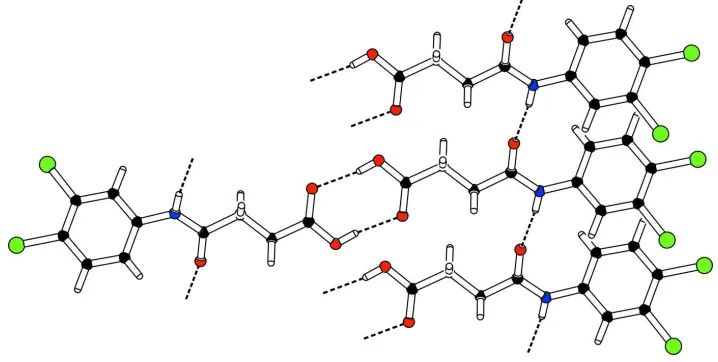
In the title compound, C10H9Cl2NO3, inversion dimers occur
due to pairs of intermolecular O—H O hydrogen bonds from the carboxyl groups formingR2
2
(8) loops. The dimers are linked intoC(4) chains along theaaxis by intermolecular N— H O links. A short intramolecular C—H O contact occurs in the molecule.
Related literature
For a related structure, see: Shahet al.(2008). For background, see: Pellerito & Nagy (2002). For graph-set notation, see: Bernsteinet al.(1995).
Experimental
Crystal data
C10H9Cl2NO3 Mr= 262.08
Monoclinic,P21=n a= 4.8441 (4) A˚
b= 10.3388 (10) A˚
c= 22.457 (2) A˚
= 90.613 (3)
V= 1124.62 (17) A˚3
Z= 4
MoKradiation
= 0.57 mm1 T= 296 K
0.250.120.10 mm
Data collection
Bruker Kappa APEXII CCD diffractometer
Absorption correction: multi-scan (SADABS; Bruker, 2005)
Tmin= 0.925,Tmax= 0.949
11915 measured reflections 2912 independent reflections 2028 reflections withI> 3(I)
Rint= 0.028
Refinement
R[F2> 2(F2)] = 0.065 wR(F2) = 0.182
S= 1.05 2912 reflections
172 parameters
Only H-atom coordinates refined max= 0.89 e A˚
3
min=0.84 e A˚ 3
Table 1
Hydrogen-bond geometry (A˚ ,).
D—H A D—H H A D A D—H A
N1—H1N O3i 0.81 (3) 2.10 (3) 2.887 (3) 165 (3) O1—H1O O2ii
0.80 (4) 1.87 (4) 2.665 (3) 170 (4) C6—H6 O3 0.88 (4) 2.58 (4) 2.960 (4) 107 (3) Symmetry codes: (i)x1;y;z; (ii)xþ1;yþ3;z.
Data collection:APEX2(Bruker, 2007); cell refinement:SAINT (Bruker, 2007); data reduction:SAINT; program(s) used to solve structure:SHELXS97(Sheldrick, 2008); program(s) used to refine structure: SHELXL97 (Sheldrick, 2008); molecular graphics: ORTEP-3 (Farrugia, 1997) and PLATON (Spek, 2009); software used to prepare material for publication:WinGX(Farrugia, 1999) and PLATON.
The authors acknowledge the the Higher Education Commission, Islamabad, Pakistan, for funding the purchase of the diffractometer at GCU, Lahore. S. Ali is also grateful to the PSF for financial support under project No. PSF/R&D/C– QU/Chem(270).
Supplementary data and figures for this paper are available from the IUCr electronic archives (Reference: HB2958).
References
Bernstein, J., Davis, R. E., Shimoni, L. & Chang, N.-L. (1995).Angew. Chem. Int. Ed. Engl.34, 1555–1573.
Bruker (2005).SADABS. Bruker AXS Inc., Madison, Wisconsin, USA. Bruker (2007).APEX2andSAINT. Bruker AXS Inc., Madison, Wisconsin,
USA.
Farrugia, L. J. (1997).J. Appl. Cryst.30, 565. Farrugia, L. J. (1999).J. Appl. Cryst.32, 837–838.
Pellerito, L. & Nagy, L. (2002).Coord. Chem. Rev.224, 111–150.
Shah, F. A., Tahir, M. N., Ali, S. & Kashmiri, M. A. (2008).Acta Cryst.E64, o787.
Sheldrick, G. M. (2008).Acta Cryst.A64, 112–122. Spek, A. L. (2009).Acta Cryst.D65, 148–155. Acta Crystallographica Section E
Structure Reports
Online
supporting information
Acta Cryst. (2009). E65, o1130 [doi:10.1107/S1600536809015025]
3-[(3,4-Dichlorophenyl)aminocarbonyl]propionic acid
Farooq Ali Shah, M. Nawaz Tahir, Saqib Ali, Sajjad Ahmed and Muhammad Danish
S1. Comment
In order to get a better insight in how the metallic species behave inside the biological systems, it is necessary to study
their coordination behavior with biomolecules i.e. ligands having hetero-donor oxygen and nitrogen atoms (Pellerito &
Nagy, 2002). Therefore, the title compound (I) has been prepared for the study of complexation with different metals.
The title compound is the structural isomer of 3-(3,5-dichloroanilinocarbonyl) propionic acid (Shah et al., 2008). Due to
the change of chloro substitution, the packing of the title compound has been changed. In this structure there does not
exist any kind of π-interaction. The dimeric nature and the linkage of the dimers in title compound is in agreement with
the reported structural isomer. In (I) the C==O bond distances for carboxylate and carbonyl group have values of
(C10==O2: 1.236 (3) Å) and (C7==O3: 1.214 (3) Å), and in comparison to 1.219 (3) and 1.225 (2) Å, respectively. The C
—N bond distances are compareable within experimental errors. In both compounds similar intermolecular H-bonding
(Table 2, Fig. 2) has been observed. The dihedral angle between the aromatic ring (C1—C6) and (C8—C10/O1/O2) have
a value of 20.45 (20)°, whereas with (C1/N1/C7/O3) its value is 39.02 (16)°. The value of dihedral angle between (C8—
C10/O1/O2) and (C1/N1/C7/O3) is 18.69 (18)°. There exist an intramolecular H-bond of C—H···O type and completes a
six-membered heterocyclic ring adjacent to the benzene ring. There does not exist any kind of π-interactions.
S2. Experimental
3,4-dichloroanilline (16.2 g, 0.1 mol) and succinic anhydride (10 g, 0.1 mole) were mixed in glacial acetic acid and
stirred overnight. The solution was filtered and precipitated material was washed with distilled water. The acid formed
Figure 1
View of (I) with displacement ellipsoids drawn at the 50% probability level. H-atoms are shown by small spheres of
arbitrary radius. The dashed lines represent the intramolecular H-bonds.
Figure 2
The partial unit cell packing of (I) showing the dimeric nature and the linkage of dimers along the a axis.
3-[(3,4-Dichlorophenyl)aminocarbonyl]propionic acid
Crystal data
C10H9Cl2NO3 Mr = 262.08 Monoclinic, P21/n Hall symbol: -P 2yn
a = 4.8441 (4) Å
b = 10.3388 (10) Å
c = 22.457 (2) Å
β = 90.613 (3)°
V = 1124.62 (17) Å3 Z = 4
F(000) = 536
Dx = 1.548 Mg m−3
Mo Kα radiation, λ = 0.71073 Å Cell parameters from 2912 reflections
θ = 2.7–28.9°
[image:3.610.125.484.305.486.2]Data collection
Bruker Kappa APEXII CCD diffractometer
Radiation source: fine-focus sealed tube Graphite monochromator
Detector resolution: 7.5 pixels mm-1 ω scans
Absorption correction: multi-scan
(SADABS; Bruker, 2005)
Tmin = 0.925, Tmax = 0.949
11915 measured reflections 2912 independent reflections 2028 reflections with I > 3σ(I)
Rint = 0.028
θmax = 28.9°, θmin = 2.7° h = −6→6
k = −13→13
l = −30→30
Refinement
Refinement on F2 Least-squares matrix: full
R[F2 > 2σ(F2)] = 0.065 wR(F2) = 0.182 S = 1.05 2912 reflections 172 parameters 0 restraints
Primary atom site location: structure-invariant direct methods
Secondary atom site location: difference Fourier map
Hydrogen site location: inferred from neighbouring sites
Only H-atom coordinates refined
w = 1/[σ2(F
o2) + (0.0667P)2 + 1.6338P] where P = (Fo2 + 2Fc2)/3
(Δ/σ)max < 0.001 Δρmax = 0.89 e Å−3 Δρmin = −0.84 e Å−3
Special details
Geometry. Bond distances, angles etc. have been calculated using the rounded fractional coordinates. All su's are estimated from the variances of the (full) variance-covariance matrix. The cell e.s.d.'s are taken into account in the estimation of distances, angles and torsion angles
Refinement. Refinement of F2 against ALL reflections. The weighted R-factor wR and goodness of fit S are based on F2, conventional R-factors R are based on F, with F set to zero for negative F2. The threshold expression of F2 > σ(F2) is used only for calculating R-factors(gt) etc. and is not relevant to the choice of reflections for refinement. R-factors based on F2 are statistically about twice as large as those based on F, and R- factors based on ALL data will be even larger.
Fractional atomic coordinates and isotropic or equivalent isotropic displacement parameters (Å2)
x y z Uiso*/Ueq
Cl1 0.2707 (3) 0.56808 (11) 0.26822 (5) 0.0954 (5)
Cl2 0.6942 (3) 0.37607 (10) 0.20648 (6) 0.0945 (5)
O1 0.7844 (5) 1.3991 (2) −0.01026 (13) 0.0584 (9)
O2 0.4038 (4) 1.3685 (2) 0.04204 (12) 0.0551 (8)
O3 0.9245 (4) 0.9675 (2) 0.08819 (12) 0.0546 (8)
N1 0.4948 (5) 0.9009 (2) 0.11088 (11) 0.0372 (7)
C1 0.5572 (5) 0.7772 (3) 0.13420 (12) 0.0341 (8)
C2 0.4079 (7) 0.7353 (3) 0.18269 (14) 0.0427 (9)
C3 0.4538 (8) 0.6133 (3) 0.20585 (14) 0.0500 (10)
C4 0.6432 (8) 0.5320 (3) 0.18016 (16) 0.0543 (11)
C5 0.7934 (8) 0.5742 (3) 0.13222 (18) 0.0568 (11)
C6 0.7517 (7) 0.6968 (3) 0.10907 (15) 0.0448 (9)
C7 0.6785 (5) 0.9883 (3) 0.09118 (12) 0.0345 (8)
C8 0.5505 (6) 1.1164 (3) 0.07282 (17) 0.0438 (9)
C9 0.7506 (6) 1.2040 (3) 0.04237 (17) 0.0437 (9)
C10 0.6312 (5) 1.3316 (3) 0.02430 (13) 0.0384 (8)
H1O 0.722 (9) 1.470 (4) −0.0157 (19) 0.0701*
H2 0.278 (7) 0.793 (4) 0.2003 (15) 0.0513*
H5 0.939 (8) 0.518 (4) 0.1166 (17) 0.0680*
H6 0.846 (7) 0.722 (4) 0.0777 (16) 0.0537*
H8A 0.489 (8) 1.153 (4) 0.1063 (16) 0.0527*
H8B 0.377 (8) 1.101 (3) 0.0478 (15) 0.0527*
H9A 0.899 (7) 1.225 (4) 0.0680 (16) 0.0523*
H9B 0.840 (7) 1.164 (4) 0.0077 (16) 0.0523*
Atomic displacement parameters (Å2)
U11 U22 U33 U12 U13 U23
Cl1 0.1600 (13) 0.0566 (6) 0.0704 (7) −0.0127 (7) 0.0418 (7) 0.0207 (5)
Cl2 0.1284 (11) 0.0363 (5) 0.1187 (10) 0.0107 (6) −0.0093 (8) 0.0277 (5)
O1 0.0476 (13) 0.0356 (12) 0.0924 (19) 0.0084 (10) 0.0234 (12) 0.0257 (12)
O2 0.0400 (11) 0.0410 (12) 0.0846 (17) 0.0114 (9) 0.0176 (11) 0.0226 (11)
O3 0.0251 (10) 0.0418 (12) 0.0969 (18) 0.0059 (8) 0.0058 (10) 0.0219 (12)
N1 0.0260 (10) 0.0317 (12) 0.0541 (14) 0.0044 (9) 0.0040 (10) 0.0114 (10)
C1 0.0337 (13) 0.0263 (12) 0.0423 (14) −0.0008 (10) −0.0030 (10) 0.0043 (10)
C2 0.0540 (17) 0.0294 (13) 0.0449 (16) −0.0031 (12) 0.0066 (13) 0.0006 (12)
C3 0.073 (2) 0.0331 (15) 0.0440 (16) −0.0104 (14) 0.0021 (15) 0.0056 (12)
C4 0.072 (2) 0.0276 (14) 0.063 (2) 0.0001 (14) −0.0119 (17) 0.0098 (14)
C5 0.059 (2) 0.0345 (16) 0.077 (2) 0.0123 (15) 0.0027 (18) 0.0006 (16)
C6 0.0445 (16) 0.0358 (15) 0.0542 (18) 0.0066 (12) 0.0086 (13) 0.0038 (13)
C7 0.0279 (12) 0.0302 (13) 0.0455 (14) 0.0028 (10) 0.0029 (10) 0.0078 (11)
C8 0.0307 (14) 0.0320 (14) 0.069 (2) 0.0075 (11) 0.0112 (13) 0.0165 (14)
C9 0.0319 (14) 0.0315 (14) 0.068 (2) 0.0042 (11) 0.0091 (13) 0.0137 (13)
C10 0.0305 (13) 0.0305 (13) 0.0543 (16) 0.0010 (10) 0.0021 (11) 0.0090 (12)
Geometric parameters (Å, º)
Cl1—C3 1.730 (4) C4—C5 1.377 (5)
Cl2—C4 1.734 (3) C5—C6 1.384 (5)
O1—C10 1.286 (4) C7—C8 1.518 (4)
O2—C10 1.236 (3) C8—C9 1.497 (5)
O3—C7 1.214 (3) C9—C10 1.495 (4)
O1—H1O 0.80 (4) C2—H2 0.96 (4)
N1—C1 1.414 (4) C5—H5 0.98 (4)
N1—C7 1.346 (4) C6—H6 0.88 (4)
N1—H1N 0.81 (3) C8—H8A 0.90 (4)
C1—C6 1.382 (4) C8—H8B 1.02 (4)
C1—C2 1.383 (4) C9—H9A 0.94 (4)
C2—C3 1.382 (4) C9—H9B 0.99 (4)
C3—C4 1.376 (5)
C10—O1—H1O 112 (3) C8—C9—C10 114.0 (2)
C1—N1—C7 126.1 (2) O1—C10—O2 123.3 (3)
C1—N1—H1N 116 (2) O2—C10—C9 121.9 (3)
N1—C1—C6 122.5 (3) C1—C2—H2 119 (2)
N1—C1—C2 117.6 (3) C3—C2—H2 121 (2)
C2—C1—C6 119.9 (3) C4—C5—H5 119 (2)
C1—C2—C3 119.9 (3) C6—C5—H5 121 (2)
Cl1—C3—C2 118.0 (3) C1—C6—H6 121 (3)
C2—C3—C4 120.4 (3) C5—C6—H6 120 (3)
Cl1—C3—C4 121.6 (3) C7—C8—H8A 106 (3)
C3—C4—C5 119.7 (3) C7—C8—H8B 110.2 (18)
Cl2—C4—C5 119.1 (3) C9—C8—H8A 111 (3)
Cl2—C4—C3 121.2 (3) C9—C8—H8B 112.2 (19)
C4—C5—C6 120.5 (3) H8A—C8—H8B 104 (3)
C1—C6—C5 119.7 (3) C8—C9—H9A 111 (2)
O3—C7—N1 123.5 (3) C8—C9—H9B 114 (2)
O3—C7—C8 122.6 (3) C10—C9—H9A 105 (2)
N1—C7—C8 113.9 (2) C10—C9—H9B 109 (2)
C7—C8—C9 112.8 (2) H9A—C9—H9B 104 (3)
C7—N1—C1—C2 140.0 (3) Cl1—C3—C4—C5 −177.0 (3)
C7—N1—C1—C6 −42.4 (4) C2—C3—C4—Cl2 −177.3 (3)
C1—N1—C7—O3 4.2 (5) C2—C3—C4—C5 2.0 (5)
C1—N1—C7—C8 −175.8 (3) Cl2—C4—C5—C6 178.1 (3)
N1—C1—C2—C3 177.7 (3) C3—C4—C5—C6 −1.2 (6)
C6—C1—C2—C3 0.0 (5) C4—C5—C6—C1 −0.2 (5)
N1—C1—C6—C5 −176.8 (3) O3—C7—C8—C9 9.0 (5)
C2—C1—C6—C5 0.8 (5) N1—C7—C8—C9 −171.0 (3)
C1—C2—C3—Cl1 177.6 (2) C7—C8—C9—C10 −179.4 (3)
C1—C2—C3—C4 −1.4 (5) C8—C9—C10—O1 −169.1 (3)
Cl1—C3—C4—Cl2 3.7 (5) C8—C9—C10—O2 11.6 (5)
Hydrogen-bond geometry (Å, º)
D—H···A D—H H···A D···A D—H···A
N1—H1N···O3i 0.81 (3) 2.10 (3) 2.887 (3) 165 (3)
O1—H1O···O2ii 0.80 (4) 1.87 (4) 2.665 (3) 170 (4)
C6—H6···O3 0.88 (4) 2.58 (4) 2.960 (4) 107 (3)