A thesis
presented for the degree of
Doctor of Philosophy in Electrical Engineering
in the
University of Canterbury,
Christchurch, New Zealand
by
E.P.M. BROWN B.E. (HONS), M.E.
"Never take anything for granted"
Benjamin Disraeli 1804-1881
CONTENTS
List of Illustrations List of Tables
List of Principal Symbols Abstract
Acknowledgements
CHAPTER 1
CHAPTER 2
INTRODUCTION
REVIEW OF TRANSMISSION LINE MODELLING AND
WEIG~TED LEAST SQUARES STATE ESTIMATION CONCEPTS
2.1 2.2 2.3 2.4 2.5 Introduction
Transmission line model and power system measurement equations Measurement noise
Weighted least squares static state estimation Other methods of state estimation
Page xL xvL xxvi. xxvii. xxviii. 1 14 14 17 19 20
2.5.1 Dynamic tracking state estimators 20
CHAPTER 3
2.5.2 Transformation-based state estimators 21
2.5.3 Linear programming-state estimators 22
2.5.4 Sequential state estimators 22
2.6 2.7
Comparison of other methods of state estimation with W.L.S. Conclusion
FAST, OPTIMAL STATE ESTIMATION WITH PSEUDO LINE-FLOW CREATION FROM INJECTION MEASUREMENTS
3.1 3.2
Introduction
Possible creation of pseudo line-flows from injection measurements
3.2.1 Method 1 3.2.2 Method 2
3.3 Modifications to the information matrix
to give sparse structures 3 . 3 . 1 Me thod 3
3.3.2 Method 4
22 23
24 '
CHAPTER 4
3.4
3.5
3.6
3.7
Optimality of the estimates obtained from pseudo line-flow creation or from modifications to the information matrix
Converge~ce properties of W.L.S.
with and w~thout pseudo line-flow creation
or modification to the information matrix 3.5.1 Method 1
3.5.2 Method 2 3.5.3 Method 3 3.5.4 Method 4
Methods of improving the convergence of W.L.S. when pseudo line-flow creation and
information matrix modifications are used Results
3.7.1 Discussion of results and selection
Page 31 31 32 33 33 34 36 36
of the best method for further testing 43
3.7.2 Reasons for the dramatic speed improvement when pseudo line-flow
creation is used 44
3.8 Further refinements to method (1)
which do not degrade optimality
3.9 Two-stage optimal W.L.S. estimation
with pseudo line-flow creation
3.10 Testing the refinements to method (1)
45
48
49 3.10.1 Performance of methods of improving
convergence without degrading optimality 49
3.11
3.10.2 Fast, optimal two-stage W.L.S. state estimation with pseudo line-flow
creation 53
3.10.3 Effect of variance conditioning on estimate accuracy when measurement
noise is present 54
3.10.3.1 Nominal measurement noise ~<3a)
3.10.3.2 Bad data
(>3a.)
present 1.Conclusions
54 56
58
REVIEW AND CONVERGENCE ANALYSIS OF DECOUPLED AND FAST DECOUPLED STATE ESTIMATION TECHNIQUES
4.1 4.2 4.3
Introduction
p-e,
Q-v partitioningConvergence analysis for state estimation
CHAPTER 5
CHAPTER 6
4.4 Summary of possible P-8, Q-v decoupling
and fast decoupling schemes
4.4.1 Algorithm P-8, Q-v decoupling
4.4.1.1 Horisberger et al.
type decoupling 4.4.1.2 'Masiello and Horton
type decoupling 4.4.2 Modal P-8, Q-v decoupling
, Page
67 67 67 79 85
4.4.2.1 Garcia et al. type decoupling 85
4.4.2.2 Couch et al. type decoupling 95
4.5
4.6
4.7
4.4.3 Other fast decoupling schemes Assumptions inherent in the
methods of decoupling presented
Accuracy of the P-8. Q-v decoupling schemes Conclusion
FAST DECOUPLED STATE ESTIMATION WITH PSEUDO LINE-FLOW CREATION FROM INJECTION MEASUREMENT
5.1 5.2
5.3
Introduction
Performance of fast decoupled W.L.S. state estimation with pseudo line-flow creation Conclusion
FAST IDENTIFICATION OF BAD DATA IN POWER SYSTEM TRACKING STATE ESTIMATION
6.1 6.2
6.3
Introduction
Bad data detection and identification 6.2.1 J(x) test
6.2.2 Weighted residual test 6.2.3 Normalised residual test Test results
6.3.1 Verification of mathematical removal technique
6.3.2 Performance of bad data handling techniques
6.3.3 Effect of modifying the variance
100 109 110 112 114 115 117 119 120 120 120 120 124 125 125
when treating bad data 129
6.4
6.3.4 Performance of bad data "replacement" techniques under conditions where
removal cannot be attempted 130
CHAPTER 7
CHAPTER 8
INCLUSION OF H.V.D.C. LINKS INTO A.C. POWER SYSTEM STATE ESTIMATION
7.1 7.2
Introduction
H.v.d.c. link model
7.2.1 Selection of a suitable h.v.d.c.
Page
136 137
link state space 137
7.2.2 H.v.d.c. link measurement equations 140
7.2.3 Effect of approximation error
on the h.v.d.c. link model 144
7.2.4 "Minimal-state" h.v.d.c. link state vector realization
7.2.5 Comparison of minimal approximation error and minimal state h.v.d.c. link state vector realizations
7.3 Performance of the combined multi
7.4
7.5
a.c. -h.v.d.c. state estimator
7.3.1 Effect of retaining a.c. system slack (reference) buses
7.3.2 Minimum h.v.d.c. link observability condition
7.3.3 Additional pseudomeasurements 7.3.4 Geographic partitioning of
the h.v.d.c. link 7.3.5 Performance results
Fast decoupled multi a.c. -h.v.d.c. state estimation
7.4.1 Method 1 7.4.2 Method 2 7.4.3 Method 3 Conclusion
ACCURATE REPRESENTATION OF COMMUTATION OVERLAP A. C. - H V D. C. STATE ESTIMATION AND LOADFLOWS
8.1
8.2
8.3
Introduction
Assu~ptions made in the derivation of
the approximate h.v.d.c. link model Error effects in the approximate model h.v.d.c. link representation
8.4 Inclusion of exact h.v.d.c. link models
in a.c. power system state estimation
CHAPTER 9
8.5
8.6
8.7
8.4.1 Performance results 8.4.2 Minimum h.v.d.c. link
observability conditions 8.4.2.1 Performance results
Exact h.v.d.c. link estimates from approximate h.v.d.c. link model state estimation
8.5.1 Performance results
8.5.1.1 Redundant measurement conditions
8.5.1.2 Minimum h.v.d.c. link measurement observability
conditions
8 • 5 . 1. 3 Mul t i a. c. - h • v . d • c . loadflow conditions Validity of convertor relationships under fault conditions when u > 600 Conclusion Page 172 172 175 177 180 180 180 180 183 184
USE OF AVAILABILITY DATA IN STATE ESTIMATION OPERATION AND OPTIMAL METER PLACEMENT DESIGN
9.1 9.2 9.3
9.4
9.5 9.6 9.7 9,8 IntroductionReview of minimum observability criteria for power system state estimation
Availability analysis
9.3.1 Inclusion of zero injection pseudomeasurements
9.3.2 "Local redundancy" versus "No. of link measurements"
Detailed nodal estimate availability analysis Review of optimal meter placement methods Optimal meter placement
185 187 188 197 201 203 207 210
9.6.1 Optimization constraints 210
9.6.2 Statement of the maximization problem 213
9.6.3 Steps in the optimum meter
placement design 213
Comparison betw'een the "power of the J (x) " test and availability-based meter placement design
Conclusion
CHAPTER 10 HIERARCHICAL STATE ESTIMATION OF A COMBINED ELECTRICAL-HYDROTURBINE AND OPEN CHANNEL
HYDRO CANAL SYSTEM - FEASIBILITY INVESTIGATIONS
10.1 Introduction
10.2 Structure of the combined electrical/ hydraulic state estimator
10.3 Electrical power system tracking state estimation
10.4 Model for the hydroturbine portion of a hydro generating unit
10.4.1 10.4.2
Local hydro turbine dynamic estimation
Local resid~al analysis
10.5 Model of the electrical part of a hydro generating unit
10.6
10.5.1 Rotor angle estimation
Test simulation results 10.6.1
10.6.2
Example 1
Example 2 - Rotor angle estimation 10.7 Model for an open channel hydrocanal
10.7.1 10.7.2
10.7.3
10.7.4
Open channel transient flow Implicit method for solving open channel flow dynamics A dynamic model suitable for a Kalman filter
Structure of the linearized hydrocanal Kalman filter 10.8 Performance results
10.8.1
10.8.2
Accuracy of the dynamic hydro canal model
Dependence of the Kalman filter gain on the flow conditions 10.8.2.1 Variation of K with
measurement set composition
Page 218 222 225 226 230 231 232 233 234 237 239 242 245 246 247 250 251 251 253
for problem 1 (1jJ::::: 0.6) 253
10.8.2.2 Variation of K with
measurement set composition
for problem 2 (1jJ::::: 0.6) 254
10.8.2.3 Varying flow condition (1jJ=0.6)
10.8.2.4 Effect of varying 1jJ 10.8.2.5 Large scale system
Kalman gain calculation
257 257
CHAPTER 11
CHAPTER 12
10.8.3 Kalmap filter tracking results
10.8.3.1 Simulation 1
10.8.3.2 Simulation 2
10.8.3.3 Simulation 3
10.8.3.4 Simulation 4
10.8.3.5 Simulation 5
10.8.3.6 Simulation 6
10.8.3.7 Simulation 7
10.8.3.8 Simulation 8
10.8.3.9 Simulation 9
10.8.3.10 Simulation 10 10.8.3.11 Simulation 11 10.8.3.12 Simulation 12 10.8.3.13 Simulation 13 10.8.3.14 Simulation 14
10.9 Conclusion
STATISTICAL TECHNIQUES IN LOADFLOW STUDIES
11.1 11.2 11.3
Introduction
Review of stochastic loadflow concepts Conclusion
REPRESENTATION OF NON-GAUSSIAN PROBABILITY DISTRIBUTIONS IN STOCHASTIC LOADFLOW STUDIES BY GAUSSIAN SUM APPROXIMATIONS
12.1 12.2 12.3 12.4 12.5 12.6 Introduction
Gaussian sum approximation Test system analysis
12.3.1 Comparison between probabilistic and stochastic loadflow results 12.3.2
12.3.3
P-
e,
Q-v decouplingEffect of nodally dependent real and reactive injection non-gaussian p.d.L's
Lower order gaussian sum approximations Selection of non-gaussian long term generation data
CHAPTER 13 INCLUSION OF H.V.D.C. LINKS IN A.C. STOCHASTIC LOADFLOW STUDIES
CHAPTER 14
REFERENCES APPENDICES Al A2 A3 A4 AS 13.1 B.2 Introduction
Specification of a multi
a.c. -h.v.d.c. stochastic loadflow
13.3 Uses for the multi
a. c. - h. v. d. c. stochastic loadflow
13.4 Multi a.c. -h.v.d.c. stochastic
loadflow test results 13.4.1 Uncorrelated multi
a. c. - h. v. d. c. loadflow data 13.4.2 Correlated multi
a.c. -h.v.d.c. loadflow data
13.5 Conclusion
CONCLUSIONS
Optimality of estimates obtained from pseudo line-flow creation
Properties of estimates resulting from pseudo line-flow creation using method (2)
A2.1 Estimation error
Ox
A2.2 Variance of A x
-A2.3 Expectation of x A -Convergence analysisConvergence analysis of W.L.S. with and without pseudo line-flow creation or information matrix modification
A4.1 W.L.S. state estimation
A4.2 Method (1)
A4.3 Method (2)
A4.4 Method (3)
A4.5 Method (4)
Invariance of Couch et ai.'s simultaneous update
(1.4.1) decoupling with respect to variations in the ratio of R-1 to R-1
-p -q
APPENDICES
A6
A7
A8
Effect of multiple bad data on the EN and Ew tests
A6.1 Single bad data
A6.2 Multiple non~interacting bad data
A6.3 Multiple interacting bad data
A6.4 Example involving the EN and Ew tests
Mathematical "removal" of measurement data
Derivation of measurement equations for Em' P2- 3, Q2-3 and 1112_3
A9 Derivation of h.v.d.c. link "minimal-state" realization measurement equations
AIO
All Al2
Al3
Al4
To show the exact relationship between a, Wand 0 is monotonically increasing for a < x < 1T -a
Approximate nodal estimate unavailability, A. J. Rotor angle estimation
Derivation of unsteady open channel flow momentum and continuity equations
Implicit trapezoidal numerical integration
Page
368 368 369
370 370
373
375
377
379
382
388
FIGURE 1.1 1.2 1.3 1.4 2.1 3.1 3.2 3.3 3.4 3.5 3.6 3.7 4.1 4.2 4.3
4.4
4.5 4.6LIST OF ILLUSTRATIONS
Typical control center operation. (Schweppe and Handschin, 1974)
The static state estimator as a buffer. (Schweppe and Handschin, 1974)
Time interval in which monitoring and control functions must be performed.
(Handschin and Bongers, 1975)
Basic operation of the state estimator.
(Schweppe and Handschin, 1974)
TI-equivalent circuit for a transmission line. (Turner, 1980)
Structure of the "difference" matrix for method (3)
Structure of the "difference" matrix for method (4)
5 bus test system (Stagg and El-Abiad, 1968)
Information matrix when 29 (Pi +Qi) injection measurements are present Information matrix when 74 (Pi + Qi) line-flow measurements are present
Optimal estimation using 2 stage W.L.S. with pseudo line-flow creation
Convergence characteristics when RaL =(1.25 azt' )2jqi and Ra :::: a ,2
R '
Horisberger-type ·decoupling: unified (1.1.1)
Horisberger-type decoupling: unified
with constant gain (1.1.3)
Horisberger-type decoupling: sequential (1.1.2)
Horisberger-type decoupling: sequent~al
with constant gain (1.1.4)
Horisberger-type decoupling: decomposed (1.1.5)
Horisberger-type decoupling: decomposed
with constant gain (1.1.6)
FIGURE
4.7 4.8 4.9 4.10 4.11 4.12 4.13 4.14 4.15 4.16 4.17 4.18 4.19 4.20 4.21 4.22 4.23 4.24 4.25 4.26Masiello-type decoupling: unified (1.2.1)
Masiello-type decoupling: unified with
constant gain (1.2.3)
Masiello-type decoupling: sequential (1.2.2)
Masiello-type decoupling: sequential with
constant gain (1.2.4)
Masiello-type decoupling: decomposed (1.2.5)
Masiello-type decoupling: decomposed with
constant gain (1.2.6)
Garcia et al. type decoupling: unified (1.3.1)
Garcia et al. type decoupling: unified with
constant gain (1.3.3)
Garcia et ale type decoupling: sequential (1.3.2)
Garcia et al. type decoupling: sequential with
constant gain (1.3.4)
Garcia et al. type decoupling: decomposed (1.3.5)
Garcia et al. type decoupling: decomposed with
constant gain (1.3.6)
Couch et ale type decoupling: unified (1.4.1)
Couch et al. type decoupling: unified with
constant gain (1.4.3)
Couch et al. type decoupling: sequential (1.4.2)
Couch et al. type decoupling: sequential with
constant gain (1.4.4)
Couch et ale type decoupling: decomposed (1.4.5)
Couch et ale type decoupling: decomposed with
constant gain (1.4.6)
Bermundez and Brameller fast decoupling (1.5.1)
Bermundez and Brameller fast decoupling -decomposed (1.5.2)
6.1 Effect of variance conditioned bad data
"replacement" techniques
FIGURE
7.1 H.v.d.c. link and equivalent circuit
7.2 H.v.d,c. link Jacobian structure for minimal
error realization (78 non-zero elements)
7.3 7.4 7.5 7.6 8.1 8.2
H.v.d.c. link Jacobian structure for minimal state realization (122 non-zero elements)
Multi a.c. -h.v.d.c. test system
Partitioned h.v.d.c. link equivalent circuit
3 a.c. - 2 h.v.d.c. link test system
Error in value of ~m at normal rectifier operationg conditions
Rectifier commutation when (a) a small and (b) a large
8.3 Flow diagram for approximate h.v.d.c. link model
a.c. -h.v.d.c. state estimation algorithm with exact residuals
9.1 9.2 9.3 9.4 9.5 9.6 9.7 10.1 10.2 10.3 10.4 10.5
Observability of 5 bus test system with an, observable measurement set
Observability of 5 bus test system with an unobservable measurement set
I.E.E.E. test network with optimal meter configuration (Hands chin and Bongers, 1975)
Node 12 and its nearest neighbours
Node 4 and its nearest neighbours
I.E.E.E. test network with first meter configuration (Hands chin and Bongers, 1975)
Transition diagram for node 1
"Possible" 220 kV measurements on Upper Waitaki system
"Possible" 33 kV electrical measurements
Location of Tekapo canal height and flow measurements
Two level "static-dynamic" state estimator of network hydrocanal and power plant states when s hydrocanals and m hydrogenerators are present
Hierarchical estimation scheme with centralized tracking estimator and local dynamic estimators for thermal
power plants (1), large loads (2), tie lines (3), hydro-power (4) and hydrocanal states (5)
FIGURE 10.6 10.7 10.8 10.9 10.10 10.11 10.12 10.13 10.14 10.15 10.16 10.17 12.1 12.2 12.3 12.4 12.5 12.6 12.7 12.8 12.9 12.10 12.11 12.12
Functional diagram of the Kettle power station turbine and governor equipment
Transient model of the electrical part of a generating unit
Test network with two hydrogenerators, three loads and one open channel hydrocanai
Frequency deviation after 0.2 p.u. incremental increase in load (no measurement noise and Tp = 0.2)
Frequency deviation after 0.2 p.u. incremental noise in load (measurement noise and T~ =0.2)
Frequency deviation after 0.2 p.u. incremental increase in load (measurement noise and T?
=
1.0)Rotor angle estimation; measurement noise and TF = 0.02
Rapidly varied unsteady flow (Chow, 1959)
Discretization of the open channel (Wylie and Streeter, 1978)
Discretization of the open channel for Kalman filter implementation
Initial flow conditions for problem 1
Initial and final flow conditions for problem 2
Gaussian sum reconstruction for
V
4Gaussian sum reconstruction for PS-6
Gaussian sum reconstruction for Q7-9
Gaussian sum reconstruction for Q3
Gaussian sum reconstruction for Q'
3 (= Q3 +Q17)
Gaussian p.d.L "stochastic loadflow" for P4-7 Gaussian p.d .f. I1s tochastic loadflow" for
P 3-4
Decoupled gaussian sum reconstruction for P5- 6
Decoupled gaussian sum reconstruction for P
4- 7 Decoupled gaussian sum reconstruction for Q7-9 Decoupled gaussian sum reconstruction for '14
Detailed decoupled gaussian sum reconstruction for Q7-9
FIGURE 12,13 12,14 12.15 12.16 12,17 12.18 12.19 12.20 12.21 12.22 12.23 13.1 Al0.l All.1 All.2 A13.1 A14.1 A14.2
Nodal-dependent gaussian sum reconstruction for V 4 Nodal-dependent gaussian sum reconstruction for P
S-6
Nodal-dependent gaussian sum reconstruction for Q7-9
Nodal-dependent gaussian sum reconstruction for Q
3 Lower order gaussian sum reconstruction for P
3-4 Lower order gaussian sum reconstruction for P
4-7
Lower order gaussian sum reconstruction for PS-6
Lower order gaussian sum reconstruction for Q7-9
Lower order gaussian sum reconstruction for V4
Lower order gaussian sum reconstruction for
Q
3Continuous "equivalent" binomial distribution for the discrete binomial distribution at node 1
Multi a.c. -h.v.d.c. stochastic loadflow test system
"Monotonic" increasing profile of f(x)
Sample a.c. system
Node 12 and its nearest neighbours isolated from the a.c. system
Control volume for application of the unsteady
momentum equation (Wylie and Streeter, 1978)
Single step trapezoidal integration
Multi step trapezoidal integration
TABLE
3.1
3.2
3.3
3.4
LIST OF TABLES
Effect of different measurement configurations (p:k ratio) on the p.erformance of W.L.S.
with pseudo line-flow creation
Effect of different measurement configurations (p:k ratio) on the performance of W.L.S.
with information matrix modification
Large scale system performance of W.L.S. with and without pseudo line-flow creation
and information matrix modification
Effect of altering RaL and ~aR by different amounts, when variance conditioned pseudo line-flows (p :k) = 14: 14 present
3.5 Effect of acceleration factors on
convergence of pseudo line-flow creation when "RL ::a = (1. 25a z . ) 2 / q . and RaR = a z .
1. l - 1.
3.6 Estimated degtadation due to variance conditioning
in the presence of noisy measurements (>3a) (in p.u.)
3.7 Detection and identification of bad data when
variance-conditioned pseudo line-flow creation is used
4.1
4.2
4.3
4.4
4.5
4.6
4.7
4.8
5.1Non-zero Jacobian partial derivatives
Different Horisberger et ale type P-8, Q-v decoupling possibilities and their convergence
Different Masiello and Horton type P-8, Q-v decoupling possibilities and their convergence
Different Garcia et ale type P-8, Q-v
decoupling possibilities and their convergence
Different Couch et ale type p-8, Q-v
decoupling possibilities and their convergence
Non-zero Jacobian partial derivatives for Bermundez and Brameller's fast decoupling
Different Bermundez and Brameller type P-8, Q-v decoupling possibilities and their convergence
Accuracy of stable sub-optimal estimation schemes
Comparison of W.L.S. and A.E.P. "line-only" method when pseudo line-flow creation is used
TABLE
5.2
5.3
6.1
Performance of fast decoupled W,L.S. with psuedo line-flow creation (measurement noise free)
30 bus test system performance of fast decoupled W.L.S. with pseudo line-flow creation
Comparison between estimates after mathematical and physical bad data removal
6,2 Change in power system states between
successive measurement scans
6.3
6.4
6.5
6.6
7.1
Comparison of bad data handling methods for different measurement configurations and power system dynamics
Comparison of variance conditioned bad data handling "replacement" methods when measurement system 1 is used
Comparison of bad data handling "replacement" methods when measurement system 1 would be unobservable if
"removal" of bad data was attempted
Comparison of bad data handling "replacement" methods when measurement system 2 would be unobservable if
"removal" of bad data was attempted
Pseudomeasurement non-zero Jacobian terms for the rectifier side
7.2 Jacobian elements for the h.v.d.c. link
measurement equations
7.3 7.4
7.5
7.6 7.7 7.8 7.9 7.10Measurement equations for "minimal state" h.v.d.c. link realization
A.c. and h.v.d.c. link parameters
A.c. -h.v.d.c. -a.c. measurement data
Effect of bad data in a.c. terminal measurement, PIS' on the quality of the approximate model h.v.d.c. link estimates of minimal observability conditions
Comparison of h.v.d.c. link estimates with and without geographic partitioning
Measurement breakdown for the a.c. -h.v.d.c. system
A.c. -h.v.d.c. flat start conditions
Comparison of various fast decoupled a.c. -h.v.d.c. stable estimation schemes
TABLE
8.1 Non-zero Jacobian elements for exact h.v.d.c.
link model convertor pseudomeasurement relationships
8.2 Comparison of exact model h.v.d.c. link and approximate
model h.v.d.c. link estimates with and without exact
Page
173
residuals, with moderate measurement redundancy present 174
8.3 Comparison of exact h.v.d.c. link and approximate model
h.v.d.c. link estimates with and without exact residuals of minimum observability conditions
8.4
9.1
Comparison of exact model h.v.d.c. link Newton Ralphson representation in approximate h.v.d.c. link state
estimation algorithms and approximate h.v.d.c. link state estimation for a loadflow measurement set
Nodal availabilities for optimal meter configuration, 14 bus I.E.E.E. test system and effect of communication link failure (one link per node)
9.2 Effect of communication link failure when measurements
from 2 nodes are transmitted through the same link. Optimal meter configuration.
9.3 Nodal availabilities for "first meter" configuration, 14 bus I.E.E.E. test system and effect of communication link failure (one link per node)
9.4 Effect of communication link failure when measurements
from 2 nodes are transmitted through the same link. First meter configuration.
9.5 9.6 10.1 10 .2 10.3 10.4 10.5
Nodal availabilities for optimal meter configuration, 14 bus I.E.E.E. test system and effect of communication link failure (one link per node) when zero injection pseudomeasurement at node 7 is included
Probability of generating observable estimates for the 14 bus optimal meter configuration
Initial conditions for power systems simulation
Power station parameters
Accuracy of the method of characteristics and the implicit Newton method
Comparison of the accuracy of the method of
characteristics and the accuracy of the trapezoidal integration method
Kalman filter gain for the initial flow conditions of problem 1
(til
=0.6)TABLE 10.6 10.7 10~8 10.9 10.10 10.11 10.12 10.13 10.14 12.1 12.2 12.3 12.4
Kalman filter gain for the initial flow conditions of problem 2 (1jJ::: 0.6)
Kalman filter gain and co-variance matrix for the flow conditions described by problem 3 (1jJ:::::: 0.6)
Kalman filter gain for the flow conditions described by problems 1, 2 and 3 when 1jJ
=
1.0"Approximate" large scale Kalman filter gains for problems 1 and 2
Open channel flow estimates, using problem 1, when the Kalman gain is modified
Open channel flow estimates, using problem 2, when the Kalman gain or the number of
measurements present are modified
Open channel flow estimates, using problem 2, when the integration step length is modified
Open channel flow estimates for problem 1 when a 20 "cell" resolution is used
Open channel flow estimates for problem 2 when a 20 "cell" resolution is used
Convolution components and their weightings
Deterministic data for the expanded I.E.E.E. 14 bus test system
Probabilistic data for the expanded I.E.E.E. 14 bus test system
Individual components of the binomial probability distribution
12.5 Probabilistic data for the S.L.F.:
12.6
12.7
12.8
12.9
Expected values and variances
Gaussian sum approximation component values and their weightings
Comparison of upper and lower limits of S.L.F. and P.L.F. results
Dependent combinations of P
9 and
Q
9Normalised non-central moments for non-gaussian distribution for PI' P2, P9,
Q
9TABLE
12.10
13.1
Minimum values of aI' ~1' aI' ~2' a2
H.v.d.c. link loadflow specifications
13.2 Possible combinations of h.v.d.c.
link control specifications
13.3
13.4
13.5
13.6 13.7 13.8 A6.1
A6.2
All.1
Expected values of a.c. and h.v.d.c.
long-term oper~ting data
S.L.F. results (uncorrelated data and different h.v.d.c. link control specifications)
S.L.F. test results (uncorrelated data and different initial loadflow data uncertainties)
A.c. correlation weightings
CR .. )
-~J
H.v.d.c. link data correlation weightings
CR .. )
-lJ
Multi a.c. -h.v.d.c. S.L.F. results (correlated data)
Comparison of
EN
and rW values for single and mUltiple baa data presentSelected segment of the residual sensitivity matrix with and without single and multiple bad data present
Effect of measurement unavailability on the observability of node 12
Page
309
320
321
323
327
329
331
332
333
372
372
LIST OF PRINCIPAL SYMBOLS
The majority of symbols are defined in the text. but for
convenience the principal symbols are redefined below. Some symbols
have more than one meaning. However, the context in which the symbol
is used should clarify any ambiguities.
a
a.c.
A
C.
1
C m
cov(A,B)
d.c.
D
D.L.F.
E
E r
E'
f
f
o
f ref g
transformer ratio
alternating current
cross-sectional area of flow (m2/sec)
availability of device i
unavailability of device i (= 1 - A ) I
susceptance
cost of data acquisition system measurement i
flow constant (= 1.0)
co-variance between dependent events A and B
direct current
"self regulation effect" gain
deterministic loadflow
frequency residual (p.u.)
expectation operator
error in gaussian sum-moment approximation
transient voltage of the hydrogenerator (p.u.)
convertor alternating voltage (pou.)
frequency deviation of the generating unit (p.u.)
nominal frequency (50 Hz)
frequency deviation of the reference generator (p.u.)
gravitational constant (= 9.806)
G
G(x)
h
h.v.d.c.
H
I
I
J
K
m
m. 1.
n
N(O,R)
conductance
R.H.S. matrix of the general state estimator
non-linear measurement function vector {h : h : hd } (mxl)
p q c
high voltage direct current
Jacobian matrix (mxn)
inertia constant of the rotor
current (p.ll.)
identity matrix
information matrix
denotes an imaginary number j
=
~residual
Kalman gain matrix
derivative control constant
integral control constant
proportional control constant
3 i2/rr
3/rr
L.R.S. (information) matrix of the general state estimator
- level of variance conditioning
number of measurements
number of nodally dependent gaussian components at node i
non-gaussian moment of order j
gaussian sum approximation moment of order j
number of busbars in the power system
Manning roughness factor
normal distribution with zero mean and variance R
normal distribution with variance
a
probability of event i occurring
p.d.L
P
P.L.F.
P (t)
e
q
Q
r
r.
1
r
m
r w
R
s
s
o
S
S.L.F.
t,T
T
P
T v
probability density function
active power (p.u.)
wetted perimeter of a trapezoidal canal
probabilistic loadflow
incremental electric power demand with time
lateral inflow per unit length of channel
level of variance conditioning
number of lines attached to bus i
probability of event i not occurring (= 1 - p.)
1
number of reactive power or voltage gaussian sum components
flow of water in a canal (m3/sec)
reactive power (p.u.)
measurement residual (~ - ~(~»)
number of active p~wer gaussian sum components
normalised residual
weighted residual
resistance
measurement noise co-variance matrix (m x m)
hydraulic radius (m)
d.c. line resistance
random number (normalised gaussian)
friction term per unit length
channel slope per unit length
complex power P
+
jQstochastic loadflow
transformer ratio (% off nominal)
time (seconds)
time constant of the pit~t servo
u
v
VL8
w
x,x
x
Xl d
Xfm,Xfn
X , X
m n
y
Y
Z
Z I
a.
1.
p
D,
8
time constant of the hydraulic turbine
commutation overlap angle (= 8 - a)
instantaneous veloc~ty of the fluid (m/sec)
nodal voltage (phase angle referred to slack node)
nodal voltage (phase angle referred to convertor current)
observation error
frequency deviation
residual sensitivity matrix
state vector = {~, v, ~. ~dc} (nxl)
random variable
reactance
transient reactance of the generator unit
filter reactance of rectifier and inverter
commutation reactances at rectifier and inverter
height of water in hydrocanal (m)
admittance (Y =
1.
= R+
j B)Z
measurement vector {z , z , zdc} (mxl) -q -p
impedance (z - R
+
jX)measurement transformation (pseudo line-flow)
rate of change between successive measurement scans
channel slope
convertor control angle
weighting factor for gaussian sum component
set of all transmission lines connected to bus i
weighting factor
mass density
measurement noise vector (mxl)
o(t)
o.
1.
o
xA.
1.2: -r
2:
-x
j.l
0.
1. w(t)
T
o
e
internal rotor angle w. r. t the frequency generator
probability of no failure or repair,
between measurement scans, of plant i
estimation error
eigenvalue
mean time to failure (MTBF)
network structure vector
residual co-variance matrix
estimation co-variance matrix
mean value
mean time to repair device i
standard deviation of the i th measurement error
model inaccuracies and system noise
unit weight of fluid
shear stress
voltage phase angle referred to slack node
voltage phase angle referred to convertor current
phase angle of convertor alternating voltage
Subscripts and superscripts
dc h.v.d.c. link pseudomeasurement
I imaginary part of a complex variable
k iteration number
m rectifier side of the h.v.d.c. link
-number of measurements
n inverter side of the h.v.d.c. link
number of states in the state vector
p active power measurement partition
q'
r
s
sec
-1
x
T
x
"
x
reactive power measurement partition
real part of a complex variable
h.v.d.c. link pseudomeasurement
secondary side of transformer
inverse of a matrix x
transpose of matrix x
time derivative of x
value of x at time t
general element of matrix x
This thesis investigates the treatment of aposteriori and
apriori uncertainties in power system planning and operation.
Aposteriori uncertainty is treated by power system state
estimators. A survey of existing techniques and their limitations is
described. A method is presented that improves the speed of weighted
least squares state estimation by modifying the structure of injection
measurements to give a very sparse information matrix, the matrix to be
inverted. Used with fast decoupling, this approach yields a very fast
on-line state estimator, capable of handling all types of measurements.
Bad data detection and identification techniques are reviewed
and an improvement based on "mathematical" bad data removal is presented.
The inclusion of h.v.d.c. links into a.c. state estimation is
considered. Decoupling and geographic partitioning of the multi
a.c. -h.v.d.c. state estimator are shown to cause little degradation
in the estimates, and a method of accurately representing commutation
overlap angle is outlined.
Availability analysis in state estimator operation and design
is considered, and applied to optimal meter placement design.
The feasibility of hierarchical central-electrical, local-dynamic
hydroturbine and canal state estimation, based on a linearized Kalman
filter, is investigated.
Apriori uncertainty in long-term future planning studies involving
expected nodal generation and loads can be included in stochastic
load-flows. A method is presented which enables the stochastic loadflow,
which handles only gaussian statistics, to handle non-gaussian
probability distributions via gaussian sum approximations. R.v.d.c.
links are also included in a.c. stochastic loadflows, using both
ACKNOWLEDGEMENTS
I especially wish to thank my supervisor, Dr H.R. Sirisena,
for his enthusiasm a?d guidance throughout this research,
Acknowledgements are also due to Professor J. Arrillaga,
Professor l.R. Wood and Dr A.J. Sutherland for answering my queries,
and to my postgraduate colleages; in particular Messrs B.J. Harker,
M.D. Heffernan and K.S. Turner, for many valuable discussions.
I wish also to thank New Zealand Electricity and the State
Services Commission for their financial assistance and granting of
leave for this study. I also wish to thank Mr C.V. Currie,
Mr W. Wilson, Mr B. Thompson, and the staff of the Christchurch
District Draughting Section of New Zealand Electricity for draughting
all the many figures in this text.
The staff of the Comp.uter Centre of the University of Canterbury
are also to be thanked for their invaluable help, and Mrs A.J. Dellow
for typing this thesis.
Last, but not least, I am indebted to my wife, Lesley, for
her continued patience and encouragement throughout this research
CHAPTER 1
INTRODUCTION
The proliferation of computerised power system control centres which monitor large sets of measurements by remote data acquisition from around the power system is in response to the need for fast, accurate control and restorative procedures. Control centre design is becoming extremely complicated; on-line programs are now available which give updated security analysis, economic dispatch and fault analysis. These programs guide the operator in the choice of
restorative action, maximize the security and economy of generation, and minimize damage and down time caused by a fault. All programs rely on having a clean data base available within the computer from which they can derive decisions. The data base within the computer is regularly updated by new measurement "snapshot" scans of the power system every few minutes. This measurement data updating procedure is intended to continue, on-line, indefinitely without failure. Each snapshot scan may contain 1000 or more individual measurements, and it is likely that, at some time, the raw measurement data arriving at the system control centre may contain bad data; metering errors that result from excessive drift or failure, or failure of communication equipment within the data acquisition system. The presence of such errors in the data base may produce the ~qrong control or alarm action (Schweppe at a.~ •• 1970; Schweppe and Handschin, 1974; Handschin and Bongers, 1975).
measurement errors (see Figure 1.1).
r.trm.-Un1t- comm:l. tmBnt :4a~
Storage optimization Interlace
Maintenance sclwd~n.g
t
Economc load d:!.sl'atchSecmri t7 l!IC)n:i. taring and control. Data
Vol.tage-reactive ~wer control.
:aulD
S!l!AUC S!l!A~E ESTIMA~O:a I
1
:
Data acquisit~on Da1:a acquisition
Protection ~tect:!.c::m
·r.o~~' control. and _ _ e • • Local. control and
mtch1ng m'fi t clJ,in.g
t
t
I
Electric Enere7 SystemJ
Figure 1.1 Typical control centre operation. Schweppe and Handschin, 1974.)
LoBd predic1::l.cll:: for short
:md. long tlllrm
:3tatis1:ic~
B:!.ll:lJ:lg Operat:lJ:lg Re'Ports
li!:ea.sureoEln1:s .! (meter)
Struct"..uT.l information !.
(break~r ?osit1on etc.)
Parameter valUElS ~
(design data)
1) system state
----eo (nodE! vo~tages)
2) mode~ (structure
and parameter values},
during static conditions'
Figure 1.2 The static state estimator as a buffer. (Schweppe and Handschin, 1974.)
III 0 E N
IJ! R A. J.
R
E G
I I I 0 N A L
0
I C A
r."
ELD: Economic Loud Diapntch 8M :; Security }'lorli taring SO & Security Optimization VVC: Vo1tagelVar Control
-1h '" 3.6 lO~f!ee Iday .. 8.6 lOSfl6c
1111eek '" 6.1 1070eo Imonth :; 1.6 10Ss6e lyear .. 2.2 10 sac
- - - -
--Figure 1.3 Time interval in whicb monitoring and control functions must be performed. (Handschin and Bongers~ 1975.)
,-
-
...
'"Z Parameter information ~
J
ISt'rUc:ur.!!.l. ~ ... 1"t'I"':::'ltit'l'" !'t'PREl"ILTERING
Plausibility check
Lim 1;' values
-Tills
Ehd
Figure 1.4
etc.
Em'OTHESIZE MODE.1'&
MI!mmIll 1) no stru~l fIIrrors e:=O
--2) no bad data: ~=2 .
3) no parameter errors :!p=Q
Usa !!!,and],to obtain 1l(~) and
valUClU1 for R.
1
ii!S'l!I~TION
Pi:l:ld .!. the 7al.ue of 3 which nw.kel!l
the residual ~-g(!) sma.ll.
D 'r
Cb.eck assumptions tlla1;' :Q, B.=Q. by
asid.ng:: Is r I!IcalL enough?
no
IDENTn'ICATIOrT
Logic to detercine location of' bad
~ta ~ and/or structural errors e
Modify inputs
Basic operation of the state estimator. (Schweppe and Handschin, 1974.)
~
Processing a redundant set of measurement data allows bad data detection and identification schemes to be included in the state estimator
algorithm, to locate and remove any faulty measurement data or circuit disconnect status information (see Figure 1.4) . (Schweppe and Handschin,
The concept of state estimation was first used by Gauss (1777-1855) to process data on the orbits of planetary bodies. Since the late 1950s~ with the beginning of aerospace exploration, state estimators have became more sophisticated in order to dynamically ·monitor noisy measurement data from outer space. The "small-scale"
nature of the aerospace problem has allowed complex state estimation techniques to be used. The power system's application, on the other hand, produces an extremely large scale problem. Some power systems may contain 500 busbars or more. Fortunately, however, power systems usually are weakly intercoupled and as a result most matrix manipulation in power system problems involves sparse matrices. Sparsity techniques can be used to handle these matrices, storing only their non-zero values and location addresses. Sparsity techniques, and the quantum leap in computing speed and power of commercial computers over the last decade, have made power system state estimation a reality (Sugarmann, 1980). However only the simple, static state estimation algorithms which process the current measurement snapshot, taking no account of any dynamics, have achieved any success in the power system's applications. The problem of regularly producing reliable power system state estimates
from noisy on-line data acquisition system measurements is not trivial (Brown and Sirisena, 1981). The "noise" usually is measurement accuracy noise, but occaSionally this metering noise will contain bad data. The state estimation algorithm required to process these measurements mu~t
do so rapidly, detecting an~ identifying any bad data present before the next scan of mepsurements arrives to be processed.
in most early papers on state estimation was concerned with generating
minimum variance, optimally filtered estimates from the noisy measurement
data available. Only recently has there been an awareness that the
maintenance of a "reliable" data base, free from bad data (errors which
are not necessarily measurement-accuracy noise), which can rapidly
change with the changing state of the power system and allow the
identification of any bad data before the next measurement scan, is as
important as the generation of optimally filtered estimates. More
important, however, is to consider the characteristics of the power
system to which the proposed state estimator is to be applied. The
characteristics of the New Zealand electricity system, the power system
of concern in this study, can be summarized as follows:
A computerized data acquisition system control centre has been
installed in the North Island of New Zealand, at Whakamaru,; and
in the South Island of New Zealand, at Islington, another centre
is nearing completion. Both monitor large a.c. power systems.
The North and South Island a.c. power systems are linked by an
h.v.d.c. submarine cable. Over half of the electricity
generated in the South Island is rectified, either at Tiwai
Point Aluminium Smelter or at Benmore, for transmission to the
North Island.
Monitoring equipment of varying vintages may be present in the data
acquisition system. This is a result of the data acquisition
system being "added to" over the years. Hence the accuracy and
availability of monitoring equipment may vary quite markedly.
Some regional area-control centres, such as Twizel, have local
computers that monitor water levels and the flow in hydro canals
feeding hydraulic turbines, as well as the measurements on the
As a result of the above considerations, the specifications for
building a state estimation algorithm(s) applicable to the New Zealand
power system would be as follows:
(i) The state estimator should rapidly process all measurement data
available, regardless of its type, accuracy and availability,
and thus maintain a reliable data base, free from bad data.
The presence of the h,v.d,c. link must also be modelled in
the state estimator,
(ii) Any optimal meter placement design should include measurement
availability aspects. Optimal meter placement design involves
the selection of the "best" set of measurements to acquire
from the power system, with regard to their individual cost,
placement and type, in order to get the best coverage for the
data acquisition system capital resource available.
(iii) Establish whether "local area" power system state estimators
which include hydro canal as well as hydro turbine dynamics
are feasible in a real time sense.
The areas of research carried out in this study have been in
response to the above three factors, The material is presented in
self-contained chapters. Only brief discussions on computational details
will appear in the text. This is because the use of efficient, sparsely
orientated programming of storage and solution has been extensively
studied and any further advances are unlikely to dramatically reduce
computation times. The use of such procedures is now "standard" power
systems programming practice.
Chapter 2 reviews advances and concepts in the state estimation
of power systems. The necessary mathematical background to understand
W.L.S. state estimation is the technique originally advocated by
Schweppe et al. (1970) and generates minimum variance estimates.
Reasons for choosing the W.L.S. state estimation method are also
outlined.
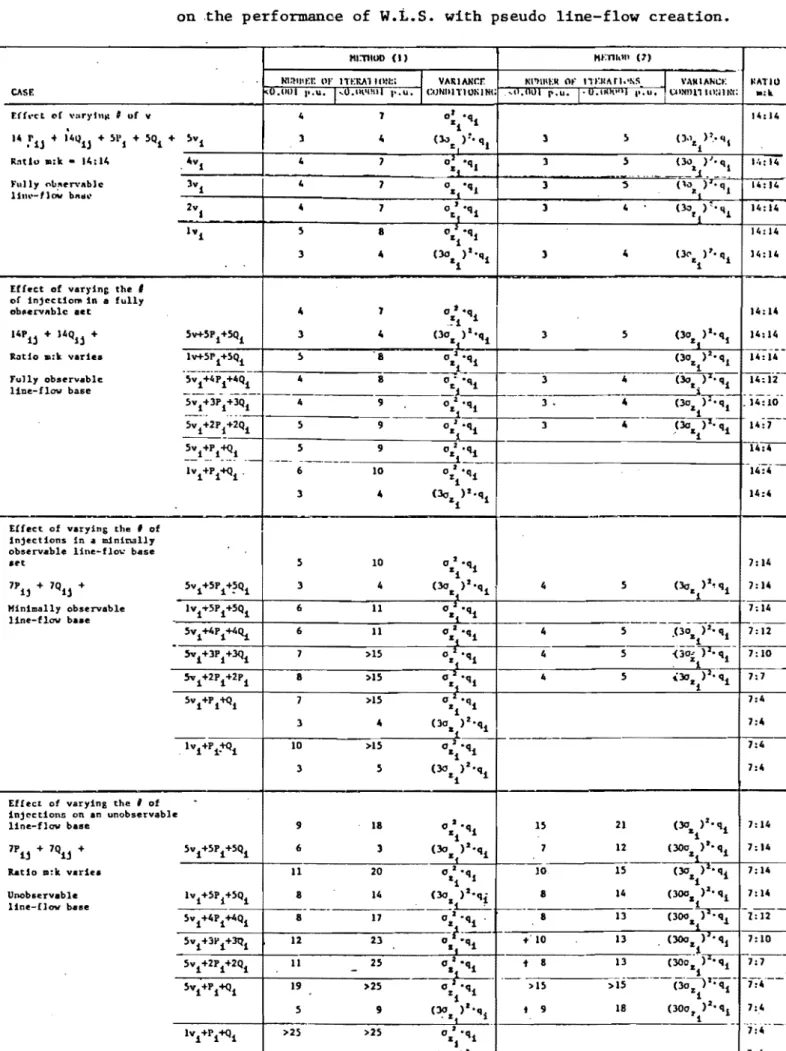
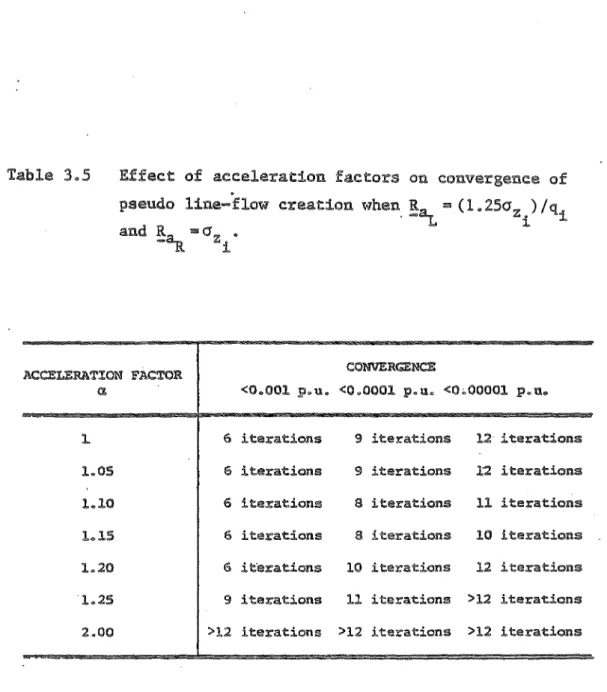
Chapter 3 investigates ways of reducing the speed limitations
of W.L.S. state estimation when processing injection measurements.
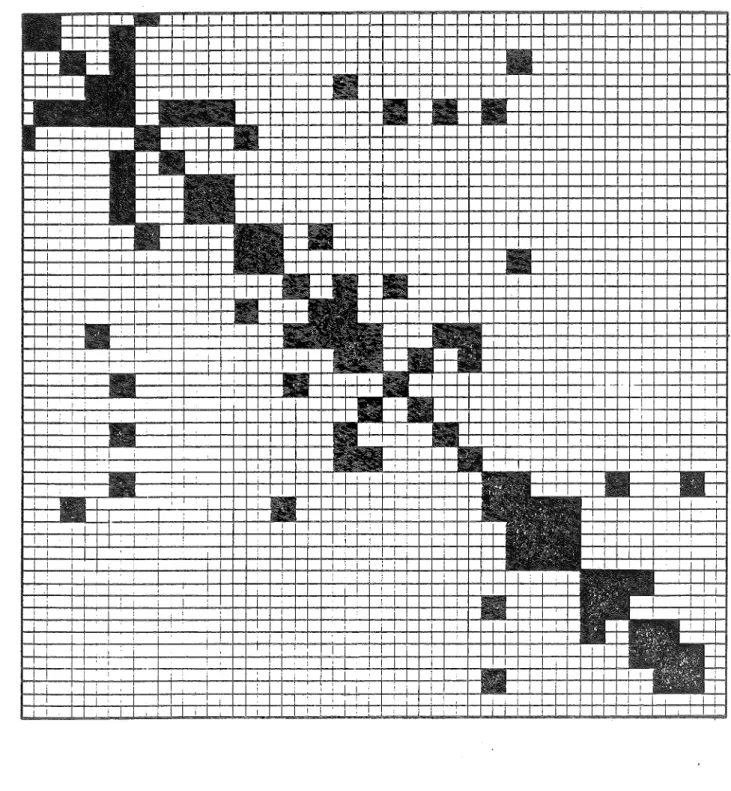
When injection measurements are included in the W.L.S. state estimation,
the density of non-zero elements in the "information" matrix, the matrix
to be reduced in the solution by sparsity techniques, rise dramatically.
As a result the solution time increases. By "creating" pseudo line-flow
measurements from the injection measurements the density of non-zero
elements in the information matrix remains constant. A technique is
outlined which retains the optimality of W.L.S., after the pseudo
line-flow creation, yet has significant speed advantages over conventional
W.L.S. state estimation when processing moderate density injection
measurement sets.
Another speed limiting factor of W.L.S. state estimation is that
all matrix quantiles require recalculation at each iteration. Many
authors have suggested P-8, Q-v decoupling and fast decoupling
techniques to overcome these speed limitations by reducing the number
of non-zero matrix elements requiring re-evaluation and/or to make
these values constant. Chapter 4 summarizes the suggested decoupling
techniques and investigates their performance by theoretically
evaluating their convergence-eigenvalues and comparing the analytic
results with practical test simulations. The aim of the tests and
analysis is to identify stable decoupled and fast decoupled state
estimation schemes whose convergence and accuracy are unaffected by
the transmission line R/X ratio of the test a.c. system or by the
Chapter 5 discusses and tests a modified W.L.S. algorithm that
is extremely fast yet generates near optimal estimates, Pseudo line~
flow creation, from injection measurement data, is included in a fast
decoupled W.L.S. state estimation algorithm selected from the tests
carried out in Chapter 4,
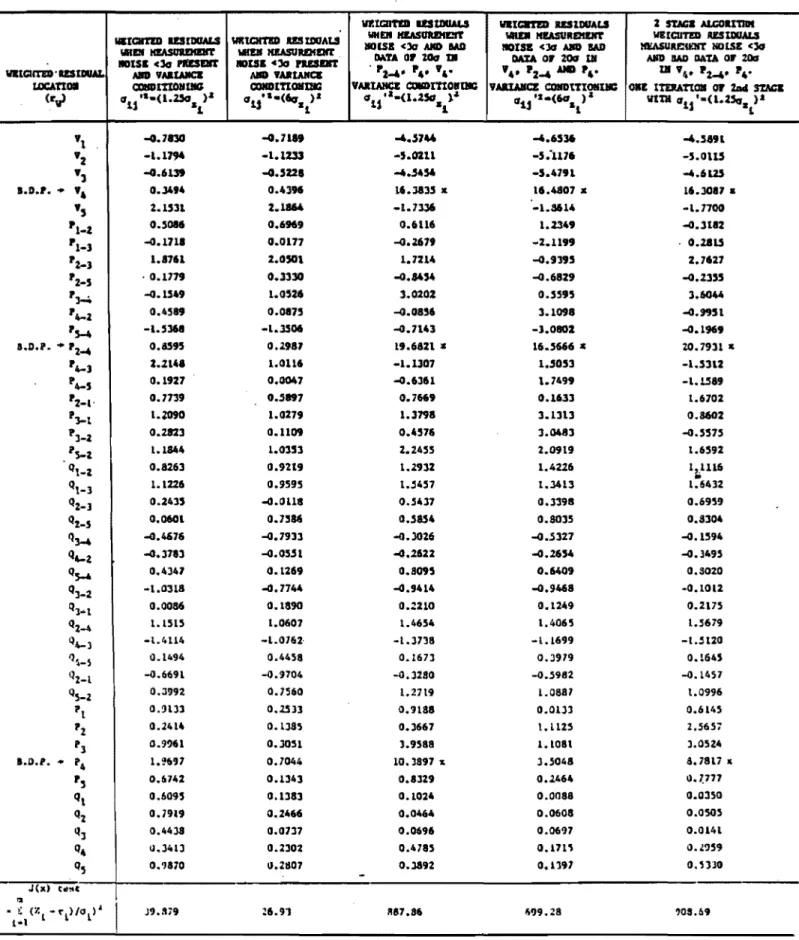
In Chapter 6, methods for detecting and identifying bad data in
on-line state estimation are reviewed, A major limitation of most bad
data detection and identification schemes is that they require a large
amount of computation, usually involving the removal of suspect
measurements, recalculation and re-ordering of all matrices within the
state estimation, and re-estimation to check whether the measurement
data is indeed corrupt. This removal process is usually repeated until
the bad data is located, A technique which mathematically removes the
presence of suspect bad data is presented. The technique is identical
to the physical removal of suspect bad data, however as re-ordering or
re-ca1culation of gain matrix quanti1es are necessary and rapid
detection and identification, essential for maintaining the integrity
of the on-line data-base, follows. Where measurement redundancies are
such that removal of suspect bad data would cause a loss of
observabi1ity, "replacement" of the suspect bad data by previous scan
measurement can be used to aid the identification process.
Chapter 7 considers the inclusion of h.v.d.c. links into a,c.
power systems state estimation. Measurement equations that describe
h.v.d.c. link conditions in and around the convertor terminals are
presented. A method of geographical decoupling of the h.v.d.c. link
into separate convertor terminal blocks is also considered and the
In Chapter 8, a more exact representation for the h.v.d.c.
link is proposed and tested. This model includes the effect of the
commutation overlap angle after the firing of the convertor. It is
also shown that the approximate h.v.d.c. link representation,
discussed in Chapter 7, can be modified to generate exact h.v.d.c.
link model estimates if the residuals in the "approximate" algorithm
are made exact.
The use of availability data in the design and operation of
state estimators is considered in Chapter 9. Most optimal meter
placement design techniques that have been advocated assume that the
measurements present at commissioning will always be present.
However all measurements have a possibility of failure at some stage
and thus membership of the measurement set is dynamic. A technique
is advocated to include the effect that likely failure has on the
observability of the state estimator measurement set in the optimal
meter placement design process. Application of availability analysis
to large scale systems is shown to be straightforward and for most
purposes does not require the use of
a
computer. The suggested,availability based optimal meter placement design technique augments
optimal meter placement design techniques which optimize the bad data
detection capability.
Chapter 10 considers the problem of locally estimating the
states of a hydro turbine and canal structure. A dynamic state
estimation algorithm based on a linearized Kalman filter is used to
monitor the behaviour of the canal and hydro turbine, and this state
estimator is co-ordinated to a higher level, static state estimator
which is estimating the states of the power system in a hierarchical
All of the preceding discussion has applied to state estimation.
However, with little or no modification the state estimation algorithm
used to account for "aposteriori", past or present measurement data
uncertainties, can be made to perform a stochastic load flow and account
for apriori or future prediction uncertainties. In long-term planning
or design of new transmission lines, a large number of deterministic
load flows may be required to test the effect that different
generation-load levels at nodes around the system during future operation will have
on the loading of the proposed new transmission line. Stochastic load
flows process the expected generation or load data at each bus together
with its Gaussian variance or spread, to give the expected power flow,
and its spread or variance, down each transmission line. Thus the
long-term, expected maximum power flow, required during the design for
circuit breaker ratings, can be found. One stochastic load flow can
replace the large number of conventional load flows required in the
planning of a new transmission line (Dopazo et ai., 1975). The concepts
of the stochastic load flow and the probabilistic load flow are
summarized in Chapter 11. Probabilistic load flows can process any
type of nodal probability distribution - Gaussian, discrete or binomial,
while the stochastic load flow handles only Gaussian probability
distribution statistics (Borkowska, 1973; Allan and Al-Shakarchi, 1976).
A technique for representing non-Gaussian probability
distributions in the st'ochastic load flow, by means of Gaussian sum
approximations, is discussed in Chapter 12. Thus the stochastic load
flow, which is easily made from an existing state estimation algorithm,
can be made to perform probabilistic load flows; accurately modelling
the available nodal data.
Chapter 13 discusses the inclusion of an h.v.d.c. link into a.c.
follows from Chapter 7. Multi a.c. h.v.d.c. stochastic load flows can
be used in long-term planning or in the design of a new h.v.d.c. link
or a new transmission line in the vicinity of an existing h.v.d.c. link.
Both uncorrelated and correlated load flow data are included in the
REVIEW OF ,TRANSMISSION LINE MODELLING AND
WEIGHTED LEAST SQUARES STATE ESTIMATION CONCEPTS
2.1 INTRODUCTION
In this chapter the mathematical principles of power system
analysis are reviewed. The rr-equivalent lumped parameter model for
a transmission line is presented, and equations relating to the
measurement of active and reactive line flow and nodal power are
defined. A derivation of the W.L.S. state estimation algorithm
for use in power systems analysis is also presented. Other possible
state estimation methods which also have been advocated are reviewed
and reasons why W.L.S. state estimation has been chosen are given.
2.2 TRANSMISSION LINE MODEL AND POWER SYSTEM MEASUREMENT EQUATIONS
The lumped parameter rr-equivalent circuit for a transmission
line connecting two busbars i and j is shown in Figure 2.1.
For a transmission line, Y .. represents the transfer impedance
lJ
and
Y
..
the shunt susceptanceI I
Y .. ""
lJ R •.
lJ
Y .. ""
y ..
I I JJ
1
+
jX ..
lJ(2.1)
I;jt
Bisw'2 )
1.J
For an off-nominal tap transformer the elements defined above
are modified by the tap position. I f the tap position, T, is given
in per cent, off-nominal, then
a .. =: 1 + O.OlT
1J (2.3)
and
Y .. == a ..
Y ..
1J t 1J 1J (2.4)
Y •. == (a: .
-
a .. ) Y ..11t 1J 1J 1J
(2.5)
Y ..
JJ t (l
-
a . .) 1J Y .• 1J (2.6)A suitable state vector to describe conditions on the power system is
where N is the number of busbars in the power system, and
v. L. 8. is the nd.dal voltage at each node i .
]. 1
In terms of the 2N -1 system states, the relationships between measurements and states can be written (As chmoneit, 1975):
Nodal voltage magnitude measurement, vi
v. = V.
1 1
Active power line-flow measurement, p .. 1.J
p .. 1.J
where c .. 1J
G •. v.2
+
c ..1J 1 1.J
- v. v. (G .. cos (8. - 8.)
+
B., sin(8. - 8,)1. J 1.J 1 J 1.J 1. J
Reactive pmver line-flow measurement, Qij
where d .. 1J
2
B .. v.
+
d ..1.1 1 1J
v v (- G1.'J' si~(81.' - 8.)
+
B,. cos(8, -e.»
i j J 1J 1 J
(2.7)
(2.8)
(2.9)
Active injected power measurement, P. 1.
P .. =
1. j da} L: p .. 1.J
Reactive injected power measurement,
Q
i
Q. = l: Q •. 1. jda} 1.J
(2.11)
(2.12)
where {a} is the set of transmission lines connected to bus i,
G .. is the transmission line admittance between nodes i and j , 1.J
B •. is the transmission line susceptance between nodes i and j,
1.J
and
B. h is the transmission line shunt susceptance between nodes 1.S
i and j.
B ..
1.1.
B. h
=B +~
ij 2 (2.13)
Thus any measurement made on the power system can be described by one
of the above equations.
2.3 MEASUREMENT NOISE
Consider a measurement, zp' made with metering equipment having
an accuracy,
np
(Schweppe and Handschin, 1974).z
=
h (x, L, p)+
n
p p - - - p (2.14)
where L is a vector representing the network structure, the manner
in which the network is connected together to form a
single line diagram, and
E
is a vector representing the network parameters.When m measurements are made simultaneously, the measurement set
can be written as; (Schweppe and Handschin, 1974):
where
n
is a random vector representing measurement errors, parametererrors, structural errors, uncertainty due to communication link failure
and transients. Parameter errors are caused by an insufficient
knowledge of G ..• B .. and/or B. h' Tables of line parameters are
~J ~J ~s
usually only accurate to within a few percent, Parameter values can be
included as states within the ~tate estimator, and estimated (Debs, 1974;
Clements and Ringlee, 1974; Allam and Laughton, 1974). Structural
errors result from faulty circuit breaker or isolator switch status
information being telemetered to the systems control centre. This can
result in the computer constructing a faulty single line diagram of the
network topology (Sasson et al., 1973; Couch and Morrison, 1974; Kato and Hammerlund, 1977). Lines or circuit elements may be assumed to be
connected when in practice they are not, or vice-versa. Structural
errors and communication link failure cause very large errors but
rarely occur.
The measurement noise vector,
n
in (2.15), is modelled as anormally distributed random vector.
n
~ N (0, R)-
--
(2.16)with zero mean; having no bias component, and a diagonal variance matrix
R:
R (2.17)
Any bias effects present can be removed by subtracting the bias,
bp' from the measurement, zp' Modelling the random measurement noise
by a normal distribution appears to be satisfactory for most cases
2.4 WEIGHTED LEAST SQUARES STATIC STATE ESTIMATION
Weighted Least Squares (W.L.S.) state estimation was the first
technique to be advocated for the state estimation of power systems
(Snhweppe et al., 1970). Although W.L.S. state estimation is not the
only method to be applied to the power system problem, it is the most
general, in terms of the range of measurement data that it can handle.
When measurements are non-linearly related to the state of the
power system, the W.L.S. criterion is to minimize (Schweppe and
Handschin, 1974):
-1
R ... (z -
-
h(x» ... (2.18)Differentiating (2.18) with respect to x leads to the following optimality condition:
dJ dx
A
x=x
(2.19)
where x is defined to be the value of x which minimizes (2.18), and
~(~) is the Jacobian matrix,
ah(x)
-a
(~) of order (mxn) (2.20)Linearization with a Taylor series expansion of h(x) about X.,
-1. the i th iterated value, gives
h(i) ~ h(x.) + H(x.)
(i -
x.) + ....- - - -1. - -1. - -1. (2.21)
and substitution into (2_.19L assuming H(x.) = H(x), gives
- -1. -
-(~T
(x. ) R-1H(x.»~~i+l
::: HT (x. ) ~-l (~ - h(x.» (2.22)-1. - - - 1 . -1.
-
-l.where Li~i+l A
(2.23)
.-
xx.--1.
That is,