1
Locked in a capability trap? The case of the composites industry
Anna Chatzimichali, Mike Yearworth, Kevin Potter Abstract
How can a new material technology create growth? Is having a better material a guarantee for industrial success? This work suggests that technological growth requires a different level of analysis to enable a holistic understanding of issues around the production capability for a new material technology. In this paper issues around the development of the composite material industry are explored. The main tenet behind this work is that the composite industry is locked in a capability trap; the paradox of fixating on seemingly profitable short-term results, while losing focus on the strategic vision. A qualitative study and interviews with experts in composites provide the basic evidence to initiate the discussion around this phenomenon.
Keywords: composite manufacturing, technology policy, manufacturing strategy, capability trap
1. Composite material, current challenges, theory and practice
1.1 Composite production capability
Composites are engineered materials, composed from two distinctive materials (fibres and resin) that together create components with advanced properties, like directional strength/stiffness, non-uniform weight distribution and lower weight. They have a variety of applications for sectors like aerospace, marine, automotive, wind industry and leisure goods.
Despite the numerous advantages that these materials can offer, the industry seems to have issues around increasing its production capability. For example, the use of composites in the new Boeing 787 Dreamliner revealed serious difficulties regarding the composite production capability and material lay-down rate. The largest percentage of the aircraft’s structure is composite, resulting in lower structural weight and consequently less fuel consumption than existing airplanes in the same class, however, Boeing fell short in reaching the forecasted material laydown rate. More specifically, the production capability target of 200-500lbs/hr proved to be unrealistic, while the actual production rate only reached 30lb/hr by the time a report became available (Airbus SAS, 2008). The corporate world has put significant effort in increasing composite production rates. Nevertheless reports of these efforts are not available, mainly due to the fact that organisations are reluctant to share evidence related with their performance. Official national and international statistical records regarding composite material are not available either. This is linked to the fact that composites pertain to a variety of sectors and therefore no single SIC code exists, as a consequence it is particularly hard to map composite activity and formulate reliable figures.
1.2 Technology development theories in composites
2 and operations level for composites manufacturing has been very limited (Oliver and Sticklans, 1990, The Lean Aircraft Initiative, 1997). Despite the significant research output in the science of composites, there seem to be no effort to understand concerns related to composite productivity at a systemic level.
But shouldn’t the general technology development literature cover those concerns? Current literature suggests that technological innovation in a sector is driven forward by the role of a “dominant design” (Utterback and Abernathy, 1975; Anderson and Tushman, 1990; Utterback and Suarez, 1993), defined as the emergence of a dominant technology in an industry. When a dominant design is broadly accepted in an industrial context, activities in an organisation shift the focus from product innovation to process innovation (Abernathy and Utterback, 1978). This allows the development of production capability and the further growth of new technologies. For composite manufacturing, however, product and material are created simultaneously and therefore product innovation cannot happen without process innovation. Composites seem to fall in the middle between the product and process innovation schemes, making technology development theories unable to describe the growth of this material technology at an industrial level. A similar pattern of product and process innovation occurring simultaneously has been identified in the nanotechnology sector (Linton and Walsh, 2008).
Another point that underpins the temperamental nature of composites according to the prevalent technology development theories is industrial structure. The structure of the composite industry has changed significantly in the recent years. The vertically integrated organisations, holding the facilities and all necessary skills in-house, that used to dominate the industrial landscape in the late ‘80s (Harris, 1991), gave their place to today’s more fragmented supply chain. This pattern appears to be in disagreement with theories of technological growth. According to Utterback and Suarez (1993), when a dominant design is established, the number of firms in the sector declines and only a few large firms remain. Looking back in the industrial history of composites, the opposite appears to be true.
1.3 Black metal and composite industrial practice
In practice, the industry has traditionally treated composites as a substitute material, usually overlooking the systemic architecture of the component and compromising on the benefits that composites can offer. Historically, the composites have evolved around the concept of “black aluminium components” (Tsai, 1993), components designed as metals but manufactured in composite material. This attitude is causing serious issues on manufacturability, since metals and composites require radically different approaches. For example, processes like milling, drilling or grinding that are used in metals, have totally different effects in composites. Composite manufacturing requires the development of a mould, followed by a unique case of assembling multiple layers of pre-impregnated fibres on the mould. Metals and composites have fundamentally different design and manufacturing philosophies and they also require different skill sets.
3
1.4 The capability trap
Despite the high strategic expectations in composite material technologies (Technology Strategy Board, 2014), (Government Office for Science, 2013), (Department for Business Innovation and Skills, 2013), the industry seems to be stuck in a low productivity situation. The possibility that this might be an example of a “capability trap” (Repenning and Sterman, 2002) is explored here. The capability trap arises from the paradox of fixating on seemingly profitable short-term results, while in the same time losing focus on the strategic vision, neglecting investment in process improvements and capabilities. This effect has also been characterised by evidence that “exploitation crowds out exploration” (Benner and Tushman, 2002).
2. Methodology and data collection
A qualitative study on the development of production capabilities in the composite industry revealed some of the blocking factors that delay the growth of the sector (Chatzimichali and Potter, 2014). Eight experts in composites with a mean of 30.5 years of experience took part in this study. All the interviewees were male and hold or held in the past high-profile positions in plant management, production and engineering management and composite technical consultancy. They had experience across a variety of composite sectors, from aerospace components to wind turbine blades and composite bridges. Each interview lasted about two hours. Interviews were recorded, fully transcribed and analysed using a constant comparative approach in NVivo 10 software. For this paper the interview data were subsequently explored using a sequential-bridging strategy (Schultz and Hatch, 1996) with a view to developing Causal Loop Diagrams (CLDs) from the data (Luna-Reyes and Andersen, 2003; Yearworth and White, 2013).
3. Qualitative data analysis
Here a short analysis of the qualitative data is presented. The focus is on the interplay between long term thinking versus short term problem solving that appears to be evident in the sector.
Some general remarks about the industry were made by Expert 4:
Expert 4: We characterize the composites industry as a cottage industry. And that is a reflection of both the typical size of smaller the companies operating in it but also the fact they tend to know what they know and that’s really good enough for them. They are not outward looking in many respects. Which is why it is quite interesting to see at the supply chain products who try to forge partnerships. And because of that they don’t look in their manufacturing techniques, they look at their material problems and if we can move and focus on their manufacturing techniques and away from a predominantly manual concept, then the world changes. Now that’s not just a question of thinking, it is a question of investment, so I think many small companies don’t know what they don’t know because they cannot afford to find about it.
4
Expert 5: We don’t openly go out and see methods that are used in another [meaning company/industry]. The general manager and business development manager have a lot of knowledge about what there is in the business about new techniques and knowledge, new application and we can discuss if a new technology can make the part.
This is also connected with the lack of a collaborative attitude in the supply chain level. It also seems that the company is reluctant to invest in strategic research in the field and prefer a more practical and problem-solving approach towards their current operations:
Expert 5: Having been in other arenas I know there is a lot of funding, there is a lot possibility doing research programs. A lot of those require an equal contribution, so an example of a two hundred thousand pounds piece of project, you are expected to find out 200.000 pounds. My CEO would tell me that for that amount of money you would make the product yourself. You don’t have to put that amount in a pot to be told how to make it. You still gonna pay 200,000 pounds out of his pocket. It is 200,000 pounds worth of work. You can get the same thing for a lot less. Keeping it to a smaller arena, than the big primes they have that huge corporate entity and they can enter into that. We don’t have to research it, we just have to make it.
Expert 1 on the other hand, was working in new product development using composites for an innovative application. Here, lack of time for long-term thinking was discussed:
Expert 1: Even now we know we want to do work, but we are too concentrating on design today’s blades and we don’t have enough time to do the work that we need to do on tomorrows. But we’ll get there.
Despite their long-term thinking, they “firefight” with the current design and not enough time is left to strategically approach the market and develop future designs.
Another point that became clear during the interviews was the extent that automation was available or possible to be developed:
Expert 3: We have been working with some people who have little or no schooling, simple guys, very good manually, they are quick, very quick, you have to be very clever to make something here that will out compete those guys.
Expert 2: You cannot make a machine to replicate that [meaning manual production] rate! If you try, you can make a machine to hold the creel and run the blade, but you have got a problem with the power supply.
As a consequence, many composite production processes are dependent on the craftsmanship skills of the workforce. However, in some cases they are many steps behind automation. Here, better understanding of the actual manufacturing process, would allow a fastest production:
5
tooling smaller. One is cheaper, two I can get more parts in the furnace, less batches, more parts per batch, cost gets down.
Lack of skills in composites was a theme that emerged many times during the interviews. Expert 5 has extensive experience in composite manufacturing and lack of composite design skills in the sector is an everyday practical struggle for him:
Expert 5: [We are] having a drawing, which lands on the desk to make something in composites and then the composite manufacturing engineer has to take it apart. Take it apart and discover how to make it. […] So what we have to do really is to change their [meaning the customers’] drawing. Change their model to what can be made.
Unfortunately getting an un-manufacturable design requires redesign and a lot of the manufacturers’ time is spent here, despite the fact that this is not their formal role. In the same case the expert continues:
Expert 5: It is difficult to get a designer to change his mind, to think such as a square corner. A square corner is no good with composite, it needs to be rounded to take the stresses away from the corner and still have a lot of hard corners drawn in a composite component. So when the designer gives you a nice sharp angle on a composite component there be no composite component
This inadequacy of designers can be attributed to the fact that the core of engineering design has been very closely interwoven with the metallic tradition. Most designers have received formal education in metal design and it is hard to change their mind-set. Expert 1, also confirmed the low level of composite skills in the workforce:
Expert 1: Very few engineers, still, know how to design and make it as a means […], [composites are] still not totally understood.
Beyond skills and manual labour, for Expert 7 the production capability is also connected with the level of investment. For him scaling up and increasing production capability means investment to machinery:
Expert 7: Big one (issue) will be labour. I think that is the biggest thing. Because everything else basically, it all comes down to money. If need to scale and I need more capacity I will buy another autoclave.
In the case of Expert 8, a negative experience with composite product development on the supply chain level was discussed:
6
evolve in conjunction with the supplier and it is not something that we have done very well and we haven’t done it certainly… we haven’t done it robustly in the sense of every project has gone that way.
This inadequacy of operational processes for the new material is negatively reflected on the growth of the sector. The old or legacy organisational processes that used to work (well or less well) for metal are completely inappropriate for composites:
Expert 8: It is because of insufficient, preparatory work. Insufficient dialog. It is going straight from the intent to the design and that doesn’t work. It doesn’t work on most things, but it particularly it doesn’t work with composites. […] And in the case of composites, that method doesn’t work very well, because all information is within specification, because the specification doesn’t recognize all the problems associated in making composite parts.
In the next section a causal loop diagram is formulated in order to explore and shed more light on the causal relationships between the points discussed by the experts.
4. Theory building and systems dynamic modelling
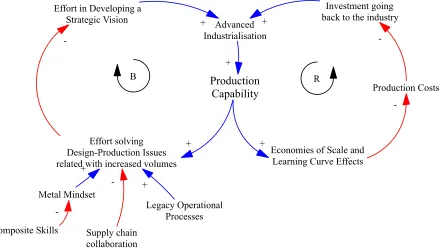
[image:6.595.83.525.468.719.2]The fundamental variable of this model is the production capability of the composite industry, positioned in the centre of the model in figure 1. Production capability is the level or volume at which composite products are developed and manufactured. This is directly dependent on the rate at which advanced industrialisation is successfully implemented (Chatzimichali, Potter and Smulders, 2013). Advanced industrialisation goes back to the basics of industrialising the development and manufacturing of a product. This starts with an integrated body of knowledge covering design, engineering, manufacturing and use of the product and is followed by division of activities, manufacturing innovation, industrial engineering practices and automation in order to increase production quality, rate and volume.
Figure 1 Causal-loop diagram of the composites capability trap Production Capability Composite Skills Advanced Industrialisation Investment going back to the industry +
Production Costs
-Effort solving Design-Production Issues related with increased volumes
+ Effort in Developing a
Strategic Vision -R B Supply chain collaboration
-Economies of Scale and Learning Curve Effects
-7 The reinforcing loop on the right side of figure 1 is representing the rudimentary mechanism behind economic growth in the sector. Advanced industrialisation and increased production capability lead to economies of scale and learning curve effects, which in turn decrease production costs. Decreased
production costs are leaving a bigger margin for profit and thus investment back in the industry. This consecutively triggers more advanced industrialisation and increases the production capability of the sector.
The balancing loop, on the other hand, has a negative impact on advanced industrialisation and
production capability. Increased production volumes and rates also result in increasing the direct
effort the sector is putting in solving issues related with design and manufacturing of products. As it was discussed in the previous section the struggle with legacy operational processes, the lack of supply chain collaboration and lack of skills in combination with the metal mind-set create the “firefighting” attitude. All these concerns are reflected upon the redesign problems with many composite products and components. These redesign problems require further investigation, since they can have debilitating effects on profitability (Williams et al. 1995). The sector’s focus seem to be more around survival and short-term profit, while larger strategic goals related to advanced industrialisation and increased production capability are not a priority.
This paradox between the lack of long-term strategy (reinforcing loop) and a short-term firefighting mode (balancing loop) is the basis of a capability trap. In the next section, the notion and the implications of this capability trap are further discussed.
5. Overcoming the capability trap
According to Repenning and Sterman (2001), a capability trap is primarily a mental barrier and therefore overcoming it, rests on changing the belief that resources or time are insufficient for improvements and that systemic problems are outside of employees’ control. Therefore succeeding in such an endeavour would primarily depend on shifting the mental models of employees and managers. But what could bring about a new belief system?
8
6. Conclusions
The intention of this paper was to examine issues around the seemingly low production capability of the composite sector. A critical study of the technology development literature indicated that composites appear to be a unique case of technology that does not follow existing rules. Expert interviews and further analysis of qualitative data led to the formulation of a capability trap hypothesis. Early findings seem to support this phenomenon that is slowing down composite technology development. The dynamics of the system appear to fixate in solving issues around work processes, short term improvement and immediate profit, rather than concentrate on longer term investment, learning goals and strategic growth. Sketching this capability trap raises several questions. First, how could growth curves reflecting production capability get expressed for a material that applies in various sectors? Second, if industrial actors and stakeholders become aware of such a capability trap, how could research support this shift towards a growth mind-set and link new technology dynamics with organisational outcomes? Technology development literature and composite research should clearly extend beyond the narrow limits of their own fields and explore the connection between composite production capability, manufacturing strategy and advanced industrialisation, in order to shape the conditions for growth.
References
Abernathy,W.J., Utterback, J., (1978). Patterns of industrial innovation. Technology Review, 50, pp. 41–47.
Airbus SAS. Boeing 787 – lessons learnt; 2008. Retrieved from: <http://www.slideshare.net/aergenium/b787-lessons-learnt-presentation>.
Anderson, P., Tushman, M. (1990) Technological discontinuities and dominant designs: a cyclical model of technological change. Administrative Science Quarterly, 35(4), pp. 604–635.
Benner, M. J., & Tushman, M. (2002). Process management and technological innovation: A longitudinal study of the photography and paint industries. Administrative Science Quarterly, 47(4), pp. 676-706.
Brown, D.S., Eckert, C.H., Kline C.H., (1985) Advanced polymer composites — five keys to success. Materials & Design, 6(5), pp. 203-206.
Carlson C.W. (1993). Polymer composites: Adjusting to the commercial marketplace. The Journal of The Minerals, Metals & Materials Society (JOM), 45(8), pp. 56-57.
Chatzimichali, A.P., Potter, K.D. (2014). Growth through material: An exploratory study in the development of the composite industry, The 2nd Business Systems Laboratory International Symposium, Jan. 23- 24, 2014, Rome, Italy.
9 Department for Business Innovation and Skills. (2013), Composites Leadership Forum, UK Composites 2013, A Study into the Status, Opportunities and Direction for the UK Composites Industry.
Government Office for Science (2013) The future of manufacturing: A new era of opportunity and challenge for the UK - project report, Foresight, Retrieved from: https://www.gov.uk/government/uploads/system/uploads/attachment_data/file/255922/13-809-future-manufacturing-project-report.pdf.
Harris, B. (1991). A perspective view of composite materials development, Materials & Design, Vol. 12(5), pp 259-272.
Le Masson, P., Weil, B., Hatchuel, A., Cogez P. (2013). Why are they not locked in waiting games? Unlocking rules and the ecology of concepts in the semiconductor industry. Technology Analysis & Strategic Management, 24 (6), pp. 617-630.
Lente van, H., Rip, A. (1998). Expectations in Technological Developments: an Example of Prospective Structures to be Filled in by Agency. In: Getting New Technologies Together. Studies in Making Sociotechnical Order. Walter de Gruyter, Berlin, pp. 203-231.
Linton, J.D., Walsh, S. (2008). A Theory of Innovation for Process Based Innovations such as Nanotechnology. Technological Forecasting and Social Change, 75(5), pp. 583–594.
Luna-Reyes, L.F., Andersen, D.L. (2003). Collecting and analyzing qualitative data for system dynamics: methods and models. System Dynamics Review, 19(4), pp. 271-296.
Oliver M., Stricklans B., (1990) Synchronised Manufacture of Composites Knowledge Study (SMACKS). Composites Manuf. 1(2) 1990.
Repenning, N., Sterman, J. (2001). Nobody ever gets credit for fixing problems that never happened: Creating and sustaining process improvement. California Management Review, 43(4), pp. 64-88. Repenning, N.P., Sterman, J.D. (2002). Capability traps and self-confirming attribution errors in the dynamics of process improvement. Administrative Science Quarterly, 47(2), pp. 265-295.
Schatzberg, E. (1998). Wings of Wood, Wings of Metal: Culture and Technical Choice in American Airplane Materials. pp. 1914-1945, Princeton University Press.
Schultz, M., Hatch, M. J. (1996). Living with multiple paradigms: The case of paradigm interplay in organizational culture studies. Academy of Management Review, 21(2), pp 529-557.
Technology Strategy Board. (2014). High Value Manufacturing Strategy 2012-2015, Retrieved from: https://www.innovateuk.org/documents/1524978/2139688/High+Value+Manufacturing+Strategy+2 012-15/9b7e55f0-ed9a-4efe-89e5-59d13b2e47f7
10 Schoonmaker, Lean Aircraft Initiative, Center for Technology, Policy, and Industrial Development, Massachusetts Institute of Technology, 77 Massachusetts Avenue, Cambridge, MA 0213.
Tsai, S.W. (1993). Rules of Composites Design: A Review in Metal Matrix Composites. Proceedings of the Ninth International Conference on Composite Materials (ICCM/9) 1993 (Vol.1). Woodhead Publishing.
Utterback, J., Abernathy, W. (1975). A dynamic model of product and process innovation. Omega, 3, pp. 639–656.
Utterback, J., Suarez F. (1993) Technology, competition and industry structure. Research Policy, 22, pp. 1–21.
Williams, T., Eden, C., Ackermann, F., Tait, A. (1995). The Effects of Design Changes and Delays on Project Costs. Journal of the Operational Research Society, 46(7), pp. 809-818