Integrating Morphological Desegmentation into Phrase-based Decoding
Mohammad Salameh† Colin Cherry‡ Grzegorz Kondrak†
†Department of Computing Science ‡National Research Council Canada University of Alberta 1200 Montreal Road
Edmonton, AB, T6G 2E8, Canada Ottawa, ON, K1A 0R6, Canada {msalameh,gkondrak}@ualberta.ca [email protected]
Abstract
When translating into a morphologically com-plex language, segmenting the target language can reduce data sparsity, while introducing the complication of desegmenting the system output. We present a method for decoder-integrated desegmentation, allowing features that consider the desegmented target, such as a word-level language model, to be considered throughout the entire search space. Our re-sults on a large-scale, English to Arabic trans-lation task show significant improvement over the 1-best desegmentation baseline.
1 Introduction
State-of-the-art systems for translating into morpho-logically complex languages, such as Arabic, em-ploy morphological segmentation of the target lan-guage in order to reduce data sparsity and improve translation quality. For example, the Arabic word
ÑîDËðYË
ldwlthm “for their country” is segmented into the prefix +Ë
l+“for”, the steméËðX
dwlp “coun-try” and the suffixÑë
+ +hm“their.” The segmen-tation sometimes involves performing orthographic normalizations, such as transforming the stem-finalttop. The result is not only a reduction in the number of word types, but also better token-to-token corre-spondence with the source language.
Morphological segmentation is typically per-formed as a pre-processing step before the train-ing phase, which results in a model that translates the source language into segmented target language.
Desegmentation is the process of transforming the segmented output into a readable word sequence,
which can be performed using a table lookup com-bined with a small set of rules. Desegmentation is usually applied to the 1-best output of the decoder. However, this pipeline suffers from error propaga-tion: errors made during decoding cannot be cor-rected, even when desegmentation results in an ille-gal or extremely unlikely word. Two principal types of solutions have been proposed for this problem:
rescoringandphrase-table desegmentation.
The rescoring approach desegments either an
n-best list (Oflazer and Durgar El-Kahlout, 2007) or lattice (Salameh et al., 2014), and then re-ranks with features that consider the desegmented word sequence of each hypothesis. Rescoring features include the score from an unsegmented target lan-guage model and contiguity indicators that flag target words that were translated from contiguous source tokens. Rescoring widens the desegmenta-tion pipeline, allowing desegmentadesegmenta-tion features to reduce the number of translation errors. However, these features are calculated for only a subset of the search space, and the extra rescoring step compli-cates the training and translation processes.
Phrase-table desegmentation (Luong et al., 2010) also translates into a segmented target language, but alters training to perform word-boundary-aware phrase extraction. The extracted phrases are con-strained to contain only complete target words, with-out any dangling affixes. With this restriction in place, the phrase table can be desegmented before decoding begins, allowing the decoder to track fea-tures over both the segmented and desegmented target. This ensures that desegmentation features are integrated into the complete search space, and
side-steps the complications of rescoring. How-ever, Salameh et al. (2015) show experimentally that these benefits are not worth giving up phrase-pairs with dangling affixes, which are eliminated by word-boundary-aware phrase extraction.
We present a method for decoder-integrated de-segmentation that combines the strengths of these two approaches. Like a rescoring approach, it places no restrictions on what morpheme sequences can ap-pear in the target side of a phrase pair. Like phrase-table desegmentation, its desegmentation features are integrated directly into decoding and considered throughout the entire search space. We achieve this by augmenting the decoder to desegment hypotheses on the fly, allowing the inclusion of an unsegmented language model and other features. Our results on a large-scale, NIST-data English to Arabic transla-tion task show significant improvements over the 1-best desegmentation baseline, and match the perfor-mance of the state-of-the-art lattice desegmentation approach of Salameh et al. (2014), while eliminating the complication and cost of its rescoring step. Our approach is implemented as a single stateful feature function in Moses (Koehn et al., 2007), which we will submit back to the community.
2 Method
Our approach extends the multi-stack phrase-based decoding paradigm to enable the extraction of word-level features inside morpheme-segmented models.1 We assume that the target side of the parallel cor-pus has been segmented into morphemes with pre-fixes and sufpre-fixes marked.2 This allows us to define acomplete wordas a maximal morpheme sequence consisting of 0 or more prefixes, followed by at most one stem, and then 0 or more suffixes.
We also assume access to a desegmentation func-tion that takes as input a morpheme sequence match-ing the above definition, and returns the correspond-ing word as output. Dependcorrespond-ing on the complexity of the segmentation, desegmentation can be achieved through simple concatenation, a small set of rules, a statistical table (Badr et al., 2008), or a
statis-1The ideas presented here could also be applied to
hierarchi-cal decoding, which would require generalizing them to account for right context as well as left.
2Throughout this paper, we use a token-final “+” to denote a
prefix, and a token-initial “+” for a suffix.
tical transducer (Salameh et al., 2013). El Kholy and Habash (2012) provide an extensive study on the influence of segmentation and desegmentation on English-to-Arabic SMT. In this work, we adopt the Table+Rules technique of El Kholy and Habash (2012) for English-Arabic SMT. The technique re-lies on a look-up table that stores mappings of segmented-unsegmented forms, and falls back on manually crafted rules for segmented sequences not found in the table. When a segmented form has mul-tiple desegmentation options available in the table, we select the most frequent option.
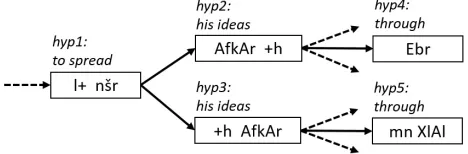
The output of a phrase-based decoder is built from left to right, and at each step, a hypothesis is ex-panded with a phrasal translation of a previously un-covered source segment. We augment this process within-decoder desegmentation, which monitors the target sequence of each translation hypothesis as it grows, detecting morpheme sequences that corre-spond to complete words and desegmenting them on the fly to generate new features. This is described in detail in Section 2.1.
Figure 1: Decoding the Arabic translation of the phrase“to spread his ideas through”.
2.1 Decoder Integration
A typical phrase-based decoder represents a hy-pothesis with a state that contains the information to guide search and calculate features, such as the source coverage vector and the target context for the language model. Hypotheses with identical states can be recombined to improve search efficiency. We augment the state with two structures: (1) a buffer
Q containing all of the morphemes that contribute to the current word in progress, represented as a queue of tokens; and (2)n-gram context C for the word-level target language model. The search’s initial state begins with an empty Q and with n-1
beginning-of-sentence tokens inC.
When a state is extended with a target phraseP, we update the in-decoder desegmentation structures
Q and C with Algorithm 1. Tokens are appended to Q until a token t would begin a new word, at which point the tokens fromQare desegmented and the resulting word is used to calculate features and update the target context. Following the lower de-coding path in Figure 1, Q would be emptied and desegmented first during hyp3 whent=AfkAr, cal-culating features forW =lnˇsrh.
The main cost of in-decoder desegmentation comes from maintaining the context necessary to evaluate the n-gram, word-level language model. As each desegmented word in C will correspond to at least one segmented token, the system’s effec-tive language-model order in terms of segmented to-kens will frequently be much larger thann. Storing larger language-model contexts make it less likely that states will be equal to one another, which re-duces the amount of recombination the system can do, and increases the number of states that must be expanded during search.
Algorithm 1Desegmentation State Update
1: Input: State variablesQ,C 2: Input: Extending phraseP 3: foreach tokentinPdo
4: iftcannot continue the word in Qthen 5: W= Desegmentation of tokens inQ 6: Extract word-level features forW 7: (Word-level LM score isp(W|C)) 8: Update current feature vector 9: UpdateCwithW
10: EmptyQ 11: Append tokenttoQ
2.2 Delayed and Optimistic Scoring
In the above approach, desegmentation and feature scoring are applied only when a complete word is formed. We refer to this asdelayed scoringbecause the features for a token are not applied until other to-kens have been added to the hypothesis. For exam-ple, in Figure 1, the tokensl+ nˇsradded in hyp1 are not evaluated with word-level features until hyp2 or hyp3 completes the word. This delay results in inac-curate scoring of hypotheses, as the cost from these tokens is hidden untilQ is emptied. These inaccu-racies can lead to poor pruning choices and search errors during beam search.
Alternatively, we can performoptimistic scoring, which tries to score the contents ofQas early as pos-sible. In this case, we assume that the contents ofQ
form a complete word, without waiting for the next token to confirm it. With each hypothesis extension, when the last token inP is processed and added to the queue, we desegment the contents ofQand ex-tract features, but without emptyingQ. The scores of these features are cached in a variableSthat does not affect recombination, as the scores are determin-istic givenQ,Cand the model. When a later token confirms the end of the word, we subtractSfrom the scores derived from the actual desegmented word, to account for our earlier approximation. Note that for aQcontaining only a prefix, we must still delay scoring.
2.3 Features
indicators, and a desegmented word penalty. The unsegmentedn-gram language model scores
W in the context of C, as shown in Algorithm 1. This language model will heavily penalize mal-formed Arabic words, as they will appear as out-of-vocabulary items. Furthermore, it will evalu-ate well-formed Arabic words in a larger, word-level context, complementing the morpheme-word-level
n-gram language model that is naturally included in SMT systems built over a segmented target.
We also implement the contiguity features pro-posed by Salameh et al. (2014). These indicators check if the desegmented form is generated from a contiguous block of source tokens, a block with 1 discontiguity, or a block with multiple disconti-guities. These features enable the decoder to pre-fer desegmented words whose component segments were translated from contiguous or nearly contigu-ous source sequences. This encourages the system to select a more local, and hopefully safer, transla-tion path when possible.
Finally, most phrase-based decoders incorporate a “word penalty” feature that counts the number of target tokens in a hypothesis. When the target lan-guage has been segmented into morphemes, this ac-tually corresponds to a morpheme penalty. However, with in-decoder desegmentation, we now have the option to count either words or morphemes. There is reason to believe that by counting words, instead of morphemes, we will give the system greater control over the length of its output word sequence, which is particularly relevant because of BLEU’s brevity penalty. We try both options in our experiments. Unfortunately, the obvious solution of including two features, a word count and a morpheme count, did not perform well during development.
2.4 Future costs
For future cost estimates, we must also provide out-of-context feature scores for each phrase-pair in our system. To do so, we ignore suffixes appearing at the beginning of a target phrase and prefixes appear-ing at the end. We assume that the remainappear-ing to-kens form complete words, and desegment and score them to provide out-of-context scores. We also con-sider dangling affixes as half words, with a count of 0.5, for out-of-context scoring of the word penalty feature.
3 Experiments
We use the NIST 2012 dataset (1.49 million sen-tence pairs excluding UN pairs) to train an English-to-Arabic system. The system is tuned with the NIST 2004 (1353 pairs) evaluation set and tested us-ing NIST 2005 (1056 sentences) and the newswire portion of NIST 2008 (813 pairs) and NIST 2009 (586 pairs). As there are multiple English reference translations provided for these evaluation sets, we use the first reference as our source text.
The Arabic part of the training set is mor-phologically segmented and tokenized by MADA 3.2 (Habash et al., 2009) using the Penn Arabic Treebank (PATB) segmentation scheme. Variants of Alif and Ya characters are uniformly normalized. We generate a desegmentation table from the Arabic side of the training data by collecting mappings of segmented forms to surface forms.
We align the parallel data with GIZA++ (Och et al., 2003), and decode with Moses (Koehn et al., 2007). The decoder’s log-linear model uses a stan-dard feature set, including four phrase table scores, six features from a lexicalized distortion model, along with a phrase penalty and a distance-based distortion penalty. KN-smoothed 5-gram language models are trained on both the segmented and un-segmented views of the target side of the parallel data. We experiment with word penalties based on either morphemes or desegmented words. The de-coder uses Moses’ default search parameters, ex-cept for the maximum phrase length, which is set to 8, and the translation table limit, which is set to 40. The decoder’s log-linear model is tuned with MERT (Och, 2003) using unsegmented Arabic ref-erence translations. When necessary, we desegment our 100-best-lists before MERT evaluates each hy-pothesis. We evaluate with BLEU (Papineni et al., 2002) measured on unsegmented Arabic, and test statistical significance with multeval (Clark et al., 2011) over 3 tuning replications.
desegmenta-System WP mt05 mt08 mt09
NoSegm. word 33.2 18.6 25.6
One-best morph. 33.8 19.1 26.8
Lattice morph. 34.4 19.7 27.4
Delayed morph.word 34.134.1 19.419.5 27.026.8
[image:5.612.78.293.60.170.2]Optimistic morph.word 34.234.5 19.619.7 27.227.2
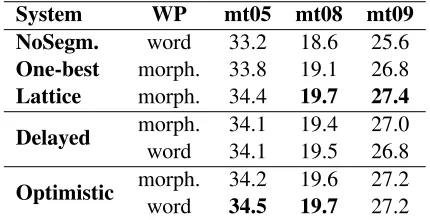
Table 1: Evaluation of the desegmentation methods using BLEU score. Both Delayed and Optimistic refer to in-Decoder Desegmentation method used. WP shows whether Word Penalty feature is based on a complete desegmented word or a morpheme.
tion approach as a feature functions in Moses, test-ing scortest-ing variants (delayed vs. optimistic), and word penalty variants (morpheme vs. word).
Table 1 shows the results on three NIST test sets, each averaged over 3 tuning replications. The lat-tice approach is significantly better than the 1-best system, which in turn is significantly better than the unsegmented baseline. Our Optimisticin-decoder approach with word penalty calculated on word to-kens is significantly (p <0.05) better than the 1-best approach, and effectively matches the quality of the more complex lattice approach.
All of the systems with word-level features im-prove over 1-best desegmentation, as their features penalize desegmentations resulting in illegal words or unlikely word sequences. We see a small, con-sistent benefit from optimistic scoring. Error anal-ysis reveals that translations with many consecu-tive stems benefit the most from this variant, which makes sense, as our approximations would be exact in these cases. Using a word penalty calculated on word tokens appears to work slightly better on aver-age than one calculated on morphemes.
Typically, one would hope to surpass a rescoring approach with decoder integration; however, our lat-tice implementation fully searches its latlat-tice, even if composition with the word-level language model would cause the lattice to explode in size. That is, lattice desegmentation has an advantage, as it trades time-efficiency for a perfect search that ignores the complexity introduced by expanded n-gram con-text. A lattice beam search that dynamically calcu-lates word-level language model scores while
prun-ing away unlikely paths would provide a more fair, and more efficient, comparison point.
Lattice rescoring also involves many steps, requir-ing one to train and tune a complete segmented sys-tem with segmented references, then desegment lat-tices and compose them with a word LM, and then tune a lattice rescorer on unsegmented references. In contrast, our system is implemented as a single decoder feature function in Moses.3 This one func-tion replaces the lattice desegmentafunc-tion, LM com-position, and lattice rescoring steps, greatly simpli-fying the translation pipeline.
4 Conclusions and Future Work
We have presented a method for in-decoder deseg-mentation, which allows a phrase-based decoder to simultaneously consider both segmented and deseg-mented views of the target language. We have shown that this approach outperforms 1-best deseg-mentation, and matches the performance of lattice desegmentation, while eliminating the complication of its lattice transformation and rescoring steps.
We are interested in building an unsegmented, word-level language model that can provide mean-ingful estimates for morphological segments, which would improve scoring for out-of-context phrases and incomplete words. Also, our system currently considers only the most likely desegmentation of each segmented word. Inspired by the disambiguat-ing desegmentation system of El Kholy and Habash (2012), we would like to extend our system to pro-pose multiple desegmentation candidates for each word, and allow the decoder to select the correct form using its other features.
Acknowledgments
This research was supported by the Natural Sci-ences and Engineering Research Council of Canada (NSERC).
3This function references a desegmentation table and an
References
Ibrahim Badr, Rabih Zbib, and James Glass. 2008. Seg-mentation for English-to-Arabic statistical machine translation. InProceedings of ACL, pages 153–156. Jonathan H. Clark, Chris Dyer, Alon Lavie, and Noah A.
Smith. 2011. Better hypothesis testing for statistical machine translation: Controlling for optimizer insta-bility. InProceedings of ACL, pages 176–181. Ahmed El Kholy and Nizar Habash. 2012.
Ortho-graphic and morphological processing for English— Arabic statistical machine translation.Machine Trans-lation, 26(1-2):25–45, March.
Nizar Habash, Owen Rambow, and Ryan Roth. 2009. Mada+tokan: A toolkit for Arabic tokenization, dia-critization, morphological disambiguation, POS tag-ging, stemming and lemmatization. In Khalid Choukri and Bente Maegaard, editors,Proceedings of the Sec-ond International Conference on Arabic Language Re-sources and Tools, Cairo, Egypt, April. The MEDAR Consortium.
Philipp Koehn, Hieu Hoang, Alexandra Birch, Chris Callison-Burch, Marcello Federico, Nicola Bertoldi, Brooke Cowan, Wade Shen, Christine Moran, Richard Zens, Chris Dyer, Ondrej Bojar, Alexandra Con-stantin, and Evan Herbst. 2007. Moses: Open source toolkit for statistical machine translation. In Proceed-ings of the 45th Annual Meeting of the Association for Computational Linguistics Companion Volume Pro-ceedings of the Demo and Poster Sessions, pages 177– 180, Prague, Czech Republic, June.
Minh-Thang Luong, Preslav Nakov, and Min-Yen Kan. 2010. A hybrid morpheme-word representation for machine translation of morphologically rich lan-guages. In Proceedings of the 2010 Conference on Empirical Methods in Natural Language Processing, pages 148–157, Cambridge, MA, October.
Franz Josef Och, Hermann Ney, Franz Josef, and Och Hermann Ney. 2003. A systematic comparison of various statistical alignment models. Computational Linguistics, 29.
Franz Joseph Och. 2003. Minimum error rate training for statistical machine translation. InProceedings of ACL, pages 160–167.
Kemal Oflazer and Ilknur Durgar El-Kahlout. 2007. Ex-ploring different representational units in English-to-Turkish statistical machine translation. InProceedings of the Second Workshop on Statistical Machine Trans-lation, pages 25–32, Prague, Czech Republic, June. Kishore Papineni, Salim Roukos, Todd Ward, and Wei
jing Zhu. 2002. BLEU: a method for automatic eval-uation of machine translation. InProceedings of 40th Annual Meeting of the Association for Computational Linguistics, pages 311–318.
Mohammad Salameh, Colin Cherry, and Grzegorz Kon-drak. 2013. Reversing morphological tokenization in English-to-Arabic SMT. InProceedings of the 2013 NAACL HLT Student Research Workshop, pages 47– 53, Atlanta, Georgia, June.
Mohammad Salameh, Colin Cherry, and Grzegorz Kon-drak. 2014. Lattice desegmentation for statistical ma-chine translation. InProceedings of the 52nd Annual Meeting of the Association for Computational Linguis-tics (Volume 1: Long Papers), pages 100–110. Mohammad Salameh, Colin Cherry, and Grzegorz