Comma Restoration Using Constituency Information
Stuart M. Shieber
Harvard University
[email protected]
Xiaopeng Tao
Harvard University
[email protected]
Abstract
Automatic restoration of punctuation from un-punctuated text has application in improving the fluency and applicability of speech recog-nition systems. We explore the possibility that syntactic information can be used to improve the performance of an HMM-based system for restoring punctuation (specifically, commas) in text. Our best methods reduce sentence error rate substantially — by some 20%, with an ad-ditional 8% reduction possible given improve-ments in extraction of the requisite syntactic in-formation.
1
Motivation
The move from isolated word to connected speech recog-nition engendered a qualitative improvement in the nat-uralness of users’ interactions with speech transcription systems, sufficient even to make up in user satisfaction for some modest increase in error rate. Nonetheless, such systems still retain an important source of unnaturalness in dictation, the requirement to utter all punctuation ex-plicitly. In order to free the user from this burden, a tran-scription system would have to reconstruct the punctua-tion from the word sequence. For certain applicapunctua-tions — for instance, transcription of naturally occurring speech not originally targeted to a speech recognizer (as broad-cast audio) — there is no alternative to performing recon-struction of punctuation.
Reconstruction of different punctuation marks is likely to respond to different techniques. Reconstruction of pe-riods, question marks, and exclamation marks, for in-stance, is in large part the problem of sentence bound-ary detection. In this paper, we address the problem of comma restoration. The published literature on intrasen-tence punctuation restoration is quite limited, the state of the art represented by Beeferman, Berger, and Lafferty’s
CYBERPUNCsystem, which we review in Section 2, and
reimplement as a baseline for our own experiments. (See Section 5 for discussion of related work.)
TheCYBERPUNCsystem uses a simple HMM with
tri-gram probabilities to model the comma restoration prob-lem. It is trained on fully punctuated text, and then tested for precision and recall in reconstructing commas in text that has had them removed. Our replication of the trigram-based method yields a sentence accuracy of 47%. However, the role of the comma in text is closely related to syntactic constituency. Nunberg (1990) de-scribes two main classes of comma: the delimiter comma, which is used to mark off a constituent, and the sepa-rator comma, which is inserted between conjoined ele-ments with or without a conjunction. In both cases, one expects to see commas at the beginning or end of con-stituents, rather than in the middle. But this type of cor-relation is difficult to model with a flat model such as an HMM. For this reason, we explore here the use of syn-tactic constituency information for the purpose of comma restoration. We show that even very rarefied amounts of syntactic information can dramatically improve comma restoration performance; our best method accurately re-stores 58% of sentences. Furthermore, even approximate syntactic information provides significant improvement.
There is, of course, great variation in appropriate punc-tuation of a single word stream.1 For this reason,
inde-pendent human annotators consider only about 86% of the sentences in the test set to be correct with respect to comma placement (Beeferman et al., 1998). Thus, a move from 47% to 58% is a quite substantial improve-ment, essentially a reduction in sentence error rate of some 30%.
1
In an old unattributed joke, an English professor asks some students to punctuate the word sequence “Woman without her man is nothing”. The male students preferred “Woman, without her man, is nothing.” whereas the female proposed “Woman! Without her, man is nothing.” No, it’s not funny, but it does make the point.
Digression: What’s Statistical Parsing Good For?
There has been a tremendous amount of research since the early 1990’s on the problem of parsing using statisti-cal models and evaluated by statististatisti-cal measures such as crossing brackets rate. Statistical parsing, like language modeling, is presumably of interest not in and of itself but rather by virtue of its contribution to some end-user appli-cation. In the case of language modeling, speech recog-nition is the leading exemplar among a large set of end-user natural-language-processing applications that bene-fit from the technology. Further, the statistical figures of merit are appropriate just insofar as they vary more or less continuously and monotonically with the performance of the end-user application. Again, in the case of language modeling, speech recognition error rate is generally ac-knowledged to improve in direct relation to reduction in cross-entropy of the language model employed.
For statistical parsing, it is much more difficult to say what applications actually benefit from this component technology in the sense that incremental improvements to the technology as measured by the statistical figures of merit provide incremental benefit to the application. The leading argument for parsing a sentence is that this establishes the structure upon which semantic interpreta-tion can be performed. But it is hard to imagine in what sense an 85% correct parse is better than an 80% correct parse, as the semantic interpretation generated off of each is likely to be wrong. Barring a sensible notion of “par-tially correct interpretation” and an end-user application in which a partially correct interpretation is partially as good as a fully correct one, we would not expect statisti-cal parsers to be useful for end user applications based on sentence interpretation.2 In fact, to the authors’
knowl-edge, the comma restoration results presented here are the first instance of an end-user application that bears on its face this crucial property, that incremental improvement on statistical parsing provides incremental improvement in the application.
2
The Trigram Baseline
As a baseline, we replicated the three-state HMM method of Beeferman et al. (1998). In this section, we describe that method, which we use as the basis for our extensions. The input to comma restoration is a sentence x =
x1. . . xn of words and punctuation but no commas. We
would like to generate a restored stringy =y1. . . yn+c,
which is the stringx withc commas inserted. The se-lectedyshould maximize conformance with a simple
tri-2
We might expect nonstatistical parsers also not to be use-ful, but for a different reason, their fragility. Rather than de-livering partially correct results, they partially deliver correct results. But that is a different issue.
w?w,
w,w_ w_w_
xi
,
xi
,
xi
,
xi
xi
xi
p(xi | xi-2 xi-1)
p(xi | , xi-1)
p(xi | xi-2 xi-1) p(, | xi-1 xi)
p(xi | xi-1 ,) p(, | , xi)
p(xi | , xi-1) p(, | xi-1 xi)
p(xi | xi-1 ,)
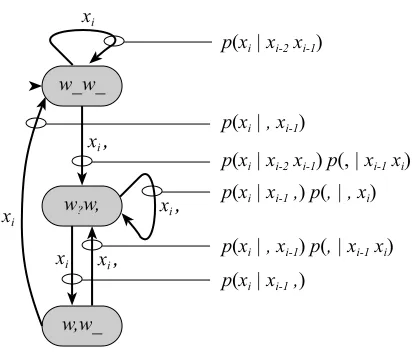
Figure 1: Three-state HMM for decoding a comma-reduced string x1· · ·xn to its comma-restored form.
Transitions are labeled with their position-dependent probabilities.
gram model:
y∗=argmax
y nY+c i=1
p(yi|yi−2yi−1)
We take the string x to be the observed output of an HMM with three states and transition probabilities de-pendent on output; the states encode the position of com-mas in a reconstructed string. Figure 1 depicts the au-tomaton. The start state (1) corresponds to having seen a word with no prior or following comma, state (2) a word with a following comma, and state (3) a word with a prior but no following comma. It is easy to see that a path through the automaton traverses a stringywith probabil-ityQni=1+cp(yi | yi−2yi−1). The decoded stringy∗ can therefore be computed by Viterbi decoding.3
This method requires a trigram language model p(). We train this language model on sections 02–22 of the Penn Treebank Wall Street Journal data (WSJ)4,
com-prising about 36,000 sentences. The CMU Statistical Language Modeling Toolkit (Clarkson and Rosenfeld, 1997) was used to generate the model. Katz smoothing was used to incorporate lower-order models. The model
3
As it turns out, the same computation can be done using a two-state model. This automaton does not, however, lend itself as easily to extensions.
4For consistency, we use the version of the Wall Street
Jour-nal data that was used by Beeferman et al. (1998) for theirCY
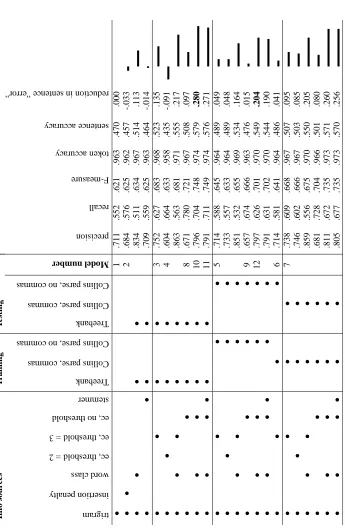
[image:2.612.323.531.72.248.2]was then tested on the approximately 2300 sentences of WSJ Section 23. Precision of the comma restoration was 71.1% and recall 55.2%. F-measure, calculated as
2P R/(P +R), where P is precision andR recall, is 62.2%. Overall 96.3% of all comma placement decisions were made correctly, a metric we refer to as token
accu-racy. Sentence accuracy, the percentage of sentences
cor-rectly restored, was 47.0%. (These results are presented as model 1 in Table 1.) This is the baseline against which we evaluate our alternative comma restoration models.
Beeferman et al. present an alternative trigram model, which computes the following:
y∗=argmax
y nY+c
i=1
p(yi|yi−2yi−1)
(1−p(,|yi−2yi−1))
δ(yi) where
δ(yi) =
0 yi=, 1 otherwise
That is, an additional penalty is assessed for not placing a comma at a given position. By penalizing omission of a comma between two words, the model implicitly re-wards commas; we would therefore expect higher recall and correspondingly lower precision.5In fact, the method
with the omission penalty (model 2 in Table 1), does have higher recall and lower precision, essentially identical F-measure, but lower sentence accuracy. Henceforth, the models described here do not use an omission penalty.
3
Commas and Constituency
Insofar as commas are used as separators or delimiters, we should see correlation of comma position with con-stituent structure of sentences. A simple test reveals that this is so. We define the start countsci of a string
posi-tionias the number of constituents whose left boundary is ati. The end counteciis defined analogously. For
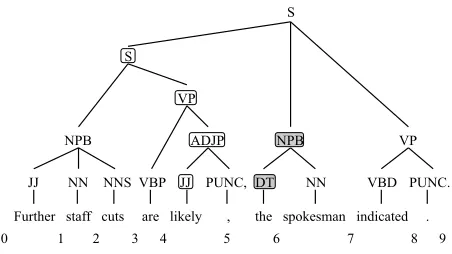
ex-ample, in Figure 2,sc0 is 4, as the constituents labeled JJ, NPB, S, and S start there;ec0is 0. We compute the end count for positions that have a comma by first drop-ping the comma from the tree. Thus, at position5,sc5 is 2 (constituents DT, NPB) andec5is 4 (constituents JJ, ADJP, VP, S).
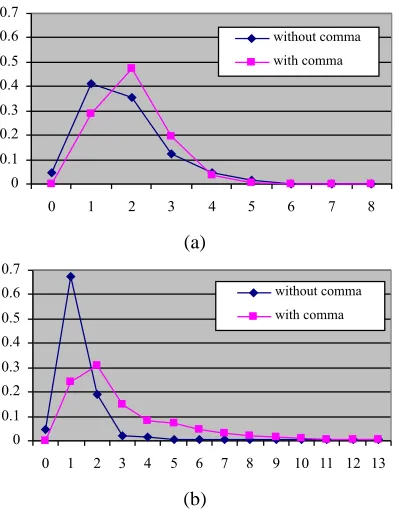
We expect to find that the distributions ofsc andec for positions in which a comma is inserted should differ from those in which no comma appears. Figure 3 reveals that this intuition is correct. The charts show the per-centage of string positions with each possible value of sc(resp.ec) for those positions with commas and those
5
Counterintuitively, Beeferman et al. (1998) come to the opposite expectation, and their reported results bear out their intuition. We have no explanation for this disparity with our results.
S
S
NPB VP
JJ NN NNS VBP JJ PUNC, DT NN VBD PUNC.
Further staff cuts are likely , the spokesman indicated . 0 1 2 3 4 5 6 7 8 9
ADJP NPB
[image:3.612.314.540.71.198.2]VP
Figure 2: Sample tree, showing computation ofsc and ecvalues. The four constituents leading toec5 = 4are shown circled, and the two leading tosc5= 2are shown circled and shaded.
without. We draw the data again from sections 02–22 of the Wall Street Journal, using as the specification for the constituency of sentences the parses for these sentences from the Penn Treebank. The distributions are quite dif-ferent, hinting at an opportunity for improved comma restoration.
The ec distribution is especially well differentiated, with a cross-over point at about 2 constituents. We can add this kind of information, a single bit specifying anec value ofkor greater (call itecci), to the language model,
as follows. We replacep(yi |yi−2yi−1)with the proba-bilityp(yi | yi−2yi−1ecci). We smooth the model using lower order modelsp(yi | yi−1ecci),p(yi | ecci),p(yi).
6
These distributions can be estimated from the training data directly, and smoothed appropriately.
Adding just this one bit of information provides signifi-cant improvement to comma restoration performance. As it turns out, akvalue of 3 turns out to maximize perfor-mance.7 Compared to the baseline, F-measure increases
to 63.2% and sentence accuracy to 52.3%. This exper-iment shows that constituency information, even in rar-efied form, can provide significant performance improve-ment in comma restoration. (Figure 1 lists performance figures as model 3.)
Of course, this result does not provide a practical al-gorithm for comma restoration, as it is based on a prob-abilistic model that requires data from a manually con-structed parse for the sentence to be restored. To make the method practical, we might replace the Treebank parse with a statistically generated parse. In the sequel, we use Collins’s statistical parser (Collins, 1997) as our canon-ical automated approximation of the Treebank. We can train a similar model, but usingecvalues extracted from
6
Alternative backoff paths, for instance backing off first to p(yi|yi
−2yi−1), exhibit inferior performance.
7
Inf o sour ces T raining T esting trigram insertionpenalty word class ec,threshold =2 ec,threshold =3 ec,no threshold stemmer Treebank Collinsparse, commas Collinsparse, nocommas Treebank Collinsparse, commas Collinsparse, nocommas Modelnumber precision recall F-measure token accuracy sentenceaccurac y reductionin sentence”error” • 1 .711 .552 .621 .963 .470 .000 • • 2 .684 .576 .625 .962 .457 -.033 • • • • .834 .511 .634 .967 .514 .113 • • • • .709 .559 .625 .963 .464 -.014 • • • • 3 .752 .627 .683 .968 .523 .135 • • • • 4 .604 .664 .633 .958 .435 -.091 • • • • • .863 .563 .681 .971 .555 .217 • • • • 8 .671 .780 .721 .967 .508 .097 • • • • • 10 .796 .704 .748 .974 .579 .280 • • • • • • 11 .791 .711 .749 .974 .576 .271 • • • • 5 .714 .588 .645 .964 .489 .049 • • • • .733 .557 .633 .964 .489 .048 • • • • • .851 .532 .655 .969 .534 .164 • • • • 9 .657 .674 .666 .963 .476 .015 • • • • • 12 .797 .626 .701 .970 .549 .204 • • • • • • .791 .631 .702 .970 .544 .190 • • • • 6 .714 .581 .641 .964 .486 .041 • • • • 7 .738 .609 .668 .967 .507 .095 • • • • .746 .602 .666 .967 .503 .085 • • • • • .859 .556 .675 .970 .550 .205 • • • • .681 .728 .704 .966 .501 .080 • • • • • .811 .672 .735 .973 .571 .260 • • • • • • .805 .677 .735 .973 .570 .256
0 0.1 0.2 0.3 0.4 0.5 0.6 0.7
0 1 2 3 4 5 6 7 8 without comma with comma
(a)
0 0.1 0.2 0.3 0.4 0.5 0.6 0.7
0 1 2 3 4 5 6 7 8 9 10 11 12 13
without comma with comma
[image:5.612.88.288.214.469.2](b)
Figure 3: Differential pattern of constituent starts and ends for string positions with and without commas. Chart (a) shows the percentage of constituents with various val-ues of sc (number of constituents starting at the posi-tion) for string positions with commas (square points) and without (diamond points). Chart (b) shows the corre-sponding pattern for values ofec(number of constituents ending).
Collins parses of the training data, and use the model to restore commas on a test sentence again usingecvalues from the Collins parse of the test datum. This model, listed as model 5 in Table 1, has an F-measure of 64.5%, better than the pure trigram model (62.2%), but not as good as the oracular Treebank-trained model (68.4%). The other metrics show similar relative orderings.
In this model, since the test sentence has no commas initially, we want to train the model on the parses of sen-tences that have had commas removed, so that the model is being applied to data as similar as possible to that on which it was trained. We would expect, and experiments verify (model 6), that training on the parses with com-mas retained yields inferior performance (in particular, F-measure of 64.1% and sentence accuracy of 48.6%). Again consistent with expectations, if we could clairvoy-antly know the value ofecci based on a Collins parse of
the test sentence with the commas that we are trying to restore (model 7), performance is improved over model 5; F-measure rises to 66.8%.
The steady rise in performance from models 6 to 5 to 7 to 3 exactly tracks the improved nature of the syntac-tic information available to the system. As the quality of the syntactic information better approximates ground truth, our ability to restore commas gradually and mono-tonically improves.
4
Using More Detailed Syntactic
Information
4.1 Using full end count information
The examples above show that even a tiny amount of syn-tactic information can have a substantive advantage for comma restoration. In order to use more information, we might imagine using values ofecdirectly, rather than thresholding. However, this quickly leads to data spar-sity problems. To remedy this, we assume independence between the bigram in the conditioning context and the syntactic information, that is, we take
p(yi |yi−2yi−1eci)≈
p(yi|yi−2yi−1)p(yi|yi−1eci) p(yi)
This model8 (model 8) has an F-measure of 72.1% due
to a substantial increase in recall, demonstrating that the increased articulation in the syntactic information avail-able provides a concomitant benefit. Although the sen-tence accuracy is slightly less than that with thresholded ec, we will show in a later section that this model com-bines well with other modifications to generate further
8
We back off the first term in the approximation as before, and the second top(yi|yi
improvements.9
4.2 Using part of speech
Additional information from the parse can be useful in predicting comma location. In this section, we incorpo-rate part of speech information into the model, generating model 10. We estimate the joint probability of each word xiand its part of speechXias follows:
p(xi, Xi|xi−2, Xi−2, xi−1, Xi−1, ec)≈ p(xi|xi−2xi−1ec)p(Xi|Xi−2Xi−1) The first term is computed as in model 8, the second back-ing off to bigram and unigram models. Addback-ing a part of speech model in this way provides a further improvement in performance. F-measure improves to 74.8%, sentence accuracy to 57.9%, a 28% improvement over the base-line.
These models (8 and 10), like model 3, assumed availability of the Treebank parse and part of speech tags. Using the Collins-parse-generated parses still shows improvement over the corresponding model 5: an F-measure of 70.1% and sentence accuracy of 54.9%, twice the improvement over the baseline as exhibited by model 5.
5
Related Work
We compare our comma restoration methods to those of Beeferman et al. (1998), as their results use only textual information to predict punctuation. Several researchers have shown prosodic information to be useful in predict-ing punctuation (Christensen et al., 2001; Kim and Wood-land, 2001) (along with related phenomena such as dis-fluencies and overlapping speech (Shriberg et al., 2001)). These studies, typically based on augmenting a Marko-vian language model with duration or other prosodic cues as conditioning features, show that prosody information is orthogonal to language model information; combined models outperform models based on each type of infor-mation separately. We would expect therefore, that our techniques would similarly benefit from the addition of prosodic information.
In the introduction, we mentioned the problem of sen-tence boundary detection, which is related to the punc-tuation reconstruction problem especially with regard to predicting sentence boundary punctuation such as peri-ods, question marks, and exclamation marks. (This prob-lem is distinct from the probprob-lem of sentence boundary disambiguation, where punctuation is provided, but the categorization of the punctuation as to whether or not
9
An alternative method of resolving the data sparsity issues is to back off the modelp(yi | yi−2yi−1eci), for instance to p(yi|yi−2yi−1)or top(yi|yi−1eci). Both of these perform less well than the approximation in model 8.
it marks a sentence boundary is at issue (Palmer and Hearst, 1994; Reynar and Ratnaparkhi, 1997).) Stolcke and Shriberg (1996) used HMMs for the related problem of linguistic segmentation of text, where the segments corresponded to sentences and other self-contained units such as disfluencies and interjections. They argue that a linguistic segmentation is useful for improving the per-formance and utility of language models and speech rec-ognizers. Like the present work, they segment clean text rather than automatically transcribed speech. Stevenson and Gaizauskas (Stevenson and Gaizauskas, 2000) and Goto and Renals (Gotoh and Renals, 2000) address the sentence boundary detection problem directly, again us-ing lexical and, in the latter, prosodic cues.
6
Future Work and Conclusion
The experiments reported here — like much of the previ-ous work in comma restoration (Beeferman et al., 1998) and sentence boundary disambiguation and restoration (Stolcke and Shriberg, 1996; Shriberg et al., 2001; Go-toh and Renals, 2000; Stevenson and Gaizauskas, 2000) (though not all (Christensen et al., 2001; Stolcke et al., 1998; Kim and Woodland, 2001)) — assume an ideal ref-erence transcription of the text. The performance of the method on automatically transcribed speech with its con-comitant error remains to be determined. A hopeful sign is the work of Kim and Woodland (Kim and Woodland, 2001) on punctuation reconstruction using prosodic in-formation. The performance of their system drops from an F-measure of 78% on reference transcriptions to 44% on automatically transcribed speech at a word error rate of some 20%. Nonetheless, prosodic features were still useful in improving the reconstructed punctuation even in the automatically transcribed case.
The simple HMM model that we inherit from earlier work dramatically limits the features of the parse that we can easily appeal to in predicting comma locations. Many alternatives suggest themselves to expand the options, including maximum entropy models, which have been previously successfully applied to, inter alia, sentence boundary detection (Reynar and Ratnaparkhi, 1997), and transformation-based learning, as used in part-of-speech tagging and statistical parsing applications (Brill, 1995).
Nonetheless, even under these severe constraints and using quite simple features distilled from the parse, we can reduce sentence error by 20%, with the potential of another 8% if statistical parsers were to approach Tree-bank quality. As such, comma restoration may stand as the first end-user application that benefits from statisti-cal parsing technology smoothly and incrementally. Fi-nally, our methods use features that are orthogonal to the prosodic features that other researchers have explored. They therefore have the potential to combine well with prosodic methods to achieve further improvements.
Acknowledgments
Partial support for the work reported in this paper was provided by the National Science Foundation under grant number IRI 9712068.
We are indebted to Douglas Beeferman for making available his expertise and large portions of the code and data for replicating theCYBERPUNCexperiments.
The first author would like to express his appreciation to Ivan Sag and the Center for the Study of Language and Information, Stanford, California and to Oliviero Stock and the Centro per la Ricerca Scientifica e Tecnologica, Trento, Italy, for space and support for this work during spring and summer of 2002.
References
Doug Beeferman, Adam Berger, and John Lafferty. 1998. CYBERPUNC: A lightweight punctuation an-notation system for speech. In Proceeding as of the
IEEE International Conference on Acoustics, Speech and Signal Processing, pages 689–692, Seattle, WA.
Eric Brill. 1995. Transformation-based error-driven learning and natural language processing: A case study in part of speech tagging. Computational Linguistics, 21(4):543–565.
Heidi Christensen, Yoshihiko Gotoh, and Steve Renals. 2001. Punctuation annotation using statistical prosody models. In Proceedings of the 2001 ISCA Tutorial and
Research Workshop on Prosody in Speech Recognition and Understanding, Red Bank, NJ, October 22–24.
In-ternational Speech Communication Association.
Philip Clarkson and Ronald Rosenfeld. 1997. Statistical language modeling using the CMU-Cambridge toolkit. In Proceedings of Eurospeech ’97, pages 2707–2710, Rhodes, Greece, 22–25 September.
Michael Collins. 1997. Three generative, lexicalised models for statistical parsing. In Proceedings of the
35th Annual Meeting of the Association for Compu-tational Linguistics and Eighth Conference of the Eu-ropean Chapter of the Association for Computational Linguistics, pages 16–23, Madrid, Spain, 7–11 July.
Yoshihiko Gotoh and Steve Renals. 2000. Sentence boundary detection in broadcast speech transcripts. In Proceedings of the ISCA Workshop on Automatic
Speech Recognition: Challenges for the New Millen-nium (ASR-2000), Paris, France, 18–20 September.
In-ternational Speech Communication Association.
Ji-Hwan Kim and P. C. Woodland. 2001. The use of prosody in a combined system for punctuation gener-ation and speech recognition. In Proceedings of
Eu-rospeech ’01, pages 2757–2760, Aalborg, Denmark,
September 3–7.
Geoffrey Nunberg. 1990. The Linguistics of
Punctua-tion. CSLI Publications, Stanford, CA.
David D. Palmer and Marti A. Hearst. 1994. Adaptive sentence boundary disambiguation. In Proceedings of
the Fourth ACL Conference on Applied Natural Lan-guage Processing, pages 78–83, Stuttgart, Germany,
13–15 October. Morgan Kaufmann.
Jeffrey C. Reynar and Adwait Ratnaparkhi. 1997. A maximum entropy approach to identifying sentence boundaries. In Proceedings of the Fifth Conference on
Applied Natural Language Processing, pages 16–19,
Washington, DC, 31 March–3 April.
Elizabeth Shriberg, Andreas Stolcke, and Don Baron. 2001. Can prosody aid the automatic processing of multi-party meetings? Evidence from predicting punc-tuation, disfluencies, and overlapping speech. In
Pro-ceedings of the 2001 ISCA Tutorial and Research Workshop on Prosody in Speech Recognition and Un-derstanding, Red Bank, NJ, October 22–24.
Interna-tional Speech Communication Association.
Mark Stevenson and Robert Gaizauskas. 2000. Ex-periments on sentence boundary detection. In
Pro-ceedings of the Sixth Conferernce on Applied Natu-ral Language Processing and the First Conference of the North American Chapter of the Association for Computational Linguistics, pages 24–30, Seattle, WA,
April.
Andreas Stolcke and Elizabeth Shriberg. 1996. Au-tomatic linguistic segmentation of conversational speech. In H. T. Bunnell and W. Idsardi, editors,
Pro-ceedings of the International Conference on Spoken Language Processing, volume 2, pages 1005–1008,
Philadelphia, PA, 3–6 October.
Andreas Stolcke, Elizabeth Shriberg, Rebecca Bates, Mari Ostendorf, Dilek Hakkani, Madelaine Plauche, G¨okhan T¨ur, and Yu Lu. 1998. Automatic detection of sentence boundaries and disfluencies based on recog-nized words. In Proceedings of the International
Con-ference on Spoken Language Processing, volume 5,