Original Article
A systematic review and meta-analysis of 4 candidate
polymorphisms with the risk of gout
Yong Chen
1, Ying Ying
1,2, Shanfen Shi
3, Liangda Li
3, Yi Huang
4, Huadan Ye
2, Qiongyao Gong
1,2, Haiyan
Huang
1,2, Huihui Ji
2, Tao Huang
2, Shiwei Duan
21Department of Rheumatology, Ningbo No. 2 Hospital, Ningbo 315010, Zhejiang, China; 2Medical Genetics Center,
School of Medicine, Ningbo University, Ningbo 315211, Zhejiang, China; 3Department of Rheumatology, Yinzhou
People’s Hospital, Ningbo 315010, Zhejiang, China; 4Department of Neurosurgery, Ningbo First Hospital, Ningbo
Hospital of Zhejiang University, Ningbo 315010, Zhejiang, China
Received December 24, 2015; Accepted May 18, 2016; Epub August 15, 2016; Published August 30, 2016
Abstract: The purpose of this research was to assess the contribution of 4 genetic polymorphisms to the risk of gout. A systematic search was performed for qualified case-control studies on 4 variants with gout among PubMed, EMBASE, CNKI and China Wanfang literature databases. Using the REVMAN software, odds ratios (ORs) with 95% confidence intervals (CIs) were calculated to evaluate the contribution of the 4 genetic variants to gout. We harvest -ed a total of 19 studies among 6,797 cases and 15,904 controls for the current meta-analyses. Our results show-ed that ABCG2 rs2231142 (OR = 2.13, 95% CI = 1.81-2.50, P < 0.00001), SLC2A9 rs3733591 (OR = 0.78, 95% CI = 0.67-0.91, P = 0.002), SLC2A9 rs16890979 (OR = 0.33, 95% CI = 0.18-0.58, P = 0.0002), and SLC2A9 rs6855911 (OR = 0.66, 95% CI = 0.56-0.77, P < 0.00001) were significantly associated with the risk of gout. Our results showed four genetic variants (including ABCG2 rs2231142, SLC2A9 rs3733591, rs16890979 and rs6855911) were signifi -cantly associated with gout.
Keywords: Gout, ABCG2, SLC2A9, meta-analysis, polymorphism
Introduction
Gout is a common disease based on
hyperuri-cemia, which is caused by urate crystals
depos-ited in synovial fluid and adjacent connective
tissues [1]. The typical clinical manifestations
of gout are comprised of a high level of serum
urate, crystal inflammatory arthritis, unbear
-able pain tophi, uric acid urolithiasis and uric
acid nephrolithiasis [2]. Gout is known to be
caused by unhealthy life-styles and dietary
habits, such as excessive alcohol drinking and
a surfeit of seafood consumption [3].
The incidence of gout and hyperuricemia was
increasing recently in the world. Domestic
sur-vey in 1980s showed that the prevalence rate
of hyperuricemia was 1.3% to 1.4% [4], and it
rose to 12.5% for hyperuricemia and 1.93% for
gout in 2006 [5]. Family members of gout
patients have an increased risk of
asymptom-atic hyperuricaemia, and gout is often seen in
the middle-aged men to elderly men and
post-menopausal women [6].
Genome-wide association studies have
identi-fied numerous genetic loci associated with
gout, and those genetic loci may help provide a
cost-effective and personalized gout treatment
in clinic [7]. Meanwhile, case-control studies
have also identified gene polymorphisms asso
-ciated with gout [8, 9]; however, other
litera-tures have found opposite results [10, 11]. The
discrepancies in the association results may be
due to various ethnic populations or the limited
detection power in association tests the
moder-ate sample size [12, 13]. Meta-analysis is able
to combine the data from various studies and
overcome the limitation in the case-control
study with moderate sample size. Here, the
goal of our meta-analyses is to establish the
association of four genetic variants with gout.
Materials and methods
Literature search
BASE, CNKI and China Wanfang literature
data-bases. The search terms in the PubMed and
EMBASE were “gout”, “podagra”,
“arthrolithia-sis”, “uarthritis”, “crystal arthritis”, “crystal ar-
thropathy”, or “tophus” combined with
“poly-morphism”, “allete”, “genotype”, “variant”, or
“SNP”. And the equivalent Chinese terms were
also used to search for related publications in
CNKI and China Wanfang literature databases.
Data extraction and quality assessment
Publications were excluded if they didn’t have
genotyping or allelic data or odds ratio (OR) to
infer the combined statistics in the
meta-analy-sis. We focused on four genetic variants with at
least three independent genotypic datasets.
The details (the name of first author, publica
-tion year, country, and genotype) for the data
extraction were described previously [14-17]. In
addition, the risk-of-bias in the included studies
was also assessed with the Review Manager
software (version 5.2, Cochrane Collaboration,
Oxford, United Kingdom) by using the logistic
regression with odds ratios (ORs) and 95%
confidence intervals (95% CIs). Hardy-Weinberg
equilibrium (HWE) was analyzed by the
chi-square test.
Characteristics of the involved studies
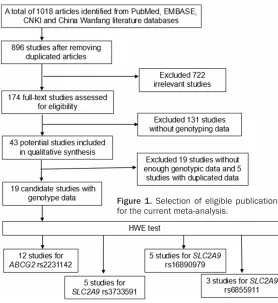
Our initial search for the eligible studies
retrieved 1018 articles from PubMed, EMBASE,
CNKI and China Wanfang literature databases
updated through December, 2015. Among
them, we discarded 122 duplicate studies, 722
studies with irrelevant titles and abstracts, 131
studies lacking of genotyping data. Among the
remaining articles, we further discarded 19
studies with less than three independent
geno-typic datasets for the same genetic variants,
and 5 studies with duplicate data. Finally, 19
studies (including 14 English and 5 Chinese
articles) involving with 6,797 cases and 15,904
controls were included in the current
meta-analyses (
Figure 1
).
[image:2.612.91.369.69.372.2]A total of four variants on two genes were
eligi-ble for the present meta-analyses. These
vari-ants comprised
ABCG2
rs2231142 and
SLC-
2A9
rs3733591, rs16890979, and rs6855911.
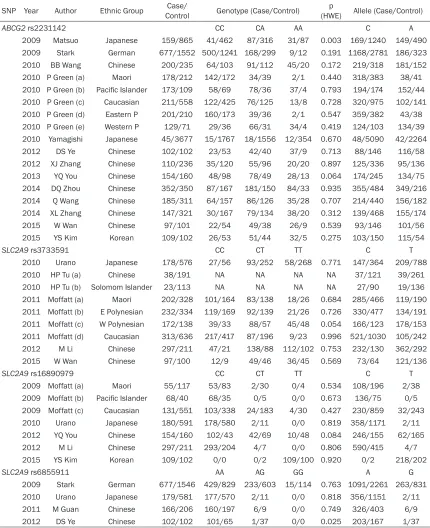
A Hardy-Weinberg equilibrium (HWE) test
showed that the genotype distribution in
healthy controls didn’t meet HWE (P = 0.003
and 0.025,
Table 1
) for
ABCG2
rs2231142 [18]
and
SLC2A9
rs6855911 [19] in two studies,
Figure 1. Selection of eligible publications for the current meta-analysis.
Statistical analysis
All the statistical analyses
were performed using the Re-
view Manager software (ver-
sion 5.2, Cochrane Collabora-
tion, Oxford, United Kingdom).
Heterogeneity of the
meta-analyses was measured by
using Cochran’s Q statistic
and the inconsistency index
(I
2). I
2≥ 50% indicated a sig
-nificant heterogeneity among
the studies in the
meta-analy-ses. Random-effect model
was used in the
meta-analy-sis with large heterogeneity;
otherwise the fixed-effect
mo-del was used instead. A
two-sided P < 0.05 was
consid-ered as significant. Funnel
plot was used to judge
wheth-er publication bias existed in
the meta-analysis.
and thus the two studies were not included in
the follow-up meta-analyses.
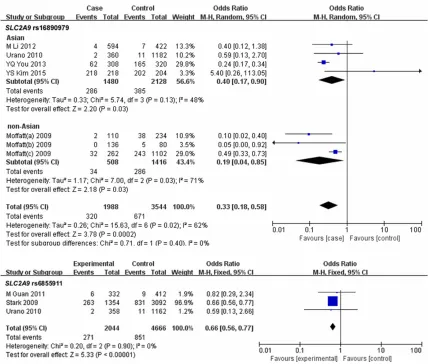
As shown in
Figure 2
, there was significant het
-erogeneity for
ABCG2
rs2231142 (I
2= 72%),
SLC2A9
rs3733591 (I
2= 53%) and rs16890-
979 (I
2= 62%). No heterogeneity was observed
for
SLC2A9
rs6855911 (I
2= 0%,
Figure 2
).
Thus, a random-effect model was applied for
the meta-analyses of
ABCG2
rs2231142,
SLC2A9
rs3733591 and rs16890979, and a
fixed-effect model was applied for the
meta-Table 1.
The detailed information of the enrolled studies in the meta-analysis
*SNP Year Author Ethnic Group ControlCase/ Genotype (Case/Control) (HWE)p Allele (Case/Control)
ABCG2 rs2231142 CC CA AA C A
2009 Matsuo Japanese 159/865 41/462 87/316 31/87 0.003 169/1240 149/490 2009 Stark German 677/1552 500/1241 168/299 9/12 0.191 1168/2781 186/323 2010 BB Wang Chinese 200/235 64/103 91/112 45/20 0.172 219/318 181/152 2010 P Green (a) Maori 178/212 142/172 34/39 2/1 0.440 318/383 38/41 2010 P Green (b) Pacific Islander 173/109 58/69 78/36 37/4 0.793 194/174 152/44 2010 P Green (c) Caucasian 211/558 122/425 76/125 13/8 0.728 320/975 102/141 2010 P Green (d) Eastern P 201/210 160/173 39/36 2/1 0.547 359/382 43/38 2010 P Green (e) Western P 129/71 29/36 66/31 34/4 0.419 124/103 134/39 2010 Yamagishi Japanese 45/3677 15/1767 18/1556 12/354 0.670 48/5090 42/2264 2012 DS Ye Chinese 102/102 23/53 42/40 37/9 0.713 88/146 116/58 2012 XJ Zhang Chinese 110/236 35/120 55/96 20/20 0.897 125/336 95/136 2013 YQ You Chinese 154/160 48/98 78/49 28/13 0.064 174/245 134/75 2014 DQ Zhou Chinese 352/350 87/167 181/150 84/33 0.935 355/484 349/216 2014 Q Wang Chinese 185/311 64/157 86/126 35/28 0.707 214/440 156/182 2014 XL Zhang Chinese 147/321 30/167 79/134 38/20 0.312 139/468 155/174 2015 W Wan Chinese 97/101 22/54 49/38 26/9 0.539 93/146 101/56 2015 YS Kim Korean 109/102 26/53 51/44 32/5 0.275 103/150 115/54
SLC2A9 rs3733591 CC CT TT C T
2010 Urano Japanese 178/576 27/56 93/252 58/268 0.771 147/364 209/788
2010 HP Tu (a) Chinese 38/191 NA NA NA NA 37/121 39/261
2010 HP Tu (b) Solomom Islander 23/113 NA NA NA NA 27/90 19/136 2011 Moffatt (a) Maori 202/328 101/164 83/138 18/26 0.684 285/466 119/190 2011 Moffatt (b) E Polynesian 232/334 119/169 92/139 21/26 0.726 330/477 134/191 2011 Moffatt (c) W Polynesian 172/138 39/33 88/57 45/48 0.054 166/123 178/153 2011 Moffatt (d) Caucasian 313/636 217/417 87/196 9/23 0.996 521/1030 105/242 2012 M Li Chinese 297/211 47/21 138/88 112/102 0.753 232/130 362/292 2015 W Wan Chinese 97/100 12/9 49/46 36/45 0.569 73/64 121/136
SLC2A9 rs16890979 CC CT TT C T
2009 Moffatt (a) Maori 55/117 53/83 2/30 0/4 0.534 108/196 2/38 2009 Moffatt (b) Pacific Islander 68/40 68/35 0/5 0/0 0.673 136/75 0/5 2009 Moffatt (c) Caucasian 131/551 103/338 24/183 4/30 0.427 230/859 32/243 2010 Urano Japanese 180/591 178/580 2/11 0/0 0.819 358/1171 2/11 2012 YQ You Chinese 154/160 102/43 42/69 10/48 0.084 246/155 62/165 2012 M Li Chinese 297/211 293/204 4/7 0/0 0.806 590/415 4/7 2015 YS Kim Korean 109/102 0/0 0/2 109/100 0.920 0/2 218/202
SLC2A9 rs6855911 AA AG GG A G
2009 Stark German 677/1546 429/829 233/603 15/114 0.763 1091/2261 263/831 2010 Urano Japanese 179/581 177/570 2/11 0/0 0.818 356/1151 2/11 2011 M Guan Chinese 166/206 160/197 6/9 0/0 0.749 326/403 6/9 2012 DS Ye Chinese 102/102 101/65 1/37 0/0 0.025 203/167 1/37
[image:3.612.91.521.86.614.2]analysis of
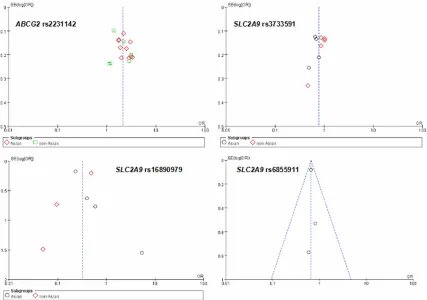
SLC2A9
rs6855911. In addition,
funnel plots were demonstrated that there was
no publication bias for all the meta-analyses
(
Figure 3
).
Results of meta-analysis
Meta-analysis of
ABCG2
rs2231142 was in-
volved with 12 studies [19-30] among 3,070
gout cases and 8,307 controls. Meta-analysis
of
SLC2A9
rs3733591 was involved with 5
studies [30-34] among 1552 gout cases and
2627 controls. Meta-analysis of
SLC2A9
rs1-
6890979 was involved with 5 studies among
994 gout cases and 1,772 controls [24, 28,
33-35]. Meta-analysis of
SLC2A9
rs6855911
was involved with 3 studies among 1,022 gout
cases and 2,333 controls [26, 34, and 36]. As
shown in
Figure 2
,
ABCG2
rs2231142 was
associated with the risk of gout (overall OR =
2.13, 95% CI = 1.81-2.50, P < 0.00001), and
the protection of gout (rs3733591: the overall
OR = 0.78, 95% CI = 0.67-0.91, P = 0.002;
SLC2A9
rs16890979: the overall OR = 0.33,
95% CI = 0.18-0.58, P = 0.0002;
SLC2A9
rs6855911: the overall OR = 0.66, 95% CI =
0.56-0.77, P < 0.00001).
Further subgroup meta-analyses by ethnic
pop-ulations showed that
SLC2A9
rs3733591 was
significantly associated with gout in Asian pop
-ulations (the overall OR = 0.67, 95% CI =
0.57-0.78, P < 0.00001) but not in non-Asian
popu-lations. However, the rest three variants were
shown to be significantly associated with gout
in both Asian and non-Asian populations. In
addition, the power was 1.000 for the
meta-analyses of all the four variants.
Discussion
In the present study, we carried out a
[image:5.612.91.519.72.436.2]ation studies with gout. Our meta-analyses
established significant association of four vari
-ants with gout. Specifically, our results indicat
-ed that
ABCG2
rs2231142-A was a risk allele of
gout, and
SLC2A9
rs37333591-T,
rs16890979-T, and rs6855911-G were protective alleles of
gout. Our observation was also supported by a
recent GWAS of gout in different populations
[37]. Since the GWAS provided an adjusted OR,
their data was not included in the current
meta-analysis.
ABCG2
encodes a multi-specific apical mem
-brane transporter expressed in several tissues
[38].
ABCG2
is able to transport nucleotide
analogs that are structurally similar to urate
[39]. SLC2A9 encodes a putative fructose
transporter [40] highly expressed in the
proxi-mal renal tubular cells [41].
SLC2A9
is an
important modulator responsible for the urate
reabsorption in the apical membrane of the
renal proximal tubules [42]. Our meta-analyses
were involved with three
SLC2A9
variants (rs-
3733591, rs16890919 and rs6855911). The
linkage disequilibrium (LD) among these three
variants showed a significant LD between
rs16890979 and rs6855911 (r
2= 0.784 in
HapMap CEU and r
2= 0.494 in HapMap CHB).
However, much weaker LD values were ob-
served between rs3733591 and rs16890979
(r
2= 0.098 in HapMap CEU; r
2= 0.058 in
HapMap CHB), and between rs3733591 and
rs6855911 (r
2= 0.086 in HapMap CEU; r
2=
0.028 in HapMap CHB). This might explain that
the association of
SLC2A9
rs3733591 with
gout was found only in Asian populations,
how-ever, the association of other two
SLC2A9
vari-ants with gout was found in Asian and
non-Asian populations.
[image:6.612.93.520.73.373.2]Prior to the current meta-analyses, there were
four meta-analyses of the
ABCG2
rs2231142
and gout [43-46]. Compared with the previous
meta-analyses [43-46], ours included 8, 7, 6
and 3 more articles, respectively. We didn’t
include the data from unpublished data in the
meta-analysis by Dong et al [43], and we also
discarded the data of the Abbas’s study [37] in
the meta-analysis by Lv et al [44], since it
pro-vided an adjusted OR value.
There were several limitations in our study.
Selection or publication biases might exist
although our analyses didn’t identify them
among the studies in the current
meta-analy-ses, since only publications in English and
Chinese languages were included in the current
meta-analyses. Meanwhile, there was a lower
chance of publication for the investigations
with negative findings. In addition, gout is a
complicated disorder influenced by numerous
factors, including gender, age and dietary
dif-ferences. However, due to a lack of relative
information in the original research articles, a
subgroup meta-analysis by these factors could
not be performed to test their interactions with
genetic factors.
In conclusion, our meta-analyses established
that
ABCG2
rs2231142,
SLC2A9
rs3733591,
rs16890979 and rs6855911 were significantly
associated with the risk of gout.
Acknowledgements
The research was supported by the grants from
National Natural Science Foundation of China
(81371469), Natural Science Foundation of
Zhejiang Province (LR13H020003), Fumin and
Huimin project of Science and Technology of
Ningbo (2015C50013), Medical of Science
and Technology Project of Zhejiang Province
(2015KYB346), and K. C. Wong Magna Fund in
Ningbo University.
Disclosure of conflict of interest
None.
Address correspondence to: Dr. Shiwei Duan, Zhe- jiang Provincial Key Laboratory of Pathophysiology, School of Medicine, Ningbo University, Ningbo 315211, Zhejiang, China. E-mail: duanshiwei@nbu. edu.cn
References
[1] Taniguchi A, Urano W, Yamanaka M, Yamanaka H, Hosoyamada M, Endou H and Kamatani N. A common mutation in an organic anion trans-porter gene, SLC22A12, is a suppressing fac-tor for the development of gout. Arthritis Rheum 2005; 52: 2576-2577.
[2] Choi HK, Mount DB and Reginato AM. Path- ogenesis of gout. Ann Intern Med 2005; 143: 499-516.
[3] Miao Z, Li C, Chen Y, Zhao S, Wang Y, Wang Z, Chen X, Xu F, Wang F, Sun R, Hu J, Song W, Yan S and Wang CY. Dietary and lifestyle changes
associated with high prevalence of hyperurice-mia and gout in the Shandong coastal cities of Eastern China. J Rheumatol 2008; 35: 1859-1864.
[4] Fang Q, You K and Lin QS. The investigation of Chinese people’s blood uric acid and the rela-tionship between it and blood-lipid.1983. [5] Mao YS, Zhou LN, Ye HY, Huang T, Chen CX, Du
J, Hong ZL and Hu RM. Epidemiological survey on prevalences of hyperuricemia and gout in staff of a petrochemical corporation in Ningbo. Chinese Journal of Endocrinology and Meta- bolism 2006; 22: 338-341.
[6] Scott JT. Gout. Baillieres Clin Rheumatol 1987; 1: 525-546.
[7] Zhou D, Liu Y, Zhang X, Gu X, Wang H, Luo X, Zhang J, Zou H and Guan M. Functional poly-morphisms of the ABCG2 gene are associated with gout disease in the Chinese Han male population. Int J Mol Sci 2014; 15: 9149-9159. [8] Cai Y, Peng YH, Tang Z, Guo XL, Qing YF, Liang
SH, Jiang H, Dang WT, Ma Q, He C and Zhou JG. Association of Toll-like receptor 2 polymor-phisms with gout. Biomed Rep 2014; 2: 292-296.
[9] Flynn TJ, Phipps-Green A, Hollis-Moffatt JE, Merriman ME, Topless R, Montgomery G, Chapman B, Stamp LK, Dalbeth N and Merri- man TR. Association analysis of the SLC22A11 (organic anion transporter 4) and SLC22A12 (urate transporter 1) urate transporter locus with gout in New Zealand case-control sample sets reveals multiple ancestral-specific effects. Arthritis Res Ther 2013; 15: R220.
[10] Li C, Yu Q, Han L, Wang C, Chu N and Liu S. The hURAT1 rs559946 polymorphism and the inci-dence of gout in Han Chinese men. Scand J Rheumatol 2014; 43: 35-42.
[11] Nakayama A, Matsuo H, Shimizu T, Takada Y, Nakamura T, Shimizu S, Chiba T, Sakiyama M, Naito M, Morita E, Ichida K and Shinomiya N. Common variants of a urate-associated gene LRP2 are not associated with gout susceptibil-ity. Rheumatol Int 2014; 34: 473-476.
[12] Torres RJ, de Miguel E, Bailen R, Banegas JR and Puig JG. Tubular urate transporter gene polymorphisms differentiate patients with gout who have normal and decreased urinary uric acid excretion. J Rheumatol 2014; 41: 1863-1870.
[13] Sakiyama M, Matsuo H, Chiba T, Nakayama A, Nakamura T, Shimizu S, Morita E, Fukuda N, Nakashima H, Sakurai Y, Ichida K, Shimizu T and Shinomiya N. Common variants of cGKII/ PRKG2 are not associated with gout suscepti-bility. J Rheumatol 2014; 41: 1395-1397. [14] Xu X, Zheng J, Liao Q, Zhu H, Xie H, Shi H
bilateral absence of the vas deferens. J Clin Bioinforma 2014; 4: 11.
[15] Dai D, Wang Y, Yuan J, Zhou X, Jiang D, Li J, Zhang Y, Yin H and Duan S. Meta-analyses of 10 polymorphisms associated with the risk of schizophrenia. Biomed Rep 2014; 2: 729-736. [16] Merriman TR, Choi HK and Dalbeth N. The ge-netic basis of gout. Rheum Dis Clin North Am 2014; 40: 279-290.
[17] Yang B, Mo Z, Wu C, Yang H, Yang X, He Y, Gui L, Zhou L, Guo H, Zhang X, Yuan J, Dai X, Li J, Qiu G, Huang S, Deng Q, Feng Y, Guan L, Hu D, Wang T, Zhu J, Min X, Lang M, Li D, Hu FB, Lin D, Wu T and He M. A genome-wide association study identifies common variants influencing serum uric acid concentrations in a Chinese population. BMC Med Genomics 2014; 7: 10. [18] Matsuo H, Takada T, Ichida K, Nakamura T,
Nakayama A, Ikebuchi Y, Ito K, Kusanagi Y, Chiba T, Tadokoro S, Takada Y, Oikawa Y, Inoue H, Suzuki K, Okada R, Nishiyama J, Domoto H, Watanabe S, Fujita M, Morimoto Y, Naito M, Nishio K, Hishida A, Wakai K, Asai Y, Niwa K, Kamakura K, Nonoyama S, Sakurai Y, Hosoya T, Kanai Y, Suzuki H, Hamajima N and Shinomiya N. Common defects of ABCG2, a high-capacity urate exporter, cause gout: a function-based genetic analysis in a Japanese population. Sci Transl Med 2009; 1: 5ra11. [19] Ye DS, Zhao DB. The research of risk factors
and urate transporter polymorphism in Han Chinese gout patients. 2012.
[20] Phipps-Green AJ, Hollis-Moffatt JE, Dalbeth N, Merriman ME, Topless R, Gow PJ, Harrison AA, Highton J, Jones PB, Stamp LK and Merriman TR. A strong role for the ABCG2 gene in suscep-tibility to gout in New Zealand Pacific Island and Caucasian, but not Maori, case and con-trol sample sets. Hum Mol Genet 2010; 19: 4813-4819.
[21] Wang B, Miao Z, Liu S, Wang J, Zhou S, Han L, Meng D, Wang Y, Li C and Ma X. Genetic analy-sis of ABCG2 gene C421A polymorphism with gout disease in Chinese Han male population. Hum Genet 2010; 127: 245-246.
[22] Zhou DQ, Liu YQ, Zhang XJ, Gu XY, Wang H, Luo XH, Zhang J, Zou HJ and Guan M. Functional polymorphisms of the ABCG2 gene are associ-ated with gout disease in the Chinese Han male population. Int J Mol Sci 2014; 15: 9149-9159.
[23] Zhang XJ and Li CG. The investigation into as-sociations between gout and polymorphisms of rsl3124007, rs6850166, rs2231142 in Chinese Han females.
[24] You YQ and Li YN. Study on relationship be-tween Single nucleotide polymorphism of the SLC2A9, SLC17A3, ABCG2 gene genetic
sus-ceptibility to gout. Chinese J Rheumatol 2013; 17: 114-118.
[25] Yamagishi K, Tanigawa T, Kitamura A, Kottgen A, Folsom AR and Iso H. The rs2231142 vari-ant of the ABCG2 gene is associated with uric acid levels and gout among Japanese people. Rheumatology (Oxford) 2010; 49: 1461-1465. [26] Stark K, Reinhard W, Grassl M, Erdmann J,
Schunkert H, Illig T and Hengstenberg C. Common polymorphisms influencing serum uric acid levels contribute to susceptibility to gout, but not to coronary artery disease. PLoS One 2009; 4: e7729.
[27] Wang Q, Wang C, Wang XB, Miao ZM, Cui Y and Li CG. Association between gout and polymor-phisms of rs2231142 in ABCG2 in female Han Chinese. Progress In Modern Biomedicine 2014; 14: 2437-2449.
[28] Kim YS, Kim Y, Park G, Kim SK, Choe JY, Park BL and Kim HS. Genetic analysis of ABCG2 and SLC2A9 gene polymorphisms in gouty ar-thritis in a Korean population. Korean J Intern Med 2015; 30: 913-920.
[29] Zhang XL, Zeng XJ. The association between ABCG2 polymorphism and gout and cemia by establish queue about staff hyperuri-cemia. 2014.
[30] Wan W, Xu X, Zhao DB, Pang YF and Wang YX. Polymorphisms of uric transporter proteins in the pathogenesis of gout in a Chinese Han population. Genet Mol Res 2015; 14: 2546-2550.
[31] Tu HP, Chen CJ, Tovosia S, Ko AM, Lee CH, Ou TT, Lin GT, Chang SJ, Chiang SL, Chiang HC, Chen PH, Wang SJ, Lai HM and Ko YC. Associations of a non-synonymous variant in SLC2A9 with gouty arthritis and uric acid le- vels in Han Chinese subjects and Solomon Islanders. Ann Rheum Dis 2010; 69: 887-890. [32] Hollis-Moffatt JE, Gow PJ, Harrison AA, Highton
J, Jones PB, Stamp LK, Dalbeth N and Merriman TR. The SLC2A9 nonsynonymous Arg265His variant and gout: evidence for a population-specific effect on severity. Arthritis Res Ther 2011; 13: R85.
[33] Li M, Zhou JG. Association of the polymor-phisms of SLC2A9 gene with primary gout and uric acid levels in Chinese Han Population. 2012.
[34] Urano W, Taniguchi A, Anzai N, Inoue E, Sekita C, Endou H, Kamatani N and Yamanaka H. Association between GLUT9 and gout in Japanese men. Ann Rheum Dis 2010; 69: 932-933.
Pacific Island, and Caucasian case-control sample sets. Arthritis Rheum 2009; 60: 3485-3492.
[36] Guan M, Zhou D, Ma W, Chen Y, Zhang J and Zou H. Association of an intronic SNP of SLC2A9 gene with serum uric acid levels in the Chinese male Han population by high-resolu-tion melting method. Clin Rheumatol 2011; 30: 29-35.
[37] Dehghan A, Kottgen A, Yang Q, Hwang SJ, Kao WL, Rivadeneira F, Boerwinkle E, Levy D, Hofman A, Astor BC, Benjamin EJ, van Duijn CM, Witteman JC, Coresh J and Fox CS. Association of three genetic loci with uric acid concentration and risk of gout: a genome-wide association study. Lancet 2008; 372: 1953-1961.
[38] Lian J, Fang P, Dai D, Ba Y, Yang X, Huang X, Li J, Chen X, Guo J, Guan F, Peng P, Zhao R, Zhang S, Gao F, Tang L, Zhang C, Ji H, Hong Q, Ye H, Xu L, Zhong Q, Liu P, Zhou J and Duan S. Association between 3279C>T and coronary artery disease: A case-control study and a me-ta-analysis. Biomed Rep 2014; 2: 879-885. [39] Kondo C, Suzuki H, Itoda M, Ozawa S, Sawada
J, Kobayashi D, Ieiri I, Mine K, Ohtsubo K and Sugiyama Y. Functional analysis of SNPs vari-ants of BCRP/ABCG2. Pharm Res 2004; 21: 1895-1903.
[40] Brandstatter A, Kiechl S, Kollerits B, Hunt SC, Heid IM, Coassin S, Willeit J, Adams TD, Illig T, Hopkins PN and Kronenberg F. Sex-specific as -sociation of the putative fructose transporter SLC2A9 variants with uric acidlevels is modi-fied by BMI. Diabetes Care 2008; 31: 1662-1667.
[41] Augustin R, Carayannopoulos MO, Dowd LO, Phay JE, Moley JF and Moley KH. Identification and characterization of human glucose trans-porter-like protein-9 (GLUT9): alternative splic-ing alters trafficksplic-ing. J Biol Chem 2004; 279: 16229-16236.
[42] Vitart V, Rudan I, Hayward C, Gray NK, Floyd J, Palmer CN, Knott SA, Kolcic I, Polasek O, Graessler J, Wilson JF, Marinaki A, Riches PL, Shu X, Janicijevic B, Smolei-Narancic N, Gorgoni B, Morgan J, Campbell S, Biloglav Z, Barac-Lauc L, Pericic M, Klaric IM, Zgaga L, Skaric-Juric T, Wild SH, Richardson WA, Hohenstein P, Kimber CH, Tenesa A, Donnelly LA, Fairbanks LD, Aringer M, McKeigue PM, Ralston SH, Morris AD, Rudan P, Hastie ND, Campbell H and Wright AF. SLC2A9 is a newly identified urate transporter influencing serum urate concentration, urate excretion and gout. Nat Genet 2008; 40: 437-442.
[43] Dong Z, Guo S, Yang Y, Wu J, Guan M, Zou H, Jin L and Wang J. Association between ABCG2 Q141K polymorphism and gout risk affected by ethnicity and gender: a systematic review and meta-analysis. Int J Rheum Dis 2015; 18: 382-391.
[44] Lv X, Zhang Y, Zeng F, Yin A, Ye N, Ouyang H, Feng D, Li D, Ling W and Zhang X. The associa-tion between the polymorphism rs2231142 in the ABCG2 gene and gout risk: a meta-analy-sis. Clin Rheumatol 2014; 33: 1801-1805. [45] Qiu Y, Liu H, Qing Y, Yang M, Tan X, Zhao M, Lin
M and Zhou J. The ABCG2 gene Q141K poly-morphism contributes to an increased risk of gout: a meta-analysis of 2185 cases. Mod Rheumatol 2014; 24: 829-834.