Augmenting Ensemble Classification for Word Sense Disambiguation with a
Kernel PCA Model
Marine CARPUAT Weifeng SU Dekai WU1
[email protected] [email protected] [email protected]
Human Language Technology Center HKUST
Department of Computer Science
University of Science and Technology, Clear Water Bay, Hong Kong
Abstract
The HKUST word sense disambiguation systems benefit from a new nonlinear Kernel Principal Component Analysis (KPCA) based disambigua-tion technique. We discuss and analyze results from the Senseval-3 English, Chinese, and Multi-lingual Lexical Sample data sets. Among an en-semble of four different kinds of voted models, the KPCA-based model, along with the maximum en-tropy model, outperforms the boosting model and na¨ıve Bayes model. Interestingly, while the KPCA-based model typically achieves close or better ac-curacy than the maximum entropy model, neverthe-less a comparison of predicted classifications shows that it has a significantly different bias. This char-acteristic makes it an excellent voter, as confirmed by results showing that removing the KPCA-based model from the ensemble generally degrades per-formance.
1 Introduction
Classifier combination has become a standard ar-chitecture for shared task evaluations in word sense disambiguation (WSD), named entity recognition, and similar problems that can naturally be cast as classification problems. Voting is the most com-mon method of combination, having proven to be remarkably effective yet simple.
A key problem in improving the accuracy of such ensemble classification systems is to find new vot-ing models that (1) exhibit significantly different prediction biases from the models already voting, and yet (2) attain stand-alone classification accura-cies that are as good or better. When either of these conditions is not met, adding the new voting model typically degrades the accuracy of the ensemble in-stead of helping it.
In this work, we investigate the potential of one promising new disambiguation model with respect
1
The author would like to thank the Hong Kong Research Grants Council (RGC) for supporting this research in part through research grants RGC6083/99E, RGC6256/00E, and DAG03/04.EG09.
to augmenting our existing ensemble combining a maximum entropy model, a boosting model, and a na¨ıve Bayes model—a combination representing some of the best stand-alone WSD models cur-rently known. The new WSD model, proposed by Wu et al. (2004), is a method for disambiguat-ing word senses that exploits a nonlinear Kernel Principal Component Analysis (KPCA) technique. That the KPCA-based model could potentially be a good candidate for a new voting model is sug-gested by Wu et al.’s empirical results showing that it yielded higher accuracies on Senseval-2 data sets than other models that included maximum entropy, na¨ıve Bayes, and SVM based models.
In the following sections, we begin with a de-scription of the experimental setup, which utilizes a number of individual classifiers in a voting en-semble. We then describe the KPCA-based model to be added to the baseline ensemble. The accuracy results of the three submitted models are examined, and also the individual voting models are compared. Subsequently, we analyze the degree of difference in voting bias of the KPCA-based model from the others, and finally show that this does indeed usu-ally lead to accuracy gains in the voting ensemble.
2 Experimental setup 2.1 Tasks evaluated
We performed experiments on the following lexical sample tasks from Senseval-3:
English (fine). The English lexical sample task includes 57 target words (32 verbs, 20 nouns and 5 adjectives). For each word, training and test in-stances tagged with WordNet senses are provided. There are an average of 8.5 senses per target word type, ranging from 3 to 23. On average, 138 training instances per target word are available.
English (coarse). This modified evaluation of the preceding task employs a sense map that groups fine-grained sense distinctions into the same coarse-grained sense.
Chinese. The Chinese lexical sample task in-cludes 21 target words. For each word, several
senses are defined using the HowNet knowledge base. There are an average of 3.95 senses per tar-get word type, ranging from 2 to 8. Only about 37 training instances per target word are available.
Multilingual (t). The Multilingual (t) task is de-fined similarly to the English lexical sample task, except that the word senses are the translations into Hindi, rather than WordNet senses. The Multilin-gual (t) task requires finding the Hindi sense for 31 English target word types. There are an average of 7.54 senses per target word type, ranging from 3 to 16. A relatively large training set is provided (more than 260 training instances per word on average).
Multilingual (ts). The Multilingual (ts) task uses a different data set of 10 target words and provides the correct English sense of the target word for both training and testing. There are an average of 6.2 senses per target word type, ranging from 3 to 11. The training set for this subtask was smaller, with about 150 training instances per target word.
2.2 Ensemble classification
The WSD models presented here consist of ensem-bles utilizing various combinations of four voting models, as follows. Some of these component mod-els were also evaluated on other Senseval-3 tasks: the Basque, Catalan, Italian, and Romanian Lexical Sample tasks (Wicentowski et al., 2004), as well as Semantic Role Labeling (Ngai et al., 2004).
The first voting model, a na¨ıve Bayes model, was built as Yarowsky and Florian (2002) found this model to be the most accurate classifier in a compar-ative study on a subset of Senseval-2 English lexical sample data.
The second voting model, a maximum entropy model (Jaynes, 1978), was built as Klein and Man-ning (2002) found that it yielded higher accuracy than na¨ıve Bayes in a subsequent comparison of WSD performance. However, note that a different subset of either Senseval-1 or Senseval-2 English lexical sample data was used.
The third voting model, a boosting model (Fre-und and Schapire, 1997), was built as boosting has consistently turned in very competitive scores on re-lated tasks such as named entity classification (Car-reras et al., 2002)(Wu et al., 2002). Specifically, we employed an AdaBoost.MH model (Schapire and Singer, 2000), which is a multi-class generalization of the original boosting algorithm, with boosting on top of decision stump classifiers (decision trees of depth one).
The fourth voting model, the KPCA-based model, is described below.
All classifier models were selected for their
abil-ity to able to handle large numbers of sparse fea-tures, many of which may be irrelevant. More-over, the maximum entropy and boosting models are known to be well suited to handling features that are highly interdependent.
2.3 Controlled feature set
In order to facilitate a controlled comparison across the individual voting models, the same feature set was employed for all classifiers. The features are as described by Yarowsky and Florian (2002) in their “feature-enhanced na¨ıve Bayes model”, with position-sensitive, syntactic, and local collocational features.
2.4 The KPCA-based WSD model
We briefly summarize the KPCA-based model here; for full details including illustrative examples and graphical interpretation, please refer to Wu et al. (2004).
Kernel PCA Kernel Principal Component Analy-sis is a nonlinear kernel method for extracting non-linear principal components from vector sets where, conceptually, the n-dimensional input vectors are nonlinearly mapped from their original space Rn to a high-dimensional feature spaceF where linear PCA is performed, yielding a transform by which the input vectors can be mapped nonlinearly to a new set of vectors (Sch¨olkopf et al., 1998).
As with other kernel methods, a major advantage of KPCA over other common analysis techniques is that it can inherently take combinations of predic-tive features into account when optimizing dimen-sionality reduction. For WSD and indeed many nat-ural language tasks, significant accuracy gains can often be achieved by generalizing over relevant fea-ture combinations (see, e.g., Kudo and Matsumoto (2003)). A further advantage of KPCA in the con-text of the WSD problem is that the dimensionality of the input data is generally very large, a condition where kernel methods excel.
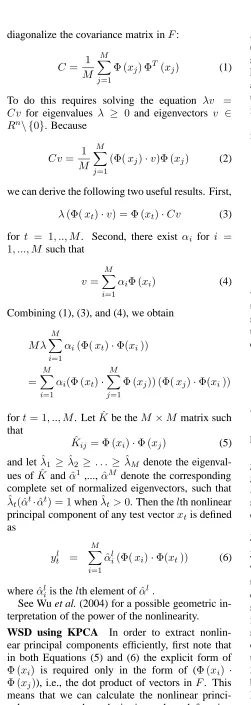
diagonalize the covariance matrix inF:
C = 1
M M X
j=1
Φ (xj) ΦT (xj) (1)
To do this requires solving the equation λv =
Cv for eigenvalues λ ≥ 0 and eigenvectors v ∈
Rn\ {0}. Because
Cv= 1
M M X
j=1
(Φ(xj)·v)Φ (xj) (2)
we can derive the following two useful results. First,
λ(Φ(xt)·v) = Φ (xt)·Cv (3)
for t = 1, .., M. Second, there exist αi for i =
1, ..., M such that
v =
M X
i=1
αiΦ (xi) (4)
Combining (1), (3), and (4), we obtain
M λ M X
i=1
αi(Φ(xt)·Φ(xi))
=
M X
i=1
αi(Φ (xt)· M X
j=1
Φ (xj)) (Φ(xj)·Φ(xi))
fort= 1, .., M. LetKˆ be theM ×M matrix such that
ˆ
Kij= Φ (xi)·Φ (xj) (5)
and letˆλ1 ≥ λˆ2 ≥ . . . ≥ ˆλM denote the eigenval-ues ofKˆ andαˆ1 ,...,αˆM denote the corresponding complete set of normalized eigenvectors, such that
ˆ
λt(ˆαt·αˆt) = 1whenˆλt >0. Then thelth nonlinear principal component of any test vectorxtis defined as
ytl =
M X
i=1 ˆ
αli(Φ(xi)·Φ(xt)) (6)
whereαˆl
iis thelth element ofαˆl.
See Wu et al. (2004) for a possible geometric in-terpretation of the power of the nonlinearity.
WSD using KPCA In order to extract nonlin-ear principal components efficiently, first note that in both Equations (5) and (6) the explicit form of
Φ (xi) is required only in the form of (Φ (xi) ·
Φ (xj)), i.e., the dot product of vectors in F. This means that we can calculate the nonlinear princi-pal components by substituting a kernel function
k(xi, xj)for(Φ(xi)·Φ(xj))in Equations (5) and (6) without knowing the mappingΦexplicitly; in-stead, the mapping Φ is implicitly defined by the kernel function. It is always possible to construct a mapping into a space wherek acts as a dot prod-uct so long ask is a continuous kernel of a positive integral operator (Sch¨olkopf et al., 1998).
Thus we train the KPCA model using the follow-ing algorithm:
1. Compute anM×M matrixKˆ such that
ˆ
Kij =k(xi, xj) (7)
2. Compute the eigenvalues and eigenvectors of matrix Kˆ and normalize the eigenvectors. Let
ˆ
λ1 ≥ ˆλ2 ≥ . . . ≥ λˆM denote the eigenvalues andαˆ1,...,αˆM denote the corresponding com-plete set of normalized eigenvectors.
To obtain the sense predictions for test instances, we need only transform the corresponding vectors using the trained KPCA model and classify the re-sultant vectors using nearest neighbors. For a given test instance vector x, its lth nonlinear principal component is
ytl =
M X
i=1 ˆ
αlik(xi, xt) (8)
whereαˆl
iis the ith element ofαˆl.
For our disambiguation experiments we employ a polynomial kernel function of the formk(xi, xj) =
(xi·xj)d, although other kernel functions such as gaussians could be used as well. Note that the de-generate case ofd= 1yields the dot product kernel k(xi, xj) = (xi·xj)which covers linear PCA as a special case, which may explain why KPCA always outperforms PCA.
[image:3.595.65.316.45.750.2]3 Results and discussion 3.1 Accuracy
Table 1: Comparison of accuracy results for various HKUST ensemble and individual models on Senseval-3 Lexical Sample tasks, confirming the high accuracy of the KPCA-based model. All test instances were attempted. (Bold model names were the systems entered.)
English (fine)
English (coarse)
Chinese Multilingual (t)
Multilingual (ts)
HKUST comb2 (me, boost, nb, kpca) 71.4 78.6 66.2 62.0 63.8
HKUST comb (me, boost, kpca) 70.9 78.1 66.5 61.4 63.8
HKUST me 69.3 76.4 64.4 60.6 60.8
HKUST kpca 69.2 - 63.6 60.0 63.3
HKUST boost 67.0 - 64.1 57.3 60.3
HKUST nb 64.3 - 60.4 57.3 56.8
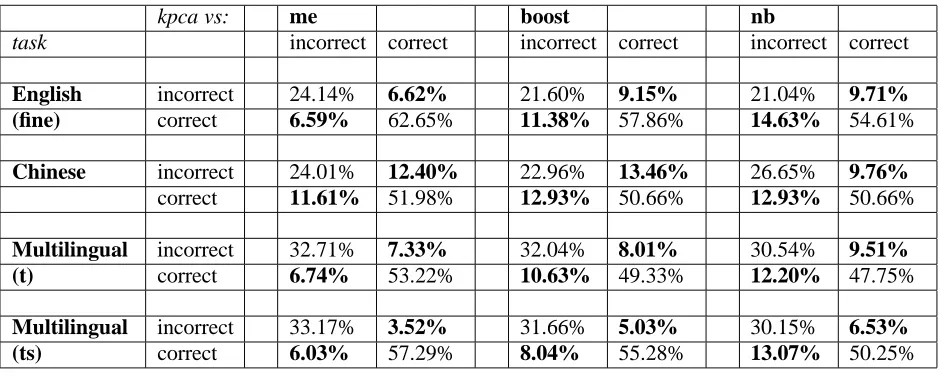
Table 2: Confusion matrices showing that the KPCA-based model votes very differently from the other models on the Senseval-3 Lexical Sample tasks. Percentages representing disagreement between KPCA and other voting models are shown in bold.
kpca vs: me boost nb
task incorrect correct incorrect correct incorrect correct
English incorrect 24.14% 6.62% 21.60% 9.15% 21.04% 9.71%
(fine) correct 6.59% 62.65% 11.38% 57.86% 14.63% 54.61%
Chinese incorrect 24.01% 12.40% 22.96% 13.46% 26.65% 9.76%
correct 11.61% 51.98% 12.93% 50.66% 12.93% 50.66%
Multilingual incorrect 32.71% 7.33% 32.04% 8.01% 30.54% 9.51%
(t) correct 6.74% 53.22% 10.63% 49.33% 12.20% 47.75%
Multilingual incorrect 33.17% 3.52% 31.66% 5.03% 30.15% 6.53%
(ts) correct 6.03% 57.29% 8.04% 55.28% 13.07% 50.25%
more accurate on the Multilingual (t) task. For un-known reasons—possibly the very small number of training instances per Chinese target word, as men-tioned earlier—there is an exception on the Chinese task, where boosting outperforms the KPCA-based model. We are investigating the possible causes. The na¨ıve Bayes model remains significantly worse under all conditions.
3.2 Differentiated voting bias
For a new voting model to raise the accuracy of an existing classifier ensemble, it is not only important that the new voting model achieve accuracy compa-rable to the other voters, as shown above, but also that it provides a significantly differentiated predic-tion bias than the other voters. Otherwise, the accu-racy is typically hurt rather than helped by the new voting model.
To examine whether the KPCA-based model sat-isfies this requirement, we compared its predictions against each of the other classifiers (for those tasks where we have been given the answer key). Table 2 shows nine confusion matrices revealing the per-centage of instances where the KPCA-based model votes differently from one of the other voters. The disagreement between KPCA and the other voting models ranges from 6.03% to 14.63%, as shown by the bold entries in the confusion matrices. Note that where there is disagreement, the KPCA-based model predicts the correct sense with significantly higher accuracy, in nearly all cases.
3.3 Voting effectiveness
[image:4.595.72.543.321.509.2]sec-Table 3: Comparison of the accuracies for the voting ensembles with and without the KPCA voter, confirm-ing that addconfirm-ing the KPCA-based model to the votconfirm-ing ensemble always helps on Senseval-3 Lexical Sample tasks.
English (fine)
English (coarse)
Chinese Multilingual (t)
Multilingual (ts)
HKUST comb3 (me, boost, nb) 71.2 - 67.5 60.6 60.8
HKUST comb2 (me, boost, nb, kpca) 71.4 78.6 66.2 62.0 63.8
tions. To verify that adding the KPCA-based model to the voting ensemble indeed improves accuracy, we compared our voting ensemble’s accuracies to that obtained with KPCA removed. The results, shown in Table 3, confirm that the KPCA-based model generally helps on Senseval-3 Lexical Sam-ple tasks. The only exception is on Chinese, due to the aforementioned anomaly of boosting outper-forming KPCA on that task. In the Multilingual (t) and (ts) cases, the improvement in accuracy is sig-nificant.
4 Conclusion
We have described our word sense disambiguation system and its performance on the Senseval-3 En-glish, Chinese, and Multilingual Lexical Sample tasks. The system consists of an ensemble clas-sifier utilizing combinations of maximum entropy, boosting, na¨ıve Bayes, and a new Kernel PCA based model.
We have demonstrated that our new model based on Kernel PCA is, along with maximum entropy, one of the most accurate stand-alone models vot-ing in the ensemble, as evaluated under carefully controlled to ensure the same optimized feature set across all models being compared. Moreover, we have shown that the KPCA model exhibits a signif-icantly different classification bias, a characteristic that makes it a valuable voter in an ensemble. The results confirm that accuracy is generally improved by the addition of the KPCA-based model.
References
Xavier Carreras, Llu´ıs M`arques, and Llu´ıs Padr´o. Named entity extraction using AdaBoost. In Dan Roth and Antal van den Bosch, editors, Proceedings of CoNLL-2002, pages 167– 170, Taipei, Taiwan, 2002.
Konstantinos I. Diamantaras and Sun Yuan Kung. Principal
Component Neural Networks. Wiley, New York, 1996.
Yoram Freund and Robert E. Schapire. A decision-theoretic generalization of on-line learning and an application to boosting. In Journal of Computer and System Sciences,
55(1), pages 119–139, 1997.
E.T. Jaynes. Where do we Stand on Maximum Entropy? MIT Press, Cambridge MA, 1978.
Dan Klein and Christopher D. Manning. Conditional struc-ture versus conditional estimation in NLP models. In
Pro-ceedings of EMNLP-2002, Conference on Empirical Meth-ods in Natural Language Processing, pages 9–16,
Philadel-phia, July 2002. SIGDAT, Association for Computational Linguistics.
Taku Kudo and Yuji Matsumoto. Fast methods for kernel-based text analysis. In Proceedings of the 41st Annual Meeting of
the Association for Computational Linguistics, pages 24–31,
2003.
Grace Ngai, Dekai Wu, Marine Carpuat, Chi-Shing Wang, and Chi-Yung Wang. Semantic role labeling with boost-ing, SVMs, maximum entropy, SNOW, and decision lists. In Proceedings of Senseval-3, Third International
Work-shop on Evaluating Word Sense Disambiguation Systems,
Barcelona, July 2004. SIGLEX, Association for Computa-tional Linguistics.
Robert E. Schapire and Yoram Singer. Boostexter: A boosting-based system for text categorization. In Machine Learning,
39(2/3), pages 135–168, 2000.
Bernhard Sch¨olkopf, Alexander Smola, and Klaus-Rober M¨uller. Nonlinear component analysis as a kernel eigen-value problem. Neural Computation, 10(5), 1998.
Richard Wicentowski, Grace Ngai, Dekai Wu, Marine Carpuat, Emily Thomforde, and Adrian Packel. Joining forces to resolve lexical ambiguity: East meets West in Barcelona. In Proceedings of Senseval-3, Third International
Work-shop on Evaluating Word Sense Disambiguation Systems,
Barcelona, July 2004. SIGLEX, Association for Computa-tional Linguistics.
Dekai Wu, Grace Ngai, Marine Carpuat, Jeppe Larsen, and Yongsheng Yang. Boosting for named entity recognition. In Dan Roth and Antal van den Bosch, editors, Proceedings
of CoNLL-2002, pages 195–198. Taipei, Taiwan, 2002.
Dekai Wu, Weifeng Su, and Marine Carpuat. A Kernel PCA method for superior word sense disambiguation. In
Pro-ceedings of the 42nd Annual Meeting of the Association for Computational Linguistics, Barcelona, July 2004.
David Yarowsky and Radu Florian. Evaluating sense disam-biguation across diverse parameter spaces. Natural