Detecting Cross-Cultural Differences Using a Multilingual Topic Model
E.D. Guti´errez1 Ekaterina Shutova2 Patricia Lichtenstein3Gerard de Melo4 Luca Gilardi5 1 University of California, San Diego
2 Computer Laboratory, University of Cambridge
3 University of California, Merced
4 IIIS, Tsinghua University,5ICSI, Berkeley
[email protected] [email protected] [email protected] [email protected] [email protected]
Abstract
Understanding cross-cultural differences has important implications for world affairs and many aspects of the life of society. Yet, the majority of text-mining methods to date focus on the analysis of monolingual texts. In con-trast, we present a statistical model that simul-taneously learns a set of common topics from multilingual, non-parallel data and automati-cally discovers the differences in perspectives on these topics across linguistic communities. We perform a behavioural evaluation of a sub-set of the differences identified by our model in English and Spanish to investigate their psy-chological validity.
1 Introduction
Recent years have seen a growing interest in text-mining applications aimed at uncovering public opinions and social trends (Fader et al., 2007; Mon-roe et al., 2008; Gerrish and Blei, 2011; Pennac-chiotti and Popescu, 2011). They rest on the as-sumption that the language we use is indicative of our underlying worldviews. Research in cognitive and sociolinguistics suggests that linguistic varia-tion across communities systematically reflects dif-ferences in their cultural and moral models and goes beyond lexicon and grammar (K¨ovecses, 2004; Lakoff and Wehling, 2012). Cross-cultural differ-ences manifest themselves in text in a multitude of ways, most prominently through the use of explicit opinion vocabulary with respect to a certain topic (e.g. “policies thatbenefitthe poor”), idiomatic and metaphorical language (e.g. “the company is spin-ning its wheels”) and other types of figurative lan-guage, such as irony or sarcasm.
The connection between language, culture and reasoning remains one of the central research ques-tions in psychology. Thibodeau and Borodit-sky (2011) investigated how metaphors affect our decision-making. They presented two groups of hu-man subjects with two different texts about crime. In the first text, crime was metaphorically portrayed as a virus and in the second as abeast. The two groups were then asked a set of questions on how to tackle crime in the city. As a result, while the first group tended to opt for preventive measures (e.g. stronger social policies), the second group converged on punishment- or restraint-oriented mea-sures. According to Thibodeau and Boroditsky, their results demonstrate that metaphors have profound influence on how we conceptualize and act with re-spect to societal issues. This suggests that in order to gain a full understanding of social trends across pop-ulations, one needs to identify subtle but systematic linguistic differences that stem from the groups’ cul-tural backgrounds, expressed both literally and fig-uratively. Performing such an analysis by hand is labor-intensive and often impractical, particularly in a multilingual setting where expertise in all of the languages of interest may be rare.
With the rise of blogging and social media, NLP techniques have been successfully used for a number of tasks in political science, including automatically estimating the influence of particular politicians in the US senate (Fader et al., 2007), identifying lex-ical features that differentiate politlex-ical rhetoric of opposing parties (Monroe et al., 2008), predicting voting patterns of politicians based on their use of language (Gerrish and Blei, 2011), and predicting political affiliation of Twitter users (Pennacchiotti and Popescu, 2011). Fang et al. (2012) addressed
47
the problem of automatically detecting and visual-ising the contrasting perspectives on a set of top-ics attested in multiple distinct corpora. While suc-cessful in their tasks, all of these approaches fo-cused on monolingual data and did not reach be-yond literal language. In contrast, we present a method that detects fine-grained cross-cultural dif-ferences from multilingual data, where such differ-ences abound, expressed both literally and figura-tively. Our method brings together opinion mining and cross-lingual topic modelling techniques for this purpose. Previous approaches to cross-lingual topic modelling (Boyd-Graber and Blei, 2009; Jagarla-mudi and Daum´e III, 2010) addressed the problem of mining common topics from multilingual cor-pora. We present a model that learns such com-mon topics, while simultaneously identifying lexi-cal features that are indicative of the underlying dif-ferences in perspectives on these topics by speakers of English, Spanish and Russian. These differences are mined from multilingual, non-parallel datasets of Twitter and news data. In contrast to previous work, our model does not merely output a list of mono-lingual lexical features for manual comparison, but also automatically infers multilingual contrasts.
Our system (1) uses word-document co-occur-rence data as input, where the words are labeled as topic words or perspective words; (2) finds the highest-likelihood dictionary between topic words in the two languages given the co-occurrence data; (3) finds cross-lingual topics specified by distribu-tions over topic-words and perspective-words; and (4) automatically detects differences in perspective-word distributions in the two languages. We perform a behavioural evaluation of a subset of the differ-ences identified by the model and demonstrate their psychological validity. Our data and dictionaries are available from the first author upon request.
2 Related work
View detection. Identifying different viewpoints is related to the well-studied area of subjectivity detection, which aims at exposing opinion, evalu-ation, and speculation in text (Wiebe et al., 2004) and attributing it to specific people (Awadallah et al., 2011; Abu-Jbara et al., 2012). In our work, we are less interested in explicit local forms of subjectivity, instead aiming at detecting more general contrasts
across linguistic communities.
Another line of research has focused on inferring author attributes such as gender, age (Garera and Yarowsky, 2009), location (Jones et al., 2007), or po-litical affiliation (Pennacchiotti and Popescu, 2011). Such studies make use of syntactic style, discourse characteristics, as well as lexical choice. The models used for this are typically binary classifiers trained in a fully supervised fashion. In contrast, in our task, we automatically infer the topic distributions and find topic-specific contrasts.
compa-rable documents in each language of the corpus. Topic models for view detection. LDA also as-sumes that the distribution of each topic is fixed across all documents in a corpus. Therefore, a topic associated with, e.g., war will have the same dis-tribution over the lexicon regardless of whether the document was taken from a pro-war editorial or an anti-war speech. However, in reality we may expect a single topic to exhibit systematic and predictable variations in its distribution based on authorship.
The cross-collection LDA model by Paul and Girju (2009) addresses this by specifically aiming to expose viewpoint differences across different doc-ument collections. Ahmed and Xing (2010) pro-posed a similar model for detecting ideological dif-ferences. Fang et al. (2012)’s Cross-Perspective Topic (CPT) model breaks up the terms in the vo-cabulary into topic terms and perspective terms with different generative processes, and differentiates be-tween different collections of documents within the corpus. The topic terms are assumed to be generated as in LDA. However, the distribution of perspective terms in a document is taken to be dependent on both the topic mixture of the document as well as the col-lection from which the document is drawn.
Recent works proposed models for specific types of data. Qiu and Jiang (2013) use user identities and interactions in threaded discussions, while Got-tipati et al. (2013) developed a topic model for De-batepedia, a semi-structured resource in which ar-guments are explicitly enumerated. However, all of these models perform their analyses on monolingual datasets. Thus, they are useful for comparing differ-ent ideologies expressed in the same language, but not for cross-linguistic comparisons.
3 Method
The goal of our model is to analyse large, non-parallel, multilingual corpora and present cross-lingually valid topics and the associated perspec-tives, automatically inferring the differences in con-ceptualization of these topics across cultures. Fol-lowing Boyd-Graber and Blei (2009) and Jagarmudi and Daum´e III (2010), our distributions of la-tent topics range over lala-tent, cross-lingualtopic con-ceptsthat manifest themselves as language-specific
topic words. We use bilingual dictionaries,
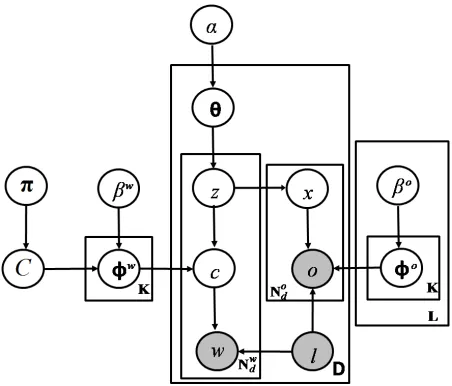
contain-Figure 1: Basic generative model.
ing words in one language and their translations in another language, to represent the topic concepts. These are represented as a bipartite graph, with each translation entry being an edge and each topic word in the two languages being a vertex. While the topic words are tied together by the translation dictionary, the perspective words can vary freely across lan-guages. Following Fang et al. (2012), we treat nouns as topic words and verbs and adjectives as perspec-tive words1. The model assumes that adjective and
verb tokens in each document are assigned to topics in proportion to the topic assignments of the topic word tokens. Then, the perspective term for this topic is drawn depending on the topic assignment and the language of the speaker.
3.1 Basic Generative Model
Given the languages`∈ {a, b}, our model infers the distributions of multi-lingual topics and language-specific perspective-words (Fig. 2), as follows: 1. Draw a setC of concepts (u, v)matching topic word ufrom language ato topic wordv from lan-guageb, where the probability of concept (u, v) is proportional to a priorπu,v (e.g. based on informa-tion from a translainforma-tion dicinforma-tionary).
2. Draw multinomial distributions:
1This approximation was adopted for convenience,
[image:3.612.314.540.53.246.2]• For topic indices k ∈ {1, ..., K}, draw language-independent topic-concept distribu-tionsφwk ∼Dir(βw)over pairs(wa, wb)∈C. • For topic indices k ∈ {1, ..., K} and
lan-guages ` ∈ {a, b}, draw language-specific perspective-term distributionsφ`,ok ∼ Dir(βo) over perspective-terms in language`.
3. For each documentd∈ {1, ..., D}with lang.`d: • Draw topic weightsθd∼Dir(α)
• For each topic-word index i ∈ {1, ..., Ndw} of documentd:
– Draw topiczi ∼θd
– Draw topic conceptci = (wa, wb) ∼φwzi,
and selectw`d as the member of that pair
corresponding to language`d.
• For each perspective-word index j∈ {1, ..., Ndo}of documentd:
– Draw topicxj ∼Uniform(zw1, ..., zwN od)
– Draw perspective-wordoj ∼φ`,oxj
3.2 Model Variants
We have experimented with several variants of our model, in order to account for the translation of pol-ysemous words, adapt the translation model to the corpus used, and to handle words for which no trans-lation is found.
a) SINGLE variants of the model match each topic term in a language with at most one topic term in the other language.
MULTIPLEvariants allow each term to match to multiple other words in the other language.
b) INFER variants allow higher-likelihood match-ings to be inferred from the data.
STATIC variants treat the matchings as fixed, which is equivalent to assigning a probability of 0 or 1 to every edge in our bipartite graphC.
c) RELEGATE variants relegate all unmatched words in each language to a single separate back-ground topic distinct from the topics that are learned for the matched topic words. This is akin to forcing the probability for currently un-matched words to 0 in all topics except for
one, and forcing the probability of all currently matched words to 0 in this topic.
INCLUDEvariants do not restrict the assignment unmatched words; they are assigned to the same set of topics as the matched words.
We test the following six variants: SINGLESTATI -CRELEGATE, SINGLESTATICINCLUDE, SIN -GLEINFERRELEGATE, SINGLEINFERINCLUDE, MULTIPLESTATICRELEGATE, and MULTI -PLESTATICINCLUDE. We do not test MULTI -PLEINFER variants because of the complexity of inferring a multiple matching in a bipartite graph. 3.3 Learning & Inference
For all variants, a collapsed Gibbs sampler can be used to infer topicsφ`,oandφw, per-document topic distributionsθ, as well as topic assignments z and
x. This corresponds to the S-step below. For INFER variants, we follow Boyd-Graber and Blei in using an M-step involving a bipartite graph matching al-gorithm to infer the matchingmthat maximizes the
posterior likelihood of the matching.
S-Step:Sample topics for words in the corpus using a collapsed Gibbs sampler. For topic-word wi =
u belonging to document d, if the word occurs in conceptci = (u, v), then sample the topic and entry according to:
p(zi =k, ci = (u, v)|wi=u,z−i, C)
∝ PNdk+αk
j
(Ndj+αj) ×
Nk(u,v)+βkw
P
v0
Nk(u,v0)+βkw
where the sum in the denominator of the first term is over all topics, and in the second term is over all words matched tou.Ndkis the count of topic-words of topic k in document d, Nk(u,v) is the count of topic-words either of type u or of type v assigned to topickin all the corpora.2 For perspective-word oi=n, sample the topic according to:
p(zi =k|oi =n,z−i, C)∝
Ndk
P
jNdj ×
N`d
kv+βok
P
m
N`d
km+βko
2In RELEGATEvariants, foruunmatchedziis sampled as:
p(zi=k|wi=u,z−i, C)∝PNdk+αk
k
(Ndk+αk),
where the sum in the second term of the denominator is over the perspective-word vocabulary of language `d; Ndk is the count of topicwords in document d with topick; and N`d
km is the count of perspective-wordmbeing assigned topickin language`d. Note that in all the counts above, the current word tokeni is omitted from the count.
Given our sampling assignments, we can then es-timateθd,φ`,o, andφwas follows:
ˆ θkd=
Ndk+αk
P
k
(Ndk+αk)
,
ˆ
φwk(u,v)= Nk(u,v)+β
w
(u,v) P
v0
Nk(u,v0)+β(wu,v0)
,
ˆ
φ`,onk = Nkn+β
o n
P
m
Nkm` +βo n
.
M-Step:(forINFERvariants only): Run the Jonker-Volgenant (Jonker and Jonker-Volgenant, 1987) bipartite matching algorithm to find the optimal matchingC given some weights. For topic-termufrom language a and topic-term v from language b, our weights correspond to the log of the posterior odds that the occurrences ofu andv come from a matched topic distribution, as opposed to coming from unmatched distributions:
µu,v=
X
k\{a∗,b∗}
Nk(u,v)log ˆφwk(u,v)
−Nulog ˆφwk(u,·)−Nvlog ˆφwk(·,v)+πu,v,
where Nu is the count of topic-term u in the cor-pus. This expression can also be interpreted as a kind of pointwise mutual information (Haghighi et al., 2008). The Jonker-Volgenant algorithm has time complexity of at mostO(V3), whereV is the size of the lexicon (Jonker and Volgenant, 1987).
3.4 Inference of Perspective-Word Contrasts Having learned our model and inferred how likely perspective-terms are for a topic in a given language, we seek to know whether these perspectives differ significantly in the two languages. More precisely, can we infer whether wordmin languageaand the equivalent wordnin language bhave significantly different distributions under a topick? To do this, we make the assumption that the perspective-words
in languages a and b are in one-to-one correspon-dence to each other. Recall that, for a given topic kand language `,Nkm` is the count for termmand φ`,ok,m is the probability for word m in language `. Just as we collect the probabilities into word-topic distribution vectorsφ`,ok , we collect the counts into word-topic count vectors[Nk`1, Nk`2, ..]. Then, since our model assumes a prior over the parameter vec-tors φ`,ok , we can infer the likelihood for that ob-served word-topic countsNkma andNknb were drawn from a single word-topic-distribution prior denoted by φ˘ := φa,o
km = φ b,o
kn. Below all our probabilities are conditioned implicitly on this event as well as on Na
k andNkbbeing fixed.
Denote the total count of word tokens in topick from language`by Nk` = PmNkm` . Now, we de-rive the probability that we observe a ratio greater than δ between the proportion of words in topick that belong to word typemin languageaand to cor-responding word typenin languageb:
p
Nkma Nka
Nb k
Nknb ≥δ
+ p
Nb kn
Nkb Na
k
Nkma ≥δ
(1)
By symmetry, it suffices to derive an expression for the first term. We note that the inequality in the prob-ability is equivalent to a sum over a range of values ofNa
km and Nknb . By rearranging terms, applying the law of conditional probability to condition on the termφ˘, and exploiting the conditional indepen-dence of Na
km and Nkmb given φ˘, Nka, andNkb, we can rewrite this first term as
Nb k X x=0 Na k X
y=xδNa/b Z
p(Nknb =x|φ)p(N˘ kma =y|φ)p( ˘˘ φ)dφ,˘
whereNa/b = Nka
Nb
k. Recall that
φ`,ok ∼ Dir(βo) un-der our model. Assume a symmetric Dirichlet dis-tribution for simplicity. It can then be shown that the marginal distribution ofφ˘isφ˘∼Beta(βo,(V −
1)βo), whereV is the total size of the perspective-word vocabulary. Similarly, it can be shown that the marginal distribution ofNkm` givenφ`,ok isNkm` ∼ Binom(N`
k, φ `,o
i )for`∈ {a, b}. Therefore, the inte-grand above is proportional to the beta-binomial dis-tribution with number of trialsNka+Nkb, successes x+y, and parametersβoand(V −1)βo, but with partition function Na
k y Nb k x
distribution byf(Na
k+Nkb, x+y, βo). Then expres-sion (1) above becomes:
Nb k X
x=0
Na k X
y=xδNa/b
f(Nka+Nkb, x+y, βo)
+
Na k X
x=0
Nb k X
y=xδNb/a
f(Nka+Nkb, x+y, βo). (2)
We cannot observe Nkba, Nknb , Nka and Nkb explic-itly, but we can estimate them by obtaining poste-rior samples from our Gibbs sampler. We substitute these estimates into expression (2).
4 Experiments
4.1 Data
Twitter Data. We gathered Twitter data in En-glish, Spanish and Russian during the first two weeks of December 2013 using the Twitter API. Following previous work (Puniyani et al., 2010), we treated each Twitter user account as a docu-ment. We then tagged each document for part-of-speech, and divided the word tokens in it into topic-words and perspective-topic-words. We constructed a lex-icon of 2,000 topic terms and 1,500 perspective-terms for each language by filtering out any perspective-terms that occurred in more than 10% of the docu-ments in that language, and then selecting the re-maining terms with the highest frequency. Fi-nally, we kept only documents that contained 4 or more topic words from our lexicon. This left us with 847,560 documents in English (4,742,868 topic-word and 1,907,685 perspective-word tokens); 756,036 documents in Spanish (4,409,888 topic-word and 1,668,803 perspective-topic-word tokens); and 260,981 documents in Russian (1,621,571 topic-word and 981,561 perspective-topic-word tokens). News Data. We gathered all the articles published online during the year 2013 by the state-run media agencies of the United States (Voice of America or “VOA”–English), Russia (RIA Novosti or “RIA”– Russian), and Venezuela (Agencia Venezolana de Noticias or “AVN”–Spanish). These three news agencies were chosen because they not only pro-vide media in three distinct languages, but they are guided by the political world-views of three dis-tinct governments. We treated each news article as
a document, and removed duplicates. Once again, we constructed a lexicon of 2,000 topic terms and 1,500 perspective-terms using the same criteria as for Twitter, and kept only documents that contained 4 or more topic words from our lexicon. This left us with 23,159 articles (10,410,949 tokens) from VOA, 41,116 articles (11,726,637 tokens) from RIA, and 8,541 articles (2,606,796 tokens) from AVN. Dictionaries. To create the translation dictionar-ies, we extracted translations from the English, Spanish, and Russian editions of Wiktionary, both from the translation sections and the gloss sections if the latter contained single words as glosses. Multi-word expressions were universally removed. We added inverse translations for every original trans-lation. From the resulting collection of translations, we then created separate translation dictionaries for each language and part-of-speech tag combination.
In order to give preference to more important translations, we assigned each translation an initial weight of1 + 1r, wherer was the rank of the trans-lation within the page. Since a transtrans-lation (or its in-verse) can occur on multiple pages, we aggregated these initial weights and then assigned final weights of1 + r10, where r0 was the rank after aggregation and sorting in descending order of weights.
4.2 Experimental Conditions
To evaluate the different variants of our model, we held out 30,000 documents (test set) during training. We plugged in the estimates ofφw andC acquired during training using the rest of the corpus to pro-duce a likelihood estimate for these held-out docu-ments. All models were initialized with the prior matching determined by the dictionary data. For each number of topicsK, we setαto50/Kand the β variables to 0.02, as in Fang et al. (2012). For the MULTIPLE variants, we setπi,j = 1ifiandj share an entry and 0 otherwise. For INFERvariants, only threeM-steps were performed to avoid overfit-ting, at 250, 500, and 750 iterations of Gibbs sam-pling, following the procedure in Boyd-Graber and Blei (2009).
4.3 Comparison of model variants
each variant on TWITTERand NEWS, for English– Spanish and English–Russian language pairs. Perplexityis a measure of how well a model trained on a training set predicts the co-occurrence of words on an unseen test setH. Lower perplexity indicates better model fit. We evaluate the held-out perplex-ity for topic wordswiand perspective-wordsoi sep-arately. For topic words, the perplexity is defined as exp(−Pw
i∈Hlogp(wi)/N
w). As for standard LDA, exact inference ofp(wi) is intractable under this model. Therefore we adapted the estimator de-veloped by Murray and Salakhutdinov (2009) to our models.
Coherenceis a measure inspired by pointwise mu-tual information (Newman et al., 2010). LetD(v)be the the number of documents with at least one token of typev and let D(v, w) be the number of docu-ments containing at least one token of typevand at least one token of typew. Then Mimno et al. (2011) define the coherence of topickas
1
M
2
M
X
m=2
mX−1
`=1
logD(v (k)
m , v(`k)) +
D(v`(k)) ,
whereV(k)= (v1(k), ..., vM(k))is a list of theMmost probable words in topickandis a small smoothing constant used to avoid taking the logarithm of zero. Mimno et al. (2011) find that coherence correlates better with human judgments than do likelihood-based measures. Coherence is topic-specific mea-sure, so for each model variant we trained, we com-puted the median topic coherence across all the top-ics learned by the model. We set= 0.1.
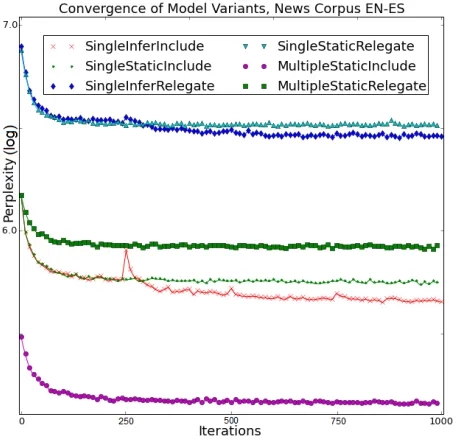
Model performance and analysis. Fig. 2 shows perplexity for the variants as a function of the num-ber of iterations of Gibbs sampling on the English-Spanish NEWS corpus. The figure confirms that 1000 iterations of Gibbs sampling on the NEWS corpus was sufficient for convergence across model variants. We omit figures for English-Russian and for the TWITTER corpus, since the patterns were nearly identical. Figure 3 shows how perplexity varies as a function of the number of topics. We used this information to choose optimal models for the different corpora. The optimal number of top-ics was K = 175 for the English-Spanish NEWS corpus, K = 200 for the English-Russian NEWS,
K = 325 for the English-Spanish TWITTER, and
K = 300 for the English-Russian TWITTER. Al-though the optimal number of topics varied across corpora, the relative performance of the different models was the same. In all of our corpora, the MULTIPLE variants provided better fits than their corresponding SINGLEvariants. There are several explanations for this. For one, the MULTIPLE vari-ants are able to exploit the information from multi-ple translations, unlike the SINGLEvariants, which discarded all but one translation per word. For an-other, the matchings produced by the SINGLEINFER variants can be purely coincidental and the result of overfitting (see some examples below). INCLUDE variants performed markedly better than RELEGATE variants. INFER variants improved model fit com-pared to STATIC variants, but required more topics to produce optimal fit.
Recall that we performed an M-step in the IN -FER variants 3 times, at 250, 500, and 750 itera-tions. As noted in §3.3, the M-step in the INFER variants maximizes the posterior likelihood of the matching. However, Fig. 2 shows that this maxi-mization causes held-out perplexity to increase sub-stantially just after the first matching M-step, around 250 iterations, before decreasing again after about 50 more iterations of Gibbs sampling. We believe that this happens because the M-step is maximizing over expectations that are approximate, since they are estimated using Gibbs sampling. If the sampler has not yet converged, then the M-step’s maximiza-tion will be unstable. We found support for this ex-planation when we re-ran the INFERvariants using 1000 iterations between M-steps, giving the Markov chain enough time to converge. After this change, perplexity went down immediately after the M-step and kept decreasing monotonically, rather than in-creasing after the M-step before dein-creasing. How-ever, this did not result in a significantly lower final perplexity or coherence and thus did not change the relative performance of the models. In addition, Fig. 2 suggests that the second and third M-steps (at 500 and 750 iterations, respectively) had little effect on perplexity. In light of the high computational ex-pense of each inference step, this suggests in prac-tice a single inference step may be sufficient.
Figure 2: Perplexity of different model variants for dif-ferent numbers of iterations atK=175.
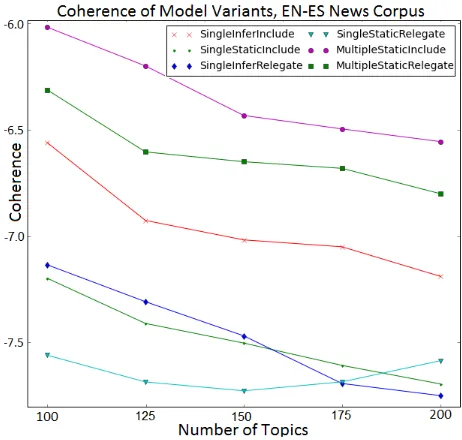
median topic coherence. Once again, this general pattern held true for the English-Russian pair and TWITTER corpora. Overall, the results show that MULTIPLESTATICINCLUDE provides superior per-formance across measures, corpora, topic numbers, and languages. We therefore used this variant in further data analysis and evaluation. Incidentally, the observed decrease in topic coherence as K in-creases is expected, because asK increases, lower-likelihood topics tend to be more incoherent (Mimno et al., 2011). Experiments by Stevens et al. (2012) show that this effect is observed for LDA-, NMF-, and SVD-based topic models.
Cross-linguistic matchings. The matchings in-ferred by the SINGLEINFERINCLUDE variant were of mixed quality. Some of the matchings corrected low-quality translations in the original dictionary. For instance, our prior dictionary matchedpassage
in English topasajein Spanish. Though technically correct, the dominant meaning ofpasajeis[travel] ticket. The TWITTERmodel correctly matched
[image:8.612.313.546.55.276.2]pas-sagetorutainstead. Many of the matchings learned by the model did not provide technically correct translations, yet were still revelatory and interesting. For instance, the dictionary translated the Spanish wordpitoascigarettein English. However, in infor-mal usage this word refers specifically to cannabis cigarettes, not tobacco cigarettes. The TWITTER
Figure 3: Perplexity of different model variants.
model matchespitoto the English slang wordweed
instead. The Spanish word Siria (Syria) was un-matched in the prior dictionary; the NEWS model matched it to the wordchemical, which makes sense in the context of extensive reporting of the usage of chemical weapons in the ongoing Syrian conflict.
4.4 Data analysis and discussion
En-Figure 4: Coherence of different model variants.
glish speakers tend to discuss economic and finan-cial processes using motion terms, such as “slow, drive, boost orsluggish”, or a related metaphor of
horse-riding, e.g. “reinin debt”, “saddlewith debt”, or even “breedmoney”. In contrast, Spanish speak-ers tend to talk about the economy in terms of size rather than motion, using verbs such asampliar or
disminuir, and other metaphors, such as sangrar
(to bleed) and incendiar (to light up). These ex-amples demonstrate coherent conceptualization pat-terns that differ in the two languages. Interestingly, this difference manifested itself in both NEWS and TWITTERcorpora and echoes the findings of a pre-vious corpus-linguistic study of Charteris-Black and Ennis (2001), who manually analysed metaphors used in English and Spanish financial discourse and reported that motion and navigation metaphors that abound in English were rarely observed in Spanish.
For the majority of the topics we analysed the model revealed interesting cross-cultural differ-ences. For instance, the Spanish corpora exhib-ited metaphors ofbattlewhen talking aboutpoverty
(withpoverty seen as an enemy), while in the En-glish corpus poverty was discussed more neutrally as a social problem that needs a practical solu-tion. English-Russian NEWS experiments revealed a surprising difference with respect to the topic of
protests. They suggested that while US media tend to use stronger metaphorical vocabulary, such as
Topic ENbudget debt deficit reduction spend balance
cut increase limit downtown tax stress addition planet
Topic ESpresupuesto deficit deuda reduccion equilib-rio disminucion gasto aumentacion tasa sacerdote
Perspective ENbalance default triplereinaccumulate accruetrimincursaddle slashprioritize avertgut bur-denevaporateborrow pilecap cut tackle
Perspective ESrenegociar mejora etiquetado
desplo-mar recortarendeudarincendiardestinar asignar au-torizar aprobado ascendersangraraugurarabatir
Figure 5: Top perspectives in system output for the topic offinancein the NEWScorpus (metaphors in red italics).
Contrasts EN:rein[in debt],saddle[with debt],cap [debt],breed[money],gut[budget], [debt]hit,tackle [debt],boost,slow,drive,sluggish[economy],spur
Contrasts ES:sangrar[dinero],ampliar,disminuir[la econom´ıa],superar[la tasa],emitir[deuda]
Figure 6: Contrasts identified by the model in NEWS.
clash, eruptorfire, in Russian protests are discussed more neutrally. Generally, the NEWS corpora con-tained more abstract topics and richer information about conceptual structure and sentiment in all lan-guages. Many of the topics discovered in TWIT -TER related to everyday concepts, such as pets or
concerts, with fewer topics covering societal issues. Yet, a few TWITTER-specific contrasts could be ob-served: e.g., thesports topic tends to be discussed using war and battle vocabulary in Russian to a greater extent than in English.
Our models tend to identify two general kinds of differences: (1) cross-corpus differences repre-senting world views of particular populations whom the corpora characterize (such differences exist both across and within languages, e.g. the metaphors used in the progressive New York Times would be different from the ones in the more conservativeWall Street Journal); and (2) deeply entrenched cross-linguistic differences, such as the motion versus
[image:9.612.71.302.55.275.2]Topic EN economy growth rate percent bank economist interest reserve market policy
Topic ES econom´ıa crecimiento tasa banco poltica
mercado inter´es inflacin empleo economista
Perspective ENeconomic financial grow global
ex-pect remaincut boostlowslow drive
Perspective ES econ´omico mundial agregar
fi-nanciero informalpeque˜nosignificar internobajar
Figure 7: Top perspectives in system output for the econ-omytopic in TWITTER(metaphors in red).
Contrasts EN: slow[the economy], push[the
econ-omy], strong [economy], weak [economy], stable [economy],boost[the economy]
Contrasts ES:caer[la econom´ıa],disminuir,superar [la econom´ıa],ampliar[el crecimiento]
Figure 8: Contrasts identified by the model in TWITTER. by highlighting linguistic trends that are indicative of the underlying conceptual differences. However, the conceptual differences are not straightforward to evaluate based on the surface vocabulary alone. In order to investigate this further, we conducted a behavioural experiment testing a subset of the con-trasts discovered by our model.
5 Behavioural evaluation
We assessed the relevance of the contrasts through an experimental study with native English-speaking and native Spanish-speaking human subjects. We focused on a linguistic difference in the metaphors used by English speakers versus Spanish speak-ers when discussing changes in a nation’s econ-omy. While English speakers tend to use metaphors involving both locative motion verbs (e.g. slow) as well as expansive/contractive motion verbs (e.g.
shrink), Spanish speakers preferentially employ ex-pansive/contractive motion verbs (e.g. disminuir) to describe changes in the economy. These differences could reflect linguistic artefacts (such as collocation frequencies) or could reflect entrenched conceptual differences. Our experiment addresses the question of whether such patterns of behaviour arise cross-linguistically in response to non-linguistic stimuli. If the linguistic differences are indicative of en-trenched conceptual differences, then we expect to see responses to the non-linguistic stimuli that corre-spond to the usage differences in the two languages.
5.1 Experimental setup
We recruited 60 participants from one English-speaking country (the US) and 60 participants from three Spanish-speaking countries (Chile, Mexico, and Spain) using the CrowdFlower crowdsourcing platform. Participants first read a brief description of the experimental task, which introduced them to a fictional country in which economists are devis-ing a simple but effective graphic for “representdevis-ing change in [the] economy”. They then completed a demographic questionnaire including information about their native language. Results from 9 US and 3 non-US participants were discarded for failure to meet the language requirement.
Participants navigated to a new page to complete the experimental task. Stimuli were presented in a 1200×700-pixel frame. The center of the frame contained a sphere with a 64-pixel diameter. For each trial, participants clicked on a button to activate an animation of the sphere which involved (1) a pos-itive displacement (in rightward pixels) of 10% or 20%, or a negative displacement (in leftward pixels) of 10% or 20%;3and, (2) an expansion (in increased
pixel diameter) of 10% or 20%, or a contraction (in decreased pixel diameter) of 10% or 20%.4
Participants saw each of the resulting conditions 3 times. The displacement and size conditions were drawn from a random permutation of 16 condi-tions using a Fisher-Yates shuffle (Fisher and Yates, 1963). Crucially, half of the stimuli contained con-flicts of information with respect to the size and dis-placement metaphors for economic change (e.g. the sphere could both grow and move to the left). Over-all we expected the Spanish speakers’ responses to be more closely associated with changes in diam-eter due to the presence and salience of the size metaphor, and the English speakers’ responses to be influenced by both conditions. We expected these differences to be most prominent in the
con-3The use of leftward/rightward horizontal displacement to
represent decreases/increases in magnitude is supported by re-search in numerical cognition showing that people associate smaller magnitudes with the left side of space and larger mag-nitudes with the right side (Dehaene, 1992; Fias et al., 1995).
4A demonstration of the English experimental interface can
Figure 9: ”Economy Improved” response rate in conflict-ing stimulus conditions.
flicting trials, which force English speakers (unlike Spanish speakers) to choose between two available metaphors. We focus on these conflicting trials in our analysis and discussion of the results.
5.2 Results
In trials in which stimuli moving rightward were simultaneously contracting, English speakers re-sponded that the economy improved 66% of the time, whereas Spanish speakers judged the econ-omy to have improved 43% of the time. In trials in which stimuli moving leftward were simultaneously expanding, English speakers judged the economy to have improved 34% of the time, and Spanish speak-ers responded that the economy improved 55% of the time. The results are illustrated in Figure 9.
These results indicate three effects: (1) En-glish speakers exhibit a pronounced bias for us-ing horizontal displacement rather than expan-sion/contraction during the decision-making pro-cess; (2) Spanish speakers are more biased to-ward expansion/contraction in formulating a deci-sion; and, (3) across the two languages the responses show contrasting patterns. The results support our expectation on the relevance of different metaphors when reasoning about the economy by the English and Spanish speakers.
To examine the significance of these effects, we fit a binary logit mixed effects model5 to the data.
The full analysis modeled judgment with native lan-guage, displacement, and size as fully crossed fixed
5See Fox and Weisberg (2011) for a discussion of such
mod-els including application of the Type II Wald test.
effects and participant as a random effect. This anal-ysis confirmed that native language was associated with judgments about economic change. In particu-lar, it indicated that changes in size affected English speakers’ judgments and Spanish speakers’ judg-ments differently (p < 0.001), with an increase in size increasing the odds (eβ = 2.5) of a judgment of IMPROVEDby Spanish speakers and decreasing the odds (eβ = 0.44) of a judgment of IMPROVED by English speakers. A Type II Wald test revealed the interaction between language and size to be highly statistically significant (χ2(1)<0.001).
In summary, the patterns we see in the be-havioural data are consistent with the patterns un-covered in the output of our model. While much ter-ritory remains to be investigated to delimit the nature of this relationship, our results represent a first step toward establishing an association between informa-tion mined from large textual data collecinforma-tions and information observed through behavioural responses on a human scale.
6 Conclusion
We presented the first model that detects common topics from multilingual, non-parallel data and au-tomatically uncovers differences in perspectives on these topics across linguistic communities. Our data analysis and behavioural evaluation offer evi-dence of a symbiotic relationship between ecolog-ically sound corpus experiments and scientifecolog-ically controlled human subject experiments, paving the way for the use of large-scale text mining to inform cognitive linguistics and psychology research.
Acknowledgments
We would like to thank the anonymous review-ers as well as the TACL editors, Sharon Gold-water and David Chiang, for helpful comments on an earlier draft of this paper. This work used the Extreme Science and Engineering Discov-ery Environment (XSEDE), which is supported by National Science Foundation grant number ACI-1053575. Ekaterina Shutova’s research is sup-ported by the Leverhulme Trust Early Career Fel-lowship. Gerard de Melo’s research is supported by China 973 Program Grants 2011CBA00300, 2011CBA00301, and NSFC Grants 61033001, 61361136003, 61550110504.
References
Amjad Abu-Jbara, Mona Diab, Pradeep Dasigi, and Dragomir Radev. 2012. Subgroup detection in ideo-logical discussions. InProceedings of the 50th Annual Meeting of the Association for Computational Linguis-tics: Long Papers - Volume 1, ACL ’12, pages 399– 409, Stroudsburg, PA, USA. Association for Compu-tational Linguistics.
Amr Ahmed and Eric P. Xing. 2010. Staying in-formed: Supervised and semi-supervised multi-view topical analysis of ideological perspective. In Pro-ceedings of the 2010 Conference on Empirical Meth-ods in Natural Language Processing, EMNLP ’10, pages 1140–1150, Stroudsburg, PA, USA. Association for Computational Linguistics.
Rawia Awadallah, Maya Ramanath, and Gerhard Weikum. 2011. OpinioNetIt: Understanding the Opinions-People network for politically controversial topics. InProceedings of the 20th ACM International Conference on Information and Knowledge Manage-ment, CIKM ’11, pages 2481–2484, New York, NY, USA. ACM.
David M. Blei, Andrew Y. Ng, and Michael I. Jordan. 2003. Latent Dirichlet allocation. Journal of Machine Learning Research, 3:993–1022.
Jordan Boyd-Graber and David M. Blei. 2009. Multilin-gual topic models for unaligned text. InProceedings of the Twenty-Fifth Conference on Uncertainty in Ar-tificial Intelligence (UAI ’09), pages 75–82. Arlington, VA, USA: AUAI Press.
Jordan Boyd-Graber and Philip Resnik. 2010. Holistic sentiment analysis across languages: multilingual su-pervised latent Dirichlet allocation. InProceedings of the 2010 Conference on Empirical Methods in Natural Language Processing, pages 45–55.
Daniel Casasanto and Lera Boroditsky. 2008. Time in the mind: Using space to think about time. Cognition, 106(2):579–593.
Jonathan Charteris-Black and Timothy Ennis. 2001. A comparative study of metaphor in Spanish and En-glish financial reporting. English for Specific Pur-poses, 20:249–266.
Stanislas Dehaene. 1992. Varieties of numerical abili-ties.Cognition, 44:1–42.
Anthony Fader, Dragomir Radev, Burt L. Monroe, and Kevin M. Quinn. 2007. MavenRank: Identifying in-fluential members of the US senate using lexical cen-trality. InIn Proceedings of the 2007 Joint Conference on Empirical Methods in Natural Language Process-ing and Computational Natural Language LearnProcess-ing, pages 658–666.
Yi Fang, Luo Si, Naveen Somasundaram, and Zheng-tao Yu. 2012. Mining contrastive opinions on polit-ical texts using cross-perspective topic model. In Pro-ceedings of the Fifth ACM International Conference on Web Search and Data Mining (WSDM ’12), pages 63–72, New York. New York: ACM.
Wim Fias, Marc Brysbaert, Frank Geypens, and G´ery d’Ydewalle. 1995. The importance of magnitude information in numerical processing: evidence from the SNARC effect. Mathematical Cognition, 2(1):95– 110.
Ronald A. Fisher and Frank Yates. 1963. Statistical Tables for Biological, Agricultural and Medical Re-search. Oliver and Boyd, Edinburgh.
John Fox and Sanford Weisberg. 2011.An R Companion to Applied Regression. SAGE Publications, CA: Los Angeles.
Orly Fuhrman, Kelly McCormick, Eva Chen, Heidi Jiang, Dingfang Shu, Shuaimei Mao, and Lera Boroditsky. 2011. How linguistic and cultural forces shape conceptions of time: English and Mandarin time in 3D. Cognitive Science, 35:1305–1328.
Nikesh Garera and David Yarowsky. 2009. Model-ing latent biographic attributes in conversational gen-res. In Proceedings of the Joint Conference of the 47th Annual Meeting of the ACL and the 4th Interna-tional Joint Conference on Natural Language Process-ing of the AFNLP: Volume 2 - Volume 2, ACL ’09, pages 710–718, Stroudsburg, PA, USA. Association for Computational Linguistics.
Sean M. Gerrish and David M. Blei. 2011. Predict-ing legislative roll calls from text. InProceedings of ICML.
Washington, USA, October. Association for Computa-tional Linguistics.
Aria Haghighi, Percy Liang, Taylor Berg-Kirkpatrick, and Dan Klein. 2008. Learning bilingual lexicons from monolingual corpora. InProceedings of the 46th Annual Meeting of the Association for Computational Linguistics, ACL-’08:HLT, pages 771–779, Colum-bus, Ohio, USA.
David Hall, Daniel Jurafsky, and Christopher D. Man-ning. 2008. Studying the history of ideas using topic models. In Proceedings of the 2008 Conference on Empirical Methods in Natural Language processing, pages 363–371. Association for Computational Lin-guistics.
Jagadeesh Jagarlamudi and Hal Daum´e III. 2010. Ex-tracting multilingual topics from unaligned compara-ble corpora. In Cathal Gurrin, Yulan He, Gabriella Kazai, Udo Kruschwitz, and Suzanne Little, editors,
Proceedings of the 32nd European Conference on Ad-vances in Information Retrieval (ECIR’2010), pages 444–456. Springer-Verlag, Berlin.
Rosie Jones, Ravi Kumar, Bo Pang, and Andrew Tomkins. 2007. “I know what you did last summer”: Query logs and user privacy. InProceedings of the Six-teenth ACM Conference on Conference on Information and Knowledge Management, CIKM ’07, pages 909– 914, New York, NY, USA. ACM.
Roy Jonker and Anton Volgenant. 1987. A shortest aug-menting path algorithm for dense and sparse linear as-signment problems. Computing, 38(4):325–340. Zolt´an K¨ovecses. 2004. Introduction: Cultural
varia-tion in metaphor. European Journal of English Stud-ies, 8:263–274.
George Lakoff and Elisabeth Wehling. 2012. The Lit-tle Blue Book: The Essential Guide to Thinking and Talking Democratic. Free Press, New York.
David Mimno, Hanna M. Wallach, Jason Naradowsky, David A. Smith, and Andrew McCallum. 2009. Polylingual topic models. InProceedings of the 2009 Conference on Empirical Methods in Natural Lan-guage Processing: Volume 2, pages 880–889. Asso-ciation for Computational Linguistics.
David Mimno, Hanna M. Wallach, Edmund Talley, Miriam Leenders, and Andrew McCallum. 2011. Op-timizing semantic coherence in topic models. In Pro-ceedings of the 2011 Conference on Empirical Meth-ods in Natural Language Processing. Association for Computational Linguistics.
Burt L. Monroe, Michael P. Colaresi, and Kevin M. Quinn. 2008. Fightin’ words: Lexical feature selec-tion and evaluaselec-tion for identifying the content of polit-ical conflict. Political Analysis, 16(4):372–403.
Iain Murray and Ruslan R. Salakhutdinov. 2009. Evalu-ating probabilities under high-dimensional latent vari-able models. InAdvances in Neural Information Pro-cessing Systems, pages 1137–1144.
David Newman, Jey Han Lau, Karl Grieser, and Timothy Baldwin. 2010. Automatic evaluation of topic coher-ence. In Proceedings of the 2010 Conference of the North American Chapter of the Association for Com-putational Linguistics: Human Language Technolo-gies. Association for Computational Linguistics. Diarmuid ´O S´eaghdha. 2010. Latent variable models
of selectional preference. InProceedings of the 48th Annual Meeting of the Association for Computational Linguistics, pages 435–444, Uppsala, Sweden. Asso-ciation for Computational Linguistics.
Michael Paul and Roxana Girju. 2009. Cross-cultural analysis of blogs and forums with mixed-collection topic models. InProceedings of the 2009 Conference on Empirical Methods in Natural Language Process-ing: Volume 3 - Volume 3, EMNLP ’09, pages 1408– 1417, Stroudsburg, PA, USA. Association for Compu-tational Linguistics.
Marco Pennacchiotti and Ana-Maria Popescu. 2011. Democrats, Republicans and Starbucks afficionados: user classification in Twitter. In Proceedings of the 17th ACM SIGKDD International Conference on Knowledge Discovery and Data Mining, KDD ’11, pages 430–438.
Kriti Puniyani, Jacob Eisenstein, Shay Cohen, and Eric P. Xing. 2010. Social links from latent topics in mi-croblogs. In Proceedings of the NAACL/HLT 2010 Workshop on Computational Linguistics in a World of Social Media, pages 19–20. Association for Computa-tional Linguistics.
Minghui Qiu and Jing Jiang. 2013. A latent variable model for viewpoint discovery from threaded forum posts. InProceedings of the 2013 Conference of the North American Chapter of the Association for Com-putational Linguistics: Human Language Technolo-gies, pages 1031–1040, Atlanta, Georgia, June. Asso-ciation for Computational Linguistics.
Alan Ritter, Mausam Etzioni, and Oren Etzioni. 2010. A latent Dirichlet allocation method for selectional pref-erences. InProceedings of the 48th Annual Meeting of the Association for Computational Linguistics, pages 424–434. Association for Computational Linguistics. Keith Stevens, Philip Kegelmeyer, David Andrzejewski,
Paul H. Thibodeau and Lera Boroditsky. 2011. Metaphors we think with: The role of metaphor in rea-soning.PLoS ONE, 6(2):e16782.