A Phrase-Discovering Topic Model Using Hierarchical Pitman-Yor Processes
Robert V. Lindsey University of Colorado, Boulder [email protected]
William P. Headden III Two Cassowaries Inc.
Michael J. Stipicevic Google Inc. [email protected]
Abstract
Topic models traditionally rely on the bag-of-words assumption. In data mining appli-cations, this often results in end-users being presented with inscrutable lists oftopical un-igrams, single words inferred as representa-tive of their topics. In this article, we present a hierarchical generative probabilistic model of topical phrases. The model simultane-ously infers the location, length, and topic of phrases within a corpus and relaxes the bag-of-words assumption within phrases by using a hierarchy of Pitman-Yor processes. We use Markov chain Monte Carlo techniques for ap-proximate inference in the model and perform slice sampling to learn its hyperparameters. We show via an experiment on human subjects that our model finds substantially better, more interpretable topical phrases than do compet-ing models.
1 Introduction
Probabilistic topic models have been the focus of intense study in recent years. The archetypal topic model, Latent Dirichlet Allocation (LDA), posits that words within a document are conditionally independent given their topic (Blei et al., 2003). This “bag-of-words” assumption is a common sim-plification in which word order is ignored, but one which introduces undesirable properties into a model meant to serve as an unsupervised ex-ploratory tool for data analysis.
When an end-user runs a topic model, the output he or she is often interested in is a list of topical
unigrams, words probable in a topic (hence, repre-sentative of it). In many situations, such as during the use of the topic model for the analysis of a new or ill-understood corpus, these lists can be insuffi-ciently informative. For instance, if a layperson ran LDA on the NIPS corpus, he would likely get a topic whose most prominent words includepolicy,value, andreward. Seeing these words isolated from their context in a list would not be particularly insightful to the layperson unfamiliar with computer science research. An alternative to LDA which produced richer output like policy iteration algorithm, value function, and model-based reinforcement learning
alongside the unigrams would be much more en-lightening. Most situations where a topic model is actually useful for data exploration require a model whose output is rich enough to dispel the need for the user’s extensive prior knowledge of the data.
Furthermore, lists of topical unigrams are often made only marginally interpretable by virtue of their non-compositionality, the principle that a colloca-tion’s meaning typically is not derivable from its constituent words (Schone and Jurafsky, 2001). For example, the meaning of compact disc as a mu-sic medium comes from neither the unigram com-pactnor the unigramdisc, but emerges from the bi-gram as a whole. Moreover, non-compositionality is topic dependent; compact disc should be inter-preted as a music medium in a music topic, and as a small region bounded by a circle in a mathemati-cal topic. LDA is prone to decompose collocations into different topics and violate the principle of non-compositionality, and its unigram lists are harder to interpret as a result.
We present an extension of LDA called Phrase-Discovering LDA (PDLDA) that satisfies two desiderata: providing rich, interpretable output and honoring the non-compositionality of collocations. PDLDA is built in the tradition of the “Topical N-Gram” (TNG) model of Wang et al. (2007). TNG is a topic model which satisfies the first desideratum by producing lists of representative, topically cohesive n-grams of the form shown in Figure 1. We diverge from TNG by our addressing the second desidera-tum, and we do so through a more straightforward and intuitive definition of what constitutes a phrase and its topic. In the furtherance of our goals, we employ a hierarchical method of modeling phrases that uses dependent Pitman-Yor processes to ame-liorate overfitting. Pitman-Yor processes have been successfully used in the past inn-gram (Teh, 2006) and LDA-based models (Wallach, 2006) for creat-ing Bayesian language models which exploit word order, and they prove equally useful in this scenario of exploiting both word order and topics.
This article is organized as follows: after describ-ing TNG, we discuss PDLDA and how PDLDA ad-dresses the limitations of TNG. We then provide de-tails of our inference procedures and evaluate our model against competing models on a subset of the TREC AP corpus (Harman, 1992) in an experi-ment on human subjects which assesses the inter-pretability of topical n-gram lists. The experiment is premised on the notion that topic models should be evaluated through a real-world task instead of through information-theoretic measures which often negatively correlate with topic quality (Chang et al., 2009).
2 Background: LDA and TNG
LDA represents documents as probabilistic mixtures of latent topics. Each wordwin a corpuswis drawn from a distributionφindexed by a topicz, wherezis drawn from a distributionθindexed by its document d. The formal definition of LDA is
θd∼Dirichlet(α) zi|d, θ ∼Discrete(θd) φz∼Dirichlet(β) wi |zi, φ∼Discrete(φzi)
where θd is document d’s topic distribution, φz is topicz’s distribution over words,zi is the topic as-signment of the ith token, and wi is the ith word. αandβare hyperparameters to the Dirichlet priors.
Here and throughout the article, we use a bold font for vector notation: for example,zis the vector of all topic assignments, and itsith entry,zi, corresponds to the topic assignment of theith token in the corpus. TNG extends LDA to modeln-grams of arbitrary length in order to create the kind of rich output for text mining discussed in the introduction. It does this by representing a joint distribution P(z,c|w)
where eachci is a Boolean variable that signals the start of a newn-gram beginning at theith token. c partitions a corpus into consecutive non-overlapping n-grams of various lengths. Formally, TNG differs from LDA by the distributional assumptions
wi|wi−1, zi, ci = 1, φ ∼ Discrete(φzi)
wi|wi−1, zi, ci = 0, σ ∼ Discrete(σziwi−1)
ci|wi−1, zi−1, π ∼ Bernoulli(πzi−1wi−1)
where the new distributions πzw and σzw are en-dowed with conjugate prior distributions: πzw ∼ Beta(λ) and σzw ∼ Dirichlet(δ). When ci = 0, wordwi is joined into a topic-specific bigram with wi−1. When ci = 1, wi is drawn from a topic-specific unigram distribution and is the start of a new n-gram.
An unusual feature of TNG is that words within a topical n-gram, a sequence of words delineated by c, do not share the same topic. To compen-sate for this after running a Gibbs sampler, Wang et al. (2007) analyze each topicaln-gram post hoc as if the topic of the final word in then-gram was the topic assignment of the entiren-gram. Though this design simplifies inference, we perceive it as a shortcoming since the aforementioned principle of non-compositionality supports the intuitive idea that each collocation ought to be drawn from a single topic. Another potential drawback of TNG is that the topic-specific bigram distributionsσzw share no probability mass between each other or with the un-igram distributionsφz. Hence, observing a bigram under one topic does not make it more likely under another topic or make its constituent unigrams more probable. To be more concrete, in TNG, observing
matter atoms elements electrons atom molecules form oxygen hydrogen particles element solution substance reaction nucleus chemical reactions atomic number hydrogen atoms hydrogen atom periodic table chemical change physical properties chemical reaction water molecules sodium chloride small amounts positive charge carbon atoms physical change chemical properties
like charges repel positively charged nucleus unlike charges attract outer energy level reaction takes place negatively charged electrons chemical change takes place form new substances physical change takes place form sodium chloride modern atomic theory electrically charged particles increasing atomic number second ionization energies higher energy levels
(a) Topic 1
president congress vote party constitution state members office government states elected representatives senate house washington supreme court new york democratic party vice president political parties national government executive branch civil rights new government political party andrew jackson chief justice federal government state legislatures public opinion
civil rights act civil rights movement supreme court ruled president theodore roosevelt second continental congress equal rights amendment strong central government sherman antitrust act civil rights legislation public opinion polls major political parties congress shall make federal district court supreme court decisions american foreign policy
(b) Topic 2
words word sentence write writing paragraph sentences meaning use subject language read example verb topic main idea topic sentence english language following paragraph words like quotation marks direct object word processing sentence tells figurative language writing process following sentences subject matter standard english use words
word processing center word processing systems word processing equipment speak different languages use quotation marks single main idea use words like topic sentence states present perfect tense express complete thoughts word processing software use formal english standard american english collective noun refers formal standard english
(c) Topic 3
energy used oil heat coal use fuel produce power source light electricity burn gas gasoline natural resources natural gas heat energy iron ore carbon dioxide potential energy solar energy light energy fossil fuels hot water steam engine large amounts sun's energy radiant energy nuclear energy
nuclear power plants nuclear power plant important natural resources electric power plants called fossil fuels important natural resource produce large amounts called solar energy electric light bulb use electrical energy use solar energy carbon dioxide gas called potential energy gas called carbon dioxide called crude oil
(d) Topic 4
water air temperature heat liquid gas gases hot pressure atmosphere warm cold surface oxygen clouds water vapor air pollution air pressure warm air cold water earth's surface room temperature boiling point drinking water atmospheric pressure cold war high temperatures liquid water cold air warm water
water vapor condenses warm air rises cold air mass called water vapor water vapor changes process takes place warm air mass clean air act gas called water vapor dry spell holds air pressure inside sewage treatment plant air pollution laws high melting points high melting point
(e) Topic 5
china africa india europe people chinese asia egypt world rome land east trade countries empire middle east western europe north africa mediterranean sea years ago roman empire far east southeast asia west africa saudi arabia capital letter asia minor united states capital city centuries ago
2000 years ago east india company eastern united states 4000 years ago
southwestern united states middle atlantic states northeastern united states western united states southeastern united states 200 years ago
middle atlantic region indus river valley western roman empire british north america act coast guard station
(f) Topic 6
...
zi-1 zi zi+1wi-1 wi+1
ci ci+1
...
...
...
G θ
π α
λ
wi
D
T
u
a b
ρ ε
...
...
V
[image:4.612.91.279.58.385.2]|u|
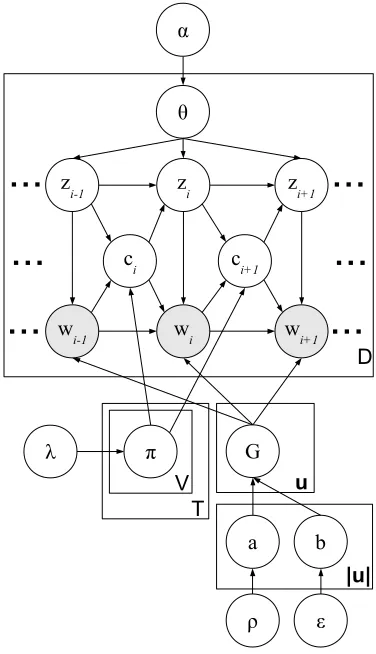
Figure 2: PDLDA drawn in plate notation.
contexts, is desirable so that a model like this does not need to independently infer the probability of every bigram under every topic. The advantages of smoothing are especially pronounced for small cor-pora or for a large number of topics. In these sit-uations, the observed number of bigrams in a given topic will necessarily be very small and thus not sup-port strong inferences.
3 PDLDA
A more natural definition of a topical phrase, one which meets our second desideratum, is to have each phrase possess a single topic. We adopt this in-tuitive idea in PDLDA. It can also be understood through the lens of Bayesian changepoint detection. Changepoint detection is used in time series mod-els in which the generative parameters periodically change abruptly (Adams and MacKay, 2007). View-ing a sentence as a time series of words, we posit that the generative parameter, the topic, changes
period-ically in accordance with the changepoint indicators c. Because there is no restriction on the number of words between changepoints, topical phrases can be arbitrarily long but will always have a single topic drawn fromθd.
The full definition of PDLDA is given by
wi|u ∼ Discrete(Gu)
Gu ∼ PYP(a|u|, b|u|, Gπ(u))
G∅ ∼ PYP(a0, b0, H)
zi|d, zi−1, θd, ci ∼ (
δzi−1 ifci = 0
Discrete(θd) ifci = 1
ci|wi−1, zi−1, π ∼ Bernoulli πwi−1zi−1
with the prior distriutions over the parameters as
θd∼Dirichlet(α) πzw∼Beta(λ) a|u|∼Beta(ρ) b|u|∼Gamma()
Like TNG, PDLDA assumes that the probability of a changepointci+1after theith token depends on
the current topic zi and word wi. This causes the length of a phrase to depend on its topic and con-stituent words. The changepoints explicitly model which words tend to start and end phrases in each document. Depending on ci, zi is either set deter-ministically to the preceding topic (when ci = 0) or is drawn anew fromθd (when ci = 1). In this way, each topical phrase has a single topic drawn from its document’s topic distribution. As in TNG, the parametersπzwandθdare given conjugate priors parameterized byλandα.
Let u be a context vector consisting of the phrase topic and the past m words: u , < zi, wi−1, wi−2, . . . , wi−m >. The operatorπ(u) de-notes the prefix ofu, the vector with the rightmost element ofuremoved. |u|denotes the length ofu, and∅represents an empty context. For practical rea-sons, we paduwith a special start symbol when the context overlaps a phrase boundary. For example, the first wordwiof a phrase beginning at a position inecessarily hasci = 1; consequently, all the pre-ceding wordswi−j in the context vector are treated as start symbols so thatwiis effectively drawn from a topic-specific unigram distribution.
H
Gz 1
Gz 1:honda
GØ z1
honda
Gz 1:civic
civic
Gz 2
Gz 2:honda
z2
honda
Gz 2:civic
civic
Figure 3: Illustration of the hierarchical Pitman-Yor process for a toy two-word vocabularyV ={honda,
civic} and two-topic (T = 2) model with m = 1. Each node G in the tree is a Pitman-Yor process whose base distribution is its parent node, andHis a uniform distribution overV. When, for example, the context isu =z1 : honda, the darkened path is
fol-lowed and the probability of the next word is calcu-lated from the shaded node using Equation 1, which combines predictions from all the nodes along the darkened path.
distributions used are Pitman-Yor processes (PYPs) linked together into a tree structure. This hierar-chical construction creates the desired smoothing among different contexts. The next section explains this hierarchical distribution in more detail.
3.1 Hierarchical Pitman-Yor process
Words in PDLDA are emitted from Gu, which has
a PYP prior (Pitman and Yor, 1997). PYPs are a generalization of the Dirichlet Process, with the ad-dition of a discount parameter 0 ≤ a ≤ 1. When considering the distribution of a sequence of words wdrawniidfrom a PYP-distributedG, one can an-alytically marginalize Gand consider the resulting conditional distribution ofwgiven its parametersa, b, and base distribution φ. This marginal can best be understood by considering the distribution of any wi|w1, . . . , wi−1, a, b, φ, which is characterized by
a generative process known as the generalized Chi-nese Restaurant Process(CRP) (Pitman, 2002). In the CRP metaphor, one imagines a restaurant with an unbounded number of tables, where each table has one shared dish (a draw fromφ) and can seat an unlimited number of customers. The CRP specifies a
process by which customers entering the restaurant choose a table to sit at and, consequently, the dish they eat. The first customer to arrive always sits at the first table. Subsequent customers sit at an occu-pied tablekwith probability proportional tock−a and choose a new unoccupied table with probabil-ity proportional to b+ta, whereck is the number of customers seated at tablek andt is the number of occupied tables inG. For our language modeling purposes, “customers” are word tokens and “dishes” are word types.
The hierarchical PYP (HPYP) is an intuitive re-cursive formulation of the PYP in which the base distribution φ is itself PYP-distributed. Figure 3 demonstrates this principle as applied to PDLDA. The hierarchy forms a tree structure, where leaves are restaurants corresponding to full contexts and in-ternal nodes correspond to partial contexts. An edge between a parent and child node represents a depen-dency of the child on the parent, where the base dis-tribution of the child node is its parent. This smooths each context’s distribution like the Bayesiann-gram model of Teh (2006), which is a Bayesian version of interpolated Kneser-Ney smoothing (Chen and Goodman, 1998). One ramification of this setup is that if a word occurs in a context u, the shar-ing makes it more likely in other contexts that have something in common withu, such as a shared topic or word.
The HPYP gives the following probability for a word following the contextubeingw:
Pu(w|τ,a,b) =
cuw·−a|u|tuw b|u|+cu··
+
b|u|+a|u|tu·
b|u|+cu··
Pπ(u)(w|τ,a,b) (1)
wherePπ(∅)(w|τ,a,b) = G∅(w), cuw· is the
num-ber of customers eating dishwin restaurantu, and tuw is the number of tables serving w in restau-rantu, andτ represents the current seating arrange-ment. Here and throughout the rest of the paper, we use a dot to indicate marginal counts: e.g., cuw· =
P
kcuwk where cuwk is the number of customers eating w in u at table k. The base distribution of G∅was chosen to be uniform:H(w) = 1/V withV
|u|,|u| −1,. . .0and realizes the sharing of statisti-cal strength between different contexts.
3.2 Inference
In this section, we describe Markov chain Monte Carlo procedures to sample from P(z,c, τ|w, U), the posterior distribution over topic assignments z, phrase boundaries c, and seating arrangements τ given an observed corpus w. Let U be short-hand for α, λ,a,b. In order to draw samples from P(z,c, τ|w, U), we employ a Metropolis-Hastings sampler for approximate inference. The sampler we use is acollapsedsampler (Griffiths and Steyvers, 2004), wherein θ, φ, and G are analyti-cally marginalized. Because we marginalize eachG, we use the Chinese Restaurant Franchise representa-tion of the hierarchical PYPs (Teh, 2006). However, rather than onerously storing the table assignment of every token inw, we store only the counts of how many tables there are in a restaurant and how many customers are sitting at each table in that restaurant. We refer the inquisitive reader to the appendix of Teh (2006) for further details of this procedure.
Our sampling strategy for a given tokeniin doc-umentdis to jointly propose changes to the change-point ci and topic assignment zi, and then to the seating arrangementτ. Recall that according to the model, if ci = 0, zi = zi−1; otherwise zi is gen-erated from the topic distribution for document d. Since the topic assignment remains the same until a new changepoint at a positioni0 is reached, each to-kenwj forjfrom positioniuntili0−1will depend onzibecause for thesej,zj =zi. We call this set of tokens thephrase suffix of theith token and denote it s(i). More formally, lets(i) be the maximal set of continuous indicesj ≥iincludingisuch that, if j 6=i,cj = 0. That is,s(i)are the indices compris-ing the remainder of the phrase beginncompris-ing at position i. In addition, letx(i) indicate theextended suffix
version ofs(i)which includes one additional index: x(i) , {s(i)∪ {max (s(i)) + 1}}. In addition to the words in the suffixs(i), the changepoint indica-tor variablescj forjinx(i)are also conditioned on zi. To make these dependencies more explicit, we refer tozs(i) ,zj ∀j∈s(i), which are constrained by the model to share a topic.
The variables that depend directly on zi, ci are zs(i),ws(i),cx(i). The proposal distribution first
draws from a multinomial overT + 1options: one option forci = 0, zi = zi−1; and one for ci = 1 paired with each possiblezi =z ∈ 1. . . T. This is given by
P(zs(i), ci|z¬s(i),c¬i, τ¬s(i),w, U)∝
Y
j∈x(i)
n¬zjx−(1jw)j−1cj+λcj
n¬zj−x(1jw)j−1·+λ0+λ1
Y
j∈s(i)
P(zj|c,z¬s(j), U) Puj(wj|τ¬s(i), U)
with
P(zj|c,z¬s(j), U) =
n¬dzs(j)
j +α
n¬d·s(j)+T α
ifcj = 1
δzj,zj−1 ifcj = 0
where Puj(wj | τ¬s(i), U) is given by Equation 1,
T is the number of topics, n¬dzs(j) is the number of phrases in documentdthat have topiczwhens(j)’s assignment is excluded, andn¬zwcs(j)is the number of times a changepointchas followed a wordw with topiczwhens(j)’s assignments are excluded.
After drawing a proposal for ci,zs(i) for tokeni,
the sampler adds a customer eating wi to a table serving wi in restaurant ui. An old table k is se-lected with probability∝ max(0, cuwk−a|u|)and
a new table is selected with probability ∝ (b|ui|+
a|ui|tui·)Pπ(u)(wi).
Let z0s(i), c0i, τs0(i) denote the proposed change to zs(i), ci, τs(i). We accept the proposal with
probabil-itymin(A,1)where
A= ˆ
P(z0s(i), c0i, τs0(i))Q(zs(i), ci, τs(i))
ˆ
P(zs(i), ci, τs(i))Q(z0s(i), c 0
i, τs0(i))
where Q is the proposal distribution and Pˆ is the true unnormalized distribution. Pˆ differs fromQin that the probability of each wordwjand the seating arrangement depends only on¬s(j), as opposed to the simplification of using¬s(i). Almost all propos-als are accepted; hence, this theoretically motivated Metropolis Hastings correction step makes little dif-ference in practice.
interleave a slice sampling algorithm (Neal, 2000) between sweeps of the Metropolis-Hastings sampler to learn these parameters. We chose not to do infer-ence on α in order to make the tests of our model against TNG more equitable.
4 Related Work
An integral part of modeling topical phrases is the relaxation of the bag-of-words assumption in LDA. There are many models that make this relaxation. Among them, Griffiths and Steyvers (2005) present a model in which words are generated either con-ditioned on a topic or concon-ditioned on the previous word in a bigram, but not both. They use this to model human performance on a word-association task. Wallach (2006) experiments with incorpo-rating LDA into a bigram language model. Her model uses a hierarchical Dirichlet to share param-eters across bigrams in a topic in a manner similar to our use of PYPs, but it lacks a notion of the topic being shared between the words in ann-gram. The Hidden Topic Markov Model (HTMM) (Gruber et al., 2007) assumes that all words in a sentence have the same topic, and consecutive sentences are likely to have the same topic. By dropping the indepen-dence assumption among topics, HTMM is able to achieve lower perplexity scores than LDA at mini-mal additional computational costs. These models are unconcerned with topicaln-grams and thus do not model phrases.
Johnson (2010) presents an Adaptor Grammar model of topical phrases. Adaptor Grammars are a framework for specifying nonparametric Bayesian models over context-free grammars in which certain subtrees are “memoized” or remembered for reuse. In Johnson’s model, subtrees corresponding to com-mon phrases for a topic are memoized, resulting in a model in which each topic is associated with a distri-bution over whole phrases. While it is a theoretically elegant method for finding topical phrases, for large corpora we found inference to be impractically slow.
5 Phrase Intrusion Experiment
Perplexity is the typical information theoretic mea-sure of language model quality used in lieu of ex-trinsic measures, which are more difficult and costly to run. However, it is well known that perplexity
Trial 1 of 80 countries
britain france museum
Trial 2 of 80 air force beverly hills defense minister
u.s. troops
Trial 3 of 80 fda book smoking cigarettes
Trial 4 of 80 roman catholic church
[image:7.612.334.519.56.177.2]air traffic controllers roman catholic priest roman catholic bishop
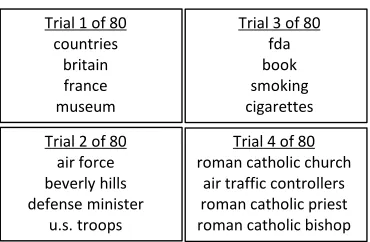
Figure 4: Experimental setup of the phrase intrusion experiment in which subjects must click on the n-gram that does not belong.
scores may negatively correlate with actual quality as assessed by humans (Chang et al., 2009). With that fact in mind, we expanded the methodology of Chang et al. (2009) to create a “phrase intrusion” task that quantitatively compares the quality of the topicaln-gram lists produced by our model against those of other models.
Each of 48 subjects underwent 80 trials of a web-based experiment on Amazon Mechanical Turk, a reliable (Paolacci et al., 2010) and increasingly com-mon venue for conducting online experiments. In each trial, a subject is presented with a randomly or-dered list of fourn-grams (cf. Figure 4). Each sub-ject’s task is to select theintruder phrase, a spurious n-gram not belonging with the others in the list. If, other than the intruder, the items in the list are all on the same topic, then subjects can easily identify the intruder because the list is semantically cohesive and makes sense. If the list is incohesive and has no discernible topic, subjects must guess arbitrarily and performance is at random.
Unigrams Bigrams Trigrams 0
0.2 0.4 0.6 0.8 1
Model Precision
PDLDA TNG LDA
(a) Word repetition allowed within a list.
Bigrams Trigrams 0
0.2 0.4 0.6 0.8 1
Model Precision
PDLDA TNG
[image:8.612.91.524.69.229.2](b) Word repetition not allowed.
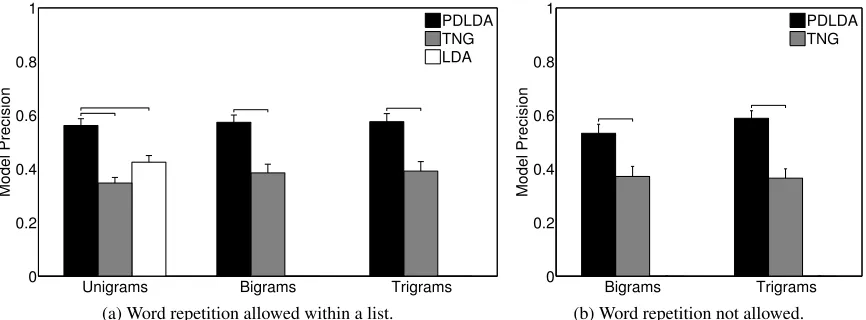
Figure 5: An across-subject measure of the ability to detect intruders as a function of n-gram size and model. Excluding trials with repeated words does not qualitatively affect the results.
wrong were excluded from our analyses.
Each subject was presented with trials constructed from the output of PDLDA and TNG for unigrams, bigrams, and trigrams. For unigrams, we also tested the output of the original smoothed LDA (Blei et al., 2003). The experiment was conducted twice for a 2,246-document subset of the TREC AP corpus (Blei et al., 2003; Harman, 1992): the first time pro-ceeded as described above, but the second time did not allow word repetition within a topic’s list. The topical phrases found by TNG and PDLDA often revolve around a central n-gram, with other words pre- or post- appended to it. In this intrusion exper-iment, anyn-gram not containing the central word or phrase may be trivially identifiable, regardless of its relevance to the topic. For example, the intruder in Trial 4 of Figure 4 is easily identifiable even if a subject does not understand English. This second experiment was designed to test whether our conclu-sions hinge on word repetition.
We used the MALLET toolbox (McCallum, 2002) for the implementations of LDA and TNG. Each model was run with 100 topics for 5,000 it-erations. We setm = 2,α =.01,β =.01,λ= 1, π1 = π2 = 1,ρ1 = 10, andρ2 =.1. For all
mod-els, we treated certain punctuation as the start of a phrase by settingcj = 1for all tokensjimmediately following periods, commas, semicolons, and excla-mation and question marks. To reduce runtime, we removed stopwords occuring in the MALLET
tool-box’s stopword list. Because TNG and LDA had trouble with single character words not in the sto-plist, we manually removed them before the experi-ment. Any token immediately following a removed word was treated as if it were the start of a phrase.
As in Chang et al. (2009), performance is mea-sured via model precision, the fraction of subjects agreeing with the model. It is defined as MPm,nk =
P
s
1(im,nk,s = ωk,sm,n)/S where ωk,sm,n is the index of the intrudingn-gram for subjectsamong the words generated from thekth topic of modelm,im,nk,s is the intruder selected bys, andS is the number of sub-jects. The model precisions are shown in Figure 5. PDLDA achieves the highest precision in all condi-tions. Model precision is low in all models, which is a reflection of how challenging the task is on a small corpus laden with proper nouns and low-frequency words. Figure 5b demonstrates that the outcome of the experiment does not depend strongly on whether the topicaln-gram lists have repeated words.
6 Conclusion
those found by TNG.
The formalism of Bayesian changepoint detection arose naturally from the intuitive assumption that the topic of a sequence of tokens changes periodically, and that the tokens in between changepoints com-prise a phrase. This formalism provides a principled way to discover phrases within the LDA framework. We presented a model embodying these principles and showed how to incorporate dependent Pitman-Yor processes into it.
Acknowledgements
The first author is supported by an NSF Graduate Research Fellowship. The first and second authors began this project while working at J.D. Power & Associates. We are indebted to Michael Mozer, Matt Wilder, and Nicolas Nicolov for their advice.
References
Ryan Prescott Adams and David J.C. MacKay. 2007. Bayesian online changepoint detection. Technical re-port, University of Cambridge, Cambridge, UK. David M. Blei, Andrew Y. Ng, Michael I. Jordan, and
John Lafferty. 2003. Latent dirichlet allocation. Jour-nal of Machine Learning Research, 3:993–1022. Jonathan Chang, Jordan Boyd-Graber, Sean Gerrish,
Chong Wang, and David M. Blei. 2009. Reading tea leaves: How humans interpret topic models. InNeural Information Processing Systems (NIPS).
Stanley F. Chen and Joshua Goodman. 1998. An empiri-cal study of smoothing techniques for language model-ing. Technical Report TR-10-98, Center for Research in Computing Technology, Harvard University. T. L. Griffiths and M. Steyvers. 2004. Finding
scien-tific topics. Proceedings of the National Academy of Sciences, 101(Suppl. 1):5228–5235, April.
Thomas L. Griffiths, Mark Steyvers, David M. Blei, and Joshua B. Tenenbaum. 2005. Integrating topics and syntax. InAdvances in Neural Information Processing Systems 17, pages 537–544. MIT Press.
Thomas L. Griffiths, Joshua B. Tenenbaum, and Mark Steyvers. 2007. Topics in semantic representation. Psychological Review, 114:211–244.
Amit Gruber, Yair Weiss, and Michal Rosen-Zvi. 2007. Hidden topic Markov models. Journal of Machine Learning Research - Proceedings Track, 2:163–170. Donna Harman. 1992. Overview of the first text
re-trieval conference (trec–1). In Proceedings of the first Text REtrieval Conference (TREC–1), Washing-ton DC, USA.
Mark Johnson. 2010. PCFGs, Topic Models, Adaptor Grammars and Learning Topical Collocations and the Structure of Proper Names. InProceedings of the 48th Annual Meeting of the Association for Computational Linguistics, pages 1148–1157, Uppsala, Sweden, July. Association for Computational Linguistics.
Thomas K. Landauer and Susan T. Dumais. 1997. A so-lution to plato’s problem: The latent semantic analysis theory of acquisition, induction, and representation of knowledge.Psychological Review, 104(2):211 – 240.
Andrew Kachites McCallum. 2002.
Mal-let: A machine learning for language toolkit. http://mallet.cs.umass.edu.
Radford Neal. 2000. Slice sampling. Annals of Statis-tics, 31:705–767.
Gabriele Paolacci, Jesse Chandler, and Panagiotis G. Ipeirotis. 2010. Running experiments on Amazon Mechanical Turk. Judgment and Decision Making, 5(5):411–419.
J. Pitman and M. Yor. 1997. The two-parameter Poisson-Dirichlet distribution derived from a stable subordina-tor.Annals of Probability, 25:855–900.
J. Pitman. 2002. Combinatorial stochastic processes. Technical Report 621, Department of Statistics, Uni-versity of California at Berkeley.
Patrick Schone and Daniel Jurafsky. 2001. Is
knowledge-free induction of multiword unit dictionary headwords a solved problem? In Lillian Lee and Donna Harman, editors,Proceedings of the 2001 Con-ference on Empirical Methods in Natural Language Processing, pages 100–108.
Yee Whye Teh. 2006. A hierarchical Bayesian language model based on Pitman-Yor processes. In Proceed-ings of the 21st International Conference on Compu-tational Linguistics and the 44th Annual Meeting of the Association for Computational Linguistics, ACL-44, pages 985–992, Morristown, NJ, USA. Associa-tion for ComputaAssocia-tional Linguistics.
Hanna M. Wallach. 2006. Topic modeling: beyond bag-of-words. In Proceedings of the 23rd International Conference on Machine Learning, pages 977–984. Xuerui Wang, Andrew McCallum, and Xing Wei. 2007.