Dependency Language Models for Transition-based Dependency Parsing
Juntao Yu
University of Birmingham Birmingham, UK [email protected]
Bernd Bohnet
Google London, UK
Abstract
In this paper, we present an approach to improve the accuracy of a strong transition-based dependency parser by ex-ploiting dependency language models that are extracted from a large parsed corpus. We integrated a small number of features based on the dependency language mod-els into the parser. To demonstrate the effectiveness of the proposed approach, we evaluate our parser on standard En-glish and Chinese data where the base parser could achieve competitive accuracy scores. Our enhanced parser achieved state-of-the-art accuracy on Chinese data and competitive results on English data. We gained a large absolute improvement of one point (UAS) on Chinese and 0.5 points for English.
1 Introduction
In recent years, using unlabeled data to improve natural language parsing has seen a surge of in-terest as the data can easy and inexpensively be obtained, cf. (Sarkar,2001;Steedman et al.,2003; McClosky et al.,2006;Koo et al., 2008;Søgaard
and Rishøj, 2010; Petrov and McDonald, 2012;
Chen et al., 2013;Weiss et al.,2015). This is in stark contrast to the high costs of manually la-beling new data. Some of the techniques such as self-training (McClosky et al., 2006) and co-training (Sarkar, 2001) use auto-parsed data as additional training data. This enables the parser to learn from its own or other parser’s annota-tions. Other techniques include word clustering
(Koo et al., 2008) and word embedding (Bengio
et al., 2003) which are generated from a large
amount of unannotated data. The outputs can be used as features or inputs for parsers. Both groups
of techniques have been shown effective on syn-tactic parsing tasks (Zhou and Li,2005;Reichart
and Rappoport, 2007; Sagae, 2010;Søgaard and
Rishøj,2010;Yu et al.,2015;Weiss et al.,2015). However, most word clustering and the word em-bedding approaches do not consider the syntactic structures and most self-/co-training approaches can use only a relatively small additional training data as training parsers on a large corpus might be time-consuming or even intractable on a corpus of millions of sentences.
Dependency language models (DLM) (Shen et al.,2008) are variants of language models based on dependency structures. An N-gram DLM is able to predict the next child when given N-1 im-mediate previous children and their head. Chen
et al. (2012) integrated first a high-order DLM
into a second-order graph-based parser. The DLM allows the parser to explore high-order features but not increasing the time complexity.
Follow-ing Chen et al. (2012), we adapted the DLM
to transition-based dependency parsing. Our ap-proach is different fromChen et al.(2012)’s in a number of important aspects:
1. We applied the DLM to a strong parser that on its own has a competitive performance.
2. We revised their feature templates to inte-grate the DLMs with a transition-based sys-tem and labeled parsing.
3. We used DLMs in joint tagging and parsing, and gained up to 0.4% on tagging accuracy.
4. Our approach could use not only single DLM but also multiple DLMs during parsing.
5. We evaluated additionally with DLMs ex-tracted from higher quality parsed data which two parsers assigned the same annotations.
Overall, our approach improved upon a compet-itive baseline by 0.51% for English and achieved state-of-the-art accuracy for Chinese.
2 Related work
Previous studies using unlabeled text could be classified into two groups by how unlabeled data is used for training.
The first group uses unlabeled data (usually parsed data) directly in the training process as additional training data. The most common ap-proaches in this group are self-/co-training. Mc-Closky et al. (2006) applied first self-training to a constituency parser. This was later adapted to dependency parsing by Kawahara and Uchimoto (2008) and Yu et al. (2015). Compared to the self-training approach used by McClosky et al. (2006), both self-training approaches for depen-dency parsing need an additional selection step to predict high-quality parsed sentences for retrain-ing. The basic idea behind this is similar toSagae and Tsujii(2007)’s co-training approach. Instead of using a separately trained classifier (Kawahara
and Uchimoto, 2008) or confidence-based
meth-ods (Yu et al., 2015), Sagae and Tsujii (2007) used two different parsers to obtain the additional training data. Sagae and Tsujii(2007) shows that when two parsers assign the same syntactic anal-ysis to sentences then the parse trees have usually a higher parsing accuracy. Tri-training (Zhou and Li,2005;Søgaard and Rishøj,2010) is a variant of co-training which involves a third parser. The base parser is retrained on additional parse trees that the other two parsers agreed on.
The second group uses the unlabeled data in-directly. Koo et al. (2008) used word clusters built from unlabeled data to train a parser. Chen
et al. (2008) used features extracted from short
distance relations of a parsed corpus to improve a dependency parsing model.Suzuki et al.(2009) used features of generative models estimated from large unlabelled data to improve a second order dependency parser. Their enhanced models im-proved upon the second order baseline models by 0.65% and 0.15% for English and Czech respec-tively. Mirroshandel et al. (2012) used the rela-tive frequencies of nine manually selected head-dependent patterns calculated from parsed French corpora to rescore the n-best parses. Their ap-proach gained a labeled improvement of 0.8% over the baseline. Chen et al. (2013) combined
meta features based on frequencies with the ba-sic first-/second-order features. The meta features are extracted from parsed annotations by counting the frequencies of basic feature representations in a large corpus. With the help of meta features, the parser achieved the state-of-the-art accuracy on Chinese. Kiperwasser and Goldberg (2015) added features based on the statistics learned from unlabeled data to a weak first-order parser and they achieved 0.7% improvement on the English data. Word embeddings that represent words as high di-mensional vectors are mostly used in neural net-work parsers (Chen and Manning, 2014; Weiss et al., 2015) and play an important role in those parsers. The approach most close to ours is re-ported byChen et al.(2012) who applied a high-order DLM to a second-high-order graph-based parser for unlabeled parsing. Their DLMs are extracted from an English corpus that contains 43 million words (Charniak, 2000) and a 311 million word corpus of Chinese (Huang et al.,2009) parsed by a parser. From a relatively weak baseline, addi-tional DLM-based features gained 0.6% UAS for English and an impressive 2.9% for Chinese.
3 Our Approach
Dependency language models were introduced by Shen et al. (2008) to capture long distance rela-tions in syntactic structures. An N-gram DLM predicts the next child based on N-1 immediate previous children and their head. We integrate DLMs extracted from a large parsed corpus into the Mate parser (Bohnet et al., 2013). We first extract DLMs from a corpus parsed by the base model. We then retrain the parser with additional DLM-based features.
Further, we experimented with techniques to improve the quality of the syntactic annotations which we use to build the DLMs. We parse the sentences with two different parsers and then se-lect the annotations which both parsers agree on. The method is similar to co-training except that we do not train the parser directly on these sentences. We build the DLMs with the method of Chen et al.(2012). For each childxch, we gain the
prob-ability distribution Pu(xch|H), where H refers
N−1immediate previous children and their head xh. The previous children for xch are those who
share the same head withxchbut closer to the head
< NODLM, φ(Pu(s0)), φ(Pu(s1)), label > < NODLM, φ(Pu(s0)), φ(Pu(s1)), label, s0pos > < NODLM, φ(Pu(s0)), φ(Pu(s1)), label, s0word > < NODLM, φ(Pu(s0)), φ(Pu(s1)), label, s1pos > < NODLM, φ(Pu(s0)), φ(Pu(s1)), label, s1word > < NODLM, φ(Pu(s0)), φ(Pu(s1)), label, s0pos, s1pos > < NODLM, φ(Pu(s0)), φ(Pu(s1)), label, s0word, s1word >
Table 1: Feature templates which we use in the parser.
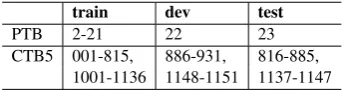
train dev test
PTB 2-21 22 23
CTB5 001-815, 886-931, 816-885, 1001-1136 1148-1151 1137-1147
Table 2: Our data splits for English and Chinese
dependency relations (xLk...xL1, xh, xR1...xRm)
as an example, the N-1 immediate previous chil-dren for xLk are xLk−1..xLk−N+1. In our ap-proach, we estimatePu(xch|H)by the relative
fre-quency:
Pu(xch|H) = Pcount(xch, H) x0
chcount(x 0
ch, H) (1)
By their probabilities, the N-grams are sorted in a descending order. We then used the thresholds ofChen et al. (2012) to replace the probabilities with one of the three classes (P H, P M, P L) ac-cording to their position in the sorted list, i.e. the N-grams whose probability has a rank in the first 10% receives the tagP H,P Mrefers probabilities ranked between 10% and 30%, probabilities that ranked below 30% are replaced withP L. During parsing, we use an additional class P O for rela-tions not presented in the DLM. In the preliminary experiments, theP H class is mainly filled by un-usual relations that only appeared a few times in the parsed text. To avoid this, we configured the DLMs to only use elements which have a mini-mum frequency of three, i.e. count(xch, H) ≥ 3. Table 1 shows our feature templates, where NODLM is an index which allows DLMs
distin-guish from each other,s0, s1 are the top and the second top of the stack, φ(Pu(s0/s1))refers the coarse label of probabilitiesPu(xs0/s1|H)(one of
the P H, P M, P L, P O), s0/s1 pos, s0/s1 word refer to the part-of-speech tag, word form of s0/s1, andlabelis the dependency label between thes0and thes1.
4 Experimental Set-up
For our experiments, we used the Penn English Treebank (PTB) (Marcus et al.,1993) and Chinese Treebank 5 (CTB5) (Xue et al., 2005). For En-glish, we follow the standard splits and used Stan-ford parser 1 v3.3.0 to convert the constituency trees into Stanford style dependencies (de
Marn-effe et al., 2006). For Chinese, we follow the
splits ofZhang and Nivre(2011), the constituency trees are converted to dependency relations by Penn2Malt2 tool using head rules of Zhang and Clark(2008). Table2shows the splits of our data. We used gold segmentation for Chinese tests to make our work comparable with previous work. We used predicted part-of-speech tags for both languages in all evaluations. Tags are assigned by base parser’s internal joint tagger trained on the training set. We report labeled (LAS) and unlabeled (UAS) attachment scores, punctuation marks are excluded from the evaluation.
For the English unlabeled data, we used the data ofChelba et al.(2013) which contains around 30 million sentences (800 million words) from the news domain. For Chinese, we used Xin-hua portion of Chinese Gigaword 3 Version 5.0 (LDC2011T13). The Chinese unlabeled data we used consists of 20 million sentences which is roughly 450 million words after being segmented by ZPar4 v0.7.5. The word segmentor is trained on the CTB5 training set. In most of our exper-iments, the DLMs are extracted from data anno-tated by our base parser. For the evaluation on higher quality DLMs, the unlabeled data is ad-ditionally tagged and parsed by Berkeley parser (Petrov and Klein, 2007) and is converted to de-pendency trees with the same tools as for gold data.
We used Mate transition-based parser with its default setting and a beam of 40 as our baseline.
5 Results and Discussion
Combining different N-gram DLMs. We first
evaluated the effects of adding different number of DLMs. Letmbe the DLMs we used in the ex-periments, e.g. m=1-3 refers all three (unigram, bigram and trigram) DLMs are used. We evaluate
1http://nlp.stanford.edu/software/lex-parser.shtml 2http://stp.lingfil.uu.se/ nivre/research/Penn2Malt.html 3We excluded the sentences of CTB5 from Chinese Giga-word corpus.
[image:3.595.95.269.186.231.2]with both single and multiple DLMs that extracted from 5 million sentences for both languages. We started from only using unigram DLM (m=1) and then increasing themuntil the accuracy drops. Ta-ble 3 shows the results with different DLM set-tings. The unigram DLM is most effective for English, which improves above the baseline by 0.38%. For Chinese, our approach gained a large improvement of 1.16% with an m of 1-3. Thus, we use m=1 for English and m=1-3 for Chinese in the rest of our experiments.
Exploring DLMs built from corpora of
dif-ferent size and quality. To evaluate the
influ-ence of the size and quality of the input corpus for building the DLMs, we experiment with corpora of different size and quality.
We first evaluate with DLMs extracted from the different number of single-parsed sentences. We extracted DLMs start from a 5 million sentences corpus and increase the size of the corpus in step until all of the auto-parsed sentences are used. Ta-ble4shows our results on English and Chinese de-velopment sets. For English, the highest accuracy is still achieved by DLM extracted from 5 million sentences. While for Chinese, we gain the largest improvement of 1.2% with DLMs extracted from 10 million sentences.
We further evaluate the influence of DLMs ex-tracted from higher quality data. The higher quality corpora are prepared by parsing unlabeled sentences with the Mate parser and the Berke-ley parser and adding the sentences to the corpus where both parsers agree. For Chinese, only 1 million sentences that consist of 5 tokens in av-erage had the same syntactic structures assigned by the two parsers. Unfortunately, this amount is not sufficient for the experiments as their average sentence length is in stark contrast with the train-ing data (27.1 tokens). For English, we obtained 7 million sentences with an average sentence length of 16.9 tokens.
To get a first impression of the quality, we parsed the development set with the two parsers. When the parsers agree, the parse trees have an accuracy of 97% LAS, while the labeled scores of both parsers are around 91%. This indicates that parse trees where both parsers return the same tree have a higher accuracy. The DLM extracted from 7 million higher quality English sentences achieved a higher accuracy of 91.56% which out-perform the baseline by 0.51%.
m 0 1 2 3 1-2 1-3 1-4
English 91.05 91.43 91.14 91.22 91.27 91.26 N/A Chinese 78.95 79.85 79.42 79.06 79.97 80.11 79.73
Table 3: Effects (LAS) of different number of DLMs for English and Chinese. m= 0 refers the baseline.
Size 0 5 10 20 30
English 91.05 91.43 91.38 91.13 91.28 Chinese 78.95 80.11 80.15 79.72 N/A
Table 4: Effects (LAS) of DLMs extracted from different size (in million sentences) of corpus. Size = 0 refers the baseline.
Main Results on Test Sets. We applied the
best settings tuned on the development sets to the test sets. The best setting for English is the un-igram DLM derived from the double parsed sen-tences. Table5 presents our results and top per-forming dependency parsers which were evaluated on the same English data set. Our approach with 40 beams surpasses our baseline by 0.46/0.51% (LAS/UAS)5 and is only lower than the few best neural network systems. When we enlarge the beam, our enhanced models achieved similar im-provements. Our semi-supervised result with 150 beams are more competitive when compared with the state-of-the-art. We cannot directly compare our results with that of Chen et al. (2012) as they evaluated on an oldYamada and Matsumoto (2003) format. In order to have an idea of the accuracy difference between our baseline and the second-order graph-based parser they used, we include our baseline on Yamada and Matsumoto (2003) conversion. As shown in table5our base-line is 0.62% higher than their semi-supervised re-sult and this is 1.28% higher than their baseline. This confirms our claim that our baseline is much stronger.
For Chinese, we extracting the DLMs from 10 million sentences parsed by the Mate parser and using the unigram, bigram and the trigram DLMs together. Table6shows the results of our approach and a number of best Chinese parsers. Our system gained a large improvement of 0.93/0.98%6for la-beled and unlala-beled attachment scores when using a beam of 40. When larger beams are used our ap-proach achieved even larger improvement of more than one percentage point for both labeled and
un-5Significant in Dan Bikel’s test (p <10−3).
System Beam POS LAS UAS
Zhang and Nivre(2011) 32 97.44 90.95 93.00 Bohnet and Kuhn(2012) 80 97.44 91.19 93.27 Martins et al.(2013) N/A 97.44 90.55 92.89 Zhang and McDonald(2014) N/A 97.44 91.02 93.22 Chen and Manning(2014)† 1 N/A 89.60 91.80 Dyer et al.(2015)† 1 97.30 90.90 93.10 Weiss et al.(2015)† 8 97.44 92.05 93.99 Andor et al.(2016)† 32 97.44 92.79 94.61 Dozat and Manning(2017)† N/A N/A 94.08 95.74 Liu and Zhang(2017)† N/A N/A 95.20 96.20
[image:5.595.80.282.61.253.2]Chen et al.(2012) Baseline * 8 N/A N/A 92.10 Chen et al.(2012) DLM * 8 N/A N/A 92.76 Our Baseline * 40 97.33 92.44 93.38 Our Baseline 40 97.36 90.95 93.08 80 97.34 91.05 93.28 150 97.34 91.05 93.29 Our DLM 40 97.38 91.41 93.59 80 97.39 91.47 93.65 150 97.42 91.56 93.74
Table 5: Comparing with top performing parsers on English. (* means results that are evaluated
on Yamada and Matsumoto(2003) conversion. †
means neural network-based parsers)
System Beam POS LAS UAS
Hatori et al.(2011) 64 93.94 N/A 81.33
Li et al.(2012) N/A 94.60 79.01 81.67
Chen et al.(2013) N/A N/A N/A 83.08
Chen et al.(2015) N/A 93.61 N/A 82.94 Our Baseline 40 93.99 78.49 81.52 80 94.02 78.48 81.58 150 93.98 78.96 82.11 Our DLM 40 94.27 79.42 82.51 80 94.39 79.79 82.79 150 94.40 80.21 83.28
Table 6: Comparing with top performing parsers on Chinese.
labeled accuracy when compared to the respec-tive baselines. Our scores with the default beam size (40) are competitive and are 0.2% higher than the best reported result (Chen et al., 2013) when increasing the beam size to 150. Moreover, we gained improvements up to 0.42% for part-of-speech tagging on Chinese tests.
6 Conclusion
In this paper, we applied dependency language models (DLM) extracted from a large parsed cor-pus to a strong transition-based parser. We in-tegrated a small number of DLM-based features into the parser. We demonstrate the effectiveness of our DLM-based approach by applying our ap-proach to English and Chinese. We achieved sta-tistically significant improvements on labeled and unlabeled scores of both languages. Our parsing system improved by DLMs outperforms most of
the systems on English and is competitive. For Chinese, we gained a large improvement of one point and our accuracy is 0.2% higher than the best reported result. In addition to that, our approach gained an improvement of 0.4% on Chinese part-of-speech tagging.
References
Daniel Andor, Chris Alberti, David Weiss, Aliaksei Severyn, Alessandro Presta, Kuzman Ganchev, Slav Petrov, and Michael Collins. 2016. Globally nor-malized transition-based neural networks. In Pro-ceedings of the 54th Annual Meeting of the Asso-ciation for Computational Linguistics. pages 2442– 2452.
Yoshua Bengio, R´ejean Ducharme, Pascal Vincent, and Christian Janvin. 2003. A neural probabilistic lan-guage model. J. Mach. Learn. Res. 3:1137–1155. http://dl.acm.org/citation.cfm?id=944919.944966. Bernd Bohnet and Jonas Kuhn. 2012. The best of
both worlds – a graph-based completion model for transition-based parsers. InProceedings of the 13th Conference of the European Chpater of the Associ-ation for ComputAssoci-ational Linguistics (EACL). pages 77–87.
Bernd Bohnet, Joakim Nivre, Igor Boguslavsky, Rich´ard Farkas Filip Ginter, and Jan Hajic. 2013. Joint morphological and syntactic analysis for richly inflected languages. Transactions of the Associta-tion for ComputaAssocita-tional Linguistics1.
Eugene Charniak. 2000. A maximum-entropy-inspired parser. In Proceedings of the First Meeting of the North American Chapter of the Association for Computational Linguistics (NAACL). pages 132– 139.
Ciprian Chelba, Tomas Mikolov, Mike Schuster, Qi Ge, Thorsten Brants, and Philipp Koehn. 2013. One billion word benchmark for measuring progress in statistical language modeling. Computing Research Repository (CoRR)abs/1312.3005:1–6.
Danqi Chen and Christopher D Manning. 2014. A fast and accurate dependency parser using neural net-works. InEmpirical Methods in Natural Language Processing (EMNLP).
Wenliang Chen, Youzheng Wu, and Hitoshi Isahara. 2008. Learning reliable information for depen-dency parsing adaptation. In Proceedings of the 22nd International Conference on Computational Linguistics-Volume 1. Association for Computa-tional Linguistics, pages 113–120.
[image:5.595.87.277.327.446.2]Computational Linguistics: Long Papers-Volume 1. Association for Computational Linguistics, pages 213–222.
Wenliang Chen, Min Zhang, and Yue Zhang. 2013. Semi-supervised feature transformation for dependency parsing. In Proceedings of the 2013 Conference on Empirical Methods in Natural Language Processing. Association for Computational Linguistics, pages 1303–1313. http://aclweb.org/anthology/D13-1129.
Wenliang Chen, Min Zhang, and Yue Zhang. 2015. Distributed feature representations for
dependency parsing. IEEE/ACM Trans.
Au-dio, Speech and Lang. Proc. 23(3):451–460. https://doi.org/10.1109/TASLP.2014.2365359. Marie-Catherine de Marneffe, Bill MacCartney, and
Christopher D. Manning. 2006. Generating typed dependency parses from phrase structure parses. In
Proceedings of the 5th International Conference on Language Resources and Evaluation (LREC). Timothy Dozat and Christopher Manning. 2017.
Deep biaffine attention for neural dependency parsing. In Proceedings of the 5th Interna-tional Conference on Learning Representations. https://openreview.net/pdf?id=Hk95PK9le.
Chris Dyer, Miguel Ballesteros, Wang Ling, Austin Matthews, and Noah A. Smith. 2015. Transition-based dependency parsing with stack long short-term memory. In Proceedings of the 53rd An-nual Meeting of the Association for Computa-tional Linguistics and the 7th InternaComputa-tional Joint Conference on Natural Language Processing (Vol-ume 1: Long Papers). Association for Computa-tional Linguistics, Beijing, China, pages 334–343. http://www.aclweb.org/anthology/P15-1033. Jun Hatori, Takuya Matsuzaki, Yusuke Miyao, and
Jun’ichi Tsujii. 2011. Incremental joint pos tagging and dependency parsing in chinese. InProceedings of 5th International Joint Conference on Natural Language Processing. Asian Federation of Natural Language Processing, Chiang Mai, Thailand, pages 1216–1224. http://www.aclweb.org/anthology/I11-1136.
Liang Huang, Wenbin Jiang, and Qun Liu. 2009. Bilingually-constrained (monolingual) shift-reduce parsing. In Proceedings of the Conference on Em-pirical Methods in Natural Language Processing (EMNLP). pages 1222–1231.
Daisuke Kawahara and Kiyotaka Uchimoto. 2008. Learning reliability of parses for domain adaptation of dependency parsing. InIJCNLP. volume 8. Eliyahu Kiperwasser and Yoav Goldberg. 2015.
Semi-supervised dependency parsing using bilexical con-textual features from auto-parsed data. In Proceed-ings of the 2015 Conference on Empirical Methods in Natural Language Processing. Association for
Computational Linguistics, Lisbon, Portugal, pages 1348–1353. http://aclweb.org/anthology/D15-1158. Terry Koo, Xavier Carreras, and Michael Collins. 2008. Simple semi-supervised dependency parsing. In
Proceedings of the 46th Annual Meeting of the Asso-ciation for Computational Linguistics (ACL). pages 595–603.
Zhenghua Li, Min Zhang, Wanxiang Che, and Ting Liu. 2012. A separately passive-aggressive training algorithm for joint POS tagging and dependency parsing. In Proceedings of COL-ING 2012. The COLING 2012 Organizing Committee, Mumbai, India, pages 1681–1698. http://www.aclweb.org/anthology/C12-1103. J. Liu and Y. Zhang. 2017. In-Order Transition-based
Constituent Parsing. ArXiv e-prints.
Mitchell P. Marcus, Beatrice Santorini, and Mary Ann Marcinkiewicz. 1993. Building a large annotated corpus of English: The Penn Treebank. Computa-tional Linguistics19:313–330.
A. Martins, M. Almeida, and N. A. Smith. 2013. ”turn-ing on the turbo: Fast third-order non-projective turbo parsers”. InAnnual Meeting of the Associa-tion for ComputaAssocia-tional Linguistics - ACL. volume -, pages 617 – 622.
David McClosky, Eugene Charniak, and Mark John-son. 2006. Effective self-training for parsing. In
Proceedings of the Human Language Technology Conference of the NAACL, Main Conference. pages 152–159.
Seyed Abolghasem Mirroshandel, Alexis Nasr, and Joseph Le Roux. 2012. Semi-supervised depen-dency parsing using lexical affinities. In Proceed-ings of the 50th Annual Meeting of the Association for Computational Linguistics: Long Papers - Vol-ume 1. Association for Computational Linguistics, Stroudsburg, PA, USA, ACL ’12, pages 777–785. http://dl.acm.org/citation.cfm?id=2390524.2390634. Slav Petrov and Dan Klein. 2007. Improved inference
for unlexicalized parsing. In Proceedings of Hu-man Language Technologies: The Annual Confer-ence of the North American Chapter of the Associ-ation for ComputAssoci-ational Linguistics (NAACL HLT). pages 404–411.
Slav Petrov and Ryan McDonald. 2012. Overview of the 2012 shared task on parsing the web. InNotes of the First Workshop on Syntactic Analysis of Non-Canonical Language (SANCL).
Roi Reichart and Ari Rappoport. 2007. Self-training for enhancement and domain adaptation of statistical parsers trained on small datasets. InACL. volume 7, pages 616–623.
on Domain Adaptation for Natural Language Pro-cessing. Association for Computational Linguistics, pages 37–44.
Kenji Sagae and Jun’ichi Tsujii. 2007. Dependency parsing and domain adaptation with LR models and parser ensembles. In Proceedings of the CoNLL Shared Task of EMNLP-CoNLL 2007. pages 1044– 1050.
Anoop Sarkar. 2001. Applying co-training methods to statistical parsing. InProceedings of the Second Meeting of the North American Chapter of the As-sociation for Computational Linguistics (NAACL). pages 175–182.
Libin Shen, Jinxi Xu, and Ralph Weischedel. 2008. A new string-to-dependency machine translation al-gorithm with a target dependency language model.
ACL-08: HLTpage 577.
Anders Søgaard and Christian Rishøj. 2010. Semi-supervised dependency parsing using generalized tri-training. In Proceedings of the 23rd Interna-tional Conference on ComputaInterna-tional Linguistics. Association for Computational Linguistics, Strouds-burg, PA, USA, COLING ’10, pages 1065–1073. http://dl.acm.org/citation.cfm?id=1873781.1873901. Mark Steedman, Rebecca Hwa, Miles Osborne, and
Anoop Sarkar. 2003. Corrected co-training for sta-tistical parsers. InProceedings of the International Conference on Machine Learning (ICML). pages 95–102.
Jun Suzuki, Hideki Isozaki, Xavier Carreras, and Michael Collins. 2009. An empirical study of semi-supervised structured conditional mod-els for dependency parsing. In Proceedings of the 2009 Conference on Empirical Methods in Natural Language Processing. Association for Computational Linguistics, Singapore, pages 551– 560. http://www.aclweb.org/anthology/D/D09/D09-1058.
David Weiss, Chris Alberti, Michael Collins, and Slav Petrov. 2015. Structured training for neural network transition-based parsing. In Proceedings of ACL 2015. pages 323–333.
Naiwen Xue, Fei Xia, Fu-Dong Chiou, and Martha Palmer. 2005. The Penn Chinese Treebank: Phase structure annotation of a large corpus. Journal of Natural Language Engineering11:207–238. Hiroyasu Yamada and Yuji Matsumoto. 2003.
Statis-tical dependency analysis with support vector ma-chines. In Proceedings of the 8th International Workshop on Parsing Technologies (IWPT). pages 195–206.
Juntao Yu, Mohab Elkaref, and Bernd Bohnet. 2015. Domain adaptation for dependency parsing via self-training. In Proceedings of the 14th International Conference on Parsing Technologies. Association for Computational Linguistics, Bilbao, Spain, pages 1–10.http://www.aclweb.org/anthology/W15-2201.
Hao Zhang and Ryan McDonald. 2014. Enforcing structural diversity in cube-pruned dependency pars-ing. InProceedings of the 52nd Annual Meeting of the Association for Computational Linguistics (Vol-ume 2: Short Papers). Association for Computa-tional Linguistics, Baltimore, Maryland, pages 656– 661. http://www.aclweb.org/anthology/P/P14/P14-2107.
Yue Zhang and Stephen Clark. 2008. A tale of two parsers: Investigating and combining graph-based and transition-based dependency parsing. In Pro-ceedings of the Conference on Empirical Methods in Natural Language Processing (EMNLP). pages 562–571.
Yue Zhang and Joakim Nivre. 2011. Transition-based parsing with rich non-local features. InProceedings of the 49th Annual Meeting of the Association for Computational Linguistics (ACL).
Zhi-Hua Zhou and Ming Li. 2005. Tri-training: Exploiting unlabeled data using three classifiers.