Self-Training for Jointly Learning to Ask and Answer Questions
Mrinmaya Sachan Eric P. Xing
School of Computer Science Carnegie Mellon University
{mrinmays, epxing}@cs.cmu.edu
Abstract
Building curious machines that can answer as well as ask questions is an important challenge for AI. The two tasks of question answering and question generation are usually tackled separately in the NLP literature. At the same time, both require significant amounts of su-pervised data which is hard to obtain in many domains. To alleviate these issues, we pro-pose a self-training method for jointly learning to ask as well as answer questions, leveraging unlabeled text along with labeled question an-swer pairs for learning. We evaluate our ap-proach on four benchmark datasets: SQUAD,
MS MARCO,WikiQA andTrecQA, and show significant improvements over a number of es-tablished baselines on both question answer-ing and question generation tasks. We also achieved new state-of-the-art results on two competitive answer sentence selection tasks:
WikiQAandTrecQA.
1 Introduction
Question Answering (QA) is a well-studied prob-lem in NLP which focuses on answering questions using some structured or unstructured sources of knowledge. Alongside question answering, there has also been some work on generating ques-tions (QG) (Heilman,2011;Du et al.,2017;Tang et al., 2017) which focuses on generating ques-tions based on given sources of knowledge.
QA and QG are closely related1tasks. However,
NLP literature views the two as entirely separate tasks. In this paper, we explore this relationship between the two tasks by jointly learning to gen-erate as well as answer questions. An improved ability to generate as well as answer questions will help us build curious machines that can interact with humans in a better manner. Joint modeling of
1We can think of QA and QG as inverse of each other.
QA and QG is useful as the two can be used in con-junction to generate novel questions from free text and then answers for the generated questions. We use this idea to perform self-training (Nigam and Ghani,2000) and leverage free text to augment the training of QA and QG models.
QA and QG models are typically trained on question answer pairs which are expensive to ob-tain in many domains. However, it is cheaper to obtain large quantities of free text. Our self-training procedure leverages unlabeled text to boost the quality of our QA and QG models. This is achieved by a careful data augmentation proce-dure which uses pre-trained QA and QG models to generate additional labeled question answer pairs. This additional data is then used to retrain our QA and QG models and the procedure is repeated.
This addition of synthetic labeled data needs to be performed carefully. During self-training, typically the mostconfidentsamples are added to the training set (Zhu,2005) in each iteration. We use the performance of our QA and QG models as a proxy for estimating theconfidencevalue of the questions. We describe a suite of heuristics inspired from curriculum learning (Bengio et al., 2009) to select the questions to be generated and added to the training set at each epoch. Curricu-lum learning is inspired from the incremental na-ture of human learning and orders training sam-ples on theeasinessscale so thateasysamples can be introduced to the learning algorithm first and
harder samples can be introduced successively. We show that introducing questions in increasing
order of hardness leads to improvements over a
baseline that introduces questions randomly. We use a seq2seq model with soft attention (Sutskever et al., 2014; Bahdanau et al., 2014)
for QG and a neural model inspired from
Atten-tive Reader (Hermann et al., 2015; Chen et al.,
2016) for QA. However, these can be any QA
and QG models. We evaluate our approach on
four datasets: SQUAD,MS MARCO,WikiQAand
TrecQA. We use a corpus of English Wikipedia as unlabeled text. Our experiments show that the self-training approach leads to significant im-provements over a number of established ap-proaches in QA and QG on these benchmarks. On the two answer sentence selection QA tasks: ( Wik-iQAandTrecQA), we obtain state-of-the-art.
2 Problem Setup
In this work, we focus on the task of machine com-prehension where the goal is to answer a question
qbased on a passagep. We model this as an an-swer sentence selection task i.e., given the set of sentences in the passage p, the task is to select
the sentence s ∈ p that contains the answer a.
Treating QA as an answer sentence selection task is quite common in literature (e.g. seeYu et al., 2014). We model QG as the task of transforming a sentence in the passage into a question. Previ-ous work in QG (Heilman and Smith,2009) trans-forms text sentences into questions via some set of manually engineered rules. However, we take an end-to-end neural approach.
Let D0 be a labeled dataset of (passage,
ques-tion, answer) triples where the answer is given by selecting a sentence in the passage. We also
as-sume access to unlabeled text T which will be
used to augment the training of the two models.
3 The Question Answering Model
Since we model QA as the task of selecting an an-swer sentence from the passage, we treat each sen-tence in the corresponding passage as a candidate answer for every input question.
We employ a neural network model inspired from theAttentive Readerframework proposed in Hermann et al. (2015); Chen et al. (2016). We map all words in the vocabulary to correspond-ing d dimensional vector representations via an
embedding matrix E ∈ Rd×V. Thus, the input
passage p can be denoted by the word sequence
{p1, p2, . . . p|p|} and the questionqcan similarly
be denoted by the word sequence{q1, q2, . . . q|q|}
where each tokenpi∈Rdandqi ∈Rd.
We use a bi-directional LSTM (Graves et al., 2005) with dropout regularization as inZaremba et al.(2014) to encode contextual embeddings of
each word in the passage:
~
ht=LSTM1
pt, ~ht−1
, ~ht=LSTM2
pt, ~ht+1
The final contextual embeddingshtare given by
concatenation of the forward and backward pass embeddings: ht = [~ht;h~ t]. Similarly, we use
an-other bi-directional LSTM and encode contextual embeddings of each word in the question.
Then, we use attention mechanism (Bahdanau
et al.,2014) to compute the alignment distribution
a based on the relevance among passage words
and the question: ai = softmax qTWhi. The
output vector o is a weighted combination of all
contextual embeddings: o=P
i
aihi. Finally, the
correct answera∗ among the set of candidate
an-swersAis given by:a∗ = arg max
a∈A
wTo.
We learn the model by maximizing the log-likelihood of correct answers. Given the training set{p(i),q(i),a(i)}N
i=1, the log-likelihood is:
LQA= N
X
i=1
logPa(i)|p(i),p(i);θ
Here,θrepresents all the model parameters to be
estimated.
4 The Question Generation Model
We use a seq2seq model (Sutskever et al., 2014) with soft attention (Bahdanau et al.,2014) as our QG model. The model transduces an input se-quence x to an input sequence y. Here, the
in-put sequence is a sentence in the passage and the output sequence is a generated question. Let
x = {x1, x2, . . . , x|x|}, y = {y1, y2, . . . , y|y|}
and Y be the space of all possible output
ques-tions. Thus, we can represent the QG task as find-ingyˆ ∈ Ysuch that: yˆ= arg max
y P(y|x).
Here,P(y|x)is the conditional probability of a
question sequenceygiven input sequencex.
Decoder: FollowingSutskever et al. (2014), the
conditional factorizes over token level predictions:
P(y|x) =
|y|
Y
t=1
P(yt|y<t,x)
Here, y<t represents the subsequence of words
generated prior to the time stept. For the decoder,
we again followSutskever et al.(2014):
P(yt|y<t,x) =softmax
WtanhWt[h(td);ct]
Here, h(td) is the decoder RNN state at time step t, andctis the attention based encoding of the
in-put sequencexat decoding time stept(described
later). Also W and Wt are model parameters
to be learned. We use an LSTM with dropout (Zaremba et al., 2014) as the decoder RNN. The LSTM generates the new decoder stateh(td)given
the representation of previously generated word
yt1 obtained using a look-up dictionary, and the
previous decoder stateh(td−)1.
Encoder: We use a bi-directional LSTM (Graves
et al.,2005) with attention mechanism as our sen-tence encoder. We use two LSTM’s: one that makes a forward pass in the sequence and another that makes a backward pass as in the QA model described earlier. We use dropout regularization
for LSTMs as in Zaremba et al. (2014) in our
implementation. The final context dependent to-ken representationh(te)is the concatenation of the
forward and backward pass token representations:
ht(e) = [~ht(e);h~ (te)]. To obtain the final context
de-pendent token representation cj at the decoding
time stepj, we take a weighted average over
to-ken representations: c(jd) =
|x|
P
i=1
aijh(ie).
Follow-ingBahdanau et al.(2014), the attention weights
aij are calculated by bilinear scoring followed by
softmax normalization:
aij =
exp
h(je)TW h(id)
P
i0
exp
h(je)TW h(id0)
Learning and Inference: We train the
en-coder deen-coder framework by maximizing data log-likelihood on a large training set with respect to all the model parametersθ. Let{x(i),y(i)}N
i=1be the
training set. The log-likelihood can be written as:
LQG = N
X
i=1
logPy(i)|x(i);θ
=
N
X
i=1
|y(i)|
X
j=1
logPy(ji)|x(i),y(<ji);θ
We use beam search for inference. As in previous works, we introduce a <UNK> token to model
rare words during decoding. These <UNK>
to-kens are finally replaced by the token in the input sentence with the highest attention score.
5 Self-training Framework for Joint Training of QA and QG models
In our self-training framework, we are given unlabeled text in addition to the labeled pas-sages, question and answer pairs. Self-training (Yarowsky,1995;Riloff et al.,2003), also known as self-teaching, is one of the earliest techniques for using unlabeled data along with labeled data to improve learning. During self-training, the learner keeps on labeling unlabeled examples and retrain-ing itself on an enlarged labeled trainretrain-ing set. We extend self-training to jointly learn two models (namely, QA and QG) iteratively. The QA and QG models are first trained on the labeled corpus. Then, the QG model is used to create more ques-tions from the unlabeled text corpus and the QA model is used to answer these newly created ques-tions. These new questions (carefully selected by an oracle – details later) and the original labelled data is then used to (stochastically) update these two models. This procedure can be repeated as long as both the two models continue to improve.
Algorithm 1:Self-training QA and QG.
1 θ(qa0)←Train initial QA model. 2 θ(qg0)←Train initial QG model. 3 Init: i = 0
4 whileperformance on dev set risesdo
5 CQi←Set of candidate questions generated using
our QG modelθqg(i)from the unlabeled textT
which are not inD.
6 Qi←k×miquestions drawn fromCQiusing
our question selector oracleQS.
7 Ai←Set of answers to questionsQiobtained
using our QA modelθ(qai).
8 LetDibe the set of chosen questionsQ iand
answersAi.
9 SubsampleS1⊂ Diof sizek1andS2⊂ D0of
sizek2. LetS=S1∪ S2
10 θ(qai+1)←Update QA model onS. 11 θ(qgi+1)←Update QG model onS.
12 i++
13 end
updated on a subsample of the newly generated datapoints and original unlabelled data.
Self-training has been seldom used in NLP. Most prominently, it has been used for WSD (Yarowsky, 1995), noun learning (Riloff et al., 2003) and AMR parsing and generation (Konstas et al.,2017). However, it has not been explored in this way for QA and QG.
5.1 The Question Selection Oracle
A key challenge in self-training is selecting which unlabeled data sample to label (iwhich generated questions to add to the training set). The self-training process may erroneously generate some bad or incorrect questions which can sidetrack the learning process. Thus, we implement a question selection oracle which determines which questions to add among the potentially very large set of ques-tions generated by the QG model in each iteration. Traditional wisdom in self-training (Yarowsky, 1995;Riloff et al.,2003) advises selecting a subset of questions on which the models have the highest
confidence. We experiment with this idea, propos-ing multiple self-trainpropos-ing oracles which introduce questions in the order of howconfidentthe QA and QG models are on the new potential question:
• QG:The QG oracle introduces the question
in the order of how confident the QG model is on generating the question. This is calculated by a number of heuristics (described later).
• QA:The QA oracle introduces the question
in the order of how confident the QA model is on answering the question. This too is cal-culated by some heuristics (described later).
• QA+QG: The QA+QG oracle introduces a
question when both QA and QG models are confident about the question. The oracle computes the minimum confidence of the QA and QG models for a question and introduces questions which have the the highest mini-mum confidence score.
Our question selection heurisitcs are based on the ideas ofcurriculum learninganddiversity:
1. Curriculum learning (Bengio et al., 2009; Sachan and Xing, 2016a) requires ordering questions on the easiness scale, so that easy questions can be introduced to the learning algorithm first and harder questions can be
introduced successively. The main challenge in learning the curriculum is that it requires the identification of easy and hard questions. In our setting, such a ranking of easy and hard questions is difficult to obtain. A human judgement of ‘easiness’ of a question might not correlate with what is easy for our algo-rithms in its feature and hypothesis space. We explore various heuristics that define a mea-sure of easiness and learn the ordering by se-lecting questions using this measure.
2. A number of cognitive scientists (Cantor, 1946) argue that alongside curriculum learn-ing, it is important to introduce diverse (even if sometimes hard) samples. Inspired by this, we introduce a measure ofdiversityand show that we can achieve further improvements by coupling the curriculum learning heuristics with a measure for diversity.
Curriculum Learning: Studies in cognitive
sci-ence (Skinner,1958;Peterson,2004;Krueger and Dayan,2009) have shown that humans learn much better when the training examples are not ran-domly presented but organized in increasing or-der of difficulty. In the machine learning commu-nity, this idea was introduced with the nomencla-ture ofcurriculum learning(Bengio et al.,2009), where a curriculum is designed by ranking sam-ples based on manually curated difficulty mea-sures. A manifestation of this idea is self-paced learning (SPL) (Kumar et al., 2010; Jiang et al., 2014, 2015) which selects samples based on the local loss term of the sample. We extend this idea and explore the following heuristics for our vari-ous oracles:
1) Greedy Optimal (GO): The simplest greedy
heuristic is to pick a questionqwhich has the
min-imum expected effect on the QA and QG models. The expected effect on addingqcan be written as:
X
a∈A
p(a∗ =a)E[LQA/QG]
Here,LQA/QGisLQA,LQGormin(LQA,LQG)
depending on which oracle we are using. p(a∗ = a) can be estimated by computing the scores of
each of the answer candidates forqand
normaliz-ing them.E[LQA/QG]can be estimated by
retrain-ing the model(s) after addretrain-ing this question.
2) Change in Objective (CiO):Choose question
there are multiple questions with the smallest in-crease in objective, pick one of them randomly.
3) Mini-max (M2): Choose questionq that
mini-mizes the expected risk when including the ques-tion with the answer candidate a that yields the
maximum error.
ˆ
q= arg min
q maxa∈ALQA/QG
4) Expected Change in Objective (ECiO): In
this greedy heuristic, we pick a questionq which
has the minimum expected effect on the model. The expected effect can be written as:
X
a
p(a∗ =a)×ELQA/QG
Here, p(a∗ = a) can again be achieved by
com-puting the scores of each of the answer candidates
forq and normalizing them andELQA/QGcan
be estimated by evaluating the model.
5) Change in Objective-Expected Change in
Objective (CiO - ECiO): We pick a question q
which has the minimum value of the difference between the change in objective and the expected change in objective described above. Intuitively, the difference represents how much the model is surprised to see this new question.
Time Complexity: GO and CiO require updating
the model, M2 and ECiO require performing
in-ference on candiate questions, and CiO - ECiO re-quires retraining as well as inference. Thus, M2
and ECiO are computationally most efficient.
Ensembling: We introduce an ensembling
strat-egy that combines the heuristics into an ensem-ble. We tried two ensembling strategies. The first strategy computes the average score over all the heuristics for all potential (top-K in beam) ques-tions and picks quesques-tions with the highest average. The second strategy uses minimum instead of the average. Minimum works better than average in practice and we use it in our experiments. The use of minimum is inspired by agreement-based learn-ing (Liang et al.,2008), a well-known extension of self-training which uses multiple views of the data (described using different feature sets or models) and adds new unlabeled samples to the training set when multiple models agree on the label.
Diversity: The strategy of introducing easy
ques-tions first and then gradually introducing harder questions is intuitive as it allows the learner to im-prove gradually. Yet, it has one key deficiency. With curriculum learning, by focusing on easy
questions first, our learning algorithm is usually not exposed to a diverse set of questions. This is particularly a problem for deep-learning ap-proaches that learn representations during the pro-cess of learning. Hence, when a harder question arrives, it can be difficult for the learner to ad-just to the new question as the current represen-tation may not be appropriate for the new level of question difficulty. We tackle this by introduc-ing an explore and exploit (E&E) strategy. E&E
ensures that while we still select easy questions first, we also want to make our selection as verse as possible. We define a measure for di-versity as the angle between the question vectors: ∠qi,qj =Cosine−1
|qiqj|
||qi||||qj||
. E&Epicks the question which optimizes a convex combination (tuned on the dev set) of the curriculum learning objective and sum of angles between the candidate questions and the questions in the training set.
6 Experiments
Implementation Details: We perform the same
preprocessing on all the text. We lower-case all the text. We use NLTK for word tokenization. For training our neural networks, we only keep the most frequent 50k words (including entity and placeholder markers), and map all other words to a special<UNK>token. We choose word
embed-ding size d = 100, and use the 100-dimensional
pretrained GloVe word embeddings (Pennington
et al., 2014) for initialization. We set k, m, k1
andk2 (hyperparameters for self-training) by grid
search on a held-out development set.
Datasets: We report our results on four datasets:
SQUAD (Rajpurkar et al., 2016), MS MARCO
(Nguyen et al.,2016),WikiQA(Yang et al.,2015) and TrecQA (Wang et al., 2007). SQUAD is a cloze-style reading comprehension dataset with questions posed by crowd workers on a set of Wikipedia articles, where the answer to each ques-tion is a segment of text from the corresponding
reading passage. MS MARCO contains questions
which are real anonymized queries issued through
Bing or Cortana and the documents are related web pages which may or help answer the question.
SQUAD MS MARCO WikiQA TrecQA
Train Dev Test Train Dev Test Train Dev Test Train Dev Test
#Questions 82,326 4,806 5,241 87,341 5,273 5,279 1,040 140 293 1,229 82 100
[image:6.595.73.526.62.97.2]#Question-Answer Pairs 676,193 39,510 42,850 440,573 26,442 26,604 20,360 2,733 6,165 53,417 1,148 1,517
Table 1: Statistics of the four datasets used in evaluating our QA and QG models.
workers. Finally,TrecQAis a QA answer sentence selection dataset from the TREC QA track.
WhileWikiQAandTrecQAare directly answer
sentence selection tasks, the other two are not.
Hence, we treat theSQUADandMS MARCOtasks
as the answer sentence selection task assuming a one to one correspondence between answer sen-tences and annotated correct answer spans. Note that only a very small proportion of answers (< 0.2% in training set) span two or more sentences.
SinceSQUADandMS MARCOhave a hidden test
set, we only use the training and development sets for our evaluation purposes and we further split the provided development set into a dev and test set. This is also the data analysis setting used in pre-vious works (Du et al., 2017;Tang et al., 2017). In fact, we use the same setting as inTang et al. (2017) for comparison. The statistics of the four datasets and the respective train, dev and test splits
are given in Table 1. For WikiQA and TrecQA
datasets, we use the standard data splits. We use a large randomly subsampled corpus of English Wikipedia and use the first paragraph of each doc-ument as unlabeled text for self-training.
Evaluation Metrics: Following Tang et al.
(2017), we evaluate our QA system with three
standard evaluation metrics: Mean Average
Pre-cision(MAP),Mean Reciprocal Rank(MRR) and
Precision@1(P@1). For QG, we followDu et al. (2017) and use automatic evaluation metrics from MT and summarization: BLEU-4(Papineni et al., 2002), METEOR (Denkowski and Lavie, 2014) andRougeL(Lin,2004) to measure the overlap
be-tween generated and ground truth questions.
Baselines:ForSQUADandMS MARCOdatasets,
we use four QA baselines that have been used in previous works (Tang et al., 2017). The first
two baselines, WordCntandNormWordCnt, have
been taken from Yang et al. (2015) and Yin
et al.(2015), and are based on simple word over-lap which have been shown to be strong base-lines. These compute word co-occurrence be-tween a question sentence and the candidate
an-swer sentence. WhileWordCntuses unnormalized
word co-occurrence,NormWordCnt uses
normal-ized word co-occurrence. The third and fourth
0.25 0.3 0.35 0.4 0.45 0.5
0 20 40 60 80 100
MA
P
[image:6.595.345.490.133.240.2]Epochs
Figure 1: MAP for our best self-trained QA model (with 10,000 Wikipedia paragraphs) without any cur-riculum learning (i.e. candidate questions are added randomly) vs epochs.
baselines are CDSSM (Shen et al., 2014) and
ABCNN (Yin et al., 2015) which use a neural network approach to model semantic relatedness
of sentence pairs. For the WikiQA and TrecQA
dataset, we report results of various existing state-of-the-art approaches on the two datasets2.
For QG, we compare our model against the fol-lowing four baselines used in previous work (Du et al.,2017). The first baseline is a simpleIR base-lines taken fromRush et al. (2015) which gener-ates questions by memorizing them from the train-ing set and uses edit distance (Levenshtein,1966) to calculate distance between a question and the input sentence. The second baseline is a MT
sys-tem – MOSES (Koehn et al., 2007) which
mod-els question generation as a translation task where raw sentences are treated as source texts and ques-tions are treated as target texts. The third baseline,
DirectIn, uses the longest sub-sentence of the in-put sentence (using a set of simple sentence split-ters) as the question. The fourth baseline, H&S
is a rule-based overgenerate-and-rank system pro-posed byHeilman and Smith(2010).
The Question Selection Oracle: The first
ques-tion we wish to answer is: Is careful question se-lection even necessary? To answer this, we plot MAP scores for our best QA model (QA+QG, En-semble+E&E) when we do not have a curriculum learning based oracle (i.e. an oracle which picks questions to be added to the dataset randomly) in Figure1as a function of epochs. We observe that 2https://aclweb.org/aclwiki/Question_
0.45 0.47 0.49 0.51 0.53 0.55
1 10 100 1000 10000
MA
P
Sc
or
e
Number of unlabeled documents
[image:7.595.335.495.62.223.2]No CL Oracle:QA Oracle:QG Oracle:QA+QG
Figure 2: MAP for the best models for the three or-acles: QA, QG and QA+QG. Also on the same plot, MAP when we have no curriculum learning.
SQUAD MS MARCO
MAP MRR P@1 MAP MRR P@1
WordCnt 0.396 0.401 0.179 0.809 0.817 0.689
NormWordCnt 0.422 0.429 0.203 0.871 0.879 0.796
CDSSM 0.443 0.449 0.228 0.798 0.804 0.672
ABCNN 0.469 0.477 0.263 0.869 0.875 0.784
Tang et al.(2017) 0.484 0.491 0.275 0.864 0.872 0.781
Ens+E&E(0) 0.471 0.478 0.263 0.858 0.865 0.774
Ens+E&E(100) 0.524 0.493 0.273 0.881 0.890 0.799
Ens+E&E(1000) 0.537 0.502 0.284 0.885 0.895 0.801
M2 0.489 0.490 0.268 0.860 0.872 0.785
ECiO 0.498 0.494 0.273 0.877 0.886 0.793
GO 0.506 0.495 0.274 0.879 0.889 0.793
CiO 0.511 0.498 0.277 0.879 0.890 0.795
CiO-ECiO 0.517 0.500 0.280 0.881 0.892 0.798
Ensemble 0.539 0.504 0.284 0.886 0.895 0.800
[image:7.595.71.286.249.371.2]Ens+E&E(10000) 0.539 0.507 0.289 0.889 0.896 0.801
Table 2: Performance of our models and QA baselines onSQUADandMS MARCOdatasets. Shaded part of the table shows results of various question selection heuristics when 10000 Wiki paragraphs are used as un-labeled data.
the MAP score degrades instead of improving with time. This supports our claim that we need to aug-ment the training set by a more careful procedure. We also plot MAP scores for our best QA model (Ensemble+E&E) when we use various question selection oracles as a function of the amount of unlabeled data in Figure 2. We can observe that when we do not have a curriculum learning based oracle, the MAP score degrades by having more and more unlabeled data. We also observe that the QA+QG oracle performs better than QA and QG which confirms that the best oracle is one that selects questions in increasing degree of hardness in terms of both question answering and question generation. This holds for all the experimental set-tings. Thus we only show results for the QA+QG strategies in our future experiments.
Evaluating Question Answering: First, we
eval-uate our models on the question answering task.
Ensemble+E&E(K) is the variant where we per-form self-training usingK Wikipedia paragraphs.
Hence, Ensemble+E&E(0) is the variant of our
MAP MRR
CNN (Yang et al.,2015) 0.665 0.652 APCNN (Santos et al.,2016) 0.696 0.689 NASM (Miao et al.,2016) 0.707 0.689 ABCNN (Yin et al.,2015) 0.702 0.692 KVMN (Miller et al.,2016) 0.707 0.727 Wang et al.(2016b) 0.706 0.723 Wang et al.(2016a) 0.734 0.742 Wang and Jiang(2016) 0.743 0.755 Tang et al.(2017) 0.700 0.684 Ensemble+E&E(0) 0.691 0.675 Ensemble+E&E(100) 0.718 0.719 Ensemble+E&E(1000) 0.734 0.733
M2 0.719 0.704
ECiO 0.721 0.708
GO 0.725 0.710
CiO 0.727 0.719
CiO-ECiO 0.734 0.724
Ensemble 0.743 0.743
Ensemble+E&E(10000) 0.754 0.753
Table 3: Performance of our models and the QA base-lines on theWikiQAdataset. Shaded part of the table shows the effect of various question selection heuris-tics when 10000 Wikipedia paragraphs are used as un-labeled data. Our model achieves the state-of-the-art.
MAP MRR
He and Lin(2016) 0.758 0.822 He et al.(2015) 0.762 0.830 Tay et al.(2017) 0.770 0.825 Rao et al.(2016) 0.780 0.834 Ensemble+E&E(0) 0.742 0.813 Ensemble+E&E(100) 0.776 0.831 Ensemble+E&E(1000) 0.783 0.836
M2 0.759 0.816
ECiO 0.762 0.822
GO 0.759 0.823
CiO 0.762 0.826
CiO-ECiO 0.767 0.830
Ensemble 0.789 0.843
Ensemble+E&E(10000) 0.798 0.854
Table 4: Performance of our models and the QA base-lines on theTrecQAdataset. Shaded part of the table shows the effect of various question selection heuris-tics when 10000 Wikipedia paragraphs are used as un-labeled data. Our model achieves the state-of-the-art.
model without any self-training. We vary K to
see the impact of the size of unlabeled Wikipedia paragraphs on the self-training model.
Table2shows the results of the QA evaluations
on theSQUADandMS MARCOdatasets. We can
observe that our QA model has competetive or better performance over all the baselines on both datasets in terms of all the three evaluation met-rics. When we incorporate ensembling or diver-sity, we see a further improvement in the result.
[image:7.595.347.487.307.430.2]SQUAD MS MARCO WikiQA TrecQA
B M R B M R B M R B M R
IR 1.07 7.77 20.85 0.81 5.42 15.78 0.93 6.89 19.98 0.83 5.73 16.34
MOSES 0.31 10.49 17.88 0.27 9.74 15.82 0.32 10.26 17.27 0.29 9.86 17.02
DirectIn 11.25 14.91 22.51 10.82 13.35 20.38 10.94 14.18 22.01 9.59 12.21 19.76
H&S 11.23 16.00 31.03 10.16 15.07 30.00 10.35 15.30 30.72 9.19 12.72 23.38
Tang et al.(2017) 5.03 - - 9.31 - - 3.15 - - - -
-Du et al.(2017) 12.28 16.62 39.75 - - -
-Ens.+E&E(0) 12.31 16.67 39.78 11.14 15.60 37.26 11.38 16.08 38.42 10.96 14.25 27.27
Ens.+E&E(100) 14.14 18.70 42.46 13.25 17.10 40.28 13.10 17.00 40.93 11.63 15.05 29.07
Ens.+E&E(1000) 14.27 18.78 42.93 13.61 17.87 41.23 13.22 18.34 42.72 12.24 15.93 30.26
M2 12.46 16.95 40.27 11.56 15.93 38.32 11.83 16.84 39.26 11.52 16.42 28.92
ECiO 12.79 17.40 40.92 12.11 16.32 38.86 12.14 17.04 39.82 11.67 16.59 29.12
GO 13.12 17.73 41.24 12.75 16.66 39.47 12.56 17.62 40.31 11.61 16.52 29.10
CiO 13.59 17.94 41.57 13.00 16.83 40.02 12.88 18.13 40.97 11.97 16.68 29.89
CiO-ECiO 13.97 18.18 41.90 13.41 17.16 40.65 13.22 18.34 41.28 12.24 16.65 29.63
Ensemble 14.37 18.57 42.73 13.56 17.40 40.92 14.26 18.91 43.26 13.32 16.76 30.12
[image:8.595.116.487.60.191.2]Ens.+E&E(10000) 14.28 18.79 42.97 13.74 17.89 41.07 15.26 19.45 44.77 14.87 16.88 31.91
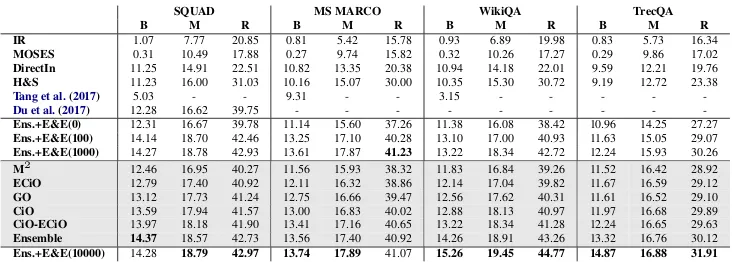
Table 5: Performance (B: BLEU4, M: METEOR, and R: ROUGE) of our model variants and various QG baselines onSQUAD,MS MARCOandWikiQAdatasets. The shaded part of the table shows the effect of various question selection heuristics when 10000 Wikipedia paragraphs are used as unlabeled data. The performance numbers for
Tang et al.(2017) andDu et al.(2017) were not reported for all the settings.
Evaluating Question Generation:Table5shows
the results for QG on the four datasets on each of the three evaluation metrics on all the four datasets. We can observe that the QG model de-scribed in our paper performs much better than all the baselines. We again observe that self-training while jointly training the QA and QG models leads to even better performance. These results show that self-training and leveraging the relationship between QA and QG is very useful for boosting the performance of the QA and QG models, while additionally only using cheap unlabeled data.
Human Evaluations: We asked two people not
involved with this research to evaluate 1000 (ran-domly selected) questions generated by our best
QG model and our best performing baseline (Du
et al., 2017) on SQUAD for fluency and correct-ness on a scale of 1 to 5. The raters were also shown the passage sentence used to generate the question. The raters were blind to which system produced which question. The Pearson correla-tion between the raters’ judgments wasr = 0.89
for fluency and r = 0.78 for correctness. In our
analyses, we used the averages of the two raters’ judgments. The evaluation showed that our sys-tem generates questions that are more fluent and correct than those by the baseline. The mean flu-ency rating of our best system was 4.15 compared to 3.35 for the baseline, a difference which is sta-tistically significant (t-test,p <0.001).
Evaluating the Question Selection Oracle: As
discussed earlier, the choice of which subset of questions to add to our labeled dataset while self-training is important. To evaluate the various heuristics proposed in our paper, we show the ef-fect of the question selection oracle on the final
QA and QG performance in Tables2,3,4and5. These comparisions are shown in the shaded grey portions of the tables for self-training with 10,000 Wikipedia paragraphs as unlabeled data.
We can observe that all the proposed heuristics (and ensembling and diversity strategies) lead to improvements in the final performance of both QA and QG. The heuristics arranged in increasing or-der of performance are: M2,ECiO,GO,CiOand
CiO-ECiO. While the choice of which heuristic to pick seems to make a lesser impact on the final performance, we do see a much more significant
performance gain by ensembling to combine the
various heuristics and using E&E to incorporate diversity. The incorporatation of diversity is im-portant because the neural network models which learnt latent representions of data usually find it hard to adjust to new level of difficulty of ques-tions as the current representation may not be ap-propriate for the new level of difficulty.
Low data scenarios:A key advantage of our
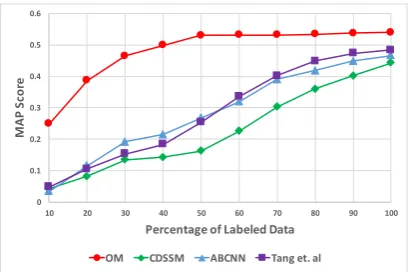
self-training approach is that it can leverage unlabeled text, and thus requires less labeled data. To test this, we plot MAP for our best self-training model and various QA baselines as we vary the propor-tion of labeled training set in Figure3. However, we keep the unlabeled text fixed (10K Wikipedia paragraphs). We observe that all the baselines sig-nificantly drop in performance as we reduce the proportion of labeled training set. However, the drop happens at a much slower rate for our self-trained model. Thus, we can conclude that our ap-proach requires less labeled data as compared to the baselines.
Does more unlabeled text always help?:
0 0.1 0.2 0.3 0.4 0.5 0.6
10 20 30 40 50 60 70 80 90 100
MA
P
Sc
or
e
Percentage of Labeled Data
[image:9.595.79.285.61.197.2]OM CDSSM ABCNN Tang et. al
Figure 3: MAP for the best self-training model and QA baselines as we vary the proportion of labeled training set but keep the unlabeled text fixed (10K Wikipedia paragraphs).
text always improve our models? Will the perfor-mance improve if we add more and more unsuper-vised data during self-training. According to our results in Tables2,3,4and5, the answer is ”prob-ably yes”. As we can observe from these tables, the performance of the QA and QG models im-proves as we increaseK, the size of the
unsuper-vised data during training of the various Ensem-ble+E&E(K)models. Having said that, we do see a tapering effect on the performance results, so it is clear that the performance will be capped by some upper-bound and we will need better ways of mod-eling language and meaning to make progress.
7 Related Work
Our work proposes an approach for joint model-ing QA and QG. While QA has recieved a lot of attention from the research community with large scale community evaluations such asNTCIR,
TREC,CLEFspurring progress, the focus on QG
is much more recent. Recently, there has been a renewed interest in reading comprehensions (also
known asmachine comprehension– a
nomencla-ture popularized byRichardson et al.(2013)). Var-ious approaches (Sachan et al.,2015;Wang et al., 2015; Sachan and Xing, 2016b; Sachan et al., 2016;Narasimhan and Barzilay,2015) have been proposed for solving this task. After the release of
large benchmarks such as SQUAD, MS MARCO
and WikiQA, there has been a surge in interest on using neural network or deep-learning models for QA (Yin et al., 2015; Seo et al., 2016; Shen et al., 2016; Chen et al., 2017; Liu et al., 2017; Hu et al., 2017). In our work, we deal with the answer sentence selection task and adapt the At-tentive Reader framework proposed in Hermann
et al.(2015);Chen et al.(2016) as our base model. While, all these models were trained on question answer pairs, we propose a self-training solution to additionally leverage unsupervised text.
Similarly, there have been works on QG. Traditionally, rule based approaches with post-processing (Woo et al.,2016;Heilman and Smith, 2009,2010) were the norm in QG. However, re-cent papers build on neural network approaches such as seq2seq (Du et al., 2017; Tang et al., 2017;Zhou et al.,2017), CNNs and RNNs (Duan et al.,2017) for QG. We also choose the seq2seq paradigm in our work. However, we leverage un-supervised text in contrast to these models.
Finally, some very recent works have concur-rently recognized the relationship between QA
and QG and have proposed joint training (Tang
et al., 2017;Wang et al., 2017) for the two. Our work differs from these as we additionally pro-pose self-training to leverage unlabeled data to improve the two models. Self-training has sel-dom been used in NLP. Most prominently, they have been used for word sense disambiguation (Yarowsky, 1995), noun learning (Riloff et al., 2003) and recently, AMR parsing and generation (Konstas et al., 2017). However, it has not been explored in this way for QA and QG.
An important decision in the workings of our self-training algorithm was the question selection using curriclum learning. While curriculum learn-ing has seldom been used in NLP, we draw some
ideas for curriculum learning from Sachan and
Xing(2016a) who conduct a case study of curricu-lum learning for question answering. However, their work focuses only on QA and not QG.
8 Conclusion
We described self-training algorithms for jointly learning to answer and ask questions while lever-aging unlabeled data. We experimented with neu-ral models for question answering and question generation and various careful strategies for ques-tion filtering based on curriculum learning and di-versity promotion. This led to improved perfor-mance for both question answering and question generation on multiple datasets and new state-of-the-art results onWikiQAandTrecQAdatasets.
Acknowledgment
References
Dzmitry Bahdanau, Kyunghyun Cho, and Yoshua Ben-gio. 2014. Neural machine translation by jointly learning to align and translate. arXiv preprint arXiv:1409.0473.
Yoshua Bengio, J´erˆome Louradour, Ronan Collobert, and Jason Weston. 2009. Curriculum learning. In
Proceedings of the 26th annual international con-ference on machine learning. ACM, pages 41–48.
Nathaniel Freeman Cantor. 1946. Dynamics of learn-ing. Foster and Stewart publishing corporation, Buf-falo, NY.
Danqi Chen, Jason Bolton, and Christopher D
Man-ning. 2016. A thorough examination of the
cnn/daily mail reading comprehension task. arXiv preprint arXiv:1606.02858.
Danqi Chen, Adam Fisch, Jason Weston, and Antoine Bordes. 2017. Reading wikipedia to answer open-domain questions. CoRRabs/1704.00051.
Michael Denkowski and Alon Lavie. 2014. Meteor universal: Language specific translation evaluation for any target language. InProceedings of the ninth workshop on statistical machine translation. pages 376–380.
Xinya Du, Junru Shao, and Claire Cardie. 2017. Learn-ing to ask: Neural question generation for readLearn-ing comprehension. arXiv preprint arXiv:1705.00106.
Nan Duan, Duyu Tang, Peng Chen, and Ming Zhou. 2017. Question generation for question answer-ing. InProceedings of the 2017 Conference on Em-pirical Methods in Natural Language Processing, EMNLP 2017, Copenhagen, Denmark, September 9-11, 2017. pages 866–874.
Alex Graves, Santiago Fern´andez, and J¨urgen Schmid-huber. 2005. Bidirectional lstm networks for im-proved phoneme classification and recognition. Ar-tificial Neural Networks: Formal Models and Their Applications–ICANN 2005pages 753–753.
Hua He, Kevin Gimpel, and Jimmy J. Lin. 2015. Multi-perspective sentence similarity modeling with con-volutional neural networks. InProceedings of the 2015 Conference on Empirical Methods in Natural Language Processing, EMNLP 2015, Lisbon, Portu-gal, September 17-21, 2015. pages 1576–1586.
Hua He and Jimmy J. Lin. 2016. Pairwise word in-teraction modeling with deep neural networks for semantic similarity measurement. InNAACL HLT 2016, The 2016 Conference of the North American Chapter of the Association for Computational Lin-guistics: Human Language Technologies, San Diego California, USA, June 12-17, 2016. pages 937–948.
Michael Heilman. 2011. Automatic factual question generation from text. Ph.D. thesis, Carnegie Mellon University.
Michael Heilman and Noah A Smith. 2009. Question generation via overgenerating transformations and ranking. Technical report, CARNEGIE-MELLON UNIV PITTSBURGH PA LANGUAGE TECH-NOLOGIES INST.
Michael Heilman and Noah A Smith. 2010. Good question! statistical ranking for question generation. In Human Language Technologies: The 2010 An-nual Conference of the North American Chapter of the Association for Computational Linguistics. As-sociation for Computational Linguistics, pages 609– 617.
Karl Moritz Hermann, Tomas Kocisky, Edward Grefenstette, Lasse Espeholt, Will Kay, Mustafa Su-leyman, and Phil Blunsom. 2015. Teaching ma-chines to read and comprehend. InAdvances in Neu-ral Information Processing Systems. pages 1693– 1701.
Minghao Hu, Yuxing Peng, and Xipeng Qiu. 2017. Mnemonic reader for machine comprehension.
CoRRabs/1705.02798.
Lu Jiang, Deyu Meng, Teruko Mitamura, and Alexan-der G Hauptmann. 2014. Easy samples first: Self-paced reranking for zero-example multimedia search. In Proceedings of the ACM International Conference on Multimedia. ACM, pages 547–556.
Lu Jiang, Deyu Meng, Qian Zhao, Shiguang Shan, and Alexander G Hauptmann. 2015. Self-paced curricu-lum learning. InTwenty-Ninth AAAI Conference on Artificial Intelligence.
Philipp Koehn, Hieu Hoang, Alexandra Birch, Chris Callison-Burch, Marcello Federico, Nicola Bertoldi, Brooke Cowan, Wade Shen, Christine Moran, Richard Zens, Chris Dyer, Ondˇrej Bojar, Alexandra Constantin, and Evan Herbst. 2007. Moses: Open source toolkit for statistical machine translation. In
Proceedings of the 45th Annual Meeting of the ACL on Interactive Poster and Demonstration Sessions. Association for Computational Linguistics, Strouds-burg, PA, USA, ACL ’07, pages 177–180.
Ioannis Konstas, Srinivasan Iyer, Mark Yatskar, Yejin Choi, and Luke Zettlemoyer. 2017. Neural amr: Sequence-to-sequence models for parsing and gen-eration. arXiv preprint arXiv:1704.08381.
Kai A Krueger and Peter Dayan. 2009. Flexible shap-ing: How learning in small steps helps. Cognition
110(3):380–394.
M Pawan Kumar, Benjamin Packer, and Daphne Koller. 2010. Self-paced learning for latent variable mod-els. InAdvances in Neural Information Processing Systems. pages 1189–1197.
Percy S Liang, Dan Klein, and Michael I Jordan. 2008. Agreement-based learning. In Advances in Neural Information Processing Systems. pages 913–920. Chin-Yew Lin. 2004. Rouge: a package for automatic
evaluation of summaries. InWorkshop on Text Sum-marization Branches Out, Post-Conference Work-shop of ACL, Barcelona, Spain.
Rui Liu, Junjie Hu, Wei Wei, Zi Yang, and Eric Nyberg. 2017. Structural embedding of syntactic trees for machine comprehension. CoRRabs/1703.00572.
Yishu Miao, Lei Yu, and Phil Blunsom. 2016. Neu-ral variational inference for text processing. In In-ternational Conference on Machine Learning. pages 1727–1736.
Alexander H. Miller, Adam Fisch, Jesse Dodge, Amir-Hossein Karimi, Antoine Bordes, and Jason We-ston. 2016. Key-value memory networks for directly reading documents. CoRRabs/1606.03126.
Karthik Narasimhan and Regina Barzilay. 2015. Ma-chine comprehension with discourse relations. In
Proceedings of the 53rd Annual Meeting of the Association for Computational Linguistics and the 7th International Joint Conference on Natural Lan-guage Processing of the Asian Federation of Nat-ural Language Processing, ACL 2015, July 26-31, 2015, Beijing, China, Volume 1: Long Papers. pages 1253–1262.
Tri Nguyen, Mir Rosenberg, Xia Song, Jianfeng Gao, Saurabh Tiwary, Rangan Majumder, and Li Deng. 2016. Ms marco: A human generated machine reading comprehension dataset. arXiv preprint arXiv:1611.09268.
Kamal Nigam and Rayid Ghani. 2000. Analyzing the effectiveness and applicability of co-training. In
Proceedings of the ninth international conference on Information and knowledge management. ACM, pages 86–93.
Kishore Papineni, Salim Roukos, Todd Ward, and Wei-Jing Zhu. 2002. Bleu: A method for automatic eval-uation of machine translation. InProceedings of the 40th Annual Meeting on Association for Computa-tional Linguistics. ACL ’02, pages 311–318.
Jeffrey Pennington, Richard Socher, and Christopher Manning. 2014. Glove: Global vectors for word representation. InProceedings of the 2014 confer-ence on empirical methods in natural language pro-cessing (EMNLP). pages 1532–1543.
Gail B Peterson. 2004. A day of great illumination: Bf skinner’s discovery of shaping. Journal of the Experimental Analysis of Behavior82(3):317–328.
Pranav Rajpurkar, Jian Zhang, Konstantin Lopyrev, and Percy Liang. 2016. Squad: 100, 000+ ques-tions for machine comprehension of text. CoRR
abs/1606.05250. http://arxiv.org/abs/
1606.05250.
Jinfeng Rao, Hua He, and Jimmy Lin. 2016. Noise-contrastive estimation for answer selection with deep neural networks. InProceedings of the 25th ACM International on Conference on Information and Knowledge Management. ACM, New York, NY,
USA, CIKM ’16, pages 1913–1916. https://
doi.org/10.1145/2983323.2983872.
Matthew Richardson, Christopher J.C. Burges, and Erin Renshaw. 2013. MCTest: A challenge dataset for the open-domain machine comprehension of text. InProceedings of the 2013 Conference on Em-pirical Methods in Natural Language Processing. Association for Computational Linguistics, Seat-tle, Washington, USA, pages 193–203. http:// www.aclweb.org/anthology/D13-1020.
Ellen Riloff, Janyce Wiebe, and Theresa Wilson. 2003. Learning subjective nouns using extraction pattern bootstrapping. InProceedings of the seventh confer-ence on Natural language learning at HLT-NAACL 2003-Volume 4. Association for Computational Lin-guistics, pages 25–32.
Alexander M Rush, Sumit Chopra, and Jason We-ston. 2015. A neural attention model for ab-stractive sentence summarization. arXiv preprint arXiv:1509.00685.
Mrinmaya Sachan, Avinava Dubey, Eric P Xing, and Matthew Richardson. 2015. Learning answer-entailing structures for machine comprehension. In
Proceedings of the Annual Meeting of the Associa-tion for ComputaAssocia-tional Linguistics.
Mrinmaya Sachan, Kumar Dubey, and Eric P. Xing. 2016. Science question answering using instruc-tional materials. InProceedings of ACL.
Mrinmaya Sachan and Eric P. Xing. 2016a. Easy ques-tions first? A case study on curriculum learning for question answering. InProceedings of the 54th An-nual Meeting of the Association for Computational Linguistics, ACL 2016, August 7-12, 2016, Berlin, Germany, Volume 1: Long Papers.
Mrinmaya Sachan and Eric P. Xing. 2016b. Machine comprehension using rich semantic representations. InProceedings of ACL.
Cicero dos Santos, Ming Tan, Bing Xiang, and Bowen Zhou. 2016. Attentive pooling networks. arXiv preprint arXiv:1602.03609.
Minjoon Seo, Aniruddha Kembhavi, Ali Farhadi, and Hannaneh Hajishirzi. 2016. Bidirectional attention flow for machine comprehension. arXiv preprint arXiv:1611.01603.
Yelong Shen, Po-Sen Huang, Jianfeng Gao, and
Weizhu Chen. 2016. Reasonet: Learning to
stop reading in machine comprehension. CoRR
abs/1609.05284. http://arxiv.org/abs/
1609.05284.
Burrhus F Skinner. 1958. Reinforcement today. Amer-ican Psychologist13(3):94.
Ilya Sutskever, Oriol Vinyals, and Quoc V Le. 2014. Sequence to sequence learning with neural net-works. InAdvances in neural information process-ing systems. pages 3104–3112.
Duyu Tang, Nan Duan, Tao Qin, and Ming Zhou. 2017. Question answering and question generation as dual tasks.arXiv preprint arXiv:1706.02027.
Yi Tay, Anh Tuan Luu, and Siu Cheung Hui. 2017.
Enabling efficient question answer retrieval via hy-perbolic neural networks. CoRR abs/1707.07847.
http://arxiv.org/abs/1707.07847.
Bingning Wang, Kang Liu, and Jun Zhao. 2016a. In-ner attention based recurrent neural networks for an-swer selection. In Proceedings of the 54th Annual Meeting of the Association for Computational Lin-guistics, ACL 2016, August 7-12, 2016, Berlin, Ger-many, Volume 1: Long Papers.
Hai Wang, Mohit Bansal, Kevin Gimpel, and David McAllester. 2015. Machine comprehension with syntax, frames, and semantics. InProceedings of the 53rd Annual Meeting of the Association for Compu-tational Linguistics and the 7th International Joint Conference on Natural Language Processing (Vol-ume 2: Short Papers). volume 2, pages 700–706.
Mengqiu Wang, Noah A Smith, and Teruko Mita-mura. 2007. What is the jeopardy model? a quasi-synchronous grammar for qa. In EMNLP-CoNLL. volume 7, pages 22–32.
Shuohang Wang and Jing Jiang. 2016. A compare-aggregate model for matching text sequences. arXiv preprint arXiv:1611.01747.
Tong Wang, Xingdi Yuan, and Adam Trischler. 2017. A joint model for question answering and question generation. CoRRabs/1706.01450.
Zhiguo Wang, Haitao Mi, and Abraham Ittycheriah. 2016b. Sentence similarity learning by
lex-ical decomposition and composition. CoRR
abs/1602.07019.
Simon Woo, Zuyao Li, and Jelena Mirkovic. 2016. Good automatic authentication question generation. InProceedings of the 9th International Natural Lan-guage Generation conference. pages 203–206.
Yi Yang, Scott Wen-tau Yih, and Chris Meek. 2015. Wikiqa: A challenge dataset for open-domain ques-tion answering. InProceedings of EMNLP.
David Yarowsky. 1995. Unsupervised word sense dis-ambiguation rivaling supervised methods. In Pro-ceedings of the 33rd annual meeting on Associa-tion for ComputaAssocia-tional Linguistics. Association for Computational Linguistics, pages 189–196.
Wenpeng Yin, Hinrich Sch¨utze, Bing Xiang, and Bowen Zhou. 2015. Abcnn: Attention-based convo-lutional neural network for modeling sentence pairs.
arXiv preprint arXiv:1512.05193.
Lei Yu, Karl Moritz Hermann, Phil Blunsom, and Stephen Pulman. 2014. Deep learning for answer sentence selection. arXiv preprint arXiv:1412.1632
.
Wojciech Zaremba, Ilya Sutskever, and Oriol Vinyals. 2014. Recurrent neural network regularization.
arXiv preprint arXiv:1409.2329.
Qingyu Zhou, Nan Yang, Furu Wei, Chuanqi Tan, Hangbo Bao, and Ming Zhou. 2017. Neural ques-tion generaques-tion from text: A preliminary study.
CoRR abs/1704.01792. http://arxiv.org/
abs/1704.01792.