Graph Methods for Multilingual FrameNets
Collin F. Baker and Michael Ellsworth
International Computer Science Institute 1947 Center St. Suite 600
Berkeley, CA 94704
collinb,[email protected]
Abstract
This paper introduces a new, graph-based view of the data of the FrameNet project, which we hope will make it eas-ier to understand the mixture of seman-tic and syntacseman-tic information contained in FrameNet annotation. We show how En-glish FrameNet and other Frame Semantic resources can be represented as sets of in-terconnected graphs of frames, frame ele-ments, semantic types, and annotated in-stances of them in text. We display ex-amples of the new graphical representation based on the annotations, which combine Frame Semantics and Construction Gram-mar, thus capturing most of the syntax and semantics of each sentence. We consider how graph theory could help researchers to make better use of FrameNet data for tasks such as automatic Frame Semantic role labeling, paraphrasing, and transla-tion. Finally, we describe the develop-ment of FrameNet-like lexical resources for other languages in the current Multilin-gual FrameNet project. which seeks to dis-cover cross-lingual alignments, both in the lexicon (for frames and lexical units within frames) and across parallel or comparable texts. We conclude with an example show-ing graphically the semantic and syntactic similarities and differences between paral-lel sentences in English and Japanese. We will release software for displaying such graphs from the current data releases.
1 Overview
In this paper, we provide a new graph-based dis-play of FrameNet annotation, which we hope will make the complex data model of FrameNet more
accessible to a variety of users. We begin with a brief introduction to the Frame Semantics and the FrameNet project and their underlying graph structures. Section 3 illustrates how annotation maps words in sentences to nodes in FrameNet, showing the struture of a sentence in the new graph representation. Sect. 4 discusses how the graph representation could help NLP developers, partic-ularly w.r.t. automatic semantic role labeling. In Sect. 5, we introduce the Multilingual FrameNet project, and what comparisons of frame structures across languages might reveal by way of another example sentence in the new format, then discuss our conclusions and acknowledge support for our work.
2 Frame Semantics and English FrameNet
The FrameNet Project [Fillmore and Baker,2010, Ruppenhofer et al., 2016] at the International Computer Science Institute (ICSI) is an ongoing project to produce a lexicon of English that is both human- and machine-readable, based on the theory of Frame Semantics developed by Charles Fillmore and colleagues [Fillmore,1997] and sup-ported by annotating corpus examples of the lexi-cal items. Although FrameNet (FN) is a lexilexi-cal re-source, it is organized not around words, but rather the roughly 1,200 semantic frames [Fillmore, 1976]: characterizations of events, relations, states and entities which are the conceptual basis for un-derstanding the word senses, called lexical units (LUs). Frames are distinguished by the set of roles involved, known asframe elements (FEs). Defin-ing individual lexical units relative to semantic frames provides a crucial level of generalization for their meaning and use. Much of the informa-tion in FN is derived from the more than 200,000 manually annotated corpus sentences; annotators
not only mark the target word which evokes the frame, but also those phrases which are syntac-tically related to the target word and express its frame elements. FN covers roughly 13,500 LUs, and provides very rich syntagmatic information about the combinatorial possibilities of each LU. Each frame averages about 10 frame elements, and the same frame can beevokedby words (or mul-tiword expressions) of any part of speech.
FrameNet frames are connected by eight types of relations, including full inheritance (IS-A relation) in which all core FEs are inher-ited, weaker forms of inheritance (called Us-ing and Perspective on), and relations between statives, inchoatives, and causatives. Most frames are linked in a single large lattice (an-alyzed in Valverde-Albacete [2008]). The full graph is difficult to render, but can be browsed
at https://framenet.icsi.berkeley.
edu/fndrupal/FrameGrapher
Animate_being
Sentient
Human Artifact
Structure
Body_of_water
Running_water Living_thing Location
Region Point Line
Landform Physical_entity
[...] Physical_object
Body_part Container
Figure 1: (Partial) FrameNet semantic type hierar-chy
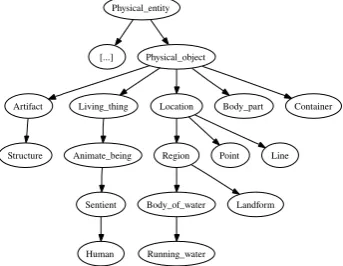
2.1 Semantic types and their hierarchy FrameNet also has a small hierarchy of seman-tic types which can be marked on Frames, FEs and LUs; a portion is shown in Fig. 1. Many of the semantic types in FrameNet are similar to nodes in widely used ontologies, but they are lim-ited to those which are linguistically important; for example, most agent FEs (not only those called “Agent”, but all those descended from the AGENT FE in the high-level frameIntentionally act) have the semantic type SENTIENT (Non-sentient ac-tants receive the FE CAUSE).1 Some semantic 1Matching FE semantic types to fillers is complicated by phenomena such as metonymy (The White house announced today . . .) and personification (She still runs good, but even-tually she’ll need new tires.), not fully addressed in FN.
types add information which cross-cuts the frame hierarchy; e.g., POSITIVE JUDGEMENTand NEG -ATIVE JUDGEMENT are used to separate those LUs in the framesJudgement, Judgement com-munication andJudgement direct address that have positive affect from those with negative af-fect.
3 Frame Semantic and Construction Grammar representation of sentence meaning
The development of Frame Semantics has gone hand in hand with the development of Construc-tion Grammar, by Fillmore and a wide range of colleagues (Michaelis [2010],Feldman et al. [2010]). FrameNet annotators not only mark which spans of the corpus sentences instantiate which Frame Elements, but also the phrase type (PT) of the constituent that covers that span2 and the grammatical function (GF, a.k.a. grammatical relation) between that constituent and the target in-stance of the lexical unit as a coextensive set of spans on three annotation “layers”. Additional in-formation is added on other “layers” indicating the presence of copulas and other support verbs, the antecedents of relative clauses, etc. This syntac-tic information, based on Construction Grammar, can be combined with the FE labels to form a joint syntactico-semantic representation of much of the meaning of a sentence. In graph terms, the annota-tion process creates a mapping between the string of characters in the sentence and (1) nodes repre-senting frame elements in the frame hierarchy and (2) nodes representing parts of constructions in the Construction Grammar hierarchy.
We illustrate this with an example sentence ex-tracted from a TED talk entitled “Do schools kill creativity?” by Ken Robinson3: The thing they
were good at in school wasn’t valued, or was actu-ally stigmatized. The graph representation derived from FrameNet annotation is shown in Fig.2.4
In this figure, the nodes of the graph are syntactico-semantic entities (solid borders) or se-mantic entities (dotted borders) and the words of the sentence are the terminal nodes of the graph (in boxes). Each edge specifies the relationship be-tween nodes, solid black for syntactico-semantic
2Most FEs are in fact constituents.
3https://www.ted.com/talks/ken_ robinson_says_schools_kill_creativity?
4For methods for producing such graphs, seeEllsworth
[image:2.595.74.246.350.483.2]the
thing they were
good
at at
school was
n't
valued
Positive_judgement or
was actually stigmatized
Negative_judgement
CNI CNI
1
2
3 3
S
NP [3] Ext
VP Head
S
NP [1] Ext
VP Head NP [2]
N:ENTITY Head
RelCl
Head Conj/Head
VP:JUDGEMENT Head
VP:JUDGEMENT Head
Supp
AP:EXPERTISE Sem H
PP Marker Ant./Sem H
T Protagonist Skill
Prep:LOCATIVE RELATION *Place Figure T Entity
T Cognizer Evaluee
AVP:NEGATION Negated_P
T
T Cognizer Evaluee
T
N:LOCALE BY USE Ground
T
Figure 2: Graph of Frame Semantic Annotation of Example English Sentence
relations, and dashed red for purely semantic re-lations. The graph is organized so that higher nodes syntactically subsume lower nodes and ar-rows point from semantic heads to semantic sub-ordinates. The graph is close to being a tree, like conventional constituent parses, but contains a few semantic edges that cross the syntactic edges, shown with the indexes 1, 2, and 3 (bare numbers with dashed arcs) which refer to the non-adjacent nodes NP[1], NP[2], and NP[3] respectively.
The nodes and edges have features represent-ing the full annotation of the sentence. The large ovals represent semantics via the names of evoked frames: Entity, Expertise, Judgement (twice), Locative relation Local by use, and Negation. Though not shown in this graph, each frame in-stance is also linked to the frame hierarchy graph (Sec. 2). The edges descending from the frames semantically represent the relations described by Frame Elements in the same hierarchy. The dot-ted lines pointing to dotdot-ted nodes are links into the semantic type hierarchy (Sec.2.1). The syntactic features of the non-terminal nodes are summarized by Phrase Type (PT) labels (S, N, NP, V, VP, PP, etc. with their conventional meanings) and part-of-speech (not shown). Other features on the edges are syntactico-semantic categories: T (target, the word(s) that evokes the frame), RelC (relative clause), Ant. (antecedent of relative clause), Head (syntactic and semantic head), Sem H (semantic head), and Supp (support, a syntactic head).
4 Applications of FrameNet data as a graph
The ability to separate syntactic and semantic de-pendency is potentially of use in many tasks in-volving FrameNet data, including automatic se-mantic role labeling (ASRL), inferencing, lan-guage generation, and cross-linguistic compari-son. Because of the clear representation of syn-tactic and semantic dependency in the graph (dis-played in Fig.2by vertical position, arrow direc-tion, and non-local edges), many tasks should be able to use the graph even without special pro-cessing for the subtypes of edges, e.g. for relative clauses as seen under NP[3]. To find out the over-all meaning of this sentence, one can start from the “S” node and follow the edges marked “Head” or “Sem H” to the two instances of theJudgement frame. From there, the application can drill fur-ther down as needed, into the frame hierarchy, the semantic type hierarchy, or the fillers of the frame roles.
学校は
gakkou wa school-TOP
彼らの
karera no their
才能を
sainou o talent
評価
hyouka value
Positive_judgement
し
shi-"do"
ない
-nai not
どころか
dokoroka instead
ダメ
dame no good
Negative_judgement
だ
da be
と
to
烙印を
rakuin o brand
押し
oshi press
てしまう
te shimau "end up" [2] NP:EXPERTISE
Protagonist Skill T
VP:JUDGEMENT
Evaluee
AUX:NEGATION Negated_p
V T
1
Cognizer
T
VP
VP:LABELING Sem H
AUX [1] NP
head Supp VP
Conj/Head
Head Head
AdjP Sfin
Cop Sem H
と-P
Sem H
N Label T Sem H
V T
1
Speaker
2
Entity S
[image:4.595.99.466.73.308.2]Ext Head
Figure 3: Frame Semantic Annotation of Equivalent Japanese Sentence
generally reflect the effort those researchers have made to understand the FrameNet data in depth, including dependencies between semantic roles within a frame, propagation of semantic types across frames, and dependencies between syntax and semantics in a specific sentence. When Frame Element annotation is treated simply as indepen-dent tags for machine learning (even if syntactic information is imported from other sources), the learning algorithms are starved of the information needed to make smarter generalizations about the large proportion of the syntactic information about each lexical unit that is predictable from other lex-ical units in the frame, other related frames, or structures of the language as a whole, such as pas-sivization and relative clause structure. The cur-rent distribution format of the FrameNet data does not make this clear. Since FrameNet data is basi-cally discrete and categorial, treating it as an in-terlocking set of graphs should enable better use of all the information, explicit and implicit, in FrameNet.
5 Multilingual FrameNet
The development of the FrameNet resource at ICSI has inspired the creation of a number of Frame Semantics-based projects for other lan-guages: efforts on Spanish, German, Japanese, Chinese, Swedish, Brazilian Portuguese, and
French have all received substantial funding, pri-marily from their national or provincial govern-ments. The basic research question is: to what ex-tent are the semantic frames universal and to what extent are they language-specific? Even if equiva-lent frames exist in two languages, how much of the frame structure will be preserved in transla-tion? If a different frame is used, is it a near neigh-bor via frame relations in one or both of the lan-guages? These questions have also been discussed by, e.g.Boas [2009], ˇCulo [2013], and ˇCulo and de Melo[2012].
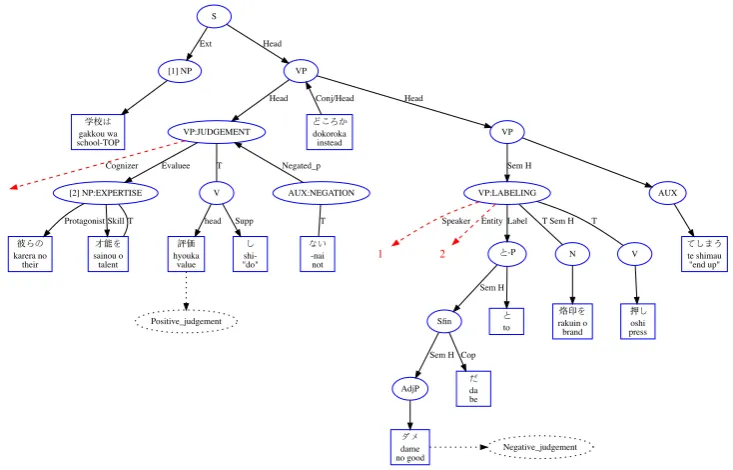
pre-sumably metonymic for either the faculty, the stu-dents, or both.5 Thus, the graph representation of the FrameNet data helps to make clear which parts of the sentences to compare across languages. We hope that ultimately such comparisons will lead to graph-based MT systems that can transfer mean-ing at a deeper level.
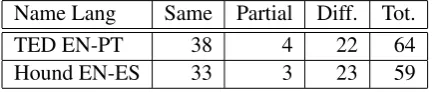
One of the goals of the Multilingual FrameNet project is to quantify the patterns of frame occur-rence across varied languages. The new annota-tion of parallel texts has just begun, so we the number of instances of frames is still small, but we can report some suggestive results based on com-paring the annotation of verbs of motion in two texts. One is the TED talk, where we have an-notation for English and Brazilian Portuguese; the other is a chapter of the Sherlock Holmes story ”The Hound of the Baskervilles”, translated by professional translators, where we compare anno-tation in English and Spanish. (We some annota-tion previously on these texts in English, Spanish, Japanese and German, but not Portuguese.)
Name Lang Same Partial Diff. Tot.
TED EN-PT 38 4 22 64
[image:5.595.71.288.373.419.2]Hound EN-ES 33 3 23 59
Table 1: Frame similarity and difference across parallel texts
Table 1gives the counts for instances of verbs of motion in two texts, showing cases where the aligned verbs are the same or different across languages. We had hypothesized that the pro-fessional, literary translations of the ”Hound” text would have more cross-linguistic differences, while that the volunteer translations of the TED talks would be more often frame-preserving. The counts shown here conform to that expectation, but the differences are not conclusive.
6 Conclusion
FrameNet data is extremely rich, but not usu-ally presented in a form that is easy for use in NLP. There are clear advantages to viewing the FrameNet annotation data as a graph that sepa-rates out entities (nodes) from relations (edges) and clarifies which information is semantic, syn-tactic, or both. The semantic information can be 5The content of the negative judgement is also made ex-plicit in the phrase headed by to, literally something like “they wind up being branded as ‘no good’.”
cleanly integrated with FrameNet’s already elab-orate graph of frames and semantic types, while generalizations over syntactic information should enable improved use of FrameNet annotation in ASRL training and cross-linguistic comparison.
6.1 Acknowledgements
The authors would like to thank the TextGraph re-viewers for their helpful suggestions. Any errors and omissions that remain are the fault of the au-thors.
This material is based in part upon work sup-ported by the National Science Foundation under Grant No. 1629989. Any opinions, findings, and conclusions or recommendations expressed in this material are those of the author(s) and do not nec-essarily reflect the views of the National Science Foundation. The text from the TED talks was used by permission under the Creative Commons Attri-bution–Non Commercial–No Derivatives license.
References
Hans C. Boas. Recent trends in multilingual
computational lexicography, pages 1–26.
Mouton de Gruyter, Berlin, 2009. URL
http://sites.la.utexas.edu/hcb/ files/2011/02/Boas_2009e_Trends_
in_Multl_Lexicography.pdf.
Dipanjan Das, Desai Chen, Andr´e F. T. Martins, Nathan Schneider, and Noah A. Smith.
Frame-Semantic parsing. Computational Linguistics, 40
(1), 2014. URL http://www.aclweb.org/
anthology/J/J14/J14-1002.pdf.
Michael Ellsworth and Adam Janin. Mutaphrase:
Paraphrasing with framenet. In Proceedings of the
Workshop on Textual Entailment and Paraphrasing, Prague, June 2007. Association for Computational
Linguistics. URLhttp://www.aclweb.org/
anthology-new/W/W07/W07-1424.pdf.
Jerome Feldman, Ellen Dodge, and John Bryant.
Embodied construction grammar. In Bernd
Heine and Heiko Narrog, editors, The Oxford
handbook of linguistic analysis, pages 111– 137. Oxford University Press, New York, 2010.
URL https://dx.doi.org/10.1093/
oxfordhb/9780199544004.013.0006.
Charles J. Fillmore. Frame semantics and the nature
of language. Annals of the New York Academy
of Sciences: Conference on the Origin and De-velopment of Language and Speech, 280(1):20–32,
1976. URLhttp://dx.doi.org/10.1111/
Charles J. Fillmore. Valence, hierarchies, and link-ing. Handout for paper presented at CLP, Prague, November 1997.
Charles J. Fillmore and Collin F. Baker. A frames approach to semantic analysis. In Bernd Heine
and Heiko Narrog, editors, Oxford Handbook of
Linguistic Analysis, pages 313–341. OUP, 2010.
URL https://dx.doi.org/10.1093/
oxfordhb/9780199544004.013.0013.
Laura A. Michaelis. Sign-Based Construction
Grammar. In Bernd Heine and Heiko
Nar-rog, editors, Oxford Handbook of
Linguis-tic Analysis, pages 139–158. OUP, 2010.
URL https://dx.doi.org/10.1093/
oxfordhb/9780199544004.013.0007.
Martha Palmer, Daniel Gildea, and Paul Kingsbury. The Proposition Bank: An annotated corpus of
se-mantic roles. Computational Linguistics, 31(1):71–
106, March 2005. URLhttp://aclweb.org/
anthology-new/J/J05/J05-1004.pdf.
Michael Roth and Mirella Lapata.
Context-aware Frame-Semantic Role Labeling.
Trans-actions of the Association for Computational
Linguistics, 3:449–460, 2015. ISSN
2307-387X. URL http://www.aclweb.org/
anthology/Q/Q15/Q15-1032.pdf.
Josef Ruppenhofer, Michael Ellsworth, Miriam R. L. Petruck, Christopher R. Johnson, Collin F. Baker,
and Jan Scheffczyk. FrameNet II: Extended
Theory and Practice. International Computer
Science Institute, Berkeley, California, 2016. URL
https://framenet2.icsi.berkeley.
edu/docs/r1.7/book.pdf.
Francisco J. Valverde-Albacete. Extracting
frame-semantics knowledge using lattice theory. J Logic
Computation, 18(3):361–384, June 2008. doi: 10.
1093/logcom/exm069. URL http://dx.doi.
org/10.1093/logcom/exm069.
Oliver ˇCulo and Gerard de Melo.
Source-Path-Goal: Investigating the Cross-Linguistic Potential
of Frame-Semantic Text Analysis. it -
Informa-tion Technology, 54, 2012. URLhttps://doi.
org/10.1524/itit.2012.0675.
Oliver ˇCulo. Constructions-and-frames analysis of translations: The interplay of syntax and seman-tics in translations between English and German. Constructions and Frames, 5(2):143–167, 2013.
URLhttp://dx.doi.org/10.1075/cf.5.