ASSESSMENT OF KNOWLEDGE, ATTITUDE AND PRACTICE OF INSULIN THERAPY AMONG
1,*
Binu Mathew,
1Elizabeth A.M
1
Department of Pharmacy Practice, NET Pharmacy College, Raichur
2
Department of General Medicine, NMCH
ARTICLE INFO ABSTRACT
Background:
regarding insulin usage will optimise insulin therapy in diabetes mellitus. to assess the knowledge, attitude, practice of insulin t
was done in various in patient departments using KAP questionnaire. A total of 70 filled questionnaires were evaluated and analysed using Chi
practice study found
their family history and educational status, towards insulin therapy. The relation between education status of participants and their knowledge about insulin discontinuation on
normalize (p value=0.047) as well as their practice of checking blood sugar level in home (p value=0.025) were found to be statistically significant. This data suggests that mean knowledge score was more for illiterate (14.21) fol
need to educate the patient about various aspects of insulin therapy including dosing, storage, site of injection, common side effects and life style modifications. Clinical pharmacist can pla
monitoring and optimization of insulin therapy.
Copyright © 2019, Binu Mathew et al. This is an open distribution, and reproduction in any medium, provided
INTRODUCTION
Diabetes mellitus is a pandemic disease that has struck each and every corner of the world. According to the Indian Council Medical Research‑Indian Diabetes study, a national diabetes study, India currently has 62.4 million people with diabetes. Various classes of anti‑diabetic drugs including insulin and Oral hypoglycemic agent are currently used in the treatment of diabetes, which acts by different mechanisms to reduce blood‑glucose levels to maintain optimal glycemic control. Different types of insulin preparations such as neutral insulin, biphasic insulin, isophane insulin etc. which is mainly
treating the patients with type 1 diabetes and type 2 diabetes mellitus (Agarwal et al., 2014; Harikrishnan
There are many factors influencing delayed insulin initiation including those caused by healthcare providers and its system as well as the patients themselves. One of the main barriers is psychological insulin resistance, defined as psychological opposition towards insulin use, among patients and healthcare providers (Hassan et al., 2013).
*Corresponding author: Binu Mathew
Department of Pharmacy Practice, NET Pharmacy College, Raichur Karnataka, India.
ISSN: 0975-833X
Article History:
Received 29th October, 2018
Received in revised form
20th November, 2018
Accepted 24th December, 2018
Published online 31st January, 2019
Citation: Binu Mathew, Elizabeth A.M., Rajkumar Reddy, M., Adeena Balkees, Doddayya, H. and Antin, S.S.
and practice of insulin therapy among diabetes patients
Key Words:
Clinical Pharmacist, Diabetes mellitus, Insulin, Questionnaire
RESEARCH ARTICLE
ASSESSMENT OF KNOWLEDGE, ATTITUDE AND PRACTICE OF INSULIN THERAPY AMONG
DIABETES PATIENTS
Elizabeth A.M.,
1Rajkumar Reddy, M.,
1Adeena Balkees
and
2Antin, S.S.
Department of Pharmacy Practice, NET Pharmacy College, Raichur-584103
Department of General Medicine, NMCH and RC, Raichur-584103 Karnataka,
ABSTRACT
Background: Rational prescribing of insulin and improved patient knowledge, attitude and practice regarding insulin usage will optimise insulin therapy in diabetes mellitus.
to assess the knowledge, attitude, practice of insulin therapy. Study method:
was done in various in patient departments using KAP questionnaire. A total of 70 filled questionnaires were evaluated and analysed using Chi- Square test.
practice study found that better knowledge, Attitude and Practice among participants irrespective of their family history and educational status, towards insulin therapy. The relation between education status of participants and their knowledge about insulin discontinuation on
normalize (p value=0.047) as well as their practice of checking blood sugar level in home (p value=0.025) were found to be statistically significant. This data suggests that mean knowledge score was more for illiterate (14.21) followed by high school and primary school.
need to educate the patient about various aspects of insulin therapy including dosing, storage, site of injection, common side effects and life style modifications. Clinical pharmacist can pla
monitoring and optimization of insulin therapy.
access article distributed under the Creative Commons Attribution the original work is properly cited.
Diabetes mellitus is a pandemic disease that has struck each According to the Indian Council Indian Diabetes study, a national diabetes study, India currently has 62.4 million people with diabetes. diabetic drugs including insulin and d in the treatment of diabetes, which acts by different mechanisms to reduce glucose levels to maintain optimal glycemic control. Different types of insulin preparations such as neutral insulin, biphasic insulin, isophane insulin etc. which is mainly used for es and type 2 diabetes Harikrishnan et al., 2012). There are many factors influencing delayed insulin initiation including those caused by healthcare providers and its system, as well as the patients themselves. One of the main barriers is psychological insulin resistance, defined as psychological tients and healthcare
Department of Pharmacy Practice, NET Pharmacy College, Raichur-584103,
Psychological insulin resistance
adverse emotions and practical concerns as questioning the necessity to intensifying medication by insulin, pain, phobia, failure, fear of side effects, operation of insulin pen, economic cost for insulin therapy, language ba
knowledge, poor social support, perceived damages on personal image, social life and perceived clinicians, negative attitude towards insulin, and lower educational level. Misconception in insulin use refers to any inaccurate idea, belief, myth, presumption and conjecture that deviate from the proven medical knowledge. The three main sources of misconception among the participants are: 1) lacking adequate knowledge 2) conflicting medical advice, and 3) hearsay from community. When Type 2 Diabetes Mellitus patients failed to rectify the misconceptions, their self
therapy will be undermined as what the research subjects in this study indicated (Sau Nga and Cheung, 2017
awareness and knowledge about the
makes remarkable difference in the glycemic control. There is a great need for continuous health education to diabetics and caregivers to improve their knowledge and awareness of different aspects of Diabetes Mellitus. This can be do
members of the private health care team through a structured
International Journal of Current Research
Vol. 11, Issue, 01, pp.697-702, January, 2019
DOI: https://doi.org/10.24941/ijcr.34004.01.2019
Binu Mathew, Elizabeth A.M., Rajkumar Reddy, M., Adeena Balkees, Doddayya, H. and Antin, S.S. 2019
among diabetes patients”, International Journal of Current Research, 11, (01), 697-702.
Available online at http://www.journalcra.com
ASSESSMENT OF KNOWLEDGE, ATTITUDE AND PRACTICE OF INSULIN THERAPY AMONG
Adeena Balkees,
1Doddayya, H.
584103, Karnataka, India
584103 Karnataka, India
Rational prescribing of insulin and improved patient knowledge, attitude and practice regarding insulin usage will optimise insulin therapy in diabetes mellitus. Objective: The study aims Study method: A cross sectional study was done in various in patient departments using KAP questionnaire. A total of 70 filled Square test. Results: Knowledge, attitude and that better knowledge, Attitude and Practice among participants irrespective of their family history and educational status, towards insulin therapy. The relation between education status of participants and their knowledge about insulin discontinuation once the blood sugar levels normalize (p value=0.047) as well as their practice of checking blood sugar level in home (p value=0.025) were found to be statistically significant. This data suggests that mean knowledge score lowed by high school and primary school. Conclusion: There is a need to educate the patient about various aspects of insulin therapy including dosing, storage, site of injection, common side effects and life style modifications. Clinical pharmacist can play a vital role in
License, which permits unrestricted use,
Psychological insulin resistance involves such a wide range of adverse emotions and practical concerns as questioning the necessity to intensifying medication by insulin, pain, phobia, failure, fear of side effects, operation of insulin pen, economic cost for insulin therapy, language barrier, inadequate knowledge, poor social support, perceived damages on personal image, social life and perceived clinicians, negative attitude towards insulin, and lower educational level. Misconception in insulin use refers to any inaccurate idea, myth, presumption and conjecture that deviate from the proven medical knowledge. The three main sources of misconception among the participants are: 1) lacking adequate knowledge 2) conflicting medical advice, and 3) hearsay from abetes Mellitus patients failed to rectify the misconceptions, their self-efficacy in starting insulin therapy will be undermined as what the research subjects in Sau Nga and Cheung, 2017). Patient’s awareness and knowledge about the disease is expected to makes remarkable difference in the glycemic control. There is a great need for continuous health education to diabetics and caregivers to improve their knowledge and awareness of different aspects of Diabetes Mellitus. This can be done by all members of the private health care team through a structured
INTERNATIONAL JOURNAL OF CURRENT RESEARCH
program using different health education strategies such as focus on group discussions (Khan et al., 2015). Several studies have been carried out regarding the prescription pattern of antidiabetic drugs in South India. But only a few studies were carried out regarding the insulin knowledge, attitude and practice among type 2 diabetes mellitus patients. In this context the we planned to conduct a study entitled “Assessment of Knowledge, Attitude and Practice of Insulin Therapy Among Diabetes Patients” will help to explore the factors that influence diabetes patients to accept insulin, to assess barriers towards insulin use which patient experienced, to formulate proactive strategies that may possibly enhance the acceptance rate of insulin injection, to assess the knowledge, attitude and practice among diabetes patients towards diabetes and insulin therapy.
MATERIALS AND METHODS
The study was carried out for a period of 6 months. A cross sectional study was carried out by administering questionnaire in 70 patients with insulin therapy from various inpatient departments of tertiary care teaching hospital. For obtaining the clearance certificate, an application along with study protocol was submitted to the chairman of the institutional ethical committee of Navodaya Medical College Hospital And Research Centre. The study was approved by committee by issuing ethical clearance certificate.
Inclusion Criteria:
Diabetic patients who are willing to respond to
questionnaire.
Exclusion Criteria:
Participants who couldn’t understand the content of the
questionnaire after it has been explained to them (illiterate or visually impaired).
Participants who are not willing to participate in the study.
The variables studied were demographic and social characteristics like gender, age, education status, marital status, type of diabetes and family history of diabetes. Outcome variables were knowledge, attitude and practice. The questionnaire had 30 questions (Knowledge-10, Attitude-10 and Practice-10 questions). A two part questionnaire form was designed. Section A deals with the patient demographics (age,
gender, patient address, level of education,
occupation/employment status, family history of diabetes etc.) and the disease (time since diagnosis, type of treatment, regularity on medication and type of diabetes). Section B deals with the knowledge attitude and practice towards insulin among the patients. Designed KAP questionnaire was validated by Cronbach’s Alpha test of reliability statistics. Data for KAP was analysed using Chi-square test to represent association between variables. Microsoft word and Excel have been used to generate graphs, tables etc.
RESULTS AND DISCUSSION
A cross sectional study was carried out by administering KAP questionnaire in 70 patients who were in insulin therapy.Out of 70 participants 58.6% of the respondents were male and 41.4% were female.
Most of the respondents (37.1%) were aged 51-60 years, followed by those aged 61-70 years (32.9%). Almost 68.6% were illiterate, followed by primary school (28.6%) and high school (2.9%). About 97.1% of the respondents were married and 94.3% of the participants were having type 2 diabetes followed by type 1 diabetes (5.7%). Almost 64.3% of the participants were not having family history and 35.7% were having family history of diabetes. This same was stated in table 1. The result was supported by the study conducted by Khan NA et al., Saadia Z et al. and Jasper US et al.
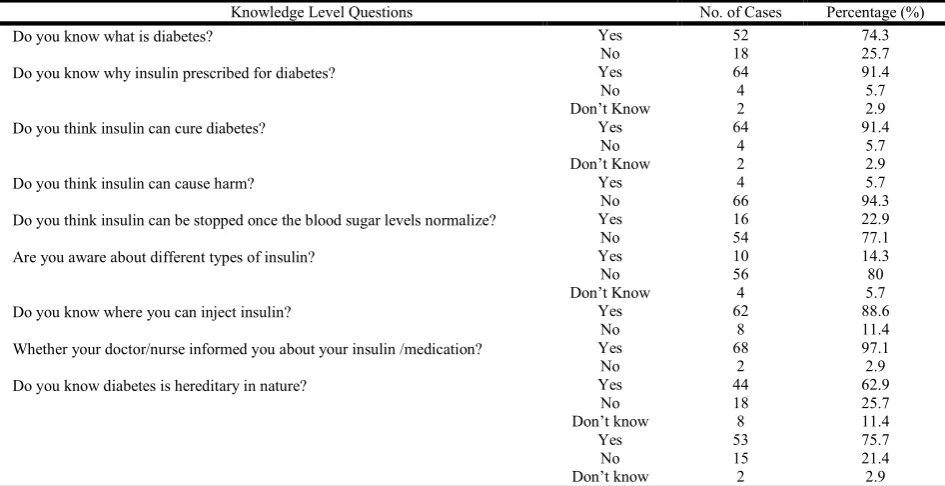
Almost 74.3% of the participants knew what diabetes was and 91.4% knew the purpose of insulin for diabetes. About 91.4% of respondents knew that insulin can cure diabetes and 94.3% knew that insulin would not cause harm if administered properly. And 77.1% of the study participants knew that insulin cannot be stopped once the blood sugar levels normalize. Eighty percentage of respondents were not aware about different types of insulin. Around 88.6% of the participants knew where they can inject insulin. Most of the participants (97.1%) has knowledge about their medication or insulin from their doctor or nurse. About 62.9% of the participants knew that diabetes is hereditary in nature and 75.7% knew how to deal with hypoglycemia. This finding was stated in table 2. This data reveals the better knowledge of patients regarding diabetes and insulin therapy. Similar study was conducted by Kant R and Thapilyal V about diabetes. Majority of the patients (65.7%) were not self confident about self administration of insulin and 90% were using insulin as advised. Around 65.7% of the participants were not used to miss insulin dose and 74.3% were not used to skip food after taking insulin. Most of the participants (61.4%) have an attitude that regular exercise can not control their blood sugar level. Almost 85.7% of the participants have an attitude that they should keep in touch with their physician and 62.9% would not let their blood sugar level fall below normal when they were taking insulin. About 48.6% of the respondents have an attitude that missing insulin dose would have negative effect on their diabetic control and 55.7% have an attitude that diabetes was a dangerous disease. Around 77.1% of the participants have an attitude that they were not allowed to adjust insulin dose by their own.
Table 1. Demographic and Social data of respondents (n=70)
Variables Total Number of Patients Percentage (%)
Gender
Male 41 58.6
Female 29 41.4
Age (years)
<= 20 2 2.9
21-30 2 2.9
41-50 8 11.4
51-60 26 37.1
61-70 23 32.9
>70 9 12.9
Education status
Illiterate 48 68.6
Primary school 20 28.6
High school 2 2.9
Marital Status
Married 68 97.1
Unmarried 2 2.9
Type of diabetes
Type 1 4 5.7
Type 2 66 94.3
Family History of Diabetes
Yes 25 35.7
[image:3.595.82.517.81.314.2]No 45 64.3
Table 2. Knowledge level (n=70)
Knowledge Level Questions No. of Cases Percentage (%)
Do you know what is diabetes? Yes 52 74.3
No 18 25.7
Do you know why insulin prescribed for diabetes? Yes 64 91.4
No 4 5.7
Don’t Know 2 2.9
Do you think insulin can cure diabetes? Yes 64 91.4
No 4 5.7
Don’t Know 2 2.9
Do you think insulin can cause harm? Yes 4 5.7
No 66 94.3
Do you think insulin can be stopped once the blood sugar levels normalize? Yes 16 22.9
No 54 77.1
Are you aware about different types of insulin? Yes 10 14.3
No 56 80
Don’t Know 4 5.7
Do you know where you can inject insulin? Yes 62 88.6
No 8 11.4
Whether your doctor/nurse informed you about your insulin /medication? Yes 68 97.1
No 2 2.9
Do you know diabetes is hereditary in nature? Yes 44 62.9
No 18 25.7
Don’t know 8 11.4
10. Do you know how to deal with the low blood sugar level than normal? Yes 53 75.7
No 15 21.4
Don’t know 2 2.9
Table 3. Attitude level (n=70)
Attitude Level Questions No. of Cases Percentage (%)
1.Are you self confident about self administration of insulin? Yes 24 34.3
No 46 65.7
2.Do you use insulin as adviced? Yes 63 90
No 7 10
3.Do you miss insulin dose? Yes 24 34.3
No 46 65.7
4.Do you skip food after taking insulin? Yes 18 25.7
No 52 74.3
5.Do you think regular exercise can control your blood sugar level?
Yes 23 32.9
No 43 61.4
Don't Know 4 5.7
6.Do you think you should keep in touch with your physician? Yes 60 85.7
No 10 14.3
7.Will you let your blood sugar levels fall below normal when you are taking insulin/medicines?
Yes 20 28.6
No 44 62.9
Don't Know 6 8.6
[image:3.595.69.542.343.586.2]8.Do you think missing taking the doses of your diabetic medications/insulin will have negative effect on your diabetic control?
Yes 32 45.7
No 34 48.6
Don't Know 4 5.7
9.Do you think diabetes is a dangerous disease?
Yes 39 55.7
No 29 41.4
Don't Know 2 2.9
10.Do you think you are allowed to adjust insulin dose by your own? Yes 16 22.9
[image:4.595.58.551.163.394.2]No 54 77.1
Table 4. Practice level (n= 70)
Practice Level Questions No. of cases Percentage (%)
1.Do you rotate injection site? Yes 54 77.1
No 16 22.9
2.Do you clean injection site with spirit before hand? Yes 40 57.1
No 30 42.9
3.Are you taking insulin before meals? Yes 63 90
No 7 10
4.Are you keeping insulin at a temperature of 2-80C (Refrigerator)? Yes 68 97.1
No 2 2.9
5.Do you check your blood sugar level in home? Yes 17 24.3
No 53 75.7
6.Do you check your fasting/post meal blood sugar level in a laboratory?
Yes 53 75.7
No 15 21.4
Don't Know 2 2.9
7.Do you take any other medication for diabetes without informing your physician? Yes 1 1.4
No 69 98.6
8.Do you follow a controlled and planned diet? Yes 43 61.4
No 27 38.6
9.Do you check your eyes regularly in clinic? Yes 16 22.9
No 54 77.1
10.Are you injecting insulin at an angle of 900?
Yes 32 45.7
No 36 51.4
[image:4.595.47.545.402.759.2]Don't Know 2 2.9
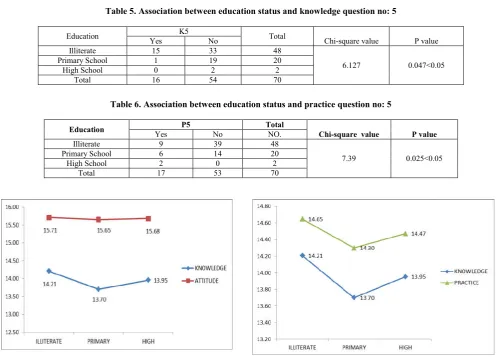
Table 5. Association between education status and knowledge question no: 5
Education K5 Total
Chi-square value P value
Yes No
Illiterate 15 33 48
6.127 0.047<0.05
Primary School 1 19 20
High School 0 2 2
Total 16 54 70
Table 6. Association between education status and practice question no: 5
Education P5 Total
Chi-square value P value
Yes No NO.
Illiterate 9 39 48
7.39 0.025<0.05
Primary School 6 14 20
High School 2 0 2
Total 17 53 70
Figure 1. Association of mean knowledge / attitude score with levels of education
Figure 3. Association of mean attitude /practice score with levels of education
The relation between education status of participants and their knowledge about insulin discontinuation once the blood sugar levels normalize was represented in table 5. This data suggests that there was statistically significant association exist between these two variables (p value= 0.047<0.05). Table 6 represents the relation between education status of participants and their practice of checking blood sugar level in home. This data suggests that there was statistically significant association exist between these two variables (p value= 0.025<0.05). Figure 1, 2, 3 shows relationship between respondents level of education and their knowledge, attitude and practice. This data suggests that mean knowledge score was more for illiterate (14.21) followed by high school (13.95) and primary school (13.70). Similarly mean attitude score was more for illiterate (15.71) followed by high school (15.68) and primary school (15.65). The mean practice score was more for illiterate (14.65) followed by high school (14.47) and primary school (14.30). This result was supported by the study conducted by Memon
MS et al. Knowledge and awareness is the greatest weapon in
the fight against diabetes mellitus and can help the people understand the risk of diabetes, motivate them to seek proper treatment and care, and prepare them to keep the disease under control. The main reason for their better knowledge, Attitude and practice irrespective educational status, towards insulin therapy was because of their years of experience with diabetes and insulin therapy. Almost all of the participants were having minimum 2 years and maximum 20 years of experience with diabetes. Some of the participants who were lacking in proper knowledge, attitude and practice in the community are important weakness to be addressed.
Future Directions
Present study outcomes indicate that the improvement in diabetic patients knowledge, attitude and practice about the insulin therapy can do productive changes in glycemic control. Still deep probing has to be done in future to know the contributing factors and solutions for such issues.
Pharmacoeconomic study can be conducted to decrease
the burden of cost to the patient.
The present study was conducted in a single hospital, hence it cannot be considered as a representative studies of south India, a comparative study on health facilities can be done in state wise or district wise to assess knowledge, attitude, practice of insulin therapy.
Limitations
Respondents may be unable/unwilling to provide the
desired information
Some participants had trouble in grasping the meaning of some questions which was clear for some other.
Respondents have hidden agenda that may lead to bias.
Conclusion
In this study we found that majority of the patients has better knowledge, attitude and practice towards insulin therapy except in a few. It is well known fact that if insulin is not used properly it may exhibit discomfort in the form of unwanted side effects to the patients receiving it. It will be good when a patient understand his/her therapy, better chances of positive outcome, which is directly linked with better knowledge, attitude and practice and further it leads to better compliance. Therefore it is always important to educate the patient about various aspects of insulin therapy including dosing, storage, site of injection, common side effects and life style modifications. Clinical pharmacist can play a vital role in monitoring and optimization of insulin therapy.
Acknowledgments
We express our sincere thanks to Shri. S.R. Reddy, M.Pharm., Chairman, Navodaya Educational Trust and Dr. Ashok Mahendrakar, Medical Superintendent, NMCH&RC, Raichur who had permitted us and provided us with the facilities to excute this work. We also record our special gratitude to all physicians and all nurses.
Conflict of interest: No conflict of interest
Funding: No Funding
REFERENCES
Agarwal, AA., Jadhav, PR. and Deshmukh, YA. 2014. Prescribing pattern and efficacy of anti-diabetic drugs in maintaining optimal glycemic levels in diabetic patients. J
Basic Clin Pharm., 5(3):79-83.
Harikrishnan, KV., Rajasree, R., Thomas, N. and Reghu, R. 2012. Study Of Prescription Pattern And Insulin Treatment In Type 2 Diabetic Patients. Int J Pharm Sci., 4(3):328-30. Hassan, HA., Tohid, H., Amin, RM., Bidin, MBL.,
Muthupalaniappien, L. and Omar, K. 2013. Factors influencing insulin acceptance among type 2 diabetes mellitus in a primary care clinic: a qualitative exploration.
BMC Fam Pract., 14:164 1-10.
Sau Nga, FU. and Cheung, S. 2017. How Misconception of Insulin Therapy Affects Type 2 Diabetes Mellitus Patients’
Acceptance on Daily Injection. Curr Res Diabetes Obes J.,
2(4):1-10.
Khan, NA., Venakatachalan, VV., Akhali, KMA., Alavudeen, SS., Dhanapal, CK. and Mohammed, AAS. 2015. Overview of glycemic control,knowledge,awareness and attitude among type 2 diabetes mellitus patients. J App
Pharm., 7(1):75-82.
attitude among type 2 diabetes mellitus patients. J App
Pharm., 7(1):75-82.
Saadia, Z., Rushdi, S., Alsheha, M., Saeed, H. and Rajab, M. A. 2009. Study Of Knowledge Attitude And Practices Of Saudi Women Towards Diabetes Mellitus. A (KAP) Study In Al-Qassim Region. The Internet Journal of Health, 11(2):1-7.
Jasper, US., Opara, MC., Pyiki, EB. and Akinrolie, O. 2014. Knowledge of insulin use and its determinants among Nigerian insulin requiring diabetes patients. Journal of
Diabetes & Metabolic Disorders, 13(10):1-8.
Kant, R. and Thalipyal, V. 2015. Knowledge attitude and practice of type 2 daibetes patients in a tertiary care teaching hospital in India. Integr food nute metab. 2(1):131-35.
Memon, MS., Shaikh, SA., Shaikh, AR., Fahim, MF., Mumtaz, SN. and Ahmed, N. 2015. An assessment of knowledge, attitude and practices (KAP) towards diabetes and diabetic retinopathy in a suburban town of Karachi. Pak J Med Sci., 31(1)183-8.