Comparison between Automatic and Human Subtitling:
A Case Study with Game of Thrones
Abstract
In this article, I would like to share my experiences with the software DeepL and the comparison anal-ysis I have made with human subtitling offered by the DVD version of the corpus I have chosen as the topic of my study – the eight Seasons of Game of Thrones. The idea is to study if the version pro-posed by an automatic translation program could be used as a first draft for the professional sub-titler. It is expected that the latter would work on the form of the subtitles, that is to say mainly on their length, in a second step.
1
Introduction
Internet research has revealed the existence of many free software applications that produce sub-titles for videos including Time Adjuster; Visu-alSubSync; Subtitle Workshop; Subtitle Creator; Aegisub Advanced Subtitle Editor; DivXLand Me-dia Subtitler; WinSubMux; Subtitle Editor and
AHD Subtitles Maker and SubEdit Player. These programs offer many features such as ex-tracting files from a video, editing these files, view-ing subtitles of a video, insertview-ing subtitles into a video, synchronizing subtitles with images, and searching for existing subtitle files on the Internet.
YouTube provides something more by the use of two tools: Google Voice and Google Translate. It offers automatic translations using automatic tran-scriptions (voice recognition). Also, it can provide automatic translations using human transcriptions (source scripts).
Furthermore, research on post-editing in transla-tion is becoming more and more extensive. It fo-cuses on the question of the quality/time ratio in the translation activity (O’ Brien, 2014).
But what about interlingual subtitling, machine translation and post-editing? Why is research
bringing together these three points which is almost non-existent?
It is true that the specific constraints of subtitling make it a very special form of translation. It is also referred to as "adaptation" because the adapter/ subtitle translator must adapt to the existence of the image as well as to the space-time parameter. It is therefore not surprising that subtitling research fo-cuses on the form of this type of translation and its polysemiotic context.
Recent decades have seen the increasing use of machine translation by professionals, the nature of whose work has gradually been transformed. In France, the very sophisticated software program
DeepL has become a popular tool, but how effec-tive is it when applied to the translation of subtitles with their very specific formal constraints?
In what follows, I will compare the automatic translation of subtitles for a television series with the one carried out by human translators. I will fo-cus on the quality of an automatic translation, re-gardless of formal restrictions. The idea is to eval-uate whether the version proposed by the automatic translation program could be used as a first draft by a subtitler. The latter would then concentrate on the formal aspects of the subtitles in a polysemiotic en-vironment.
2
Choice of the Corpus
I have chosen as my corpus the eight Seasons of the American television series Game of Thrones, di-rected by David Benioff and Daniel Brett Weiss and broadcast on HBO from 2011 to 2019. This fantasy drama is an adaptation of the novel A Game of Thrones, from the fantasy series A Song of Ice and Fire written by the American author George R. R. Martin and published in 1996.
Sabrina Baldo de Brébisson
University of Evry Val d’Essonne/Paris-Saclay
91000 Evry, France
According to the 2016 edition of the Guinness Book of Records (Lexpress.fr, 2015), Game of Thrones is the most widely distributedseries in the world, with no less than 171 countries. It holds the record for global diffusion and plot twists. Its pop-ularity has led to a large amount of data available on the Internet, including the entire English script of the eight Seasons (more than 800,000 words) and the French subtitles from the DVDs of the eight Seasons.
The nature of the dialogues in Game of Thrones
are interesting from a linguistic point of view for several reasons. First, the vocabulary is relatively extensive, rich and varied. There is frequent us of specialized words specific to the Middle Ages, which makes it possible to analyze the processing of a specialized glossary (rather than a general one) by the machine translation system. Then, the themes of social hierarchy, political and power re-lations being widely explored, the translation of the personal pronoun you into tu or vous is particularly important. It was an opportunity to analyze this re-current problem in English to French translation. Finally, the dialogues contain relatively long and complex syntactical elements, which puts the sys-tem's ability to handle non-canonic sentences and literary style to the test
.
3
Research on Subtitling
The term "adaptation" was chosen to refer to the translation of subtitles because it is subject to spe-cific spatial and temporal constraints. The profes-sional adapter must adapt their translation using specific techniques in order to produce bare, gen-eral and sometimes unfair subtitles (Baldo, 2009). The adapter is therefore required to express an idea in a limited number of words – depending on the time and space at his/her disposal - and deliberately discard certain semantic information from the source script.
It is therefore not surprising that academic re-search in subtitling focuses on its polysemiotic na-ture and its purpose: the comfort of the viewer (Orero, 2008). Some researchers argue for the use of creative subtitles to overcome traditional con-straints, made possible with advances in digital technology (Nornes, 2007; Diaz, 2007; Baldo, 2019).
4
Automatic Translation of Subtitles with GoogleThere is a gap between university research in France on automatic subtitling translation, which is very rare, and the large number of computer pro-grams that offer automatic subtitling services on the Internet, such as the ubiquitous YouTube. YouTube provides us with the opportunity to do automatic captioning for videos thanks to the cou-pling of two systems: Google Voice and Google Translate. The subtitles which are first generated by voice recognition technology (Google Voice) are then automatically translated by the machine translation tool (Google Translate).
My research so far in the field of automatic titling has focused on the use of the automatic sub-titling tool provided by Google on YouTube, enti-tled "Is automatic subtitling a new technology that professional adapters can use?" (Baldo, 2015). The latter was the continuation of a study entitled
"Automatic subtitling: a technological innovation that can be used by professional adapters?" that I presented at the University of Rennes 2 (France) during the Symposium "Optimizing the place of the human in translation: facing the technological challenge" in 2013.
My research was based on a comparative anal-ysis between human translations done by a profes-sional adapter and the automatic translation pro-vided by Google. In other words, I studied the quality of vocal recognition and machine transla-tion proposed by the program, thanks to a compar-ative analysis with the work of a professional adapter. My purpose was to discover whether this technology was potentially helpful for a profes-sional adapter or not.
I limited my research to a qualitative study of speech recognition (automatic transcription), au-tomatic translations using auau-tomatic transcrip-tions (voice recognition) and automatic transla-tions using human transcriptransla-tions (source scripts). The use of both of these tools, Google Voice and
Google Translate proved to be chaotic, unman-ageable and therefore unusable by a professional adapter:
quality of speaker enunciation to the sonic envi-ronment, not to mention the recording quality of the medium itself;
– The quality of a machine translation from an automatic transcription: pure madness. With-out a doubt, a machine translation system cannot produce meaningful text from text which is sense-less;
– The quality of a machine translation from a human transcript: sweet madness since in the context of adaptation, the automatic translation would probably not be acceptable as it cannot pro-vide subtitle-length segments. It would be hard to read on the screen.
The conclusion of my work, valid for the corpus of my study, was that Google's automatic subtitling system in 2015 was an unsuitable technology for professional adapters. Using it was a technological feat: the final quality was unusable (with or without Google Voice), even when the machine translation was acceptable. On the rare occasions when ma-chine translation was acceptable, it did not meet the
sui generis requirements of adaptation
5
Automatic Translation of Subtitles with DeepLDeepL, as an online machine translation service of
DeepL GmbH, was launched in 2017 by the Linguee team, authors of the world’s largest dic-tionary since 2010. The dicdic-tionary is based on a program that detects bilingual sites, which are col-lected in the Linguee database. Afterwards, an au-tomatic learning algorithm judges the quality of the translations of words, phrases or sentences and sorts them. DeepL uses Convolutional Neural Net-works which are part of automatic learning (CNN or ConvNet) and that are built on the Linguee data-base.
The service offers seventy-two combinations from nine languages (Dutch, English, French, Ger-man, Italian, Polish, Portuguese, Russian and Spanish,) the quality of the combinations likely quite variable, depending on the combination. Ac-cording to one study (Coldewey, Lardinois, 2017),
DeepL is more nuanced and more precise, with similar speed, to its competitors Google Transla-tion, Microsoft Translation and Facebook.
My analysis has focused on the linguistic quality of the machine translation offered by DeepL from English into French, as regards subtitles.
5.1
Analysis
My analysis focused on a sample of 5,000 words per Season, which makes a total corpus of 40,000 words. I developed the assurance quality grid in two main steps. First, by considering other existing professional grids, such as the one from Lisa soft-ware (Localization Industry Standards Associa-tion) and the one created by my colleagues of the University of Rennes 2 (Toudic & al.: 2014), then in parallel with the corpus analysis phase. In the end, the grid I will present is adapted to the analysis of subtitles produced by DeepL's system as a first draft for the adapter.
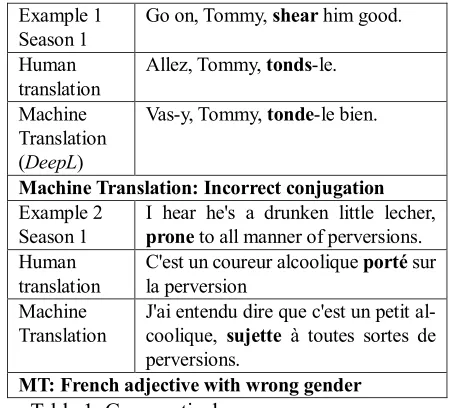
I have identified five categories to illustrate the errors identified in DeepL translation followed by my comments. DeepL’s mistakes are presented in bold print. Lastly, I have added the human subtitled translation for comparison.
Category 1: Grammar; Spelling; Typography This first category includes grammatical, spelling and typographical errors (including punctuation). In short, these are errors that can be attributed to the program, in the sense that they are correctable, such as a wrong conjugated verb or a capital letter that is not reproduced.
Example 1 Season 1
Go on, Tommy, shear him good.
Human translation
Allez, Tommy, tonds-le.
Machine Translation (DeepL)
Vas-y, Tommy, tonde-le bien.
Machine Translation: Incorrect conjugation
Example 2 Season 1
I hear he's a drunken little lecher,
prone toall manner of perversions. Human
translation
C'est un coureur alcoolique porté sur la perversion
Machine Translation
J'ai entendu dire que c'est un petit al-coolique, sujette à toutes sortes de perversions.
[image:3.595.303.529.435.639.2]MT: French adjective with wrong gender
Table 1: Grammatical error.
S6 And without an heir, well let's hope the maes-ters are right and Lady Walda's carrying a boy. HT Sans héritier, eh bien... Espérons que les
mestres disent vrai et que lady Walda porte un fils.
MT Et sans héritier, espérons que les maitres ont raison et que Lady Walda porte un garçon.
MT: Spelling (missing accent.)
[image:4.595.302.534.71.325.2]"Maître" with accent is more common than "maitre" without accent. The latter is rare but not considered as a complete error since the 1990 Spelling Reform in France.
Table 2: Spelling error.
S2 King Joffrey is a Baratheon, Your Grace. HT Le roi Joffrey est un Baratheon.
MT Le roi Joffrey est un baratheon, Votre Grâce
MT: Absence de majuscule
Table 3: Typography error.
Category 2: Style
I borrowed the name of the second category – Style – from my colleagues at the University of Rennes 2 (Toudic & al.: 2014).
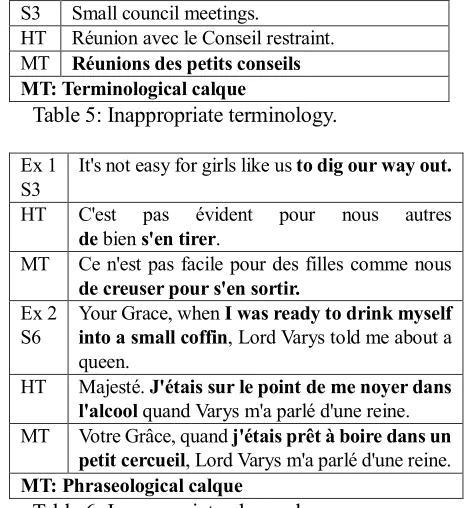
The Style category is divided into five sub-catego-ries: inappropriate lexicon, terminology, phraseol-ogy, language register and finally non-fluidity. It accounts for all the clumsy writing, approximations or even inaccuracies in the translation of a word or a group of words, whether or not they are special-ized.
S1 Is it true they lie with their horses?
HT Est-ce vrai qu'ils dorment avec leurs che-vaux ?
MT C'est vrai qu'ils mentent avec leurs chevaux ?
MT: Nonsense due to the polysemiotic verb "lie".
S2 I had two cupsof wine
HT J'ai bu deux coupes. MT J'ai bu deux tasses de vin.
MT: Wrong collocation
S2 Or do you want to trade gossip like a couple of
fishwives?
HT Ou veux-tu échanger des ragots ?
MT Ou tu veux échanger des ragots comme deux
femmes-poissons ?
MT: Lexical calque (instead of “poissionnières” for fishmongers.) Good translation by DeepL when "fishwife" is in the singular.
Table 4: Inappropriate lexicon.
S3 Small council meetings.
HT Réunion avec le Conseil restraint.
MT Réunions des petits conseils
MT: Terminological calque
Table 5: Inappropriate terminology.
Ex 1 S3
It's not easy for girls like us to dig our way out.
HT C'est pas évident pour nous autres
de bien s'en tirer.
MT Ce n'est pas facile pour des filles comme nous
de creuser pour s'en sortir.
Ex 2 S6
Your Grace, when I was ready to drink myself into a small coffin, Lord Varys told me about a queen.
HT Majesté. J'étais sur le point de me noyer dans l'alcool quand Varys m'a parlé d'une reine. MT Votre Grâce, quand j'étais prêt à boire dans un
petit cercueil, Lord Varys m'a parlé d'une reine.
MT: Phraseological calque
Table 6: Inappropriate phraseology.
The series is known for its different language levels. Brienne of Tarth uses a much more formal register than The Hound, who doesn't hesitate to swear.
S1 And you, you're Ned Stark's bastard, aren't you?
HT Et toi, tu es le bâtard de Ned Stark.
MT Et toi, tu es le salaud de Ned Stark, n'est-ce pas ?
Literal vs. figurative meaning Formal vs. informal
Table 7: Inappropriate language register.
S4 For 40 years I've tried to teach you.
If you haven't learned by now, you never will. HT 40 années passées à t'éduquer.
Tu es irrécupérable.
MT Pendant 40 ans, j'ai essayé de t'apprendre. Si tu n'as pas encore appris, tu ne l'apprendras jamais.
MT: Badly expressed because of the ellipse
[image:4.595.74.291.72.306.2]Category 3: Morphosyntax
This category includes only one type of error, that of a morphosyntactic natu
re including syntactic
calque.
S1 Whatever Jon Arryn knew or didn't know, it
died with him.
HT Ce que Jon Arryn savait est mort avec lui. MT Ce que Jon Arryn savait ou ne savait pas, il est
mort avec lui.
MT: Morphological calque
S2 When Eddard Stark learned the truth, he told only me.
HT Ned Stark n'avait alerté que moi.
MT Quand Eddard Stark a appris la vérité, il n'a dit que moi.
MT: Syntactic calque
Table 9: Morphosyntactic error.
Category 4: Localization
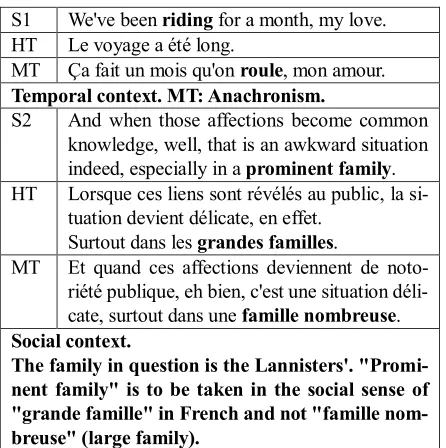
This category is probably the most interesting for a translation scientist as it deals with the most diffi-cult cases in translation. Indeed, (briefly explain what localization is). One wonders how the system could operate to provide a correct translation. The category contains all the translations that seem un-suitable due to the context (i.e. temporal, social one) or to the linguistics itself of the target lan-guage.
S1 We've been riding for a month, my love. HT Le voyage a été long.
MT Ça fait un mois qu'on roule, mon amour.
Temporal context. MT: Anachronism.
S2 And when those affections become common knowledge, well, that is an awkward situation indeed, especially in a prominent family. HT Lorsque ces liens sont révélés au public, la
si-tuation devient délicate, en effet. Surtout dans les grandesfamilles.
MT Et quand ces affections deviennent de noto-riété publique, eh bien, c'est une situation déli-cate, surtout dans une famillenombreuse.
Social context.
[image:5.595.305.526.125.434.2]The family in question is the Lannisters'. "Promi-nent family" is to be taken in the social sense of "grande famille" in French and not "famille nom-breuse" (large family).
Table 10: Non-adaptation to the context
By "non-adaptation to the linguistics of the tar-get language", I refer to all the cases that present difficulties due to differences in linguistic matters. For example, the female or male gender of French
determiners, adjectives or names, the translation of the pronoun you by the pronouns tu or vous or the translations of modal auxiliaries.
S1 All these years, and I still feel like anoutsider
when I come here.
HT Depuis toutes ces années, je me sens toujours
étrangère en ces lieux.
MT Toutes ces années, et je me sens toujours comme un étranger quand je viens ici.
MT: French noun translated with wrong gender
S4 - Do you like women?
- When they look like her, my lord. - This one will do nicely.
HT - Tu aimes les femmes ? - Quand elles lui ressemblent, oui.
- Elle devrait faire l'affaire. MT - Vous aimez les femmes ?
- Quand ils lui ressemblent, mon seigneur. - Celui-ci fera très bien l'affaire.
MT: French pronoun translated with wrong gen-der
S6 She was fearless.
There was nothing she wouldn't do. HT Elle était intrépide.
Elle ne reculait devant rien. MT Elle n'avait peur de rien.
Il n'y avait rien qu'elle ne ferait pas.
MT: wrong tense
[image:5.595.72.295.140.298.2]Modal auxiliaries: habit value (past tense) vs. con-ditional value
Table 11: Non-adaptation to the linguistics of the target language
Category 5: Omission or Addition of Infor-mation
This fifth category is essential in a study on tling. Indeed, an omission of information in subti-tling is rarely considered an error, unless it affects the viewer's understanding of the film. I have in-cluded in this sub-category the untranslated parts as as a form of omission.
S3 The Unsullied have stood here for a day and a night with no food or water.
HT Les Immaculés sont plantés là depuis un jour et une nuit.
MT Les Unsullied sont restés ici un jour et une nuit sans nourriture ni eau.
MT: Non-translated
Table 12: Omission.
[image:5.595.71.294.461.685.2]S3 One brother inside his army will be worth 1,000
fighting against it.
HT Un homme infiltré dans son armée vaudra 1 000 hommes le combattant.
MT Un frère à l'intérieur de son armée vaudra mille dollars en combattant contre elle.
MT: Addition of incorrect information.
Erroneous meaning due to an ellipse: “dollars” has been added instead of “men.”
Table 13: Addition
5.2
Results: Comparison between DeepL
and Human Translation of Subtitles
DeepL Quantitative AnalysisThe analysis I did on DeepL was significant for the corpus that was used. It found that the French ver-sion provided by the program could be used a pri-ori as a draft. Indeed, only an average of 1.18% of errors was found. Also, the number of errors per category varied: 45.9% of style errors; 36% of lo-calization errors; 13% morphosyntactic errors; 5% of grammatical, spelling and typography errors and only 0.1% of omission/addition errors.
Several conclusions can be drawn from this. The most common errors concern stylistic clumsiness involving a poor choice of the lexicon and expres-sions. The Localization category represents more than a third of all errors, the ones that are due to a failure to consider the context (i.e. feminine sex of the character, of the pronouns and of determiners). Morphosyntactic and grammatical errors are few and spelling errors are non-existent. The least rep-resented category is the omission/addition cate-gory, with a very low percentage. However, this deserves more attention as it raises, among other things, the question of non-translation, including the non-translation of proper names. This point proved to be delicate because it is quite subjective (Delavaud: 2014).
The saga is extremely rich in names, nicknames, houses, places, castles, cities, villages, rivers, lakes, regions, islands.... If I had counted the oc-currences of non-translated proper names by the program, the percentage of errors in this category would have been higher. But this would have re-quired a full study on a very complex point. The adapters of the series acknowledged that they had mainly relied on the literary translation of Jean Sola and Patrick Marcel of the fantasy novel se-ries A Song of Ice and Fire (Pacheco: 2017). This is not without reminding us of the massive trans-lation work done by Jean-François Ménard (Mari-aule: 2019) on Harry Potter, which could be used
as a model for the adapters of the French subtitled version of the Game of Thrones series.
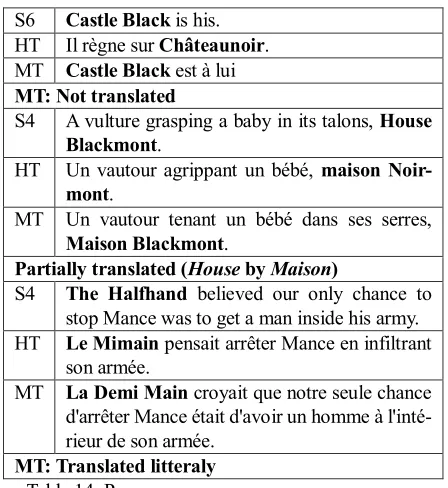
Here are some examples illustrating the fact that the translation of proper names by DeepL has been very variable: from non-translation to translation, including partial translation.
S6 Castle Black is his. HT Il règne sur Châteaunoir. MT Castle Black est à lui
MT: Not translated
S4 A vulture grasping a baby in its talons, House
Blackmont.
HT Un vautour agrippant un bébé, maison Noir-mont.
MT Un vautour tenant un bébé dans ses serres,
MaisonBlackmont.
Partially translated (House by Maison)
S4 The Halfhand believed our only chance to stop Mance was to get a man inside his army.
HT Le Mimain pensait arrêter Mance en infiltrant
son armée.
MT La Demi Main croyait que notre seule chance
d'arrêter Mance était d'avoir un homme à l'inté-rieur de son armée.
[image:6.595.305.529.156.400.2]MT: Translated litteraly
Table 14: Proper names
Besides, I couldn’t consider the translation of
you by the French pronouns tu or vous in my quan-titative analysis of DeepL translation. First of all, because there is, like the translation of proper names, a great deal of subjectivity. Secondly, the task is a complex one given the many characters and their multiple and complex relationships. In order to better manage this point, the adapters have created what they call a Bible, which is a very detailed table listing the characters and their use of vous or tu in addressing this or that charac-ter (Pacheco: 2017).
More broadly, I was confronted with several problems:
– the repetition of erroneous occurrences. I opted to count them only once, but they are prob-lematic ;
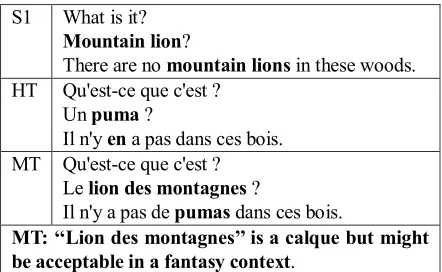
– it was not always easy to determine the appro-priate category for errors that sometimes covered different fields. The error mentioned above in "you're Ned Stark's bastard" translated by DeepL
into "Tu es le salaud de Ned Stark" is from an In-appropriate language register but could also have been identified as a lexical translation error;
S1 What is it?
Mountain lion?
There are no mountain lions in these woods. HT Qu'est-ce que c'est ?
Un puma ?
Il n'y en a pas dans ces bois. MT Qu'est-ce que c'est ?
Le lion des montagnes ?
Il n'y a pas de pumas dans ces bois.
[image:7.595.77.537.65.727.2]MT: ‘‘Lion des montagnes’’ is a calque but might be acceptable in a fantasy context.
Table 15: Non-homogeneity
Lastly, the percentage of errors obtained in my corpus is only indicative but we can assume that given the very low rate of errors that was obtained,
DeepL could be used as a draft.
DeepL Better than Human Translation?
In choosing to work from DVDs, I assumed I
was avoiding the amateurish quality of
subti-tling associated with, for example, Netflix.
The quality of its translation of French subtitles has been subject to controversy and accused of be-ing amateurish (Wachthausen: 2019). So, I chose to rely on the French subtitles of the DVD box set of the series because I assumed that they would be of a more professional quality. However, I have identified a number of errors that are so gross that it cannot be assumed that the subtitles have been reviewed by a professional human being. Here are some examples:Ex. 1, S1, Episode 1
They were meant to have them.
HT Ils leurs sont destinés leur
MT Ils étaient censés les avoir.
HT: Grammar error MT: Correct grammar
Ex. 2 S2, E3
This bastard’s been meddling where he shouldn’t.
HT Ce bâtard àfourré son nez où il n’aurait pas dû.
a
MT Ce salaud s'est immiscé là où il ne devrait pas.
HT: Grammatical and typographical error
(confusion between the preposition à to and the aux-iliary avoir.)
MT: Proper translation
Ex. 3 S1, E3
You never fall.
HT Tu ne tombe jamais.tombes
MT Tu ne tombes jamais.
Ex. 4 S1, E4
What did I buy you for?
HT Pourquoi t’ais-je achetée ?
t’ai-je
MT Pourquoi t'ai-je acheté ? Ex. 5,
S2, E3
He ran off before anyone could split.
HT Il s’est enfuit en une clin d’œil. s’est enfui
MT Il s'est enfui avant que quelqu'un puisse
partir.
HT: Conjugation error MT: Correct conjugation
Table 16: Grammar error.
Ex 1 S1, E3
She must take his side even when he’s
wrong.
HT Elle doit le défendre même s’il a tord. tort
MT Elle doit prendre son parti même quand il a
tort. Ex 2
S2, E3
You didn’t win my father’s support or his army on charm alone.
HT Tu n’as pas gagné le soutient et l’armée de mon père uniquement par ton charme.
soutien
MT Tu n'as pas gagné le soutien de mon père ou de son armée par le seul charme.
Ex 3 S2, E3
Your ennemies aren’t happy about us. They want to tear us apart.
HT Notre union déplaît à tes ennemies. Ils veu-lent nous séparer.
ennemis
MT Vos ennemis ne sont pas contents de nous.
Ils veulent nous séparer.
[image:7.595.71.292.69.205.2]HT: Spelling mistake MT: Correct spelling
Table 17: Spelling mistake
S1,E2 It’s time we reviewed the accounts. HT Il est tant de revoir les comptes.
temps
MT Il est temps de revoir les comptes.
HT: nonsense because of a major grammatical/lexi-cal error (homonymic confusion between the adverb tant and the name temps)
MT: Correct translation
Table 18: Inappropriate lexicon
[image:7.595.306.535.69.528.2]The human errors identified are typical of those found in writings by people who have poor com-mand of French spelling, grammar and typography. However, I have found relatively few such errors (5%) with DeepL.
Even in case of a pun (Brisset & al.: 2019), which generally poses a difficulty in translation,
DeepL is surprisingly successful:
S1 - Why do they call you Littlefinger?
- When I was a child, I was very small, and I come from a little spit of land called the Fingers, so you see, it’s an exceedingly clever nickname. HT - Pourquoi le surnom de Littlefinger ?
- Enfant, j’étais très petit (little), et je viens d’une terre appelée Doigts (Fingers)…, c’est un surnom très malin.
MT - Pourquoi on t'appelle Littlefinger ?
- Quand j'étais enfant, j'étais très petit, et je viens d'un petit bout de terre appelé les Fingers, alors vous voyez, c'est un surnom extrêmement intelligent.
HT: Explanatory translation MT: Acceptable translation
Table 19: Pun
The adapter chose to propose an explanatory subtitle, which deconstructs the play on words. This is what I called, the "note-on" (Baldo: 2019, p. 345) by analogy with the word "pop-on". The note refers to a type of subtitle that includes a trans-lator's note. It is becoming more and more com-mon, especially in the case of wordplay or complex translations. As for DeepL, the automatic software goes beyond explanations and submits an accepta-ble and fluent translation, relying on a minimum of English knowledge on the part of the viewer for his/her understanding of the pun.
DeepL's Limits When Applied to Subtitling
Some of the errors found in the DeepL version could not have been avoided. For instance, in a case of syntactic ambiguity:
S3 The girl likes you.
You like herback, Snow? HT La fille t'apprécie.
C'est réciproque ? MT La fille t'aime bien.
Tu aimes son dos, Snow ?
HT: Correct translation
MT: Correct translation but wrong context
Table 20: Syntactic ambiguity
Or in the case of an ellipsisthat creates a misin-terpretation:
S6 Martell raped and murdered, and you did noth-ing. Oberyn Martell butchered, and you did nothing.
HT Elia Martell a été violée et tuée.
Vous n'avez rien fait. Oberyn Martell a été massacré. Vous n'avez rien fait.
MT Elia Martell a violé et assassiné, et vous n'avez rien fait. Oberyn Martell a massacré, et vous n'avez rien fait.
HT: Correct semantical translation
[image:8.595.305.532.109.255.2]MT: Correct syntactic translation vs. incorrect se-mantical translation.
Table 21: Ellipse of the auxiliary be
Above all, DeepL's output is limited in the sec-ond phase of the adapter's work: the one that con-sists in reducing the length of the subtitle. This is not surprising since DeepL was not developed for this purpose. Here is an example that shows the adapter's work of synthesizing:
S7 With their help, the Mad King's daughter has fer-ried an army of savages to our shores, mindless Unsullied soldiers who will destroy your castles
and your holdfasts, Dothraki heathens who will burn your villages to the ground, rape and en-slave your women, and butcher your children
without a second thought.
HT Avec leur aide, la fille du roi fou a conduit des sauvages à nos portes. Des Immaculés écervelés qui détruiront vos châteaux. Des brutes dothraks qui brûleront vos villages, violeront vos femmes et égorgeront vos enfants.
MT Avec leur aide, la fille du Roi Fou a transporté une armée de sauvages sur nos rives, des soldats sans scrupules qui détruiront vos châteaux et vos possessions, des païens Dothraki qui brûle-ront vos villages, violebrûle-ront et réduiront vos femmes en esclavage, et abattront vos enfants
sans hésiter.
HT: Use of omission and short synonyms. 36 words
and 221characters including spaces
MT: Full translation. 48 words and 295 characters including spaces
Table 22: Synthesizing
6
Conclusion
In France, today, we can no longer ignore the use of DeepL in the field of translation. There is no longer any shame associated with the use of an au-tomatic translation program and translation agen-cies now offer machine translation services with post-editing. Whereas a few years ago this was a taboo subject among agencies, today DeepL is part of the reality of professional translation practice, at least with regard to the English-French combina-tion of languages. The real quescombina-tion is no longer whether or not to use DeepL, but how to manage this new market reality.
The objective of this research has been to estab-lish whether DeepL's automatic translations are a pure utopia or if they can be used by professional adapters. My study has attempted to answer the fol-lowing question: Can automatic subtitling be of a sufficiently high quality to be used primarily by the human subtitler? I would answer that this is a pos-sible option. The error rate seems low enough to save the translator time. The next step of this re-search on automatic subtitling practice could be to compare the time adapters spend translating with and without DeepL.
However, the integration of an automatic transla-tion program into the adaptatransla-tion process is a major issue, that of the image of a profession already ex-posed to criticism. This also explains why few sub-titlers admit to using fansubbing translations as a draft for their professional ones.
References
Abé Mark NORNES. 2007. Translating Global Cinema, Minneapolis, University of Minnesota Press.
Daniel Toudic, Katell Hernandez Morin, Fabienne Mo-reau, Franck Barbin & Gaëlle Phuez. 2014. Du con-texte didactique aux pratiques professionnelles : pro-position d’une grille multicritères pour l’évaluation de la qualité en traduction spécialisée.
http://journals.openedition.org/ilcea/2517
David Benioff, Daniel Brett Weiss (dir.). Game of Thrones. 2017. 34 DVD.
DeepL
https://www.DeepL.com/translator
Devin Coldewey, Frederic Lardinois. 2017. DeepL schools other online translators with clever machine learning.
https://techcrunch.com/2017/08/29/DeepL-schools- other-online-translators-with-clever-machine-learn-ing/
Frédérique Brisset, Audrey Coussy, Ronard Jenn, Julie Loison-Charles (éds.). 2019. Du jeu dans la langue. Traduire le jeu de mots, Collection « Traductologie », Presses du Septentrion, Lille.
Game of Thrones Episode Scripts
https://www.springfieldspringfield.co.uk/epi-sode_scripts.php?tv-show=game-of-thrones
George R. R. Martin.1996. A Song of Ice and Fire,
Bantam Book.
Jadine Labbé Pacheco. 2017. Game of Thrones : Blan-dine a vu les épisodes avant vous.
https://www.nouvelobs.com/rue89/rue89-nos-vies- connectees/20170731.OBS2783/game-of-thrones-blandine-a-vu-les-episodes-avant-vous.html
Jean-Luc Wachthausen. 2019. Pourquoi les sous-titres de Netflix frisent l’amateurisme.
https://www.lepoint.fr/pop-culture/series/pourquoi- les-sous-titres-de-netflix-frisent-l-amateurisme-06-05-2019-2310985_2957.php
Jorge Diaz Cintas. 2007. Back to the Future in Subti-tling [en ligne]. In MuTra Conference Proceedings. http://euroconferences.info/proceedings/2005_Pro-ceedings/2005_DiazCintas_Jorge.pdf
Lexpress.fr. 2015. Game of Thrones entre dans le livre des records.
https://www.lexpress.fr/culture/tele/game-of-
thrones-entre-dans-le-livre-des-re-cords_1712204.htm
Lisa (The Localization Industry Standards Associa-tion) QA
http://dssresources.com/news/1558.php
Mickaël Mariaule. 2019. Harry Potter : la traduction française des noms propres. In L’intraduisible. Les méandres de la traduction. Sabrina Baldo de Brébis-son et Stephanie Genty (éds.). Artois Presses Univer-sité, Arras, pages 361-373.
Pilar Orero. 2008. Le format des sous-titres : les mille et une possibilités. In La traduction audiovisuelle. Jean-Marc Lavaur & Adriana Serban (eds.), Bruxelles, De Boeck, pages 55-65.
Presses Université, Arras, pages 335-59.
Sabrina Baldo de Brébisson. 2017. « Venture into the untranslatable: A tribute to the subtitler explorer, a hero with a thousand faces », in Élisabeth Navarro et Jean-Michel Benayoun (éds.), Langues, diversité et stratégies interculturelles, Michel Houdiard Édi-teur, Paris, pages 302-322.
Sabrina Baldo de Brébisson. 2015. Is automatic subti-tling a new technology that professional adapters can use? In La main de Thôt, n°3, Miscellanées, Traduc-tion et mémoire, mis à jour le : 08/03/2018. http://re-vues.univ-tlse2.fr/lamaindethot/index.php?id=517.
Sabrina Baldo de Brébisson. 2009. Traduction et Adap-tation : Analyse comparative. In Traductologie et en-seignement de traduction à l’Université. Michel Bal-lard (ed.). Artois, Presses Université Arras, pages 157-167.
Sharon O’Brien, Laura Winther Balling, Michael Carl, Michel Simard, and Lucia Specia. 2014. PostEdit-ing of Machine Translation: Processes and Applica-tions. Cambridge Scholars Publishing, Newcastle upon Tyne.
Thibault Delavaud. 2014. La traduction de Game of Thrones est-elle si mauvaise.
http://thibaultdelavaud.unblog.fr/2014/04/28/la-tra- duction-de-game-of-thrones-est-elle-si-mau-vaise/comment-page-1/#comment-758
Wondershare. 2019. Créer des sous-titres à vos vi-déos : 10 meilleurs logiciels sous-titrage gratuits
https://filmora.wondershare.com/fr/astuces-mon-
tage-video/creer-des-sous- titres.html?gclid=Cj0KCQjwhdTqBRDNARI-