doi:10.4236/ijcns.2009.25038 Published Online August 2009 (http://www.SciRP.org/journal/ijcns/).
Iterative Detection and Decoding with PIC Algorithm for
MIMO-OFDM Systems
Zhongpeng WANG
School of Information Technology and Electronic Engineering Zhejiang University of Science and Technology, Hangzhou, China
Email: wzp1966@sohu.com
Received February 4, 2009; revised March 25, 2009; accepted April 30, 2009
ABSTRACT
In this paper, we propose a new iterative detection and decoding scheme based on parallel interference can-cel (PIC) for coded MIMO-OFDM systems. The performance of proposed receiver is improved through the joint PIC MIMO detection and iterative detection and decoding. Its performance is evaluated based on com-puter simulation. The simulation results indicate that the performance of the proposed receiver is greatly im-proved compared to coded MIMO-OFDM systems based on VBLAST detection scheme.
Keywords: Iterative Detection and Decoding, MIMO-OFDM, PIC Signal Detection, VBLAST
1. Introduction
In multipath environments, multiple input multiple output wireless communication system can increase spectral efficiency. Furthermore, to achieve high data rate wireless communications, space-time communication systems need to be in wideband frequency selective channels. Orthogonal frequency division multiple (OFDM) has be-come a popular technique for transmission of signals over wireless channels. OFDM are robust to frequency selec-tive fading channels for OFDM systems use the discrete Fourier transform (DFT) to modulate the data on or-thogonal frequency carriers and effectively divide the wideband channel into a number of narrowband flat channels. One important advantage of the OFDM trans-mission technique is that the intersymbol interference (ISI) can be removed if the channel delay spread is less than he inserted guard interval.
Clearly, conventional MIMO detection algorithms can be applied for MIMO-OFDM system [1-4]. The MIMO maximum likelihood detection detector is the optimal receiver, but its complexity is best high. A number of sub-optimum receivers of low to moderate complexity have been devised, yet all suffer from rather limited per-formance. The conventional VBLAST algorithm exhibits the best tradeoff between performance and complexity.
However, it involves an intensive computation and hence it may be difficult to implement it for high data rate communications. Linear ZF and MMSE have the best low complexity but the performances are the worse. The QR [3] detection receiver avoids the matrix inversion, but the performance is not good as ZF-VBLAST. The QR detec-tion based on ordering MMSE criterion is proposed [5]. Compared to zero-forcing criterion the detection method based on MMSE criterion needs estimating the signal- noise ratio or variance of noise.
Now considerable research interests have been focused on techniques and algorithms which realize various bene-fits of turbo principle for MIMO systems [6-8]. The method based on turbo principle, is regarded as an essen-tial technique to furthermore improve system perform-ance with soft iterative detection and decoding through an exchange of information. One of major drawbacks of such turbo-MIMO concepts is that its complexity in-creases exponentially with the number of transmit/receive antennas, the number of bits per symbol and /or the code constraint length.
system.
The rest of this paper is organized as follows. In Sec-tion 2, we describe MIMO-OFDM systems model. In Section 3, a joint iterative detection and decoding scheme is proposed for MIMO-OFDM systems based on parallel interference cancel (PIC). The simulation results and per-formance analysis are presented in Section 4 and 5. Con-cludes follow in Section 6.
2. MIMO-OFDM Systems Model
Before introducing the signal detection, we briefly de-scribe a MIMO-OFDM system. The combination of OFDM and VBLAST can overcome intersymbol inter-
In this section, we consider a coded MIMO-OFDM communication system with nT transmit antennas and
R
n receive antennas, denoted by (nT,nR). Figure 1 is
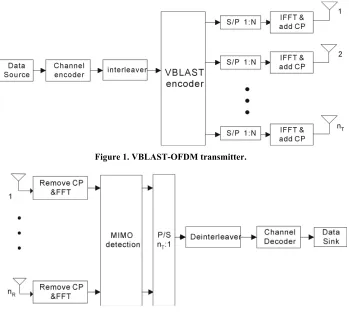
diagram of MIMO-OFDM transmitter. At the transmitter the input bit stream is de-multiplexed and coded to gen-erate symbol streams. The encoded data stream is then interleaved and launched into the IFFT modulators and added cyclic prefix (CP). Finally, the OFDM signals are transmitted over every transmit antenna.
T
n
[image:2.595.127.476.399.711.2]Figure 2 shows the block diagram of a VBLAST- OFDM receiver. Each receiver antenna receivers signals sent from all transmit antennas. After the cyclic prefix is removed, each received signal passes through a FFT block for demodulation.
Figure 1. VBLAST-OFDM transmitter.
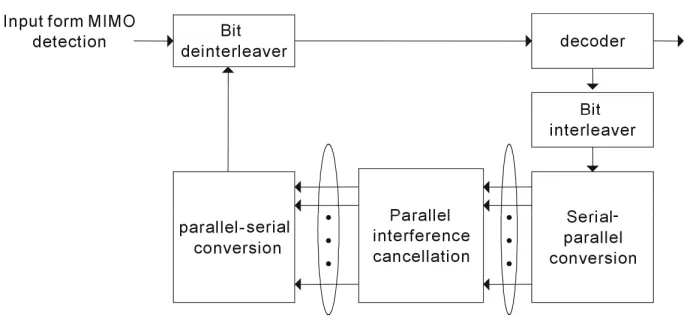
Figure 3. Proposed receiver structure for MIMO-OFDM system.
Figure 4. Proposed detection block.
At the receiver, we assume perfect OFDM synchroni-zation. The receiver signal after demodulation, at receive antenna for subchannel , is given by j k
[ , ] [ , ] [ , ] [ , ]
j ij i j
i
r n k
H n k s n k w n k (1)where i1, , nT, j1, , nR,s n ki[ , ]
2 n
is the transmit-ted symbol from the i-th transmit antenna at k subchan-nel, in (1) denotes the additive complex Gaus-sian noise at the receiver antenna, and is assumed to be zero-mean with variance
[ , ]
j
w n k
jth
.H n kij[ , ]in (1) de-notes the channel frequency response for the tone at time , corresponding to the transmit and the
receiver antenna.
th k
n ith
th j
During the reception, each receiver antenna receives the signal transmitted from all the transmit antennas. First, the cyclic prefix of each received signal is removed. After passing through a serial-to-parallel converter and the fast Fourier transformation blocks (FFTs), the sub-carriers are separated. Then, the N information symbols belonging to each subcarrier are routed to their corre-sponding VBLAST multi-antenna processing unit where
the mapping and decoding are performed. The de-tected bits are converted back into a serial form accord-ingly to recover the transmitted data bits.
T
n
2.2. Channel Models
We assume that the OFDM signal is transmitted over a wireless communications environment by a mutipah fading channel and a given coherence bandwidth. The complex baseband equivalent of a fading channel im-pulse response from transmit antenna to receiver an-tenna can be expressed as,
i j
1
( , ) L l( ) ( )
ij ij l
l
h t t
(2)where are wide-sense stationary narrowband complex Gaussian processes and are assumed to be in-dependent among different paths form transmit antenna
to receiver antenna . L is the number of multipaths. Thus for each receive antenna, the channel frequency response for the th subcarrier at time n is
( ) ' l ij t s
i j
k
1
2
0
[ , ] ( ) l
L
j k f l
ij ij
l
H n k t e
[image:3.595.126.470.248.407.2]signals for MIMO-OFDM architecture. Furthermore, iterative detection and decoding is used to enhance the performance of system in a progressive fashion.
Figure 3 presents a simple schematic of the proposed receiver scheme with PIC MIMO detection for MIMO-OFDM systems. For a wideband system, the OFDM demodulator is applied for each transmitter stream over parallel subchannels. To perform the iterative detection and decoding processing, the esti-mated signal by decoder is used to reconstruct the trans-mitted coded signal. Consequently, the PIC detection uses the reconstructed signal to improve the detection performance and start the iterative process. Figure .4 illustrates the proposed iterative detection and decoding block in Figure 3 in detail.
N
The PIC in [11] is another conventional detection al-gorithm which detects all layers simultaneously by sub-tracting interference from all the other layers regenerated by the estimate from hard decision based on ZF or MMSE criteria. The PIC detection scheme based on MIMO system algorithm is described as below:
InputH, r
+
s = H r
s= (QG r)
For i=1:nT
1
1 (:, )
T
n
j j
j i
r r H j s
( (:, ))j
G H
( )
j
s QGr
End Output s
where( ) is operation of calculating inverse of matrix (or vector). Comparing to conventional VBLAST, the PIC algorithm doesn’t need calculate the pseudo-inverse matrix of the channel, so the complexity of proposed receiver is reduced. However, the detection scheme
lation. We evaluate the performance of MIMO-OFDM systems. The FFT size is 64, and the cyclic prefix length is L=16. For the 20 MHz channel, channel assumes an exponentially decaying power delay profile with 4 mul-tipaths which are sample-spaced, and assume the channel is constant during one packet. In the simulation, the an-tenna configuration consists of 4 transmit anan-tennas, and 4 receive antennas and BPSK is used. For comparison, we also include the performance of V-BLAST and the per-formance of conventional PIC receiver in signal detec-tion.
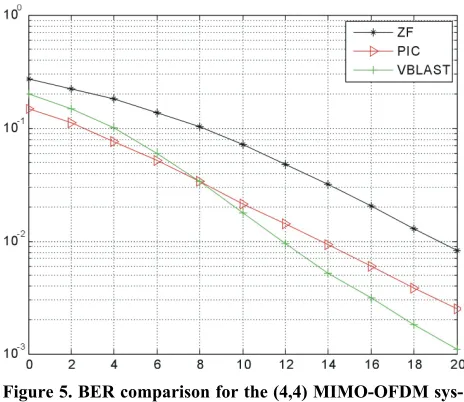
We first evaluate the performance of PIC algorithm in MIMO-OFDM without coding case. Figure 5 shows the comparison performance of the three detection methods. Simulation states that PIC detection scheme obtains about 6dB gain than linear ZF method at error bit rate 10-3. At low SNR case, the PIC detection scheme
out-performs the conventional V-BLAST detection. At high SNR, the advantage of the proposed scheme died down because the affect of error diffuse is taken off. The per-formance of conventional ZF-VBLAST detection is the best when the SNR is higher than 8 dB. The linear ZF has the worst performance.
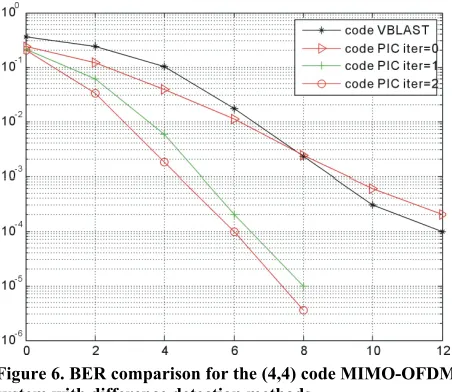
[image:4.595.307.539.507.708.2]Figure 6. BER comparison for the (4,4) code MIMO-OFDM system with difference detection methods.
Figure 6 shows the performance of proposed iterative detection and decoding scheme for code MIMO-OFDM systems. The convolutional code used in the simulations is a rate 12 , and the generator vectors are
and . The channel decoder
0 (1, 0,11)
g g1(1,1,0,1)
uses the Viterbi algorithm. The other conditions is the same as to above case. As can be shown in this plot, the proposed MIMO detection scheme greatly outperforms the conventional linear Zero-Forcing detection.
The coded BER of proposed scheme is produced after 0, 1, 2 iterations. When iteration is 0, the proposed scheme is the conventional PIC algorithm for code MIMO-OFDM systems. We also observe that the pro-posed scheme outperforms the conventional coded PIC detection algorithm without iteration. After first iteration, the BER is significantly improved. There is a litter dif-ference between the first iteration and the second itera-tion. Simulation states that proposed scheme with 2 it-erations obtains about 4dB gain than conventional MIMO-VBLAST algorithm without iteration at error bit rate 10-3.
From the simulation results presented in this section, the proposed scheme is quite effective in all simulation configurations. Below we furthermore analyze perform-ance of proposed.
In actual, the difference algorithms have difference diversity order. For linear ZF receiver, the MIMO system may obtain order diversity gain and the conventional VBLAST algorithm may obtain
1
R T
n n
1
R T
n n
R order diversity gain [12]. However, PIC detection scheme may obtain
n
R
n order diversity gain when the interference comes from the all other lay-ers is completely cancelled. Below we mainly analyze effect error propagation for our proposed detection scheme.
5. Conclusions
In this paper, we proposed a iterative detection and de-coding scheme with PIC algorithm for MIMO-OFDM systems. To demonstrate the potential of this proposed technique, we have investigated the PIC and conven-tional VBLAST algorithms in MIMO-OFDM systems. We have also studied the effect of error forward coding on the system. By computer simulation, the performance of the proposed scheme is evaluated. The simulation re-sults states that the performance of proposed scheme is greatly improved compared to conventional VBLAST detection receiver for MIMO-OFDM systems.
6. References
[1] P. W. Wolniansky, G. J. Roschini, G. D. Golden, and R. A. Valenzuela, “V-BLAST: An architecture for realizing very high data rates over the rich-scattering wireless channel,” Proceedings International Symposium on Sig-nals, Systems, and Electronics (ISSSE’98), Pisa, Italy, pp. 230-235, September 1998.
[2] D. Wubben, J. Rinas, R. Bohnke, V. Kuhn, and K. D. Kammeyer, “Efficient algorithm for detecting layered space-time codes,” Proceedings ITG Conference on Source and Channel coding, Berlin, Germany, pp. 399-405, January 2002.
[3] B. Hassibi, “An efficient square-root algorithm for blast,” in Proceedings IEEE International Conference Acoustic, Speech, Signal Processing, Istanbul, Turkey, pp. 5-9, June 2000.
[4] W. Zhu, J. Y. Jin, and Y. W. Park, “Detection algorithm improving parallel interference cancellation for V-BLAST system over error propagation,” Proceedings ICACT2006, Gangwon-Do, Korea, pp. 11-15, February 2006.
[5] X. Li and X. Cao, “Low complexity signal detection al-gorithm for MIMO-OFDM systems,” Electronics letters, Vol. 41, No. 2, pp. 20-21, January 2005.
[6] S. Haykin, M. Sellathurai, Y. D. Jong, and T. Willink, “Turbo-MIMO for wireless communications,” IEEE Communications Magazine, Vol. 42, No. 10, pp. 48-53, October 2004.
[7] M. Sellathurai and S. Haykin, “Turbo-BLAST for wire-less communications: Theory and experiments,” IEEE Transaction Signal Processing, Vol. 50, No. 10, pp. 2538-2546, October 2002.
[8] C. Berrou, A. Glavieum, and P. Thitimajshima, “Near shannon limit error-correcting coding and decoding: Turbo-Codes (1),” Proceedings of ICC’93, pp. 1064-