Ticketing & CS System Development For
Industrial Needs
Kenneth Filbert, Seng Hansun
Abstract: This research discusses the design and development of a web-based ticketing and customer support system for the IT consultant company PT Mitra Mentari Global (MMG), This research aims to build a system that can aid customers of PT MMG in submitting any problem or complaints they might have when using PT MMG‘s products in the form of a support ticket, while also helping the employees in handling and organizing those complaint tickets from customers. The object of this research is the ticketing and customer support system itself, which was designed and built for PT MMG. The research started with the fundamental design of the system. After the design and building of the system were completed, it was tested using the black box testing method. The measurement of a unit of satisfaction, End-User Computing Satisfaction (EUCS), from customers who have used the system, was done through a data collection using a questionnaire that can be accessed by customers after they gave their approval on the work of a ticket. The testing results show that every feature of the system that was tested is working correctly. The analysis on the questionnaire data, which was filled by nine customers, results in an overall EUCS value of 3.742 from the five instruments of EUCS (Content, Format, Accuracy, Ease of Use, Timeliness) that was measured, which indicates that the customers of PT MMG is generally satisfied with the system that they used.
Index Terms: black box testing, customer support, EUCS, PT MMG, ticketing.
—————————— ——————————
1.
INTRODUCTION
IN this day and age, companies and businesses are increasingly dependent on technology to run their businesses. Therefore, companies engaged in the Information Technology (IT) consulting sector are increasingly needed. IT consulting is a field of work or activity that focuses on giving advice (advising) to an organization or company in the use of Information Technology to achieve their business goals [1]. PT Mitra Mentari Global (MMG) is one of the companies engaged in IT consulting, which was only established in 2017. Due to the company's short operational period, PT MMG does not yet have an adequate customer support system, so that all incoming cases of complaint from customers were still recorded and handled manually, either by using anExcel spreadsheet or recorded in a text file akin to the sample in Figure 1, so that the handling of customer complaints is sometimes less than organized [2]. This research is done in partnership with PT MMG, where the goal of the said partnership is to design web-based ticketing and customer system. The system‘s specifications were provided by the vice president of PT MMG, and was intended to aid PT MMG‘s customers to submit their complaints regarding problems in the usage of PT MMG‘s products, and to aid PT MMG‘s employees to manage the problems and complaints in the customers‘ tickets, i.e. managing which tickets that have or have not been handled, and also measure the performance of said employees[2]. This research was also intended to measure the satisfaction level of customers who had used the system.
Fig. 1. Sample of the note used to record PT MMG customers’ complaint cases
2
BASIC
CONCEPTS
2.1 Ticketing System
The Ticketing System also called the Issue Tracking System, or Helpdesk is computer software that manages and stores a list of problems. These problems are submitted by the user or customer of the organization that runs the ticketing system, to be resolved by the support section of the organization, either individually or collaboratively. This system can include resource allocation, time calculation, and priority management to compile a centralized list of problems [3].
2.2 Waterfall Development
Software Development Life Cycle (SDLC) with the Waterfall model is a software development process that is carried out sequentially, flowing gradually downwards like a waterfall. This SDLC process has several steps that must be done sequentially in order to produce working software [4]. The aforementioned steps are requirement analysis, design, implementation, testing, and maintenance.
————————————————
Kenneth Filbert is a graduate student from the Informatics department in Universitas Multimedia Nusantara, Indonesia, 15131. E-mail: [email protected]
2.3 Black-box Testing
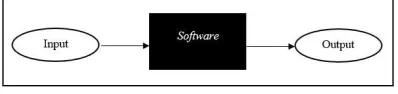
Black-box testing, also called specification-based testing, is a method of testing software that does not focus on the internal mechanism or source code of the software that‘s being tested, but instead on the input in the form of test cases designed based on specifications or functions that were offered by the software, and output produced based on those inputs and the conditions at which the execution was carried out. Software testers do not need to know the source code of the software, and only need to know that the input entered into the 'black box' of the software will produce a result or output [5].
Fig. 2. Flow chart of black-box testing
One technique in doing black-box testing is functional testing, which is testing that was carried out when an application or system has been developed to ensure the application or system meets all the required requirements, functions, and behaviors. To test each function, requirement, and behavior of the system, a test case is designed based on the needs or design specifications of the system being tested.
2.4 End-User Computing Satisfaction (EUCS) and Cronbach Alpha
End-User Computing Satisfaction, or commonly called EUCS, is the overall cognitive and affective evaluation of the end-user of an Information System (IS) regarding the level of satisfaction or fulfillment experienced in the usage of the IS [6]. In the EUCS model set by Doll and Torkzadeh [7], there are 5 instruments or dimensions in EUCS measurement, namely Content (quality of system contents), Accuracy (accuracy of the data displayed by the system), Format (layout / presentation of the system), Ease of Use (how effortless is the use of the system), and timeliness (how up to date is the system information). Cronbach's Alpha is a scale developed by Lee Cronbach in 1951 and designed to measure the internal consistency of a scale or test. Cronbach's Alpha is expressed as a number between 0 and 1. Internal consistency can be interpreted as the ability of all items in a test to measure a concept. Therefore, internal consistency is closely related to the correlation between items in a test. The higher the value of Cronbach's Alpha, the higher the internal consistency of the test. The higher the internal consistency, the more reliable the test will be to produce consistent measurement results [8, 9]. Based on studies of several scientific papers from a number of leading science education journals, there are many boundary scales or internal consistency thresholds that determine how the value of Cronbach's Alpha is interpreted [10]. However there exists a rule of thumb that is used by similar research, which can be seen in Table 1.
TABLE1
CRONBACH‘S ALPHA MEASUREMENT
Internal Consistency Cronbach‘s Alpha Level
Excellent ≥ 0.9
Good 0.8-0.9
Acceptable 0.7-0.8
Questionable 0.6-0.7
Poor 0.5-0.6
Unacceptable ≤ 0.5
3 SYSTEM
DESIGN
AND
METHOD
The system design process is done according to the Waterfall SDLC method. First, requirements that must be fulfilled by the system was given by PT MMG‘s supervisor, and those requirements are as follows:
1. The system is comprised of two parts, front-end for customer use, back-end for employee use.
2. The front-end part has the following requirements: sign-in and sign-out for customers, a feature for customers to reset their password, a feature to submit a support ticket to PT MMG employees, a feature to view a history of submitted tickets, and a feature to provide feedback for completed ticket works.
3. The back-end part has the following requirements: sign-in and sign-out for employees, 3 levels of employee privilege (Super Admin, Supervisor Level 1, Employee Level 2), with Super Admin able to manage customer and employee account data, Supervisor Level 1 able to handle ticket work in addition to delegating ticket works to Level 2 Employees, and Employee Level 2 able to handle ticket works. Lastly, three ticket handling status: ‗open‘ for newly-submitted tickets, ‗ongoing‘ for tickets being worked on by employees, and ‗closed‘ for finished tickets.
Fig. 3. Context Diagram / Data Flow Diagram Level 0
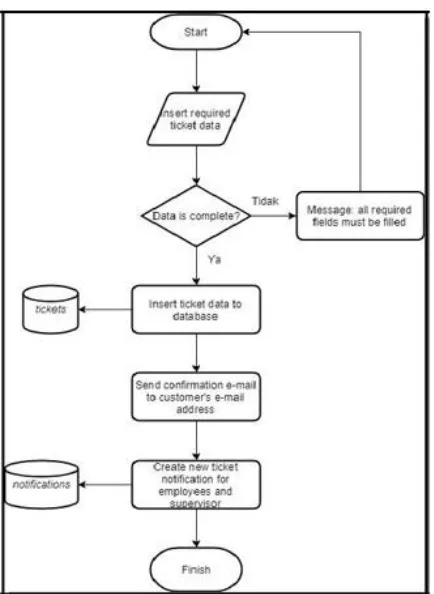
Fig. 4. Flowchart for the ticket submission feature
Fig. 5. Database Schema
Fig. 6. Mockup of the ticket submission feature page
4
RESULTS
AND
ANALYSIS
4.1 Software and Hardware Requirements
In the system design and development phases, the specifications of the software and hardware used are as follows.
A.1 Software
Laragon v2.0.2 (includes PHP v7.0.8, MySQL v5.7.13, and Apache v2.4.23)
CodeIgniter v3.1.9 framework
MySQL Workbench 8.0 CE
CPanel hosting platform
Google Chrome web browser
Draw.io diagram creator web application (www.draw.io)
Windows 10 64-bit Operating System
o Dell Inspiron 7567 laptop
o Intel i7 7700HQ 2.8GHz processor o 8GB of RAM
o 1TB capacity hard disk
4.2 System Implementation
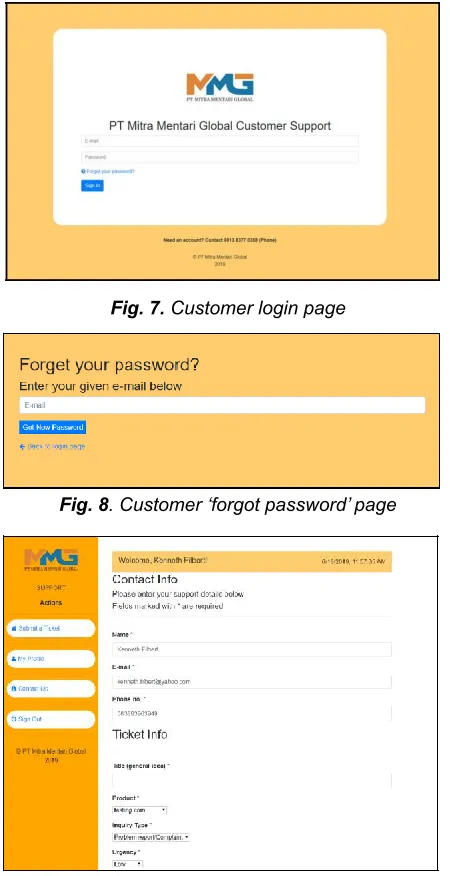
Once the system design phase is completed, the implementation phase of the software development process can be started. The following figures are some examples of the programming results done as the implementation of the requirement analysis and system design phases beforehand. The front-end part of the system can be accessed and used by customers of PT MMG. To use the system, customers would first need an account from the Super Admin by contacting them first.
Fig. 7. Customer login page
Fig. 8. Customer ‘forgot password’ page
Fig. 9. Customer ticket submission page
Fig. 10. Customer profile/ticket history page
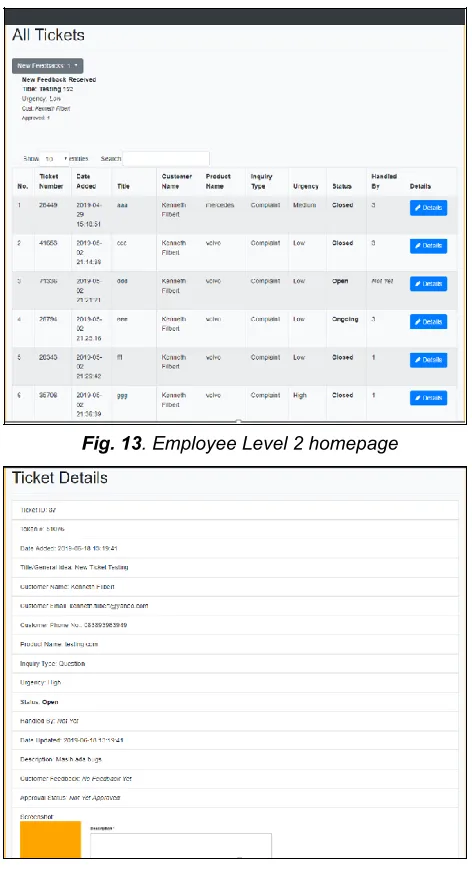
Fig. 11. Customer ticket details/feedback submission page The back-end part of the system can be accessed and used only by employees of PT MMG. To use the system, employees would first need an account from the Super Admin by contacting them first. When they have successfully signed in, employees would be redirected to different homepages according to their access level.
Fig. 13. Employee Level 2 homepage
Fig. 14. The Ticket Details page for both Employee Level 2 and Supervisor Level 1
Fig. 15. The ‘Handle Ticket’ button for Employee Level 2
Fig. 16. The ‘Delegate Ticket’ button and ‘Handle Ticket’ buttons for Supervisor Level 1
Fig. 17. The Ticket Details page, where Employee or Supervisor can update a ticket’s status and describe the changes done
Fig. 18. The Manage Users page for Super Admin. Super Admin can also go to Manage Customers Page to manage
Customer account data
Fig. 19. The Manage Products page for Super Admin can be accessed from the Manage Customers page
4.3 System Testing and Evaluation
and is done for every feature provided by the system, both on the front-end and back end parts. The system testing was carried out by an employee of PT Mitra Mentari Global, namely Ms. Audrey Mariana who served as Managing Director of PT MMG but also worked as an employee at PT MMG, in the latest version of the system that had been deployed on the company's server. Based on all the test case results of the testing done, it is concluded that all of the system‘s features that were tested are working correctly. From the Google Form questionnaire that was used to measure End-User Computing Satisfaction (EUCS) value from the customer, the size of the study sample is 9 people. The sample consists entirely of PT Mitra Mentari Global customers who have used the front-end of PT MMG‘s Ticketing and Customer Support system by submitting at least one ticket, and have provided a positive feedback on the work done on the said ticket to be able to fill out questionnaires from link obtained in the positive response feedback e-mail. The questionnaire had 17 question items that used a 5-point Likert scale: 1 = very dissatisfied / disagreed; 2 = not satisfied / agreed; 3 = neutral; 4 = satisfied / agreed; 5 = very satisfied / agreed. To measure the overall EUCS value, the average or mean value will be taken from the combined average or the mean score of the answers to the questionnaire questions for each EUCS instrument. The questions are then categorized according to the five instruments of EUCS, as follows.
1. Content : Q4, Q6, Q8, Q10, Q13, Q14 2. Accuracy : Q9, Q11
3. Format : Q1, Q2, Q5 4. Ease of use : Q3, Q7, Q12, Q15 5. Timeliness : Q16, Q17
Based on the categorization of questions and the quantification of questionnaire result data, the data for each EUCS instrument can be arranged into the following tables, with the nine respondents represented by R1-9.
1. Content
The score and mean for the Content instrument can be viewed in Table 2.
TABLE2
SCORE FOR CONTENT
Q4 Q6 Q8 Q10 Q13 Q14
R1 3 4 4 4 4 3
R2 4 4 3 4 5 5
R3 4 5 5 4 5 3
R4 4 4 4 5 4 4
R5 4 4 4 4 4 4
R6 3 4 4 4 5 3
R7 3 5 4 5 3 3
R8 4 5 4 4 4 5
R9 4 4 4 4 3 4
Mean 4.018518519
2. Accuracy
The score and mean for the Accuracy instrument can be viewed in Table 3.
TABLE3
SCORE FOR ACCURACY
Q9 Q11
R1 4 4
R2 4 4
R3 4 4
R4 3 5
R5 2 4
R6 3 4
R7 3 4
R8 3 5
R9 3 5
Mean 3.777777778
3. Format
The score and mean for the Format instrument can be viewed in Table 4.
TABLE4
SCORE FOR FORMAT
Q1 Q2 Q5
R1 4 3 4
R2 2 5 3
R3 3 4 5
R4 4 4 4
R5 3 4 3
R6 2 3 2
R7 3 4 3
R8 3 5 4
R9 4 4 4
Mean 3.555555556
4. Ease of Use
The score and mean for the Ease of Use instrument can be viewed in Table 5.
TABLE5
SCORE FOR EASE OF USE
Q3 Q7 Q12 Q15
R1 4 4 3 4
R2 4 4 4 4
R3 5 5 3 4
R4 3 3 4 4
R5 3 3 4 3
R6 2 4 5 3
R7 4 5 3 4
R8 4 5 4 4
R9 4 3 4 4
Mean 3.805555556
5. Timeliness
The score and mean for the Timeliness instrument can be viewed in Table 6.
TABLE6
SCORE FOR TIMELINESS
Q16 Q17
R1 4 3
R2 4 3
R3 4 4
R4 3 4
R5 3 2
R6 3 3
R7 5 4
R8 4 4
R9 4 3
Mean 3.555555556
According to the 5-point Likert scale used in the questionnaire, an overall EUCS category scale can be generated on the following Table 7.
TABLE7
OVERALL EUCSSCALE
Interval Scale Overall EUCS
4 - 5 Very Satisfied
3 - 4 Satisfied
2 - 3 Neutral
1 - 2 Dissatisfied
0 - 1 Very Dissatisfied
It can be inferred that the overall EUCS value that was calculated, 3.742592593, belongs in the ‗Satisfied‘ category. After the questionnaire data from PT MMG‘s customers are entered, Cronbach's Alpha value can be measured. Based on the results of the quantification of questionnaire data, nine respondents were represented by R1-9, and 17 question items were represented by Q1-17. Calculation of variance and sum/total value of variance is done in Microsoft Excel. After the required data is obtained, calculation of Cronbach‘s Alpha
(α) can be done.
The value of Cronbach's Alpha (α) for this questionnaire is 0.708 after rounding, which if referring to Table 1, has an internal consistency level of "Acceptable."
4 CONCLUSIONS
Based on system design, implementation, data analysis, and testing of PT Mitra Mentari Global‘s web-based customer support and ticketing system, it can be concluded that:
1. The features of the ticketing system and web-based customer support, both on the front-end and back-end, are already running and can be used properly.
2. The system has been designed and built using the PHP programming language by implementing the CodeIgniter framework and using the Visual Studio Code IDE. This research produces a system in the form of a website that can be accessed using a computer/desktop or
smartphone device that has an internet connection and a web browser application.
3. Cronbach's Alpha measurement to measure the internal consistency of the questionnaire used to measure PT MMG's customers‘ End-User Computing Satisfaction (EUCS) value produces a value of α = 0.708, which if referring to the rule of thumb in Table 1, is classified as an acceptable level of internal consistency for in order of a test to produce consistent measurement results. 4. From the results of the overall End-User Computing
Satisfaction (EUCS) value measurement from the questionnaire filled by PT MMG customers, the overall EUCS value was 3.742, which on the 5-point Likert scale used for questionnaire questions, fell in the "Satisfied" category. This result indicates that PT MMG customers who have used the ticketing and customer support system generally feel satisfied.
REFERENCES
[1] K. Schwalbe, Information Technology Project Management. Cengage Learning, 2009.
[2] Boby, Interview with Kenneth Filbert via e-mail. March 1st 2019.
[3] D. Bertram, ―The social nature of issue tracking in software engineering,‖ Doctoral dissertation, University of Calgary, 2009.
[4] Y. Bassil, ―A simulation model for the waterfall software development life cycle,‖ International Journal of Engineering & Technology (iJET), 2012. arXiv preprint arXiv:1205.6904.
[5] S. Nidhra and J. Dondeti, ―Black box and white box testing techniques - a literature review,‖ International Journal of Embedded Systems and Applications (IJESA), 2(2), pp.29-50, 2012.
[6] V.P. Aggelidis and P.D. Chatzoglou, ―Hospital information systems: Measuring end user computing satisfaction (EUCS),‖ Journal of biomedical informatics, 45(3), pp.566-579, 2012.
[7] S.S. Pandean and S. Hansun, ―Aplikasi Web untuk Rekomendasi Restoran Menggunakan Weighted Product,‖ Jurnal Teknologi Informasi dan Ilmu Komputer, 5(1), pp.87-94, 2018.
[8] A. Oktavianus and S. Hansun, ―Sistem Rekomendasi Lowongan Kerja dengan Glassdoor API dan Metode Simple Additive Weighting,‖ Jurnal Teknik dan Ilmu Komputer, 7(26), pp.201-211, 2018.
[9] M. Tavakol and R. Dennick, ―Making sense of Cronbach's alpha,‖ International journal of medical education, 2, p.53, 2011.
![Figure 1, so that the handling of customer complaints is sometimes less than organized [2]](https://thumb-us.123doks.com/thumbv2/123dok_us/8623960.1413668/1.612.319.568.280.465/figure-handling-customer-complaints-organized.webp)