rspb.royalsocietypublishing.org
Research
Cite this article:
Rodrigues AMM, Gardner A.
2015 Simultaneous failure of two sex-allocation
invariants: implications for sex-ratio variation
within and between populations.
Proc. R. Soc. B
282
: 20150570.
http://dx.doi.org/10.1098/rspb.2015.0570
Received: 11 March 2015
Accepted: 19 May 2015
Subject Areas:
behaviour, evolution
Keywords:
constant male hypothesis, dispersal,
kin selection, local mate competition,
local resource competition, viscosity
Author for correspondence:
Anto´nio M. M. Rodrigues
e-mail: [email protected]
Electronic supplementary material is available
at http://dx.doi.org/10.1098/rspb.2015.0570 or
via http://rspb.royalsocietypublishing.org.
Simultaneous failure of two sex-allocation
invariants: implications for sex-ratio
variation within and between populations
Anto´nio M. M. Rodrigues
1,2and Andy Gardner
31Department of Zoology, University of Cambridge, Downing Street, Cambridge CB2 3EJ, UK 2Wolfson College, Barton Road, Cambridge CB3 9BB, UK
3School of Biology, University of St Andrews, Dyers Brae, St Andrews KY16 9TH, UK
Local mate competition (LMC) occurs when male relatives compete for mating opportunities, and this may favour the evolution of female-biased sex allocation. LMC theory is among the most well developed and empiri-cally supported topics in behavioural ecology, clarifies links between kin selection, group selection and game theory, and provides among the best quantitative evidence for Darwinian adaptation in the natural world. Two striking invariants arise from this body of work: the number of sons pro-duced by each female is independent of both female fecundity and also the rate of female dispersal. Both of these invariants have stimulated a great deal of theoretical and empirical research. Here, we show that both of these invariants break down when variation in female fecundity and limited female dispersal are considered in conjunction. Specifically, limited dispersal of females following mating leads to local resource competition (LRC) between female relatives for breeding opportunities, and the daugh-ters of high-fecundity mothers experience such LRC more strongly than do those of low-fecundity mothers. Accordingly, high-fecundity mothers are favoured to invest relatively more in sons, while low-fecundity mothers are favoured to invest relatively more in daughters, and the overall sex ratio of the population sex ratio becomes more female biased as a result.
1. Introduction
Local mate competition (LMC) occurs when male relatives compete for mating opportunities, and this may favour the evolution of female-biased sex allocation [1]. Hamilton’s [2] classic study of LMC helped to clarify the relationship between kin selection and group selection and provided an early application of game-theoretic thinking to evolutionary biology. Hamilton’s model considered a scenario in which one or more mothers each contribute a fixed number of off-spring to a patch, followed by random mating among the offoff-spring in the patch and complete dispersal of mated females to new patches. This basic scenario has subsequently been extended in multiple directions, and the theory of LMC has come to be one of the most successful topics in behavioural ecology, boasting a healthy interplay of theory and empiricism and an impressive fit between math-ematical prediction and real-world observation, and providing among the best quantitative support for Darwinian adaptation in the natural world (reviewed by West [1]).
Two striking invariance results have emerged from the study of LMC, both of which concern constancy in the number of sons produced by mothers, despite the relaxation of key assumptions in Hamilton’s [2] model. The first invariant arises in the context of relaxing the assumption that all mothers have the same fecundity. When fecundity varies, the sons of high-fecundity mothers experience relatively more-intense LMC and, accordingly, the proportion of a mother’s reproductive resources that she invests into sons is expected to be inversely proportional to her fecundity. Consequently, the absolute number of sons that she produces is
expected to be independent of her fecundity [3–5]. This result has been termed the ‘Constant Male Hypothesis’ (CMH) [6] and has stimulated a great deal of theoretical and empirical work [3–21].
The second invariant arises in the context of relaxing the assumption of complete female dispersal following mating. When female dispersal is incomplete, the associated increase in relatedness within mating groups enhances LMC among males (promoting female bias) but this effect is offset by an increase in local resource competition (LRC; [1]) among related females (inhibiting female bias), such that the number of sons that a mother produces is expected to be independent of the rate of female dispersal [22,23]. This surprising result has stimulated huge interest in the interplay of relatedness and kin competition in driving the evolution of social evolution in so-called ‘viscous populations’ [24–44].
Here, we consider the scenario in which there is both vari-ation in female fecundity and also limited dispersal of females following mating. We develop a kin-selection model of sex allocation in the context of a population that is both class-structured—in terms of individuals being separ-ated into males versus females, and breeding females being separated into high- and low-fecundity mothers—and also genetically structured—as a consequence of limited dispersal of females between patches from generation to generation. We derive analytical results to explore how the unbeatable sex-allocation strategy varies as a function of inequality in female fecundity and the rate of female dispersal, both in terms of an individual female’s production of sons and also in terms of the population average investment into males, when sex allocation is either facultatively adjusted accord-ing to female condition or else obligately fixed at a value that balances the selective pressures faced by high- and low-fecundity mothers.
2. Results and discussion
(a) Mathematical model
We assume an infinite island model [45], in which each patch contains one high-fecundity mother (denoted by the subscript H) and one low-fecundity mother (denoted by the subscript L). High-fecundity mothers produce a very large number FH of offspring and low-fecundity mothers
produce a large number FL¼(12s)FH of offspring, where
0s1. Each mother is free to adjust the proportion of her offspring that are male versus female, with a focal high-fecundity mother producing FHzH sons and FH(12zH)
daughters and a focal low-fecundity mother producing FL
zL sons and FL(12zL) daughters, where 0zH, zL1.
After reproduction, mothers die, and offspring mate at random within their patch, with each female mating once. Following mating, males die, and each female attempts to disperse to a new patch at random with probability d
or else remains in her natal patch with probability 12d. Dispersing females die on the way to their new patch with probabilitykand arrive safely at their new patch with prob-ability 12k. Following dispersal, in each patch, one female is chosen at random to be the high-fecundity mother and one female is chosen at random to be the low-fecundity mother, with all other females dying, and this recovers the beginning of the life cycle. Table 1 provides a summary of key model notation.
(b) Evolution of sex allocation
Employing a neighbour-modulated fitness approach to kin selection [46 –52], we find that the condition for natural selec-tion to favour an increase in the sex allocaselec-tion (i.e. investment into sons) of high-fecundity mothers is
cm 1 nmrS
cf 1 nfrD
cm 1 nf
þ 1
nm
(uHmrSþuLmrM)
þ 1
nf
w(cf(uHfrDþuLfrF)þcm(uHmrSþuLmrM)).0, (2:1)
where:cm is the class-reproductive value of males;cf is the
class-reproductive value of females; nf¼12zHþ(12
zL)(12s) is the relative number of juvenile females, and
nm¼zHþzL(12s) the relative number of juvenile males,
produced in a local patch;uHf¼(12zH)/nfis the frequency
of juvenile females who have high-fecundity mothers;uLf¼
((12zL)(12s))/nfis the frequency of juvenile females who
have low-fecundity mothers;uHm¼zH/nmis the frequency
of juvenile males who have high-fecundity mothers;uLm¼
(zL(12s))/nmis the frequency of juvenile males who have
low-fecundity mothers; w¼(12d)2/(12kd)2 is the prob-ability that two random juvenile females in a patch following dispersal are both born in this patch (i.e. the probability of co-philopatry);rD is the relatedness between a mother and
her daughters;rSis the relatedness between a mother and her
sons; rFis the relatedness between a mother and a juvenile
female who is a daughter of the other mother;rMis the
related-ness between a mother and a juvenile male who is a son of the other mother. All of these relatedness coefficients are calculated from the mother’s perspective (see electronic supplementary material for details).
A similar condition may be derived for low-fecundity mothers:
cm 1 nmrS
cf 1 nfrD
cm 1 nf
þ 1
nm
(uHmrMþuLmrS)
þ 1
nf
w(cf(uHfrFþuLfrD)þcm(uHmrMþuLmrS)).0: (2:2)
(c) Rarer-sex effect
The first two terms on the left-hand side (LHS) of each of these conditions (2.1) and (2.2) jointly describe the rarer-sex effect [53]. In both conditions, the first termcm(1/nm)rS describes
the mother’s marginal inclusive-fitness gain through increased allocation to her sons, holding fixed the mating success of each individual son, and this promotes an increased investment into
Table 1.
Summary of key model notation.
symbol
meaning
c
class-reproductive value
d
probability of dispersal
w
probability of co-philopatry
k
cost of dispersal
n
relative number of juveniles
r
relatedness coefficients
s
reproductive inequality
u
frequency of juveniles
z
sex ratio
rspb.r
oy
alsocietypublishing.org
Pr
oc.
R.
Soc.
B
282
:
20150570
sons. The second term 2cf(1/nf)rD describes her marginal
inclusive-fitness loss through decreased allocation to her daughters, holding fixed the mating success of each individual daughter, and this inhibits an increased investment into sons. Under haploid and diploid inheritance, a mother is equally related to her sons and her daughters (rS¼rD), and
the class-reproductive value of males and females are equal (cm¼cf), so which of these two terms is larger depends on
the relative number of males and females (nmversusnf). In
particular: when males are the rarer sex (nm,nf), the
mar-ginal inclusive-fitness gain through sons outweighs the marginal inclusive-fitness loss through daughters, such that increased allocation to sons is favoured; and, likewise, an increased allocation to daughters is favoured when females are the rarer sex (nm.nf). Under haplodiploid inheritance,
a mother is twice as related to her sons as she is to her daugh-ters in the context of outbreeding (rS¼2rD), because while all
of her son’s genes derive from her, half of her daughter’s genes derive from an unrelated male. But, as the class-reproductive value of females is twice that of males (cf¼2cm), the
rarer-sex effect once again favours increased in investment into offspring of whichever sex is rarer [2,54]. However, in the con-text of inbreeding, a mother is relatively more related to her daughters than to her sons (rS,2rD), because her daughter’s
paternal-origin genes come from a male with whom she shares genes in common and, consequently, a slight female bias is expected as a consequence of inbreedingper se[3,55].
(d) Local mate competition
The third term in each condition is the LMC effect, which arises as a consequence of greater investment into sons leading to more competition among related males for fewer mating opportunities with females, to the extent that mating occurs among relatives [2]. Firstly, a greater investment into sons leads to an increase in the number of mate competitors [56]. The corresponding increase in competition depends on the number of males that are being produced by both mothers: if very few males are being produced, then an additional male has a large impact upon the mating success of other males; but if many males are already being produced, then an additional male has only a small impact. Accordingly, the amount of additional LMC falls when the number of male off-spring rises, as captured by the factor 1/nmin the LMC term.
Secondly, a greater investment into sons leads to a decrease in the number of females for them to mate with [56]: if very few females are being produced, then one fewer female has a large impact upon the mating success of other males; but if many females are being produced, then one fewer female has only a small impact. Accordingly, the amount of additional LMC falls when the number of female offspring rises, as captured by the factor 1/nfin the LMC term. Thirdly, the amount of
LMC also depends on the value of males for mothers. This value depends on the reproductive value of males (cm), and
on the relatedness between the mother and the males, which is uHmrSþuLmrM from the perspective of a high-fecundity
mother, and uHmrMþuLmrS from the perspective of a
low-fecundity mother. In viscous populations, mating is more likely to occur among closely related individuals, so both relat-edness coefficients (i.e.rS andrM) increase with population
viscosity. This means that the intensity of LMC rises when population viscosity rises, as shown in electronic supplemen-tary material, figure H1a,c). A high-fecundity mother is more
related to her sons than she is to her patchmate’s sons (i.e.
rS.rM), and this is exactly the same for a low-fecundity
mother (i.e. rS.rM). By contrast, a high-fecundity mother
has a higher proportion of sons among the males than does a low-fecundity mother (i.e.uHm.uLm). Accordingly,
high-fecundity mothers suffer more LMC than do low-high-fecundity mothers, as shown in electronic supplementary material, figure H1a,c. This difference leads to the CMH result in the context of full female dispersal: each mother’s proportional investment into sons is inversely proportional to her fecund-ity, so that her absolute investment into sons is constant, i.e. independent of her fecundity [3,5].
(e) Local resource competition
The fourth term in each condition is the LRC effect, which arises as a consequence of greater investment into sons, lead-ing to less competition among related females for breedlead-ing opportunities, to the extent that competition for breeding opportunities occurs among relatives [57]. Firstly, the benefit of the LRC effect depends on the number of females mothers produce (i.e.nf): if there are few females, one fewer female
has a large impact on the reproductive success of other females; but if there are many females, one fewer female has only a small impact. Accordingly, the inclusive-fitness benefit of the LRC effect falls when the number of females rises, as captured by the factor 1/nf in the LRC term.
Secondly, two juveniles are related only if they are both locals, which occurs with probability w. Thirdly, a mother values juvenile females according to the reproductive value of the latter (cf), and according to her relatedness to them,
which is uHfrDþuLfrF from the perspective of a
high-fecundity mother, anduHfrFþuLfrDfrom the perspective of
a low-fecundity mother. Each mother is more related to her own daughters than she is to her patchmate’s daughters (i.e. rD.rF), but because a high-fecundity mother has a
higher proportion of daughters among the juvenile females in her patch (i.e. uHf.uLf), she is more related to the
juvenile females than is the low-fecundity mother (i.e.
uHfrDþuLfrF.uHfrFþuLfrD). Fourthly, a mother values
juvenile males according to the reproductive value of the latter (cm), and according to her relatedness to them, which
is uHfrSþuLfrM from the perspective of a high-fecundity
mother, and uHfrMþuLfrS from the perspective of a
low-fecundity mother. Again, the high-low-fecundity mother is more related to the juvenile males than is the low-fecundity mother (i.e. uHfrSþuLfrM.uHfrMþuLfrS). Accordingly, the
high-fecundity mother gains more from the LRC effect than a low-fecundity mother, as shown in electronic supplementary material, figure H1b,d. As a consequence of this difference, high-fecundity mothers are relatively favoured to invest more into sons and low-fecundity mothers are relatively favoured to invest more into daughters.
(f ) Explicit demography
We have expressed conditions (2.1) and (2.2) in terms of emergent quantities—such as relatedness and reproductive value—that do not take explicitly assumed values but rather may be derived from the model’s assumptions and expressed in terms of its demographic parameters (see electronic sup-plementary material, appendix, for details). Substituting these explicit expressions into conditions (2.1) and (2.2), we may derive convergence-stable (CS) [58,59] sex-allocation
rspb.r
oy
alsocietypublishing.org
Pr
oc.
R.
Soc.
B
282
:
20150570
strategies for high- and low-fecundity mothers (figure 1a,c; see also electronic supplementary material, figure H2).
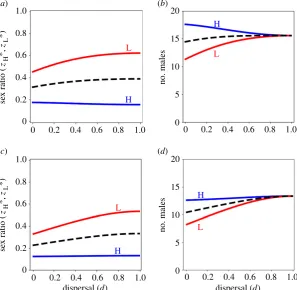
In the context of full dispersal of females following mating (d¼1), we recover the CMH result: the number of sons pro-duced by high- and low-fecundity females is exactly the same, and is independent of the difference in their fecundity (figure 1b,d; [3,5]). This can be understood by noting that the rarer-sex-effect terms (i.e. the first two terms) in inequalities (2.1) and (2.2) are exactly the same for high- and low-fecundity mothers, and that the LRC-effect terms (i.e. the final term) in inequalities (2.1) and (2.2) are both zero (because there is no LRC in the context of full dispersal of females). Accordingly, at evolutionary equilibrium (i.e. the point at which both inequalities become equations), the LMC terms (i.e. the third term) in inequalities (2.1) and (2.2) must be equal for both high- and low-fecundity mothers. Thus, uHmrSþuLmrM¼
uHmrMþuLmrS, which impliesuHm¼uLm, i.e. high- and
low-fecundity mothers must be producing the same number of sons at evolutionary equilibrium. That is, in the full-dispersal scenario, the only asymmetry in the selection pressures acting upon sex allocation for high- and low-fecundity mothers is that the high-fecundity mothers produce sons who experi-ence more LMC and, accordingly, they are selectively favoured to reduce their relative investment into sons until this asymmetry vanishes, at which point they are producing the same number of sons as the low-fecundity females.
However, in the context of incomplete dispersal of females following mating (d,1), we find that the CMH
result breaks down: high-fecundity mothers are favoured to produce more sons than are low-fecundity mothers (figure 1b,d). This difference owes to the LRC terms (i.e. the fourth term) in inequalities (2.1) and (2.2) taking non-zero values, that depend not only on the number of sons but also on the number of daughters that each mother produces. If both mothers produce the same number of sons (i.e.uHm¼uLm),
then the high-fecundity mother must be producing more daughters than the low-fecundity mother (i.e.uHf.uLf; in
particular, uHf¼uLfþs/nf). Accordingly, high-fecundity
mothers experience relatively more LRC than low-fecundity mothers, such that the former are favoured to invest relatively more into sons than are the latter (i.e.uHm.uLm). That is, in
addition to the asymmetric selection pressures that operate in the full-dispersal scenario (such that high-fecundity mothers are favoured to invest proportionally less into sons and, accordingly, produce the same absolute number of sons as do low-fecundity mothers; i.e. the CMH result), the limited-dispersal scenario introduces an additional asymmetry (which is that the daughters of high-fecundity mothers experience LRC more strongly than do those of low-fecundity mothers), and this leads to high-fecundity mothers producing more sons than do low-fecundity mothers (i.e. breakdown of the CMH result).
Moreover, in the absence of fecundity variation between mothers (s¼0), we recover the dispersal-invariance result: the number of sons produced by mothers is independent of the rate of female dispersal [22,23]. Limited dispersal of
1.0 20
15
10
5
0 0.8
0.6
0.4
0.2
0
1.0
0.8
0.6
0.4
0.2
0
0 0.2 0.4 0.6 0.8 1.0 0 0.2 0.4 0.6 0.8 1.0
20
15
10
5
0
0 0.2 0.4 0.6 0.8 1.0 0 0.2 0.4 0.6 0.8 1.0
se
x ratio (
zH
*,
zL
*)
se
x ratio (
zH
*,
zL
*)
no. males
no. males
L
H
L
L
H
H H
L
dispersal (d) dispersal (d) (a)
(c) (d)
[image:4.595.150.448.44.334.2](b)
Figure 1.
Facultative sex allocation for the basic model. (
a
,
c
) High-fecundity mothers (blue line, H) are favoured to produce relatively less female-biased sex ratios,
whereas low-fecundity mothers (red line, L) are favoured to produce relatively more female-biased sex ratios, in viscous populations (
d
,
1), and the population
average sex ratio strategy (dashed line) becomes more female-biased as the population becomes more viscous (lower
d
), under haploidy and diploidy (
a
), and under
haplodiploidy (
c
). (
b
,
d
) High-fecundity mothers (blue line, H) are favoured to invest relatively more into sons than are low-fecundity mothers (red line, L) in viscous
populations (
d
,
1), and the population average allocation to sons (dashed line) decreases as the population becomes more viscous (lower
d
), under haploidy and
diploidy, and under haplodiploidy. However, while under haploidy and diploidy high-fecundity mothers are favoured to invest more into sons, under haplodiploidy
high-fecundity mothers are favoured to invest less into sons, as the population becomes more viscous. We arbitrarily set the number of offspring of a high-fecundity
mother to 100. Parameter values:
k
¼
0 and
s
¼
0.75.
rspb.r
oy
alsocietypublishing.org
Pr
oc.
R.
Soc.
B
282
:
20150570
females (d,1) leads to an increase in LMC (figure 1a,c), which acts to promote female bias, and also an increase in LRC (electronic supplementary material, figure H1b,d), which acts to inhibit female bias, and these two effects cancel each other out [23]. The cancellation is exact under haploidy and diploidy [23], but there is a very slight decrease in investment into sons as the population becomes more viscous under haplodiploidy [60], owing to the resulting inbreeding inflating the relative value of daughters [3,55].
However, in the context of fecundity inequality (s.0), we find that the dispersal-invariance result breaks down: a decrease in dispersal rate (lower d) leads to an increase in both LMC and LRC (electronic supplementary material, figure H1) and, although in the context of all mothers having the same fecundity (s¼0) these two effects cancel each other out, in the context of fecundity inequality (s.0) the LRC effect is relatively stronger than the LMC effect for high-fecundity mothers, and the LRC effect is relatively weaker than the LMC effect for low-fecundity mothers (elec-tronic supplementary material, figure H1), as explained above. In addition, although these forces are opposite in direction, they are not symmetric, and therefore the average investment into sons does not remain constant as the popu-lation becomes more viscous. Accordingly, under haploidy and diploidy, high-fecundity mothers are favoured to invest relatively more into sons in viscous populations (figure 1b); although, under haplodiploidy, the increased value of daughters under inbreeding means they actually invest rela-tively less into sons (figure 1d). Under haploidy, diploidy and haplodiploidy, low-fecundity mothers are favoured to invest relatively less into sons in viscous populations (figure 1b,d). Moreover, the average investment into sons across all mothers in the population decreases as the population becomes increasingly viscous (lowerd; figure 1b,d).
(g) Model extensions
Following the standard CMH scenario [3–5], we have assumed that each female may facultatively adjust her sex allocation according to her own fecundity status. However, for complete-ness, we now also consider the consequences of obligate sex allocation that is not adjusted according to a female’s fecundity status. Here, the selective forces acting on the obligate sex-allocation strategy are an average of those acting on high-and low-fecundity mothers separately. Weighting the LHS’s of inequalities (2.1) and (2.2) by the relative reproductive values of high- and low-fecundity mothers (i.e. 1 and 12s, respectively), and adding them together, yields a single con-dition for an increase in the obligate sex-allocation strategy (see electronic supplementary material, appendix, for details). Perhaps surprisingly, although we found above that the population average of the optimal facultative investment into sons decreases as the population becomes increasingly viscous (lower d; figure 1)—i.e. failure of the dispersal-invariance result—we now find that the optimal obligate investment into sons is independent of the dispersal rate (d; electronic supplementary material, figure H3)—i.e. recovery of the dispersal-invariance result. In particular, the invariance is exact under haploidy and diploidy (electronic supple-mentary material, figure H3a,b), and the CS proportional investment into sons is given byz*¼(12s)/(22s)2
(see elec-tronic supplementary material, appendix, for details). Setting
s¼0 recovers Hamilton’s [2]z*¼1/4 result for two equally
fecund mothers under full dispersal (d¼1), which Bulmer [22] and Frank [23] showed also extends to limited dispersal (d,1), and which has been generalized here to extend to var-iance in maternal fecundity (s.0). It also recovers Charnov’s [61] resultz*¼(n212(s2/m2))/2nfor full dispersal (d¼1) where there aren¼2 mothers in each patch and the coefficient of variation in fecundity iss2/m2¼s2/(22s)2, and extends
this to viscous population settings (d,1). There is a very slight tendency for reduced investment into sons being favoured as populations become more viscous (lower d) under haplodiploidy, owing to the inflation in the value of daughters under inbreeding (electronic supplementary material, figure H3c,d), and this recovers the result obtained by Taylor [60] in the absence of fecundity variation. This sur-prising mismatch owes to the optimal sex allocation being a nonlinear function of a mother’s fecundity in viscous popu-lations, such that the average sex allocation employed by mothers who respond facultatively to their own fecundity is distinct from the optimal sex allocation for a mother who is ignorant of (or cannot respond to information concerning) her own fecundity (note that an identical mismatch also occurs in the context of dispersal evolution [62]).
We have also assumed that there is one high-fecundity mother and one low-fecundity mother in every patch, such that a female’s knowledge of her own fecundity immediately provides knowledge of her patchmate’s fecundity. Accord-ingly, the facultative adjustment scenario falls within a category of models that have been termed ‘complete knowl-edge’ models [9]. An alternative model could consider that each female’s fecundity is determined independently of her patchmates’, such that some patches would contain two high-fecundity mothers, some would contain two low-fecundity mothers, and others would contain one high-fecundity mother and one low-high-fecundity mother. This scenario may then fall within a category of models that have been termed ‘self-knowledge’ models [9]. This could occur, for example, if mothers cannot assess the fecundity of other mothers directly, or if mothers decide their sex allocation before they encounter their patchmates [9]. If we assume that a fraction r of newborn females become high-fecundity mothers and a fraction 12rbecome low-fecundity mothers, independently of where and with whom they settle to breed, and that a focal female is aware of her own fecundity but not the fecundity of her patchmate, then we find that high-fecundity mothers are favoured to produce more sons than are low-fecundity mothers and that high-fecundity mothers are favoured to invest relatively more into sons as the popu-lation becomes more viscous (figure 2). That the CMH invariant breaks down in this scenario was already known for the special case of full dispersal (d¼1; [9]), and here we have also shown that the dispersal invariant breaks down in the context of variable fecundity as well.
3. Discussion
The enormously successful theory of sex allocation has yielded two striking invariants concerning the number of sons that a mother should produce. First, mothers are expected to produce the same number of sons, irrespective of their fecundity [3,5]. Second, mothers are expected to produce the same number of sons, irrespective of their dispersal rate [22,23,60]. Here, we have shown that these two invariance results break down when variation in maternal fecundity and limited female
rspb.r
oy
alsocietypublishing.org
Pr
oc.
R.
Soc.
B
282
:
20150570
dispersal are considered in conjunction with each other. In par-ticular, limited female dispersal leads to related females competing with each other for breeding opportunities, which acts to inhibit the evolution of female-biased sex allocation, and this effect becomes stronger as a mother’s fecundity increases, such that high-fecundity mothers are favoured to invest relatively more into sons and low-fecundity mothers are favoured to invest relatively more into daughters, with the overall consequence that population sex ratio becomes increasingly biased towards females.
Our main focus has been on the simplest scenario of one high-quality mother and one low-quality mother breeding in every patch, with every female being able to facultatively adjust her sex allocation in response to her own fecundity. But we have also investigated the consequences of relaxing var-ious model assumptions. First, we have investigated scenarios where mothers lack information about both their own fecund-ity and the fecundfecund-ity of their patchmates. We have found that under this scenario we recover the result that the sex-allocation strategy does not change with population viscosity. Second, we considered scenarios where mothers know their own fecund-ity, but lack information about the fecundity of their patch-mates. We find that although this has a quantitative impact on the analysis, our main qualitative results are unaffected by this alteration of model assumptions. Accordingly, these results may apply to a broad range of species that differ in the details of their life cycles.
Awealth of empirical work has tested the CMH [5,10,12–21]. There is often a qualitative fit between the predictions of the
theory and empirical data, and in some cases there is also a good quantitative fit (reviewed by West [1]). The results of the present analysis may help to explain those instances where the fit between theory and data is relatively poor. In this vein, we encourage empiricists to measure and report the degree of viscosity or pattern of dispersal in their study species. By contrast, theoretical and empirical work exploring the impact of population viscosity on sex allocation is relatively lacking, and we therefore also encourage more research focus on this front. Our present results caution against the idea that sex ratios are unaffected by the degree of population viscosity [22,23,60] and lend formal support to recent specu-lation that limited dispersal may explain the ‘scandalous’ sex ratios of Melittobia parasitoid wasps [63] as well as the evolution of paternal genome elimination—and concomitant sex-ratio bias—in many small arthropods [64].
More generally, the failure of a life-history invariant may both impede and facilitate the interplay of theoretical and empirical evolutionary research. The typical means of testing evolutionary theory is by use of the comparative approach [65], in which—in contrast to experimental manipulations— there may be simultaneous variation in many ecological and demographic variables. Accordingly, on the one hand, the failure of life-history invariants means that extraneous variables are more likely to be confounding, making patterns of key interest more difficult to discern; and, on the other hand, owing to the difficulties in formulating an appropriate null model, life-history invariants can be difficult to demonstrate empirically with statistical rigour [66], and so their failure—and
1.0
20
15
10
5
0 0.8
0.6
0.4
0.2
0
1.0
0.8
0.6
0.4
0.2
0
0 0.2 0.4 0.6 0.8 1.0 0 0.2 0.4 0.6 0.8 1.0
20
15
10
5
0
0 0.2 0.4 0.6 0.8 1.0 0 0.2 0.4 0.6 0.8 1.0
se
x ratio (
zH
*,
zL
*)
se
x ratio (
zH
*,
zL
*)
no. males
no. males
L
H
H
L
H
L
H
L
dispersal (d) dispersal (d) (a)
(c) (d)
[image:6.595.150.448.44.330.2](b)
Figure 2.
Facultative sex allocation under self-knowledge. (
a
,
c
) High-fecundity mothers (blue line, H) are favoured to produce relatively less female-biased sex ratios,
whereas low-fecundity mothers (red line, L) are favoured to produce relatively more female-biased sex ratios, in viscous populations (
d
,
1), and the population
average sex ratio strategy (dashed line) becomes more female-biased as the population becomes more viscous (lower
d
), under haploidy and diploidy (
a
), and under
haplodiploidy (
c
). (
b
,
d
) High-fecundity mothers (blue line, H) are favoured to invest relatively more into sons than are low-fecundity mothers (red line, L) in viscous
populations (
d
,
1), and the population average allocation to sons (dashed line) decreases as the population becomes more viscous (lower
d
), under haploidy and
diploidy (
b
), and under haplodiploidy (
d
). We arbitrarily set the total number of offspring of a high-fecundity mother to 100. Parameter values:
k
¼
0,
r
¼
0.5,
s
¼
0.75.
rspb.r
oy
alsocietypublishing.org
Pr
oc.
R.
Soc.
B
282
:
20150570
the consequent predicted dependency of the phenotype upon a further ecological or demographic variable—provides further means of putting evolutionary theory to a proper empirical test. Furthermore, the results of the present analysis highlight the importance of variation in individual quality in mediating not only the evolution of sex allocation, but also the evolution of other social behaviours that have fitness consequences for individuals in addition to the actor. Traditionally, applications of the comparative approach to testing social evolution theory have focused upon how differences between populations— in terms of their genetics, ecology and demography—are associated with differences in the level and types of social behaviour exhibited by those populations. However, the pre-sent analysis emphasizes the important role of differences in individual quality in mediating differences in social behaviour at the within-population level (e.g. mothers achieving different fecundities adopt different sex-allocation behaviours) and at the between-population level (e.g. populations in which there is more variation in maternal fecundity exhibit different
average sex-allocation behaviours). Moreover, we have demonstrated the importance of phenotypic plasticity in driv-ing such differences, with qualitatively different predictions emerging—concerning differences within and between popu-lations—according to whether individuals are obliged to adopt fixed behaviours or else are able to adjust their behaviours to their particular circumstances.
Data accessibility.No data were used in this paper.
Authors’ contributions.A.M.M.R. and A.G. designed the study. A.M.M.R. analysed the model. A.M.M.R. wrote the first draft of the manuscript, and A.M.M.R. and A.G. contributed substantially to later versions and approved the paper.
Competing interests.We declare we have no competing interests. Funding.This research was supported by Wolfson College Cambridge (A.M.M.R.) and the Natural Environment Research Council (grant no. NE/K009524/1) (A.G.).
Acknowledgements. We thank Stuart West and two anonymous reviewers for helpful discussion.
References
1. West SA. 2009Sex allocation. Princeton, NJ: Princeton University Press.
2. Hamilton WD. 1967 Extraordinary sex ratios.Science 156, 477 – 488. (doi:10.1126/science.156.3774.477) 3. Frank SA. 1985 Hierarchical selection theory and sex ratios. II. On applying the theory, and a test with fig wasps.Evolution39, 949 – 964. (doi:10.2307/ 2408727)
4. May RM, Seger J. 1985 Sex ratios in wasps and aphids.Nature318, 408 – 409. (doi:10.1038/ 318408a0)
5. Yamaguchi Y. 1985 Sex ratios of an aphid subject to local mate competition with variable maternal condition.Nature385, 460 – 462. (doi:10.1038/ 318460a0)
6. Frank SA. 1987 Variable sex ratio among colonies of ants.Behav. Ecol. Sociobiol.20, 195 – 201. (doi:10. 1007/BF00299733)
7. Frank SA. 1987 Demography and sex ratio in social spiders.Evolution41, 1267 – 1281. (doi:10.2307/ 2409092)
8. Frank SA. 1987 Individual and population sex allocation patterns.Theor. Popul. Biol.31, 47 – 74. (doi:10.1016/0040-5809(87)90022-0)
9. Stubblefield JW, Seger J. 1990 Local mate competition with variable fecundity: dependence of offspring sex ratios on information utilization and mode of male production.Behav. Ecol.1, 68 – 80. (doi:10.1093/beheco/1.1.68)
10. Foster WA, Benton TG. 1992 Sex ratio, local mate competition and mating behaviour in the aphid Pemphigus spyrothecae.Behav. Ecol. Sociobiol.30, 297 – 307. (doi:10.1007/BF00170595)
11. Moran NA. 1993 Evolution of sex ratio variation in aphids. InEvolution and diversity of sex ratio in insects and mites(eds DL Wrensch, MA Ebbert), pp. 346 – 368. New York, NY: Chapman and Hall. 12. Hasegawa E, Yamaguchi T. 1995 Population
structure, local mate competition, and sex-allocation
pattern in the antMessor aciculatus.Evolution49, 260 – 265. (doi:10.2307/2410336)
13. Petersen CW, Fischer EA. 1996 Intraspecific variation in sex allocation in a simultaneous hermaphrodite: the effect of individual size.Evolution50, 636 – 645. (doi:10.2307/2410837)
14. Flanagan KE, West SA, Godfray HCJ. 1998 Local mate competition, variable fecundity and information use in a parasitoid.Anim. Behav.56, 191 – 198. (doi:10.1006/anbe.1998.0768) 15. Wool D, Sulami Z. 2001 Induction of alate sexuparae
in root-cage colonies, and female-biased sex ratios in the galling aphid,Aploneura lentisci.Entomol. Exp. Appl.101, 299 – 303. (doi:10.1046/j.1570-7458.2001.00915.x)
16. Ode PJ, Rissing SW. 2002 Resource abundance and sex allocation by queen and workers in the harvester ant,Messor pergandei.Behav. Ecol. Sociobiol.51, 548 – 556. (doi:10.1007/s00265-002-0462-6)
17. Dagg JL, Vidal S. 2004 Sex ratio adjustment and maternal condition in two aphid species.Behav. Ecol. Sociobiol.55, 231 – 235. (doi:10.1007/s00265-003-0702-4)
18. Baeza JA. 2007 Sex allocation in a simultaneously hermaphroditic marine shrimp.Evolution61, 2360–2373. (doi:10.1111/j.1558-5646.2007.00199.x) 19. Greeff JM, Newman DVK. 2011 Testing models of facultative sex ratio adjustment in the pollinating fig waspPlatyscapa awekei.Evolution65, 203 – 219. (doi:10.1111/j.1558-5646.2010.01116.x)
20. Akimoto S-I, Murakami T. 2012 Condition-dependent sex allocation by clones of a galling aphid.Behav. Ecol. Sociobiol.66, 1475 – 1484. (doi:10.1007/s00265-012-1402-8)
21. Akimoto S-I, Mitsuhashi R, Yoshino T. 2012 Female-biased sex allocation in wild populations of the eriosomatine aphidProciphilus oriens: local mate competition or transgenerational effects of maternal
investment?Popul. Ecol.54, 411 – 419. (doi:10. 1007/s10144-012-0312-y)
22. Bulmer MG. 1986 Sex ratio theory in geographically structured populations.Heredity56, 69 – 73. (doi:10.1038/hdy.1986.10)
23. Frank SA. 1986 The genetic value of sons and daughters.Heredity56, 351 – 354. (doi:10.1038/ hdy.1986.56)
24. Taylor PD. 1992 Altruism in viscous populations— an inclusive fitness model.Evol. Ecol.6, 352 – 356. (doi:10.1007/BF02270971)
25. Taylor PD. 1992 Inclusive fitness in a homogeneous environment.Proc. R. Soc. Lond. B249, 299 – 302. (doi:10.1098/rspb.1992.0118)
26. Taylor PD, Irwin A. 2000 Overlapping generations can promote altruistic behavior.Evolution54, 1135 – 1141. (doi:10.1111/j.0014-3820.2000. tb00549.x)
27. Irwin AJ, Taylor PD. 2001 Evolution of altruism in stepping-stone populations with overlapping generations.Theor. Popul. Biol.60, 315 – 325. (doi:10.1006/tpbi.2001.1533)
28. Perrin N, Lehmann L. 2001 Is sociality driven by the costs of dispersal or the benefits of philopatry? A role for kin-discrimination mechanisms.Am. Nat. 158, 471 – 483. (doi:10.1086/323114)
29. Gardner A, West SA. 2006 Demography, altruism, and the benefits of budding.J. Evol. Biol.19, 1707– 1716. (doi:10.1111/j.1420-9101.2006.01104.x)
30. Lehmann L, Perrin N, Rousset F. 2006 Population demography and the evolution of helping behaviors.Evolution60, 1137 – 1151. (doi:10.1111/ j.0014-3820.2006.tb01193.x)
31. Alizon S, Taylor PD. 2008 Empty sites can promote altruistic behavior.Evolution62, 1335 – 1344. (doi:10.1111/j.1558-5646.2008.00369.x) 32. El Mouden C, Gardner A. 2008 Nice natives and
mean migrants: the evolution of dispersal-dependent social behaviour in viscous populations.
rspb.r
oy
alsocietypublishing.org
Pr
oc.
R.
Soc.
B
282
:
20150570
J. Evol. Biol.21, 1480 – 1491. (doi:10.1111/j.1420-9101.2008.01614.x)
33. Grafen A, Archetti M. 2008 Natural selection of altruism in inelastic viscous homogeneous populations.J. Theor. Biol.252, 694 – 710. (doi:10. 1016/j.jtbi.2008.01.021)
34. Johnstone RA. 2008 Kin selection, local competition, and reproductive skew.Evolution62, 2592 – 2599. (doi:10.1111/j.1558-5646.2008.00480.x) 35. Johnstone RA, Cant MA. 2008 Sex differences in
dispersal and the evolution of helping and harming. Am. Nat.172, 318 – 330. (doi:10.1086/589899) 36. Gardner A, Arce A, Alpedrinha J. 2009 Budding
dispersal and the sex ratio.J. Evol. Biol.22, 1036 – 1045. (doi:10.1111/j.1420-9101.2009.01719.x) 37. Ku¨mmerli R, Gardner A, West SA, Griffin AS. 2009
Limited dispersal, budding dispersal, and cooperation: an experimental study.Evolution63, 939 – 949. (doi:10.1111/j.1558-5646.2008.00548.x) 38. Wild G, Fernandes AD. 2009 Investment in the
public good through conditional phenotypes of large effect.J. Evol. Biol.22, 927 – 941. (doi:10. 1111/j.1420-9101.2009.01711.x)
39. Gardner A. 2010 Sex-biased dispersal of adults mediates the evolution of altruism among juveniles. J. Theor. Biol.262, 339 – 345. (doi:10.1016/j.jtbi. 2009.09.028)
40. Johnstone RA, Cant MA. 2010 The evolution of menopause in cetaceans and humans: the role of demography.Proc. R. Soc. B277, 3765 – 3771. (doi:10.1098/rspb.2010.0988)
41. Rodrigues AMM, Gardner A. 2012 Evolution of helping and harming in heterogeneous populations. Evolution66, 2065 – 2079. (doi:10.1111/j.1558-5646.2012.01594.x)
42. Rodrigues AMM, Gardner A. 2013 Evolution of helping and harming in heterogeneous groups. Evolution67, 2284 – 2298. (doi:10.1111/evo.12110)
43. Rodrigues AMM, Gardner A. 2013 Evolution of helping and harming in viscous populations when group size varies.Am. Nat.181, 609 – 622. (doi:10. 1086/670031)
44. Yeh AY-C, Gardner A. 2012 A general ploidy model for the evolution of helping in viscous populations. J. Theor. Biol.304, 297 – 303. (doi:10.1016/j.jtbi. 2012.04.004)
45. Wright S. 1931 Evolution in Mendelian populations. Genetics16, 97 – 159.
46. Hamilton WD. 1964 The genetical evolution of social behaviour. I.J. Theor. Biol.7, 1 – 16. (doi:10. 1016/0022-5193(64)90038-4)
47. Hamilton WD. 1964 The genetical evolution of social behaviour. II.J. Theor. Biol.7, 17 – 52. (doi:10.1016/0022-5193(64)90039-6) 48. Taylor PD, Frank SA. 1996 How to make a kin
selection model.J. Theor. Biol.180, 27 – 37. (doi:10.1006/jtbi.1996.0075)
49. Frank SA. 1997 Multivariate analysis of correlated selection and kin selection, with an ESS maximization method.J. Theor. Biol.189, 307 – 316. (doi:10.1006/jtbi.1997.0516) 50. Frank SA. 1998Foundations of social evolution.
Princeton, NJ: Princeton University Press. 51. Rousset F. 2004Genetic structure and selection in
subdivided populations. Princeton, NJ: Princeton University Press.
52. Taylor PD, Wild G, Gardner A. 2007 Direct fitness or inclusive fitness: how shall we model kin selection? J. Evol. Biol.20, 301 – 309. (doi:10.1111/j.1420-9101.2006.01196.x)
53. Fisher RA. 1930The genetical theory of natural selection. Oxford, UK: Clarendon Press.
54. Gardner A. 2014 Total reproductive value of juvenile females is twice that of juvenile males under X-linkage and haplodiploidy.J. Theor. Biol.359, 236 – 237. (doi:10.1016/j.jtbi.2014.06.036)
55. Herre EA. 1985 Sex ratio adjustment in fig wasps. Science228, 896 – 898. (doi:10.1126/science.228. 4701.896)
56. Taylor PD. 1981 Intra-sex and inter-sex sibling interactions as sex ratio determinants.Nature291, 64 – 66. (doi:10.1038/291064a0)
57. Clark AB. 1978 Sex ratio and local resource competition in a prosimian primate.Science201, 163 – 165. (doi:10.1126/science.201.4351.163) 58. Christiansen FB. 1991 On conditions for evolutionary
stability for a continuously varying character.Am. Nat.138, 37 – 50. (doi:10.1086/285203) 59. Taylor PD. 1996 Inclusive fitness arguments in
genetic models of behaviour.J. Math. Biol.34, 654 – 674. (doi:10.1007/BF02409753)
60. Taylor PD. 1988 Inclusive fitness models with two sexes.Theor. Popul. Biol.34, 145 – 168. (doi:10. 1016/0040-5809(88)90039-1)
61. Charnov EL. 1982Sex allocation theory. Princeton, NJ: Princeton University Press.
62. Rodrigues AMM, Johnstone RA. 2014 Evolution of positive and negative density-dependent dispersal. Proc. R. Soc. B281, 20141226. (doi:10.1098/rspb. 2014.1226)
63. Abe J, Kamimura Y, West SA. 2014 Inexplicably female-biased sex ratios inMelittobia wasps. Evolution68, 2709 – 2717. (doi:10.1111/ evo.12451)
64. Gardner A, Ross L. 2014 Mating ecology explains patterns of genome elimination.Ecol. Lett.17, 1602 – 1612. (doi:10.1111/ele.12383)
65. Harvey PH, Pagel MD. 1991The comparative method in evolutionary biology. Oxford, UK: Oxford University Press.
66. Gardner A, Allsop DJ, Charnov EL, West SA. 2005 A dimensionless invariant for relative size at sex change in animals: explanation and implications. Am. Nat.165, 551 – 566. (doi:10.1086/429526)