DOI:10.1051/0004-6361/201525716 c
ESO 2015
Astrophysics
&
Fast approximate radiative transfer method for visualizing
the fine structure of prominences in the hydrogen H
α
line
P. Heinzel
1,3, S. Gunár
2,†, and U. Anzer
31 Astronomical Institute, The Czech Academy of Sciences, Czech Republic, 25165 Ondˇrejov, Czech Republic
e-mail:[email protected]
2 School of Mathematics and Statistics, University of St Andrews, North Haugh, St Andrews, KY16 9SS, UK 3 Max-Planck-Institut für Astrophysik, Karl-Schwarzschild-Str. 1, 85740 Garching bei München, Germany
Received 22 January 2015/Accepted 9 April 2015
ABSTRACT
Aims.We present a novel approximate radiative transfer method developed to visualize 3D whole-prominence models with multiple fine structures using the hydrogen Hαspectral line.
Methods.This method employs a fast line-of-sight synthesis of the Hαline profiles through the whole 3D prominence volume and realistically reflects the basic properties of the Hαline formation in the cool and low-density prominence medium. The method can be applied both to prominences seen above the limb and filaments seen against the disk.
Results.We provide recipes for the use of this method for visualizing the prominence or filament models that have multiple fine structures. We also perform tests of the method that demonstrate its accuracy under prominence conditions.
Conclusions.We demonstrate that this fast approximate radiative transfer method provides realistic synthetic Hαintensities useful for a reliable visualization of prominences and filaments. Such synthetic high-resolution images of modeled prominences/filaments can be used for a direct comparison with high-resolution observations.
Key words.radiative transfer – Sun: filaments, prominences – Sun: magnetic fields
1. Introduction
During the past two decades, a significant effort was devoted to 3D modeling of prominence magnetic structures – see, for ex-ample, the reviews byMackay et al. (2010),van Ballegooijen & Su (2014), and Gunár (2014). For quiescent prominences, a variety of magnetic field configurations with numerous mag-netic dips was produced with these models. These magmag-netic dips are routinely visualized schematically by plotting their char-acteristic length, often corresponding to one pressure scale-height (300 km if assuming an isothermal plasma with a tem-perature of 10 000 K), see, for instance,Aulanier & Démoulin (1998),Dudík et al.(2008),Mackay & van Ballegooijen(2009), andSu & van Ballegooijen(2012). Such illustrative visualiza-tion provides an idea about the global pattern of the prominence or filament structures. However, the magnetic field configura-tions visualized in this way cannot be directly compared with high-resolution images of the prominence or filament fine struc-tures obtained by various instruments, often in the Hαline. The main reason is that the prominence Hα visibility largely de-pends on the number of fine structures projected into the line of sight (LOS). And while the Hαoptical thickness of individual prominence fine structures may be significantly below unity, the total optical thickness along the LOS in typical quiescent promi-nences is larger. The effects of radiative transfer along the LOS therefore have to be taken into account to provide more realistic prominence visualizations.
† On leave from Astronomical Institute of the Czech Academy of Sciences.
To visualize a prominence consisting of many dips, first in-dividual magnetic dips must be filled by the plasma with real-istic temperature and gas pressure distributions and then, ide-ally, one has to perform 3D radiative-transfer modeling of such highly heterogeneous prominence to predict its visibility in a given spectral line. One way to fill the dips with prominence plasma is to consider the thermal non-equilibrium models of Karpen et al.(2006), which are based on the heating and evap-oration of the chromospheric plasma and its subsequent cooling and condensation inside the magnetic dips.Luna et al.(2012) have shown that these prominence formation models can pre-dict the signatures of hotter parts of the prominence fine struc-tures (such as thermal properties, velocities, and mass loading) but do not directly provide the Hα visibility of the cool fine structures. Recently, Gunár et al. (2013) developed a method allowing to fill individual force-free magnetic dips with the prominence plasma in a hydrostatic equilibrium. These dips can be approximated by 2D vertically infinite threads similar to those ofHeinzel & Anzer(2001), and thus the 2D non-LTE (i.e., departures from local thermodynamic equilibrium) radia-tive transfer modeling can be used to obtain their radiaradia-tive output in hydrogen spectral lines. Gunár & Mackay (2015) used the method of filling the force-free dips with prominence plasma to construct the first 3D whole-prominence fine struc-ture (WPFS) models. These are based on the nonlinear force-free field simulations of the entire prominence magnetic field (Mackay & van Ballegooijen 2009) and contain realistic promi-nence plasma distributed along a large number of fine struc-tures. However, an implementation of the full 3D non-LTE com-putations to such extensive highly heterogeneous models with
hundreds of prominence fine structures would present a task that is extremely demanding on computing resources. This is dic-tated by the need to use fine grid-spacing down to a few km to properly resolve steep temperature gradients within individual plasma fine structures. Such fine grid-spacing is also required to accurately solve the radiative transfer in the optically thick lines such as the Lyman-αline of hydrogen. Moreover, the structure of entire prominences can span large dimensions on the order of 200 000×50 000×20 000 km (Gunár & Mackay 2015). This would lead to extremely large computational grids, and even with adaptive mesh refinement such computations would still significantly exceed the computing requirements of current mas-sive radiation-magneto-hydrodynamic simulations such as the 3D chromospheric simulations ofLeenaarts et al. (2012) and Leenaarts et al.(2015).
In this paper we present a fast approximate method for visu-alizing 3D whole-prominence models in the Hαline that can be used for imaging of the cool prominence structures. This method is based on our experience with the Hαline formation in prominences, see, for example,Heinzel(2015). It employs a fast line-of-sight synthesis of the Hαline profiles through the whole 3D prominence volume and realistically reflects the ba-sic properties of the Hα line formation in the cool and low-density prominence medium. The method can be applied both to prominences seen above the limb and to filaments seen against the disk. It was recently used byGunár & Mackay(2015) to visualize their 3D WPFS model.
We present the Hαvisualization method in Sect.2and give recipes for its use in Sect.3. Section3also provides the results of several tests comparing 1D and 2D non-LTE radiative trans-fer models and the new fast visualization method. In Sect.4we present a sample image of visualized force-free magnetic dips, and in Sect.5we discuss our results and make conclusions.
2. H
α
synthesisThe Hαintensity is obtained by the LOS integration of the radia-tive transfer equation through generally nonuniform prominence media. To obtain the Hαintensity, we must know the distribu-tion of the line source funcdistribu-tion and the opacity along the LOS. The specific intensity is then obtained from the formal solution of the radiative transfer equation
I(ν)= τν
0
S(tν)e−tνdt
ν, (1)
where
dtν=κ(ν,l) dl. (2)
The term dtνrepresents the optical-depth increment correspond-ing to the geometrical path increment dl,andκ(ν,l) is the ab-sorption coefficient for the Hαline.τνis the total optical thick-ness integrated through all structures crossed by a given LOS. Assuming a uniform source function in the whole medium, Eq. (1) reduces to the well-known from (see, e.g.,Heinzel 2015)
I(ν)=S 1−e−τν. (3)
The absorption coefficient for the Hαline has the standard form κ(ν,l)= πe
2
mec
f23n2φ(ν)=1.7×10⁻²n2φ(ν), (4)
where f23 is the Hαline oscillator strength,n2 is the hydrogen
second-level population, andφ(ν) is the normalized absorption
profile. Since the individual fine structures are assumed to be optically thin (see below), the absorption line profile is well ap-proximated by a Gaussian profile in our case, depending on the thermal and microturbulent broadening
φ(ν)= √1 πΔνD
exp
−ΔΔνν
D
2
, (5)
where ΔνD=ν0
c
2kT
mH +ξ
2 t
1/2
. (6)
We assume a given LOS distribution of the kinetic temperatureT
and gas pressure pg. The microturbulent velocity is difficult to
determine and thus we take a representative value of 5 km s−1in
the whole prominence (see, e.g.,Engvold et al. 1990;Labrosse et al. 2010). Certain variations would not affect the Hα promi-nence visibility significantly. To compute the line intensity ac-cording to Eq. (1), we need to know the value of the source function and the LOS variations of the hydrogen second-level population, which enters the absorption coefficient, see Eq. (4).
2.1. Hαline source function
Under typical prominence conditions, the Hαline source func-tion is dominated by the scattering of the incident radiafunc-tion from the solar disk (Heinzel 2015), which depends on the al-titude of the prominence material above the solar surface. For an altitude of 10 000 km,Gouttebroze et al.(1993) constructed a grid of 140 isothermal-isobaric 1D slab models and tabu-lated various structural and radiative quantities. Based on this, Heinzel et al. (1994) demonstrated several important correla-tions between these quantities. One of the most important results is that the Hα source function is nearly constant in 1D slabs for the line-center optical thicknesses up to unity. Above this value, the Hαsource function starts to increase (see Fig. 18 in Heinzel et al. 1994). At an altitude of 10 000 km the source function S is fixed at a value approximately equal to the di-luted Hαline-center intensity at the solar disk center, which is
W ×0.17×4.077×10−5 erg s−1cm−2sr−1Hz−1. The dilution
factorWhas the form
W= 1
2 ⎛ ⎜⎜⎜⎜⎜ ⎜⎜⎝1−
1− R
2
(R+H)2
⎞ ⎟⎟⎟⎟⎟
⎟⎟⎠, (7)
where H represents the height above the solar surface and
R is the solar radius (see, e.g., the Appendix in Jejˇciˇc & Heinzel 2009). The factor 0.17 corresponds to the central de-pression of the Hα line at the disk center (David 1961) and 4.077×10⁻⁵erg s−1cm−2sr−1Hz−1is the disk-center continuum
intensity near the Hαline.
radiation and that they do not interact radiatively among them-selves. However, the Hα source function will remain similar even for more densely packed structures.
2.2. Hαabsorption coefficient
The only unknown quantity in Eq. (4) is the population (num-ber density) of hydrogen atoms in the second quantum leveln2.
To determine this in an approximate way, we use the relation between the electron density and the hydrogen second-level population
n2e= f(T,pg)n2. (8)
This relation was derived by various authors, and its nature is explained inHeinzel et al.(1994), who foundf 3×1016cm−3
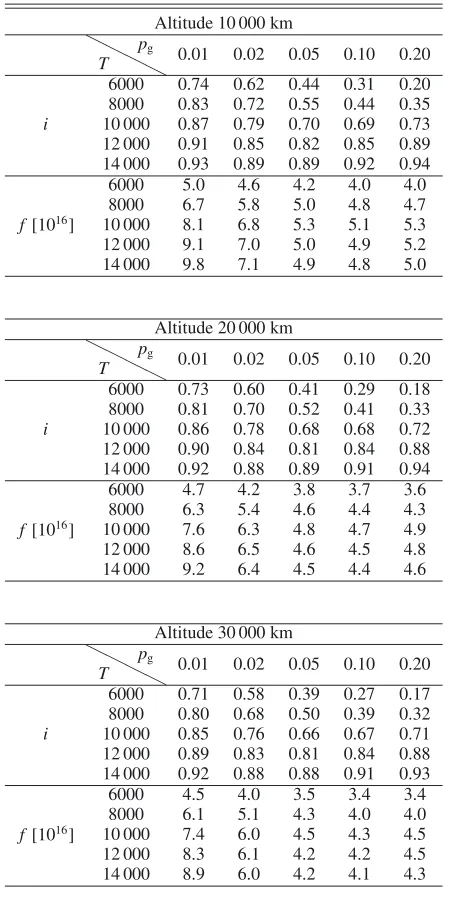
forT =8000 K. The same value was also reported byLandman & Mongillo(1979). In general, this factor mildly depends on the temperature and gas pressure (see Table1). The electron density can be estimated from the local values of the gas pressure and the temperature using the following set of formulas:
pg=NkT, (9)
whereNis the total particle number density given byN =nH+
nHe+ne. Here,nHis the total hydrogen density – the sum of the
neutral hydrogen and the proton density, andnHeis the helium
density. Assuming 10% abundance of the helium and no helium ionization (fully ionized helium would contribute to the electron density by 20%), we can write
pg=
1+1.1
i
nekT, (10)
wherei = ne/nHis the hydrogen ionization degree. The value
ofi depends on temperature and gas pressure and is specified below.
2.3. Parameters S, f, and i
Mean values ofiandf can be inferred from the correlation plots ofHeinzel et al.(1994). However, for this new Hα visualiza-tion method we evaluated these parameters for a broader range of temperatures using the most advanced 1D non-LTE radiative transfer models recently implemented byHeinzel et al.(2014). The results are given in Table1for three representative altitudes of 10 000, 20 000, and 30 000 km and for a nominal slab thick-ness of 500 km. For the isothermal-isobaric slabs ofHeinzel et al.(2014) that are not optically thick in Hα, the atomic level populations and the electron densities are almost constant inside the slabs (Gouttebroze et al. 1993), and we took the values at the slab center to tabulateiand f. For the same altitudes we also determined average values of the Hαline source functionS as 3.22×10⁻⁶, 2.98×10⁻⁶, and 2.80×10⁻⁶erg s−1cm−2sr−1Hz−1, respectively. The values ofS andf can be approximately scaled in altitude by the ratio of the dilution factors, as these quantities are proportional to the dilution factor by their very nature. The ionization degreeivaries much less with the altitude and is not directly related to the dilution factorW.
3. Recipes for prominence or filament visualizations
[image:3.595.320.545.107.557.2]To visualize the whole-prominence magnetic field configuration containing many magnetic dips filled with the plasma having a
Table 1.Values of the ionization degreeiand the parameterf for
vari-ous values of the temperature (in K) and gas pressure (in dyn cm−2).
Altitude 10 000 km HH
HH
T pg
0.01 0.02 0.05 0.10 0.20
i
6000 0.74 0.62 0.44 0.31 0.20 8000 0.83 0.72 0.55 0.44 0.35 10 000 0.87 0.79 0.70 0.69 0.73 12 000 0.91 0.85 0.82 0.85 0.89 14 000 0.93 0.89 0.89 0.92 0.94
f[1016]
6000 5.0 4.6 4.2 4.0 4.0
8000 6.7 5.8 5.0 4.8 4.7
10 000 8.1 6.8 5.3 5.1 5.3 12 000 9.1 7.0 5.0 4.9 5.2 14 000 9.8 7.1 4.9 4.8 5.0
Altitude 20 000 km HH
HH
T pg
0.01 0.02 0.05 0.10 0.20
i
6000 0.73 0.60 0.41 0.29 0.18 8000 0.81 0.70 0.52 0.41 0.33 10 000 0.86 0.78 0.68 0.68 0.72 12 000 0.90 0.84 0.81 0.84 0.88 14 000 0.92 0.88 0.89 0.91 0.94
f[1016]
6000 4.7 4.2 3.8 3.7 3.6
8000 6.3 5.4 4.6 4.4 4.3
10 000 7.6 6.3 4.8 4.7 4.9 12 000 8.6 6.5 4.6 4.5 4.8 14 000 9.2 6.4 4.5 4.4 4.6
Altitude 30 000 km
HHHH
T pg
0.01 0.02 0.05 0.10 0.20
i
6000 0.71 0.58 0.39 0.27 0.17 8000 0.80 0.68 0.50 0.39 0.32 10 000 0.85 0.76 0.66 0.67 0.71 12 000 0.89 0.83 0.81 0.84 0.88 14 000 0.92 0.88 0.88 0.91 0.93
f[1016]
6000 4.5 4.0 3.5 3.4 3.4
8000 6.1 5.1 4.3 4.0 4.0
10 000 7.4 6.0 4.5 4.3 4.5 12 000 8.3 6.1 4.2 4.2 4.5 14 000 8.9 6.0 4.2 4.1 4.3
given temperature and pressure distribution, we proceed in the following way. First, we compute the LOS optical thickness τν=
LOS
κ(ν,l) dl, (11)
where the line absorption coefficientκ(ν,l) is given by Eq. (4). For a given height above the solar surface, we can interpolate the value of the Hαsource function given in Sect.2.3. The values ofiand f entering the evaluation of the absorption coefficient are obtained from Table1for the local values ofT andpgalong
the LOS. Then Eq. (3) is used to compute the synthetic line pro-file for each LOS (a pixel in the simulated image). To obtain the synthetic image for a specific Hαfilter, one has to multiply the emission line profile by the filter response function and integrate over the wavelength range of the filter sensitivity. We note that forτν > 1, the line intensity will saturate to the value of the source function, as evident from Eq. (3).
background disk radiation attenuated by the filament must be added, that is,
I(ν)=S(1−e−τν)+I
bgre−τν. (12)
Depending on the position of the filament on the solar disk, the background Hα intensityIbgr can be obtained fromDavid
(1961), for instance, and using the limb-darkened continuum in-tensity in the vicinity of the Hαline (Allen 1976). We note that for filaments,S varies with height along the LOS (see Sect.2.3), which might require a more accurate solution.
The visualization method presented here can also accommo-date LOS velocities on the order of 10 km s−1. Such velocities
are typically encountered in quiescent prominences, seeGunár et al.(2012), for example. The source function and the ionization degree are not significantly affected by such velocities, which al-lows us to use the same tabulated values ofS, f, andi. These velocities therefore only affect the absorption coefficientκ(ν,l). Taking into account a local Doppler shiftΔν(l) due to the local LOS velocity, we can modify Eq. (4) as
κ(ν,l)=1.7×10⁻²n2φ
ν−Δν(l). (13)
3.1. Tests of the method
To demonstrate the accuracy of our Hαvisualization method, we performed several tests comparing the Hαline intensities ob-tained by 1D and 2D non-LTE radiative transfer models with the results of the fast approximate Hαsynthesis.
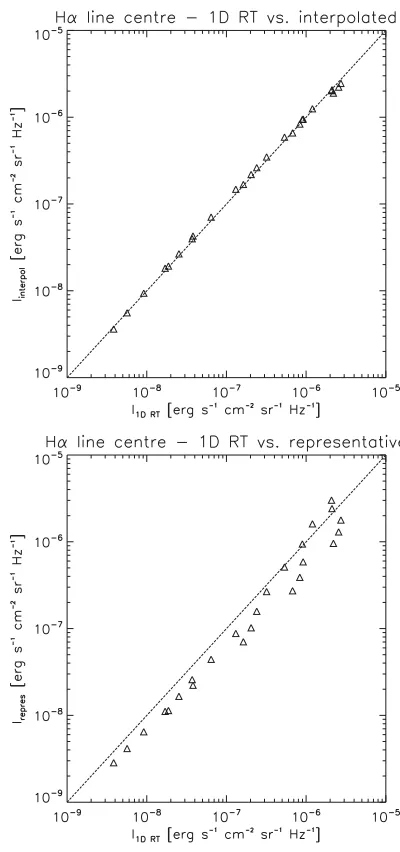
In the first test we used the series of 1D non-LTE isothermal-isobaric models of Heinzel et al. (2014). We compared the Hαline-center intensities obtained by the models with the inten-sities computed by the Hαsynthesis when using the interpola-tion of parametersiandf from the tables provided in this paper and when using representative fixed values of parametersiandf
for all models. All results are valid for the altitude of 10 000 km. In Fig.1(top) we show the scatterplot of the Hαline-center in-tensities obtained by 1D non-LTE computations (x-axis) and our approximate synthesis usingiand f interpolation (y-axis). The bottom part of Fig.1shows the same scatterplot, but using the approximate synthesis with representative values ofi=0.35 and
f =4.7×1016cm−3. It is evident that the intensities obtained by the approximate synthesis withiand f interpolation agree very well with the intensities obtained by exact 1D non-LTE compu-tations. The approximate synthesis with selected representativei
and f values also produces results that agree reasonably well with the exact solutions.
[image:4.595.328.528.71.497.2]In the second test we used the 2D temperature and gas pressure distribution inside the force-free magnetic dip named D
eep
_
dip
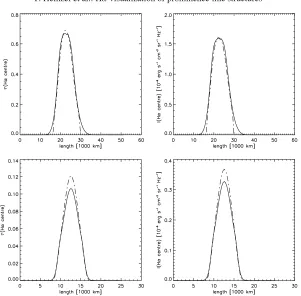
presented inGunár et al.(2013), see Fig. 6 therein. We scanned its 2D structure along its length with the LOS per-pendicular to the x-axis and at each position computed the Hαline-center intensity and optical thickness using the approx-imate Hαsynthesis with the interpolation ofiand f. We com-pared this with the results of the 2D non-LTE radiative trans-fer modeling reported byGunár et al. (2013). In the top row of Fig.2 we plot the optical thickness (left) and the intensity (right) at the Hα line center along the length of the magnetic dip. Solid lines represent the full 2D non-LTE radiative trans-fer calculations and dashed-dotted lines show the approximate Hαsynthesis. In the bottom row of Fig.2we show the same, but for the 2D fine-structure thread model Model
_
dem
presented byGunár et al.(2011), see Fig. 6 therein. Again, we plot the op-tical thickness (left) and the intensity (right) using solid lines forFig. 1. Scatterplots of the Hα line center intensities obtained by
1D non-LTE computations (x-axes) and by approximate synthesis using
iand finterpolation (top) and using fixed representativeiand fvalues (bottom). Dashed lines correspond to the precise match with the inten-sities obtained by 1D non-LTE computations.
Fig. 2.Optical thickness (left column) and intensity (right column) at the Hαline center plotted along the length of the 2D plasma structure of the D
eep
_
dip
(upper row) and the Model
_
dem
(lower row). Solid lines represent the 2D non-LTE radiative transfer calculations, while the dash-dotted lines show the results of the approximate Hαsynthesis with the interpolation ofiandf.representing its sides. We note that our test-cases represent dif-ferent 2D prominence fine-structure models – the first based on the force-free magnetic dips and the second using gravity-induced dips. We used them to demonstrate the ability of the ap-proximate Hαsynthesis method to reproduce results for a wide variety of models, but it is not our aim to compare these models with each other.
4. Sample image of the prominence magnetic dip
To illustrate the application of the approximate Hαline synthesis method presented here, we visualized two force-free magnetic dips filled with prominence plasma. The magnetic field configu-ration of these dips was obtained by the 3D nonlinear force-free field simulations of the whole prominence magnetic structure byMackay & van Ballegooijen(2009). These dips were filled with prominence plasma in the hydrostatic equilibrium accord-ing to the method ofGunár et al.(2013). One of the visualized dips is the D
eep
_
dip
,
representing a prominence fine structure with higher gas pressure in its center due to its significant depth, seeGunár et al.(2013). The other dip is shallower (but not the Shallow
_
dip
ofGunár et al. 2013), resulting in a much lower central gas pressure. It is also more extended along the mag-netic field, about 65 000 km compared to the 50 000 km of the Deep
_
dip
. Both dips simulate prominence fine structures with an assumed cross-section of 1000 km. In Fig.3we show a syn-thetic image in the Hαline center where the Deep
_
dip
is placed above the shallower dip. The Deep
_
dip
appears much brighter due to its higher central gas pressure. Moreover, it also appears somewhat longer than the (in reality more extended) shallower dip. This can be attributed to the Hαvisibility of the prominence material.Fig. 3.Synthetic image in the Hαline center of the D
eep
_
dip
(upperstructure) and a shallower dip (lower structure).
5. Discussion and conclusions
[image:5.595.315.547.421.564.2]presented in Sect.3.1show that our approximate Hα visualiza-tion method is sufficiently accurate. We note that this accuracy would break down in an extreme case when all prominence fine structures were densely packed close to each other within a large prominence. This scenario may be simulated by a large homoge-neous slab that is only illuminated at its two boundaries. In this case, the depth-dependent behavior of the source function will be different, reflecting the actual conditions within the (optically thick) slab – seeGouttebroze et al.(1993).
We have demonstrated that our fast approximate radiative transfer method for vizualising the Hα prominence provides realistic synthetic Hαintensities that are useful for a reliable vi-sualization of prominences and filaments. Such synthetic high-resolution images of whole prominences/filaments are quan-titatively accurate enough and thus can be used for a direct comparison with radiometrically calibrated observations.
Acknowledgements. P.H. acknowledges the support from grant 209/12/0906 of the Grant Agency of the Czech Republic. S.G. acknowledges support from the European Commission via the Marie Curie Actions – Intra-European Fellowships Project No. 328138. P.H. and S.G. acknowledge support from project RVO:67985815 of the Astronomical Institute of the Czech Academy of Sciences and from the MPA Garching. U.A. thanks for the support from the Astronomical Institute of the Czech Academy of Sciences.
References
Allen, C. W. 1976, Astrophysical Quantities (London: The Athlone Press) Aulanier, G., & Démoulin, P. 1998,A&A, 329, 1125
David, K.-H. 1961,Z. Astrophys., 53, 37
Dudík, J., Aulanier, G., Schmieder, B., Bommier, V., & Roudier, T. 2008, Sol. Phys., 248, 29
Engvold, O., Hirayama, T., Leroy, J. L., Priest, E. R., & Tandberg-Hanssen, E. 1990, in Dynamics of Quiescent Prominences, eds. V. Ruzdjak & E. Tandberg-Hanssen (New York: Springer Verlag),IAU Colloq., 363, 294 Gouttebroze, P., Heinzel, P., & Vial, J. C. 1993,A&AS, 99, 513
Gunár, S. 2014, in IAU Symp. 300, eds. B. Schmieder, J.-M. Malherbe, & S. T. Wu, 59
Gunár, S., & Mackay, D. H. 2015,ApJ, 803, 64
Gunár, S., Parenti, S., Anzer, U., Heinzel, P., & Vial, J.-C. 2011, A&A, 535, A122
Gunár, S., Mein, P., Schmieder, B., Heinzel, P., & Mein, N. 2012,A&A, 543, A93
Gunár, S., Mackay, D. H., Anzer, U., & Heinzel, P. 2013,A&A, 551, A3 Heinzel, P. 2015, in Astrophys. Space Sci. Lib. 415, eds. J.-C. Vial, &
O. Engvold, 103
Heinzel, P., & Anzer, U. 2001,A&A, 375, 1082
Heinzel, P., Gouttebroze, P., & Vial, J.-C. 1994,A&A, 292, 656 Heinzel, P., Vial, J.-C., & Anzer, U. 2014,A&A, 564, A132 Jejˇciˇc, S., & Heinzel, P. 2009,Sol. Phys., 254, 89
Karpen, J. T., Antiochos, S. K., & Klimchuk, J. A. 2006,ApJ, 637, 531 Labrosse, N., Heinzel, P., Vial, J., et al. 2010,Space Sci. Rev., 151, 243 Landman, D. A., & Mongillo, M. 1979,ApJ, 230, 581
Leenaarts, J., Carlsson, M., & Rouppe van der Voort, L. 2012,ApJ, 749, 136 Leenaarts, J., Carlsson, M., & Rouppe van der Voort, L. 2015,ApJ, 802, 136 Luna, M., Karpen, J. T., & DeVore, C. R. 2012,ApJ, 746, 30
Mackay, D. H., & van Ballegooijen, A. A. 2009,Sol. Phys., 260, 321
Mackay, D. H., Karpen, J. T., Ballester, J. L., Schmieder, B., & Aulanier, G. 2010,Space Sci. Rev., 151, 333
Su, Y., & van Ballegooijen, A. 2012,ApJ, 757, 168