ISSN Online: 2327-4379 ISSN Print: 2327-4352
DOI: 10.4236/jamp.2019.711188 Nov. 13, 2019 2751 Journal of Applied Mathematics and Physics
Practical Security of the Continuous-Variable
Quantum Key Distribution with
Locally-Generated Local Oscillators
Biao Huang
1,2,3,4,5*, Yongjun Zhu
5, Pu Tang
5, Yongmei Huang
1,2,3, Zhenming Peng
41Key Laboratory of Optical Engineering, Chinese Academy of Sciences, Chengdu, China 2Institute of Optics and Electronics, Chinese Academy of Sciences, Chengdu, China 3University of Chinese Academy of Sciences, Beijing, China
4School of Information and Communication Engineering, University of Electronic Science and Technology of China,
Chengdu, China
5Southwest Communication Institute, Chengdu, China
Abstract
Continuous-variable quantum key distribution (CVQKD) with the locallocal
oscillator (LLO) is confronted with new security problems due to the refer-ence pulses transmitted together with quantum signals over the insecure quantum channel. In this paper, we propose a method of phase attack on ref-erence pulses of the LLO-CVQKD with time-multiplexing. Under this phase attack, the phase drifts of reference pulses are manipulated by eavesdroppers, and then the phase compensation error is increased. Consequently, the secret key rate is reduced due to the imperfect phase compensation for quantum signals. Based on the noise model of imperfect phase compensation, the prac-tical security of LLO-CVQKD under phase attack is analyzed. The simulation results show that the practical security is reduced due to the phase attack, yet it is still tight when system parameters are estimated by training signals.
Keywords
Continuous-Variable Quantum Key Distribution, Local Oscillator, Reference Pulse, Practical Security, Phase Attack
1. Introduction
Continuous-variable quantum key distribution (CVQKD) allows two remote participants to establish a common key through an insecure quantum channel [1]. The CVQKD scheme using Gaussian-modulated coherent state (GMCS) is
How to cite this paper: Huang, B., Zhu, Y.J., Tang, P., Huang, Y.M. and Peng, Z.M. (2019) Practical Security of the Conti-nuous-Variable Quantum Key Distribution with Locally-Generated Local Oscillators. Journal of Applied Mathematics and Phys-ics, 7, 2751-2759.
https://doi.org/10.4236/jamp.2019.711188
DOI: 10.4236/jamp.2019.711188 2752 Journal of Applied Mathematics and Physics
the most favorable one due to its optimal transmission rate under the Gaussian noise channel and its excellent compatibility with the standard optical equip-ments [2]. So far, the GMCS scheme has been theoretically proven to be uncon-ditionally secure against collective attacks and coherent attacks [3] [4]. Mean-while, some experiments have demonstrated its availability over long distance [5] [6].
In the traditional GMCS-CVQKD experiments, the local oscillator (LO) needs to be transmitted from the sender Alice to the receiver Bob over the insecure quantum channel for the homodyne detection at Bob’s side. However, the LO transmission brings secure issues quickly. The LO transmitted in the insecure quantum channel is most likely to be controlled and manipulated by eavesdrop-pers who may cause practical attacks on GMCS-CVQKD system, such as the LO fluctuation attack [7], the wavelength attack [8] and the saturation attack [9]. Although some solutions have been proposed to enhance the security of practic-al systems [10] [11] [12] [13], it is difficult to protect practicpractic-al systems against practic-all the potential loopholes caused by the LO transmission have been discovered.
Recently, in order to completely solve those loopholes caused by the LO transmission, several researchers adopt the local LO (LLO) scheme that the LO is generated locally at Bob’s side, while the reference pulses are transmitted instead of the LO pulses to ensure the reliability of coherent detection [14] [15] [16]. The local LO is absolutely controlled by Bob so that the shot-noise-limited co-herent detection becomes secure and the high-speed homodyne detection can be achieved. Moreover, the reference pulses provide phase information for Bob’s coherent detection, so that the phase drift between Alice and Bob can be com-pensated exactly in real time. Besides, the reference pulses can be transmitted with quantum signals over the same quantum channel by time-multiplexing and polarization-multiplexing [17] [18], so that it is easy for practical systems to separate them.
However, while the issues caused by the LO transmission are eliminated in the LLO-CVQKD system, the reference pulses may open new loopholes at the same time. The role of reference pulses is to provide reliable phase information for phase compensation at Bob’s side, but reference pulses are also confronted with the potential threats in the insecure quantum channel. If these reference pulses are manipulated by eavesdroppers, the phase information carried by them will become unreliable, and the phase compensation during Bob’s coherent detection will become imperfect. As a result, the security of the practical LLO-CVQKD system will be reduced due to the imperfect phase compensation [19] [20].
DOI: 10.4236/jamp.2019.711188 2753 Journal of Applied Mathematics and Physics
2. Theoretical Analysis
2.1. System Description
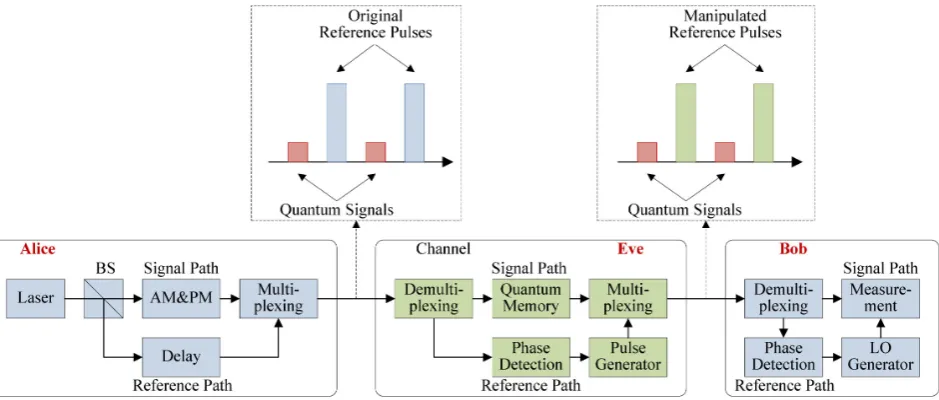
The practical LLO-CVQKD system using time-multiplexing is depicted in Fig-ure 1. The sender Alice uses a commercial laser to generate a set of optical pulses, which are split by a beam splitter (BS) into the signal path and the refer-ence path. In the signal path, the optical pulses are modulated by an amplitude modulator (AM) and a phase modulator (PM), and then the quantum signal pulses of Gaussian-modulated coherent states are generated, in which the
qua-dratures XA and PA are two independent random variables with Gaussian
distribution N V(0, )A , where VA denotes the modulation variance. In the
ref-erence path, the refref-erence pulses with source phase information θS are delayed
by a delay line and then they are multiplexed with the quantum signals in time-domain. Then, both the signal pulses and reference pulses are sent to the
receiver Bob through a quantum channel with transmittance T and excess noise
c
ε , where the total channel-added noise referred to the channel input is
ex-pressed in shot noise units as χline=1T− +1 εc.
At Bob’s side, the received pulses are split into reference path and signal path by time-demultiplexing. In the reference path, the phase values of the reference pulses are measured by a heterodyne detector and they are used to modify the phase of LO generated locally at Bob’s side. In the signal path, the quantum sig-nals are detected by a homodyne detector with the local LO, where the phase drift is compensated, so that the quadrature X or quadrature P of a coherent state can be measured exactly according to Bob’s random selection of
measure-ment basis. For a practical homodyne detector of detection efficiency
η
andelectronic noise variance vel, the detection noise referred to Bob’s input is
[image:3.595.67.537.495.695.2]ex-pressed in shot noise units as χhom = +(1 vel) η−1. Thus, the total noise referred to the channel input can be expressed as χtot=χline+χhom T.
DOI: 10.4236/jamp.2019.711188 2754 Journal of Applied Mathematics and Physics
2.2. Phase Attack
In the LLO-CVQKD system with time-multiplexing, the reference pulses are lo-cated uniformly among signal pulses, where the reference pulses and signal pulses are transmitted alternately one by one. This simple multiplexing pattern enables Bob to demultiplex the signal pulses and reference pulses precisely. While this multiplexing pattern is employed by Alice and Bob, it is reasonable to assume that the eavesdropper Eve also knows this pattern.
For the signal pulses and reference pulses transmitted into quantum channel, Eve can easily split these pluses into signal path and reference path according to the multiplexing pattern (see Figure 1). In the signal path, the signal pulses are stored by quantum memories for being resent later. In the reference path, the reference phase of Alice’s reference pulse is measured by a phase detector, and then a forged reference pulse is produced where an additional phase noise is in-troduced. After being multiplexed, the signal pulses and the forged reference pulses are transmitted to Bob. At Bob’s side, the phase drift of a quantum signal is estimated by the adjacent reference pulse, so that the phase compensation er-ror can be written as:
drift drift eve
δθ θ= −θ′ −θ (1)
where θdrift and θ ′drift are the phase drifts for a quantum signal and its
follow-ing reference pulse, and θeve is the additional phase noise caused by Eve’s phase
attack. Assuming that the phase drifts of quantum signals can be can be com-pensated by reference pulses, namely θdrift =θ ′drift, the additional phase noise is
left and then it leads to the imperfect phase compensation. Furthermore,
as-suming that this phase noise is zero-mean and with variance VE, the deviation
of the actual phase compensation error can be given by
[ ] E
Dδθ =V (2)
2.3. Security Analysis
The security analyses of the traditional GMCS-CVQKD scheme with the imper-fect phase compensation have been analyzed in the existing researches [19] [20]. Here, we utilize the noise model of imperfect phase compensation for GMCS-CVQKD to analyze the practical security of LLO-CVQKD scheme.
For the LLO-CVQKD scheme with imperfect phase compensation, the Gaus-sian modulated coherent states are transmitted from Alice to Bob over a
quan-tum channel with transmittance T and excess noise εc. At Bob’s side, The
phase compensation error
δθ
leads to a random phase rotation between themodulated coherent state (X PA, )A and the measured one (X PB, )B .
There-fore, the measurement results can be expressed as
( cos sin )
B A A X
X = T X δθ−P δθ +W (3)
( sin cos )
B A A P
P = T X δθ+P δθ +W (4)
DOI: 10.4236/jamp.2019.711188 2755 Journal of Applied Mathematics and Physics
and P respectively. In the noise model of imperfect phase compensation, it is
as-sumed that the phase compensation error
δθ
is zero-mean, so that thecova-riance matrix of the mixture state ρAB shared by Alice and Bob can be given by
2 2
2
2
( 1)
( 1) ( )
z AB
z tot
V T V
T V T V
κ κ κ κ σ γ σ χ − = − + Ι
I (5)
where Ι2 is a second-order identity matrix, σ =z diag(1, 1)− and V V= A+1.
The parameter Tκ denotes the actual transmittance, and the parameter χtotκ
denotes the actual total noise referred to the channel input. On the one hand, due to the imperfect phase compensation, the actual transmittance can be ex-pressed as
Tκ =κT (6)
where
κ
denotes the phase compensation accuracy which will be introduced indetail later. On the other hand, the actual total noise can be given by
tot line hom T
κ κ
κ
χ =χ +χ (7)
where χlineκ =1Tκ +εcκ −1 is the actual total channel-added noise referred to the
channel input, and εcκ is the actual excess noise given by
[ (1 )( 1)]
cκ c V
ε = ε + −κ − κ (8)
For the CVQKD with imperfect phase compensation, the parameters Tκ and
c κ
ε are closely related to the phase compensation accuracy
κ
which can beexpressed as
2
( [cos ])E
κ = δθ (9)
where
E x
[ ]
denotes the expectation of a random variable x. When the phasecompensation error
δθ
is smaller than 5 degrees, the Taylor approximation2
cosx≈ −1 x 2 can be achieved, so that the phase compensation accuracy can
be approximated as
2
1 (1 [ ])
2D
κ′ = − δθ (10)
where
D
[ ]
δθ
is the deviation of phase compensation error that has beenin-troduced in Equation (2).
In the case of reverse reconciliation, the secret key rate of the CVQKD system under collective attack is calculated asymptotically as
R AB BE
K =βI −χ (11)
where
β
is the reconciliation efficiency, IAB is the Shannon mutualinforma-tion between Alice and Bob, and χBE is the Holevo bound that defines the
maximum information available to Eve on Bob’s secret information. For the homodyne detection employed by Bob, the Shannon mutual information is giv-en by
2
1 log
2 1 tot
AB
tot
V
I κκ
χ χ + =
DOI: 10.4236/jamp.2019.711188 2756 Journal of Applied Mathematics and Physics
The Holevo bound can be derived from the covariance matrix γAB shown in
Equation (5) and then it is calculated as
2 5 1 3 1 1 2 2 i i BE
i G i G
λ λ χ = = − − = −
∑
∑
(13)where G x( ) (= x+1)log (2 x+ −1) xlog2x, and λ =i( 1,2,...,5)i are given by
2 2
1,2 1 (2 A A 4 )B
λ = ± − (14)
2 2
3,4 1 (2 C C 4 )D
λ = ± − (15)
5 1
λ = (16)
with symbols defined as
2 2 (1 2) 2( )2
line
A V T V T V κ
κ κ χ
= + − + + (17)
2(1 )2
line
B T V κ
κ χ
= + (18)
( )
( )
hom line
line
A V B T V
C T V κ κ κ κ χ χ χ + + + =
+ (19)
( )
hom
line
V B B D
T V κ
κ
χ χ + =
+ (20)
2.4. Parameters Estimation
For the practical LLO-CVQKD system, the actual transmittance Tκ and the
actual excess noise εcκ should be estimated by training signals which are ran-domly selected from the received quantum signals at Bob’s side. It is supposed
that Bob randomly selects M quantum signals for training, and then the
quadra-ture measurements of them are denoted as { , ,...,y y1 2 yM}. Also, the modulated
quadratures of them, denoted as { , ,..., }x x1 2 xM , are announced by Alice via a
classical channel. According to the training signals, Alice and Bob would esti-mate the actual transmittance and the actual excess noise such as
2 1
2 1
ˆ iM i i
M i i x y T x κ = = =
∑
∑
(21)and
2 1
1 ˆ
ˆc ˆ M ( i i)
i y T x
MT κ κ κ ε =
=
∑
− (22)Statistically, the expectations of the estimated parameters are consistent with the theoretical ones as E T[ ]ˆκ =Tκ and E[ ]εˆcκ =εcκ, so that the practical secret key rate for the LLO-CVQKD under collective attacks can also be calculated.
3. Simulation and Discussion
DOI: 10.4236/jamp.2019.711188 2757 Journal of Applied Mathematics and Physics
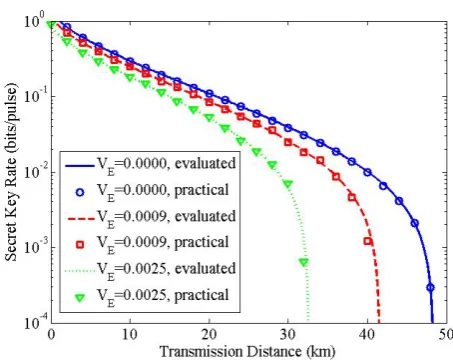
Figure 2. The secret key rates of the LLO-CVQKD system under phase attack. The phase noise variance is 0.0000, 0.0009 and 0.0025 respectively. The solid line, dash line and dot-ted line are the secret key rates evaluadot-ted in theory, while the circles, squares and triangles are the secret key rates estimated by 2000 training signals.
0.01
c
ε = (in shot-noise units),
β =
0.926
andη =
0.59
, all of which arede-termined by the practical CVQKD experiment [19]. Besides, it is assumed that
the phase noise caused by Eve’s phase attack is normally distributed from −Φ
to Φ degree, where Φ is given by 0, 3 and 5 degrees respectively, so that the
corresponding noise variance VE is 0.0000, 0.0009 and 0.0025 (rad2), and then
the phase compensation accuracy
κ
is evaluated as 1.0000, 0.9991 and 0.9975respectively. With the noise model of imperfect phase compensation, the theo-retical secret key rates of the LLO-CVQKD system under phase attack can be evaluated.
In order to confirm the validity of our security analysis, 2000 Gaus-sian-modulated coherent states are generated for training, all of which are added with a uniformly-distributed phase noise, and then the actual transmittance Tˆκ and the actual excess noise εˆcκ are estimated by them. The practical secret key rates based on the estimated parameters are depicted by the circles, squares and triangles in Figure 2. By the comparison of the theoretical secret key rates and the practical ones, the security analysis of the LLO-CVQKD under phase attack is confirmed to be correct.
4. Conclusion
DOI: 10.4236/jamp.2019.711188 2758 Journal of Applied Mathematics and Physics
Acknowledgements
This work is supported by the National Natural Science Foundation of China (Grants No. U1738204, 61571096 and 61775030) and the Foundation of Key Laboratory of Optical Engineering Chinese Academy of Sciences (Grant No. 2017LBC003). The authors thank Dr. Bingjie Xu and Dr. Heng Wang for discus-sion.
Conflicts of Interest
The authors declare no conflicts of interest regarding the publication of this pa-per.
References
[1] Ralph, T.C. (2000) Continuous Variable Quantum Cryptography. Physical Review A, 61, Article ID: 010303. https://doi.org/10.1103/PhysRevA.61.010303
[2] Grosshans, F., Assche, G.V., Wenger, J., Brouri, R., Cerf, N.J. and Grangier, P. (2003) Quantum Key Distribution Using Gaussian-Modulated Coherent States. Nature, 421, 238-241. https://doi.org/10.1038/nature01289
[3] Leverrier, A., Grosshans, F. and, P. (2010) Finite-Size Analysis of a Conti-nuous-Variable Quantum Key Distribution. Physical Review A, 81, Article ID: 062343. https://doi.org/10.1103/PhysRevA.81.062343
[4] Leverrier, A., García-Patrón, R., Renner, R. and Cerf, N.J. (2013) Security of Conti-nuous-Variable Quantum Key Distribution against General Attacks. Physical Re-view Letters, 110, Article ID: 030502.
https://doi.org/10.1103/PhysRevLett.110.030502
[5] Jouguet, P., Kunz-Jacques, S., Leverrier, A., Grangier, P. and Diamanti, E. (2013) Experimental Demonstration of Long-Distance Continuous-Variable Quantum Key Distribution. Nature Photonics, 7, 378-381.
https://doi.org/10.1038/nphoton.2013.63
[6] Huang, D., Huang, P., Lin, D.K. and Zeng, G.H. (2016) Long-Distance Conti-nuous-Variable Quantum Key Distribution by Controlling Excess Noise. Scientific Reports, 6, Article ID: 19201. https://doi.org/10.1038/srep19201
[7] Ma, X.C., Sun, S.H., Jiang, M.S. and Liang, L.M. (2013) Local Oscillator Fluctuation Opens a Loophole for Eve in Practical Continuous-Variable Quan-tum-Key-Distribution Systems. Physical Review A, 88, Article ID: 022339.
https://doi.org/10.1103/PhysRevA.88.022339
[8] Huang, J.Z., Weedbrook, C., Yin, Z.Q., Wang, S., Li, H.W., Chen, W., Guo, G.C. and Han, Z.F. (2013) Quantum Hacking of a Continuous-Variable Quan-tum-Key-Distribution System Using a Wavelength Attack. Physical Review A, 87, Article ID: 062329. https://doi.org/10.1103/PhysRevA.87.062329
[9] Qin, H., Kumar, R. and Alléaume, R. (2016) Quantum Hacking: Saturation Attack on Practical Continuous-Variable Quantum Key Distribution. Physical Review A, 94, Article ID: 012325. https://doi.org/10.1103/PhysRevA.94.012325
DOI: 10.4236/jamp.2019.711188 2759 Journal of Applied Mathematics and Physics https://doi.org/10.1103/PhysRevA.89.032310
[11] Liu, W.Q., Peng, J.Y., Huang, P., Huang, D. and Zeng, G.H. (2017) Monitoring of Continuous-Variable Quantum Key Distribution System in Real Environment. Op-tics Express, 25, 19429-19443. https://doi.org/10.1364/OE.25.019429
[12] Jouguet, P., Kunz-Jacques, S. and Diamanti, E. (2013) Preventing Calibration At-tacks on the Local Oscillator in Continuous-Variable Quantum Key Distribution. Physical Review A, 87, Article ID: 062313.
https://doi.org/10.1103/PhysRevA.87.062313
[13] Huang, P., Huang, J.Z., Wang, T., Li, H.S. and Huang, D. (2017) Robust Conti-nuous-Variable Quantum Key Distribution against Practical Attacks. Physical Re-view A, 95, Article ID: 052302. https://doi.org/10.1103/PhysRevA.95.052302
[14] Qi, B., Lougovski, P., Pooser, R., Grice, W. and Bobrek, M. (2015) Generating the Local Oscillator “Locally” in Continuous-Variable Quantum Key Distribution Based on Coherent Detection. Physical Review X, 5, Article ID: 041009.
https://doi.org/10.1103/PhysRevX.5.041009
[15] Soh, D.B.S., Brif, C., Coles, P.J., Lütkenhaus, N., Camacho, R.M., Urayama, J. and Sarovar, M. (2015) Self-Referenced Continuous-Variable Quantum Key Distribu-tion Protocol. Physical Review X, 5, Article ID: 041010.
https://doi.org/10.1103/PhysRevX.5.041010
[16] Huang, D., Lin, D.K., Huang, P. and Zeng, G.H. (2015) High-Speed Conti-nuous-Variable Quantum Key Distribution without Sending a Local Oscillator. Op-tics Letters, 40, 3695-3698. https://doi.org/10.1364/OL.40.003695
[17] Wang, T., Huang, P., Zhou, Y.M., Liu, W.Q., Ma, H.X., Wang, S.Y. and Zeng, G.H. (2018) High Key Rate Continuous-Variable Quantum Key Distribution with a Real Local Oscillator. Optics Express, 26, 2794-2806.
https://doi.org/10.1364/OE.26.002794
[18] Wang, T., Huang, P., Zhou, Y.M., Liu, W.Q. and Zeng, G.H. (2018) Pi-lot-Multiplexed Continuous-Variable Quantum Key Distribution with a Real Local Oscillator. Physical Review A, 97, Article ID: 012310.
https://doi.org/10.1103/PhysRevA.97.012310
[19] Huang, P., Lin, D.K., Huang, D. and Zeng, G.H. (2015) Security of Conti-nuous-Variable Quantum Key Distribution with Imperfect Phase Compensation. International Journal of Theoretical Physics, 54, 2613-2622.
https://doi.org/10.1007/s10773-014-2492-z