ISSN: 1524-4628
Copyright © 2007 American Heart Association. All rights reserved. Print ISSN: 0039-2499. Online Stroke is published by the American Heart Association. 7272 Greenville Avenue, Dallas, TX 72514
DOI: 10.1161/STROKEAHA.106.474080
2007;38;1911-1915; originally published online Apr 26, 2007;
Stroke
The Optimising Analysis of Stroke Trials (OAST) Collaboration
Tables II and III) * OAST Supplemental Appendix IV: Results (see Table IV)
Supplementary Analyses * OAST Supplemental Appendix III: Trial Data (see
Statistical Tests Compared (see Table I) * OAST Supplemental Appendix II:
of Functional Outcomes in Stroke Trials * OAST Supplemental Appendix I:
Can We Improve the Statistical Analysis of Stroke Trials?: Statistical Reanalysis
http://stroke.ahajournals.org/cgi/content/full/38/6/1911
located on the World Wide Web at:
The online version of this article, along with updated information and services, is
http://www.lww.com/reprints
Reprints: Information about reprints can be found online at
410-528-8550. E-mail:
Fax: Kluwer Health, 351 West Camden Street, Baltimore, MD 21202-2436. Phone: 410-528-4050. Permissions: Permissions & Rights Desk, Lippincott Williams & Wilkins, a division of Wolters
http://stroke.ahajournals.org/subscriptions/
Subscriptions: Information about subscribing to Stroke is online at
at UNIV OF NOTTINGHAM on January 26, 2009 stroke.ahajournals.org
efficient in analyzing outcomes from stroke trials.
Methods—Individual patient data from acute, rehabilitation and stroke unit trials studying the effects of interventions which alter functional outcome were assessed. Outcomes included modified Rankin Scale, Barthel Index, and “3 questions”. Data were analyzed using a variety of approaches which compare 2 treatment groups. The results for each statistical test for each trial were then compared.
Results—Data from 55 datasets were obtained (47 trials, 54 173 patients). The test results differed substantially so that approaches which use the ordered nature of functional outcome data (ordinal logistic regression,ttest, robust ranks test, bootstrapping the difference in mean rank) were more efficient statistically than those which collapse the data into 2 groups (2; ANOVA, P⬍0.001). The findings were consistent across different types and sizes of trial and for the
different measures of functional outcome.
Conclusions—When analyzing functional outcome from stroke trials, statistical tests which use the original ordered data are more efficient and more likely to yield reliable results. Suitable approaches included ordinal logistic regression,t test, and robust ranks test.(Stroke. 2007;38:1911-1915.)
Key Words:stroke 䡲 randomised controlled trial 䡲 statistical analysis
T
he management of patients with acute or recent stroke has benefited significantly from the results of random-ized controlled trials and meta-analyses of these. For exam-ple, functional outcome is improved with alteplase, aspirin, management in a Stroke Unit, and community occupational therapy.1–7 In contrast, some studies were overtly negativefinding that treatment worsened outcome, eg, DCLHb, enli-momab, selfotel, or tirilazad.8 –11 However, the majority of
acute stroke trials were neutral in spite of positive preclinical findings. The failure of these latter studies can be attributed to multiple causes, including the relevance of laboratory find-ings to clinical stroke,12inadequate sample size,13choice of
primary outcome, and its statistical analysis.
Measures of functional outcome such as the modified Rankin Scale (mRS),14 Barthel Index (BI)15 and
“3-questions”16are ordinal in nature: that is, they consist ofⱖ3
categories which have a natural ordering, eg, the mRS has 7 categories ranging from no symptoms to dead. It might then be expected that statistical analysis would preserve and use the data in this ordinal form. However, most published trials have used a “yes/no” (dichotomized) analysis of functional outcome, eg, combining categories within the mRS into 2 groups, such as “dead or dependent” (eg, mRS 3 to 6) and
“independent” (mRS 0 to 2), and then comparing these between the treatment groups. Unfortunately, there is little agreement where mRS data should be divided (ie, 0,1 versus 2 to 6,10 to 2 versus 3 to 6,17or 0 to 3 versus 4 to 6,18) and
whether this matters.19 Furthermore, collapsing data in this
way generally lowers statistical power and therefore reduces the chance of finding a significant treatment effect because information from many subjects are ignored. For example, patients responding to treatment and achieving a mRS of 3 rather than 4 or 0 rather than 1 are not detected in a analysis comparing mRS 0 to 2 with 3 to 6.
Inadequacies in the statistical analysis of trials in acute stroke are apparent in 2 examples. First, the ECASS II trial of alteplase showed no treatment effect for its primary outcome (when comparing mRS 0,1 with mRS 2 to 6) but was positive when reanalyzed using the data collapsed in a different place (mRS 0 to 2 versus 3 to 6)20 or when analyzed using a
“bootstrapping” technique (Figure 1).21 Second, 5 trials of
tirilazad individually showed no treatment effect when ana-lyzed using dichotomous outcomes22–24although a
meta-anal-ysis found that the intervention was associated with a worse outcome25; post hoc analysis then suggested that one of these
trials was negative24 (not neutral) when analyzed using a
Received September 27, 2006; final revision received November 2, 2006; accepted November 21, 2006.
From the Division of Stroke Medicine (P.M.W.B., L.J.G.), University of Nottingham, Nottingham, UK; and the Medical Statistics Unit (T.C., S.P.), London School of Hygiene and Tropical Medicine, London, UK.
Correspondence to Prof Philip M.W. Bath, Division of Stroke Medicine, University of Nottingham, D Floor, South Block, Queen’s Medical Centre, Nottingham, NG7 2UH UK. E-mail [email protected]
© 2007 American Heart Association, Inc.
Strokeis available at http://www.strokeaha.org DOI: 10.1161/STROKEAHA.106.474080
method which preserved the original ordered data (P.B., unpublished data, 2004).
We aimed to identify which statistical methods might optimize the analysis of data from functional outcome scales in stroke trials.
Methods
Identification of Trials
We sought individual patient data from randomized controlled trials assessing functional outcome after stroke for interventions which were either positive or negative according to the trial publication, or were included in a meta-analysis showing benefit or harm; neutral trials in a neutral meta-analysis were excluded. Published studies (full article or abstract) fulfilling these criteria were identified from electronic searches of the Cochrane Library (to end of 2005). In each case, we invited the chief investigator to join the collaboration and share their data. In some cases where individual data could not be obtained it was possible to extract it from the original publication.
Trial Data
Demographic (age, gender), trial (setting, intervention, length of follow-up, result), patient severity, and functional outcome (BI, mRS, “3 question” scale [3Q, a derivative of mRS], or another measure) data were collected for each trial. In factorial trials or those having⬎2 treatment groups, data were analyzed for each compari-son of active therapy versus control. Where outcome data were scored at several time points (eg, 1, 3 and 6 months) the time point used for the primary outcome was included.
Statistical Tests
We compared different statistical tests for assessing treatment effect. Some of these required the data to be collapsed into groups (such as the2test), whereas others used the original ordinal data (such as Wilcoxon test and t test). Statistical tests which dichotomized (“yes/no”) data were assessed multiple times collapsing the data in different places, eg, mRS 0,1 versus 2 to 6, 0 to 2 versus 3 to 6 and 0 to 5 versus 6. A description of the statistical tests used is given in the supplemental Appendix I, available online at http://stroke. ahajournals.org.
Comparison of Statistical Tests
Each data set was analyzed using each statistical test. These results were then ordered within each trial and given a rank, with the lowest rank given to the test which produced the most significant result, ie, the largestzscore, within that trial. A 2-way analysis of variance test was then used to see on average which statistical test had produced the lowest ranks. We were then able to order the statistical tests in
terms of their efficiency in identifying treatment effects. We also assessed how many statistically significant (at 5%) results each test found.
To assess the validity and reliability of the results, a number of supplementary analyses were carried out. First, the comparison of statistical tests was repeated within subgroups of trials sharing similar characteristics; second, the statistical assumptions of the tests were assessed; and last, the sensitivity of the tests was explored to make sure treatment effects were only detected when they truly existed (the type 1 error rate). Technical details of these supplemen-tary analyses can be found in the supplemental Appendix II, available online at http://stroke.ahajournals.org.
Analyses were carried out in SAS (version 8.2) and Stata (version 7) and significance was taken atP⬍0.05.
Results
Trials Characteristics
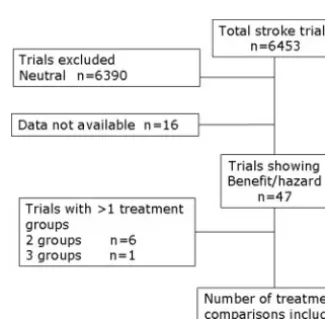
[image:3.594.47.345.64.247.2]A total of 55 comparisons of active versus control treatment (54 173 patients) were included, these comprising individual patient data from 38 trials and summary data extracted from the publications of a further 9 studies; 6 trials had 2 active treatment groups, and 1 had 3 active groups so a further 8 comparisons were available (Figure 2). The data related to 34 acute stroke trials, 7 trials of rehabilitation (1164 patients) and 6 trials of stroke units (1399 patients). BI was used to measure functional outcome in 22 trials, 18 used the mRS, 3 used the 3Q scale, 1 used the Rivermead scale, 2 related trials
Figure 1.Distribution in mRS in the ECASS II trial showing the primary and post hoc analyses.20
Figure 2.Identification of included trials.
1912 Stroke June 2007
at UNIV OF NOTTINGHAM on January 26, 2009 stroke.ahajournals.org
[image:3.594.338.501.570.730.2]FISS-TRIS); nimodipine (INWEST); occupational therapy (Corr, Gilbertson, Logan, TOTAL, Walker); physiotherapy (Young); pro-urokinase (PROACT II); selfotel (ASSIST); streptokinase (ASK, MAST-E, MAST-I); stroke unit (Dover, Helsinki, Kuopio, Nottingham, Orpington, Newcastle); and tirilazad (RANTTAS I & II, STIPAS, TESS I & II). Data relating to 16 trials or interventions which fulfilled the inclusion criteria were not made available.
The method of analyzing functional outcome used in the original trial publication varied considerably, see supplemental Appendix III, available online at http://stroke.ahajournals.org. Twenty-three (48.9%) trials assessed the treatment effect using a method which required the data to be collapsed into groups, eg,2test; 17 (36.2%) used a test based on comparing
medians and 4 (8.5%) used a test which compared means; the remaining trials were unpublished so the method of analysis is not known.
Comparison of Statistical Tests
The statistical tests assessed differed significantly in the results they gave for each trial (2-way ANOVA,P⬍0.0001). The ordering of the tests showed that those which analyze the original ordinal data generally perform better than those which collapse the data intoⱖ2 groups. The most efficient tests included ordinal logistic regression,t test, robust rank test and bootstrapping the difference in mean rank (Table). The subgroup analysis showed the same ordering of tests irrespective of type of intervention (acute, rehabilitation, stroke unit), trial size, time between randomization and onset, patient age, baseline severity, outcome measure, length of follow-up, and trial result (supplemental Appendix IV, avail-able online at http://stroke.ahajournals.org).
When assessed by how many trials were statistically significant, those tests which did not collapse the data into groups again out-performed the other approaches; for exam-ple, ordinal logistic regression (using raw data) gave a statistically significant result in 25.9% of trials, whereas the 2⫻22test comparing death or poor outcome to an excellent
outcome only gave a significant result in 9.3% of the trials (Figure 3).
Test Assumptions and Sensitivity
The statistical assumptions of thettest were not met for the majority of trials, and the assumptions of the ordinal logistic regression analysis failed for 8 of the 55 data sets; in contrast, the assumptions for the other tests were maintained. The sensitivity analysis showed that the top performing statistical tests were not overly sensitive, and statistically significant treatment effects were only found where they truly existed; see supplemental Appendix V, available online at http:// stroke.ahajournals.org, for detailed results.
Discussion
These results show that statistical approaches which analyze the original ordinal data for functional outcome are more efficient than those which work on preprocessed data which has been collapsed intoⱖ2 groups. Interestingly, this point was originally demonstrated mathematically by Shannon in 1948.27In particular, ordinal logistic regression,ttest, robust
ranks test, and bootstrapping (the difference in mean rank) performed well and appear to be useful irrespective of the type of stroke trial, patient or intervention. Although individ-ual tests based on dichotomized data using2 analysis (eg,
“dead/dependent” versus “independent”) were effective for some data sets, they performed poorly in many and therefore cannot be recommended as general solutions for analyzing stroke trials. From an historical perspective, it is quite possible that trials which collapsed mRS or BI in 2 groups may have used a suboptimal analysis, and this may have contributed to false neutral findings in some cases in the past. For example, MAST-E28 and STIPAS24 were neutral as
reported using dichotomous analysis but negative when assessed with ordinal approaches.
Several comments can be made about this study. First, it aimed to include data from all stroke trials assessing a beneficial or harmful intervention. Unfortunately, data were not made available for all identified trials; where possible, we created individual data from publications which provided patient numbers by outcome score. Data were missing for a variety of trial types (acute/rehabilitation/stroke unit) and
Comparison of rank scores for 16 statistical tests; lower ranks imply the test is more efficient. Analysis by two-way ANOVA and Duncan’s multiple compar-ison procedure; tests joined by the same band are not significantly different from each other atP⬍0.05.
sizes, and functional outcome measure (mRS/BI), so it is unlikely that a systematic bias was introduced into the findings; however, the precision of the results may have been attenuated by the missing trials. Second, we did not exhaus-tively search for all possible statistical tests relevant to the problem of analyzing ordered categorical data; instead, we focused on those approaches which are available in standard statistical textbooks and computer packages. Additionally, we could not include some tests used in recent trials, eg, patient specific outcomes29 and Cochran Mantel-Haenszel test,30
because these require access to individual data for both baseline and outcome variables, and these data were not available uniformly. Third, some of the statistical assump-tions underlying the more efficient tests were not met in all trials; for example, the t test assumes data are normally distributed, whereas ordinal logistic regression assumes that any treatment effect is similar across outcome levels (“pro-portionality of odds”, ie, the odds of moving a treated patient from mRS 2 to 1 is similar to that for moving them from 5 to 4). Nevertheless, the robustness of these tests to deviations from their underlying assumptions means that they remain relevant for analyzing functional outcome data from stroke trials.
If alternative approaches to analyzing functional outcome data are to be used in the future, it is pertinent to ask how sample size should be calculated at the trial design stage. Historically, most calculations assumed that functional out-come would be dichotomized and analyzed using a 2 test
approach.13Although future trials could continue to calculate
sample size in the same way (and then gain extra power by analyzing their data using an ordinal approach), specific sample size calculations are available when data are to be analyzed using ordinal logistic regression31 or the t test.
Ideally, the extra power gained by using an ordinal statistical approach should not be used to reduce sample size; stroke trials have been too small in the past, as shown in a recent meta-analysis,13 and this may also have contributed to the
failure of some of them.
A further issue with using a statistical test which analyses ordered categorical data are how to report the results to patients, carers, clinicians, and health-policy makers. The results of dichotomous tests may be summarized easily as the
proportion of patients who benefit (or suffer) with a treat-ment, ie, alteplase reduced absolute death or dependency (mRS⬎1) by 13% in the NINDS part 2 trial.1 In contrast,
ordinal tests will need to be presented as the average absolute improvement in outcome, eg, alteplase improved the mRS by 1 (of 7) point and BI by 22.5 (of 100) points. Alternatively, the combined odds ratio and its confidence intervals would be reported if ordinal logistic regression was used. In this respect, health consumers will need to decide what differ-ences in mRS and BI are worthwhile, both clinically and in terms of health economics. In reality, it is reasonable to present the effect on functional outcome using both abso-lute percentage change and mean or median change in functional outcome score, and show this data graphically (as in Figure 1).
In summary, we suggest that ongoing and future trials should consider using statistical approaches which use the original ordered categorical data in the primary analysis of functional outcome measures. Such ordinal tests include ordinal logistic regression, and the robust ranks test; thettest may also be used although its assumptions were not meant in the majority of trials.
Acknowledgments
Secretariat and writing committee: Philip M.W. Bath (chief investi-gator, Nottingham, UK); Laura J. Gray (lead statistician, Notting-ham, UK); Timothy Collier (statistical advisor, London, UK); Stuart Pocock (statistical advisor, London, UK). Statistical advisor: James Carpenter (Medical Statistics Unit, London School of Hygiene and Tropical Medicine, London, UK).
[image:5.594.49.343.63.247.2]The following contributors provided individual patient data from their trial, and commented on the draft manuscript: Abciximab: H Adams (USA), E. Barnathan (USA); W Hacke (Germany); ASK: G. Donnan (Australia); ASSIST 07 & 10: S. Davis (Australia); ATLANTIS A & B: G. Albers, S. Hamilton (USA); BEST Pilot & Main: D. Barer (UK); Citicoline 1, 7, 10, 18: A. Davalos (Spain); Corr: S. Corr (UK); Dover Stroke Unit: P. Langhorne (UK); DCLHb: P. Koudstaal, R. Saxena (Netherlands); Ebselen: T. Yamaguchi (Japan); ECASS II: W. Hacke, E. Bluhmki (Germany); Factor VII: S. Mayer (USA), K. Begtrup (Denmark); FISS: R. Kay (Hong Kong); FOOD 3: M. Dennis (UK); Gilbertson: L. Gilbertson (UK); INWEST: N.-G. Wahlgren, N. Ahmed (Sweden); IST: P. Sander-cock (UK); Kuopio Stroke Unit: J. Sivenius (Finland); Logan: P. Logan (UK); MAST-I: L. Candelise (Italy), J. Wardlaw (UK); Newcastle Stroke Unit: H. Rodgers (UK); NINDS: J. Marler (USA);
Figure 3.Percentage of trials significant at the 5% level with each statistical test.
1914 Stroke June 2007
at UNIV OF NOTTINGHAM on January 26, 2009 stroke.ahajournals.org
ceutical company. Each collaborator listed above commented on the draft manuscript.
Sources of Funding
L.J.G. is funded, in part, by BUPA Foundation and The Stroke Association (UK). P.M.W.B. is Stroke Association Professor of Stroke Medicine. The funding sources had no involvement in this project.
Disclosures
None.References
1. The National Institute of Neurological Disorders and Stroke rt-PA Stroke Study Group. Tissue plasminogen activator for acute stroke. N Engl J Med.1995;333:1581–1587.
2. CAST (Chinese Acute Stroke Trial) Collaborative Group. CAST: ran-domised placebo-controlled trial of early aspirin use in 20 000 patients with acute ischaemic stroke.Lancet.1997;349:1641–1649.
3. Walker M, Gladman J, Lincoln N, Siemonsma P, Whiteley T. Occupa-tional therapy for stroke patients not admitted to hospital: a randomised controlled trial.The Lancet. 1999;354:278 –280.
4. Chen ZM, Sandercock P, Pan HC, Counsell C, Collins R, Liu LS, Xie JX, Warlow C, Peto R; on behalf of the CAST and IST Collaborative Groups. Indications for early aspirin use in acute ischemic stroke: a combined analysis of 40 000 randomized patients from the chinese acute stroke trial and the international stroke trial.Stroke.2000;31:1240 –1249. 5. Stroke Unit Trialists’ Collaboration. Organised inpatient (stroke unit) care
for stroke.The Cochrane Library.Oxford: Update Software; 2002. 6. The ATLANTIS ECASS and NINDS rt-PA Study Group Investigators.
Association of outcome with early stroke treatment: pooled analysis of ATLANTIS, ECASS, and NINDS rt–PA Stroke trials.The Lancet.2004; 363:768 – 813.
7. Walker MF, Leonardi-Bee J, Bath P, Langhorne P, Corr S, Drummond A, Gilbertson L, Gladman JRF, Jongbloed L, Parker C. An individual patient data meta-analysis of randomised controlled trials of community occu-pational therapy for stroke patients.Stroke. 2004;35:2226 –2232. 8. Saxena R, Wijnhoud AD, Carton H, Hacke W, Kaste M, Przybelski RJ,
Stern KN, Koudstaal PJ. Controlled safety study of a hemoglobin-based oxygen carrier, DCLHB, in acute ischemic stroke. Stroke. 1999;30: 993–996.
9. Davis SM, Lees KR, Albers GW, Diener HC, Markabi S, Karlsson G, Norris J; for the ASSIST Investigators. Selfotel in acute ischemic stroke: possible neurotoxic effects of an NMDA antagonist. Stroke.2000;31: 347–354.
10. Enlimomab acute stroke trial investigators. Use of anti-ICAM-1 therapy in ischemic stroke: results of the enlimomab acute stroke trial.Neurology.
2001;57:1428 –1434.
11. Bath PMW, Blecic S, Bogousslavsky J, Boysen G, Davis S, Diez-Tejedor E, Ferro JM, Gommans J, Hacke W, Indredavik B, Norrving B, Orgogozo
characteristics, and relationship with outcome. Stroke. 2004;35: 1216 –1224.
14. Rankin J. Cerebral vascular accidents in patients over the age of 60. 2. Prognosis.Scott Med J. 1957;2:200 –215.
15. Mahoney FI, Barthel DW. Functional evaluation: The Barthel Index.
Maryland State Medical Journal.1965:61– 65.
16. Lindley RI, Waddell F, Livingstone M, Sandercock P, Dennis MS, Slattery J, Smith B, Warlow C. Can simple questions assess outcome after stroke?Cerebrovascular Diseases. 1994;4:314 –324.
17. Bath P, Lindenstrom E, Boysen G, De Deyn P, Friis P, Leys D, Marttila R, Olsson J-E, O’Neill D, Orgogozo J-M, Ringelstein B, van der Sande J-J, Turpie AGG. Tinzaparin in acute ischaemic stroke (TAIST): a ran-domised aspirin-controlled trial.Lancet. 2001;358:702–710.
18. Horn J, deHaan R, Vermeulen M, Limburg M. Very early nimodipine use in stroke (VENUS): a randomised, double-blind, placebo-controlled trial.
Stroke. 2001;32:461– 465.
19. Wardlaw J, Sandercock P, Warlow C, Lindley RI. Trials of thrombolysis in acute ischemic stroke: does the choice of primary outcome measure really matter?Stroke. 2000;31:1133–1135.
20. Hacke W, Markku K, Fieschi C, von Kummer R, Davalos A, Meier D, Larrue V, Bluhmki E, Davis S, Donnan G, Schneider D, Diez-Tejedor E, Trouillas P. Randomised double-blind placebo-controlled trial of thrombolytic therapy with intravenous alteplase in acute ischaemic stroke (ECASS II).Lancet. 1998;352:1245–1251.
21. Stingele R, Bluhmki E, Hacke W. Bootstrap statistics of ECASS II data: just another post hoc analysis of a negative stroke trial?Cerebrovascular Diseases. 2001;11:30 –33.
22. Haley EC. High-dose tirilazad for acute stroke (RANTTAS II).Stroke. 1998;29:1256 –1257.
23. The RANTTAS Investigators. A randomized trial of tirilazad mesylate in patients with acute stroke (RANTTAS).Stroke.1996;27:1453–1458. 24. The STIPAS Investigators. Safety study of tirilazad mesylate in patients
with acute ischemic stroke (STIPAS).Stroke.1994;25:418 – 423. 25. The Tirilazad International Steering Committee. Tirilazad for acute
ischaemic stroke (cochrane review). Oxford: Update Software; 2002. 26. Barer DH, Cruickshank JM, Ebrahim SB, Mitchell JR. Low dose beta
blockade in acute stroke (“Best” Trial): an evaluation.BMJ. 1988;296: 737–741.
27. Shannon CE. A mathematical therory of communication.The Bell System Technical Journal. 1948;27:379 – 423.
28. The Multicenter Acute Stroke Trial; Europe Study Group. Thrombolytic therapy with Streptokinase in acute ischemic stroke.N Engl J Med.1996; 335:145–149.
29. Adams HP, Leclerc JR, Bluhmki E, Clarke WR, Hansen MD, Hacke W. Measuring outcomes as a function of baseline severity of ischemic stroke.
Cerebrovascular Diseases. 2004;18:124 –129.
30. Lees KR, Zivin JA, Ashwood T, Davalos A, Davis SM, Diener H-C, Grotta J, Lyden P, Shuaib A, Hardernark H-G, Wasiewski WW; for the Stroke-Acute Ischemic NXY Treatment (SAINT I) Trial Investigators. NXY-059 for acute ischemic stroke.N Engl J Med.2006;354:588 – 600. 31. Whitehead J. Sample-size calculations for ordered categorical-data.