Proceedings of the Fourth Conference on Machine Translation (WMT), Volume 3: Shared Task Papers (Day 2) pages 11–28 11
Findings of the WMT 2019 Shared Task on Automatic Post-Editing
Rajen Chatterjee(1), Christian Federmann(2) Matteo Negri(3), Marco Turchi(3)
(1) Apple Inc., Cupertino, CA, USA
(2)Microsoft Cloud+AI, Redmond, WA, USA
(3)Fondazione Bruno Kessler, Trento, Italy
Abstract
We present the results from the5th round of the WMT task on MT Automatic Post-Editing. The task consists in automatically correcting the output of a “black-box” ma-chine translation system by learning from human corrections. Keeping the same gen-eral evaluation setting of the previous four rounds, this year we focused on two lan-guage pairs (German and English-Russian) and on domain-specific data (In-formation Technology). For both the lan-guage directions, MT outputs were pro-duced by neural systems unknown to par-ticipants. Seven teams participated in the
English-German task, with a total of 18 submitted runs. The evaluation, which was performed on the same test set used for the 2018 round, shows further progress in APE technology: 4 teams achieved bet-ter results than last year’s winning sys-tem, with improvements up to -0.78 TER and +1.23 BLEU points over the baseline. Two teams participated in the English-Russiantask submitting 2 runs each. On this new language direction, characterized by a higher quality of the original trans-lations, the task proved to be particularly challenging. Indeed, none of the sub-mitted runs improved the very high re-sults of the strong system used to produce the initial translations (16.16 TER, 76.20 BLEU).
1 Introduction
MT Automatic Post-Editing (APE) is the task of automatically correcting errors in a machine-translated text. As pointed out by (Chatterjee et al., 2015), from the application point of view the
task is motivated by its possible uses to:
• Improve MT output by exploiting informa-tion unavailable to the decoder, or by per-forming deeper text analysis that is too ex-pensive at the decoding stage;
• Cope with systematic errors of an MT system whose decoding process is not accessible;
• Provide professional translators with im-proved MT output quality to reduce (human) post-editing effort;
• Adapt the output of a general-purpose MT system to the lexicon/style requested in a spe-cific application domain.
In its5thround, the APE shared task organized within the WMT Conference on Machine Transla-tion kept the same overall evaluaTransla-tion setting of the previous four rounds. Specifically, the participat-ing systems had to automatically correct the output of an unknown “black box” MT system by learn-ing from human revisions of translations produced by the same system.
difficult language like Russian and only with high-quality NMT output, also this round presented par-ticipants with an increased level of difficulty with respect to the past.
Seven teams participated in the English-German task, submitting 18 runs in total. Two teams participated in the English-Russian task, submitting 2 runs each. Similar to last year, all the teams developed their systems based on neu-ral technology, which confirms to be the state-of-the-art approach to APE. Only in one case, in-deed, a participating team achieved its highest re-sults (but with no improvement over the baseline) with a phrase-based APE system. In most of the cases, participants experimented with the Trans-former architecture (Vaswani et al., 2017), either directly or by adapting it to the task (see Sec-tion 3). Another common trait of the submit-ted systems is the reliance on the consolidasubmit-ted multi-source approach (Zoph and Knight, 2016; Libovick´y et al., 2016), which is able to exploit information from both the MT output to be cor-rected and the corresponding source sentence. The third aspect common to all submissions is the ex-ploitation of synthetic data, either those provided together with the task data (Negri et al., 2018; Junczys-Dowmunt and Grundkiewicz, 2016) or similar, domain-specific resources createdad-hoc by participants.
In the English-German task, the evaluation was performed on the same test set used in 2018, whose “gold” human post-edits were kept undis-closed to participants for the sake of future com-parisons. Evaluating on the same benchmark allowed to observe further technology improve-ments over the past. Last year, the largest gain over the baseline (16.84 TER, 74.73 BLEU) was -0.38 TER (16.46) and +0.8 BLEU (75.53). This year, four teams achieved better results than last year’s best submission. The top-ranked system achieved 16.06 TER (-0.78 with respect to the baseline) and 75.96 BLEU (+1.23). Most notice-ably, the fact that the TER/BLEU differences be-tween the top four primary submissions are not statistically significant indicates that the observed progress is not isolated.
The newly proposed English-Russian task rep-resents a more challenging evaluation scenario, mainly due to the higher quality of the NMT out-put to be corrected. In this case, even the best submission (16.59 TER, 75.27 TER) was unable
to beat the baseline (16.16 TER, 76.20 BLEU). These results confirm one of the main findings of previous rounds (Bojar et al., 2017; Chatterjee et al., 2018a): improving high-quality MT output re-mains the biggest challenge for APE. This moti-vates further research on precise and conservative solutions able to mimic human behaviour by per-forming only the minimum amount of edit opera-tions needed.
2 Task description
In continuity with all the previous rounds of the APE task, participants were provided with train-ing and development data consisttrain-ing of (source, target, human post-edit) triplets, and were asked to return automatic post-edits for a test set of un-seen (source,target) pairs.
2.1 Data
This year, the evaluation was performed on two language pairs, German and English-Russian. For both the subtasks, data were se-lected from the Information Technology (IT) do-main. As emerged from the previous evaluations, the selected target domain is specific and repetitive enough to allow supervised systems to learn from the training set useful correction patterns that are also re-applicable to the test set.
The released training and development sets con-sist of (source,target,human post-edit) triplets in which:
• The source (SRC) is a tokenized English sen-tence;
• The target (TGT) is a tokenized Ger-man/Russian translation of the source, which was produced by a black-box system un-known to participants. For both the lan-guages, translations were obtained from neu-ral MT systems:1 this implies that their over-all quality is generover-ally high, making the task harder compared to previous rounds, which
1
Number of instances
Training Development Test Additional Resources
English-German 13,442 1,000 1,023
eSCAPE-PBSMT: 7,258,533 eSCAPE-NMT: 7,258,533 Artificial: 4.5M
[image:3.595.110.494.60.149.2]English-Russian 15,089 1,000 1,023 eSCAPE-NMT: 7.7 M
Table 1: Data statistics.
focused only (until 2017) or also (as in 2018) on the correction of the output of phrase-based systems.
• The human post-edit (PE) is a manually-revised version of the target, which was pro-duced by professional translators.
Test data consists of (source,target) pairs hav-ing similar characteristics of those in the trainhav-ing set. Human post-edits of the test target instances are left apart to measure system performance.
For theEnglish-Germansubtask, the same in-domain data2collected for last year’s round of the task have been used. The training and develop-ment set respectively contain 13,442 and 1,000 triplets, while the test set consists of 1,023 in-stances. Participants were also provided with two additional training resources, which were widely used in last year’s round. One (called “Artificial” in Table 1) is the corpus of 4.5 mil-lion artificially-generated post-editing triplets de-scribed in (Junczys-Dowmunt and Grundkiewicz, 2016). The other resource is the English-German section of the eSCAPE corpus (Negri et al., 2018). It comprises 14.5 million instances, which were artificially generated both via phrase-based and neural translation (7.25 millions each) of the same source sentences.
For the English-Russian subtask, Microsoft Office localization data have been used. This material, which mainly consists of short seg-ments (menu commands, short messages, etc.), is shared with the English-Russian Quality Estima-tion shared task.3 The training anddevelopment set respectively contain 15,089 and 1,000 triplets, while thetestset comprises 1,023 instances. For this language pair, the eSCAPE corpus has been extended to provide participants with additional
2
Released by the European Project QT21 (Specia et al., 2017).
3http://www.statmt.org/wmt19/qe-task.
html
training material.4
Table 1 provides basic statistics about the data of the two subtasks.
2.1.1 Complexity indicators: repetition rate
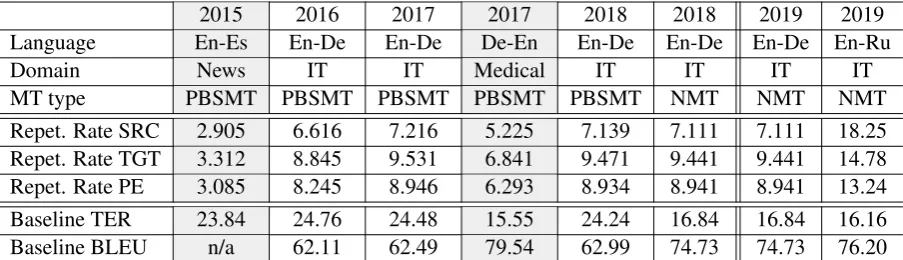
Table 2 provides a view of the data from a task dif-ficulty standpoint. For each dataset released in the five rounds of the APE task, it shows the repeti-tion rate of SRC, TGT and PE elements, as well as the TER (Snover et al., 2006) and the BLEU score (Papineni et al., 2002) of the TGT elements (i.e. the original target translations).
The repetition rate measures the repetitiveness inside a text by looking at the rate of non-singleton n-gram types (n=1...4) and combining them us-ing the geometric mean. Larger values indicate a higher text repetitiveness and, as discussed in (Bo-jar et al., 2016; Bo(Bo-jar et al., 2017; Chatterjee et al., 2018a), suggest a higher chance of learning from the training set correction patterns that are appli-cable also to the test set. In the previous rounds of the task, we considered the large differences in repetitiveness across the datasets as a possible ex-planation for the variable gains over the baseline obtained by participants. In this perspective, the low system performance observed in the APE15 task and in the APE17 German-English subtask was in part ascribed to the low repetition rate in the data. In contrast, much higher repetition rates in the data likely contributed to facilitate the prob-lem in the APE16 task and in the APE17 English-German subtask, in which most of the participants achieved significant gains over the baseline. Al-though in both the APE18 subtasks the repeti-tion rate values were relatively high, evaluarepeti-tion results shown that the influence of data repetitive-ness on final APE performance is marginal. In-deed, while in the last year’s PBSMT subtask the improvements over the baseline were impressive
(-4This newly released artificial dataset and a short
2015 2016 2017 2017 2018 2018 2019 2019 Language En-Es En-De En-De De-En En-De En-De En-De En-Ru
Domain News IT IT Medical IT IT IT IT
MT type PBSMT PBSMT PBSMT PBSMT PBSMT NMT NMT NMT
Repet. Rate SRC 2.905 6.616 7.216 5.225 7.139 7.111 7.111 18.25 Repet. Rate TGT 3.312 8.845 9.531 6.841 9.471 9.441 9.441 14.78 Repet. Rate PE 3.085 8.245 8.946 6.293 8.934 8.941 8.941 13.24
[image:4.595.73.525.62.192.2]Baseline TER 23.84 24.76 24.48 15.55 24.24 16.84 16.84 16.16 Baseline BLEU n/a 62.11 62.49 79.54 62.99 74.73 74.73 76.20 Table 2: Basic information about the APE shared task data released since 2015: languages, domain, type of MT technology, repetition rate and initial translation quality (TER/BLEU of TGT). Grey columns refer to data covering different language pairs and domains with respect to this year’s evaluation round.
6.24 TER, +9.53 BLEU points), in the NMT sub-task (whose data were reused this year) the quality gains were considerably smaller (-0.38 TER and +0.8 BLEU points). As discussed in Section 4.1, also this year we observe a similar situation: espe-cially for English-Russian, the high repetition rate values reported in Table 2, which are the highest ones across all the APE data released so far, are not enough to determine quality improvements com-parable to previous rounds. This suggests that, although it used to play an important role when dealing with lower quality MT output in the first rounds of the APE task, text repetitiveness has less influence on final performance compared to other complexity indicators.
2.1.2 Complexity indicators: MT quality
Indeed, another important aspect that determines the difficulty of APE is the initial quality of the MT output to be corrected. This can be measured by computing the TER (↓) and BLEU (↑) scores (last two rows in Table 2) using the human post-edits as reference.
As discussed in (Bojar et al., 2017; Chatterjee et al., 2018a), numeric evidence of a higher quality of the original translations can indicate a smaller room for improvement for APE systems (having, at the same time, less to learn during training and less to correct at test stage). On one side, in-deed, training on good (or near-perfect) automatic translations can drastically reduce the number of learned correction patterns. On the other side, testing on similarly good translations can drasti-cally reduce the number of corrections required and the applicability of the learned patterns, thus making the task more difficult. As observed in the previous APE evaluation rounds, there is a noticeable correlation between translation quality
and systems’ performance. In 2016 and 2017, on English-German data featuring a similar level of quality (24.76/24.48 TER, 62.11/62.49 BLEU), the top systems achieved significant improvements over the baseline (-3.24 TER and +5.54 BLEU in 2016, -4.88 TER and +7.58 BLEU in 2017). In 2017, on higher quality German-English data (15.55 TER, 79.54 BLEU), the observed gains were much smaller (-0.26 TER, +0.28 BLEU). In 2018, the correction of English-German transla-tions produced by a phrase-based system (24.24 TER, 62.99 BLEU) yielded much larger gains (up to -6.24 TER and +9.53 BLEU) compared to the correction of higher-quality neural transla-tions (16.84 TER, 74.73 BLEU), which resulted in TER/BLEU variations of less than 1.00 point. As discussed in Section 4, also this year’s results confirm the strict correlation between the quality of the initial translations and the actual potential of APE.
2.1.3 Complexity indicators: TER distribution
Further indications about the difficulty of the two subtasks are provided by Figures 1 and 2, which plot the TER distribution for the items in the two test sets. As shown in Figure 1, the distribution for English-German is quite skewed towards low TER values, with almost 50% of the test test items having a TER between 0 and 10 that indicates their very high quality (in other terms, they re-quire few edits). In particular, the proportion of “perfect” test instances having TER=0 (i.e. items that should not be modified by the APE systems) is quite high (25.2% of the total).5 For these test
5This value is considerably lower than the proportion
Figure 1: TER distribution in theEnglish-German test set
Figure 2: TER distribution in theEnglish-Russian test set
items, any correction made by the APE systems will be treated as unnecessary and penalized by automatic evaluation metrics. This problem calls for conservative and precise systems able to prop-erly fix errors only in the remaining test items, leaving the “perfect” ones unmodified.
Data skewedness is exacerbated in the English-Russian test set, in which 63.5% of the instances have a TER between 0 and 10 (in particular, 61.4% of them are perfect translations). Together with the high BLEU score, this contributes to make the English-Russian task considerably more difficult compared to the English-German one (as well as compared to most of the APE test sets released so far).
As discussed in Section 4, also this year’s evalu-ation results confirm the strict correlevalu-ation between the quality of the initial translations and the actual potential of APE.
2.2 Evaluation metrics
System performance was evaluated both by means of automatic metrics and manually. Automatic metrics were used to compute the distance be-tween automatic and human post-edits of the machine-translated sentences present in the test sets. To this aim, TER and BLEU (case-sensitive) were respectively used as primary and secondary evaluation metrics. Systems were ranked based on the average TER calculated on the test set by using the TERcom6software: lower average TER scores correspond to higher ranks. BLEU was com-puted using the multi-bleu.perl package7available
6
http://www.cs.umd.edu/˜snover/tercom/
7https://github.com/moses-smt/
mosesdecoder/blob/master/scripts/
in MOSES.
Manual evaluation was conducted via source-based direct human assessment (Graham et al., 2013; Cettolo et al., 2017; Bojar et al., 2018) as implemented by Appraise (Federmann, 2012). Details are discussed in Section 6.
2.3 Baseline
In continuity with the previous rounds, the official baseline results were the TER and BLEU scores calculated by comparing the raw MT output with the human post-edits. In practice, the baseline APE system is a “do-nothing” system that leaves all the test targets unmodified. Baseline results, the same shown in Table 2, are also reported in Tables 4 and 5 for comparison with participants’ submissions.8
For each submitted run, the statistical signif-icance of performance differences with respect to the baseline was calculated with the bootstrap test (Koehn, 2004).
3 Participants
Seven teams submitted a total of 18 runs for the English-German subtask. Two of them partici-pated also in the English-Russian subtask by
sub-generic/multi-bleu.perl
8
ID Participating team
ADAPT DCU ADAPT Centre & Dublin City University, Ireland (Shterionov et al., 2019) FBK Fondazione Bruno Kessler, Italy (Tebbifakhr et al., 2019)
POSTECH Pohang University of Science and Technology, South Korea (Lee et al., 2019) UDS Saarland University, Germany (Xu et al., 2019)
UNBABEL Unbabel, Portugal (Lopes et al., 2019)
USAAR DFKI Saarland University & German Research Center for Artificial Intelligence, Germany (Pal et al., 2019) IC USFD Imperial College London & University of Sheffield, United Kingdom
Table 3: Participants in the WMT19 Automatic Post-Editing task.
mitting 2 runs each. Participants are listed in Ta-ble 3, and a short description of their systems is provided in the following.
ADAPT Centre & Dublin City University.
The ADAPT DCU team participated in both the subtasks proposed this year. Their submissions pursue two main objectives, namely: i) investi-gating the effect of adding extra information in the form of prefix tokens in a neural APE sys-tem; andii)assessing whether an SMT-based ap-proach can be effective for post-editing NMT out-put. The neural APE system exploits a multi-source approach based on Marian-NMT.9 Train-ing data were augmented with two types of extra context tokens that identify partitions of the train-ing set that may be relevant to guide system’s be-haviour (i.e. to identify features in the dataset with a very close relation to the editing patterns the system is supposed to learn). Such partitions are based on sentence length and topic information. Hence, the prepended tokens respectively state the data partition based on the number of source to-kens and the topic induced via LDA clustering (Blei et al., 2003). The statistical APE models, which are based on Moses (Koehn et al., 2007), were trained to explore the idea of interleaving different MT technologies to improve NMT out-put quality. All the models are built by taking advantage of both the released training material and the provided artificial data (Negri et al., 2018; Junczys-Dowmunt and Grundkiewicz, 2016).
Fondazione Bruno Kessler. Also FBK partici-pated in both the subtasks. Their submissions fo-cus on mitigating the “over-correction” problem in APE, that is the systems’ tendency to rephrase and correct MT output that is already acceptable, thus producing translations that will be penalized by evaluation against human post-edits. Following (Chatterjee et al., 2018b), the underlying idea is that over-correction can be prevented by
inform-9https://marian-nmt.github.io/
ing the system about the predicted quality of the MT output or, in other terms, the expected amount of corrections needed. The proposed solution is based on prepending a special token to the source text and the MT output, so to indicate the re-quired amount of post-editing. Three different to-kens are used, namely “no post-edit” (no edits are required), “light post-edit” (minimal edits are re-quired), and “heavy post-edit” (a large number of edits are required. At training time, the instances are labelled based on the TER computed between the MT output and its post-edited version, with the boundary between light and heavy post-edit set to TER=0.4 based on the findings reported in (Turchi et al., 2013; Turchi et al., 2014). At test time, to-kens are predicted with two approaches. One is based on a classifier obtained by fine-tuning BERT (Devlin et al., 2018) on the in-domain data. The other approach exploits a retrieval-based method similar to (Farajian et al., 2017): given a query containing the source and the MT output to be post-edited, it:i)retrieves similar triplets from the training data,ii)ranks them based on the sentence level BLEU score between the MT output and the post-edit, and iii) creates the token based on the TER computed between the MT output and the post-edit of the most similar triplet. The back-bone architecture is the multi-source extension of Transformer (Vaswani et al., 2017) described in (Tebbifakhr et al., 2018), which is trained both on the task data and on the available artificial corpora.
Pohang University of Science and Technology.
atten-tion between the decoder state and the two outputs of the encoder. Therefore, four different model variants were suggested in terms of the existence of the encoder future mask and the type of the multi-source attention layer in the decoder. The eSCAPE corpus (Negri et al., 2018) was filtered to contain similar statistics as the official training dataset. During training, various teacher-forcing ratios were adjusted to alleviate the exposure bias problem. After training four variants with vari-ous teacher-forcing ratios, the final submissions were obtained from an ensemble of models. These are: 1) the primary submission that ensembles the variants with the two best TER scores in each ar-chitecture, 2) the contrastive submission that en-sembles the variants with the best TER scores in each architecture, 3) the contrastive submission that ensembles two variants from each architec-ture, achieving the best TER and BLEU, respec-tively.
Saarland University. UdS’s participation (English-German subtask) is based on a multi-source Transformer model for context-level machine translation (Zhang et al., 2018) imple-mented with the Neutron implementation (Xu and Liu, 2019) for the Transformer translation model (Vaswani et al., 2017). To improve the robustness of the training, and inspired by (Cheng et al., 2018), the APE task is jointly trained with the de-noising encoder task, which adds noises distribution directly to the post-editing results’ embedding as machine translation outputs and tries to recover the original post-editing results. Both Gaussian noise and uniform noise were tried for the de-noising encoder task. The synthetic eSCAPE corpus (Negri et al., 2018) was also used for the training. Contrastive submissions were generated with the best averaged models of 5 adjacent checkpoints of 2 kinds of noise, and the primary submission is obtained with the ensemble of 5 models (4 averaged models + 1 model saved for every training epoch).
Unbabel. Following (Correia and Martins, 2019), Unbabel’s submission (English-German subtask) adapts BERT (Devlin et al., 2018) to the APE task with an encoder-decoder framework. The system consists in a BERT encoder ini-tialised with the pretrained model’s weights and a BERT decoder initialised analogously, where the multi-head context attention is initialised with
the self-attention weights. Additionally, source embeddings, target embeddings and projection layer (Press and Wolf, 2017) are shared, as well as the self-attention weights of the encoder and decoder. The system exploits BERT training schedule with streams A and B: the encoder receives as input both the source and the MT output separated by the special symbol “[SEP]”, assigning to the first “A” segment embeddings and to the latter “B” segment embeddings. Regarding the BERT decoder, they use just the post-edit with “B” segment embeddings. In addition, as the NMT system has a strong in-domain performance, a conservativeness factor to avoid over-correction is explored. Similarly to (Junczys-Dowmunt and Grundkiewicz, 2016), a penalty is added during beam decoding (logits or log probabilities) to constrain the decoding to be as close as possible to the input – both the source and the MT output are considered, which allows to copy from the source – in order to avoid over edition of the MT segment. This penalty is tuned over the development set. In addition to the shared task in-domain data, system training exploits a variant of the eSCAPE corpus built on a closer in-domain parallel corpus (IT domain) provided by the Quality Estimation shared task.
Saarland University & German Research Cen-ter for Artificial Intelligence. USAAR DFKI’s participation (English-German subtask) is based on a multi-encoder adaptation of the Transformer architecture. The system consists in: i)a Trans-former encoder block for the source sentence, fol-lowed by ii) a Transformer decoder block, but without masking, for self-attention on the MT seg-ment, which effectively acts as second encoder combining source and MT output, and iii) feeds this representation into a final decoder block gen-erating the post-edit. The intuition behind the pro-posed architecture is to generate better represen-tations via both self- and cross- attention and to further facilitate the learning capacity of the feed-forward layer in the decoder block. Also in this case, model training takes advantage of the eS-CAPE synthetic data (Negri et al., 2018).
Tensor2Tensor (Vaswani et al., 2017) toolkit. The model was enriched with a copying mechanism that prevents unnecessary corrections. In addi-tion to the main training data, the primary sub-mission uses the EN-DE eSCAPE data (Negri et al., 2018). The contrastive submission uses data triplets where source and target are genuine data, and MT is a modified target (200K). This modified target mimics MT by simulating errors in the task training data. Sentences where error simulation is possible are selected from in-domain corpora (eS-CAPE, as well as the in-domain data released with the WMT18 Quality Estimation task).
4 Results
Participants’ results are shown in Tables 4 (English-German) and 5 (English-Russian). The submitted runs are ranked based on the average TER (case-sensitive) computed using human post-edits of the MT segments as reference, which is the APE task primary evaluation metric (“TER (pe)”). The two tables also report the BLEU score com-puted using human post-edits (“BLEU (pe)” col-umn), which represents our secondary evaluation metric. These results are discussed in Section 4.1. Table 4 includes four additional columns, which show the TER/BLEU scores computed using ex-ternal references (“TER (ref)” and “BLEU (ref)”) as well as the multi-reference TER/BLEU scores computed using human post-edits and external ref-erences (“TER (pe+ref)” and “BLEU (pe+ref)”). In Section 4.2, these figures are respectively used to discuss systems’ capability to reflect the post-editing style of the training data and their tendency to produce unnecessary corrections of acceptable MT output. Since external references are available only for German, this analysis was not feasible for the English-Russian task.
4.1 Automatic metrics computed using human post-edits
Different from the past, this year the primary (“TER (pe)”) and secondary evaluation metric (“BLEU (pe)”) produce slightly different rank-ings.10 For English-German, system results are quite close to each other, up to the point that i) TER differences between the top eight submis-sions are not statistically significant andii)all the
10The correlation between the ranks obtained by the two
metrics is 0.97 for the English-German subtask and 0.7 for the English-Russian subtask.
submissions with a TER score equal or lower than the baseline are concentrated in a performance in-terval of less than 0.8 TER points and less than 1.2 BLEU points. This compression can contribute to explain the ranking differences, especially at higher ranks where discriminating between strong systems with almost identical performance is par-ticularly difficult. However, for the sake of fu-ture analysis or alternative views of this year’s out-comes, it’s worth remarking that the2nd,3rd and
5th runs in terms of TER (all by the same team –POSTECH) respectively represent the top three submissions in terms of BLEU.
For English-Russian, the distance between the top and the worst submissions is larger, but also in this case the BLEU-based ranking is not identical to the TER-based one. Though with a negligible margin, the worst run in terms of TER would rank
2ndin terms of BLEU.
English-German subtask. In order to measure the progress with respect to last year’s round of the APE task, for this language pair the evaluation has been performed with the same data used for the NMT subtask in 2018. Last year, the majority of the participants’ scores fell in a range of less than one TER/BLEU point improvement over the do-nothing baseline (16.84 TER, 74.73 BLEU), be-ing 16.46 TER (-0.38) and 75.53 BLEU (+0.8) the scores and the corresponding quality gains achieved by the top submission. This year, eight submissions achieved a TER reduction larger than 0.4 points and a BLEU increase of more than 0.9 points. The top submission, in particular, obtained improvements up to -0.78 TER and +1.23 BLEU points over the baseline. Although correcting the output of a neural MT system still proves to be quite hard, we take the fact that 4 teams achieved better results than last year’s winning system as an indicator of technology advancements.
lan-TER BLEU TER BLEU TER BLEU
ID (pe) (pe) (ref) (ref) (pe+ref) (pe+ref)
UNBABEL Primary 16.06* 75.96 41.66 44.95 15.58 78.1 POSTECH Primary 16.11* 76.22 42.04 44.57 15.68 78.08 POSTECH Contrastive (var2Ens8) 16.13* 76.21 42.09 44.53 15.73 78.05 USAAR DFKI Primary 16.15* 75.75 41.84 44.65 15.69 77.84 POSTECH Contrastive (top1Ens4) 16.17* 76.15 42.09 44.52 15.74 78.01 UNBABEL Contrastive (2) 16.21* 75.7 41.59 45.08 15.72 77.98 UNBABEL Contrastive (1) 16.24* 75.7 41.62 45.01 15.76 77.97 FBK Primary 16.37* 75.71 42.18 44.39 15.90 77.54 FBK Contrastive 16.61† 75.28 42.12 44.49 16.1 77.43 UDS Primary 16.77† 75.03 42.64 43.78 16.34 76.83 IC USFD Contrastive 16.78† 74.88 42.45 44.01 16.31 76.82 UDS Contrastive (Gaus) 16.79† 75.03 42.55 44.0 16.33 76.87 UDS Contrastive (Uni) 16.80† 75.03 42.66 43.79 16.37 76.85 IC USFD Primary 16.84† 74.8† 42.58 43.86 16.41 76.68
Baseline 16.84 74.73 42.24 44.2 16.27 76.83
[image:9.595.71.501.61.350.2]ADAPT DCU Contrastive (SMT) 17.07 74.3 42.40 44.14 16.54 76.36 ADAPT DCU Primary 17.29 74.29 42.41 44.09 16.81 76.51 USAAR DFKI Contrastive 17.31 73.97 42.45 43.71 16.87 76.06 ADAPT DCU Contrastive (LEN) 17.41 74.01 42.44 44.01 16.91 76.2
Table 4: Results for the WMT19 APEEnglish-German subtask– average TER (↓), BLEU score (↑). The symbol “*” indicates results differences between runs that are not statistically significant. The symbol “†” indicates a difference from the MT baseline that is not statistically significant.
TER BLEU
ID (pe) (pe)
Baseline 16.16 76.2
ADAPT DCU Contrastive 16.59 75.27 ADAPT DCU Primary 18.31 72.9 FBK Primary 19.34 72.42 FBK Contrastive 19.48 72.91
Table 5: Results for the WMT19 APEEnglish-Russian subtask– average TER (↓), BLEU score (↑).
guage like Russian is problematic not only for MT but also from the APE standpoint. Under similar data conditions (the training sets of the two sub-tasks differ by∼1,650 instances), the training set of a morphology-rich language is likely to be more sparse compared to other languages. The other possible explanation lies in the higher quality of the original translations (our second complexity indicator discussed in Section 2.1.2), which re-duces the room for improvement with APE and, at the same time, increases the possibility to dam-age MT output that is already correct. From the MT quality point of view, according to the base-line results shown in Table 2, the English-Russian dataset used for this year’s campaign is the second most difficult benchmark released in five rounds of the APE task. Also the TER distribution of the test set instances (our third complexity
[image:9.595.197.399.395.486.2]of participants. Likely, poor results observed on the development set during system development (i.e. the difficulty to beat thedo-nothingbaseline) discouraged other potential participants.
4.2 Automatic metrics computed using external references
By learning from (SRC, TGT, PE) triplets, APE systems’ goal is to perform a “monolingual trans-lation” from raw MT output into its correct ver-sion. In this translation process, the same sentence can be corrected in many possible ways that make the space of possible valid outputs potentially very large. Ideally, from this space, APE systems should select solutions that reflect as much as pos-sible the post-editing style of the training data (in real-use settings, this can be the style/lexicon of specific users, companies, etc.). However, noth-ing prevents to end up with outputs that partially satisfy this constraint. In light of these consid-erations, TER and BLEU scores computed using human post-edits as reference represent a reliable measure of quality but:
1. They provide us with partial information on how systems’ output reflects the post-editing style of the training data;
2. They are not informative at all about the amount of valid corrections that are not present in the human post-edits.
In order to shed light on these aspects, in previ-ous rounds of the task, further analysis was per-formed by taking advantage of reference trans-lations. In continuity with the past, in Sections 4.2.1 and 4.2.2 we re-propose this analysis for the English-German subtask, the only one for which external references are available.
4.2.1 Output style
To gain further insights on point 1. (i.e. sys-tem’s capability to learn the post-editing style of the training data), the “TER (ref)” and “BLEU (ref)” columns in Table 4 show the TER and BLEU scores computed against independent refer-ence translations. The rational behind their com-putation is that differences in TER/BLEU(pe) and TER/BLEU(ref) can be used as indicators of the “direction” taken by the trained models (i.e. ei-ther towards humans’ post-editing style or to-wards a generic improvement of the MT output).
Since independent references are usually very dif-ferent from conservative human post-edits of the same TGT sentences, all the TER/BLEU scores measured using independent references are ex-pected to be worse. However, if our hypothe-sis holds true, visible differences in the baseline improvements measured with TER/BLEU(pe) and TER/BLEU(ref) should indicate system’s ability to model the post-editing style of the training data. In particular, larger gains measured with TER/BLEU(pe) will be associated to this desired ability.
As can be seen in Table 4, systems’ results on English-German show this tendency. Look-ing at the improvements over the baseline, those measured by computing TER and BLEU scores against human post-edits (i.e. TER/BLEU(pe)) are often larger than those computed against indepen-dent references (i.e. TER/BLEU(ref)). In terms of TER, this holds true for most of the submitted runs, with the best system that shows a difference of 0.2 TER points in the gains over the baseline computed with TER(pe) (-0.78) and those com-puted with TER(ref) (-0.58). On average, for the runs achieving improvements over the baseline, the difference in the gains over the baseline com-puted with TER(pe) and TER(ref) is respectively -0.41 and -0.08. In terms of BLEU, the differ-ences are more visible. The best system improves over the baseline by 1.23 points with BLEU(pe) and 0.75 points with BLEU(ref), while the aver-age difference in the gains over the baseline is 0.8 with BLEU(pe) and 0.2 with BLEU (ref). The larger (0.32/0.6) average improvements over the baseline observed with TER/BLEU computations against human post-edits can be explained by sys-tems’ tendency to reflect the post-editing style of the training data.
4.2.2 Over-corrections
“over-correction”). APE corrections of a given MT out-put can indeed be of different types, namely: i) correct edits of a wrong passage, ii) wrong ed-its of a wrong passage,iii)correct edits of a cor-rect passage andiv)wrong edits of a correct pas-sage. TER/BLEU scores computed against hu-man post-edits work reasonably well in captur-ing cases i)-ii) by matching APE systems’ out-put with human post-edits: for wrong MT outout-put passages (i.e. those changed by the post-editor), they inform us about the general quality of auto-matic corrections (i.e. how close they are to the post-editor’s actions). Cases iii)-iv), in contrast, are more problematic since any change performed by the system to a correct passage (i.e. those that were not changed by the post-editor) will al-ways be penalized by automatic comparisons with human post-edits. Although discriminating be-tween the two types of unnecessary corrections is hard, we hypothesize that a comparison between TER/BLEU(pe) and TER/BLEU(pe+ref) can be used as a proxy to quantify those belonging to type iii). In general, due to the possibility to match more and longer n-grams in a multi-reference set-ting, TER/BLEU(pe+ref) scores are expected to be higher than TER/BLEU(pe) scores. However, if our hypothesis holds true, visible differences in the increase observed for the baseline and for the sys-tems should indicate syssys-tems’ tendency to produce acceptable over-corrections (typeiii)). In particu-lar, larger gains observed for the APE systems will be associated to their over-correction tendency to-wards potentially acceptable edits that should not be penalized by automatic evaluation metrics.
As expected, Table 4 shows that, on English-German data, multi-reference evaluation against post edits and external references (TER/BLEU(pe+ref)) yields better results compared to single reference evaluation with post-edits only (TER/BLEU(pe)). The variations of the do-nothing baseline are -0.57 TER (from 16.84 to 16.27) and 2.1 BLEU (from 74.73 to 76.83) points. In contrast, systems’ scores vary by -0.46 TER and +2.01 BLEU points on average. In comparison with the larger variation observed for the baseline, this indicates that, for most of the submissions, the multi-reference evaluation does not indicate a tendency to produce unnecessary but acceptable corrections. On a positive note, while last year this was true for all the systems, this year four runs perform slightly better than
the baseline in terms of BLEU(pe+ref). Though minimal, these differences suggest that a certain amount of corrections made by the top systems still represent acceptable modifications of the original translations.
5 System/performance analysis
As a complement to global TER/BLEU scores, also this year we performed a more fine-grained analysis of the changes made by each system to the test instances.
5.1 Macro indicators: modified, improved and deteriorated sentences
Tables 6 and 7 show the number of modified, im-proved and deteriorated sentences, respectively for the English-German and the English-Russian sub-tasks. It’s worth noting that, as in the previous rounds and in both the settings, the number of sen-tences modified by each system is higher than the sum of the improved and the deteriorated ones. This difference is represented by modified sen-tences for which the corrections do not yield TER variations. This grey area, for which quality im-provement/degradation can not be automatically assessed, contributes to motivate the human eval-uation discussed in Section 6.
Systems Modified Improved Deteriorated UNBABEL Primary 366 (35.78%) 187 (51.09%) 110 (30.05%) POSTECH Primary 207 (20.23%) 127 (61.35%) 41 (19.81%) POSTECH Contrastive (var2Ens8) 210 (20.53%) 125 (59.52%) 45 (21.43%) USAAR DFKI Primary 301 (29.42%) 157 (52.16%) 83 (27.57%) POSTECH Contrastive (top1Ens4) 213 (20.82%) 125 (58.69%) 47 (22.07%) UNBABEL Contrastive (2) 400 (39.1%) 202 (50.50%) 121 (30.25%) UNBABEL Contrastive (1) 393 (38.42%) 195 (49.62%) 117 (29.77%) FBK Primary 200 (19.55%) 115 (57.50%) 50 (25.00%) FBK Contrastive 363 (35.48%) 164 (45.18%) 131 (36.09%) UDS Primary 96 (9.38%) 42 (43.75%) 36 (37.50%) IC USFD Contrastive 41 (4.01%) 21 (51.22%) 16 (39.02%) UDS Contrastive (Gaus) 125 (12.22%) 54 (43.20%) 51 (40.80%) UDS Contrastive (Uni) 112 (10.95%) 49 (43.75%) 41 (36.61%) IC USFD Primary 72 (7.04%) 29 (40.28%) 35 (48.61%) ADAPT DCU Contrastive (SMT) 120 (11.73%) 29 (24.17%) 61 (50.83%) ADAPT DCU Primary 368 (35.97%) 116 (31.52%) 169 (45.92%) USAAR DFKI Contrastive 391 (38.22%) 135 (34.53%) 168 (42.97%) ADAPT DCU Contrastive (LEN) 354 (34.60%) 101 (28.53%) 169 (47.74%)
Table 6: Number of test sentences modified, improved and deteriorated by each run submitted to theEnglish-German subtask.
Systems Modified Improved Deteriorated ADAPT DCU Contrastive 92 (8.99%) 17 (18.48%) 49 (53.26%) ADAPT DCU Primary 245 (23.95%) 57 (23.27%) 130 (53.06%) FBK Primary 147 (14.37%) 49 (33.33%) 67 (45.58%) FBK Contrastive 26 (2.54%) 5 (19.23%) 18 (69.23%)
Table 7: Number of test sentences modified, improved and deteriorated by each run submitted to theEnglish-Russian subtask.
consequence, the percentage of deteriorated sen-tences out of the total amount of modified test items shows a significant drop. On average, a quality decrease is observed for 35.11% of the test items, while last year the average was 47.85%.
English-Russian subtask. As shown in table 7, also in this subtask the amount of sentences mod-ified by the submitted systems varies considerably and does not correlate with systems’ ranking. On average, the proportion of modifications is 12.46% (much less compared to the English-German sub-task). With values ranging from 2.54% to 23.95%, all the four runs are far from the expected value of 38.6% modifications (recall that 61.4% of the test items are perfect translations). Systems’ precision is also lower compared to the English-German task. The average proportion of improved sen-tences is 23.58%, while the deteriorated ones are on average 55.28%, thus confirming the higher difficulty of the English-Russian evaluation set-ting.
Overall, the analysis confirms that correct-ing high-quality translations still remains a hard
task, especially when dealing with higher-quality English-Russian outputs. On one side, systems’ low precision is an evident limitation. On the other side, one possible explanation is that the margins of improvement to the input sentences are reduced to types of errors (e.g. lexical choice) on which APE systems are less reliable. The analysis pro-posed in Section 5.2 aims to explore also this as-pect.
5.2 Micro indicators: edit operations
(a) (b)
Figure 3: System behaviour (primary submissions) forEnglish-German(a) andEnglish-Russian(b) – TER(MT, APE)
For both the subtasks, the differences in sys-tem’s behaviour are indeed barely visible, mainly due to the fact that, in most of the cases, the submitted neural APE models implement sim-ilar solutions (multi-source, Transformer-based models trained with the same in-domain and ar-tificial corpora). All the submitted runs are characterized by a large number of substitu-tions (on average, 53.6% for English-German and 59.7% for English-Russian), followed by the deletions (22.6% for English-German and 26.4% for English-Russian), the insertions (respectively 16.3% and 9.4%) and finally the shifts (7.4% and 4.5%). These results are in line with previous find-ings. Also in 2018, for instance, the high fluency of neural translations induced the trained models to perform few reordering operations leaving lex-ical choice as a main direction of improvement, as suggested by the larger amount of substitutions performed by all the systems.
6 Human evaluation
In order to complement the automatic evaluation of APE submissions, a manual evaluation of the primary systems submitted (seven for English-German, five for English-Russian) was conducted. Similarly to the manual evaluation carried out for last year APE shared task, it was based on the direct assessment (DA) approach (Graham et al., 2013; Graham et al., 2017). In this Section, we present the evaluation procedure as well as the re-sults obtained.
6.1 Evaluation procedure
The manual evaluation carried out this year in-volved 32 native German speakers with full pro-fessional proficiency in English. All annotators
were paid consultants, sourced by a linguistic ser-vice provider company. Each evaluator had expe-rience with the evaluation task through previous work using the same evaluation platform in order to be familiar with the user interface and its func-tionalities. A screenshot of the evaluation inter-face is presented in Figure 4.
We measure post-editing quality using source-based direct assessment(src-DA), as implemented in Appraise (Federmann, 2012). Scores are col-lected asx∈ [0,100], focusing on adequacy (and not fluency, which previous WMT evaluation cam-paigns have found to be highly correlated with ad-equacy direct assessment results).
The original DA approach (Graham et al., 2013; Graham et al., 2014) is reference-based and, thus, needs to be adapted for use in our paraphrase as-sessment and translation scoring scenarios. Of course, this makes translation evaluation more dif-ficult, as we require bilingual annotators. Src-DA has previously been used, e.g., in (Cettolo et al., 2017; Bojar et al., 2018).
Direct assessment initializes mental context for annotators by asking a priming question. The user interface shows two sentences:
- the source (src-DA, reference otherwise); and
- the candidate output.
Figure 4: Screenshot of the direct assessment user interface.
Eval mode Priming question used
Post-editing How accurately does the above candidate text convey the original semantics of the source text? adequacy Slider ranges fromNot at all(left) toPerfectly(right).
Table 8: Priming question used for human evaluation of post-editing adequacy.
For adequacy, we ask annotators to assess se-mantic similarity between source and candidate text, labeled as “source text” and “candidate trans-lation”, respectively. The annotation interface im-plements a slider widget to encode perceived sim-ilarity as a value x ∈ [0,100]. Note that the ex-act value is hidden from the human, and can only be guessed based on the positioning of the slider. Candidates are displayed in random order, pre-venting bias.
For our human evaluation campaign, we also include human post-editing output (test.tok.pe) and unedited, neural ma-chine translation output (test.tok.nmt). We expect human post-editing to be of higher quality than output from automatic post-editing submissions, which in turn should outperform unedited, neural machine translation output.
6.2 Human Evaluation results
English-German subtask. Score convergence over time for English-German assessments is pre-sented in Figure 5. This figure tracks average sys-tem adequacy (as measured by Src-DA) over time, as assessments come in from human annotators. Note that we use the so-calledalternate HIT lay-out as named in the WMT18 findings paper, us-ing an 88:12 split between actual assessments and those reserved for quality control. All annotators have proven reliable, passing qualification tests.
The results of Src-DA for the English-German subtask are presented in Table 9. Our main find-ings are as follows:
• Human post-editing outperforms all auot-matic post-editing systems, the quality differ-ence is significant;
• UNBABEL achieves best APE performance;
• USAAR DFKI comes in second;
• POSTECH comes in third;
• All but one APE systems outperform unedited NMT output;
• Difference to the remaining APE system is not statistically significant.
Human evaluation does only result in very coarse result cluster. Thus, in order to order sub-missions by their respective post-editing quality, as perceived by human annotators, we also present win-based resultsin Table 10.
Figure 5: Score convergence over time for English-German assessments.
# Systems Ave % Avez
1 Human post-edit 90.39 0.154 2 UNBABEL 88.87 0.056 USAAR DFKI 88.45 0.027 POSTECH 88.11 -0.006
FBK 88.05 -0.014
ADAPT DCU 87.70 -0.037
UDS 87.54 -0.043
NMT output 87.35 -0.054 IC USFD 87.31 -0.059 Table 9: DA Human evaluation results for the English-German subtaskin terms of average raw DA (Ave %) and average standardized scores (Avez). Dashed lines between systems indicate clusters according to Wilcoxon signed-rank test at p-levelp≤0.05.
7 Conclusion
We presented the results from the fifth shared task on Automatic Post-Editing. This year, we pro-posed two subtasks in which the neural MT out-put to be corrected was respectively generated by an German system and by an English-Russian system. Both the subtasks dealt with data drawn from the information technology domain. Seven teams participated in the English-German task, with a total of 18 submitted runs, while two teams participated in the English-Russian task submitting two runs each. Except in one case
# Systems Wins Ave % Avez
1 Human post-edit 8 90.39 0.154
2 UNBABEL 4 88.87 0.056
3 USAAR DFKI 3 88.45 0.027
4 POSTECH 1 88.11 -0.006
5 FBK 0 88.05 -0.014
ADAPT DCU 0 87.70 -0.037
UDS 0 87.54 -0.043
NMT output 0 87.35 -0.054 IC USFD 0 87.31 -0.059 Table 10: DA Human evaluation results for the English-German subtaskin terms of average raw DA (Ave %) and average standardized scores (Avez). Dashed lines between systems indicate clusters according to number of wins.
(a contrastive run produced with a phrase-based system), the submissions are based on neural ap-proaches, which confirm to be the state-of-the-art in APE. Most of them rely on multi-source mod-els built upon the Transformer and trained by tak-ing advantage of the synthetic corpora released as additional training material.
[image:15.595.82.276.381.520.2] [image:15.595.306.527.381.519.2]shown by: i)the top result (-0.78 TER and +1.23 BLEU points over the baseline), which is signif-icantly better than last year (-0.38 TER and +0.8 BLEU), andii)the fact that four teams achieved higher results than last year’s winning system.
The newly proposed English-Russian subtask proved to be more challenging. None of the sub-mitted runs was able to beat the baseline, whose high TER (16.16) and BLEU (76.2) indicate a very high quality of the initial translations. This is also confirmed by the very skewed TER distribution of the test set items. With more than 60.0% of the translations with TER=0 (the highest value across all the APE datasets released so far), the chance of damaging a perfect MT output is extremely high. Despite the high repetition rate of the English-Russian data (also in this case, the highest across all datasets), the difficulty of handling such a high level of quality contributes to explain the lower re-sults achieved by the two participating teams.
Overall, also this year the main open problem remains to mitigate systems’ tendency towards over-correction. In light of the steady progress of NMT technology, handling increasingly better translations calls for conservative and precise so-lutions able to avoid the unnecessary modification of correct MT output.
Acknowledgments
We would like to thank Apple and Microsoft for their support and sponsorship in organizing the 2019 APE shared task. We are also particularly grateful to the anonymous Appraise annotators that contributed their human intelligence to this activity.
References
Dzmitry Bahdanau, Kyunghyun Cho, and Yoshua Ben-gio. 2014. Neural Machine Translation by Jointly Learning to Align and Translate. arXiv preprint arXiv:1409.0473.
David M. Blei, Andrew Y. Ng, Michael I. Jordan, and John Lafferty. 2003. Latent dirichlet allocation. Journal of Machine Learning Research, 3:2003.
Ondˇrej Bojar, Rajen Chatterjee, Christian Federmann, Yvette Graham, Barry Haddow, Matthias Huck, Antonio Jimeno Yepes, Philipp Koehn, Varvara Logacheva, Christof Monz, Matteo Negri, Aure-lie Neveol, Mariana Neves, Martin Popel, Matt Post, Raphael Rubino, Carolina Scarton, Lucia Spe-cia, Marco Turchi, Karin Verspoor, and Marcos
Zampieri. 2016. Findings of the 2016 confer-ence on machine translation. In Proceedings of the First Conference on Machine Translation, pages 131–198, Berlin, Germany, August. Association for Computational Linguistics.
Ondˇrej Bojar, Rajen Chatterjee, Christian Federmann, Yvette Graham, Barry Haddow, Shujian Huang, Matthias Huck, Philipp Koehn, Qun Liu, Varvara Logacheva, Christof Monz, Matteo Negri, Matt Post, Raphael Rubino, Lucia Specia, and Marco Turchi. 2017. Findings of the 2017 Conference on Machine Translation (WMT17). InProceedings of the Second Conference on Machine Translation, Vol-ume 2: Shared Task Papers, pages 169–214, Copen-hagen, Denmark, September. Association for Com-putational Linguistics.
Ondej Bojar, Christian Federmann, Mark Fishel, Yvette Graham, Barry Haddow, Matthias Huck, Philipp Koehn, and Christof Monz. 2018. Find-ings of the 2018 conference on machine translation (wmt18). InProceedings of the Third Conference on Machine Translation, Volume 2: Shared Task Pa-pers, pages 272–307, Belgium, Brussels, October. Association for Computational Linguistics.
Mauro Cettolo, Marcello Federico, Luisa Bentivogli, Jan Niehues, Sebastian St¨uker, Katsuhito Sudoh, Koichiro Yoshino, and Christian Federmann. 2017. Overview of the iwslt 2017 evaluation campaign. In Proc. of IWSLT, Tokyo, Japan.
Rajen Chatterjee, Marion Weller, Matteo Negri, and Marco Turchi. 2015. Exploring the Planet of the APEs: a Comparative Study of State-of-the-art Methods for MT Automatic Post-Editing. In Pro-ceedings of the 53rd Annual Meeting of the Associa-tion for ComputaAssocia-tional Linguistics), Beijing, China.
Rajen Chatterjee, Matteo Negri, Raphael Rubino, and Marco Turchi. 2018a. Findings of the WMT 2018 shared task on automatic post-editing. In Proceed-ings of the Third Conference on Machine Transla-tion: Shared Task Papers, pages 710–725, Belgium, Brussels, October. Association for Computational Linguistics.
Rajen Chatterjee, Matteo Negri, Marco Turchi, Fr´ed´eric Blain, and Lucia Specia. 2018b. Combin-ing quality estimation and automatic post-editCombin-ing to enhance machine translation output. InProceedings of the 13th Conference of the Association for Ma-chine Translation in the Americas (Volume 1: Re-search Papers), pages 26–38, Boston, MA, March. Association for Machine Translation in the Ameri-cas.
Gonc¸alo Correia and Andr´e Martins. 2019. A sim-ple and effective approach to automatic post-editing with transfer learning. In To appear at Proceed-ings of the 57th annual meeting on association for computational linguistics. Association for Compu-tational Linguistics.
Jacob Devlin, Ming-Wei Chang, Kenton Lee, and Kristina Toutanova. 2018. BERT: pre-training of deep bidirectional transformers for language under-standing. CoRR, abs/1810.04805.
M Amin Farajian, Marco Turchi, Matteo Negri, and Marcello Federico. 2017. Multi-domain neural ma-chine translation through unsupervised adaptation. In Proceedings of the Second Conference on Ma-chine Translation, pages 127–137.
Christian Federmann. 2012. Appraise: An open-source toolkit for manual evaluation of machine translation output. The Prague Bulletin of Mathe-matical Linguistics, 98:25–35, September.
Yvette Graham, Timothy Baldwin, Alistair Moffat, and Justin Zobel. 2013. Continuous Measurement Scales in Human Evaluation of Machine Transla-tion. In Proceedings of the 7th Linguistic Annota-tion Workshop and Interoperability with Discourse, pages 33–41, Sofia, Bulgaria, August. Association for Computational Linguistics.
Yvette Graham, Timothy Baldwin, Alistair Moffat, and Justin Zobel. 2014. Is machine translation getting better over time? InProceedings of the 14th Con-ference of the European Chapter of the Association for Computational Linguistics, pages 443–451.
Yvette Graham, Timothy Baldwin, Alistair Moffat, and Justin Zobel. 2017. Can machine translation sys-tems be evaluated by the crowd alone. Natural Lan-guage Engineering, 23(1):3–30.
Marcin Junczys-Dowmunt and Roman Grundkiewicz. 2016. Log-linear Combinations of Monolingual and Bilingual Neural Machine Translation Models for Automatic Post-Editing. InProceedings of the First Conference on Machine Translation, pages 751– 758, Berlin, Germany, August.
Marcin Junczys-Dowmunt and Roman Grundkiewicz. 2018. Microsoft and University of Edinburgh at WMT2018: Dual-Source Transformer for Auto-matic Post-Editing. In Proceedings of the Third Conference on Machine Translation, Brussels, Bel-gium, October.
Guillaume Klein, Yoon Kim, Yuntian Deng, Jean Senellart, and Alexander Rush. 2017. OpenNMT: Open-Source Toolkit for Neural Machine Transla-tion. InProceedings of ACL 2017, System Demon-strations, pages 67–72. Association for Computa-tional Linguistics.
Philipp Koehn, Hieu Hoang, Alexandra Birch, Chris Callison-Burch, Marcello Federico, Nicola Bertoldi, Brooke Cowan, Wade Shen, Christine Moran,
Richard Zens, Chris Dyer, Ondrej Bojar, Alexandra Constantin, and Evan Herbst. 2007. Moses: Open Source Toolkit for Statistical Machine Translation. In Proceedings of the 45th Annual Meeting of the Association for Computational Linguistics Compan-ion Volume Proceedings of the Demo and Poster Ses-sions, pages 177–180, Prague, Czech Republic.
Philipp Koehn. 2004. Statistical Significance Tests for Machine Translation Evaluation. InProceedings of EMNLP 2004, pages 388–395, Barcelona, Spain.
WonKee Lee, Jaehun Shin, and Jong-Hyeok Lee. 2019. Transformer-based Automatic Post-Editing Model with Joint Encoder and Multi-source Atten-tion of Decoder. In Proceedings of the Fourth Conference on Machine Translation (WMT19), Flo-rence, Italy, August.
Jind˘rich Libovick´y, Jind˘rich Helcl, Marek Tlust´y, Ond˘rej Bojar, and Pavel Pecina. 2016. CUNI at Post-editing and Multimodal Translation Tasks. In Proceedings of the 11th Workshop on Statistical Ma-chine Translation (WMT).
Ant´onio V. Lopes, M. Amin Farajian, Gonc¸alo M. Correia, Jonay Tr´enous, and Andr´e F. T. Martins. 2019. Unbabel’s Submission to the WMT2019 APE Shared Task: BERT-based Encoder-Decoder for Au-tomatic Post-Editing. InProceedings of the Fourth Conference on Machine Translation (WMT19), Flo-rence, Italy, August.
Matteo Negri, Marco Turchi, Rajen Chatterjee, and Nicola Bertoldi. 2018. eSCAPE: a Large-scale Synthetic Corpus for Automatic Post-Editing. In Proceedings of the Eleventh International Confer-ence on Language Resources and Evaluation (LREC 2018), Miyazaki, Japan, May 7-12, 2018.
Santanu Pal, Nico Herbig, Antonio Kr¨uger, and Josef van Genabith. 2019. USAAR-DFKI – The Transference Architecture for English–German Au-tomatic Post-Editing. InProceedings of the Fourth Conference on Machine Translation (WMT19), Flo-rence, Italy, August.
Kishore Papineni, Salim Roukos, Todd Ward, and Wei-Jing Zhu. 2002. BLEU: A Method for Automatic Evaluation of Machine Translation. InProceedings of the 40th Annual Meeting on Association for Com-putational Linguistics, ACL ’02, pages 311–318.
Ofir Press and Lior Wolf. 2017. Using the Output Em-bedding to Improve Language Models. In Proceed-ings of the 15th Conference of the European Chap-ter of the Association for Computational Linguis-tics: Volume 2, Short Papers, pages 157–163, Va-lencia, Spain, April. Association for Computational Linguistics.
Linguistics (Volume 1: Long Papers), pages 1715– 1725, Berlin, Germany, August.
Rico Sennrich, Orhan Firat, Kyunghyun Cho, Alexan-dra Birch, Barry Haddow, Julian Hitschler, Marcin Junczys-Dowmunt, Samuel L¨aubli, Antonio Vale-rio Miceli Barone, Jozef Mokry, and Maria Nade-jde. 2017. Nematus: a Toolkit for Neural Ma-chine Translation. InProceedings of the Software Demonstrations of the 15th Conference of the Euro-pean Chapter of the Association for Computational Linguistics, pages 65–68, Valencia, Spain, April.
Dimitar Shterionov, Joachim Wagner, and do Carmo F´elix. 2019. APE through neural and statistical MT with augmented data. ADAPT/DCU submission to the WMT 2019 APE Shared task. In Proceedings of the Fourth Conference on Machine Translation (WMT19), Florence, Italy, August.
Michel Simard, Cyril Goutte, and Pierre Isabelle. 2007. Statistical Phrase-Based Post-Editing. In Proceedings of the Annual Conference of the North American Chapter of the Association for Compu-tational Linguistics (NAACL HLT), pages 508–515, Rochester, New York.
Matthew Snover, Bonnie Dorr, Richard Schwartz, Lin-nea Micciulla, and John Makhoul. 2006. A Study of Translation Edit Rate with Targeted Human An-notation. InProceedings of Association for Machine Translation in the Americas, pages 223–231, Cam-bridge, Massachusetts, USA.
Lucia Specia, Kim Harris, Aljoscha Burchardt, Marco Turchi, Matteo Negri, and Inguna Skadina. 2017. Translation Quality and Productivity: A Study on Rich Morphology Languages. InProceedings of the 16th Machine Translation Summit, Nagoya, Japan, September.
Amirhossein Tebbifakhr, Ruchit Agrawal, Rajen Chat-terjee, Matteo Negri, and Marco Turchi. 2018. Multi-source Transformer with Combined Losses for Automatic Post-Editing. InProceedings of the Third Conference on Machine Translation, Brussels, Belgium, October.
Amirhossein Tebbifakhr, Matteo Negri, and Marco Turchi. 2019. Effort-Aware Neural Automatic Post-Editing. In Proceedings of the Fourth Conference on Machine Translation (WMT19), Florence, Italy, August.
Marco Turchi, Matteo Negri, and Marcello Federico. 2013. Coping with the subjectivity of human judge-ments in MT quality estimation. InProceedings of the Eighth Workshop on Statistical Machine Trans-lation, pages 240–251, Sofia, Bulgaria, August. As-sociation for Computational Linguistics.
Marco Turchi, Matteo Negri, and Marcello Federico. 2014. Data-driven annotation of binary MT quality estimation corpora based on human post-editions. Machine Translation, 28(3):281–308.
Ashish Vaswani, Noam Shazeer, Niki Parmar, Jakob Uszkoreit, Llion Jones, Aidan N Gomez, Lukasz Kaiser, and Illia Polosukhin. 2017. Attention is All you Need. In I. Guyon, U. V. Luxburg, S. Bengio, H. Wallach, R. Fergus, S. Vishwanathan, and R. Gar-nett, editors, Advances in Neural Information Pro-cessing Systems 30, pages 5998–6008. Curran As-sociates, Inc.
Hongfei Xu and Qiuhui Liu. 2019. Neutron: An Im-plementation of the Transformer Translation Model and its Variants. arXiv preprint arXiv:1903.07402, March.
Hongfei Xu, Qiuhui Liu, and Josef van Genabith. 2019. UdS Submission for the WMT 19 Automatic Post-Editing Task. In Proceedings of the Fourth Conference on Machine Translation (WMT19), Flo-rence, Italy, August.
Jiacheng Zhang, Huanbo Luan, Maosong Sun, Feifei Zhai, Jingfang Xu, Min Zhang, and Yang Liu. 2018. Improving the transformer translation model with document-level context. InProceedings of the 2018 Conference on Empirical Methods in Natural Lan-guage Processing, pages 533–542, Brussels, Bel-gium, October-November. Association for Compu-tational Linguistics.