Proceedings of the Fourth Conference on Machine Translation (WMT), Volume 3: Shared Task Papers (Day 2) pages 118–123 118
Unbabel’s Submission to the WMT2019 APE Shared Task:
BERT-based Encoder-Decoder for Automatic Post-Editing
Ant´onio V. Lopes
Unbabel
M. Amin Farajian
Unbabel
Gonc¸alo M. Correia
Instituto de Telecomunicac¸˜oes
Jonay Trenous
Unbabel
Andr´e F. T. Martins
Unbabel
{antonio.lopes, amin, sony,andre.martins}@unbabel.com [email protected]
Abstract
This paper describes Unbabel’s submission to the WMT2019 APE Shared Task for the English-German language pair. Follow-ing the recent rise of large, powerful, pre-trained models, we adapt the BERT prepre-trained model to perform Automatic Post-Editing in an encoder-decoder framework. Analogously to dual-encoder architectures we develop a BERT-based encoder-decoder (BED) model in which a single pretrained BERT encoder re-ceives both the sourcesrcand machine trans-lationmtstrings. Furthermore, we explore a conservativeness factor to constrain the APE system to perform fewer edits. As the official results show, when trained on a weighted com-bination of in-domain and artificial training data, our BED system with the conservative-ness penalty improves significantly the trans-lations of a strong Neural Machine Translation (NMT) system by−0.78and+1.23in terms of TER and BLEU, respectively. Finally, our submission achieves a new state-of-the-art, ex-aequo, in English-German APE of NMT.
1 Introduction
Automatic Post Editing (APE) aims to improve the quality of an existing Machine Translation (MT) system by learning from human edited samples. It first started by the automatic article selection for English noun phrases (Knight and Chander,1994) and continued by correcting the errors of more complex statistical MT systems (Bojar et al.,2015, 2016;Chatterjee et al.,2018a). In 2018, the orga-nizers of the WMT shared task introduced, for the first time, the automatic post-editing of neural MT systems (Chatterjee et al.,2018b).
Despite its successful application to SMT sys-tems, it has been more challenging to automati-cally post edit the strong NMT systems ( Junczys-Dowmunt and Grundkiewicz,2018). This mostly
is due to the fact that high quality NMT sys-tems make fewer mistakes, limiting the improve-ments obtained by state-of-the-art APE systems such as self-attentive transformer-based models (Tebbifakhr et al., 2018; Junczys-Dowmunt and Grundkiewicz, 2018). In spite of these findings and considering the dominance of the NMT ap-proach in both the academic and industrial appli-cations, the WMT shared task organizers decided to move completely to the NMT paradigm this year and ignore the SMT technology. They also provide the previous year in-domain training set (i.e. 13k of <src,mt,pe> triplets) further in-creasing the difficulty of the task.
Training state-of-the-art APE systems capable of improving high quality NMT outputs requires large amounts of training data, which is not al-ways available, in particular for this WMT shared task. Augmenting the training set with artificially synthesized data is one of the popular and effec-tive approaches for coping with this challenge. It was first used to improve the quality of NMT sys-tems (Sennrich et al.,2016) and then it was applied to the APE task (Junczys-Dowmunt and Grund-kiewicz, 2016). This approach, however, showed limited success on automatically post editing the high quality translations of APE systems.
Post Editing as generating pe which is (possi-bly) the modified version ofmtgiven the original source sentence src. As discussed in §2.1, in-stead of using multi-encoder architecture, in this work we concatenate the src and mt with the BERT special token (i.e. [SEP] and feed them to our single encoder.
We also introduce theconservativeness penalty, a simple yet effective mechanism that controls the freedom of our APE in modifying the given MT output. As we show in §2.2, in the cases where the automatic translations are of high quality, this factor forces the APE system to do less modifi-cations, hence avoids the well-known problem of over-correction.
Finally, we augmented our original in-domain training data with a synthetic corpus which con-tains around 3M <src,mt,pe>triplets (§3.1). As discussed in §4, our system is able to im-prove significantly the MT outputs by −0.78
TER (Snover et al.,2016) and+1.23 BLEU ( Pa-pineni et al., 2002), achieving an ex-aequo first-place in the English-German track.
2 Approach
In this section we describe the main features of our APE system: the BERT-based encoder-decoder (BED) and theconservativeness penalty.
2.1 BERT-based encoder-decoder
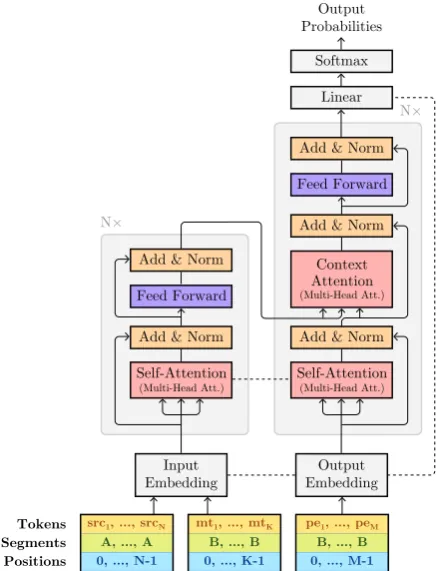
Following (Correia and Martins, 2019) we adapt the BERT model to the APE task by integrating the model in an encoder-decoder architecture. To this aim we use a single BERT encoder to obtain a joint representation of the src and mt sen-tence and a BERT-based decoder where the multi-head context attention block is initialized with the weights of the self-attention block. Both the en-coder and the deen-coder are initialized with the pre-trained weights of the multilingual BERT1(Devlin et al.,2018b). Figure1depicts our BED model.
Instead of using multiple encoders to separately encode src and mt, we use BERT pre-training scheme, where the two strings after being con-catenated by the [SEP] special symbol are fed to the single encoder. We treat these sentences as sentenceA andsentenceB in (Devlin et al., 2018b) and assign different segment embeddings to each of them. This emulates a similar setting
1https://github.com/google-research/
bert
Context Attention
(Multi-Head Att.)
Input Embedding
Output Probabilities
Add & Norm
Linear Softmax
Add & Norm Add & Norm
Add & Norm
Add & Norm
Feed Forward
Feed Forward
N×
N×
Self-Attention
(Multi-Head Att.) Self-Attention(Multi-Head Att.)
Output Embedding
Segments Positions
Tokens src1, …, srcN mt1, …, mtK pe1, …, peM
B, …, B B, …, B
A, …, A
0, …, M-1 0, …, K-1
[image:2.595.307.528.62.348.2]0, …, N-1
Figure 1: BERT encoder decoder, taken fromCorreia and Martins(2019).
to (Junczys-Dowmunt and Grundkiewicz, 2018) where a dual-source encoder with shared parame-ters is used to encode both input strings.
On the target side, following (Correia and Mar-tins, 2019) we use a single decoder where the context attention block is initialized with the self attention weights, and all the weights of the attention are shared with the respective self-attention weights in the encoder.
2.2 Conservativeness penalty
With domain specific NMT systems making rel-atively few translation errors, APE systems face new challenges. This means more careful deci-sions have to be made by the APE system, making the least possible edits to the rawmt. To this aim, we introduce our “conservativeness” penalty de-veloped on the post editing penalty proposed by (Junczys-Dowmunt and Grundkiewicz, 2016). It is a simple yet effective method to penalize/reward hypotheses in the beam, at inference time, that di-verge far from the original input.
More formally, let V be the source and target vocabulary. We define Vc = {Vsrc ∪ Vmt} as
the conservative tokens of an APE triplet, where
re-spectively. For the sake of argument we defineVc
for decoding a single APE triplet, which can be generalized to batch decoding withVcdefined for
each batch element. Given the|V|sized vector of candidatesht at each decoding stept, we modify
the score/probability of each candidatevas:
ht(v) =
(
ht(v)−c ifv∈V \Vc
ht(v) otherwise
(1)
wherecis the conservativeness penalty, penalizing (or rewarding for negative values) all tokens ofV
not present in Vc. Note that, this penalty can be
applied to either the raw non-normalized outputs of the model (logit) or the final probabilities (log probabilities).
As the log probabilities and logit scores have different bounds of(−∞,0)and(−∞,+∞), re-spectively, c is set accordingly. Hence, for posi-tive values of conservaposi-tiveness the aim is to avoid picking tokens not in thesrcandmt, thus, limit-ing the number of corrections. On the other hand, negative values enable over correction.
Moreover, in order to apply the penalty in the log probabilities, there are some considerations to take into account as we don’t renormalize af-ter the transformation. For positive values, the factor lowers the probability of all non conser-vative tokens, either increasing the confidence of an already picked conservative token, or favouring these tokens that are close to the best candidate – thus being closer to scores rather than probabili-ties. In contrast, negative penalties might require carefully selected values and truncating at the up-per boundary – we did not exup-periment with nega-tive values in this work, however the Quality Esti-mation shared task winning system used an APE-QE system with negative conservativeness (Kepler et al.,2019).
In contrast withJunczys-Dowmunt and Grund-kiewicz, our model takes into account both src andmt, allowing to copy either of them directly. This is beneficial to handle proper nouns as they should be preserved in the post edition without any modification. Moreover, instead of setting the penalty as a fixed value of−1, we define it as a hy-perparameter which enables a more dynamic con-trol of our model’s post-editions to themtinput.
3 Experiments
3.1 Data
This year for the English-German language pair the participants were provided an in-domain train-ing set and the eSCAPE corpus, an artificially syn-thesized generic training corpus for APE (Negri et al., 2018). In addition to these corpora, they were allowed to use any additional data to train their systems. Considering this, and the fact that the in-domain training set belongs to the IT do-main, we decided to use our own synthetic training corpus. Thus, we trained our models on a combi-nation of the in-domain data released by the APE task organizers and this synthetic dataset.
In-domain training set:we use the13ktriplets of<src,mt,pe>in the IT domain without any preprocessing as they are already preprocessed by the shared task organizers. Despite the previous year where the mt side was generated either by a phrase-based or a neural MT system, this year all the source sentences were translated only by a neural MT system unknown to the participants.
Synthetic training set:instead of the eSCAPE corpus provided by the organizers we created our own synthetic corpus using the parallel data pro-vided by the Quality Estimation shared task2. We found this corpus closer to the IT domain which is the target domain of the APE task. To create this corpus we performed the following steps:
1. Split the corpus into5foldsfi.
2. Use OpenNMT (Klein et al.,2017) to train 5 LSTM based translation models, one model
Mifor every subset created by removing fold fifrom the training data.
3. Translate each fold fi using the translation
ModelMi.
4. Join the translations to get an unbiased ma-chine translated version of the full corpus.
5. Remove empty lines.
The final corpus has 3.3M triplets. We then oversampled the in-domain training data 20 times (Junczys-Dowmunt and Grundkiewicz,2018) and used them together with our synthetic data to train our models.
System Beam ↓w/o c ↓best c ↓worst c
MT Baseline - 15.08 -
-BED 4 15.65 -
-6 15.61 -
-+ logprobs 4 - 14.84 (c= 1.5) 15.06 (c= 2.3) 6 - 14.87 (c= 1.5) 15.01 (c= 2.5)
[image:4.595.145.454.63.173.2]+ logits 4 - 15.03 (c= 1.7) 15.25 (c= 0.9) 6 - 15.05 (c= 1.7) 15.23 (c= 0.9)
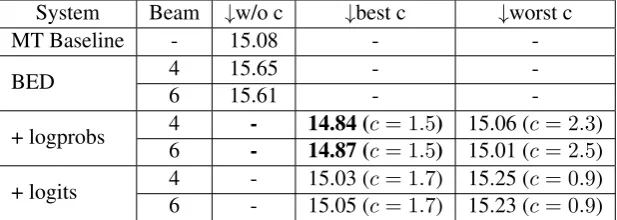
Table 1: TER scores of the baseline NMT system and our BERT encoder-decoderapemodel. The columns “w/o c”, “best c”, and “worst c” presents the scores of our system without the conservativeness penalty, with the best and the worst conservativeness penalty settings on our dev corpus, respectively. “logprobs” and “logits” refer, respectively, to the state where we apply the conservativeness factor (see §2.2)
3.2 BED training
We follow Correia and Martins for training our BERT-based Encoder-Decoder APE models. In particular, we set the learning rate to5e−5and use
bertadamoptimizer to perform200ksteps from which20kare warmup steps. We set the effective batch size to2048 tokens. Furthermore, we also use a shared matrix for the input and output token embedddings and the projection layer (Press and Wolf, 2017). Finally, we share the self-attention weights between the encoder and the decoder and initialize the multi-head attention of the decoder with the self-attention weights of the encoder.
Similarly to Junczys-Dowmunt (2018), we ap-ply a data weighting strategy during training. However, we use a different weighting approach, where each sample si is assigned a weight, wsi,
defined as 1−T ER(si). This results in
assign-ing higher weights to the samples with less MT errors and vice versa, which might sound counter intuitive since in the APE task the goal is to learn more from the samples with larger number of er-rors. However, in this task, where the translations are provided by strong NMT systems with very small number of errors, our APE system needs to be conservative and learn to perform limited num-ber of modifications to themt.
3.3 BED decoding
In the decoding step we perform the standard beam decoding with our conservativeness factor. We fine tuned the this factor on the dev set pro-vided by the organizers. Furthermore, in our ex-periments we set restrict the search toc ∈[0,+5]
and use beam sizes of 4 and 6. In our prelimi-nary experiments larger beam sizes didn’t help to improve the performance further. Finally, we used
the evaluation script available on the website to ac-cess the performance of our model.
4 Results and discussion
In our preliminary experiments we noticed that using the pure BED model does not improve the quality of the translations provided by strong NMT systems. As Table1 shows, it actually de-grades the performance by−0.57TER scores. Al-though the scores inCorreia and Martinsare actu-ally closer to the baseline, we find that using the BED model only, without controlling the conser-vativeness to the original MT can lead to baseline level scores (on dev). Hence, we applied different conservativeness penalties during the beam decod-ing and as the results in Table1show, different val-ues for this hyperparameter significantly changes the performance of our model. For the sake of compactness, here we present only the best (i.e. best c) and worst (i.e.worst c) scores by our model, to compare the effect of this factor.
con-servativeness penalty. We, however, leave it to be explored in future work.
Regarding the performance of our model on the official test set, as the results of Table2show, we outperform last year’s winning systems by almost
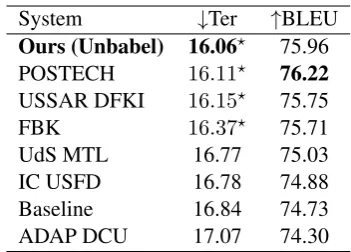
−0.4TER and+0.5BLEU, which for strong per-forming NMT systems is significant. In addition, our submission ranks first in the official results3, ex aequowith 3 other systems. Table3depicts the official results of the shared task, considering only the best submission of each team.
↓TER ↑BLEU
Baseline 16.84 74.73
(Tebbifakhr et al.,2018) 16.46 75.53
Primary 16.08 75.96
[image:5.595.327.503.60.186.2]Contrastive 16.21 75.70
Table 2: Submission at the WMT APE shared task.
Although in this paper we did not present an ab-lation analysis (due to time constraints), we hy-pothesize that three BED training and decoding techniques used in this work were influential on the final result obtained for this task: i) the syn-thetic training corpus contains more IT domain samples than the generic eSCAPE corpus, mak-ing it a suitable dataset to train APE systems for this domain; ii) the data weighting mechanism enforces the system to be more conservative and learn fewer edits which is crucial for strong spe-cialized NMT engines, and, finally, iii) the con-servativeness factor is crucial to avoid the well-known problem of over-correction posed generally by APE systems over the high quality NMT out-puts, guaranteeing faithfulness to the original MT.
5 Conclusion
We presented Unbabel’s submissions to the APE shared task at WMT 2019 for the English-German language pair. Our model uses the BERT pre-trained language model within the encoder-decoder framework and applies a conservative fac-tor to control the faithfulness of APE system to the original input stream.
The result of the official evaluation show that our system is able to effectively detect and correct the few errors made by the strong NMT system, improving the score by−0.8and+1.2in terms of TER and BLEU, respectively.
3Available at http://www.statmt.org/wmt19/ ape-task.htmlunderResults.
System ↓Ter ↑BLEU
Ours (Unbabel) 16.06? 75.96 POSTECH 16.11? 76.22
USSAR DFKI 16.15? 75.75
FBK 16.37? 75.71
UdS MTL 16.77 75.03
IC USFD 16.78 74.88
[image:5.595.75.285.218.296.2]Baseline 16.84 74.73 ADAP DCU 17.07 74.30
Table 3: APE Results as provided by the shared task or-ganizers. We only present the best score of each team.
? indicates not statistically significantly different, ex aequo.
Finally, using APE to improve strong domain Neural Machine Translation systems is in-creasingly more challenging, and ideally the edit-ing system will tend to perform less and less mod-ifications of the raw mt. In line with Junczys-Dowmunt and Grundkiewicz’s suggestion, study-ing how to apply APE to engines in generic data (domain agnostic) can be a more challenging task, as it would require more robustness and general-ization of the APE system.
Acknowledgments
The authors would like to thank the anonymous reviewers for the feedback. Moreover, we would like to thank Ant´onio G´ois, F´abio Kepler, and Miguel Vera for the fruitful discussions and help. We would also like to thank the support provided by the EU in the context of the PT2020 project (contracts 027767 and 038510), by the European Research Council (ERC StG DeepSPIN 758969), and by the Fundac¸˜ao para a Ciˆencia e Tecnologia through contract UID/EEA/50008/2019.
References
Ondˇrej Bojar, Rajen Chatterjee, Christian Federmann, Yvette Graham, Barry Haddow, Matthias Huck, Antonio Jimeno Yepes, Philipp Koehn, Varvara Logacheva, Christof Monz, Matteo Negri, Aure-lie Neveol, Mariana Neves, Martin Popel, Matt Post, Raphael Rubino, Carolina Scarton, Lucia Spe-cia, Marco Turchi, Karin Verspoor, and Marcos Zampieri. 2016. Findings of the 2016 conference on machine translation. InProceedings of the First Conference on Machine Translation, pages 131– 198, Berlin, Germany. Association for Computa-tional Linguistics.
Barry Haddow, Matthias Huck, Chris Hokamp, Philipp Koehn, Varvara Logacheva, Christof Monz, Matteo Negri, Matt Post, Carolina Scarton, Lucia Specia, and Marco Turchi. 2015. Findings of the 2015 workshop on statistical machine translation. InProceedings of the Tenth Workshop on Statistical Machine Translation, pages 1–46, Lisbon, Portugal. Association for Computational Linguistics.
Rajen Chatterjee, Matteo Negri, Raphael Rubino, and Marco Turchi. 2018a. Findings of the WMT 2018 shared task on automatic post-editing. In Proceed-ings of the Third Conference on Machine Trans-lation: Shared Task Papers, pages 710–725, Bel-gium, Brussels. Association for Computational Lin-guistics.
Rajen Chatterjee, Matteo Negri, Raphael Rubino, and Marco Turchi. 2018b. Findings of the WMT 2018 shared task on automatic post-editing. In Proceed-ings of the Third Conference on Machine Trans-lation: Shared Task Papers, pages 710–725, Bel-gium, Brussels. Association for Computational Lin-guistics.
Gonc¸alo Correia and Andr´e Martins. 2019. A sim-ple and effective approach to automatic post-editing with transfer learning. In Proceedings of the 57th annual meeting on association for computational linguistics. Association for Computational Linguis-tics.
Jacob Devlin, Ming-Wei Chang, Kenton Lee, and Kristina Toutanova. 2018a. Bert: Pre-training of deep bidirectional transformers for language under-standing. arXiv preprint arXiv:1810.04805.
Jacob Devlin, Ming-Wei Chang, Kenton Lee, and Kristina Toutanova. 2018b. Bert: Pre-training of deep bidirectional transformers for language under-standing. arXiv preprint arXiv:1810.04805.
Marcin Junczys-Dowmunt. 2018. Microsoft’s submis-sion to the wmt2018 news translation task: How i learned to stop worrying and love the data. In Pro-ceedings of the Third Conference on Machine Trans-lation: Shared Task Papers, pages 425–430.
Marcin Junczys-Dowmunt and Roman Grundkiewicz. 2016. Log-linear combinations of monolingual and bilingual neural machine translation models for au-tomatic post-editing. In Proceedings of the First Conference on Machine Translation, pages 751– 758, Berlin, Germany. Association for Computa-tional Linguistics.
Marcin Junczys-Dowmunt and Roman Grundkiewicz. 2018. MS-UEdin submission to the WMT2018 APE shared task: Dual-source transformer for automatic post-editing. In Proceedings of the Third Confer-ence on Machine Translation: Shared Task Papers, WMT 2018, Belgium, Brussels, October 31 - Novem-ber 1, 2018, pages 822–826.
Fabio Kepler, Jonay Tr´enous, Marcos Treviso, Miguel Vera, Ant´onio G´ois, M. Amin Farajian, Ant´onio V. Lopes, and Andr´e F. T. Martins. 2019. Unbabels participation in the wmt19 translation quality esti-mation shared task. In Proceedings of the Fourth Conference on Machine Translation, Florence, Italy. Association for Computational Linguistics.
Guillaume Klein, Yoon Kim, Yuntian Deng, Jean Senellart, and Alexander M. Rush. 2017. Open-NMT: Open-source toolkit for neural machine trans-lation. InProc. ACL.
Kevin Knight and Ishwar Chander. 1994. Automated postediting of documents. In Proceedings of the Twelfth AAAI National Conference on Artificial In-telligence, AAAI’94, pages 779–784. AAAI Press.
Xiaodong Liu, Pengcheng He, Weizhu Chen, and Jian-feng Gao. 2019. Multi-task deep neural networks for natural language understanding. arXiv preprint arXiv:1901.11504.
Matteo Negri, Marco Turchi, Rajen Chatterjee, and Nicola Bertoldi. 2018. escape: a large-scale syn-thetic corpus for automatic post-editing. In LREC 2018, Eleventh International Conference on Lan-guage Resources and Evaluation, pages 24–30. Eu-ropean Language Resources Association (ELRA).
Kishore Papineni, Salim Roukos, Todd Ward, and Wei-Jing Zhu. 2002. Bleu: a method for automatic eval-uation of machine translation. In Proceedings of the 40th annual meeting on association for compu-tational linguistics, pages 311–318. Association for Computational Linguistics.
Ofir Press and Lior Wolf. 2017. Using the output em-bedding to improve language models. In Proceed-ings of the 15th Conference of the European Chap-ter of the Association for Computational Linguistics: Volume 2, Short Papers, pages 157–163, Valencia, Spain. Association for Computational Linguistics.
Rico Sennrich, Barry Haddow, and Alexandra Birch. 2016. Improving neural machine translation mod-els with monolingual data. In Proceedings of the 54th Annual Meeting of the Association for Compu-tational Linguistics (Volume 1: Long Papers), pages 86–96, Berlin, Germany. Association for Computa-tional Linguistics.
Matthew Snover, Bonnie Dorr, Richard Schwartz, Lin-nea Micciulla, and John Makhoul. 2016. A study of translation edit rate with targeted human annotation. In Proceedings of association for machine transla-tion in the Americas, pages Vol. 200, No. 6.