Entity Hierarchy Embedding
Zhiting Hu, Poyao Huang, Yuntian Deng, Yingkai Gao, Eric P. Xing School of Computer Science
Carnegie Mellon University Pittsburgh, PA 15213, USA
{zhitingh,poyaoh,yuntiand,yingkaig,epxing}@cs.cmu.edu
Abstract
Existing distributed representations are limited in utilizing structured knowledge to improve semantic relatedness modeling. We propose a principled framework of em-bedding entities that integrates hierarchi-cal information from large-shierarchi-cale knowl-edge bases. The novel embedding model associates each category node of the hi-erarchy with a distance metric. To cap-ture struccap-tured semantics, the entity sim-ilarity of context prediction are measured under the aggregated metrics of relevant categories along all inter-entity paths. We show that both the entity vectors and cat-egory distance metrics encode meaningful semantics. Experiments in entity linking and entity search show superiority of the proposed method.
1 Introduction
There has been a growing interest in distributed representation that learns compact vectors (a.k.a embedding) for words (Mikolov et al., 2013a), phrases (Passos et al., 2014), and concepts (Hill and Korhonen, 2014), etc. The induced vectors are expected to capture semantic relatedness of the linguistic items, and are widely used in senti-ment analysis (Tang et al., 2014), machine transla-tion (Zhang et al., 2014), and informatransla-tion retrieval (Clinchant and Perronnin, 2013), to name a few.
Despite the impressive success, existing work is still limited in utilizing structured knowledge to enhance the representation. For instance, word and phrase embeddings are largely induced from plain text. Though recent knowledge graph em-beddings (Lin et al., 2015; Wang et al., 2014) inte-grate the relational structure among entities, they primarily target at link prediction and lack an ex-plicit relatedness measure.
In this paper, we propose to improve the dis-tributed representations of entities by integrating hierarchical information from large-scale knowl-edge bases (KBs). An entity hierarchy groups en-tities into categories which are further organized to form a taxonomy. It provides rich structured knowledge on entity relatedness (Resnik, 1995). Our work goes beyond the previous heuristic use of entity hierarchy which relies on hand-crafted features (Kaptein and Kamps, 2013; Ponzetto and Strube, 2007), and develops a principled optimization-based framework. We learn a dis-tance metric for each category node, and mea-sure entity-context similarity under the aggregat-ed metrics of all relevant categories. The met-ric aggregation encodes the hierarchical property that nearby entities tend to share common seman-tic features. We further provide a highly-efficient implementation in order to handle large complex hierarchies.
We train a distributed representation for the w-hole entity hierarchy of Wikipedia. Both the entity vectors and the category distance metrics capture meaningful semantics. We deploy the embedding in both entity linking (Han and Sun, 2012) and entity search (Demartini et al., 2010) tasks. Hi-erarchy embedding significantly outperforms that without structural knowledge. Our methods also show superiority over existing competitors.
To the best of our knowledge, this is the first work to learn distributed representations that in-corporates hierarchical knowledge in a principled framework. Our model that encodes hierarchy by distance metric learning and aggregation provides a potentially important and general scheme for u-tilizing hierarchical knowledge.
The rest of the paper is organized as follows:
§2 describes the proposed embedding model; §3 presents the application of the learned embed-ding;§4 evaluates the approach;§5 reviews related work; and finally,§6 concludes the paper.
e
1...
e
2….e
3…………..
Text Context
e
1e
2e
3Entity Hierarchy
h
2h
1𝑀ℎ1
𝑀ℎ2
𝑣𝑒1
Entity pairs
𝑀𝑒1.𝑒3 = 𝜋ℎ1𝑀ℎ1+ 𝜋ℎ2𝑀ℎ2 𝑣𝑒2
𝑣𝑒3
(𝑒1, 𝑒3)
𝑒1, 𝑒2
Dist. metrics
[image:2.595.92.491.57.173.2]𝑀𝑒1,𝑒2= 𝑀ℎ2
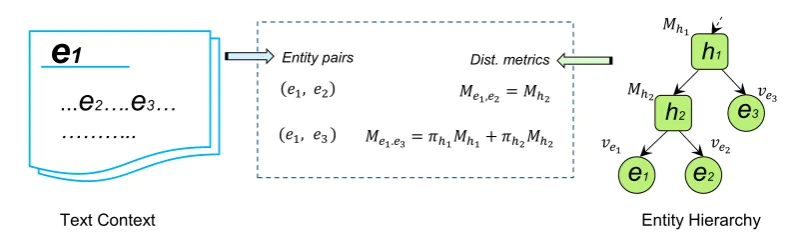
Figure 1: The model architecture. The text context of an entity is based on its KB encyclopedia article. The entity hierarchical structure is incorporated through distance metric learning and aggregation.
2 Entity Hierarchy Embedding
The objective of the embedding model is to find a representation for each entity that is useful for predicting other entities occurring in its contex-t. We build entity’s context upon KB encyclope-dia articles, where entity annotations are readily available. We further incorporate the entity hierar-chical structure in the context prediction through distance metric learning and aggregation, which encodes the rich structured knowledge in the in-duced representations. Our method is flexible and efficient to model large complex DAG-structured hierarchies. Figure 1 shows an overview of the model architecture.
2.1 Model Architecture
Our architecture builds on the skip-gram word embedding framework (Mikolov et al., 2013b). In the skip-gram model, a set of (target, con-text) word pairs are extracted by sliding a fixed-length context window over a text corpus, and the word vectors are learned such that the similarity of the target- and context-word vectors is maxi-mized. We generalize both the context definition and the similarity measure for entity hierarchy em-bedding.
Unlike words that can be directly extracted from plain text, entities are hidden semantics underly-ing their surface forms. In order to avoid manual annotation cost, we exploit the text corpora from KBs where the referent entities of surface text are readily annotated. Moreover, since a KB encyclo-pedia article typically focuses on describing one entity, we naturally extend the entity’s context as its whole article, and obtain a set of entity pairs
D = {(eT, eC)}, where eT denotes the
target-entity andeC denotes the context-entity occurring
in entityeT’s context.
LetEbe the set of entities. For each entitye∈
E, the model learns both a “target vector”ve ∈Rn
and “context vector”¯ve∈Rn, by maximizing the
training objective
L= 1|D|X
(eT,eC)∈Dlogp(eC|eT), (1)
where the prediction probability is defined as a softmax:
p(eC|eT) = Pexp{−d(eT, eC)}
e∈Eexp{−d(eT, e)}
. (2)
Here d(e, e0) is the distance between the target
vector of e(i.e., ve) and the context vector of e0
(i.e.,¯ve0). We present the design in the following.
2.2 Hierarchical Extension
An entity hierarchy takes entities as leaf nodes and categories as internal nodes, which provides key knowledge sources on semantic relatedness that 1) far-away entities in the hierarchy tend to be se-mantically distant, and 2) nearby entities tend to share common semantic features. We aim to en-code this knowledge in our representations. As K-B hierarchies are large complex DAG structures, we develop a highly-efficient scheme to enable practical training.
Specifically, we associate a separate distance metricMh ∈ Rn×n with each category h in the
hierarchy. A distance metric is a positive semidef-inite (PSD) matrix. We then measure the distance between two entities under some aggregated dis-tance metric as detailed below. The local metrics thus not only serve to capture the characteristics of individual categories, but also make it possible to share the representation across entities through metric aggregation of relevant categories.
Metric aggregation Given two entitieseande0,
e
h
2h
1h
3h
4e'
𝑒 → 𝑒′path 1
𝑒 → 𝑒′path 2
[image:3.595.108.255.64.173.2]turning node
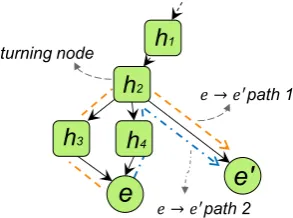
Figure 2: Paths in a DAG-structured hierarchy. A pathP is defined as a sequence of non-duplicated nodes with the property that there exists aturning nodet ∈ P such that any two consecutive nodes beforet are (child, parent) pairs, while consecu-tive nodes aftertare (parent, child) pairs. Thus a turning node is necessarily a common ancestor.
path:Ph∈Pe,e0Mh, leading to a nice property that
the more nodes a path has, the more distant the en-tities tend to be (asMhis PSD). This simple
strat-egy, however, can be problematic when the hier-archy has a complex DAG structure, in that there can be multiple paths between two entities (Fig-ure 2). Though the shortest path can be selected, it ignores other related category nodes and loses rich information. In contrast, an ideal scheme should not only mirror the distance in the hierarchy, but also take into account all possible paths in order to capture the full aspects of relatedness.
However, hierarchies in large KBs can be com-plex and contains combinationally many paths be-tween any two entities. We propose an efficien-t approach efficien-thaefficien-t avoids enumeraefficien-ting paefficien-ths and in-stead models the underlying nodes directly. In par-ticular, we extend Pe,e0 as the set of all category nodes included in any of the e → e0 paths, and
define the aggregate metric as
Me,e0 =γe,e0X
h∈Pe,e0πee0,hMh, (3) where{πee0,h}are the relative weights of the cat-egories such thatPh∈Pe,e0πee0,h= 1. This serves to balance the size of P across different entity pairs. We set πee0,h ∝ (s1
h↓e +
1
sh↓e0) with sh↓e being the average #steps going down from node
h to node ein the hierarchy (infinite if h is not an ancestor of e). This implements the intuition that an entity (e.g., “Iphone”) is more relevant to its immediate categories (e.g., “Mobile phones”) than to farther and more generic ancestors (e.g., “Technology”). The scaling factor γe,e0 encodes the distance of the entities in the hierarchy and can
be of various choices. We setγe,e0 = minh{sh↓e+
sh↓e0}to mirror the least common ancestor. In Figure 2, Pe,e0 = {h2, h3, h4}, and the rel-ative weights of the categories areπee0,h2 ∝ 3/2 andπee0,h3 =πee0,h4 ∝1. Categoryh2 is the least common ancestor andγe,e0 = 3.
Based on the aggregated metric, the distance be-tween a target entityeT and a context entityeCcan
then be measured as
d(eT, eC) = (veT −¯veC)>MeT,eC(veT −v¯eC). (4)
Note that nearby entities in the hierarchy tend to share a large proportion of local metrics in Eq 3, and hence can exhibit common semantic features when measuring distance with others.
Complexity of aggregation As computing dis-tance is a frequent operation in both training and application stages, a highly efficient aggregation algorithm is necessary in order to handle complex large entity hierarchies (with millions of nodes). Our formulation (Eq 3) avoids exhaustive enumer-ation over all paths by modeling the relevant nodes directly. We show that this allows linear complex-ity inthe number of children of two entities’ com-mon ancestors, which is efficient in practice.
The most costly operation is to find Pe,e0, i.e., the set of all category nodes that can occur in any ofe→e0 paths. We use a two-step procedure that
(1) finds all common ancestors of entity eande0
that areturning nodesof any e → e0 paths (e.g.,
h2in Figure 2), denoted asQe,e0; (2) expands from
Qe,e0 to construct the fullPe,e0. For the first step, the following theorem shows each common ances-tor can be efficiently assessed by testing only its children nodes. For the second step, it is straight-forward to see thatPe,e0 can be constructed by ex-pandingQe,e0 with its descendants that are ances-tors of eithereore0. Other parameters (π
ee0 and
γe,e0) of aggregation can be computed during the above process.
We next provide the theorem for the first step. LetAebe the ancestor nodes of entitye(including
e itself). For a node h ∈ Ae ∪ Ae0, we define itscritical nodeth as the nearest (w.r.t the length
of the shortest path) descendant ofh(includingh
itself) that is inQe,e0 ∪ {e, e0}. E.g., in Figure 2,
th1 =h2;th2 =h2;th3 =e. LetCh be the set of
immediate child nodes ofh.
Proof. We outline the proof here, and provide the details in the appendix.
Sufficiency: Note thate, e0 ∈/ Qe,e0. We prove
the sufficiency by enumerating possible situation-s: (i) ta = e, tb = e0; (ii) ta = e, tb ∈ Qe,e0; (iii)ta, tb ∈ Qe,e0. For (i): asta = e, there exists a path e → · · · → a → h where any two con-secutive nodes is a (child, parent) pair. Similarly, there is a pathh → b → · · · → e0 where any
t-wo consecutive nodes is a (parent, child) pair. It is provable that the two paths intersect only ath, and thus can be combined to form ane→e0 path:
e→ · · · → a→ h → b→ · · · → e0, yieldingh
as a turning node. The cases (ii) and (iii) can be proved similarly.
Necessity: We prove by contradiction. Suppose that ∀a, b ∈ Ch ∩(Ae∪ Ae0) we have ta = tb. W.l.o.g. we consider two cases: (i)ta = tb = e,
and (ii)ta = tb ∈ Qe,e0. It is provable that both cases will lead to contradiction.
Therefore, by checking common ancestors from the bottom up, we can construct Qe,e0 with time complexity linear to the number of all ancestors’ children.
2.3 Learning
For efficiency, we use negative sampling to refor-mulate the training objective, which is then opti-mized through coordinate gradient ascent.
Specifically, given the training data{(eT, eC)}
extracted from KB corpora, the representation learning is formulated as maximizing the objec-tive in Eq 1, subject to PSD constraints on distance metricsMh 0, andkvek2 =k¯vek2 = 1to avoid scale ambiguity.
The likelihood of each data sample is defined as a softmax in Eq 2, which iterates over all en-tities in the denominator and is thus computation-ally prohibitive. We apply the negative sampling technique as in conventional skip-gram model, by replacing each log probabilitylogp(eC|eT)with
logσ(−d(eT, eC)) +
Xk
i=1Eei∼P(e)[logσ(−d(eT, ei))],
where σ(x) = 1/(1 + exp(−x)) is the sigmoid function; and for each data sample we drawk neg-ative samples from the noise distributionP(e) ∝
U(e)3/4withU(e)being the unigram distribution (Mikolov et al., 2013b).
The negative sampling objective is optimized using coordinate gradient ascent, as shown in
Al-gorithm 1. To avoid overfitting and improve effi-ciency, in practice we restrict the distance metrics
Mh to be diagonal (Xing et al., 2002). Thus the
PSD project ofMh (line 17) is simply taking the
positive part for each diagonal elements.
Algorithm 1Entity Hierarchy Embedding
Input: The training dataD={(eT, eC)},
Entity hierarchy,
Parameters:n– dimension of the embedding
k– number of negative samples
η– gradient learning rate
B– minibatch size
1: Initializev,v¯,Mrandomly such thatkvk2=k¯vk2= 1 andM0.
2: repeat
3: Sample a batchB={(eT, eC)i}Bi=1fromD
4: for all(eT, eC)∈ Bdo
5: Compute{P,π, γ}eT,eC for metric aggregation
6: Sample negative pairs{(eT, ei)}ki=1
7: Compute{{P,π, γ}eT,ei}ki=1for metric
aggrega-tion 8: end for
9: repeat
10: for alle∈ Eincluded inBdo
11: ve=ve+η∂v∂Le
12: ¯ve= ¯ve+η∂∂v¯Le
13: ve,¯ve=Project to unit sphere(ve,v¯e)
14: end for
15: untilconvergence 16: repeat
17: for allhincluded inBdo
18: Mh=Mh+η∂M∂Lh
19: Mh=Project to PSD(Mh)
20: end for
21: untilconvergence 22: untilconvergence
Output: Entity vectorsv,¯v, and category dist. metricsM
3 Applications
One primary goal of learning semantic embedding is to improve NLP tasks. The compact represtations are easy to work with because they en-able efficient computation of semantic relatedness. Compared to word embedding, entity embedding is particularly suitable for various language under-standing applications that extract underlying se-mantics of surface text. Incorporating entity hier-archies further enriches the embedding with struc-tured knowledge.
3.1 Entity Linking
The entity linking task is to link surface form-s (mentionform-s) of entitieform-s in a document to entitieform-s in a reference KB. It is an essential first step for downstream tasks such as semantic search and K-B construction. The quality of entity relatedness measure is critical for entity linking performance, because of the key observation that entities in a document tend to be semantically coherent. For example, in sentence “Apple released an operating system Lion”, The mentions “Apple” and “Lion” refer to Apple Inc. and Mac OS X Lion, respec-tively, as is more coherent than other configura-tions like (fruit apple, animal lion).
Our algorithm finds the optimal configuration for the mentions of a document by maximizing the overall relatedness among assigned entities, to-gether with the local mention-to-entity compatibil-ity. Specifically, we first construct a mention-to-entity dictionary based on Wikipedia annotations. For each mentionm, the dictionary contains a set of candidate entities and for each candidate entity
ea compatibility score P(e|m) which is propor-tional to the frequency thatmrefers toe. For effi-ciency we only consider the top-5 candidate enti-ties according toP(e|m). Given a set of mentions
M={mi}Mi=1 in a document, letA={emi}Mi=1 be a configuration of its entity assignments. The score ofAis formulated as probability
P(A|M)∝YM
i=1P(emi|mi)
XM
j=1 j6=i
1
d emi, emj +,
where for each entity assignment we define its global relatedness to other entity assignments as the sum of the reciprocal distances ( = 0.01 is a constant used to avoid divide-by-zero). Direct enumeration of all potential configurations is com-putationally prohibitive, we therefore use simulat-ed annealing to search for an optimal solution.
3.2 Entity Search
Entity search has attracted a growing interest (Chen et al., 2014b; Balog et al., 2011). Unlike conventional web search that finds unorganized web pages, entity search retrieves knowledge di-rectly by generating a list of relevant entities in re-sponse to a search request. The input of the entity search task is a natural language questionQalong with one or more desired entity categoriesC. For example, a query can be Q =“films directed by Akira Kurosawa” andC={Japanese films}.
Previous methods typically score candidate tities by measuring both the similarity between en-tity content and the query questionQ(text match-ing), and the similarity between categories of en-tities and the query categoriesC(category match-ing).
We apply a similar category matching strate-gy as in previous work (Chen et al., 2014b) that assesses lexical (e.g., head words) similarity be-tween category names, while replacing the text matching with entity relatedness measure. Specif-ically, we first extract the underlying entities men-tioned inQthrough entity linking, then score each candidate entity by its average relatedness to the entities in Q. For instance, the entity Rashomon will obtain a high score in the above example as it is highly related with the entity Akira Kurosawa in the query. This scheme not only avoids complex document processing (e.g., topic modeling) in tex-t matex-tching, butex-t also implicitex-tly augmentex-ts tex-the shortex-t query text with background knowledge, and thus improves the accuracy and robustness.
4 Experiments
We validate the quality of our entity representa-tion by evaluating its applicarepresenta-tions of entity linking and entity search on public benchmarks. In the entity linking task, our approach improves the F1 score by 10% over state-of-the-art results. We al-so validate the advantage of incorporating hierar-chical structure. In the entity search task, our sim-ple algorithm shows competitive performance. We further qualitatively analyze the entity vectors and category metrics, both of which capture meaning-ful semantics, and can potentially open up a wide rage of other applications.
Knowledge base We use the Wikipedia snap-shot from Jan 12nd, 2015 as our training data and KB. After pruning administrative information we obtain an entity hierarchy including about 4.1M entities and 0.8M categories organized into 12 layers. Loops in the original hierarchy are re-moved by deleting bottom-up edges, yielding a DAG structure. We extract a set of 87.6M entity pairs from the wiki links on Wikipedia articles.
factor of5 whenever the objective value does not increase, and the negative sample sizek= 5. The model is trained on a Linux machine with 128G RAM and 16 cores. It takes5days to converge.
4.1 Entity Linking 4.1.1 Setup
Dataset As our entities based on English Wikipedia include not only named entities (e.g., persons, organizations) but also general concepts (e.g., “computer” and “human”), we use a stan-dard entity linking dataset IITB1 where mentions of Wikipedia entities are manually annotated ex-haustively. The dataset contains about 100 docu-ments and 17K mentions in total. As in the base-line work, we use only the mentions whose refer-ent refer-entities are contained in Wikipedia.
Criteria We adopt the common criteria, preci-sion, recall, andF1. Let A∗ be the golden
stan-dard entity annotations, andAbe the annotations by entity linking model, then
precision= |A∗|A|∩ A| recall=|A|A∗∩ A|∗| .
The F1 score is then computed based on the aver-age precision and recall across all documents.
Baselines We compare our algorithm with the following approaches. All the competitors are de-signed to be able to link general concept mentions to Wikipedia.
CSAW (Kulkarni et al., 2009) has a similar framework as our algorithm. It measures entity relatedness using a variation of Jaccard similarity on Wikipedia page incoming links.
Entity-TM(Han and Sun, 2012) models an en-tity as a distribution over mentions and words, and sets up a probabilistic generative process for the observed text.
Ours-NoH. To validate the advantage of incor-porating hierarchical structure, we design a base-line that relies on entity embedding without enti-ty hierarchy. That is, we obtain entienti-ty vectors by fixing the distance metric in Eq 4 as an identity matrix.
4.1.2 Results
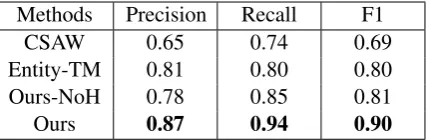
Table 1 shows the performance of the competitors. Our algorithm using the entity hierarchy embed-ding gets 21% to 10% improvement in F1, and
1http://www.cse.iitb.ac.in/soumen/doc/CSAW/Annot
Methods Precision Recall F1
CSAW 0.65 0.74 0.69
Entity-TM 0.81 0.80 0.80 Ours-NoH 0.78 0.85 0.81
[image:6.595.311.525.62.132.2]Ours 0.87 0.94 0.90
Table 1: Entity linking performance
over 6% and 14% improvements in Precision and Recall, respectively. The CSAW model devises a set of entity features based on text content and link structures of Wikipedia pages, and combines them to measure relatedness. Compared to these hand-crafted features which are essentially heuris-tic and hard to verify, our embedding model in-duces semantic representations by optimizing a s-ingle well-defined objective. Note that the em-bedding actually also encodes the Wikipedia inter-page network, as we train on the entity-context pairs which are extracted from wiki links.
The Entity-TM model learns a representation for each entity as a word distribution. However, as noted in (Baroni et al., 2014), the counting-based distributional model usually shows inferior perfor-mance than context-predicting methods as ours. Moreover, in addition to the text context, our mod-el integrates the entity hierarchical structure which provides rich knowledge of semantic relatedness. The comparison betweenOursandOurs-NoH fur-ther reveals the effect of integrating the hierarchy in learning entity vectors. With entity hierarchy, we obtain more semantically meaningful represtations that achieve 9% F1 improvement over en-tity vectors without hierarchical knowledge.
4.2 Entity Search 4.2.1 Setup
Dataset We use the dataset from INEX 2009 en-tity ranking track2, which contains 55 queries. The golden standard results of each query contains a set of relevant entities each of which corresponds to a Wikipedia page.
Criteria We use the common criteria of
precision@k, i.e., the percentage of relevant entities in the top-k results (we set k = 10), as well as precision@R where R is the number of golden standard entities for a query.
Baselines We compare our algorithm with the following recent competitors.
Balog (Balog et al., 2011) develops a proba-bilistic generative model which represents entities, as well as the query, as distributions over both words and categories. Entities are then ranked based on the KL-divergence between the distribu-tions.
K&K (Kaptein and Kamps, 2013) exploits Wikipedia entity hierarchy to derive the content of each category, which is in turn used to measure relatedness with the query categories. It further incorporates inter-entity links for relevance propa-gation.
Chen (Chen et al., 2014b) creates for each en-tity a context profile leveraging both the whole document (long-range) and sentences around en-tity (short-range) context, and models query text by a generative model. Categories are weighted based on the head words and other features. Our algorithm exploits a similar method for category matching.
Methods Precision@10 Precision@R
Balog 0.18 0.16
K&K 0.31 0.28
Chen 0.55 0.42
[image:7.595.75.289.376.447.2]Ours 0.57 0.46
Table 2: Entity search performance.
4.2.2 Results
Table 2 lists the entity search results of the com-petitors. Our algorithm shows superiority over the previous best performing methods. Balog con-structs representations for each entity merely by counting (and smoothing) its co-occurrence be-tween words and categories, which is inadequate to capture relatedness accurately. K&K leverages the rich resources in Wikipedia such as text, hi-erarchy, and link structures. However, the hand-crafted features are still suboptimal compared with our learned representations.
Chen performs well by combining both long-and short-context of entities, as well as catego-ry lexical similarity. Our algorithm replaces it-s text matching component with a it-semantic en-richment step, i.e., grounding entity mentions in the query text onto KB entities. This augments the short query with rich background knowledge, facilitating accurate relatedness measure based on our high-quality entity embedding.
4.3 Qualitative Analysis
We qualitatively inspect the learned representa-tions of the entity hierarchy. The results show that both the entity vectors and the category distance metrics capture meaningful semantics, and can po-tentially boost a wide range of applications such as recommendation and knowledge base completion.
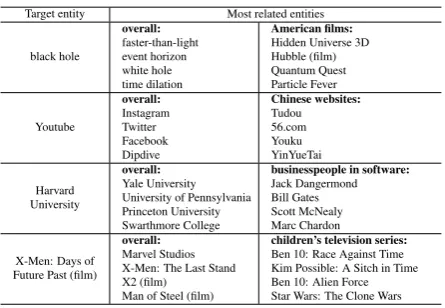
Entity vectors Table 3 shows a list of target en-tities, and their top-4nearest entities in the whole entity set or subsets belonging to given categories. Measuring under the whole set (column 2) results in nearest neighbors that are strongly related with the target entity. For instance, the nearest enti-ties for “black hole” are “faster-than-light”, “event horizon”, “white hole”, and “time dilation”, all of which are concepts from physical cosmology and the theory of relativity. Similar results can be ob-served from other 3 examples.
Even more interesting is to specify a category and search for the most related entities under the category. The third column of Table 3 shows sev-eral examples. E.g., our model found that the most related Chinese websites to Youtube are “Tudou”, “56.com”, “Youku” (three top video hosting ser-vices in China), and “YinYueTai” (a major MV sharing site in China). The high-quality results show that our embedding model is able to discov-er meaningful relationships between entities from the complex entity hierarchy and plain text. This can be a useful feature in a wide range of appli-cations such as semantic search (e.g., looking for movies about black hole), recommendation (e.g., suggesting TV series of specific genre for kids), and knowledge base completion (e.g., extracting relations between persons), to name a few.
Target entity Most related entities
black hole
overall:
faster-than-light event horizon white hole time dilation
American films:
Hidden Universe 3D Hubble (film) Quantum Quest Particle Fever
Youtube
overall:
Instagram Twitter Facebook Dipdive
Chinese websites:
Tudou 56.com Youku YinYueTai
Harvard University
overall:
Yale University University of Pennsylvania Princeton University Swarthmore College
businesspeople in software:
Jack Dangermond Bill Gates Scott McNealy Marc Chardon
X-Men: Days of Future Past (film)
overall:
Marvel Studios X-Men: The Last Stand X2 (film)
Man of Steel (film)
children’s television series:
[image:7.595.307.530.560.714.2]Ben 10: Race Against Time Kim Possible: A Sitch in Time Ben 10: Alien Force Star Wars: The Clone Wars
Xbox 360 games Xbox
Xbox games Xbox live arcade games
Windows 98 Windows me
Windows 7 Windows server 2008 r2
Windows 2000
snapshots of Windows Vista snapshots of Microsoft Office snapshots of Windows 2000 snapshots of Microsoft Windows
[image:8.595.75.290.64.162.2]snapshots of Windows softwares
Figure 3: Distance metric visualization for the subcategories of the category “Microsoft”. The t-SNE (Van der Maaten and Hinton, 2008) algorith-m is used to algorith-map the high-dialgorith-mensional (diagonal) matrixes into the 2D space.
Category distance metrics In addition to learn-ing vector representations of entities, we also as-sociate with each category a local distance metric to capture the features of individual category. As we restrict the distance metrics to be diagonal ma-trixes, the magnitude of each diagonal value can be viewed as how much a category is character-ized by the corresponding dimension. Categories with close semantic meanings are expected to have similar metrics.
Figure 3 visualizes the metrics of all subcate-gories under the category “Microsoft”, where we amplify some parts of the figure to showcase the clustering of semantically relevant categories. For instance, the categories of Microsoft Windows op-erating systems, and those of the Xbox games, are embedded close to each other, respectively. The results validate that our hierarchy embedding model can not only encode relatedness between leaf entities, but also capture semantic similarity of the internal categories. This can be helpful in taxonomy refinement and relation discovery.
5 Related Work
Distributed representation There has been a growing interest in distributed representation of words. Skip-gram model (Mikolov et al., 2013a) is one of the most popular methods to learn word representations. The model aims to find a rep-resentation for each word that is useful for pre-dicting its context words. Word-context simi-larity is measured by simple inner product. A set of recent works generalizing the basic skip-gram to incorporate dependency context (Levy and Goldberg, 2014), word senses (Chen et al., 2014a), and multi-modal data (Hill and Korho-nen, 2014). However, these work leverages
lim-ited structured knowledge. Our proposed method goes beyond skip-gram significantly such that we measures entity-context similarity under aggregat-ed distance metrics of hierarchical category n-odes. This effectively captures the structured knowledge. Another research line learn knowl-edge graph embedding (Lin et al., 2015; Wang et al., 2014; Bordes et al., 2013), which models enti-ties as vectors and relations as some operations on the vector space (e.g., translation). These work-s aim at relation prediction for knowledge graph completion, and can be viewed as a supplement to the above that extracts semantics from plain text.
Utilizing hierarchical knowledge Semantic hi-erarchies are key sources of knowledge. Previ-ous works (Ponzetto and Strube, 2007; Leacock and Chodorow, 1998) use KB hierarchies to de-fine relatedness between concepts, typically based on path-length measure. Recent works (Yogatama et al., 2015; Zhao et al., 2011) learn representa-tions through hierarchical sparse coding that eforces similar sparse patterns between nearby n-odes. Category hierarchies have also been wide-ly used in classification (Xiao et al., 2011; Wein-berger and Chapelle, 2009). E.g., in (Verma et al., 2012) category nodes are endowed with discrim-inative power by learning distance metrics. Our approach differs in terms of entity vector learning and metric aggregation on DAG hierarchy. 6 Conclusion
In this paper, we proposed to learn entity hierarchy embedding to boost semantic NLP tasks. A princi-pled framework was developed to incorporate both text context and entity hierarchical structure from large-scale knowledge bases. We learn a distance metric for each category node, and measure enti-ty vector similarienti-ty under aggregated metrics. A flexible and efficient metric aggregation scheme was also developed to model large-scale hierar-chies. Experiments in both entity linking and enti-ty search tasks show superiorienti-ty of our approach.
The qualitative analysis indicates that our model can be potentially useful in a wide range of other applications such as knowledge base completion and ontology refinement. Another interesting as-pect of future work is to incorporate other sources of knowledge to further enrich the semantics. Acknowledgments
References
Krisztian Balog, Marc Bron, and Maarten De Rijke. 2011. Query modeling for entity search based on terms, categories, and examples. TOIS, 29(4):22. Marco Baroni, Georgiana Dinu, and Germ´an
Kruszewski. 2014. Dont count, predict! a systematic comparison of context-counting vs. context-predicting semantic vectors. In Proc. of ACL, volume 1, pages 238–247.
Antoine Bordes, Nicolas Usunier, Alberto Garcia-Duran, Jason Weston, and Oksana Yakhnenko. 2013. Translating embeddings for modeling multi-relational data. InProc. of NIPS, pages 2787–2795. Xinxiong Chen, Zhiyuan Liu, and Maosong Sun. 2014a. A unified model for word sense representa-tion and disambiguarepresenta-tion. InProc. of EMNLP, pages 1025–1035.
Yueguo Chen, Lexi Gao, Shuming Shi, Xiaoyong Du, and Ji-Rong Wen. 2014b. Improving context and category matching for entity search. In Proc. of AAAI.
St´ephane Clinchant and Florent Perronnin. 2013. Ag-gregating continuous word embeddings for informa-tion retrieval. page 100.
Gianluca Demartini, Tereza Iofciu, and Arjen P De Vries. 2010. Overview of the inex 2009 entity ranking track. InFocused Retrieval and Evaluation, pages 254–264. Springer.
Xianpei Han and Le Sun. 2012. An entity-topic model for entity linking. InProc. of EMNLP, pages 105– 115. Association for Computational Linguistics. Felix Hill and Anna Korhonen. 2014. Learning
ab-stract concept embeddings from multi-modal data: Since you probably can’t see what i mean. InProc. of EMNLP, pages 255–265.
Rianne Kaptein and Jaap Kamps. 2013. Exploiting the category structure of wikipedia for entity ranking.
Artificial Intelligence, 194:111–129.
Sayali Kulkarni, Amit Singh, Ganesh Ramakrishnan, and Soumen Chakrabarti. 2009. Collective anno-tation of wikipedia entities in web text. InProc. of KDD, pages 457–466. ACM.
Claudia Leacock and Martin Chodorow. 1998. Com-bining local context and wordnet similarity for word sense identification. WordNet: An electronic lexical database, 49(2):265–283.
Omer Levy and Yoav Goldberg. 2014. Dependency-based word embeddings. InProc. of ACL, volume 2, pages 302–308.
Yankai Lin, Zhiyuan Liu, Maosong Sun, Yang Liu, and Xuan Zhu. 2015. Learning entity and relation em-beddings for knowledge graph completion. InProc. of AAAI.
Tomas Mikolov, Kai Chen, Greg Corrado, and Jeffrey Dean. 2013a. Efficient estimation of word represen-tations in vector space.
Tomas Mikolov, Ilya Sutskever, Kai Chen, Greg S Cor-rado, and Jeff Dean. 2013b. Distributed representa-tions of words and phrases and their compositional-ity. InProc. of NIPS, pages 3111–3119.
Alexandre Passos, Vineet Kumar, and Andrew McCal-lum, 2014. Lexicon Infused Phrase Embeddings for Named Entity Resolution, pages 78–86. Association for Computational Linguistics.
Simone Paolo Ponzetto and Michael Strube. 2007. Knowledge derived from wikipedia for computing semantic relatedness. JAIR, 30(1):181–212. Philip Resnik. 1995. Using information content to
e-valuate semantic similarity in a taxonomy. InProc. of IJCAI, pages 448–453.
Duyu Tang, Furu Wei, Nan Yang, Ming Zhou, Ting Li-u, and Bing Qin. 2014. Learning sentiment-specific word embedding for twitter sentiment classification. InProc. of ACL, pages 1555–1565.
Laurens Van der Maaten and Geoffrey Hinton. 2008. Visualizing data using t-sne. JMLR, 9(2579-2605):85.
Nakul Verma, Dhruv Mahajan, Sundararajan Sella-manickam, and Vinod Nair. 2012. Learning hier-archical similarity metrics. InProc. of CVPR, pages 2280–2287. IEEE.
Zhen Wang, Jianwen Zhang, Jianlin Feng, and Zheng Chen. 2014. Knowledge graph and text jointly em-bedding. InProc. of EMNLP.
Kilian Q Weinberger and Olivier Chapelle. 2009. Large margin taxonomy embedding for document categorization. InProc. of NIPS, pages 1737–1744. Lin Xiao, Dengyong Zhou, and Mingrui Wu. 2011. Hierarchical classification via orthogonal transfer. InProc. of ICML, pages 801–808.
Eric P Xing, Michael I Jordan, Stuart Russell, and An-drew Y Ng. 2002. Distance metric learning with application to clustering with side-information. In
Proc. of NIPS, pages 505–512.
Dani Yogatama, Manaal Faruqui, Chris Dyer, and Noah Smith. 2015. Learning word representations with hierarchical sparse coding.Proc. of ICML.
Jiajun Zhang, Shujie Liu, Mu Li, Ming Zhou, and Chengqing Zong. 2014. Bilingually-constrained phrase embeddings for machine translation. InProc. of ACL.
Bin Zhao, Fei Li, and Eric P Xing. 2011. Large-scale category structure aware image categorization. In