Munich Personal RePEc Archive
Financial incentives for open source
development: the case of Blockchain
Canidio, Andrea
IMT Lucca, INSEAD
2018
Financial incentives for open source
development: the case of Blockchain
∗
Andrea Canidio
†First version, March 20, 2018. This version: May 8, 2019. Please check here for the latest version.
Abstract
I consider a developer working on an open-source blockchain-based software that can be used only in conjunction with a specific crypto-token. This token can be sold in an Initial Coin Offering (ICO) to raise funds, but can also be sold later on a frictionless financial market to earn a profit. I show that, if the developer raises funds in an ICO, in each post-ICO period there is a positive probability that the developer sells all of his tokens on the market and, as a consequence, no development occurs. If the developer does not need to raise funds via an ICO, the equilibrium will nonetheless be inefficient because the developer’s payoff depends on the surplus generated by the protocol in a given period (when he expects to sell his tokens). He therefore fails to internalize that the protocol will be used (and generate surplus) over multiple periods.
JEL classification: D25, O31, L17, L26
Keywords: Blockchain, decentralized ledger technologies, Initial Coin Offering (ICO), seigniorage, innovation, incentives, open source
∗I am grateful to Bruno Biais, Ennio Bilancini, Sylvain Chassang, Lin William Cong, Kenneth Corts,
Antonio Fatas, Gur Huberman, John Kuong, Jiasun Li, Allistair Milne, Julien Prat, Massimo Riccaboni, Harald Uhlig, the participants of the CoPFiR workshop on FinTech, Bank of Finland/CEPR Conference on Money in the Digital Age, ZEW conference on the Dynamics of Entrepreneurship, Annual Meeting of the Central Bank Research Association, 8th EIEF-Unibo-IGIER Bocconi Workshop on Industrial Organization, second Toronto FinTech Conference, Paris Tokenomics conference, seminar participants at the University of Bolzano for their comments and suggestions.
†IMT school of advanced studies, Lucca, Italy & INSEAD, Fontainebleau, France.
1 Introduction 2
1
Introduction
The astonishing rise of Initial Coin Offerings (ICOs) brought blockchain-based crypto-tokens to the forefront of the policy, academic, and regulatory debate. An ICO is a form or crowd-funding in which startups (or loose groups of developers) raise capital by selling crypto-tokens. The first notable ICO was that of Ethereum in 2014, raising USD 2.3 million in approximately 12 hours. ICO activity exploded in 2017 and, especially, in 2018, with ICOs raising more that USD 6 billion in a single month (July 2018, from Lyandres, Palazzo, and Rabetti, 2018, see Figure 1). For comparison, in 2016 total Venture Capital investment in Europe was USD 4.7 billion (OECD, 2017).
However, these extraordinary events partially obscured a crucial fact: that in the vast majority of cases, teams going through an ICO plan to profit from their work by selling more tokens at a later stage. That is, the sale of tokens constitutes not only an innovative fundraising mechanism, but also a novel way to profit from software development. I call the sale of tokens as a mean to earn profits seigniorage.1
Seignorage is by far the dominant business model in the blockchain sector, covering the largest ICOs to date and at least 90% of the total crypto-market.2
Even more interesting is that, as I will discuss in more details later, it is possible to earn profits via seigniorage only if the source code behind both the software and the token itself are publicly available. Seignorage therefore constitutes the only way in which the developer of an open-source software can earn a direct financial reward (in addition to indirect benefits derived from, for example, career concerns).
To illustrate how seigniorage works, consider a population of agents who wish to ex-change either a good or a service, but are prevented from doing so by the lack of required infrastructure. If this exchange can occur in electronic form, then the missing infrastructure may be aprotocol, that is, the technical specifications governing the communication between machines. A developer who creates the missing protocol can profit from his innovation by simultaneously creating a token, and by establishing that all exchanges that occur using the protocol must use this token.3
The developer owns the initial stock of tokens so that, if the
1
Seigniorage is defined as the profits earned by issuing currency, and is a well known concept from monetary economics. What is novel here is that, thanks to blockchain technology, it can be used to create incentives for innovation.
2
At the time of writing, among the top-30 tokens by market capitaliztion, 28 constitute both a source of financing and of profits for the respective developers. These 28 tokens represent 90% of the total crypto-market (data from www.coincrypto-marketcap.com).
3
1 Introduction 3
Fig. 1: From Lyandres, Palazzo, and Rabetti (2018) page 35: “This figure reports monthly values of the number of ICOs that raise at least U.S.D. 10,000 (left axis) and the total amount raised across all ICOs each month (billions, right axis). Monthly observations go from August 2016 to November 2018. The observations reported for the month of August 2016 group all 33 ICOs up to August 2016”.
protocol is successful, there will be a positive demand for tokens, a positive price for tokens and positive profits earned by the developer.4
Blockchain enables seigniorage because it allows the developer to commit to a given supply of tokens (see Section 2.1 for additional details on blockchain). This is because the rules determining whether (and how) the supply of tokens increases over time can initially be specified within the protocol. If the protocol is open source, this commitment is credible because anybody can verify the software’s source code. Similarly, blockchain can be used to specify that only a given token can be used to transact using the protocol. Of course, this type of commitment could be achieved by other means, for example by complex institutional design (e.g., creating a “central bank”) or by building reputation over time. But these alternative means are very expensive and not widely available.Blockchain instead generates commitment by computer code.
4
1 Introduction 4
I build a model in which a developer can sell tokens both to raise funds and, novel with respect to the existing literature, to then profit from his/her work. More precisely, in every period, a developer exerts effort and invests in the development of a protocol. Initially, the developer owns the entire stock of tokens, and can sell some to investors via an Initial Coin Offering (ICO), modeled as an auction. Subsequently, in every period, he can sell or buy tokens on a frictionless market for tokens in which investors are active. The developer can use the proceedings of the sale of tokens to either invest in the development of the protocol or to consume.
The first result is that, if investors are price takers, then in any post-ICO period there is an anti-coordination problem. If investors expect the developer to develop the software in the future, this expectation should be priced into the token’s current price. But if this is the case, then the developer is strictly better off by selling all of his tokens, which allows him to “cash in” on future developments without doing any work. On the other hand, if investors expect no development to occur, the price of the token will be low. The developer should hold onto as many tokens as possible, exert effort and invest in the development of the protocol, so to increase the future price of the token. In every post-ICO period, therefore, the equilibrium is in mixed strategy: the price of the token is such that the developer is indifferent between selling all of his tokens (and therefore not developing the protocol) or keeping a strictly positive amount of tokens (and therefore continuing the development of the protocol). The developer randomizes between these two options, in a way that leaves investors indifferent between purchasing tokens in any given period.
When choosing whether and when to hold an ICO, the developer is therefore facing a tradeoff. If he holds an ICO, in every subsequent period with positive probability he will sell all of his tokens and not develop the software. Postponing the ICO, therefore, prevents the creation of a market for tokens and works as a commitment device, because the developer will hold all of his tokens for certain and set the corresponding level of effort and investment. However, if the developer does not sell tokens at ICO, he may lack the funds to invest in the development of the protocol. As a consequence, the developer never wants to hold an ICO if his own assets are sufficient to finance the optimum level of investment in the development of the protocol, but may hold the ICO otherwise.
1 Introduction 5
result is the specific form of this inefficiency: in every period after the ICO the developer may sell all his tokens and stop the development of the protocol. The second insight is more subtle but more interesting. Even assuming that the developer has sufficient funds to invest optimally (so that the first source of inefficiency is absent), his level of effort and investment are set so as to maximize the value of his stock of tokens. This value depends on the volume of the transaction occurring using the protocol during a given period of time.5
Instead, in the first best, effort and investment should be set so as to maximize the present discounted value of the surplus generated by the protocol. That is, the fact that the protocol will be used and generate surplus over multiple periods is completely disregarded by the developer. Interestingly, the level of effort and investment set by the developer may be above or below their first best levels. Back-of-the envelope calculations using data from the Ethereum blockchain suggest that, conditional on exerting positive effort, the equilibrium level of effort and investment is above the welfare-maximizing level. This is due to the fact that, at present, only a small fraction of tokens is used by users, with the vast majority being held by investors. In light of the model, this implies a very high sensitivity of the price of token to the developer’s effort and investment.6
The model delivers a number of other interesting results. For example, both at ICO and post-ICO there may be multiple equilibria. Because of a cash constraint, the developer cannot invest in the development of the protocol more than his assets. It follows that the developer may sell some of his tokens, as a way of accumulating assets to finance the future development of the protocol. The number of tokens that the developer needs to sell in order to finance future investments depends on the current price for tokens, therefore generating a coordination problem. If the price is high, the developer needs to sell fewer tokens, and his incentives to invest and develop the software in the future are high. This, in turn, justifies the high price for tokens today. If instead the price today is low, in order to finance future development, the developer needs to sell more tokens. But then his incentives to develop the software will be low, which justifies the fact that the price is low today. Therefore, at ICO there could be multiple pure-strategy Nash equilibria, while post-ICO there could be
5
This will result from an application of the equation of exchange, usually employed to link a country’s price level, real GDP, money supply and velocity of money.
6
2 Background and relevant literature 6
multiple mixed-strategy Nash equilibria.7
The remainder of the paper is organized as follows. The next Section provides the reader with the necessary background information on blockchain, ICOs and seigniorage, and also discusses the relevant literature. Section 3 presents a model of seigniorage. Section 4 solves for its equilibrium. Section 5 illustrates the first best of the model and compares it to its equilibrium. Section 6 discusses some extensions to the model, such as the possibility of using monopoly pricing (instead of seigniorage) and the possibility of raising funds from a Venture Capitalists (instead of via an ICO). Section 7 concludes. Unless otherwise noted, all proofs and mathematical derivations missing from the text are in the Appendix.
2
Background and relevant literature
2.1
Blockchain-based protocols
The key premise of this paper is that blockchain can be the technological foundation of various other protocols. To illustrate this fact, it is useful to make an analogy between blockchain and the Internet Protocol Suite.
The Internet Protocol Suite (commonly known as TCP/IP) was developed in the late ’60s and early ’70s to allow for the decentralisedtransmissionof data, that is, transmission of data via a network of computers in which no node is, individually, essential for the well functioning of the network. Financed by the Defense Advanced Research Projects Agency (DARPA), it had the goal of increasing military communication resilience by moving from a hub-and-spoke model of communication to a complete (or mesh) network model of communication.8
The Internet Protocol Suite is the technological foundation of a second set of protocols, also called application layer protocols. Those protocols make use of TCP/IP to handle specific types of data in a specific context: HTTP for accessing web pages; SMTP, POP, and IMAP for sending and receiving emails; FTP for sending receiving files; and so on.
Blockchain further expands the possible operations that can be performed by a network of computers in which no node is essential. Like TCP/IP, it allows for the decentralized
7
Clearly, if there are network effects, then there is an additional coordination problem: for a given sequence of effort and investment by the developer, there is a coordination problem among users, possibly leading to the existence of a “high adoption” and a “low adoption” equilibrium. The novelty here is that, for a given adoption equilibrium, there are multiple equilibrium sequences of effort and investment arising from a coordination problem between investors and the developer.
8
2 Background and relevant literature 7
transmission of data, but also permits the decentralized storage, verification and manipu-lation of data.9
Blockchain is also similar to TCP/IP in that it provides the foundation for a number of other protocols. The most well-known is the Bitcoin protocol: a protocol allowing a network of computers to store data (how many Bitcoins each address owns), and to enforce specific rules regarding how these data can be manipulated (no double spending). The Bitcoin protocol is not only the oldest and most widely known application of blockchain technology, but also well illustrates an important point: absent blockchain technology, the same type of data can be maintained only within a traditional organization (typically a bank).
Numerous other open-source blockchain-based protocols currently exist or are actively being developed. In addition to several cryptocurrencies (such as Monero, ZCash, Litecoin), there are protocols for building decentralized computing platforms that can run any applica-tion or software (see Ethereum, EOS, Cardano, NEO);10
protocols for decentralized real-time gross settlement (see Ripple, Stellar); protocols enabling the creation of decentralized mar-ketplaces for storage and hosting of files (see SIA, Filecoin, Storj), for renting in/out CPU cycles (see Golem), for event or concert tickets (see Aventus), for e-books (see Publica); protocols for generic e-commerce transactions (see Openbazaar); protocols creating fully de-centralized prediction markets (see Augur, Gnosis), financial exchanges (see 0xproject), and financial derivatives (see MakerDAO); protocols allowing the existence of fully decentralized organizations (see Aragon) and virtual worlds (see Decentraland); and many more.
2.2
Blockchain and Seigniorage
An important difference between the protocols built on TCP/IP and those built on blockchain is the way in which their developers are rewarded. The vast majority of protocols based on TCP/IP are open source, free to adopt and use. The contributors to these projects are not organized in a single, traditional company, but rather form a loosely-defined group around one (or multiple) project leader(s) and are based on open collaboration (as is typical of open source projects). These protocols are the backbone of the digital economy and created
9
Occasionally a distinction is made between blockchain and decentralized ledger technologies, where blockchain refers to a specific way of maintaining a decentralized ledger. This distinction is not relevant for the purpose of this paper. Another distinction is between “blockchain” meaning the technology, and “the blockchain” meaning a specific application of the blockchain technology, usually the Bitcoin blockchain.
10
2 Background and relevant literature 8
enormous value, yet none of this value was captured by its developers. Unsurprisingly, there is little investment in maintaining and updating this digital infrastructure.
As already discussed in the Introduction, the development of blockchain-based proto-cols can instead leverage financial incentives via seigniorage. This is possible whenever the protocol must be used in conjunction with a token. In case of protocols creating decentral-ized marketplaces, the token is typically the internal currency the marketplace. Similarly, within decentralized computing platforms (e.g., Ethereum), users of the protocol must use the protocol native token (e.g., Ether) to pay other users of the protocol (called miners or validators) for executing some piece of software (called smart contracts). In the case of cryptocurrencies such as Bitcoin, people who need to exchange Bitcoins reward those who process these transactions (called, again, miners) in two ways. One is direct: the sender can directly pay some Bitcoins to the miner to process his transaction faster. The second is indirect: the network awards miners with new bitcoins for their work. Because of its effect on the price, this increase in the supply of bitcoins amounts to a transfer from the holders of bitcoins to the miners.11
In other blockchain-based protocols, the use of the token can be the most diverse and the most complex.12
If the token is necessary to operate a protocol, this token will have positive value as long as the protocol will have some usage. Given this, the developers behind the protocol can sell some tokens to investors in earlier periods. One way to sell a token is via an ICO. ICOs are typically well advertised and, as already discussed in the introduction, sales of tokens at ICOs exploded in 2017 and 2018. But tokens can be sold also on the open market, possibly after the ICO. With few exceptions,13
either token sales on the open market are not disclosed, or they are discussed only within blog posts and informal communication.14
Despite the difference in visibility between these two ways of selling tokens, recent work by
11
See also Huberman, Leshno, and Moallemi (2017).
12
For example, MakerDAO is a blockchain based protocol that allow users to create Collateralized Debt Obligation (CDO) by locking a given amount of Ethers in a smart contract. The system is designed so that the USD-value of these obligations is roughly constant. Its native token is MKR and has several uses. For example, a user who wants retrieve his collateral will need to pay a fee established in MKR. Also, if the value of the collateral falls below the nominal value of the CDO, the protocol will automatically liquidate the collateral, and simultaneously sell newly created MKR so to cover the shortfall. MKR holders are therefore bearing the risk associated with issuing the CDO. Finally, MKR holder can vote to change some parameters of the protocol (such as, the fee required to retrieve a collateral or the threshold below which a collateral is liquidated).
13
For example, Ripple announces in advance a schedule for selling parts of its XRP stock, see https: //ripple.com/insights/q1-2018-xrp-markets-report/.
14
2 Background and relevant literature 9
Howell, Niessner, and Yermack (2018) and Amsden and Schweizer (2018) show that projects that go through an ICO sell only about half of their tokens at ICO, with the rest being kept by the founding team.15
This indicates that projects that go through an ICO expect to sell as many tokens at ICO as on the market post-ICO. Furthermore, it is not uncommon for some projects to skip the ICO stage and only sell tokens on the market, in a practice known as “airdrop”. This is typically the case for forks (i.e., derivations) of other projects, such as Stellar (a fork of Ripple and currently the ninth most valuable blockchain project by market capitalization), Bitcoin cash and Bitcoin Gold (forks of Bitcoin).16
2.3
Relevant literature
The novelty of this paper with respect to the existing literature studying blockchain-based tokens is to argue that selling tokens is both a mean to raise funds and a mean to earn a profit.
Cong, Li, and Wang (2019) is the only other paper builiding a model in which tokens can be sold to earn a profit (but not to raise funds). They study the incentives to maintain a decentralized platform by a platform owner, who can create new tokens which can be either consumed or used to pay workers who will improve the value of the platform. Their main result is that the platform owner will choose the monetary policy that maximizes the value of the platform. This result may look, at first, in contrast with those derived here. However, in my model the developer (also the platform owner) chooses both how many tokens to sell on the market and how much effort to exert in the development of the protocol powering the decentralized platform. In Cong, Li, and Wang (2019) instead there is no such effort, and hence the model better fits a situation in which the technology underlying the decentralized platform already exists.
15
More precisely, Howell et al. (2018) finds that 54% of tokens are sold at ICO, while Amsden and Schweizer (2018) put this number at 60%. Interestingly, Howell et al. (2018) also find that only about one third of the ICOs in their sample include vesting provisions that lock up the tokens not sold at ICO (or part of them) for some amount of time.
16
2 Background and relevant literature 10
The rest of the literature studying tokens has focused on the ICO. This literature can be divided into two parts. Most closely related are papers studying the role of tokens in decentralized digital platforms, where a decentralized platform is the peer-to-peer network generated by a blockchain-based protocol. All those papers take as given the existence of a protocol powering the decentralized platforms, and study how the presence of a native token affects its functioning. Sockin and Xiong (2018), Cong, Li, and Wang (2018), Bakos and Halaburda (2018), and Li and Mann (2018) argue that because of network externalities there could be coordination failures in the adoption of a decentralized platform. They study the role of tokens and they way they are sold in achieving the high-adoption equilibrium.
A second strand of literature has studied ICOs held by startups that may be completely unrelated to blockchain. In this case, the tokens sold represent a contract between issuers and token holders.17
For example, a token may represent a voucher and therefore give the right to acquire a good or a service from the issuer, or may represent a claim on a business revenues. This use of blockchain-based tokens is studied in Catalini and Gans (2018), Chod and Lyandres (2018) and Garratt and van Oordt (2019), who assume that tokens represent a pre-sale of output, that is, a firm issues tokens and simultaneously commit to accepting those tokens as sole mean of payment in the future. It is also studied in Malinova and Park (2018) who assume that tokens can represent either a pre-sale of output, or a revenue-share agreement. In all those models, the seller of a token also sells a product or a service, which is what generates a profits. That is, the token only serves as fundraising tool. Instead, in case of tokens linked to blockchain-based protocols, a developer (or a group of developers) releases the protocol as an open-source, free to use piece of software, and earn profits exclusively via the sale of tokens.
There is a small but growing literature building economic models to study how blockchain works (see, for example Catalini and Gans, 2016; Huberman, Leshno, and Moallemi, 2017; Dimitri, 2017; Prat and Walter, 2018; Ma, Gans, and Tourky, 2018; Budish, 2018). Within this literature, closely related is Biais, Bisiere, Bouvard, and Casamatta (2018), in which the price of a token and incentives of miners (i.e., the computers that process transactions and therefore constitute the nodes of the Bitcoin blockchain) are determined in the equi-librium of a game-theoretic model. Also in my paper, prices and incentives are determined in equilibrium, but the interest is in the incentives to develop the protocol rather than
pro-17
3 The model 11
cessing transactions. The portion of the model that determines the equilibrium price of the token borrows heavily from Athey, Parashkevov, Sarukkai, and Xia (2017), who propose an equilibrium model of the price of Bitcoin. The novelty with respect to their paper is that, here, the demand for tokens is a function of the developer’s effort and investment, while the “quality” of the Bitcoin protocol is taken as given in their model (but is unknown and therefore discovered over time).18
Gans and Halaburda (2015) study platform-based digital currencies, such as Facebook credits and Amazon coins. These currencies share some similarities with the tokens discussed in the Introduction, because they can be used to perform exchanges on a specific platform. They are, however, controlled by their respective platforms, which decide on their supply and the extent to which they can be traded or exchanged. This may explain why, despite some initial concerns,19
these currencies have neither gained wide adoption, nor generated significant profits for the platform issuing them.
Finally, this paper contributes to the literature on innovation and incentives, in particular to the literature studying the motivation behind contributions to open-source software (see the seminal paper by Lerner and Tirole, 2002). In this respect, I show that open source— with its organizational structure and ethos—can coexist with strong financial incentives. Of course, an open question not addressed here is whether or not financial rewards will crowd out other motives (see, for example, Benabou and Tirole, 2003); that is, whether the open source ethos will be compromised by the introduction of strong financial incentives.
3
The model
The economy is composed of a developer, a large mass of risk-neutral price-taking investors and a large mass of users. At the beginning of every period 1≤t ≤T, the developer exerts effortetand investsitinto the development of a blockchain-based protocol. The development
of the protocol lasts T periods, after which the developer exits the game and users starts using the protocol to transact with each other. The protocol can be used indefinitely. At
18
A second, more technical, difference is that Athey et al. (2017) assume that the demand for Bitcoins by investors is zero in the long run. I, instead, allow this demand to be positive. Indeed, the fraction of tokens held by investors in the long run will be an important determinant of the equilibrium of the model and of its efficiency properties.
19
3 The model 12
the beginning of the game, the developer establishes that all transactions using the protocol must be conducted using a specific token, with total supplyM, fully owned by the developer. In period to ≤ T, the developer sells some tokens to investors via an auction. This
stage is the ICO (Initial Coin Offering) stage, and its date to is chosen by the developer.
In each period after the ICO, but before the developer exits the game (that is, in every
t ∈ {to + 1, ..., T}), first the developer exerts effort and invests, then a frictionless market
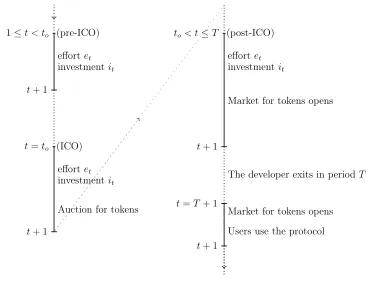
for tokens opens. In every period after the developer exits (that is, in every t > T), first the market for tokens opens and then users use the protocol. See Figure 3 for a graphical representation of the timeline.
1≤t < to (pre-ICO)
t+ 1
effortet
investmentit
t=to (ICO)
t+ 1
effortet
investmentit
Auction for tokens
to< t≤T (post-ICO)
t+ 1
effortet
investmentit
Market for tokens opens
The developer exits in periodT
t=T+ 1
t+ 1
[image:13.612.120.486.267.569.2]Market for tokens opens Users use the protocol
Fig. 2: Timeline
3 The model 13
future expected price. If insteadpt>p¯, then the investors’ demand for tokens in periodt is
zero. Finally, if pt<p¯, then the investors’ demand for tokens in periodt is not defined.
The developer. CallQt ≤M the stock of tokens held by the developer at the beginning
of period t, with Q1 =M. Call:
At ≡a+ t−1
X
s=1
[(Qs−Qs+1)·ps−is] =At−1−it−1+pt−1(Qt−1−Qt)
the total resources available to the developer at the beginning of period t, where a is the developer’s initial assets (cash) and the rest are resources earned from the sale of tokens in previous periods, net of the investments made. To account for the fact that during periods
t < to the developer cannot sell tokens, I impose that pt≡0for allt < to. Intuitively, in any
t < to the developer cannot sell tokens but can destroy them, which is equivalent to selling
them at price zero. Of course, this will not happen in equilibrium.
In every period, the developer maximizes his end-of-life assets AT+1 minus the disutility
of effort. He faces a per-period feasibility constraint determining the largest investment that can be made:
it≤At,
and a per-period cash constraint determining the maximum amount of tokens that can be purchased by the developer:
ptmax{Qt+1−Qt,0} ≤At−it.
Note that the cash constraint is always tighter than the feasibility constraint, which can therefore be disregarded.
Similar to investors, the developer does not discount the future either. Hence, his problem can be rewritten in recursive form as, for t < T:
Ut(Qt, At)≡ max Qt,et,it
−1 2e
2
t +Ut+1(Qt+1, At+ (Qt−Qt+1)·pt−it)+
3 The model 14
and for t=T:
UT(QT, AT)≡max eT,iT
AT +QT ·pT −iT − 1 2e
2
T +λT(AT −iT)
,
where λt is the Lagrange multiplier associated with the period-t cash constraint. The
se-quence of effort, investments and Qt are assumed observable by investors and users .
Users. In periodT the development of the protocol stops and users start using the protocol. To do so, in every period they first purchase tokens and then use them to transact with other users using the protocol. The total value (in US dollars) of all exchanges occurring using the protocol during a given period is the value of the protocol and is defined as:
VT = T
X
s=1
f(es, is), (1)
where f(., .) is increasing in both arguments, concave in et, with limi→∞
n
∂f(et,it) ∂it
o
= 0 for all et. For ease of notation, I assume that each user can access the market for tokens only
once in every period.20
This implies that, in every t > T, those who use the protocol to purchase goods and services have a demand for tokens in period t equal to VT
pt, while those
who use the protocol to sell goods or services have a supply of tokens in period t+ 1 equal, again, to VT
pt.
Equation (1) is meant to capture in a parsimonious way the fact that the developer’s effort and investment generates an improvement of the protocol (i.e., lower transaction costs, more ease of use, increased security, and reliability), which in turns induces more users to use the protocol and perform more/larger transactions. Being parsimonious, however, it also abstracts away from important elements. For example, because of network externalities, it is possible that for a given sequence of effort and investment there is both a “high adoption” equilibrium (in which the value of the protocol is high) and a “low adoption” equilibrium (in which the value of the protocol is low). With a minimal loss of generality, the reader can interpretVT as the value of the protocol in one of these equilibria, the one that the developer
expects to emerge.21
Also, the justification behind (1) implies that the token is used as a
20
That is, the velocity of the token is 1. Assuming a different velocity will introduce an additional parameter without affecting the results.
21
4 Solution 15
mean of exchange. If the token is necessary in order to use the protocol, but without being a means of exchange, thenVT is a measure of token usage which is not necessarily equal to the
value of the exchanges occurring using the protocol. All of the results presented are robust to this different interpretation, with the exception of the back-of-the envelope calculations in Sections 5 and 6.1.
4
Solution
4.1
Periods
t
≥
T
I start by solving for the price of the token from periodT onward, using the behavior of users (as captured by equation (1)) and an appropriate equilibrium selection criterion (introduced below).
The fact that no development is possible after periodT implies that the price of the token must be constant from periodT onward. Investors are therefore indifferent between holding cash and holding the token, which implies that there are multiple equilibria: the price of the token will depend on the stock of tokens held by the investors, who are indifferent between holding any level of tokens. To break this indeterminacy, I impose the following assumption:
Assumption 1. In equilibrium, the stock of tokens held by investors from period t ≥ T is
γ·M for γ ∈[0,1).
That is, out of the many equilibria possible, I am interested here in those in which the demand for tokens by investors is a constant fraction of the stock of tokensM.
The term γ·M therefore represents the “speculative” demand for tokens: the demand for tokens driven by the expectation that future investors will also demand γ·M. Next to this demand, in every period there is a demand and a supply for tokens originating from users. Because the stock of tokens available to users is (1−γ)·M, the price for tokens must solve:
pT =
VT (1−γ)M.
It follows that the price at which the developer can sell his token is strictly increasing in the value of the protocol VT—and hence in the sequence of effort and investments made by
the developer. As we will see, this result will play a central role in solving for developer’s
4 Solution 16
problem. But before doing so, it is important to point out that the results presented below are robust to different assumptions about what happens from periodT onward (i.e., different assumptions regarding the demand and supply of tokens by users or investors), provided that under these different assumptions pT is increasing in VT.
4.2
The developer’s problem
In solving the developer’s problem, the following observation will play a key role. Because investors are price takers, in every t > to their demand for tokens depend exclusively on pt
and p¯t (the largest future price) and not on the quantity of tokens sold by the developer
in period t.22
In particular, if pt = ¯pt, then investors are indifferent between purchasing
any amount of tokens. At the same time, the equilibrium price in period t should reflect effort and investments made prior tot. Hence, because the instantaneous demand for tokens by investors is inelastic to the supply of tokens, in every period the developer can sell any amount of tokens at the market price. But because prices react to effort and investment which in turn depend on the stock of tokens held by the developer, the amount sold by the developer in each period will have an effect on future prices.
It is useful to solve the developer’s problem by considering two cases. The first is the “rich developer” case, in which the developer’s initial assets a are sufficient to cover the optimal level of investment in every period. In this case, the cash constraint is never binding and can be ignored. The second case is that of a “poor developer”, in which the cash constraint is binding for at least one period.
4.2.1 Rich developer
If the cash constraint is never binding, the developer’s utility can be written as, fort ≤T−1:
˜
Ut(Qt)≡ max Qt+1,et,it
(Qt−Qt+1)·pt−it− 1 2e
2
t + ˜Ut+1(Qt+1)
,
and for t=T:
˜
UT(QT)≡max eT,iT
QT ·pT −iT − 1 2e
2 T
.
22
4 Solution 17
Note that(Qt−Qt+1)·pt−it is the cash generated in period t, net of investment. Because
there is no discounting and the cash constraint is never binding, I can include this cash in period-t utility function (i.e., the period in which it is generated), even if it is consumed in period T.
Consider the last period of the developer’s life. The fact that pT increases in eT and iT
immediately implies that U˜T(QT) is strictly convex. The argument is quite standard: if eT
and iT were fixed, then pT would be fixed and U˜T(QT)would be linear in QT. However, the
optimaleT and iT are:23
e∗(QT)≡argmaxe
f(e, i∗(QT))
QT (1−γ)M −
1 2e
2
(2)
i∗(QT)≡argmaxi
f(e∗(QT), i)
QT
(1−γ)M −i
. (3)
As long as eithere∗(Q
T)ori∗(QT)are positive for someQT ≤M (an assumption maintained
in order to avoid trivialities), then optimal effort and investment react to changes in QT,
which implies that U˜T(QT) must grow faster than linearly.
Consider now the choice of QT in period T −1. For given eT−1 and iT−1, the developer
choosesQT so as to maximize pT−1(QT−1−QT) + ˜UT(QT), which, for given pT−1, is strictly
convex inQT because U˜T(QT)is strictly convex. It follows that the developer’s problem has
a corner solution: depending on pT−1, the developer will either sell all of his tokens (when
pT−1 is high), purchase as many tokens as possible (when pT−1 is low), or be indifferent
between these two options. The price at which the developer is indifferent is:
pT−1 =
˜
UT(M)
M =
VT−1+f(e∗(M), i∗(M))
(1−γ)M −
(e∗(M))2/2 +i∗(M)
M , (4)
where VT−1+f(e∗(M),i∗(M))
(1−γ)M is the period T price in case the developer holds M tokens at the
beginning of period T.
Note, however, that if investors expect the developer to sell all of his tokens, they should also expect no effort or investment in periodT, and thereforepT−1 should be low. If instead
23
4 Solution 18
they expect the developer to set QT =M, they should expect maximum effort and
invest-ments in period T and therefore pT−1 should be high. Thus, we have an anti-coordination
problem, which implies that the unique equilibrium is in mixed strategy: the price will be such that the developer is indifferent, and the developer will randomize betweenQT = 0 and
QT =M.
More precisely, if the developer sells all of his tokens in period T −1, then the price in period T will be VT−1
(1−γ)M. If instead the developer purchases M tokens in period T −1, then
pT = VT−1+f(e
∗(M),i∗(M))
(1−γ)M . Because investors must be indifferent between purchasing in period
T or period T −1, it must be that:
pT−1 =
VT−1
(1−γ)M + (1−αT−1)
f(e∗(M), i∗(M)) (1−γ)M ,
whereαT−1 is the probability that the developer sells all of his tokens in periodT−1, which
using (4) can be written as:
αT−1 = (1−γ)
(e∗(M))2/2 +i∗(M)
f(e∗(M), i∗(M)) .
For intuition, note that (e∗(M))2/2 + i∗(M) is the cost generated by holding M tokens,
coming from the additional effort and investment that the developer will exert in periodT. Instead:
M · f(e
∗(M), i∗(M))
(1−γ)M ,
is the benefit of settingQT =M, coming from the increase in the value of these tokens due
to the developer’s effort and investment in period T. αT−1 is therefore equal to the ratio
between cost and benefit of holdingM tokens in periodT. Because effort and investment are chosen optimally, the benefit should be at least as large as the cost, and thereforeαT−1 ≤1.
The following proposition shows that these results generalize to every period in which the market for tokens operates.
Proposition 1 (Equilibrium post-ICO). In every period t∈ {to+ 1, ..., T}:
1. Optimal effort and investment for given Qt are e∗(Qt) and i∗(Qt), given by (2) and
4 Solution 19
2. The developer sells all his tokens (so that Qt+1 = 0) with probability
αt =
1 if t=T
(1−γ)(ef∗((eM∗())M2/),i2+∗(iM∗())M) otherwise
(5)
and purchases all tokens (so that Qt+1 =M) with probability 1−αt,
3. The price of tokens as a function of past effort and investment is
pt=
Vt+ (1−αt)(T −t)f(e∗(M), i∗(M))
(1−γ)M . (6)
The proposition is based on the fact that all U˜t(Qt)are strictly convex and, therefore, in
every period t < T the equilibrium price must be such that the agent is indifferent between holding all of his tokens and selling all of his tokens. But this also implies that the agent is indifferent between selling all of his tokens in periodt or holdingM in every period until
T. The benefit of exerting effort and of investing in a given period is therefore given by the resulting change in pT, which is constant over time and given by (2) and (3).
Hence, wheneverQt =M the value of the protocol increases byf(e∗(M), i∗(M))in period
t, while ifQt= 0 the value of the protocol does not change in periodt. The probability that
Qt= 0 is such that investors are indifferent between holding the token at t−1or at t, and
is also constant over time. It follows that the price in period t (Equation (6)) reflects past effort and past investment via the termVt, as well as expected future effort and investment
via the term(1−αt)(T −t)f(e∗(M), i∗(M)). This expression can also be interpreted as the
law of motion of the price, because it implies that, in every period t≤T, the price of token will increase by:
(e∗(M))2/2 +i∗(M)
M ,
with probability:
1−(1−γ)e
∗(M))2/2 +i∗(M)
f(e∗(M), i∗(M)) ,
and will decrease by:
1
M
f(e∗(M), i∗(M))
1−γ −(e
∗(M))2/2 +i∗(M))
,
4 Solution 20
Period to (the ICO) is characterized by the fact that tokens are sold via an auction.
Hence, contrary to all subsequent periods, in period to the price of a token depends on the
number of tokens sold, which isM−Qto. Again, in equilibrium, investors must be indifferent,
and therefore, for any number of tokens sold at ICO, it must be that pto = pto+1. Hence,
whenever to < T, the developer’s problem at ICO can be written as:
max Qto+1
n
˜
Uto+1(Qto+1) + (M −Qto+1)pto
o
=
max Qto+1
max eto+1,ito+1
Qto+1·pto+1−
1 2e
2
to+1−ito+1
+ (M −Qto+1)pto+1
≤
max Qto+1
max eto+1,ito+1
Qto+1·pto+1−
1 2e
2
to+1−ito+1+ (M −Qto+1)pto+1
=
max eto+1,ito+1
M ·pto+1−
1 2e
2
to+1−ito+1
= ˜Uto+1(M),
where the first and the last equality follow from writing U˜to+1(Qto+1) explicitly (under the assumption that the developer sells all of his tokens in periodto+1). The developer therefore
anticipates that the price of tokens will be the same at ICO and in the following period, in-dependently from how many token he sells. The number of tokens sold, however, determines the equilibrium level of effort and investment in period to+1. By choosing Qto+1 = M, the developer maximizes effort and investments in periodto+1, and therefore the price in period
to+1. If instead to = T, then the developer sells all of his tokens during the ICO, and then
exits the game. The following proposition summarizes these observations.
Proposition 2 (Equilibrium at to). If the ICO occurs beforeT, then the developer does not
sell any tokens at ICO. It follows that Qto+1 =M with probability 1. Effort and investment in all t≤to+ 1are e∗(M) andi∗(M) with probability 1. If instead the ICO occurs at period
T, then the developer sells all of his tokens at ICO.
Proof. In the text.
Period to+ 1is therefore the only period in which the market for tokens is open and the
developer contributes to the development of the protocol with probability 1.
With respect to the optimal timing of the ICO, the previous proposition shows that optimal effort and investment between period 1 and to+1 are e∗(M) and i∗(M). In all
4 Solution 21
every period until T, but this cannot happen in equilibrium. From period to+2 onward, the
developer exerts effort and invests with probability less than one, which implies the following proposition:
Proposition 3 (Equilibriumto). The developer holds the ICO either in periodT or in period
T −1.
Proof. In the text.
Note that if the ICO is held in period T −1, the developer will auction off 0 tokens, and will sell M tokens on the market in period T. If instead the ICO is in period T, the developer will sell all of his tokens via the auction. Holding the ICO in periodT−1or period
T, therefore, achieves the same outcome: the developer does not sell any tokens before period
T and sells all of his tokens in periodT. As a consequence, effort and investment aree∗(M)
and i∗(M) with probability 1 in every period.
Corollary 1. The cash constraint is never binding (and hence we are in the “rich developer”
case) if and only if a≥T ·i∗(M).
Proof. Immediate from the above Proposition.
That is, we are in the “rich developer” case whenever the developer does not need to sell tokens to finance the optimal amount of investment for T periods.
Finally, it is easy to check that the developers’ utility does not depend on the total stock of tokens M. From (2) and (3) we know that the equilibrium sequence of effort and investment depends on M exclusively via the share of tokens held by the developer. This share is 1 for t ≤to, and can be either 1 or 0 for to < t ≤T (with the probability of being
1 or 0 given by 5, also independent from M). This implies that VT and, as a consequence,
ptM are independent from M. The developer’s utility is therefore independent from M for
any to.
4.2.2 Poor developer
The rich developer case focuses on one side of seigniorage: the incentives provided to the developer. It shows that the developer will hold the ICO just before exiting the game, as a way to commit to the highest level of effort and investment in every period.
4 Solution 22
aspect into the model by assuming that the developer is “poor”, in the sense thata < T·i∗(M):
the developer cannot invest efficiently in all periods, and the cash constraint could be binding. To focus on the role of the cash constraint, I introduce the following functional form:
f(e, i)≡g(e)1{i≥i}, (A1)
where 1{} is the indicator function, and g(e) is strictly increasing and strictly concave. Hence,iis an essential input in the development of the protocol, because effort is productive only if i≥ i. However, investing more that i is also not productive. The choice of optimal investment, therefore, simplifies to the choice between two levels: i and 0.
Given this, period-T effort and investment are:
ˆ
eT(QT, iT)≡
e∗(Q
T)≡argmaxe
n
g(e) QT (1−γ)M −
1 2e
2o if i T ≥i
0 otherwise
(7)
ˆiT(QT, AT)≡
i if i≤maxe
n
g(e) QT (1−γ)M −
1 2e
2o and i≤A T
0 otherwise.
(8)
To avoid trivial equilibria in which there is never any effort or investment, I furthermore assume that:
i <maxe
g(e) 1 1−γ −
1 2e
2
, (A2)
that is: there is a level of QT for which the developer will invest and exert positive effort
whenever his assets are sufficient to do so. I call the threshold level Qˆ, implicitly defined as:
ˆ
Q≡Q: i=maxe
g(e) Q (1−γ)M −
1 2e
2
. (9)
4 Solution 23
Case 1: to =T. If the ICO occurs in the last period, then optimal effort and investment
in period T are given by (7) and (8). The price of a token is therefore:
VT−1
(1−γ)M +
0 if AT < i
g(e∗(M))
(1−γ)M otherwise.
In period T −1, the choice of optimal investment affects AT and the period-T optimal
effort and investment. This is relevant whenever i≤ AT−1 <2i, that is, whenever assets in
period T −1are not sufficient to invest optimally in both period T −1 and period T. It is immediately clear that, in this case, the final price is always VT−2+g(e∗(M))
(1−γ)M , independent from
whether effort and investment are positive in period T −1 or in period T. The same logic applies to the choice of investment and effort in any earlier period. Define:
n≡argmaxk∈{1,2,...,T}{k·i≤a}, (10)
as the number of periods in which the developer can invest efficiently using his initial assets exclusively. The above discussion implies that the developer will invest and exert effort forn
periods, and he is indifferent with respect to which ones. The following lemma summarizes these observations.
Lemma 1 (ICO in period T). Whenever to = T, the final value of the protocol is VT =
n·e∗(M).
Proof. In the text.
Case 2: to=T−1. If the ICO occurs in periodT−1, then the developer can finance some
of the periodT investment by selling tokens in periodT−1. Remember that, in equilibrium, the price of tokens at ICO pT−1 must be equal to pT. Hence, for given M −QT (i.e., tokens
sold at ICO), the price for tokens will be:
pT =
VT−1
(1−γ)M +
0 if AT−1−iT−1+pT(M −QT)< i g(e∗(Q
T))
(1−γ)M otherwise.
(11)
WheneverAT−1−iT−1 < i(that is, whenever the developer does not have enough own funds
4 Solution 24
QT there are multiple equilibrium pT. For intuition, suppose that the developer announces
the sale of M −QT tokens at ICO. If investors expect pT to be low, they will drive down
pT−1 (the price at ICO), which implies that the level of investment achievable in period T
by selling M−QT at ICO may be below i, which justifies the initial expectation. If instead
investors expect pT to be high, in equilibrium pT−1 will also be high, which implies that the
level of investment achievable in period T by selling M −QT tokens at ICO may be above
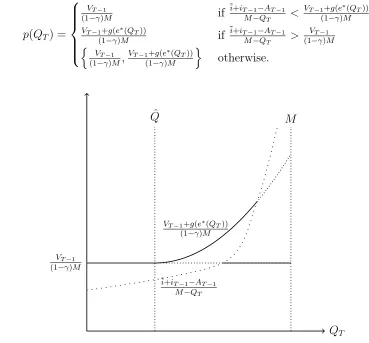
i, which justifies the initial expectation. This can be interpreted as a coordination problem among investors. For any number of tokens sold by the developer at ICO, investors may coordinate on a “high” equilibrium that leads to high effort and investment in period T, or on a “low” equilibrium leading to low (or no) effort and investment in periodT. Call p(QT)
the correspondence mapping QT to the equilibrium pT. We therefore have (see also Figure
4):
p(QT) =
VT−1
(1−γ)M if
i+iT−1−AT−1
M−QT <
VT−1+g(e∗(QT)) (1−γ)M VT−1+g(e∗(QT))
(1−γ)M if
i+iT−1−AT−1
M−QT > VT−1
(1−γ)M
n
VT−1
(1−γ)M,
VT−1+g(e∗(QT))
(1−γ)M
o
otherwise.
QT VT−1
(1−γ)M
ˆ
Q M
VT−1+g(e∗(QT))
(1−γ)M
i+iT−1−AT−1
[image:25.612.109.478.317.660.2]M−QT
4 Solution 25
Given this, we can solve for the utility-maximizing QT. As a preliminary step, the next
lemma shows that UT(QT, AT) is convex in QT, provided that the developer has enough
wealth to invest, and provided that he has enough “skin in the game” in the sense that
QT >Qˆ.
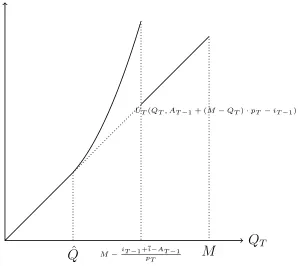
Lemma 2. UT(QT, AT) is strictly convex in QT whenever i ≤ AT and QT ≥ Qˆ, and is
otherwise linear in QT. UT(QT, AT)is linearly increasing in AT with slope 1 (corresponding to the marginal utility of consumption), and has an upward discontinuity at AT = i if and only if QT ≥Qˆ.
Proof. By the same argument made in the previous case: UT(QT, AT) is linear inQT
when-ever optimal investment and effort do not change with QT, and is strictly convex whenever
optimal investment and effort depend on QT. Similarly, UT(QT, AT) is discontinuous in AT
whenever the level of wealth allows for the optimal level of investment.
From period T −1viewpoint, however, AT is a function of QT because:
AT =AT−1+ (M −QT)·pT−1−iT−1,
where pT−1 ∈p(QT)is the price of tokens at ICO. Hence, the choice of QT determines both
period T’s incentives to exert effort and whether the developer will have enough resources to invest. The next lemma shows that the continuation value is maximized at:
Q∗
T =M −
max{iT−1+i−AT−1,0}
pT−1
, (12)
which is the largest QT such that the developer can invest i in period T.
Lemma 3 (Equilibrium in period T −1 for to =T −1). If Q∗T >Qˆ the developer chooses
QT = Q∗T; there is positive investment and effort in period T. If instead Q∗T ≤ Qˆ then the developer is indifferent between any QT, and there is no investment or effort in period T. When AT−1 −iT−1 < ¯i multiple equilibria are possible and Q∗T may not be unique. When
AT−1−iT−1 ≥¯i the equilibrium is unique and Q∗T =M.
For intuition, remember that the developer has incentives to invest and exert effort in periodT only ifQT >Qˆ. Whether QT >Qˆ is attainable depends on the cash constraint. If
this constraint is tight, Q∗
T ≤Qˆ and no level of QT that allows for positive investment will
4 Solution 26
the cash constraint is sufficiently loose, then Q∗
T >Qˆ and for some level of QT there will be
positive effort and investment in periodT.
In this last case, multiple equilibria are possible. This is because the right hand side of (12) may be neither monotonic nor continuous (remember that pT−1 ∈ p(QT)). That is,
even assuming that the investors can solve their coordination problem and therefore p(QT)
is a function and not a correspondence, there is an additional coordination problem between developer and investors giving rise to multiple equilibriumQ∗
T. Suppose thatAT−1−iT−1 < i,
so that the developer needs to sell some tokens at ICO in order to finance future development. If the price in period T is expected to be high, so will be the price in period T −1 and, as a consequence, the developer needs to sell fewer tokens in order to achieve iT =i. Because
he can hold a large fraction of tokens, future effort will be high, which implies that today’s price for tokens should be high. Similarly, if period-T price is expected to be low, price at ICO will be low, and the developer needs to sell a large fraction of his tokens, which implies that future effort will be low, as should today’s price. If instead AT−1 −iT−1 ≥ i, then
the developer does not need to sell any tokens to finance his future investment and, as a consequence, in the unique equilibrium Q∗
T =M.
Consider now optimal investment and effort in periodT−1. It is easy to see that optimal effort is again given by (7). The choice of optimal investment, instead, has an inter-temporal element to consider: for given initial assets, the choice of periodT−1investment affects the equilibrium at ICO and therefore Q∗
T. This is relevant whenever AT−1 < 2i, in which case
the developer may choose not to invest in period T −1, so as to set Q∗
T =M.
It is, however, easy to show that postponing the investment is never optimal. Suppose that the developer has sufficient funds to invest in only one period. If the developer invests in period T −1, then total utility is:
VT−2+g∗(M) +g∗(Q∗T)
(1−γ)M M −
1 2(e
∗(M))2−1
2(e
∗(g∗(Q∗ T))2.
If instead the developer does not invest inT −1, he can set QT =M and achieve utility:
VT−2+g∗(M)
(1−γ)M M −(e
∗(M))2.
4 Solution 27
sale of tokens at ICO. This reasoning extends to any period prior to the ICO, and therefore implies the following proposition.
Lemma 4 (ICO in period 2). Whenever to =T −1, the final value of the protocol is:
VT =
3g∗(M) if a≥3i
ng∗(M) +g∗(Q∗
T) otherwise,
where n is defined in (10) and Q∗
T is defined in (12).
Proof. In the text.
Case 3: to < T −1. If the ICO occurred in period to < T −1, then in period T −1 there
is a market for tokens. I start by considering the choice ofQT, that is, how many tokens to
sell or buy on the market in period T −1. For a given market price pT−1, the developer’s
utility as a function of QT is:
UT(QT, AT−1+ (QT−1−QT)·pT−1−iT−1) +λT−1(AT−1−iT−1−pT−1max{QT −QT−1,0}).
There are similarities with the previous case (i.e., the case of an ICO in period T −1). Also here, the choice of QT determines the assets available in the following period. As a
consequence, the continuation value:
UT(QT, AT−1+ (QT−1−QT)·pT−1−iT−1),
is strictly convex in QT only for:
ˆ
Q≤QT ≤Q∗T,
and is linearly increasing inQT otherwise, with a downward discontinuity atQ∗T (whereQ∗T
is defined in (12)).
There are, however, two important differences with the previous case. The first one is that, here, the developer could have sold some tokens during a previous period, and therefore it is possible that QT−1 < M. It follows that the cash constraint in period T −1 may be
binding. In this respect, note that if the cash constraint in period T −1 is binding, then
AT = 0 and the cash constraint in period T is binding. Conversely, if the period T cash
4 Solution 28
is not binding. Hence, in solving for QT, the only constraint that needs to be taken into
consideration is the period-T cash constraint.
Second, and most importantly, because investors are price takers, then the market price in periodT −1 does not depend onQT. Only period-T price depends onQT, leading to the
same type of anti-coordination problem discussed in the “rich developer” case.
Lemma 5 (Equilibrium in period T −1 for to < T −1). If Q∗T ≤ Qˆ, then the developer is
indifferent between holding any level of QT. Effort and investment in period T are zero, so that pT =pT−1 = (1V−Tγ−)1M.
If instead Q∗
T > Qˆ, then, in equilibrium, the developer is indifferent between setting
QT = 0 and setting QT =Q∗T. He sets QT = 0 with probability:
αT−1 =
1 2(e
∗(Q∗
T)2+i Q∗T ·
g(e∗(Q∗ T) (1−γ)M
−1
.
The equilibrium price is:
pT−1 =
VT−1+ (1−αT−1)g(e∗(Q∗T))
(1−γ)M .
If AT−1−iT−1 ≤i multiple equilibria are possible, while ifAT−1−iT−1 > ithe equilibrium is always unique.
Contrary to the case considered in Lemma 3, here the presence of the market generates the same anti-coordination problem discussed in the previous section. The developer randomizes between selling everything and settingQT = 0 and holding the maximum number of tokens,
which is the minimum between the one at which period-T cash constraint is binding andM. Similarly to the case considered in Lemma 3, whenever AT−1−iT−1 ≤ i there could be
multiple equilibria. There could be an equilibrium in which pT−1 is high, which implies that
the developer needs to sell only a few tokens to finance future investment, and therefore period-T effort is high. Next to this equilibrium, there could be one in which pT−1 is low,
which implies that the developer needs to sell many tokens to finance future investment, and therefore period-T effort is low. If, instead, AT−1 −iT−1 > i, then the developer does not
need to sell any tokens to achieve iT =i, and this coordination problem is absent. In case
the market for tokens is open, there are therefore multiple mixed strategy equilibria, each corresponding to a different Q∗
5 First best 29
Deriving the equilibrium in earlier periods is complicated by the fact that the choice of investment in every period affects the equilibrium in all subsequent periods. For example, the choice of iT−1 affects Q∗T. Hence, the developer may want to set iT−1 = 0 even ifAT−1 ≥ i
and QT−1 > Qˆ so as to achieve a higher Q∗T. Not only, but because there are multiple
equilibrium Q∗
T, the choice of iT−1 may determine what equilibrium emerges in the market
for tokens. This difficulty extends to the choice ofQT−2, because QT−2 determines iT−1.
Despite these issues, it is possible to characterize the developer’s choice of when to hold an ICO. The reason is that every time the market is open, there is the basic anti-coordination problem discussed earlier and the equilibrium is in mixed strategy. If instead the developer does not hold the ICO and has sufficient funds to invest¯i, he will set a high level of effort and investments with probability 1. Hence, if the developer’s funds are greater that¯i, he will never want to hold the ICO. But if the developers funds are below¯i, then no development will occur unless the developer holds the ICO. This observation implies the following proposition.
Proposition 4. In equilibrium to =n, that is, the developer initially invests using his own
funds, and holds the ICO as soon as his funds are below¯i.
Proof. In the text.
5
First best
In the first best, effort and investment are set to maximize the present discounted value of the surplus generated by the protocol.24
The equilibrium of the game differs from the first best in several ways. As already discussed, if the developer is poor, he will hold the ICO after exhausting his own funds. This is, however, inefficient because, in every post-ICO period, the developer may set zero effort and zero investment, even if the social value of his effort and investment is strictly positive.
More interestingly, even assuming that the developer is rich, there is an additional source of inefficiency. The developer is setting effort and investment so as to maximize the value of the protocol in periodT, when he will exit the game. A minor observation is that the value of the protocol in a given period (i.e., the value of the transactions that occur using the protocol) is, in general, different from the social surplus generated by the protocol.25
A more important
24
The discount factor should be that of users.
25
5 First best 30
observation is that, in its objective function, the developer completely disregards the fact that the protocol will generate value over multiple periods, instead focusing exclusively on the period in which he will sell all of his tokens and exit the game.
Whether the developer’s effort and investment will be above or below their first best level is, however, ambiguous as it depends on γ, which determines the elasticity of the price of token to his effort and investment. If the speculative demand for tokens is sufficiently high, then the developer will exert effort and investment above the first best. If instead it is low, then the developer may exert effort and invest below the first best.
It is possible to resolve this ambiguity by introducing a few simplifying assumptions and performing some back-of-the-envelope calculations. Consider the rich developer case, and assume that the value of the protocol in a given period is a good approximation of the surplus generated in that period. Social welfare is therefore:
∞
X
s=T
βs−TVT =
VT 1−β,
where β is the user’s discount factor. The choice of effort and investment that maximize social welfare is:
e∗∗ ≡argmaxe
f(e, i∗∗) 1−β −
1 2e
2
(13)
i∗∗≡argmaxi
f(e∗∗, i) 1−β −i
. (14)
By comparing the above expression with the equilibrium level of effort and investment (equa-tions (2) and (3) forQT =M), it is clear that equilibrium effort and investment will be below
the efficient level if γ < β, and above the efficient level if γ > β.
5 First best 31
difficult to distinguish between users and investors.26
Instead, Ethereum is a decentralized computing platform and is used primarily to run software, which are in this context called
smart contracts. The fraction of ETH (Ethereum native token) paid in fees is therefore a measure of the value of the protocol Vt: the payments (in tokens) from users of Ethereum to
the nodes maintaining the Ethereum network, performed in exchange for a service—executing a smart contract.27
After collecting data on the total fees paid on the Ethereum network,28
what remains to do in order to derive γ is to define the length of a period. In the model, users can exchange fiat money for tokens once in every period. The empirical equivalent of a “period” is, therefore, the average number of days before a given token can be used again to pay a fee (that is, the inverse of the velocity of ETH). Absent any good prior, I will consider different possible values, from one to 30 days.
I therefore compute the average value of:
1− total transaction fees collected over n days
total stock of ETH ,
for the year 2018, where the n goes from 1 to 30. This value corresponds to γ, under the assumption that a single period of the model corresponds to n days. I compare this value to the discount factor over n days, computed assuming a daily discount factor of 0.015%
(approximately a 5% yearly discount factor). As Table 1 shows, for all values of n, the estimated γ is orders of magnitude above β, which suggests that the equilibrium effort and investment is above the efficient level.29
The above result is specific to the rich developer case. In the poor developer case, after ICO, the developer invests and exerts effort with probability less than one. Furthermore, conditional on exerting effort, because in every period he holds less than the full stock of tokens, his level of effort and investment are lower than in the rich developer case. By comparing the values for β and γ in Table 1 for n = 10, as long as the developer holds more
26
For more details on these difficulties, see Athey et al. (2017).
27
As in the Bitcoin network, these nodes also earn a “per-block” reward. In the case of Ethereum, however, this reward is a much smaller component of the node’s total payoff. As a consequence, performing any operation on the Ethereum network requires the payment of a fee.
28
Easily downloadable from several sources, such as https://etherscan.io/chart/transactionfee
29
6 Discussion 32
n γ β
1 0,99999 0,00015 2 0,99999 0,00030 3 0,99998 0,00045 4 0,99998 0,00060 5 0,99998 0,00075 6 0,99998 0,00090 7 0,99997 0,00105 8 0,99997 0,00120 9 0,99996 0,00135 10 0,99996 0,00150 20 0.99992 0.00300 30 0.99988 0.00451
Tab. 1: Data from https://etherscan.io/chart, elaborated by the author
than 0.15% of the share of tokens, he will set effort and investment above the social optimum. It seems likely, therefore, that conditional on exerting positive effort and investment, the level of effort and investments will be above the socially optimal level, even in the “poor developer” case.
6
Discussion
6.1
Seigniorage vs monopoly pricing
It is possible to compare seigniorage with more standard mechanisms, such as establishing a set of fees/prices for using the protocol. Profits generated via seigniorage depend on the value of the protocol in the moment at which the developer sells his tokens. Under standard monopoly pricing, instead, the monopolist is able, in every period, to capture only a fraction of the value of the protocol (which will depend on the elasticity of supply and demand). But the monopolist is able to earn profits in every period; not only in one period.
Profits under seigniorage therefore depend on the value of the protocol in a given period, while profits under standard monopoly pricing will accrue in every period. Which one is larger is, again, ambiguous and crucially depends on γ: the speculative demand for tokens. It is always possible to find a large enough γ such that profits under seigniorage are greater than profits under monopoly pricing. For low γ, however, the ranking may reverse.
6 Discussion 33
τ the fraction of total value lost as deadweight loss caused by monopoly pricing, and ν the fraction of the remaining value that is captured by the monopolist in every period. Profits earned via monopoly pricing from period T onward are therefore:
∞
X
s=T
βs−Tν(1−τ)VT =
ν(1−τ)VT 1−β ,
which are greater than profits earned via seigniorage if and only if:
ν(1−τ)≥ 1−β 1−γ.
The above inequality can be satisfied only ifβ > γ. However, the above calculations suggest that, empirically, γ > β and hence profits under seignior